8 Examples of Subtext Writers Can Apply
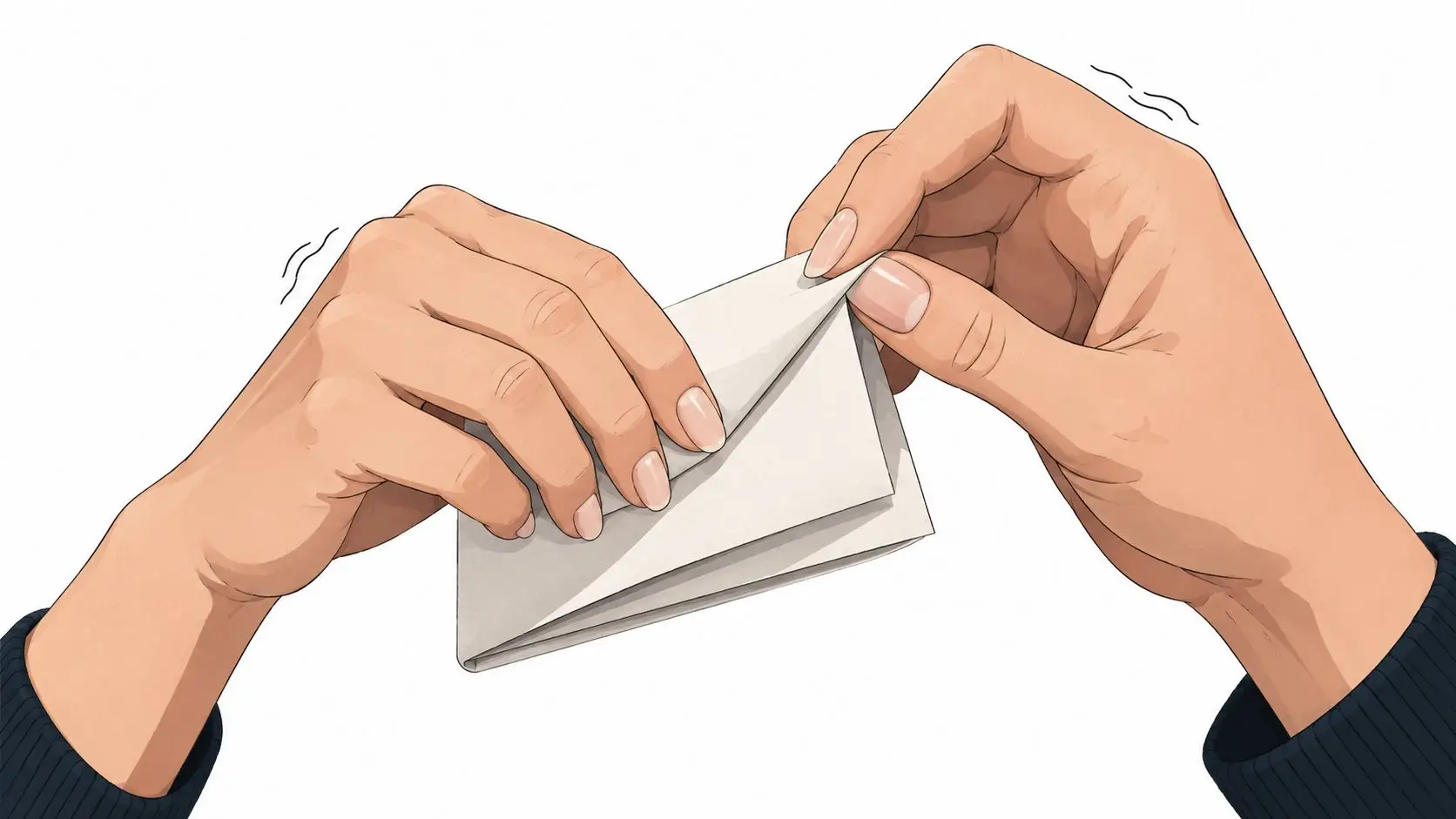
You're already reading subtext all the time, even when no one names it. A character says, “I'm fine,” while folding a napkin into smaller and smaller squares. A friend arrives early but waits in the car. A narrator skips the one night you most want described. On the surface, nothing dramatic happened. Underneath, everything did.
That hidden layer is subtext: meaning carried beneath explicit words and actions. Writers use it because readers like making connections for themselves. Instead of receiving every feeling as explanation, they infer it from behavior, setting, omission, rhythm, and pattern. In cognitive-pragmatic literary analysis, subtext is often treated as an implicit layer readers reconstruct through inference rather than direct decoding, which is a useful way to think about craft as well as criticism (cognitive-pragmatic discussion of subtext).
Subtext also isn't some modern trick. A scholarly Oxford reference traces indirect meaning back to Greek and Latin rhetoric around 2,000 years ago and notes that later critics made hidden textual relations central to literary criticism, including forms of reading that expose ideological or historical subtext (Oxford chapter on subtext, intertextuality, and symptomatic reading).
The most useful way to study examples of subtext isn't by collecting famous scenes and admiring them from a distance. It's by asking five practical questions each time: what's on the surface, what meaning sits underneath, what craft choices create that gap, what can go wrong, and how can you apply the same move in revision. The eight examples below move from the smallest unit, a line of dialogue or a gesture, to the broadest, an entire narrative design.
Table of Contents
- 1. Emotional Subtext – Character Conflict Through Dialogue
- 2. Dialogue Subtext – Unspoken Agreement and Power Dynamics
- 3. Emotional Resonance Through Specific Detail – Microtext Subtext
- 4. Visual Subtext – Symbolic Objects and Settings
- 5. Structural Subtext – Pacing and Narrative Gaps
- 6. Thematic Subtext – Ideas Embedded in Narrative
- 7. Narrator Reliability and Perspective Subtext – Unreliable Narration
- 8. Historical and Cultural Subtext – Embedded Context and Meaning
- 8 Types of Subtext Compared
- Turn Hidden Meaning Into Deliberate Craft
1. Emotional Subtext – Character Conflict Through Dialogue
Two people sit across from each other after a bad night. One asks, “Did you sleep okay?” The other says, “The hotel coffee was terrible.” On the surface, they are talking about coffee. Underneath, the answer signals strain, avoidance, and a refusal to discuss what happened.
That is emotional subtext in its simplest form. The spoken line handles the social task. The detour reveals the feeling.

A thermostat works as a useful comparison here. The number on the wall is the visible reading. The heating system behind it is what changes the room. In dialogue, the words are the reading. The pressure behind them is the system.
Hemingway's “Hills Like White Elephants” gets cited so often because the characters discuss almost everything except the subject. The technique matters more than the famous example: keep the conversation on a manageable surface while the emotional conflict pushes from below. In a breakup scene, one character may ask whether the suitcase zipper still sticks. The other may answer, “It closes if you force it.” Surface topic: luggage. Underlying meaning: this relationship is being held shut by effort.
Surface versus underlying feeling
Use the same three-part frame each time you study or revise a scene.
Surface: ordinary, polite, low-stakes dialogue.
Underlying meaning: anger, dread, guilt, grief, longing, or humiliation.
Craft choice: let the character protect themself before they express themself. People avoid pain in recognizable ways. They switch to logistics, answer the wrong question, make a joke, become overly helpful, or sound calmer than the moment should allow.
A direct confession can carry strong emotion, but it leaves the reader less work to do. Subtext creates that small gap between what is said and what is meant. That gap is where tension lives.
The common mistake is making the gap so wide that the scene turns muddy. Hidden feeling still needs visible support. Give the reader clues through context, prior conflict, timing, body language, or a word choice that feels slightly off.
What to watch for on the page
A single line can carry emotional subtext if two things are true: the character has a reason not to speak plainly, and the replacement line still points back to the buried feeling.
For example:
- “Did you get my messages?”
- “Traffic was awful.”
Surface meaning: an excuse about the commute.
Underlying meaning: I saw them, I know I am in trouble, and I do not want to answer.
That pattern is repeatable. Pressure creates avoidance. Avoidance creates meaning.
Revision exercise
Take one blunt line from your draft, such as “I'm angry you forgot my audition,” and rewrite it three ways without naming the emotion.
- Replace the feeling with logistics: “The recital started at seven.”
- Let the character sound generous in a strained way: “I know you've been busy.”
- Pair calm dialogue with a revealing action: “It's fine,” she says, flattening the straw wrapper into shreds.
Then test the result with the same framework used across this article. What is the surface line? What is the underlying feeling? What exact choice creates the gap?
When you revise in Storyloft, the notes panel can help you track each character's hidden motive for the scene, and tone analysis can help you check whether the spoken line still sounds like that character rather than like the author pushing the reader.
2. Dialogue Subtext – Unspoken Agreement and Power Dynamics
A dean says, “Send me the revised proposal.” The student hears the message at once. The draft is weak, the conversation is over, and arguing now could cost them more than this meeting. On the surface, the line is ordinary. Underneath, it enforces rank.
That is the layer of subtext this section adds to the article's surface-versus-underlying-meaning framework. At the dialogue level, hidden meaning often comes from shared rules. Who can ask directly? Who has to soften, stall, or translate a need into something safer?
Here is a quick way to read it on the page.
Surface line: “We'll revisit your contract next quarter.”
Underlying meaning: Do not press me while I hold the advantage.
Surface line: “We don't discuss that outside the family.”
Underlying meaning: Silence protects the group, and someone here has the authority to enforce it.
The words themselves are plain. The pressure sits around them, like furniture in a room. You may not stare at the chair first, but it still determines where everyone can sit.
Power changes dialogue in three visible ways. It changes who gets to be vague, who must be careful, and who can pretend a decision has not already been made. A boss can call a refusal “timing.” A parent can call control “manners.” A politician can call a threat “policy.”
That is why dialogue subtext is not just about what characters avoid saying. It is also about what both characters already know. Subtext gets stronger when the scene contains an unspoken agreement about consequences.
A lower-status character often speaks in cushions: qualifiers, apologies, questions, titles. A higher-status character often speaks in edits: short answers, delayed answers, subject changes, procedural language. If you want to sharpen this layer in your own scenes, it helps to study how to write better dialogue that reflects status and motive.
Try reading this exchange like a mechanic checking where the pressure sits:
“Could I ask about the promotion timeline?”
“We're focusing on team stability right now.”
“Of course. I just wanted to make sure I was preparing correctly.”
“You should keep doing what you're doing.”
No one says no. Still, the answer is no for now. The manager keeps deniability. The employee protects access. That is the craft move: let each speaker guard something different, and the hidden meaning appears between the lines.
A revision exercise with two passes
First pass. Draft a short exchange between two characters with unequal power: teacher and parent, older sibling and younger sibling, editor and freelancer, officer and witness. Keep it to five or six lines. Let the lower-power character want one concrete thing.
Second pass. Revise by adjusting only the dialogue, not the plot.
- Give the lower-power character one softening habit, such as hedging, over-explaining, or asking permission.
- Give the higher-power character one control habit, such as changing the frame, invoking process, or answering with a future promise instead of a present decision.
- Remove any line that states the conflict directly.
- Keep one line bland on the surface so the reader has to feel the hidden pressure.
Then label the exchange using the same framework as the rest of this article: surface line, underlying meaning, and the exact choice that creates the gap. If you can point to a title, a pause, a deflection, or a procedural phrase, the subtext is doing real work.
3. Emotional Resonance Through Specific Detail – Microtext Subtext
A character says, “I'm fine.” Then she gets home, kneels by the door, and straightens one crooked shoe, then another, until both pairs line up perfectly.
That second action often carries more feeling than the line of dialogue.
Microtext subtext works at the smallest layer of a story. A hand that lingers on a cup. A receipt folded into quarters. A light switched off in the middle of the day. The surface action stays ordinary. The underlying meaning comes from pressure, timing, and selection. Out of all possible details, the writer chose that one.
Readers believe behavior fast. If you write “he felt guilty,” the reader understands the fact. If you write “he rinsed the same spoon three times before putting it away,” the reader has to participate. That small act creates a gap between what is happening on the surface and what it suggests underneath. Subtext lives in that gap.
A useful way to read these details is to ask three questions in order:
What did the character physically do?
What pressure surrounds the moment?
Why this detail, instead of a dozen other possible details?
For example, a boy lies and wipes both palms on his jeans. Surface action: he wipes his hands. Underlying meaning: his body is leaking stress before his words admit it. Repeatable technique: pair a minor, involuntary action with a moment when the character has something to hide.
Here is another one. A husband washes one already-clean glass before speaking. Surface action: cleaning. Underlying meaning: stalling, self-control, dread, or a need for order before a hard sentence. Repeatable technique: give the character a practical task that becomes emotional cover.
That is the difference between microtext and decoration. Decoration fills space. Microtext changes how the reader interprets a moment.
Researchers studying how language models handle implied meaning found that systems perform better when context and shared assumptions are clear, rather than when every hidden meaning must be guessed from literal wording alone (2026 LLM evaluation on subtext and common ground). The writing lesson is simple. Specific detail lands best when the scene already gives the reader enough situation to interpret the cue.
Try a revision exercise that works like tightening a camera lens.
Start with one flat line from your draft, such as “she was nervous” or “he dreaded the call.” Then rewrite the sentence by shrinking the evidence down to one visible action and one sensory anchor. The action shows pressure. The sensory anchor keeps it concrete.
A few strong swaps:
- “She was nervous” becomes “She sorted the sugar packets by color and left her coffee untouched.”
- “He was afraid to answer” becomes “The phone buzzed against the table, and he let it buzz twice more.”
- “She felt grief again” becomes “At home, she placed the funeral program in the junk drawer, then took it back out.”
Use one charged detail, maybe two. More than that, and the prose starts pointing at itself. Storyloft's focus mode can help during this kind of line revision because you can isolate a scene and check whether each chosen detail carries emotion or just adds clutter.
4. Visual Subtext – Symbolic Objects and Settings
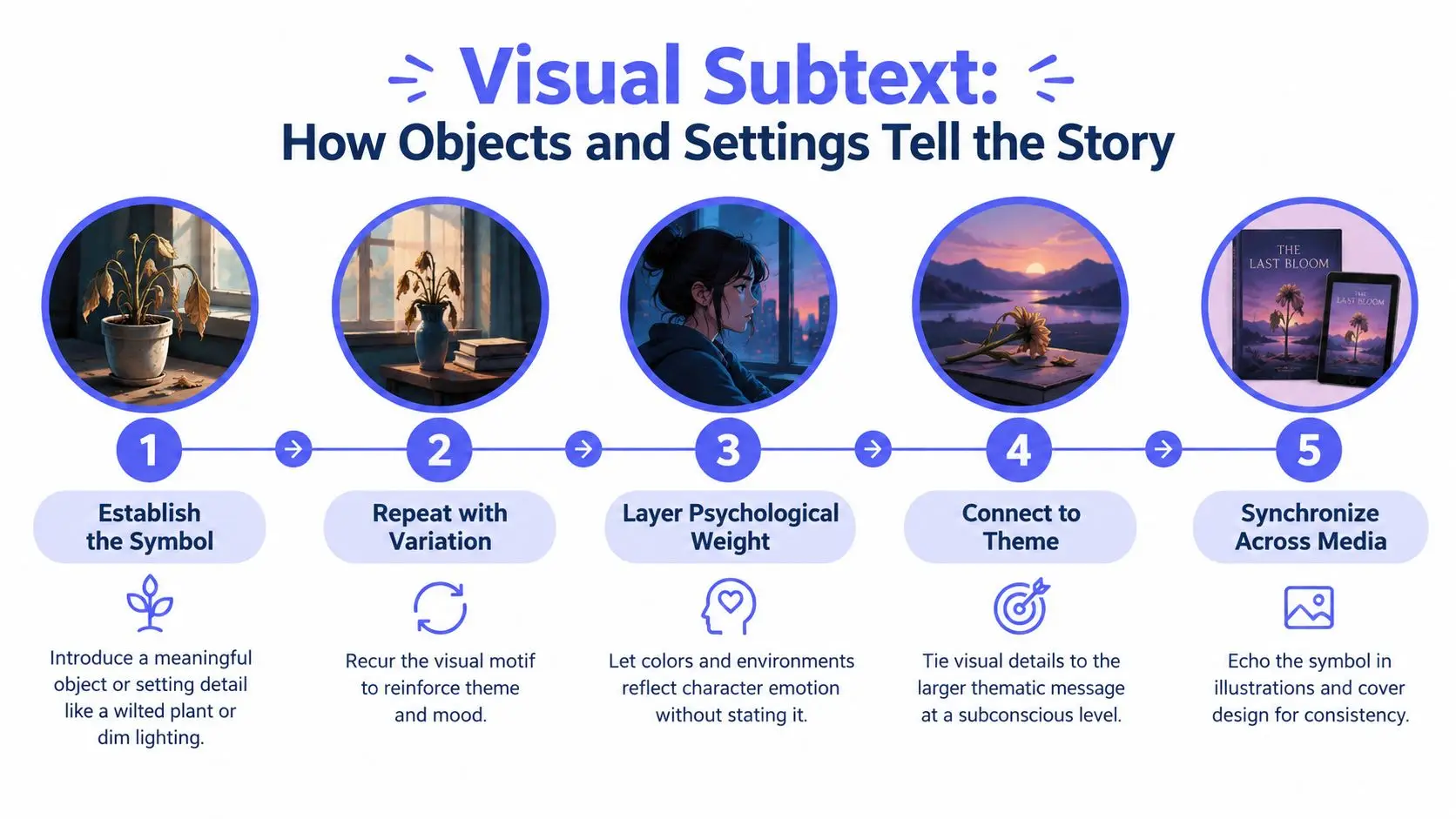
A daughter visits her father after years of silence. He offers tea in a chipped mug he never used when she was a child. He says nothing important. The mug does the work. On the surface, it is just an object in the room. Underneath, it suggests lowered standards, age, regret, or an attempt at ordinary comfort after damage that cannot be named easily.
That is visual subtext. The reader sees a thing, a place, or a repeated image. The story teaches the reader what that visible element means by where it appears, who notices it, and what emotion surrounds it.
At this layer, subtext moves from line-level behavior to the physical world of the story. A room can support a lie. A hallway can feel like a sentence. A polished dining table in a family that never eats together can reveal more than a paragraph of explanation.
The familiar example is the green light in The Great Gatsby, but the useful lesson is practical. Meaning builds through pattern. One object shown once is usually scenery. The same object placed at moments of hope, shame, or compromise starts carrying a second message.
A red umbrella can show the difference.
If it appears in one rainy scene, it is set dressing. If it appears whenever the character chooses what looks proper over what she wants, the umbrella becomes a pressure signal. The surface meaning stays literal. She is holding an umbrella. The underlying meaning gathers through repetition. She is sheltering herself inside a public version of her life.
Settings work the same way. A burned-out bulb in a kitchen does not automatically mean neglect. In one story, it may suggest poverty. In another, secrecy. In another, a marriage that has been maintained just enough to remain standing. The object is the same. Context assigns the hidden meaning.
Writers who work visually often find it helpful to compare how repeated images create cohesion across different media. One useful outside example appears in this discussion of powerful brand narratives with AI.
Surface cue, hidden meaning, craft move
Here is a simple way to test whether an object or setting is doing real subtext work:
- Surface cue: What does the reader see?
- Hidden meaning: What emotional or thematic pressure gathers around it?
- Craft move: How does the story teach that meaning without explaining it?
Example:
- Surface cue: A wedding dress remains zipped in its garment bag long after the ceremony.
- Hidden meaning: The marriage may exist socially more than emotionally.
- Craft move: Repeat the dress at moments of distance, avoidance, or performance.
The key is restraint. Characters should interact with the object for ordinary reasons. Readers should be the ones connecting the pattern.
Try a revision exercise that treats visual subtext like set design with a hidden agenda.
Choose one object or one feature of a setting already present in your draft. Give it one underlying job only: shame, safety, ambition, grief, status, or control. Then place it in three scenes where that pressure rises. Each time, keep the literal use the same but alter one visible detail, its condition, location, or who handles it.
For example, a watch can begin polished and inherited, later run five minutes fast, then end forgotten in a drawer. The watch still tells time on the surface. Underneath, it can track duty, lineage, or a character's changing relationship to expectation.
If you need to state the meaning outright, the pattern is not strong enough yet.
5. Structural Subtext – Pacing and Narrative Gaps
A daughter gets a voicemail from her father. The chapter cuts there. Three chapters later, she is repainting the guest room and avoiding every question about why. The missing conversation becomes the subtext.
That is structural subtext. The hidden meaning does not sit inside one line of dialogue or one object. It forms through timing. What the story shows in full, what it skips, and where it leaves space all shape what readers infer.
At the sentence level, subtext works like a glance. At the structural level, it works like a closed door in a hallway. Readers notice the door because the story walks past it on purpose.
A few common signals carry a lot of weight:
- a scene that ends just before disclosure
- a time jump placed right after emotional pressure peaks
- one kind of event summarized while another gets full scene treatment
- a repeated blank spot, such as every private argument happening offstage
Those choices create a surface pattern and an underlying meaning. If a novel lingers over routine dinners but rushes through a wedding, the surface choice is pacing. The underlying meaning may be reluctance, dread, family performance, or a bond that matters less than the ceremony around it.
Structure also controls suspicion. If every public moment is dramatized and every intimate reckoning is skipped, readers start to feel that the characters can perform connection more easily than they can live it. That idea never has to be stated.
Pacing helps here because speed signals value. A slow scene says, "stay here." A skipped scene says, "notice the hole." Used well, both create pressure. If you want a clearer sense of how scene order builds that pressure, this guide to rising action in a story is a useful companion.
Try a gap test on one chapter
Use one chapter, not your whole draft. Mark the scene where a secret is explained, admitted, or named. Then test whether the chapter gets stronger if the reader sees the effect before the cause.
For example:
You write the confession scene in full. Two sisters argue in a parked car, one reveals she sold their mother's house, and both leave furious.
Now revise the structure instead of the dialogue. End the first scene with the parked car pulling over. Start the next scene at the funeral reception. One sister will not meet the other's eyes. An uncle asks about the house and gets silence. Readers feel the damage before they receive the facts.
That is the repeatable technique. Rearrange revelation so consequence arrives first, then let explanation catch up.
Revision exercise
Pick one emotionally loaded event in your draft that is currently shown straight through.
Test one of these revisions:
- Cut away before the key admission, then show changed behavior in the next scene.
- Replace the event with a time jump and let the reader reconstruct what happened from fallout.
- Move a consequence scene earlier than the explanation scene.
- Track one recurring absence. If apologies are always skipped, or family fights always happen offstage, make that omission consistent enough to read as meaning.
The guardrail is clarity. Readers should be able to form a working theory, even when the full answer is delayed. If they are lost about basic facts, the gap is doing the wrong job.
6. Thematic Subtext – Ideas Embedded in Narrative
A story can argue without ever sounding like an argument.
A father keeps choosing work over home. A daughter stops asking him to come. By the final chapter, nobody says, "success can hollow out a family," but the reader has already felt that idea take shape. That is thematic subtext at the largest layer of this article's pattern: the surface is plot, the underlying meaning is the story's view of how life works.
The difference between theme and sermon is placement. A sermon states the idea. Thematic subtext distributes it across decisions, tradeoffs, rewards, and losses. Readers do not need a character to announce, "justice matters." They need to watch what justice costs, who avoids that cost, and who pays it anyway.
One useful test is to separate the visible action from the hidden claim.
Surface action: a young lawyer wins a case by discrediting a truthful witness.
Underlying meaning: institutions may reward victory more than truth.
That hidden claim grows stronger when the story repeats the same pressure in different forms. A major trial can show it. So can a smaller beat, like a mentor praising strategy while ignoring honesty. Repetition turns a plot event into a thematic pattern.
Tone shapes that pattern too. The same event can imply tragedy, satire, or reluctant acceptance depending on the narrative attitude. If you want a clearer handle on that relationship, study how tone in writing shapes reader interpretation.
Here is the practical shift many drafts need. Stop asking, "What is my theme?" Ask, "What does my story reward, punish, or excuse?" Theme often lives there. Stories teach by consequence the way parents teach a child not to touch a hot stove. The lesson sticks because the outcome carries it.
Try a scene-level revision instead of a thesis statement.
Take one scene from your draft and fill in these three lines:
What happens on the surface? A son lies to protect his mother.
What idea sits underneath? Love can require deception.
What craft choice delivers that idea? The lie solves the immediate problem but creates a deeper moral debt.
Now strengthen the theme without adding explanation. Give the character a real gain from the compromise, then attach a cost that cannot be ignored later. That cause-and-effect chain is where thematic subtext becomes convincing.
A quick exercise:
Choose your story's central idea and rewrite it as a question. "What does loyalty cost?" works better than "loyalty matters." Then scan one chapter for a place where two values collide, such as mercy and fairness, security and freedom, ambition and care. Revise that moment so the clash appears in action, not commentary.
If the chapter already contains a speech explaining the point, cut or shorten it. Let the outcome do more of the work.
The guardrail is balance. If every scene points to one approved answer, readers feel managed. If different characters embody different values and each value carries both appeal and consequence, the story keeps its dramatic life while still saying something clear.
7. Narrator Reliability and Perspective Subtext – Unreliable Narration
A narrator says, "I was perfectly calm," then spends a paragraph describing a shaking hand, a missed turn, and the exact wording of an insult from ten years ago. That surface account says calm. The underlying meaning says threatened, obsessed, or ashamed.
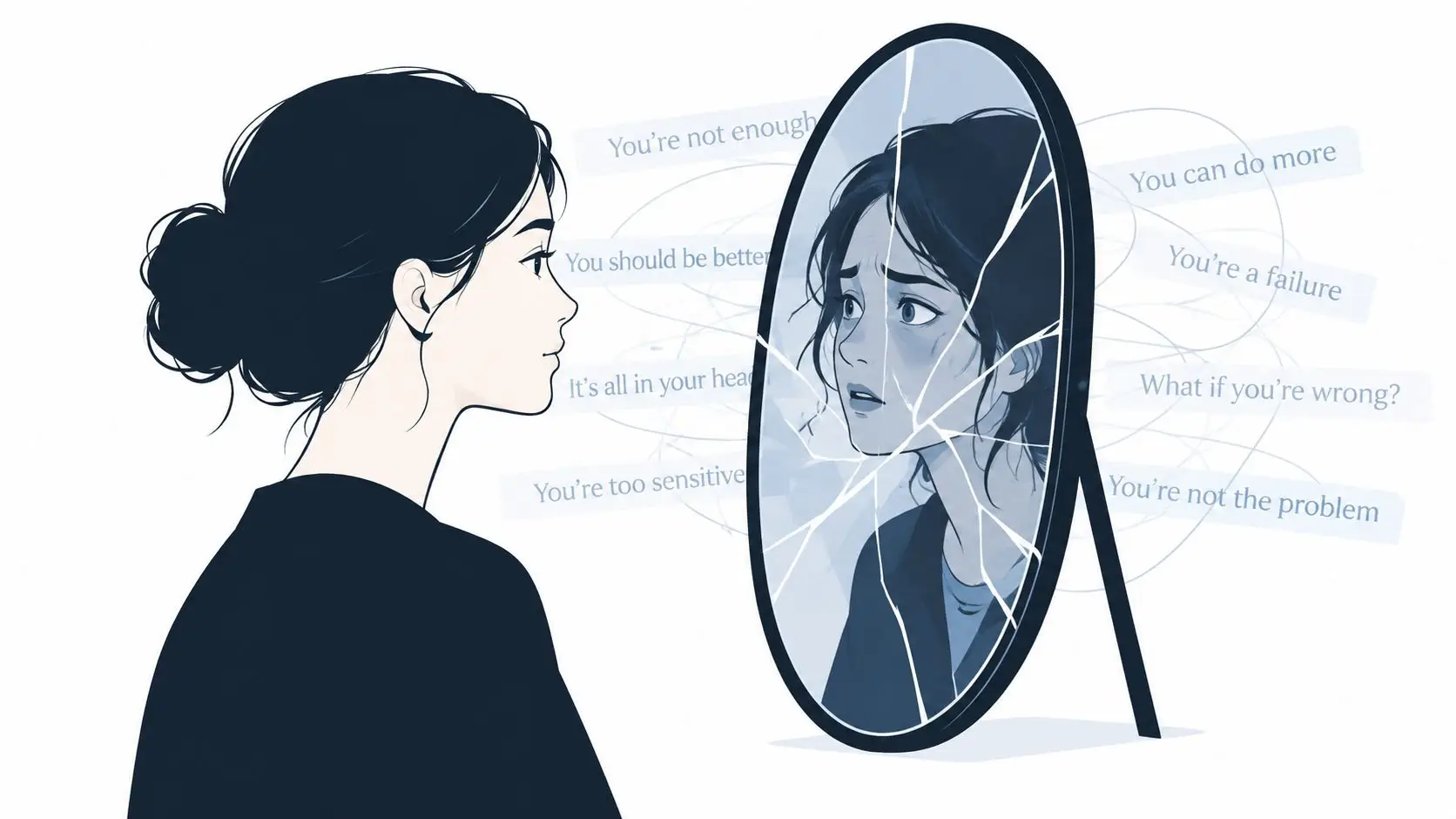
This layer of subtext works like a cracked lens. The narrator reports the world, but the distortion tells its own story.
With dialogue subtext, readers compare words against feelings. With perspective subtext, readers compare the narrator's version against the evidence on the page. The gap may be tiny. A woman insists she is not jealous while cataloging another woman's jewelry, laugh, haircut, and shoes. She may believe herself. The reader notices what her attention reveals.
That is the craft move to watch. Surface meaning comes from the narrator's explanation. Underlying meaning comes from pattern: what they notice, what they skip, what they soften, and what they repeat.
A reliable test is motive. Strong unreliability usually protects something. Self-respect. Innocence. Control. A usable public identity. Random contradiction feels sloppy because it has no pressure behind it. Biased contradiction feels human because readers can sense what the narrator needs to hide, even from themselves.
Here are three common signals, but use them as pressure points inside a scene rather than as a checklist.
A father calls himself supportive, yet answers every question directed at his daughter. A comic narrator gets suddenly breezy whenever guilt gets close. A memoir-style voice races past one afternoon and slows down for every flattering detail around it.
If you want more models for building that kind of controlled bias, this guide on how to write an unreliable narrator breaks down the mechanics clearly.
Try a lens revision instead of a standard scene edit.
Take one first-person paragraph and mark two columns:
What the narrator says about themselves: "I didn't care."
What the paragraph shows: they remember the room temperature, the exact pause before the reply, and the name of the person who laughed.
Now revise with one deliberate mismatch. Keep the self-description, but change the evidence under it. Add a fixation, a rushed omission, or a too-careful justification. That single crack often creates more subtext than a full confession would.
The guardrail is fairness. Readers should be able to reconstruct the hidden truth from clues already on the page. If the narrator lies in one direction consistently, the subtext feels designed. If the perspective shifts only to fool the audience, it feels withheld.
8. Historical and Cultural Subtext – Embedded Context and Meaning
Two characters can say the same sentence and mean different things because the world around them changes the cost of saying it.
A dinner invitation in one story is hospitality. In another, it is a test of class, loyalty, religion, or safety. A school uniform can signal discipline, wealth, colonial history, or enforced belonging. A surname can open doors, close them, or warn a reader that the character is carrying an inheritance they did not choose.
That is the surface-versus-underlying-meaning pattern at a larger scale. Earlier layers of subtext often live inside a line, a gesture, or a scene. Historical and cultural subtext lives in the rules of the world itself. Readers feel pressure not because a character explains the system, but because ordinary behavior bends around it.
Use a simple question while drafting: what does this action mean here?
If a woman asks whether the curtains should stay open, the surface action is practical. The hidden meaning may be about surveillance, reputation, or who is allowed privacy. If a son refuses a meal, the surface action is preference. The hidden meaning may be refusal of a family role, a caste expectation, or a whole chain of duty. The line stays small. The context makes it heavy.
Writers often miss this layer by keeping the research offstage. They know the laws, customs, taboos, migration history, or institutional rules, but none of that pressure reaches the sentence. Subtext appears only when context changes behavior. Who speaks first. Who uses a title. Who is not named. Who touches the food last. Who leaves before the police arrive.
Nonverbal context matters here too. Popular summaries of Albert Mehrabian's research often reduce communication to the 55/38/7 rule, though that formula gets overstated outside its original context (discussion of the 55/38/7 claim and nonverbal communication). The useful craft lesson is narrower: in tense scenes, readers often infer social meaning from delivery, setting, and shared rules more than from literal wording.
Try a pressure rewrite instead of another explanation pass.
Take one scene shaped by history or culture and divide it into two columns:
Surface action: tea is served, a guest arrives late, a document stays unsigned.
Underlying meaning: deference is being demanded, a boundary is being tested, a risk is being avoided.
Then revise the scene with three context-bearing choices:
- Protocol: change who speaks first, who interrupts, who sits at the head of the table.
- Material culture: swap generic props for items with social history, such as ration books, prayer beads, factory badges, wedding gold, or official seals.
- Visible consequence: show what happens to people who say the forbidden thing directly.
That exercise turns background into craft. Readers should be able to sense the larger structure from the smallest action, the way a floorboard creak tells you where the weight of the house is.
8 Types of Subtext Compared
| Technique | 🔄 Implementation complexity | ⚡ Resource requirements | ⭐ Expected outcomes | 📊 Ideal use cases | 💡 Key advantages / Tips |
|---|---|---|---|---|---|
| Emotional Subtext – Character Conflict Through Dialogue | 🔄🔄 (moderate), requires psychological calibration | ⚡⚡ (moderate), revision + tone tools | ⭐⭐⭐⭐, realistic emotional depth | Intimate scenes; family drama; character-driven fiction | Engages readers; reduces exposition; use tone analysis and notes to track hidden motives |
| Dialogue Subtext – Unspoken Agreement and Power Dynamics | 🔄🔄🔄 (high), needs ear for social cues | ⚡⚡⚡ (moderate–high), iteration & voice-aware tools | ⭐⭐⭐⭐, naturalistic voice, clear hierarchies | Workplace scenes; status-driven conflict; literary realism | Reveals power relations; differentiate voices; use character profiles and voice-aware rewrites |
| Emotional Resonance Through Specific Detail – Microtext Subtext | 🔄🔄🔄 (high), precision in sensory writing | ⚡⚡⚡ (high), time‑intensive revision & editing | ⭐⭐⭐⭐⭐, strong visceral reader connection | Close‑third scenes; sensory, literary moments | Creates vivid immersion; eliminate "telling"; use focus mode and sensory note tags |
| Visual Subtext – Symbolic Objects and Settings | 🔄🔄 (moderate), planning across scenes & media | ⚡⚡ (moderate), visual assets + design tools | ⭐⭐⭐⭐, thematic reinforcement; subconscious cues | Symbolic narratives; covers/illustrations; mood-driven scenes | Reinforces theme across manuscript and visuals; track motifs with tags and illustration suite |
| Structural Subtext – Pacing and Narrative Gaps | 🔄🔄🔄 (very high), sequencing & omission design | ⚡⚡⚡ (high), extensive outlining & cross‑checking | ⭐⭐⭐⭐, sustained suspense and reader engagement | Mystery, thriller, fragmented literary forms | Builds tension via omission; map revelations in binder and outline before drafting |
| Thematic Subtext – Ideas Embedded in Narrative | 🔄🔄 (high), requires thematic clarity and restraint | ⚡⚡⚡ (high), mapping themes + revisions | ⭐⭐⭐⭐⭐, lasting literary resonance and discussion | Literary fiction; novels aiming for depth and crossover appeal | Embeds ideas without preaching; tag themes, use notes and beta feedback for coherence |
| Narrator Reliability and Perspective Subtext – Unreliable Narration | 🔄🔄🔄 (very high), precise inconsistency management | ⚡⚡⚡ (high), tracking contradictions & reader cues | ⭐⭐⭐⭐, powerful discovery and re‑reading value | Psychological fiction; twist narratives; first‑person voice pieces | Reveals bias and self‑deception; track reliability status, use beta readers for detection |
| Historical and Cultural Subtext – Embedded Context and Meaning | 🔄🔄 (high), deep research and contextual integration | ⚡⚡⚡ (very high), archival research + sensitivity readers | ⭐⭐⭐⭐, layered meaning for informed readers | Historical fiction; diaspora narratives; socially conscious works | Adds authenticity and depth; organize sources in binder, use sensitivity readers and tags |
Turn Hidden Meaning Into Deliberate Craft
Subtext feels mysterious when you meet it as a reader. It becomes manageable when you handle it as a set of craft decisions.
Start with the hidden meaning, not the line. Ask what the scene really carries underneath the visible action. Is it jealousy under politeness, class pressure under courtesy, grief inside routine, ideology inside plot, or historical danger inside ordinary speech? Once you know the underlying meaning, choose the right carrier. A gesture may do the job. So might evasive dialogue, one specific detail, a recurring object, a withheld scene, a biased narrator, a thematic pattern, or a piece of cultural context.
Then check whether the scene offers fair evidence. Readers shouldn't need a decoder ring, but they also shouldn't be handed a summary paragraph that repeats what the scene already showed. Plant enough signals for inference. Remove any explanatory line that merely duplicates the visible evidence. If a character's hands shake, their answer wanders, and they won't meet anyone's eyes, you probably don't need “she was terrified” right after.
A good revision pass for examples of subtext is practical and a little ruthless. Read dialogue aloud. Mark every place where a character says exactly what they mean and ask whether that directness is earned. Highlight recurring objects and ask whether they gather meaning or just recur by accident. Check your chapter order for strategic omissions and useful delays. Look at your narrator's claims beside their behavior. Look at the world of the story and ask what pressures shape speech before anyone opens their mouth.
Outside readers help because subtext lives in inference. If readers consistently miss a hidden meaning that the scene requires, the problem usually isn't that they're inattentive. The cues probably aren't strong enough, or the scene is hiding the wrong thing. If readers all infer the same hidden pressure without being told, the subtext is working.
A manuscript-centered workspace can make this easier to track. Storyloft, for example, gives authors one place to draft scenes, keep notes on character motives, tag motifs and themes, organize research, test rewrites with AI assistance, and gather feedback from collaborators. That kind of setup won't create subtext for you, but it does make the revision process more visible. And subtext gets better when you can see the pattern you're building across the whole manuscript.
The broad lesson is simple. Hidden meaning works best when it isn't added like garnish. It grows from desire, obstacle, pressure, and choice. Build those clearly, and the subtext usually has somewhere real to live.
If you want a single workspace for drafting layered scenes and revising them with intent, Storyloft brings manuscript writing, notes, tags, AI-assisted rewrites, illustration tools, and collaboration into one app. It's a practical fit for tracking motives, recurring symbols, and scene-level revisions while you sharpen the hidden meaning already inside your story.