What if the best name for a character isn't the one that sounds most beautiful, but the one that changes what readers expect before the character speaks? A strong name can signal role, culture, class, era, personality, or hidden history. It can make a hero feel ordinary enough to trust, give an antagonist an unsettling […]
Character Profile Template: A Complete Writer’s Reference
You're deep in a draft, the plot is moving, and a supporting character suddenly walks into a scene. Then you pause. Was the scar above her eyebrow, or on her wrist? Did she speak in clipped sentences, or ramble when nervous? You search through earlier chapters, find three slightly different answers, and lose the momentum […]
8 Types of Antagonists Every Writer Should Know
Conflict starts with more than a villain. In literary analysis, an antagonist is the force that blocks the protagonist's goal, and that force may be a person, a group, nature, technology, fate, or the protagonist's own traits. Modern writing guides describe antagonists across these broader categories, while literary reference sources group recurring conflicts around person, […]
8 Examples of Subtext Writers Can Apply
You're already reading subtext all the time, even when no one names it. A character says, “I'm fine,” while folding a napkin into smaller and smaller squares. A friend arrives early but waits in the car. A narrator skips the one night you most want described. On the surface, nothing dramatic happened. Underneath, everything did. […]
Character vs Self Conflict Explained with Examples
You've written a character into a room with one impossible choice. They can tell the truth and lose the person they love, or stay silent and protect the relationship while betraying what they believe. Their hand rests on the door. They rehearse both answers. Nothing outside them moves, yet the scene feels charged because the […]
What Is a Character Bible and Why Authors Need One
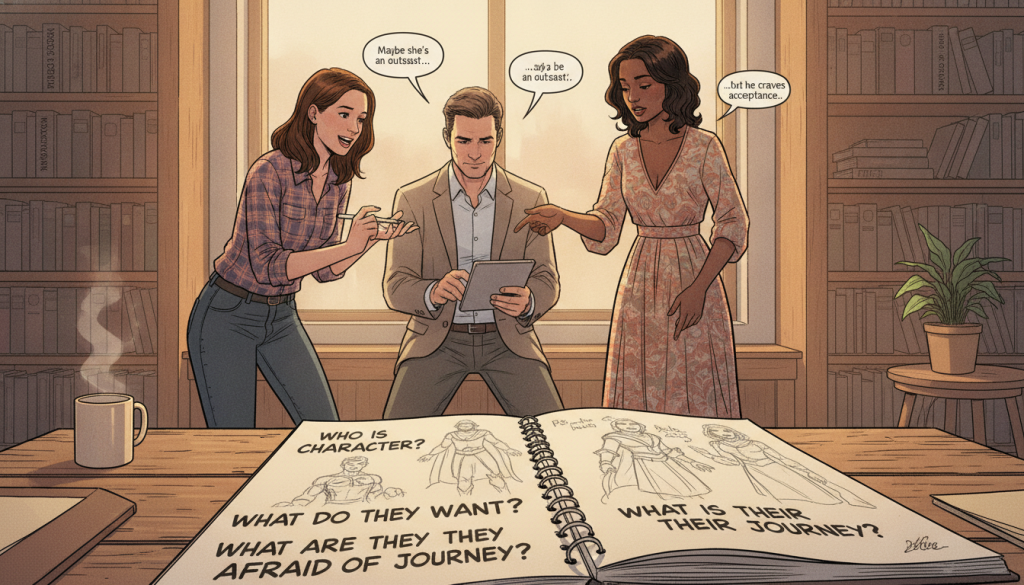
A character bible is a reference document that collects a character's name, age, occupation, family background, relationships, physical traits, goals, fears, voice, and story arc in one place so you can keep the character consistent across a long manuscript. You usually need one when your draft has grown large enough that you can't remember every […]
7 Conflict in Literature Examples to Master in 2026
What actually makes a scene grip readers, the villain, the setting, or the conflict that keeps forcing a choice? Most writers know conflict matters, but they still treat it like a label instead of a craft tool. That leaves scenes feeling repetitive, one-note, or mechanically “correct” without landing emotionally. Conflict in literature examples are useful […]
What Is a Character’s Motivation: The Engine of Your 2026
You're probably here because something in your draft feels off. Your protagonist makes decisions, scenes happen, dialogue moves, but the character still feels thin. Maybe they storm out of a room because the plot needs conflict. Maybe they accept a dangerous mission because chapter three needs momentum. On the page, those actions work mechanically. Emotionally, […]
Essential Questions to Answer Before Writing a Novel
I once stared at a blank screen for hours. I thought my plot was perfect. But my main character felt like a cardboard cutout. It wasn’t until I focused on my character’s thoughts that the story came alive. Understanding your cast is the secret to unlocking a compelling narrative. Wondering how to write a character […]
Essential Questions to Answer Before Writing a Novel
I once stared at a blank screen for hours. I thought my plot was perfect. But my main character felt like a cardboard cutout. It wasn’t until I focused on my character’s thoughts that the story came alive. Understanding your cast is the secret to unlocking a compelling narrative. Wondering how to write a character […]