What Is a Character Bible and Why Authors Need One
A character bible is a reference document that collects a character's name, age, occupation, family background, relationships, physical traits, goals, fears, voice, and story arc in one place so you can keep the character consistent across a long manuscript. You usually need one when your draft has grown large enough that you can't remember every detail you've already invented.
You're halfway through a chapter when a small problem stops you cold. What color were your side character's eyes in chapter four? Did she grow up with two brothers or one? Would she really speak so openly to this person after spending the first part of the novel avoiding them? You search through the manuscript, find three different answers, and suddenly a simple scene has become a continuity repair job.
That's the practical reason authors create a character bible. It turns scattered decisions into a reusable source of truth, while leaving room for the character to develop as the story reveals more about them.
Table of Contents
- The Problem a Character Bible Solves
- Core Elements Every Character Bible Needs
- Voice and Motivation as the Two Fields That Matter Most
- Minimal vs Deep Character Bible Templates
- How to Use the Bible Through Drafting and Revision
- Why the Best Character Bibles Are Living Documents
- Your First Character Bible in One Sitting
The Problem a Character Bible Solves
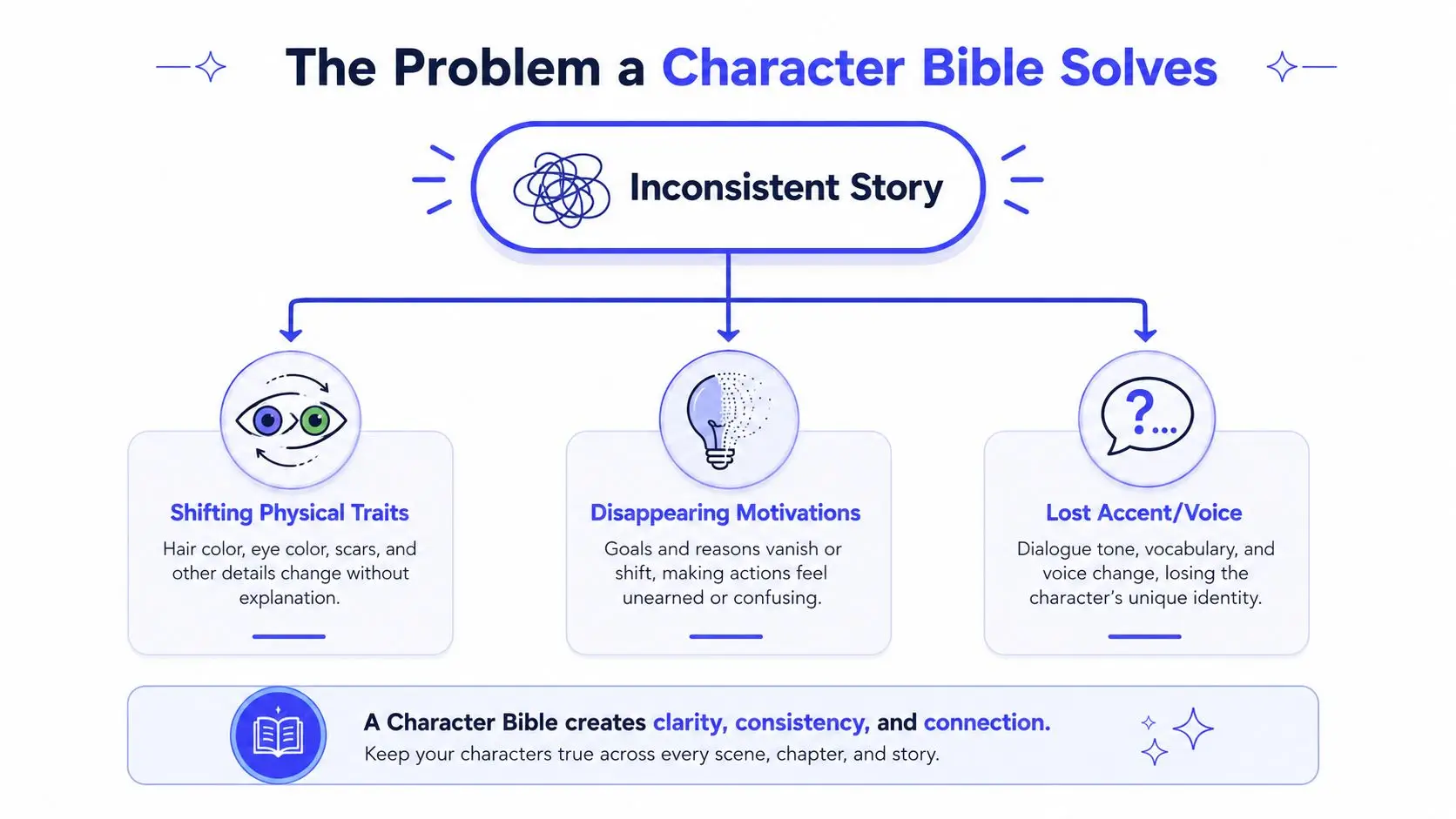
A long manuscript stores character information in many places. One detail appears in a description, another in dialogue, a third in a flashback, and a fourth exists only in your notes. During drafting, you may remember the emotional truth of a character while forgetting the physical or biographical details that support it.
A character bible gathers those details into one reference document. It commonly records a character's identity, physical traits, background, relationships, motivations, fears, and arc. In television writing, it also tracks how a character changes across episodes or seasons, which makes the document useful for any story with continuing plotlines. The character-bible guidance from Writers in the Storm describes the document as a continuity tool for keeping motivations, personalities, and backstory consistent when several writers or collaborators contribute to a project.
Practical rule: If a detail could affect a scene later, give it a clear home before you lose track of it.
Continuity is more than physical description
An incorrect eye color is easy to spot, but continuity problems often run deeper. A character who fears abandonment may suddenly leave without hesitation. A guarded detective may confess a secret in dialogue that doesn't match the trust established between the characters. Someone who began the story wanting safety may act as though they've always wanted adventure.
These inconsistencies weaken the reader's confidence. The reader might not identify every contradiction, but they can feel when a character's decisions no longer grow from the person established on the page.
A useful bible helps you check three connected areas:
- Physical continuity: appearance, age, injuries, clothing habits, abilities, and other details that can change or recur.
- Psychological continuity: wants, fears, assumptions, wounds, values, and the beliefs that shape decisions.
- Narrative continuity: relationships, secrets, turning points, and the transformation that carries the character through the story.
Authors working on complex projects can also use a manuscript-centered approach to organizing characters, worldbuilding, and research so those details stay close to the draft rather than disappearing into disconnected files.
The bible protects the story without replacing discovery
A character bible isn't a substitute for writing scenes. It won't tell you every surprising thing a character might do, and it shouldn't prevent you from changing your mind. Its job is narrower and more useful. It records what you currently understand, shows where decisions conflict, and gives you a reliable place to update the story when your understanding changes.
That matters especially in serialized fiction, novels with large casts, comics, and other long-form formats. The broader bible format organizes characters, setting, tone, and future story potential, while the character section gives collaborators or future-you a quick view of who each person is and how they create dramatic possibilities. The screenwriting overview of the television bible tradition) also describes a development document built around a series overview, principal characters, season arc, and episode material.
Your bible doesn't need to be impressive. It needs to be accurate enough to help you write the next scene.
Core Elements Every Character Bible Needs
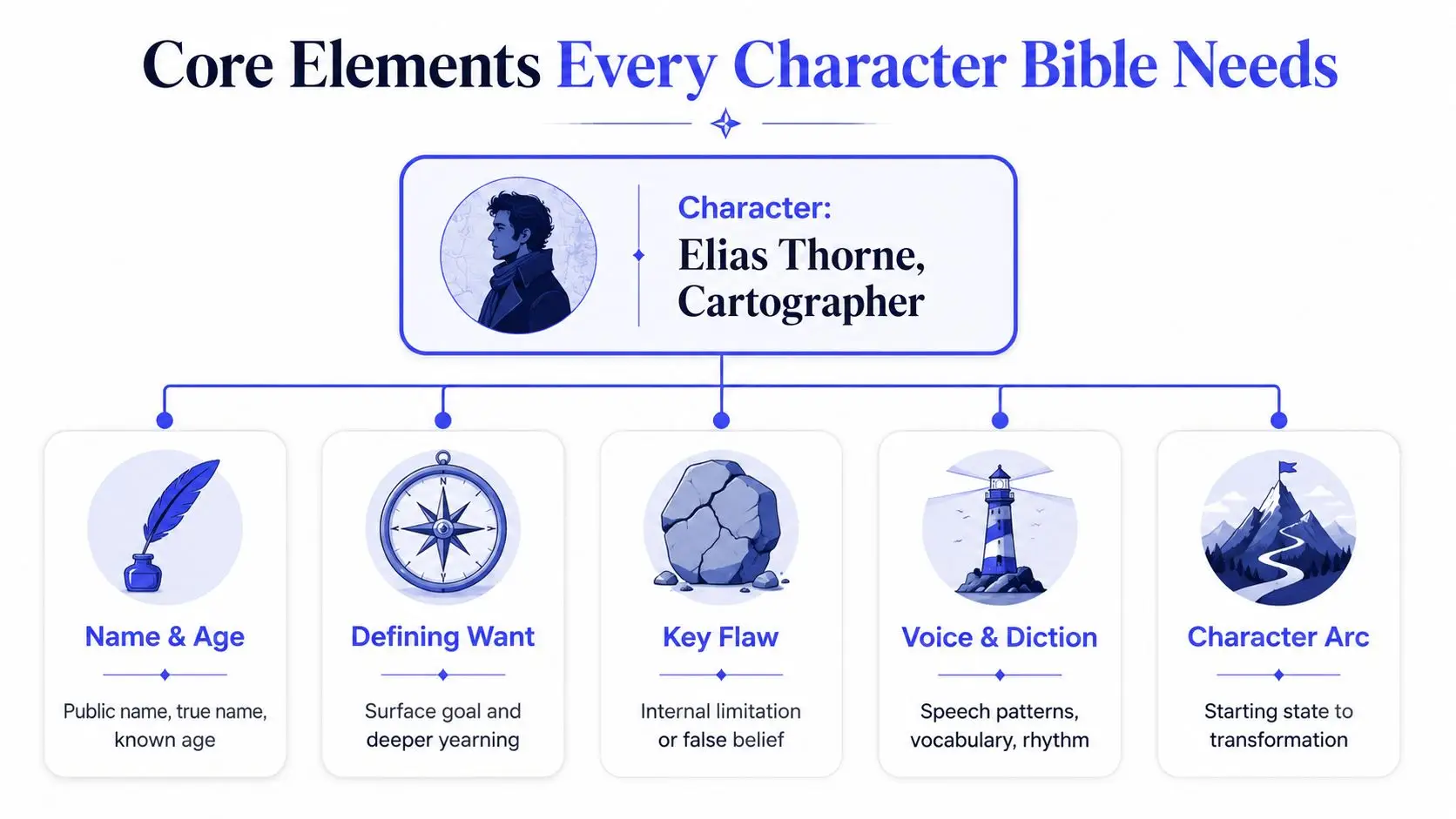
Start with one character and one concrete drafting problem. Suppose you're writing about Elias Thorne, a reclusive cartographer in a secondary-world fantasy. He has agreed to map a dangerous pass, although he hasn't left his isolated home since his brother disappeared.
The document becomes useful when each field answers a question your draft will eventually ask.
Identity and visible facts
Begin with name, age, occupation, physical traits, location, and role in the story. Include a public name if the character uses one, along with a true name, title, nickname, or alias when those details matter.
For Elias, the entry might record that he maps forbidden territories for wealthy merchants, walks with a damaged knee, keeps ink under his fingernails, and avoids crowded rooms. These details prevent contradictions, but they also create scene material. His knee affects travel. His work explains what he notices. The ink becomes a recurring physical reminder of his chosen life.
Background anchors
Backstory should explain present behavior, not decorate the page. Record the family history, formative experiences, secrets, loyalties, and false conclusions that still influence the character.
Elias's brother vanished while charting the same pass. Elias now believes that careful preparation can prevent loss, even though the belief has isolated him. That single background anchor can shape his maps, his arguments with companions, and his resistance to entering unfamiliar territory.
Relationships and pressure points
List the people who matter, but don't stop at labels such as friend, rival, parent, or love interest. Note what each relationship brings out of the character.
Elias trusts an apprentice who questions his maps, fears the expedition leader who knows what happened to his brother, and resents his mother for treating the disappearance as a closed chapter. These relationships give him different voices and choices. A character doesn't reveal the same self to everyone.
Want, flaw, and arc
The want is the outcome the character pursues. The flaw is the limitation that makes pursuit difficult. The arc describes how the character's understanding or behavior changes.
Elias wants to find the pass and learn whether his brother survived. His flaw is a need for control that makes him reject help. His deeper need is to accept uncertainty and allow other people to share responsibility. His arc might move from solitary certainty to vulnerable cooperation.
The character profile guidance for developing these details can help you turn those broad ideas into entries you can consult while drafting.
Voice and behavior
Record how the character thinks, speaks, reacts under pressure, and hides emotion. A useful voice note might say that Elias speaks in measurements and directions when frightened, avoids contractions when angry, and answers personal questions with observations about terrain.
That note prevents every character from sounding like the author. It also gives you a practical test for dialogue. When Elias is terrified, he shouldn't merely say that he's terrified. He might start describing the slope of the ground because technical language is how he keeps control.
A strong character bible connects these fields. Elias's occupation influences his voice, his loss influences his want, and his flaw complicates his relationships. The fields shouldn't read like separate answers. Together, they should explain why this person makes the choices your plot requires.
Voice and Motivation as the Two Fields That Matter Most
A character can have a detailed history and still feel lifeless. Voice and motivation give that history consequences on the page.
Elias's apprentice asks whether he is afraid to enter the mountain pass. His answer should do more than deliver information. It should reveal the habit he uses to manage fear, while creating a choice the scene can test.
A generic version might read:
“Yes,” Elias said. “The pass is dangerous. We should be careful.”
The meaning is clear, but the response could belong to almost anyone. A stronger version lets Elias's established voice shape the answer:
Elias studied the loose stones beside the path. “Fear is a poor measurement. The western slope is worse than the map suggests.”
He still avoids naming his emotion. Technical analysis becomes a form of control, so the reader understands both what he feels and what he refuses to admit. Voice includes vocabulary, rhythm, sentence length, metaphors, silences, and withheld answers. During revision, compare a character's dialogue across scenes. If every emotional moment produces the same kind of confession, the voice has stopped doing useful work.
Motivation turns background into action. It answers, Why does this character choose this action now? That question helps prevent plot decisions from feeling imposed by the author.
Elias's surface want is to map the pass and find evidence about his brother. His deeper need is to stop treating control as protection. Those aims can pull against each other. He may refuse an experienced guide because accepting help would expose his fear, even though the refusal makes the expedition more dangerous.
The distinction between want and need is practical. The want drives the immediate pursuit. The need identifies the truth or change the character keeps avoiding. For a clearer explanation of this connection, use this guide to character motivation.
Tie each entry to a drafting problem. Voice can prevent inconsistent dialogue. Motivation can explain why a character rejects an obvious solution, escalates a conflict, or repeats a damaging choice. During revision, update both fields when the manuscript reveals something new. A scene may show that Elias's stated goal is only a cover for a more personal fear, and the bible should record that discovery rather than preserve an outdated answer.
If time is limited, begin with voice and motivation. They influence dialogue, scene choices, conflict, and the direction of the arc more directly than a long inventory of favorite foods or childhood memories.
Minimal vs Deep Character Bible Templates
Your first draft is moving quickly when a continuity error appears. Elias refers to a scar in one chapter, then seems never to have had it. His dialogue sounds guarded in one scene and carefree in the next. A character bible can prevent those slips, but only if its size matches the problem you are solving.
A minimal bible is a quick reference for drafting. A deep bible is a revision tool for stories with more relationships, timelines, or reveals to track. The difference is not the writer's seriousness. It is the amount of information the manuscript needs you to control.
| Field | Minimal Template | Deep Template |
|---|---|---|
| Identity | Name, age, role, essential physical traits | Public identity, private identity, appearance changes, timeline details |
| Motivation | Surface want, deeper need, main fear | Goals by story stage, competing desires, triggers, changed priorities |
| Voice | Speech rhythm, vocabulary, emotional habit | Dialogue samples, internal narration, silence patterns, behavior under stress |
| Relationships | Important people and basic dynamic | Relationship history, power shifts, secrets, scene-specific tensions |
| Backstory | One or two events that shape the present | Family history, formative wounds, reveals, callbacks, unresolved questions |
| Arc | Starting state and ending change | Turning points, reversals, false beliefs, evidence of transformation |
| Continuity | Details likely to recur | Revision triggers, timeline checks, scene-by-scene updates |
Start with the smallest useful version
Before drafting, write five compact entries:
- Name: What does the character call themselves, and what do others call them?
- Want: What result are they pursuing?
- Flaw: What internal limitation keeps interfering?
- Voice: How do they sound when relaxed and under stress?
- Arc: What changes between the opening and ending?
This can fit on one screen. For Elias, it should explain why he refuses help, show the difference between his calm and pressured speech, and identify the change his journey must force. You do not need every childhood detail to draft the next scene.
Expand in response to evidence
Add fields when the draft exposes a specific risk. A complicated relationship may need a history and power-shift notes because characters keep misreading one another. A mystery with recurring revelations may need callbacks and revision triggers. A large cast may require a relationship map so two characters do not share the same function or voice.
The character design template from Storyloft can provide a starting structure. Use it selectively. If a detail does not prevent continuity drift, clarify voice, support a choice, or track an arc change, leave it out for now.
A living bible grows through revision. Record discoveries from the manuscript, then adjust earlier entries when a new fact changes the character's history, motivation, or behavior. The document should reduce the next drafting mistake, not become another project to maintain.
How to Use the Bible Through Drafting and Revision
A character bible becomes valuable through use. Treating it as a file you complete before writing and never open again turns it into paperwork. Treating it as a working reference makes it part of the drafting loop.
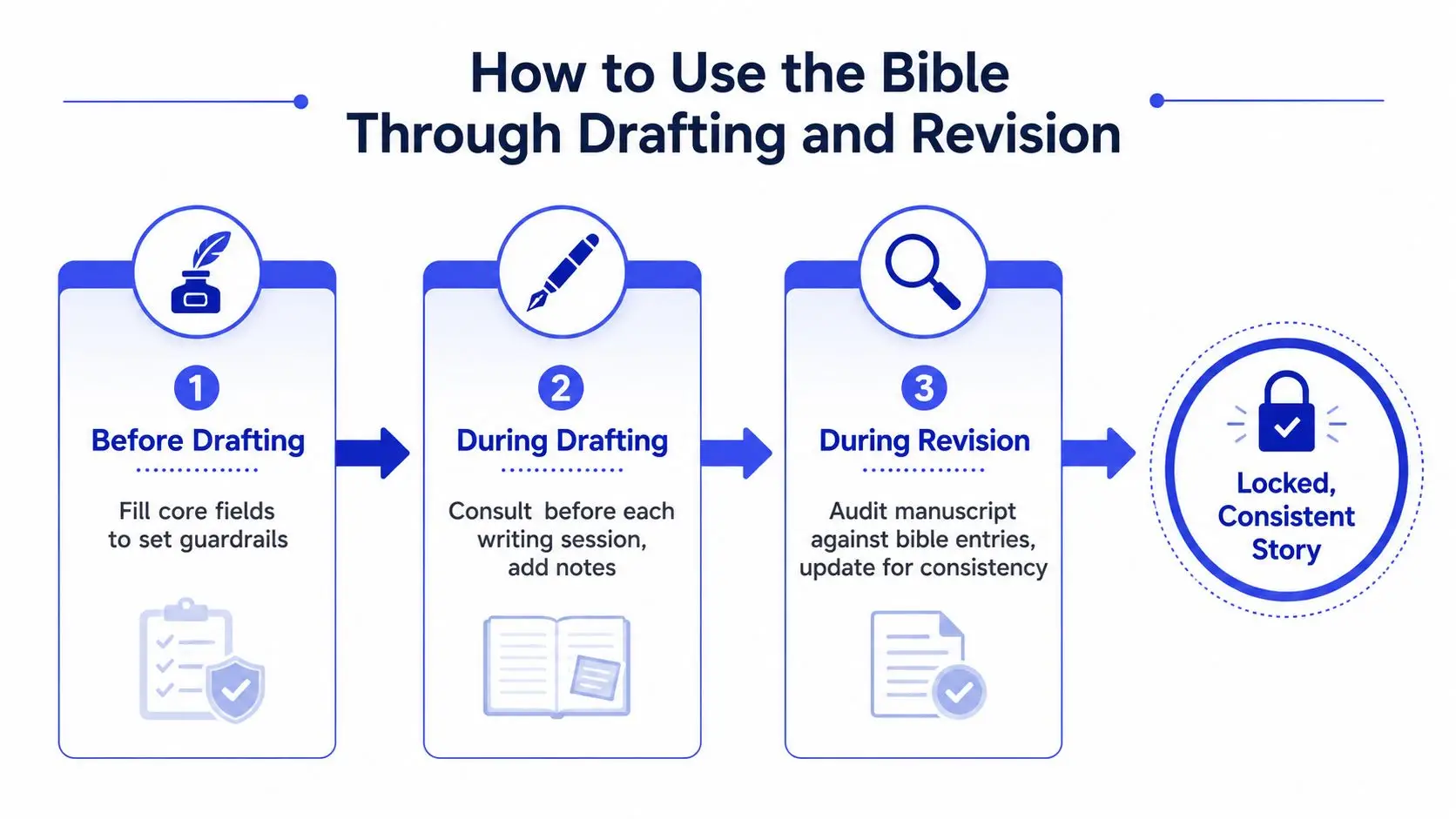
Before drafting
Before you write the opening scenes, fill in the core identity, want, flaw, voice, relationships, and arc. You're not trying to solve the entire novel. You're checking whether the character can generate conflict.
Ask practical questions:
- Does the character's occupation create useful skills or restrictions?
- Does the main relationship challenge the character's flaw?
- Does the want produce actions rather than passive wishes?
- Does the ending represent a meaningful change from the beginning?
- Do the timeline and backstory support the choices in the opening?
If the answers conflict, fix the plan while it's still cheap to change. A character who wants freedom but has no reason to remain in the central situation may need a stronger obligation, relationship, or fear.
During drafting
Keep the bible easy to reach. Use it to check details before writing a scene, not to interrupt every sentence while you draft.
At the beginning of a session, glance at the character's current want and emotional condition. If the scene follows an argument, the character may not speak with the same rhythm they used in a calm chapter. If an injury, secret, or relationship change occurred earlier, add a short note rather than trusting memory.
A useful entry might look like this:
After the pass argument: Elias no longer trusts Mara's route calculations, but he still needs her knowledge. He hides the distrust by correcting minor map details.
That note preserves the dynamic without forcing you to rewrite the entire bible immediately.
During revision
Revision turns the bible into an audit tool. Compare the manuscript against the document and look for drift in three areas:
- Arc drift: the character's actions no longer reflect the stated transformation.
- Voice drift: dialogue sounds interchangeable with another character.
- Continuity drift: physical details, relationships, dates, or knowledge change without explanation.
Update the bible when the draft reveals a stronger truth. Then decide whether that change requires a manuscript edit. The bible and the draft should agree by the time you prepare the final version, but the bible doesn't have to remain identical to its earliest form.
Why the Best Character Bibles Are Living Documents
A character may enter the draft with a clear motive, then surprise you in the third scene. Their fear explains a past choice, a new relationship exposes a contradiction, or an improvised line reveals a voice you had not planned. A static character bible cannot account for those discoveries. A living one records them and helps prevent continuity drift, inconsistent voice, and flat arcs.
Treat the document as a revision record. Begin with a working version, then update it when the manuscript produces evidence that changes your understanding.
Let discoveries trigger revisions
Revise the bible when a want changes, such as when a character abandons an original outcome to protect someone, seek truth, or escape a consequence. Add a note when a secret surfaces and changes how earlier behavior should be read. Track relationship shifts, including broken trust, changing power, or affection turning into resentment.
Also record voice patterns that emerge through drafting, such as a repeated metaphor, avoidance tactic, or sentence rhythm. Reconsider the arc when the planned ending no longer follows from the choices appearing on the page.
Record each change and where it occurred. “Updated after chapter twelve” gives you a useful continuity checkpoint. It is more informative than erasing the old version.
Keep experiments separate from established facts
A bible can become restrictive when every early decision is treated as permanent. You might keep forcing a planned flaw even after the draft shows that another limitation creates sharper conflict.
A character bible should preserve discoveries, not imprison them.
Separate stable facts from working hypotheses. A birth name may become fixed once established, while a hidden need can remain provisional until the scenes support it. Mark uncertain ideas with “test in revision,” so you know which details can change.
The document works like a conversation with the character. You make an initial proposal, the scenes challenge it, and the next version keeps what proves useful. That workflow lets the bible guide the draft without overruling what the draft has taught you.
Your First Character Bible in One Sitting
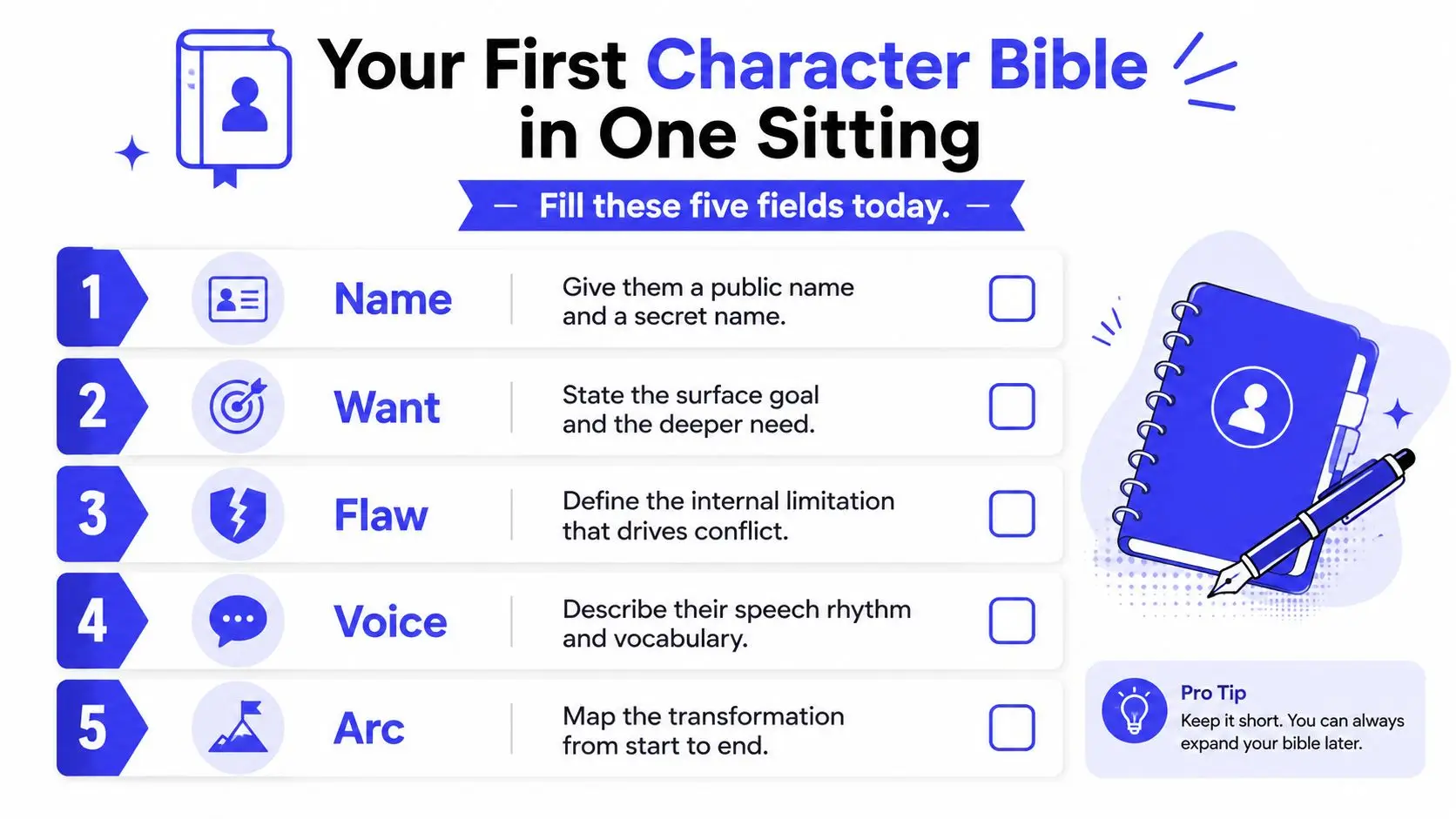
Choose your protagonist and set a short writing timer. Fill in only these five fields:
- Name: Include the public name and any private or secret name.
- Want: State the visible goal and the deeper need beneath it.
- Flaw: Identify the internal limitation that creates conflict.
- Voice: Describe speech rhythm, vocabulary, and behavior under stress.
- Arc: Write the starting state and the transformation you expect.
Save the document somewhere you'll consult it. After the first draft, add relationship history, backstory reveals, and continuity notes based on what the manuscript shows you.
Storyloft gives authors a place to draft long-form work, organize research and character details, and use character profiles and relationship notes alongside the manuscript. Visit Storyloft to create your protagonist's first profile and keep the character bible connected to the story as it develops.