10 Names for a Character by Story Style
What if the best name for a character isn't the one that sounds most beautiful, but the one that changes what readers expect before the character speaks? A strong name can signal role, culture, class, era, personality, or hidden history. It can make a hero feel ordinary enough to trust, give an antagonist an unsettling edge, or reveal a family tradition that shapes the plot.
This guide presents ten names for a character approaches connected to story style and narrative purpose. You'll find archetype-based, etymology-driven, occupational, phonetic, cultural, alliterative, functional, backstory, genre-aware, and symbolic methods. Use one primary approach, then add one contrasting detail. A severe-sounding name paired with a gentle personality creates tension. A culturally familiar name in an unusual speculative setting can make the world feel grounded.
Storyloft's Character Creator can help you test a name against behavior, personality, and visual identity. Its Planning Workspace gives you a place to save alternatives, naming logic, cultural notes, and cast relationships while you draft. You can also use the Scrape API to gather research material into a broader writing workflow.
Before choosing, ask:
- Pronunciation: Can readers say it without constant uncertainty?
- Cultural context: Does it fit the character's region, family, religion, and era?
- Cast clarity: Does it stand apart from other names in the manuscript?
- Genre fit: Does it belong in this kind of story?
- Room for surprise: Does the character remain more complex than the name suggests?
Table of Contents
- 1. Archetype-Based Naming
- 2. Etymology-Driven Naming
- 3. Occupational and Class-Based Naming
- 4. Sound Symbolism and Phonetic Appeal
- 5. Cultural and Linguistic Authenticity
- 6. Alliterative and Pattern-Based Naming
- 7. Narrative Function Naming
- 8. Personal Significance and Backstory Naming
- 9. Genre and Trope-Aware Naming
- 10. Minimalist and Symbolic Naming
- Character Naming: 10 Approaches Compared
- Turn Naming Inspiration Into a Character System
1. Archetype-Based Naming
A name can give readers an immediate doorway into a familiar story role. Hero, Mentor, Shadow, Trickster, Caregiver, and Ruler are recognizable archetypal patterns, and a name that supports one of them can orient readers quickly. That doesn't mean the character must become predictable. It means the name establishes an expectation that the character can fulfill, complicate, or overturn.
Think about the plain strength of Harry Potter, the authority of Dumbledore, or the menace associated with Darth Vader. These names carry different levels of familiarity and theatrical force. Harry sounds accessible, Dumbledore sounds eccentric and old, and Darth Vader sounds imposing before readers know the character's history.
Start by defining the character's dominant archetypal traits in Storyloft's Character Creator. Then ask what kind of name would support those traits without reducing the person to a label. A Mentor might have a formal, old-fashioned name, while a Trickster might have a nickname that feels quick and difficult to pin down.

Build recognition, then add friction
Use tags in your binders to track archetypes across an ensemble. If every major character has a highly dramatic name, the effect weakens. A quiet, practical name can make a Shadow character more disturbing because the threat hides beneath normality.
You can also record visual traits and archetypal decisions beside the name. Storyloft's illustration tools can then help maintain a consistent character presentation as the manuscript develops. For further planning, compare your cast with examples of archetypal heroes.
Prompt: Create five names for a Mentor who appears patient and wise but secretly fears becoming irrelevant.
2. Etymology-Driven Naming
Names with meaningful linguistic roots can place a second layer beneath the visible story. The character may not know what the name means, and readers may never look it up, but the sound and cultural origin can still influence your choices. Literary onomastics treats names as more than labels. Names can help establish identity, social setting, historical period, regional background, and perceived personality, while their meanings can support a character's larger thematic role. Academic research on literary names explains why naming can help construct the literary character rather than merely identify who is acting.
Examples from popular fiction show how this method works. Hermione Granger has a name associated with a messenger in Greek tradition, which can support an interpretation of her as a communicator and intellectual guide. Katniss Everdeen connects the character to a plant and its survival qualities. Tyrion Lannister creates a productive tension between a name that can suggest tyranny and a character whose intelligence often matters more than physical dominance.
Keep the meaning beneath the surface
Don't choose a name only because its dictionary meaning matches a trait. A courageous character doesn't need a name that literally means brave. Subtle associations usually leave more room for character development.
Save the etymology and your reason for choosing it in a Storyloft binder entry. You might write:
- Surface association: The name sounds formal and controlled.
- Hidden connection: Its root relates to endurance.
- Arc tension: The character begins by rejecting endurance as weakness.
- Reveal timing: The family explains the name during a later confrontation.
Use Eddy's tone analysis to check whether the name belongs beside the manuscript's diction and atmosphere. The name should enrich the story, not announce its theme so loudly that readers feel directed.
Prompt: Generate five names from a language associated with the character's family history that suggest resilience without directly meaning “strong.”
3. Occupational and Class-Based Naming
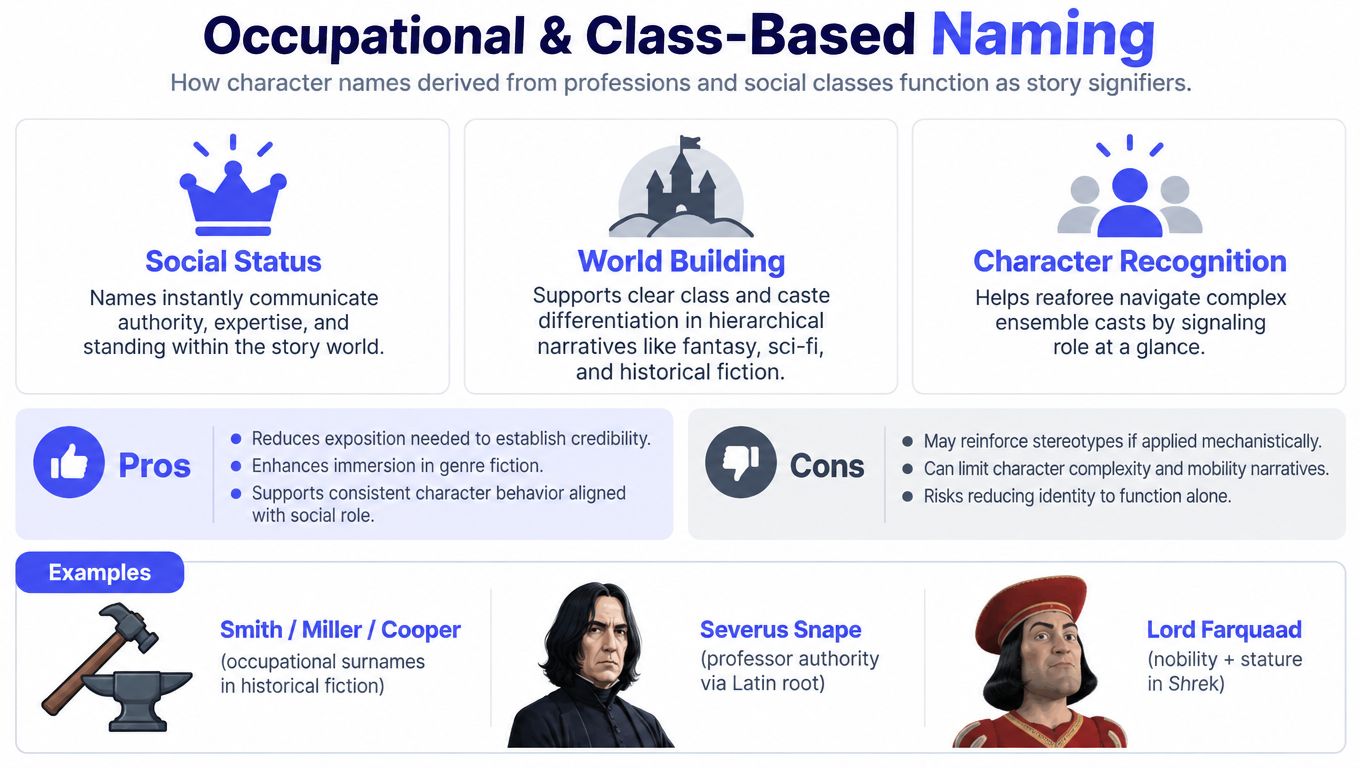
A character's name can expose the social world that produced them. Surnames such as Smith, Miller, and Cooper carry occupational associations that can feel especially useful in historical fiction. They suggest a trade, a family line, or a community where work shaped identity. A title, honorific, or inherited surname can also show who has authority and who must earn recognition.
This method works through contrast as much as direct meaning. Severus Snape sounds severe, which supports the character's formal authority and intimidating presence. Lord Farquaad combines an aristocratic title with a name that feels exaggerated and physically comic, creating a satirical picture of status rather than a realistic noble identity.
Begin with the character's occupation, economic position, and relationship to power. A physician, dockworker, court official, heir, and servant may all live in the same city, but their names can reflect different expectations about education, family, and public behavior.
Show the hierarchy inside the cast
Storyloft's Character Creator can store the profession and naming logic together. In the Planning Workspace, tag characters by occupational group or class position. This makes patterns visible when an ensemble includes a ruling family, military order, merchant network, or religious institution.
Don't turn class into a caricature. A wealthy character can have a modest, common name. A laborer can have an elaborate inherited name. Those contradictions often create more depth than a perfectly matching label.
Practical rule: Use occupational or class signals to establish a reader's first impression, then let the character's choices confirm or challenge it.
Read the name aloud beside the character's dialogue. Eddy's tone analysis can help you check whether a formal name fits the voice on the page, especially when the character's public role differs from private speech.
Prompt: Create names for a minor noble whose title sounds powerful but whose family has recently lost its influence.
4. Sound Symbolism and Phonetic Appeal
Readers respond to a name before they consciously interpret it. Sharp consonants can make a name feel energetic or dangerous. Long vowels and flowing syllables can suggest elegance, distance, or reflection. Repeated sounds can make a name memorable, comic, ceremonial, or ominous.
Katniss has a compact, pointed sound that suits a character associated with action and survival. Hermione has more flowing syllables and a different rhythm, which can support associations with intelligence and refinement. Voldemort uses harsh sounds and a strong ending to create a sense of threat. These effects aren't fixed rules. They are reader expectations you can use deliberately or reverse.
Test the name in speech
Write several candidates in Storyloft's notes panel and say each one aloud. Notice where your mouth slows down, where the stress falls, and whether the name sounds natural in dialogue. A name that looks impressive on the page may become awkward when another character calls it during an argument.
Check the whole cast phonetically. Two names with different spellings can still sound too similar, particularly in an audiobook. You can record your reactions, compare syllable patterns in binders, and ask a beta reader to pronounce the names without guidance. Research involving character names in online games and novels found that more than 60% of respondents paid attention to character names, while 76% considered alignment between a name and a character's image essential. The 2025 questionnaire study focused on a limited sample, so treat those findings as directional rather than universal.
Use this video as a further prompt for listening to how character names sound in context.
Prompt: Generate five names with clipped consonants for a disciplined character who hides a tender private life.
5. Cultural and Linguistic Authenticity
A believable name belongs to a social context, not just a country on a list. Writers need to consider region, era, religion, family structure, diaspora experience, pronunciation, formality, and the relationship between given names and surnames. A name can be individually real yet implausible beside another name if the combination ignores local naming conventions.
Cultural authenticity also requires restraint. A distinctive or unfamiliar name isn't automatically more accurate, and a translated meaning isn't enough to establish a character's identity. Academic discussion of fiction naming emphasizes the fit between a name, its character, and the story's cultural, geographic, and historical setting. The research on cultural plausibility in naming also supports looking beyond decorative diversity toward internal coherence and consultation.
Create a plausibility record
Use the Planning Workspace to store the character's family background, location, time period, naming convention, pronunciation, and social register. Add consultation notes when you seek feedback from people connected to the represented culture. Record uncertainty instead of hiding it.
A practical workflow can include:
- Family context: Identify who chose the name and what traditions shaped the choice.
- Geographic context: Check whether the name fits the character's specific region or diaspora community.
- Social register: Decide whether it sounds formal, intimate, religious, old-fashioned, or ordinary.
- Compatibility: Check whether the given name and surname follow the same naming logic.
- Marked meanings: Flag sacred, ceremonial, or highly associated names before using them.
Storyloft can keep these notes beside research materials and character entries. Tags can help you maintain consistency across characters from the same community. For invented settings, the names of fantasy lands can inspire systems, but the final names should still follow rules established inside your world.
Prompt: Create names for a character from a specific diaspora community, showing the family tradition, everyday nickname, and formal version used in public.
6. Alliterative and Pattern-Based Naming
Repeated initials and naming patterns give families, teams, schools, and institutions a shared identity. The pattern may signal affection, status, vanity, ritual, or an attempt by one generation to control the next. It can also help readers remember a large cast, though too much repetition creates confusion.
The Stark family names Benjen, Brandon, and Bran demonstrate how similar sounds can create family cohesion. In the Harry Potter series, names such as Luna, Lavender, and Lily contribute to a varied but recognizable soundscape among female characters. A pattern doesn't have to use the same first letter. Repeated lengths, shared syllable shapes, seasonal references, or names drawn from the same mythology can work just as well.
Make the pattern tell a story
A family may name every child after a flower because of a religious tradition. A military unit may use shortened names to erase personal identity. A royal house may repeat names to claim continuity with an admired ancestor. The pattern becomes more interesting when one character rejects it or receives the one name that doesn't fit.
Use Storyloft tags to group the relevant characters, then isolate them in Focus mode while checking the manuscript. Store the rationale in each character's binder entry. This helps beta readers understand the pattern without forcing you to explain it in exposition.
A naming pattern should help readers recognize relationships, not make them pause to distinguish siblings.
Read a chapter containing the whole group and mark every similar name. If two characters are confused in dialogue, change one name's rhythm or nickname rather than abandoning the entire pattern. Eddy can also help identify repeated names in the manuscript and show where the pattern becomes distracting.
Prompt: Generate names for five siblings who share a family tradition, then give one sibling a name that reveals a break with the household.
7. Narrative Function Naming
Some names work because they support what a character does in the plot. A protagonist may need a name that readers can carry through many chapters. An antagonist may have a title that makes opposition clear. A romantic interest may need a name that sounds natural in intimate dialogue. A comic character may benefit from rhythm or exaggeration, but only if the humor belongs to the story's tone.
Katniss Everdeen has a forceful, distinctive quality that supports a protagonist built around action and survival. President Snow uses a title and a simple natural image to create an authoritative antagonist. Gale Hawthorne combines a storm association with a sharp surname, which supports a character who carries emotional and ideological tension.
Start with the job in the story
Before choosing the name, write one sentence describing the character's narrative function. For example: “This character pressures the protagonist to choose between loyalty and freedom.” Then decide whether the name should reinforce that function, disguise it, or create an ironic contrast.
In Storyloft's Character Creator, record the function beside the persona. Use the Planning Workspace to map when the character appears, what information they carry, and which other roles they balance. Tags such as protagonist, rival, witness, guide, and comic relief can reveal an ensemble with too many characters doing the same work.
Avoid naming every supporting character as if they were central. A shopkeeper who appears once may need a clear, natural name, while a secret antagonist may need an ordinary name that avoids suspicion.
- Reinforcing name: Makes the role legible immediately.
- Disguising name: Delays recognition and supports a reveal.
- Ironic name: Contradicts the role to expose a gap between image and reality.
Eddy's manuscript-aware suggestions can help you test whether dialogue and description reinforce the intended function.
Prompt: Create five names for a trusted adviser who benefits from every conflict between the main characters.
8. Personal Significance and Backstory Naming
A name becomes emotionally powerful when someone in the character's past made a choice about it. Parents may name a child after an ancestor, a place, a religious figure, a lost loved one, or an experience they want to preserve. The character may embrace that history, resent it, hide it, or reinterpret it.
Katniss, for example, connects the character to a plant and to survival, giving the name personal and thematic weight. Éowyn carries an older linguistic texture that can support a story about identity, duty, and freedom. Arya can suggest nobility while the character's journey questions who has the right to define her identity. These associations don't replace characterization. The character's actions give them force.
Decide who uses which version
A full name, nickname, childhood name, and title can reveal relationships. A parent may use a formal name during anger. A sibling may use a private nickname that no outsider understands. A character who changes their name may be claiming independence rather than merely seeking a more attractive identity.
Save the naming event in Storyloft's Character Creator. In the Planning Workspace, note when readers learn the reason for the name and whether the explanation belongs in dialogue, memory, a document, or a confrontation. The character description example can help you connect naming details to behavior and appearance.
Use the name sparingly as a reveal. If every chapter explains its symbolism, the meaning becomes mechanical. Let a small detail carry the history, such as a character refusing to answer to the name their parent chose.
Prompt: Create five names given by a family after a public loss, then explain why the character now avoids using the name.
9. Genre and Trope-Aware Naming
Readers bring genre expectations to a name. A fantasy name can suggest a constructed language, a noble lineage, or an ancient order. A science-fiction name may reflect migration, technology, corporate culture, or a changed relationship with Earth. A mystery protagonist may need a name that sounds credible in professional scenes, while a romance character's name must work in both public introductions and intimate dialogue.
A name such as Dagny Taggart feels modern, forceful, and professionally capable. Elara Nightshade signals a more heightened fantasy register through an ethereal first name and a darkly suggestive surname. Detective Sarah Chen combines professional clarity with a specific cultural identity. These examples show how genre naming can orient readers quickly, but they shouldn't become rigid formulas.
Use convention as a starting point
In Storyloft's Planning Workspace, record the genre promise and the tropes your story uses. Then decide whether the name should meet that promise or challenge it. A fantasy heroine called Elara may fit reader expectations, but giving her an ordinary name can make the surrounding world feel stranger. A detective with an elegant, unusual name may become memorable if the rest of the cast remains grounded.
Review examples of tropes while identifying which expectations matter to your manuscript. Save candidates in a binder with tags for genre, role, tone, and cultural context. Don't let an aesthetic name override plausibility. A name that sounds “fantasy” but ignores the world's linguistic rules will feel decorative rather than native to the setting.
Prompt: Generate five names for a romantic-fantasy rival who fits the genre's dark elegance but behaves with unexpected generosity.
10. Minimalist and Symbolic Naming
A minimalist name can create space around a character. One word, a short name, an initial, or an abstract label may feel intimate, allegorical, futuristic, or deliberately incomplete. The approach suits stories that focus on identity, systems, isolation, memory, or transformation. It can also make a character feel iconic, but only when the manuscript gives the name enough human detail to support its weight.
Pearl works as a simple concept with symbolic associations. Holden has a restrained literary quality that contrasts with the character's complicated inner life. A single initial such as Z can suggest anonymity, classification, or a world where personal identity has been reduced to a code. Katniss also functions as a concise plant-based name whose meaning gains power through the character's actions and setting.
Keep the person larger than the symbol
A symbolic name can become thin if it does all the characterization. Give the character specific habits, contradictions, relationships, and physical choices. If the name means isolation, show the character making an unwanted connection. If the name suggests purity, show the compromises that complicate it.
Use Storyloft's Character Creator to record the symbolic meaning alongside a detailed persona. Ask beta readers whether the name feels intriguing, confusing, pretentious, or memorable. The study of online-game and novel characters found that 66% of respondents preferred poetic or cultural connotations, while 30% favored names that were simple and easy to remember. Because the sample was limited and focused on particular media, use the contrast as a design prompt rather than a universal rule. A good tool should test meaning and memorability separately.
Eddy's tone analysis can help you check whether a minimalist name matches the manuscript's voice. If the story is warm and domestic, a stark symbolic name may create useful distance or an unwanted mismatch.
Prompt: Generate five single-word names for a character who has lost their original identity but is slowly building a new one.
Character Naming: 10 Approaches Compared
| Naming Method | 🔄 Implementation Complexity | ⚡ Resource Requirements | 📊 Expected Outcomes | 💡 Ideal Use Cases | ⭐ Key Advantages |
|---|---|---|---|---|---|
| Archetype-Based Naming | Medium, conceptually simple but needs craft to avoid clichés | Low–Medium, basic theory resources; Storyloft tools helpful | Clear, immediate role recognition; risk of stereotype if overused | Genre fiction, series, quick ensemble development | ⭐ Instant role clarity; speeds development; consistent tone/image |
| Etymology-Driven Naming | Medium–High, requires linguistic research and intent | Medium–High, etymology sources, possible expert consultation | Layered meaning and stronger worldbuilding; meaning may be subtle to readers | Epic fantasy, literary fiction, culturally rich worlds | ⭐ Adds depth and intentionality; memorable, meaningful names |
| Occupational & Class-Based Naming | Low–Medium, uses clear conventions but needs nuance | Low, naming conventions and Storyloft tagging | Fast social/status signaling; can reduce exposition but risk stereotype | Historical fiction, hierarchical fantasy/sci‑fi, ensemble casts | ⭐ Instant social signifiers; reduces exposition; genre immersion |
| Sound Symbolism & Phonetic Appeal | Medium, requires phonetic sensitivity and testing | Low–Medium, pronunciation tests, notes, audio checks | Strong memorability and emotional tone; varies by language | Character‑driven stories, audiobooks, names needing immediate impact | ⭐ Enhances recall and emotional resonance through sound |
| Cultural & Linguistic Authenticity | High, deep research and cultural consultation required | High, consultants, research, vetting, translation checks | Authentic representation, reader trust, better translation; time‑intensive | Diverse contemporary/historical fiction; respectful worldbuilding | ⭐ Builds credibility and inclusive representation |
| Alliterative & Pattern-Based Naming | Low, straightforward patterning but needs subtlety | Low, pattern planning and Storyloft tagging | Improved recall for groups; risk of feeling contrived if overused | Large ensembles, families, teams, comics | ⭐ Boosts memorability and signals group membership |
| Narrative Function Naming | Low–Medium, define roles clearly and name accordingly | Low, planning workspace and role tagging | Clarifies expectations and reduces reader confusion; may feel predictable | Complex plots, multi‑book series, structurally driven narratives | ⭐ Clarifies role/function; aids tracking and coherence |
| Personal Significance & Backstory Naming | Medium–High, integrates backstory and pacing | Medium, detailed character development and documentation | Deep emotional resonance and authenticity; may need exposition | Literary fiction, character‑driven arcs, stories with name revelations | ⭐ Creates emotional depth and meaningful identity |
| Genre & Trope-Aware Naming | Medium, requires genre knowledge and awareness of tropes | Low–Medium, genre research and marketing considerations | Immediate genre orientation; enables deliberate subversion; risk of cliché | Genre fiction (fantasy, romance, mystery), marketing‑driven works | ⭐ Orients readers quickly; supports expectation management/subversion |
| Minimalist & Symbolic Naming | Medium, simple form but needs strong supporting characterization | Low, conceptual clarity and reader testing | High distinctiveness and thematic punch; may alienate some readers | Literary, experimental, contemporary fiction | ⭐ Exceptional memorability and thematic resonance through brevity |
Turn Naming Inspiration Into a Character System
The strongest name usually comes from a process rather than a flash of inspiration. Start by defining the character's genre, setting, narrative function, social context, and central tension. You don't need to solve every detail before drafting, but you should know what kind of expectation the name needs to create.
Choose one primary approach from the list. An archetype-based name may establish a familiar role. An etymology-driven name may add thematic depth. A cultural approach may anchor the character in family and place. A phonetic approach may shape the reader's emotional response. A symbolic name may create a deliberate gap between the person and the label.
Then add one contrasting detail. A Mentor can have a youthful, ordinary name. A noble character can carry a common surname. A name associated with gentleness can belong to someone ruthless. Contrast gives the character room to surprise readers, while the primary method keeps the choice connected to the story.
Use this repeatable workflow:
- Define the character: Write the role, public identity, private fear, setting, family background, and desired reader impression.
- Choose the method: Select one naming approach that supports the character's most important story function.
- Generate candidates: Produce several names instead of committing to the first attractive option.
- Test the sound: Say each name aloud, check stress and pronunciation, and compare it with the rest of the cast.
- Check the context: Verify regional, historical, religious, linguistic, and family compatibility.
- Test the manuscript: Place the name in dialogue, description, chapter headings, and emotionally intense scenes.
- Save the reasoning: Record the final choice, alternatives, pronunciation, meaning, and intended contrast in Storyloft.
Useful prompts can keep the process focused. Try:
Create five names for a [genre] character whose public role contrasts with their private fear.
Or:
Generate names from [linguistic or cultural context] that suggest [trait] without stating it directly.
You can also ask for candidates with different levels of familiarity, from ordinary to rare, then judge them by fit rather than novelty. Official registration datasets can help compare whether a proposed name feels contemporary, historical, regional, or unusually rare. The name popularity database is useful as a reference layer, but frequency isn't a quality judgment. A common name may make a character feel grounded, while a rare name may help readers distinguish a speculative figure.
Storyloft's Character Creator is a practical place to hold the name beside personality, behavior, appearance, and relationships. Its Planning Workspace can keep family trees, cultural notes, research, alternate names, and scene plans connected to the manuscript. That matters because a name can change as the character becomes clearer. You might discover that the protagonist's original name belongs to an earlier version of the person, or that a nickname carries more emotional truth than the legal name.
Let the character's actions earn the name's meaning. Don't force a brave name to produce a brave character, or a dark name to produce an obvious villain. Draft a scene before finalizing the choice, then revisit the name after the character has spoken, lied, failed, desired, and made a decision. The most appealing option at the planning stage isn't always the one that belongs to the finished story.
Storyloft brings manuscript drafting, character planning, AI-assisted editing, research organization, illustration, and publishing tools into one writing environment. Use its Character Creator and Planning Workspace to develop names with their cultural context, sound, backstory, and narrative purpose, then test those choices directly in your scenes. Visit Storyloft to start building a character system that grows with your manuscript.