Character Description Example: A Guide to Writing Vivid
You're probably staring at a sentence like this:
Elena was tall, beautiful, and mysterious.
It isn't wrong. It's just forgettable.
Most flat character description comes from the same habit. Writers reach for visible traits first, stack adjectives, and hope the pile turns into a person. It rarely does. Readers don't bond with a checklist. They bond with a pattern of details that suggests history, pressure, desire, prejudice, status, and contradiction.
A strong character description example doesn't just show what someone looks like. It shows what that appearance means inside the story, and who is noticing it. That last part matters more than many guides admit. A rival never describes a hero the same way a lover does. A child doesn't notice the same things as a cop, a nurse, or a debt collector. The lens creates the description.
The other under-taught problem is authenticity. Too much advice treats diverse characters as a skin-tone adjustment on an otherwise default character. That's how writers drift into exoticizing, flattening, or reducing identity to visual shorthand. Better description pays attention to culture, habit, speech rhythm, environment, and lived experience.
Table of Contents
- The Anatomy of a Memorable Character Description
- Show Dont Tell in Action With Examples
- Advanced Techniques for Deeper Characterization
- Adapting Descriptions Across Different Genres
- Common Pitfalls and How to Revise Your Descriptions
- Using Tools to Ensure Character Consistency
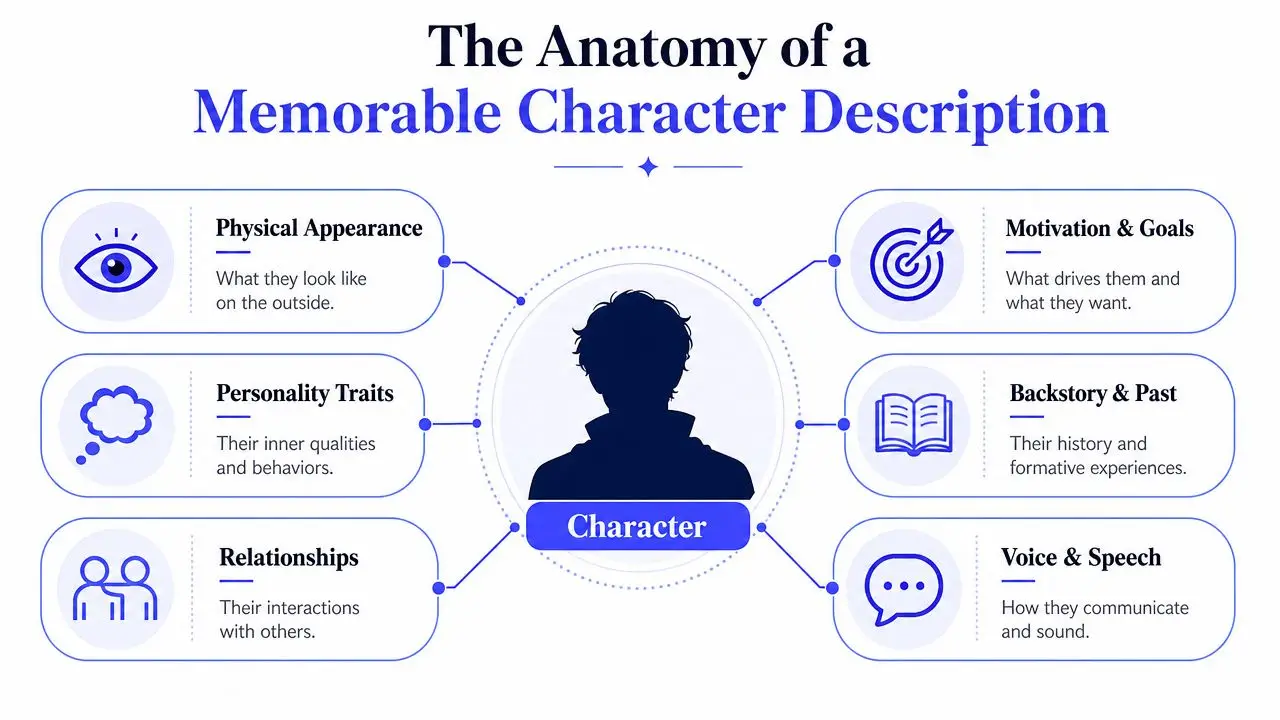
The Anatomy of a Memorable Character Description
Flat description usually comes from writing what the author knows instead of what the scene needs. You know the character's age, face, clothes, and childhood wound, so you try to fit all of it into the first entrance. The page stiffens immediately.
A more useful model treats description as selection under pressure. You choose details that reveal the person in motion. That approach aligns with guidance summarized by StoryGrid's breakdown of character description techniques, which notes that effective character description works across at least three core dimensions: physical traits, emotional expressions, and behavioral patterns. The same guidance also points to six teaching categories: appearance, background, speech, movement, actions or thoughts or feelings, and personality.
Start with function, not inventory
Description has jobs to do. It should orient the reader, create emotional tone, hint at conflict, and make the character legible enough to remember. If a detail doesn't do one of those jobs, it's probably clutter.
That's why “brown hair, blue eyes, medium height” so often dies on the page. Those details aren't specific in a story sense. They don't imply anything. Compare that to “her thumbnail was bitten to the quick, but her lipstick was flawless.” Now you have tension between control and strain.
Practical rule: Pick details that create an inference. If the reader can conclude something about the character without being told, the description is working.
A good planning tool helps here. If you want a clean worksheet for deciding which details matter, BarkerBooks has an author's guide to character creation that's useful for sorting superficial facts from story-bearing ones.
Build from six working layers
I don't think in terms of “appearance only.” I think in layers that can be deployed at different moments.
- Surface marker. One visible trait that anchors the mental image. A split knuckle. An immaculate collar. A missing earring.
- Behavioral tell. What the body does under pressure. Taps a ring. Avoids doorways. Laughs too quickly.
- Emotional leakage. The feeling the character tries and fails to hide. Irritation in clipped replies. Fear in overexplaining.
- Voice pattern. Their syntax, rhythm, evasions, favorite kinds of words.
- Social trace. Class, profession, subculture, region, or upbringing showing through clothes, posture, assumptions, or manners.
- Relational effect. How others respond to them. People step aside. Waiters relax. Children stare. Exes go quiet.
A memorable character description example usually combines several of these at once. Not by dumping them in a paragraph, but by letting one observed detail trigger another.
Here's the difference:
| Weak approach | Stronger approach |
|---|---|
| Lists traits | Selects story-charged details |
| Describes in a vacuum | Describes in a scene |
| Tries to complete the portrait at once | Builds the portrait across encounters |
| States personality | Lets behavior imply personality |
For writers who want to keep that process tied to scene design, this guide to character-driven storytelling is a useful reminder that description works best when it grows out of want, conflict, and reaction.
Show Dont Tell in Action With Examples
The phrase “show, don't tell” gets repeated so often that writers either overuse it or stop hearing it. The key question isn't whether to show or tell. It's what deserves dramatization. Character description becomes vivid when the chosen detail creates consequence.
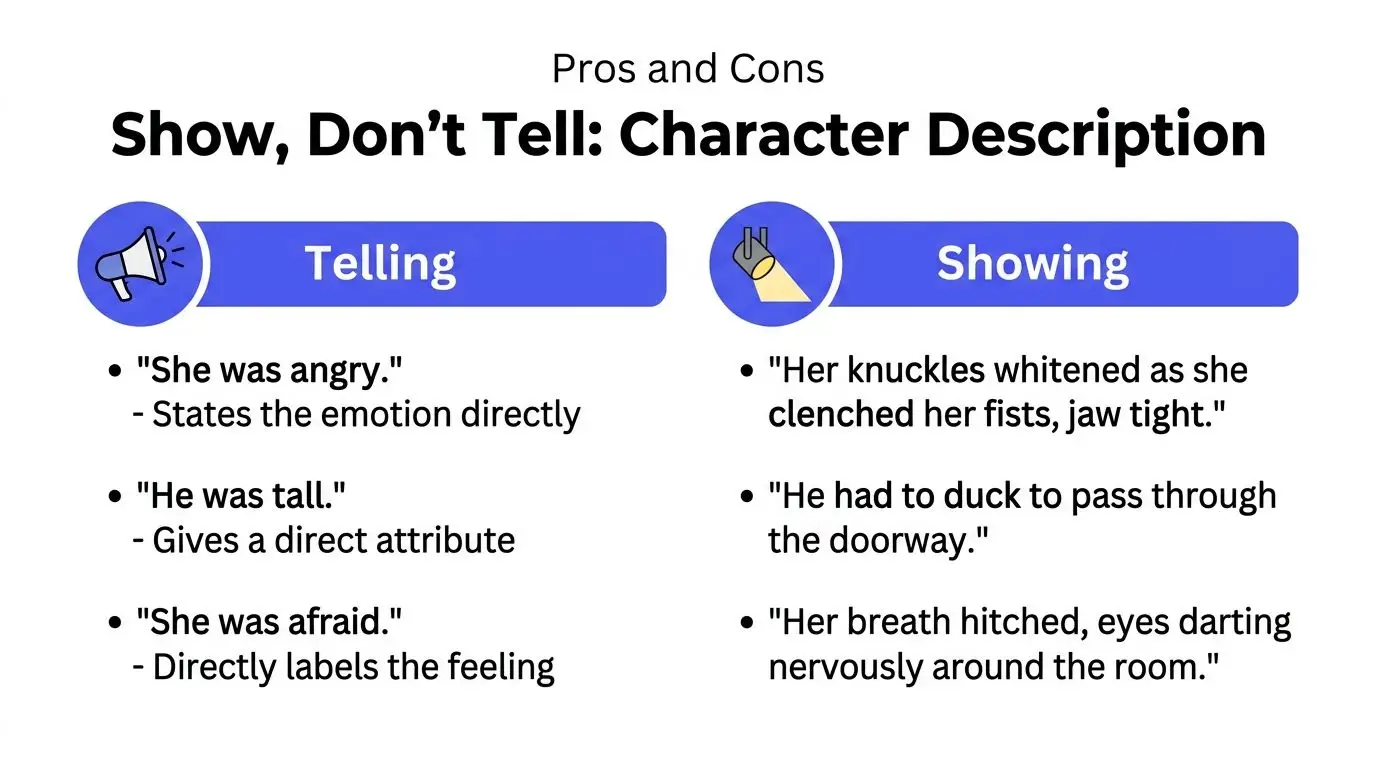
One useful benchmark comes from Writer's Digest on effective character description, which says 78% of published fiction successes rely on fewer than five signature details per character, and that scattering those details across scenes can increase character retention by 40%. The point isn't the exact number of details as a rule. The point is restraint.
Before and after on the page
Telling:
Marcus was intimidating.
Showing:
When Marcus stepped into the kitchen, nobody mentioned the broken window again. He set his keys down softly, which was somehow worse than if he'd slammed them.
The second version gives the reader behavior, atmosphere, and social impact. “Intimidating” becomes unnecessary.
Telling:
Nina was disorganized.
Showing:
Nina's tote bag held three pens without caps, a bruised peach, and a phone bill folded around a parking ticket. She found the contract only after shaking out a child's mitten and a teaspoon.
The possessions do the work. They imply a life, not just a trait.
A camera metaphor helps many writers. A useful professional close-up photography guide explains how narrowing the frame changes what the viewer notices. Character description works the same way. Don't shoot the whole body if the frayed cuff says more.
How to choose the right detail
Writers often think they need a richer vocabulary. Usually they need a sharper decision.
Use details that satisfy at least one of these tests:
It creates consequence.
He has to duck under the doorway. She keeps wiping her palms before touching the file.It reveals contradiction.
Her voice is soothing, but she's shredding the paper sleeve around her coffee cup.It exposes status or history.
He thanks the server without looking up. She folds the receipt before standing, as if money has always required witnesses.
Don't describe everything visible. Describe what a pressure point makes visible.
Here's a quick rewrite set:
Flat: She was nervous.
Vivid: She smiled before anyone had finished speaking, like she was trying to get ahead of bad news.Flat: He was rich.
Vivid: His sweater had a hole at the cuff, but his watch was the sort of object people hand back with both hands.Flat: She was very neat.
Vivid: She aligned the sugar packets with the edge of the saucer while she listened.
The page also needs rhythm. Not every line should labor under symbolism. Sometimes one quick physical consequence is enough, and then you move on. If you want more examples of how to embed character detail inside scene action, this article on show don't tell in writing is worth keeping nearby while you revise.
A craft discussion can help more than a static article, so here's a useful video to watch with your draft open beside you:
Advanced Techniques for Deeper Characterization
Most writing advice stops at “use specific details.” That's beginner advice. The stronger move is to ask who is describing this person, and what bias bends the description.
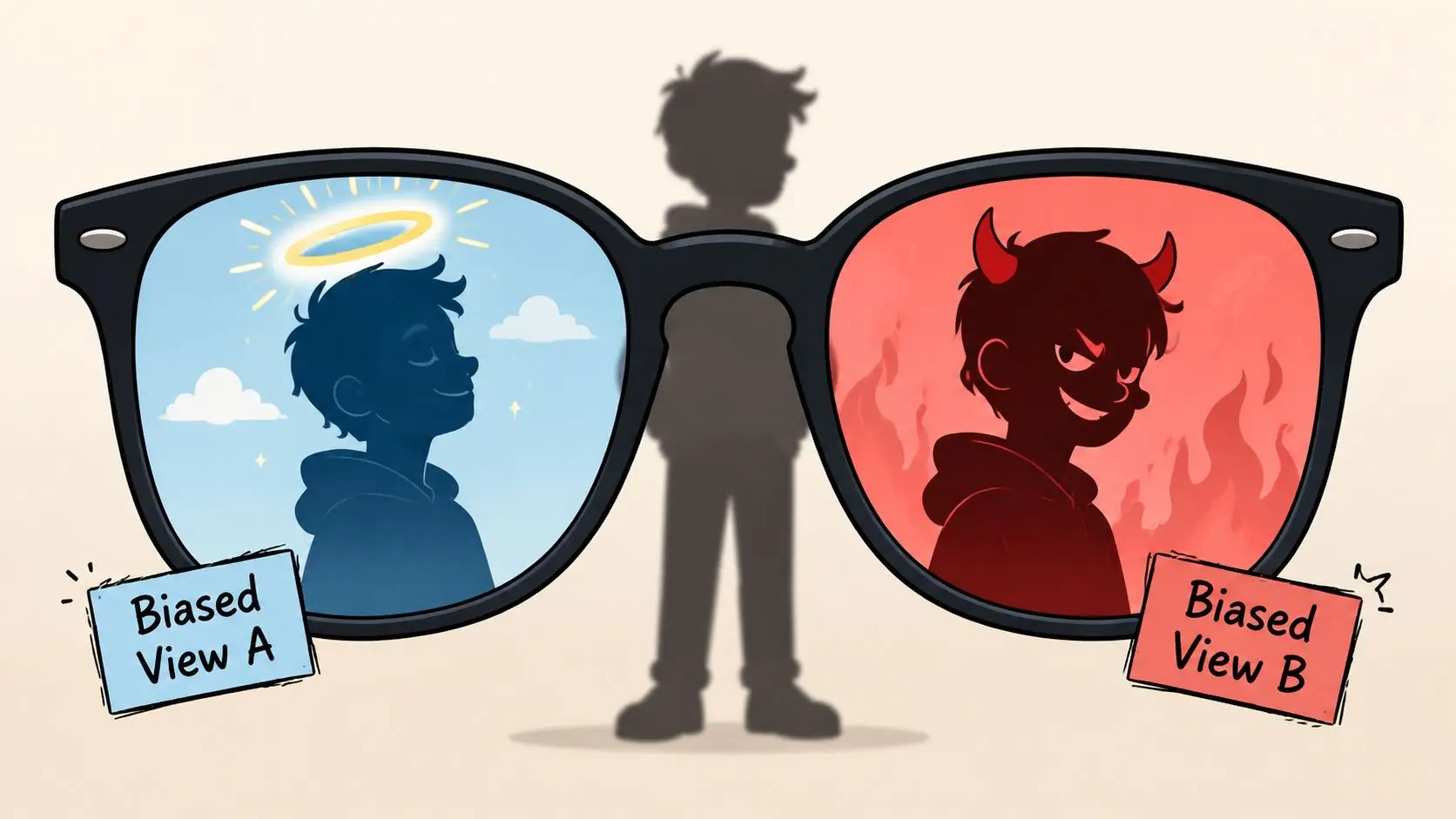
An analysis discussed by John Fox on character description says 65% of amateur writers introduce characters via neutral, omniscient lists, while pros use subjective lenses. The same source notes that 78% of aspiring writers struggle to depict non-white characters authentically, often because advice fixates on physical traits instead of cultural markers and mannerisms. Both problems come from the same mistake. Writers treat description as objective labeling instead of human perception.
Use biased perception on purpose
Neutral description has its place, but it often produces generic prose. A rival notices weakness. A lover notices grace. A frightened witness notices threat. None of them are lying. They're selecting.
Compare these introductions of the same woman:
Neutral lens
Detective Vega wore a gray coat and had dark hair pinned back from a narrow face.
Daughter's lens
My mother's gray coat still made her look official, even with the hem coming loose. She pinned her hair so tightly it seemed to pull her patience back with it.
Suspect's lens
Vega didn't dress to impress. She dressed to remove excuses. The pinned-back hair, the plain coat, the expression that said she'd already heard the polished version.
The facts overlap. The meaning changes.
Use perspective-biased description to reveal two things at once:
- The observed character
- The observer's fear, hunger, resentment, or devotion
A character introduction should never be just an introduction. It should also expose the relationship.
For writers shaping longer emotional trajectories, studying character arcs in fiction can sharpen this further. The way one character notices another should change as the relationship changes.
Write diverse characters without reducing them
Many drafts announce difference before they establish personhood. That's where stereotype enters. The problem isn't mentioning race, culture, disability, or faith. The problem is reducing identity to display.
A more grounded method starts with contextual specifics:
- Cultural familiarity. What references, habits, celebrations, etiquette, foods, grooming practices, or family rhythms feel normal to this person?
- Embodied routine. How do they tie a wrap, oil their hair, choose shoes for a temple floor, carry themselves in a neighborhood that reads them correctly or incorrectly?
- Sensory precision. Texture, scent, cadence, fabric, weather response, household soundscape.
- Social navigation. What do they clock in a room because life taught them to clock it?
Here's a weak line:
Amara had exotic features and caramel skin.
That tells me almost nothing, and what it does tell me is lazy.
Here's a stronger approach:
Amara twisted her braid over one shoulder while she read the menu, then asked whether the kitchen used peanut oil before anyone else had sat down. Her aunt had trained that reflex into the whole family years ago. The waiter answered her boyfriend first. She waited until he was done and asked again.
Now she's a person in a social world. Identity isn't decorative. It shapes behavior, expectation, and interaction.
If you're writing outside your direct experience, that doesn't mean “avoid all detail.” It means earn detail. Read work by writers from that background, listen for internal distinctions, and stop searching for a shortcut adjective that will do all the labor for you.
Adapting Descriptions Across Different Genres
Genre changes what readers need from a description and how long they'll tolerate it. The same character can enter three novels in three completely different ways, and each can be right.
Thriller versus fantasy versus literary fiction
In a thriller, description has to move at the speed of danger. You usually get one or two details, and at least one should imply capability, threat, vulnerability, or deception.
Example:
The man at the motel desk had the pink, scrubbed hands of someone who wanted you to think he did clean work. His left cuff was stiff with something darker than coffee.
That's enough. The story can sprint.
In fantasy, readers often need more orienting detail because the world itself is unfamiliar. Clothing, bodily markers, ritual objects, and status symbols may carry worldbuilding weight. But the same rule applies. Don't catalogue. Select.
Example:
Serit's mourning braids were threaded with hammered silver instead of ash thread. Half the hall looked away. The other half recalculated what her family could now afford to risk.
The description isn't there to decorate the setting. It tells us how the culture reads her.
In literary fiction, the sentence often lingers longer inside perception. What matters may be less the objective body than the self-consciousness around it.
Example:
Daniel still wore shirts that assumed he'd grow into the shoulders. At forty-one, he buttoned them carefully, as if neatness might pass for certainty.
That kind of line uses description to expose interiority.
Match the sentence to the genre pressure
A simple comparison helps when a draft feels tonally off:
| Genre | What description should prioritize | What to avoid |
|---|---|---|
| Thriller | Speed, risk, immediate impression | Long scenic inventory |
| Fantasy | Distinctive cultural markers, status, world logic | Costume dumps with no social meaning |
| Literary fiction | Perception, self-image, emotional nuance | Pretty but disconnected detail |
A useful drafting question is this: what does the reader need to understand right now to read the next scene correctly?
If your assassin enters a thriller, the reader needs unease. If your heir enters a fantasy court, the reader needs rank and danger. If your estranged father enters literary fiction, the reader may need the daughter's dread before they need the color of his coat.
That's why a single character description example can't be universal. The right description depends on the genre's pressure, the scene's purpose, and the point of view carrying the moment.
Common Pitfalls and How to Revise Your Descriptions
Bad character description usually isn't bad because the writer lacks imagination. It's bad because the writer is solving the wrong problem. They're trying to make the reader see the character perfectly instead of making the reader feel the character clearly.
The usual failures
Three mistakes show up constantly.
The info-dump entrance
A character appears, and the narrative halts for a full-body scan plus backstory. Readers feel the machinery immediately.
The mirror cliché
The character studies their own reflection so the author can smuggle in hair, eyes, height, and bone structure. Real people don't think that way unless the moment has emotional stakes.
The adjective heap
“Tall, handsome, stern, elegant, tired” isn't precision. It's indecision disguised as abundance.
Here's a cleaner diagnosis list:
- If the scene pauses for biography, cut until only the detail affecting the current exchange remains.
- If the character notices themselves unnaturally, replace the mirror with interaction. Let another person react, or let an object create consequence.
- If every trait sounds generic, swap adjectives for nouns and verbs. “Scuffed patent shoes” will beat “shabby” almost every time.
When revision hurts, keep the detail that changes interpretation. Cut the detail that only completes the sketch.
A revision pass that actually works
I use a four-question test.
Who is noticing this character?
Rewrite the description from that observer's priorities.What is the scene pressure?
Attraction, suspicion, grief, competition, shame, awe. Let pressure choose the detail.Which one trait can carry the entrance?
Not ten traits. One trait with story voltage.What can wait until later?
Most of the portrait can be delayed.
Take this weak draft:
Jonah was thirty-two, broad-shouldered, blond, handsome, with a square jaw and deep-set blue eyes. He wore a navy suit and looked tired from work.
A revised version:
Jonah filled the doorway without seeming to notice it. His tie was expensive, his jaw rough with missed stubble, and when his phone buzzed he flinched before he checked the screen.
Now we know more, not less. The details suggest money, fatigue, vigilance, and strain.
A final editing trick. Highlight every descriptive adjective in the scene. Then ask whether each one could be replaced by action, object, social reaction, or comparison. If yes, replace it. If no, keep it. That single pass strips away a surprising amount of blur.
Using Tools to Ensure Character Consistency
Even skilled writers lose track of character details in a long manuscript. Not because they're careless. Because novels are long, revisions scramble chronology, and minor traits migrate when scenes get rewritten.
That practical problem is one reason data-driven character tools have become more attractive. Large public repositories like the OpenPsychometrics character statistics dataset include over 5,000 unique personality ratings for fictional characters, showing that writers and readers increasingly treat characterization as something that can be compared, benchmarked, and analyzed rather than guessed at loosely.

Why memory fails in long manuscripts
The first draft says a side character drums two fingers when anxious. The third draft changes that scene, and suddenly he's biting his lip instead. Chapter nineteen still references the finger tap. Nobody notices until proofs.
Consistency failures usually happen in a few predictable areas:
- Physical continuity. Eye color, scars, handedness, height, clothing habits.
- Behavioral continuity. Speech patterns, recurring gestures, stress responses.
- Relational continuity. Who knows what, who resents whom, who uses which nickname.
- World continuity. Cultural customs, uniforms, titles, family structures tied to the character.
A loose note file can help, but a real character system works better when it keeps the details visible during drafting rather than buried in a separate app or document.
What to track in a character system
The best character sheets don't just store biography. They track repeatable choices on the page.
Use fields like these:
| Track this | Why it matters |
|---|---|
| Signature details | Prevents the character from becoming visually generic |
| Behavioral tells | Keeps emotional reactions consistent |
| Voice notes | Protects dialogue from blending across characters |
| Social role and status markers | Maintains how others respond to them |
| Contradictions | Preserves complexity instead of flattening later drafts |
| Scene-specific reveals | Stops you from repeating the same introduction beat |
If your writing process sprawls across research docs, notes apps, and manuscript files, consolidation helps. A practical overview of organizing characters, worldbuilding, and research without leaving your manuscript shows the kind of workflow that reduces continuity drift.
The advantage isn't convenience alone. It's cognitive relief. When your reference system holds the stable facts, your attention stays on the sentence, the scene, and the emotional truth of the moment.
If you want one place to draft scenes, track character details, organize research, and keep long-form projects coherent, Storyloft is worth a look. It's built for authors working across planning, drafting, revision, illustration, and publishing tasks in a single writing environment, which makes it easier to protect character consistency without breaking your momentum.