How to Start Writing: A Practical 2026 Guide for Beginners
You're probably staring at a blank page with too many tabs open, a half-formed idea in your head, and a vague sense that real writers must have some secret you missed. They don't. What they usually have is a process.
That's the piece beginners rarely get taught. How to start writing isn't one decision. It's a chain of smaller decisions. You build a habit. You test an idea. You shape it into scenes. You draft badly on purpose. Then you revise with a different brain than the one that created the mess.
If you treat writing as one giant act of inspiration, you'll stall. If you treat it as a set of stages, each with its own job, you can keep moving even on ordinary days.
Table of Contents
- Build the Habit Before the Masterpiece
- Find and Develop Your Core Idea
- Structure Your Story for Success
- Write Your First Draft Without Fear
- The Art of Revision and Your Next Steps
- From Blank Page to First Draft Your Roadmap
Build the Habit Before the Masterpiece
The worst writing advice for beginners is “just write.” It sounds motivating, but it skips the underlying problem. Writers often aren't struggling with whether they want to write. They're struggling with when, for how long, and what counts as enough.
Data from writing educators suggests 78% of aspiring authors fail because they don't have a plan for micro-sessions, and the practical fix is to track your own minutes-per-word for 10 to 14 days instead of relying on generic motivation (peer writing educator guidance). That matters because habit failure is often a planning failure.
Stop following the "just write" advice
A sustainable writing habit starts with realism.
If you only count a session as “real writing” when you have a free afternoon, you'll write rarely. If you treat writing as something you can do in a gap between obligations, you'll write far more often. That doesn't sound romantic, but it works.
Practical rule: Build a writing routine around the time you actually control, not the time you wish you had.
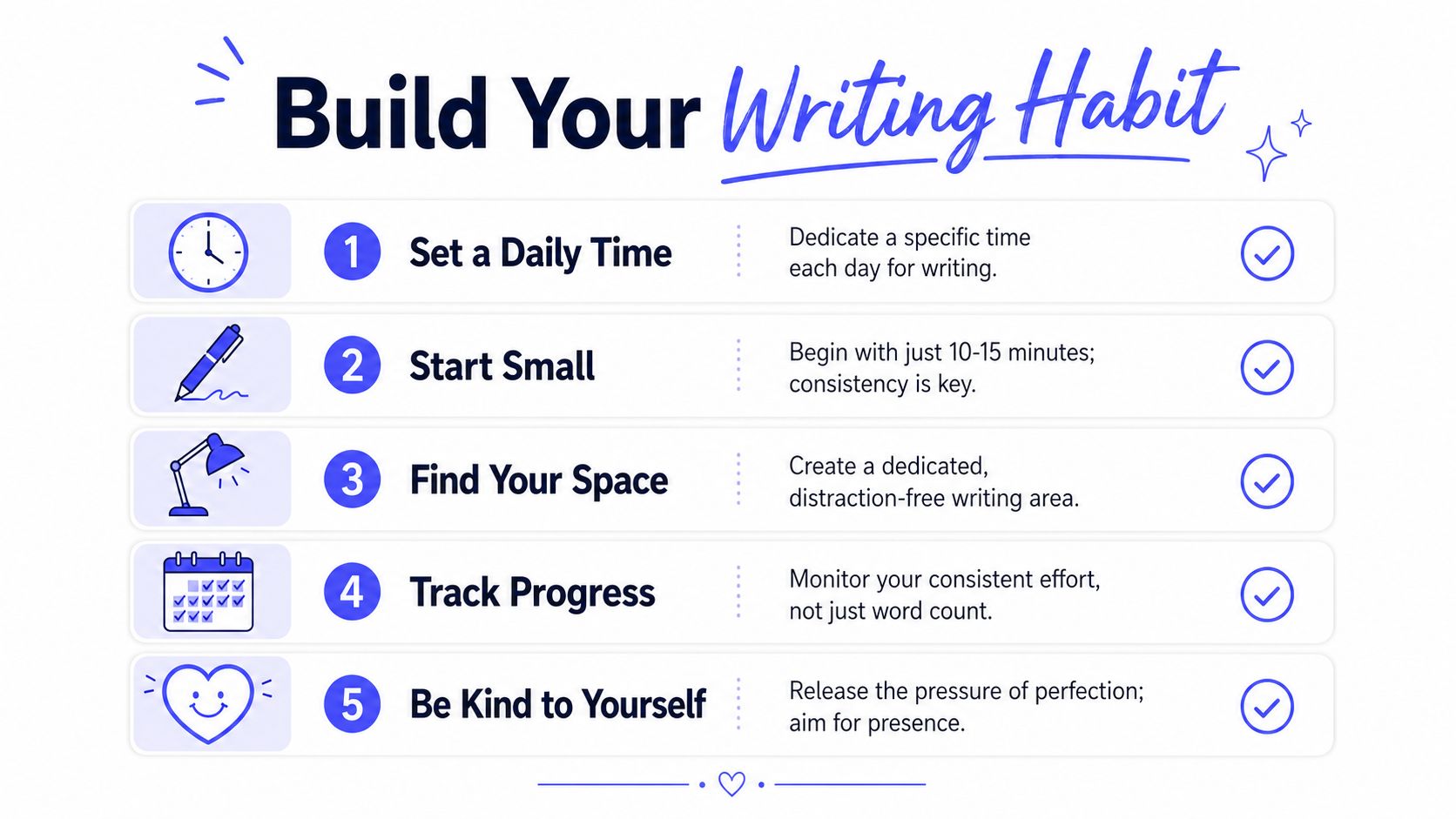
Start with a small daily slot. Protect it. Then track what happens in that slot without judging yourself.
Measure your real writing life
For the next 10 to 14 days, collect your own data. Don't optimize yet. Observe.
Use a simple log:
| What to track | What to note |
|---|---|
| Session length | How many minutes you actually wrote |
| Output | Rough word count or pages moved forward |
| Energy | Alert, tired, distracted, focused |
| Friction | What slowed you down |
| Starting task | Drafting, notes, outlining, revision |
Patterns show up quickly. Some writers do well before work. Others only get traction at night. Some can draft in short bursts but need a longer block for revision. This is how you stop guessing.
If you want a practical framework for habit design outside writing, Habit Huddle has a useful piece on how to build unstoppable momentum. The helpful part isn't hype. It's the emphasis on repeatable behavior over dramatic starts.
Make the habit visible
A habit survives when you can see it. Streaks, calendars, and simple progress markers help because they convert “I should write more” into evidence that you are writing.
That's also where tools can help. A manuscript workspace with daily goals, streak tracking, and progress records makes the habit measurable. Storyloft's guide for daily habits of productive authors is useful here because it focuses on repeatable routines rather than inspiration.
Use three rules:
- Set a floor, not a fantasy goal. Pick a minimum session you can hit on a bad day.
- Count return speed. Missing a day matters less than how fast you come back.
- Track effort separately from quality. Early on, consistency is the win.
When beginners ask how to start writing, this is my first answer. Don't begin with ambition. Begin with a repeatable appointment.
Find and Develop Your Core Idea
A spark isn't enough. Plenty of people have premises. Fewer have ideas that can survive contact with actual pages.
A workable idea has pressure inside it. Someone wants something. Something blocks them. The situation creates choices. If your idea doesn't generate tension, it usually collapses into background notes, world-building files, or opening paragraphs that never become a story.
An idea becomes usable when it creates pressure
Start with a simple situation, not a complete plot.
Instead of asking, “What's my whole story?” ask:
- Who is under strain right now?
- What changed for them today?
- What can't stay the same?
- What decision are they resisting?
That gives you something alive enough to test.
Here's the trade-off beginners often miss. Heavy planning can make you feel productive while keeping you away from the page. Discovery writing can feel messy, but it reveals whether the idea has a voice, a pulse, and a direction.
A practical fiction method is to write the first 50 pages without an outline, starting from a single situation. That approach has been described as a way to avoid premature rigidity, and it's associated with writers such as Stephen King in the source material (long-form fiction method).
Don't test your idea by explaining it. Test it by putting a character in motion.
Draft to discover, then organize what matters
During this early phase, don't try to solve the whole book. Write to uncover what's interesting.
A useful pattern looks like this:
Start with a situation
Not “a saga about power and memory.” Start with something playable. A daughter arrives at a house she swore never to enter again.Follow immediate reactions
What does she notice first? Who is already there? What does she want to avoid?Write fragments that reveal energy
Dialogue. A room description. An argument. A secret half-spoken.Save supporting material without forcing order too early
Research, images, scraps of backstory, and loose notes help if they stay available without taking over.
That last point matters. Beginners often derail themselves by scattering material across notes apps, documents, browser tabs, and notebooks. A central idea workspace helps because it lets you capture fragments without pretending they're finished. For idea generation and collection, Storyloft's page on story ideas for writers fits that stage well.
Use a quick test to judge whether your idea deserves more time:
| If the idea has depth | If the idea is still thin |
|---|---|
| Characters make surprising choices | Characters only deliver exposition |
| Scenes create new questions | Scenes repeat the premise |
| Conflict appears naturally | You have to force events to happen |
| The voice feels distinct | The pages read like setup notes |
You don't need certainty. You need enough energy to keep going. That's a very different standard, and it's a much better one.
Structure Your Story for Success
Once you've found the living part of the story, structure stops being the enemy. It becomes support.
Writers usually resist outlining for one of two reasons. Either they think it will kill spontaneity, or they think an outline has to be a giant formal document. Neither is true. A useful outline is just a chain of meaningful turns.
Build scenes that force movement
One of the clearest ways to create momentum is scene structure built around a goal-conflict-choice-consequence chain. The core idea is simple: a character enters a scene wanting something, conflict blocks that goal, the character makes a choice, and that choice creates consequences that drive the next scene (scene structure framework).

Many drafts flatten out. A scene exists, but nothing changes. Characters talk. Backstory appears. The chapter ends where it began. That's stagnation.
Use this chain instead:
- Goal
The character tries to get something specific. - Conflict
Someone or something blocks the attempt. - Choice
The character responds, ideally under pressure. - Consequence
The response creates a new problem, cost, or direction.
Use a scene audit before you draft chapters
Before writing a chapter, ask four questions:
| Scene check | What you need to answer |
|---|---|
| Goal | What does the character want right now? |
| Conflict | What prevents that from happening? |
| Choice | What does the character decide or do? |
| Consequence | What changes because of that decision? |
If you can't answer those questions, the scene may not be ready. Or it may not belong in the draft at all.
A lot of beginners think structure means locking every moment in advance. In practice, structure gives you a clean test for whether a scene earns its place. It doesn't remove freedom. It removes drift.
This becomes easier when you can view scene notes, research, and character material side by side instead of bouncing between files. A planning workspace built for long projects helps turn a vague outline into a usable list of scenes. Storyloft's guide to three-act structure is one example of how to translate broad story architecture into practical planning.
A good outline doesn't tell you every sentence. It tells you what must change.
That's enough. Often it's better than enough.
Write Your First Draft Without Fear
The first draft isn't where you prove skill. It's where you generate material.
Most beginners try to draft and judge at the same time. That's why they stop. They write a paragraph, evaluate it like an editor, panic, and rewrite the opening instead of continuing. The cure isn't confidence. The cure is giving the draft a smaller job.
Its job is to exist.
Curiosity beats perfection
One of the easiest ways to keep a rough draft alive is to make readers, and yourself, curious about what happens next. The information gap technique does exactly that. Analysis in the source material says 65% of debut novels lose engagement because writers fail to establish gaps between what readers know and what they want to know, and the recommended approach is to plant unanswered questions and break patterns deliberately (information gap technique).

That doesn't mean manufacturing fake mystery. It means controlling what the reader receives, and when.
Try this in a draft:
- Open with a change. Someone arrives late. A letter is missing. A rule is broken.
- Withhold the full explanation. Let the character react before they explain.
- Break a pattern. A calm conversation turns evasive. A routine errand becomes charged.
- End scenes on altered understanding. The reader should know something new, or want to know something urgently.
This approach helps the writer too. If you're curious about your own scene, you're less likely to stall out polishing sentences that don't matter yet.
Use support when you're stuck, not as a substitute
Writers freeze for ordinary reasons. You don't know how to phrase a transition. A conversation sounds flat. You can see the room in your head but can't render it cleanly on the page.
That's where support tools can help, if you use them with restraint. An assistant can generate alternatives, help brainstorm dialogue options, or surface a sharper description when momentum drops. The key is to stay in charge of the draft's intent and voice.
For some writers, speed also improves when they speak rather than type. If dictation helps you keep moving, AIDictation has a useful article on how to improve digital writing with AI dictation. It's relevant when the bottleneck is physical output rather than story logic.
This short walkthrough is worth watching if you want to see drafting support inside a modern writing workflow.
Here's the line I give new writers: use tools to remove friction, not to avoid decision-making. The scene still needs your judgment. The character still needs your instincts. The draft still needs your willingness to write something clumsy and move on.
The Art of Revision and Your Next Steps
Revision is not drafting with better manners. It's a separate skill.
Drafting asks, “What happens?” Revision asks better questions. What's unclear? What drags? What did the story promise and fail to deliver? Where did the emotional logic weaken? If you try to answer all of that while still creating new material, you'll exhaust yourself.
Revise in layers, not all at once
A clean revision process usually moves from large to small.
Start with the structural pass. Look at scenes, pacing, character decisions, and missing transitions. After that, move to paragraph and sentence work. Save polish for late.
A practical order looks like this:
Story pass
Check whether the central conflict holds, scenes connect, and the ending pays off what the draft set up.Character pass
Look for inconsistent motives, emotional jumps, and dialogue that sounds interchangeable.Language pass
Cut repetition. Sharpen vague wording. Remove filler.Proof pass
Fix grammar, typos, formatting, and continuity details.
Read your work aloud. Your ear catches stiffness faster than your eyes do.
That single move exposes a surprising amount: rushed phrasing, repeated words, accidental rhythm, and dialogue that no one would say.
Bring in other eyes at the right time
Outside feedback helps most when the draft is coherent enough for someone else to read without constant explanation. Too early, and readers comment on noise. Too late, and you're too attached to weak choices.
Ask beta readers or editors focused questions:
- Where did your attention drop?
- What confused you?
- Which character felt most alive?
- What did you expect that never arrived?
This is also where an integrated writing environment earns its keep. Storyloft is useful at this stage because it combines long-form drafting, manuscript-aware AI assistance, role-based collaboration, notes, and export tools in one workspace. That matters when you're revising across structure, prose, feedback, and final formatting instead of jumping between disconnected apps.
Finishing a draft is a milestone. Treating revision as its own craft is what turns that milestone into a book.
From Blank Page to First Draft Your Roadmap
Starting gets easier when the path is short enough to follow.
Writers often don't need more inspiration. They need a sequence they can trust on an average Tuesday. If you remember nothing else, remember this: writing becomes manageable when each stage has one clear job.
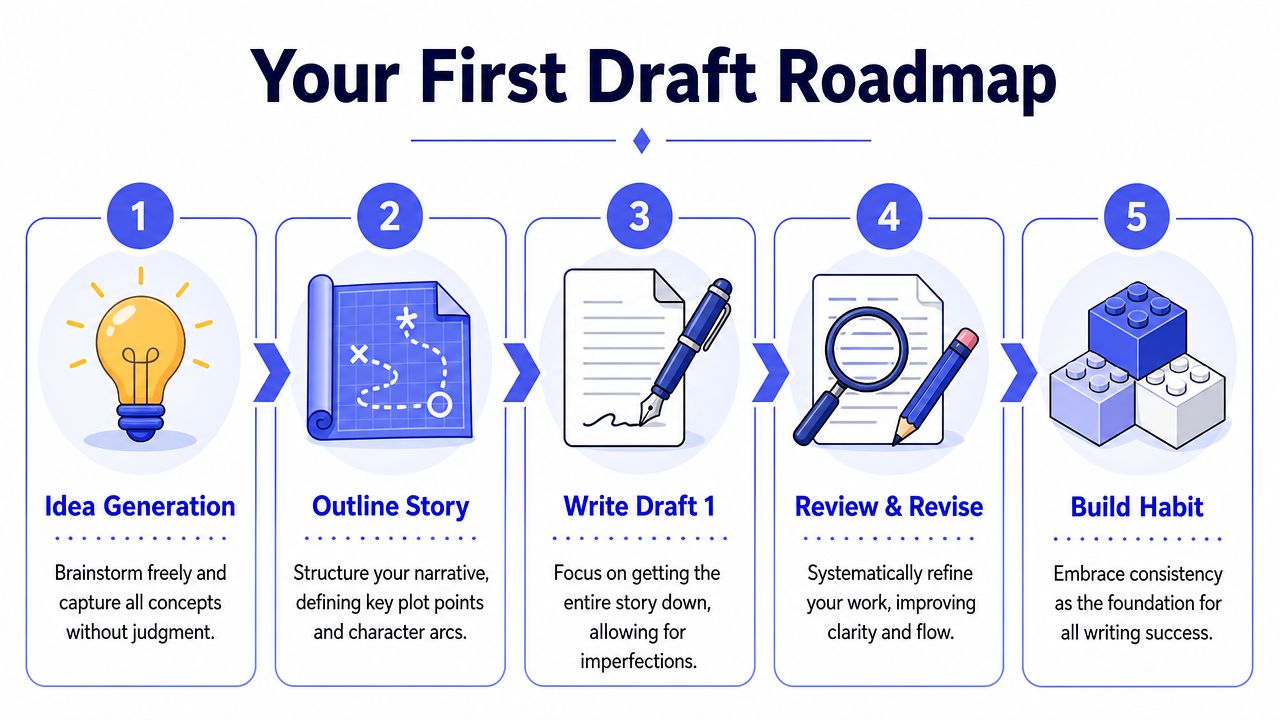
What to do this week
Use this as your practical starting plan:
| Stage | What to do now |
|---|---|
| Habit | Pick a daily writing slot and track it for the next several days |
| Idea | Start from one situation with pressure, not a full plot |
| Discovery | Write forward without overexplaining the story to yourself |
| Structure | Build scenes around goal, conflict, choice, and consequence |
| Drafting | Keep moving. Leave awkward lines in place and continue |
| Revision | Return later with a separate editing mindset |
A few final rules help more than most craft books do:
- Protect continuity over intensity. Small sessions beat dramatic bursts followed by silence.
- Trust scenes over summaries. Story lives in action and reaction.
- Let the first draft be uneven. You can revise pages that exist.
- Keep your materials together. Notes, scenes, and manuscript fragments are easier to use when they aren't scattered.
If you want a practical companion for taking the first step, Storyloft's guide on how to begin writing a book is a useful next read.
How to start writing is not a mystery. It's a workflow. Build the habit. Pressure-test the idea. Structure the scenes. Draft without fear. Revise with intent. Then do it again with a little more skill than before.
If you want one place to draft, organize notes, revise, collaborate, and prepare a manuscript for publication, Storyloft is a practical option to explore. It's built for long-form writing and gives beginners a clearer path from blank page to finished book without stitching together a pile of separate tools.