What Is the Three Act Structure in Books?

Have you ever stared at a blank page, wondering how to turn your story idea into something real? The three act structure offers a solution. This narrative model divides stories into a beginning, middle, and end, making it easier for writers to craft compelling tales.
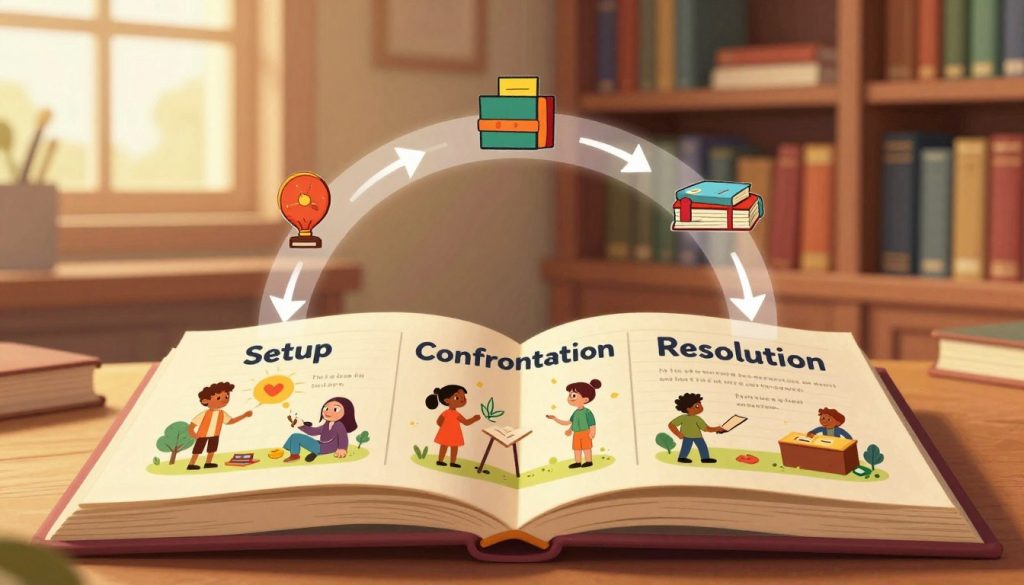
Screenwriter Syd Field popularized this framework in 1978 with his book, Screenplay. He defined the acts as Setup, Confrontation, and Resolution. This gives writers a common language to discuss storytelling. At its core, this structure is straightforward: the first act introduces the world and characters, the second escalates conflict, and the third resolves the story.
Understanding this model transforms chaotic ideas into a coherent journey. It allows every scene to earn its place, driving the protagonist toward their goal. Whether you’re writing a fantasy epic or a literary novel, this structure supports your creative vision. It’s not just a formula; it’s a guiding principle that brings cohesion to your narrative.
Key Takeaways
- The three act structure divides stories into a beginning, middle, and end.
- Syd Field popularized this framework for modern writers.
- Act One sets up the world and characters, while Act Two raises the stakes.
- Act Three delivers a satisfying resolution to the story.
- This structure helps writers create coherent narratives that engage readers.
Understanding the User Intent Behind the Three Act Structure
Every writer knows the struggle of transforming a flicker of inspiration into a full-fledged narrative. It’s a challenge that often feels like navigating a vast sea of possibilities. This is where the three act structure comes into play, offering a reliable compass for those who find themselves adrift.
Writers often seek structure for their stories because, like sailors relying on constellations, it provides guidance through the chaos of creativity. Many authors admit their narratives can resemble a jumbled drawer filled with brilliant scenes that lack connection. The three act structure serves as the organizing principle that brings clarity to this chaos.
The user intent behind searching for the three act structure is practical. Writers want a proven framework to help them plan, troubleshoot, and execute their narratives. This framework does not stifle creativity; instead, it enhances it, allowing the spark of inspiration to shine through.
I believe that a storytelling framework goes beyond mere organization. It taps into the psychological rhythm that readers expect, creating a sense of satisfaction that keeps them turning pages long past their bedtime. This is where Storyloft’s guided experience shines. Rather than providing a generic template, Eddy, the AI writing companion, asks simple questions to build a complete outline tailored to your unique story.
The three act structure also acts as a diagnostic tool. When I find myself stuck on a scene, I can ask which act I’m in and what that act demands. This simple reflection often dissolves the blockage, allowing the narrative to flow once more.
Writers seek structure not due to a lack of creativity, but rather because they possess an abundance of it. The framework acts as a container, shaping the raw energy of imagination into a form that readers can hold and cherish. A well-defined structure ensures that the protagonist’s journey includes the emotional peaks and valleys that make a narrative feel true to life, even in the realm of fiction.
I’ve witnessed countless writers transform from anxious messes into confident creators. They realize that structure isn’t the enemy of creativity; it’s the dance floor where creativity can showcase its best moves. Understanding user intent reveals that every search for the three act structure represents a writer serious about their craft, eager to elevate their story from good to unforgettable.
Tracing the Origins: Aristotle and the Birth of the Three Act Structure
What if I told you that the roots of modern storytelling trace back to ancient Greece? Aristotle’s Poetics is the first playwriting manual on record. This theoretical text lays out critical insights into the foundations of all storytelling. Aristotle argued that every story must have a beginning, middle, and end, representing the three acts in the three-act structure.
Writing in the 4th Century B.C., Aristotle’s observations came at a time when the Greek alphabet was still relatively new. His work emerged from a tradition where storytelling was primarily oral. This means his insights are among humanity’s first attempts to understand why certain narratives resonate.
In Poetics, Aristotle describes a narrative triangle: a story’s beginning sets off a rising action, leading to a climactic moment, followed by a falling action that moves toward resolution. This framework maps beautifully onto the three-act structure.
What strikes me most about Aristotle’s framework is his insistence that each scene must lead causally into the next. This creates a chain of cause-and-effect beats rather than standalone episodes featuring the same characters. It’s a vital lesson for writers today.
When I first read Aristotle’s argument about the necessity of a beginning, middle, and end, I thought it was obvious. Yet, many manuscripts fail because they neglect this deceptively simple wisdom. I often tell skeptical writers that when they feel a story beat should happen at a certain point, they are channeling Aristotelian principles.
Even Storyloft’s AI writing companion, Eddy, uses similar principles when generating intelligent planning notes. This ensures your project feels real from the start, complete with a concept book cover inspired by your idea.
Aristotle’s ideas shape modern storytelling not as rigid rules but as deep structural wisdom. Understanding that a protagonist’s journey must have escalating stakes, a midpoint that changes everything, and a climax that delivers on promises made in the beginning is essential.
Every time I outline a new book, I feel like I’m having a conversation with Aristotle across the centuries. I adapt his foundational insights to the specific demands of contemporary fiction, whether I’m writing a thriller, a romance, or a literary novel.
The Three Acts Defined: Setup, Confrontation, and Resolution
Every story has its own rhythm, and understanding that beat can elevate your writing. The three act structure provides a clear framework to help you navigate your narrative. Each act serves a distinct purpose, guiding your protagonist through their journey.
Act One: Setting the Stage and Inciting Incident
Act One, which I affectionately call the “promise phase,” is where you set the stage. Here, you introduce your protagonist in their ordinary world. Establish what they want, what they need, and what’s standing in their way before the inciting incident kicks the whole story into motion.
The inciting incident is your story’s catalyst—the moment that makes everything else inevitable. Think of it as the moment when John Hammond convinces Grant and Sattler to visit Jurassic Park. Without a strong inciting incident, your story is just a character sitting around waiting for something to happen.
This act typically occupies the first quarter of your narrative. By the time it ends with the first plot point—the point of no return—your protagonist has made a decision that launches them irrevocably into Act Two’s confrontation.
Act Two: Rising Action, Midpoint, and Escalating Conflict
Act Two is the glorious, messy middle where the rising action escalates. Stakes climb higher than a cat in a tree, and your protagonist faces obstacles that test their resolve. This act builds toward the midpoint that changes everything they thought they knew about their journey.
The midpoint isn’t just the halfway mark—it’s the moment that redirects the entire plot. Like the T. Rex reveal in Jurassic Park, it shifts the story from wonder to survival. This is where your protagonist stops reacting and starts getting proactive.
Act Two also features pinch points that remind readers of the antagonist’s power and the stakes of failure. Tension remains taut until the second plot point propels us into the final act.
Act Three: Climax, Resolution, and Denouement
Act Three is where all your careful setup pays off. The climax delivers the emotional and narrative catharsis readers have been craving. Whether it’s a bittersweet farewell on a sinking ship or a velociraptor getting its comeuppance from a T. Rex, this is the moment where everything comes together.
The denouement, that gentle exhale after the climax, gives readers a moment to see how the journey has permanently changed your characters. Like Alan Grant finally liking kids after surviving Jurassic Park, it’s where you tie up loose ends without overstaying your welcome.
Syd Field’s labels—Setup, Confrontation, and Resolution—are wonderfully straightforward. However, I also love the alternative “setup, build, and payoff.” This reminds me that every scene in Act Three is earning the trust I built with readers in Act One.
With Storyloft’s guided experience, you can map out all three acts without the blank page blues. Eddy helps you define your inciting incident, midpoint, and climax before you’ve written a single word of prose. This gives you a working book foundation that makes the actual writing feel like flying.
Unpacking the Three Act Structure: Key Story Beats Explained
Crafting a compelling narrative involves understanding the key moments that drive your story forward. These moments, or beats, serve as the backbone of your tale, guiding your characters through their journey. Let’s dive into the essential elements that make up this structure.
Exposition and Establishing the Protagonist’s World
The exposition is more than just information; it’s about immersing readers in your protagonist’s world. You want to paint a vivid picture of their ordinary life, showing what’s at stake when the inciting incident disrupts everything. Think of it as setting the stage for a grand performance.
The Inciting Incident: Your Story’s Catalyst
This moment is crucial. The inciting incident serves as the catalyst that propels your protagonist into action. It’s that defining moment when everything changes. Ask yourself: what would force your character to confront their deepest fears? This is where the journey truly begins.
Plot Points, Pinch Points, and Midpoint Turning Moments
Plot points are pivotal moments that shift the direction of your story. The first plot point is the springboard into Act Two, marking a clear choice for your protagonist. Pinch points, often involving the antagonist, remind readers of the stakes at play. The midpoint is where the story takes a turn, challenging everything your characters believed.
Climaxes and Satisfying Resolutions
The climax is the grand finale, the moment your story has been building toward. It’s where the stakes reach their peak, and the resolution allows readers to catch their breath. Here, they see how the journey has changed your characters and their world, offering a satisfying conclusion to their adventures.
When I outline using Storyloft, I ensure each of these beats has a dedicated space in my chapter descriptions. This way, when I sit down to write, I know exactly which emotional note I need to hit in every scene.
Spotlight on the Three Act Structure: Examples from Popular Culture
Exploring how popular stories utilize a classic framework can illuminate your own writing. By examining iconic films and books, we can see how the structure enhances their narratives. Let’s dive into some familiar tales and uncover the magic behind their storytelling.
Jurassic Park: A Beat-by-Beat Breakdown
Jurassic Park remains my favorite example of this structure in action. Steven Spielberg hits every story beat with the precision of a Swiss watchmaker. The journey begins with a mysterious opening hook that sets the tone.
- The Hook: The opening scene introduces suspense and mystery.
- The Inciting Event: John Hammond convinces Grant and Sattler to visit the park.
- First Plot Point: Alan and Ellie see the dinosaurs, marking the point of no return.
- First Pinch Point: The storm worsens, and the Jeeps are recalled.
- The Midpoint: The T. Rex reveal shifts the story from wonder to horror.
- Second Pinch Point: Nedry dies, and the park is broken.
- Third Plot Point: Ellie turns on the power, and raptors become the primary antagonists.
- Climax: Alan and Ellie are reunited, chased by raptors, and saved by the T. Rex.
- Resolution: Alan doesn’t hate kids anymore, and the protagonists leave the island.
Titanic: Love and Tragedy Within Three Acts
Titanic uses this framework to frame a love story within a disaster narrative. Act One establishes Rose’s suffocating engagement, setting the stage for her character development.
- Act One: Jack and Rose meet, and Rose falls in love.
- Act Two: The Titanic hits the iceberg, and Cal frames Jack.
- Act Three: Jack dies, and Rose lives fully, finding her strength.
What I love about Titanic’s denouement is how it returns to the present-day framing device. An aged Rose drops the necklace into the ocean, giving the entire story a bittersweet sense of closure.
The Wizard of Oz: Classic Storytelling for All Ages
The Wizard of Oz exemplifies the three act structure in its purest form. Dorothy’s Kansas life establishes her longing for something more, leading to her journey in Oz.
- Exposition: Dorothy’s ordinary life in Kansas.
- Inciting Incident: A tornado takes her to Oz.
- Plot Point One: Dorothy decides to follow the Yellow Brick Road.
- Rising Action: She meets the Scarecrow, Tin Man, and Lion, encountering obstacles.
- Midpoint: The Wicked Witch confronts Dorothy with “I’ll get you, my pretty!”
- Climax: Dorothy defeats the Witch.
- Resolution: “There’s no place like home.”
These three examples—Jurassic Park, Titanic, and The Wizard of Oz—demonstrate that this narrative framework works across genres. It taps into something fundamentally human about how we process stories. When I use Storyloft to outline my own novels, I often reference these classic examples as touchstones. They remind me of the importance of structure in crafting a compelling narrative.
How the Three Act Structure Works Across Different Mediums
The beauty of storytelling lies in its ability to adapt across different mediums. Each format brings its own unique flavor to the narrative, showcasing the versatility of the three-act framework.
Film and Screenwriting: Visual Storytelling Techniques
In film and screenwriting, the three act structure manifests with almost mathematical precision. Act One typically occupies the first 20 to 30 minutes. This is essential because visual storytelling relies on clear structural signposts to keep audiences oriented.
I’ve noticed that screenwriters often have a love-hate relationship with this framework. Some swear by it, while others reject it entirely. Yet, even the most experimental films usually have a beginning, middle, and end buried somewhere in their DNA.
Theater and Stage Plays: Acts and Scenes in Live Performance
Theater and stage plays make the three act structure wonderfully explicit. Actual act breaks send the audience to the lobby for a moment of reflection. Tennessee Williams’ Orpheus Descending demonstrates how each act can function as its own dramatic unit while contributing to the whole.
Interestingly, Shakespeare’s plays often use five acts rather than three. This suggests that the three act framework isn’t the only way to organize a narrative. It’s simply the one that has become dominant in Western storytelling traditions.
Literature: Adapting the Structure to Novels and Narratives
When adapting this structure to literature, I’ve learned that novels have more room to breathe than screenplays. This allows for richer exposition, more nuanced character development, and subplots that weave through the main narrative like tributaries feeding a river.
A prime example is To Kill a Mockingbird. Scout’s narration provides extensive exposition, while the inciting incident is Atticus agreeing to defend Tom Robinson. The climax involves Bob Ewell’s attack on Jem, all filtered through a child’s perspective.
The key difference across mediums is pacing. Films compress the structure into roughly two hours, while plays thrive on the energy of live performance. Novels can stretch the structure across hundreds of pages without losing tension if the beats are properly placed.
Storyloft’s AI writing companion, Eddy, understands these medium-specific demands. It helps you build an outline that respects the conventions of your chosen format, whether you’re writing a screenplay, a stage play, or a novel.
Remember, the three act structure is a tool, not a tyrant. It should adapt to your medium and your story, not the other way around. The best practitioners know when to follow the beats faithfully and when to let the story breathe.
The universality of this framework across film, theater, and literature proves it taps into something fundamental about human cognition. We understand the world through narratives, and narratives make the most sense when they have a clear setup, confrontation, and resolution.
Why the Three Act Structure Is a Writer’s Best Friend
Navigating the labyrinth of storytelling can be daunting, but having a solid framework can light the way. The three act structure serves as a reliable companion, offering clarity and direction to your story planning.
Bringing Clarity and Direction to Your Story Planning
I consider this structure my most dependable writing ally. It provides a roadmap that keeps me focused on my protagonist’s journey without stifling my creative impulses. Think of it as a GPS for your narrative; it won’t dictate the scenic routes, but it ensures you won’t drive in circles while your readers grow confused.
Balancing Creativity with Structure: A Witty Writer’s Dance
Finding the balance between creativity and structure is what I call the witty writer’s dance. You learn the steps so well that you can improvise, adding your own flourishes while still moving toward a satisfying conclusion. The essence of this structure lies in understanding that one event must lead to another, creating a chain of meaning that transforms random incidents into a cohesive story.
How Storyloft’s Free Book Outline Generator Can Turbocharge Your Process
Storyloft’s Free Book Outline Generator has become my secret weapon for streamlining the outlining process. Instead of staring at a blank page, I collaborate with Eddy, the AI writing companion. This guided experience helps me build a complete, usable outline in minutes.
What sets Storyloft apart is that it doesn’t just generate chapter titles. It creates a full workspace with detailed subpoints, chapter descriptions, creative notes, reader direction, and supporting context. This seamless transition from planning to writing is invaluable.
I’m particularly fond of how Storyloft generates creative assets early in the process, like intelligent planning notes and a concept book cover inspired by my idea. Seeing my book take shape before I write a single word is psychologically powerful.
The three act structure and Storyloft work together beautifully. The framework provides a timeless narrative foundation, while Storyloft’s AI populates it with my unique characters, conflicts, and creative vision. By the end of a session, I have a solid book foundation that eliminates the blank page blues entirely.
I’ve witnessed writers transform from feeling overwhelmed to energized and productive once they realize that structure isn’t the enemy of creativity. Instead, it’s the scaffolding that allows creativity to reach heights it could never achieve on its own.
| Feature | Benefit |
|---|---|
| Clarity | Helps in planning your story effectively. |
| Guidance | Acts as a GPS for your narrative journey. |
| Flexibility | Allows for creative improvisation within a structured framework. |
| Efficiency | Storyloft speeds up the outlining process. |
| Visual Assets | Generates concept covers and planning notes early on. |
When to Break the Rules: Flexibility Within the Three Act Structure
Every writer reaches a point where they wonder if they can bend the rules of storytelling. The three act framework provides a solid foundation, but knowing when to stray from it can elevate your narrative. Master the rules first, then break them with confidence.
Understanding the fundamentals of this structure is crucial. It serves as a roadmap for your story, guiding your protagonist through their journey. However, creativity thrives when you allow for flexibility. As I often say, “Creative freedom and storytelling foundations aren’t enemies locked in eternal combat—they’re dance partners.” You need to learn their rhythms before crafting something breathtaking.
Knowing the Rules Before You Break Them
It’s vital to recognize that the specifics of where your inciting incident or midpoint should occur must come from the organic nature of your story. Rigid adherence to a formulaic page count can lead to contrived plot points. Readers can smell inauthenticity from a mile away. Let your narrative’s needs dictate the structure.
Creative Freedom vs. Storytelling Foundations
Some of the most successful stories deliberately subvert the traditional framework. These creators understand the rules they are breaking and why those rules exist. For instance, the Japanese four-act structure, known as Kishōtenketsu, emphasizes the unfolding of human events rather than conflict. This illustrates that the three act model isn’t the only valid way to tell a story.
Moreover, short stories and flash fiction often don’t require this framework at all. They capture moments and emotions, driven by conflict, but without the bells and whistles of long-form plot devices. Remembering this can be liberating when you feel constrained by traditional frameworks.
Examples of Successful Storytelling Beyond Traditional Acts
I’ve found that the three act structure is particularly effective in genre fiction, where readers have certain expectations about pacing and payoff. However, literary fiction often plays more freely with structure to explore character and theme in unconventional ways. The key to flexibility is recognizing that this framework is a guideline, not a straitjacket.
Your story might need two midpoints or a climax that happens earlier than expected. That’s perfectly fine, as long as the causal chain of events remains intact. When I work with Storyloft to outline a book, I appreciate that the AI doesn’t force my story into a rigid template. Instead, it helps me identify where my natural story beats want to fall, even if they don’t align perfectly with traditional act breaks.
Breaking the rules successfully requires confidence, which comes from practice. Write a few novels that follow the three act structure faithfully before you decide to take the plunge into uncharted waters. As I like to say, “The best way to learn is by doing.” So embrace the rules, master them, and then feel free to explore the creative possibilities beyond.
Mastering the Three Act Structure as a Writer
Transforming a mere idea into a captivating narrative can feel like climbing a mountain for many writers. Yet, mastering this structure can simplify the process. With a clear roadmap, you can navigate the twists and turns of storytelling with confidence.
Before diving into your story, ask yourself, “Whose book is this?” Identifying your protagonist is crucial. Think of it as casting for an Academy Award for Best Leading Actor. If you don’t know whose story you’re telling, the framework won’t save you.
Practical Tips for Outlining Your Novel or Screenplay
Understanding your character’s goal is the engine driving the entire narrative. What do they want? What keeps them from achieving it? How will this journey change them? These questions form the backbone of every scene you’ll write.
I always determine my ending before outlining. Knowing the destination makes plotting the route easier. The framework becomes a map rather than a mystery when you know where you’re headed.
Before writing any scene, I interrogate it ruthlessly. Who is in it? Where does it take place? What happens? Most importantly, why is it in this book? Every scene must either move the story forward or deepen our understanding of the characters.
Understanding Your Characters’ Goals and Obstacles
Using story beats to maintain momentum means treating each beat like a link in a chain. The hook grabs attention, the inciting incident creates forward motion, the midpoint redirects, and the climax delivers on every promise made.
Reader engagement can flag when beats are missing or misplaced. That’s why I use Storyloft’s detailed subpoints and chapter descriptions. They ensure every section of my outline serves a clear narrative purpose.
Character goals and obstacles should escalate throughout the acts. Act One establishes what the protagonist wants. Act Two introduces increasingly difficult obstacles, while Act Three forces them to prove they’ve earned their resolution.
Using Story Beats to Maintain Momentum and Reader Engagement
One of my favorite outlining tricks is to write a single sentence describing each story beat before fleshing anything out. This creates a skeleton that I can then dress with detailed scenes and subplots.
Storyloft’s guided experience makes this process almost embarrassingly easy. By answering a few simple questions about your protagonist and their journey, you get a complete outline. It includes creative notes and reader direction that would have taken me weeks to develop on my own.
The difference between a writer who finishes manuscripts and one who doesn’t often comes down to outlining. The framework provides the foundation, but tools like Storyloft provide the momentum that carries you from “once upon a time” to “the end.”

Three Act Structure: Your Shortcut From Idea to Manuscript
Transforming an idea into a manuscript can feel like a daunting task for many writers. But fear not! The three act structure offers a clear path to follow, guiding you from concept to completion without the dreaded blank page blues.
Building a solid story foundation doesn’t require a degree in narrative theory. Instead, it demands a framework like the three act structure, combined with a guided experience that asks the right questions. This is where Storyloft’s Free Book Outline Generator comes into play. It helps authors turn vague ideas into a complete, usable book plan in just minutes.
Building a Solid Story Foundation Without the Blank Page Blues
When I first started writing, I often found myself paralyzed by the blank page. I’ve watched talented writers experience the same struggle for months. That’s why I’m evangelical about tools like Storyloft. It transforms your ideas into structured outlines, allowing you to focus on writing instead of formatting.
Creative Notes, Chapter Descriptions, and Reader Directions Made Easy
One of the standout features of Storyloft is its ability to generate a workspace that includes structured outlines, detailed subpoints, chapter descriptions, and creative notes. These elements appear as if by magic, capturing those fleeting flashes of inspiration that might otherwise be lost.
I’m particularly obsessed with how Storyloft creates a concept book cover inspired by your idea early in the process. There’s something incredibly motivating about seeing your book look like a real book before you’ve even written a single chapter!
From Outline to Manuscript: Keeping Your Story Alive
Moving from outline to manuscript is where many writers stumble. However, when your outline includes supporting context and intelligent planning notes, the transition feels less like a leap of faith and more like stepping onto a well-marked trail. The three act structure keeps your story alive during the long middle of drafting, ensuring you always know what story beat comes next.
With Storyloft, there’s genuinely no blank page, no complicated setup, and no excuse for letting your brilliant idea languish in the purgatory of “someday.” It’s just a faster, smarter way to go from idea to outline to manuscript.
| Feature | Benefit |
|---|---|
| Structured Outlines | Provides clarity and direction for your writing journey. |
| Creative Notes | Captures inspiration and ideas seamlessly. |
| Chapter Descriptions | Helps you stay focused on your narrative’s goals. |
| Reader Directions | Ensures your writing engages your audience effectively. |
| Concept Book Cover | Motivates you by visualizing your project early on. |
Conclusion
Every great story begins with a spark of imagination, but how do you turn that spark into a blazing narrative? The three act structure is a trusted companion for writers, guiding them through the intricacies of storytelling.
This framework isn’t a rigid formula; it reflects how we naturally process narratives. We crave setup, confrontation, and resolution in the stories we consume and in our own lives. Iconic tales like Jurassic Park and Titanic demonstrate that while the beats may be similar, the emotional impact remains unique.
With tools like Storyloft’s Free Book Outline Generator, you can easily harness this structure to create a solid foundation for your book. By answering a few simple questions, your ideas can transform into a structured outline, eliminating the dreaded blank page.
So, whether you’re crafting a screenplay or a novel, embrace this framework. Remember, the world needs your story, and now you have everything you need to tell it!
FAQ
What is the three act structure?
It’s a storytelling framework that divides a narrative into three parts: setup, confrontation, and resolution. Think of it as a recipe for a delicious plot!
Why do writers use this structure?
Writers crave structure like I crave coffee on a Monday morning. It helps them organize their thoughts and craft engaging stories that keep readers hooked.
How did Aristotle influence storytelling?
Aristotle’s *Poetics* laid the groundwork for narrative structure. His ideas about beginnings, middles, and ends still resonate in modern storytelling.
What happens in the first act?
The first act sets the stage and introduces the characters. It’s like the opening scene of a movie where you get to know the players before the drama unfolds.
What can I expect in the second act?
This act is all about rising action and conflict. Think of it as the rollercoaster ride where things get thrilling and intense!
What’s the climax in the third act?
The climax is the story’s peak moment of tension, followed by the resolution where all the loose ends are tied up. It’s like the grand finale of a fireworks show!
Can you give examples of stories that use this structure?
Absolutely! Movies like *Jurassic Park*, *Titanic*, and *The Wizard of Oz* are classic examples that follow this structure, each with its unique twist.
How does this structure apply to films?
In film, this framework helps directors and screenwriters create visual storytelling that captivates audiences, ensuring a satisfying experience from start to finish.
Is it okay to break the rules?
Sure! Knowing the rules allows you to bend or break them creatively. Some of the best stories have emerged from daring to be different.
What tips do you have for mastering this structure?
Start with a solid outline, understand your characters’ goals, and use story beats to keep the momentum going. It’s like a dance—find your rhythm!
How can I turn my idea into a manuscript?
Use this structure as a guide to build your story foundation. With clear notes and chapter descriptions, you’ll be well on your way to a finished manuscript!