10 Chekhov’s Gun Examples for Writers
A small detail can carry an entire story, but it doesn't have to be a weapon. Chekhov's gun is a planted narrative element whose later significance feels prepared rather than arbitrary. Anton Chekhov's 1889 advice became associated with this principle, and the idea remains foundational for drama, fiction, and screenwriting after well over 125 years of use (Encyclopaedia Britannica explains the principle and its history).
The “gun” might be a ring, a contradiction, a sensory detail, a character trait, a location, or a recurring image. Its payoff can work through plot mechanics, character psychology, visual revelation, sensory memory, environmental consequence, or ambiguity. The important question isn't whether every detail returns. It's whether the story has made a promise by drawing attention to it, and whether the eventual function earns that attention.
The examples below use a practical sequence: identify what is planted, observe how the story reinforces it, locate the moment when it fires, and then test why the payoff works or risks failing. For long-form writers, the same process can live in a planning workspace such as Storyloft, where binders, notes, tags, character profiles, and revision tools help track an element across chapters instead of relying on memory.
Table of Contents
- 1. The Great Gatsby 1925 and the green light as a foreshadowing device
- 2. Jaws 1975 and the mechanical shark as a hidden threat
- 3. The Lord of the Rings 1954 to 1955 and the Ring as a narrative anchor
- 4. Gone Girl and planted contradictions in an unreliable narrator
- 5. The Sixth Sense and the wedding ring as a hidden truth indicator
- 6. Breaking Bad and the ricin cigarette as a structural anchor
- 7. Beloved and the tin tobacco box as a sensory trigger
- 8. Inception and the spinning top as an ambiguity tool
- 9. Harry Potter and the Philosopher's Stone and the Mirror of Erised as thematic setup
- 10. Parasite and the basement flood as a planted consequence
- Chekhovs Gun, Comparison of 10 Examples
- Turn Every Planted Detail Into a Promise
1. The Great Gatsby 1925 and the green light as a foreshadowing device
F. Scott Fitzgerald's green light is introduced as a distant visual detail across the water. At first, it seems to be part of Gatsby's private world, something Nick observes without fully understanding. As the novel develops, the light becomes inseparable from Gatsby's longing for Daisy and from his larger belief that the future can restore an idealized past.
This is a symbolic and emotional payoff, not a mechanical one. The green light doesn't open a room, reveal evidence, or cause a physical reversal. Instead, its meaning expands as Gatsby's hope becomes clearer and his dream moves further beyond his reach. The detail fires when readers understand that the object has represented an imagined future all along.
Practical rule: A symbol earns its place when its meaning changes as the character changes.
The risk is overuse without development. Repeating a color or object won't create significance by itself. Each appearance needs a slightly different context, emotional pressure, or relationship to the character's desire.
What writers can replicate
Use a planning binder to record the symbol's first meaning, later variations, and final emotional charge. A character profile can hold the associations that the protagonist attaches to it, while notes can record every appearance and the immediate scene purpose. The plot development guide offers a useful framework for checking whether a recurring image remains connected to the story's changing action.
Storyloft users can also review tone around each appearance with Eddy's tone analysis. If the symbol feels announced rather than experienced, revise the surrounding prose so the object belongs naturally to the character's attention.

2. Jaws 1975 and the mechanical shark as a hidden threat
In Jaws, the shark is a literal threat, but the film's early production problems with the mechanical shark helped create a distinctive suspense pattern. The danger is often established through absence, reaction, movement in the water, and the characters' growing awareness rather than through constant visibility.
That makes this example a visual and suspense-based payoff. The planted element isn't only the shark itself. It's also the expectation that something may be beneath the surface, close enough to affect the people on shore. When the threat finally becomes visible or attacks directly, the audience has already supplied much of the terror.
The technique works because the story gives viewers evidence without giving them complete access. A fin, a scream, a sudden movement, or a character's changed behavior can reinforce the threat while preserving uncertainty.
Build danger through knowledge states
Track three things for every suspense setup:
- Threat presence: Is the danger nearby, approaching, hidden, or temporarily absent?
- Character knowledge: Who knows the danger exists, and who still treats the scene as safe?
- Audience knowledge: What does the reader understand that the characters don't?
The rising action guide can help writers position these increments so that each scene increases pressure without forcing an immediate reveal. Storyloft's focus mode is useful for dialogue-heavy suspense scenes, while tone analysis can identify passages that flatten tension through unnecessary explanation.
The lesson is simple. You don't need to describe a threat repeatedly. You need to make its consequences increasingly difficult to ignore.
3. The Lord of the Rings 1954 to 1955 and the Ring as a narrative anchor
The One Ring begins as a mystery larger than the characters who possess it. Tolkien gradually defines its history, powers, and risks, then makes it the physical anchor of the trilogy's central quest. Its planted importance pays off through several channels rather than one final reveal.
First, the Ring creates mechanical plot pressure. It determines where the characters must travel and why the quest cannot be abandoned. Its presence also produces psychological consequences. Possession invites fear, desire, suspicion, and the belief that personal strength might be enough to control it. The same object therefore changes decisions and relationships while giving the wider conflict a visible focus.
Its thematic payoff concerns temptation, responsibility, and corruption. The Ring works like a weight carried through the story: its physical location matters, but so does the moral pressure it places on whoever carries it. A long narrative can sustain such an element when its function changes with each stage.
Classify the payoff, then track the change
Use a scene ledger rather than counting appearances. For each entry, record:
- Minor presence: The Ring is nearby or mentioned, establishing continuity.
- Active pressure: A character chooses, refuses, or fears something because of it.
- Turning-point moment: Contact with it changes a relationship, goal, or moral position.
- Thematic meaning: The scene clarifies what power, duty, or corruption means to a character.
This classification separates plot mechanics from emotional and thematic effects. It also prevents a planted object from becoming decorative. A character creator can record how different people respond to the same Ring, while binder entries can define its rules and limitations. Edit history lets writers compare early setup with later consequences. Storyloft's guide to how to structure a story supports this kind of long-range planning by connecting immediate scenes to the larger arc.
The repeatable exercise is simple: after each scene, note who has the element, who knows its risks, what they believe it means, and what changes because of it. Track state changes, not mentions.
4. Gone Girl and planted contradictions in an unreliable narrator
Gone Girl makes contradiction itself function like Chekhov's gun. Nick and Amy offer accounts shaped by omissions, timeline gaps, defensive statements, and conflicting evidence. Each detail may seem incidental until later information changes its meaning.
A planted contradiction should alter the reader's interpretation, not erase the earlier scene.
The payoff here is mainly character psychology and ambiguity. A defensive sentence can reveal calculation. A missing event can expose control over the narrative. The plot advances through the information shift, while the emotional effect comes from realizing that trust was misplaced. Unlike a mechanical payoff, the contradiction does not open a door or cause an action directly. Unlike a symbolic detail, it gains force through competing versions of the truth.
A useful distinction keeps the device fair:
- Known fact: What the narrator understands but withholds.
- Belief: What the narrator sincerely thinks, including mistaken assumptions.
- Presentation: What the reader receives as stated, omitted, distorted, or later contradicted.
- Payoff type: Whether the detail changes plot knowledge, explains behavior, creates emotional doubt, or remains ambiguous.
The aim is controlled uncertainty. An obvious contradiction makes deception predictable. A contradiction with no recoverable pattern feels arbitrary because the reader lacks material for inference.
Storyloft's comments panel can flag discrepancies during drafting. A timeline binder can place both accounts beside the same event, while the character creator can preserve each narrator's knowledge and bias. The guide on how to write an unreliable narrator helps separate an unreliable voice from an inconsistent one.
For revision, mark every planted discrepancy and record its later payoff. Then ask: who knew the truth, who misunderstood it, and what changed when the reader learned more? This ledger tracks state changes, not repeated mentions.
5. The Sixth Sense and the wedding ring as a hidden truth indicator
In The Sixth Sense, Dr. Malcolm Crowe's wedding ring becomes a visual clue connected to his true condition. The detail is easy to overlook during a first viewing, yet it gains force after the ending because viewers can revisit earlier scenes and recognize what was missing or inconsistent.
This is a visual revelation payoff. The ring doesn't function like a key or weapon. It functions as evidence. Its power depends on the audience noticing a change that the characters don't explain directly.

The setup must satisfy two competing demands. It needs to be observable enough to support a fair interpretation, but subtle enough that the twist doesn't collapse before the story reaches it. Writers often fail by hiding the clue completely or by highlighting it with suspiciously elaborate description.
Test the clue in two passes
First, read the scene as a person who doesn't know the ending. Does the detail fit naturally into the character's attention? Second, review it after the reveal. Does the clue now carry a stronger, coherent meaning?
Notes can list what each character wears, touches, or fails to notice. A planning binder can hold an observation list for scenes involving the clue. In revision, side-by-side comparison helps you check whether the first appearance and later absence remain consistent.
The payoff doesn't need to announce itself. A visual clue works when the audience can discover it without being told where to look.
6. Breaking Bad and the ricin cigarette as a structural anchor
The ricin cigarette turns a small object into a shifting tactical problem. In Breaking Bad, it begins as a possible weapon, then gathers new meaning as characters make plans, suspect one another, and try to control the situation. Its role changes because possession, intention, and use do not remain aligned.
The payoff is mechanical payoff sustained by uncertainty. Unlike a symbolic object, which mainly reflects a theme or emotion, this cigarette can produce a concrete plot event. The suspense comes from several unanswered questions: Who has it? Who knows about it? Is someone actively preparing to use it? A near-payoff or reversal updates those questions without making the planted detail irrelevant.
Track the cigarette like a threat moving through a chain of custody. For each appearance, record five fields:
- Introduced: the audience learns the threat exists.
- Expected: a character or the audience anticipates deployment.
- Misread: a false assumption changes the perceived danger.
- Transferred: custody, access, or knowledge moves to another person.
- Fired: the element creates its decisive consequence.
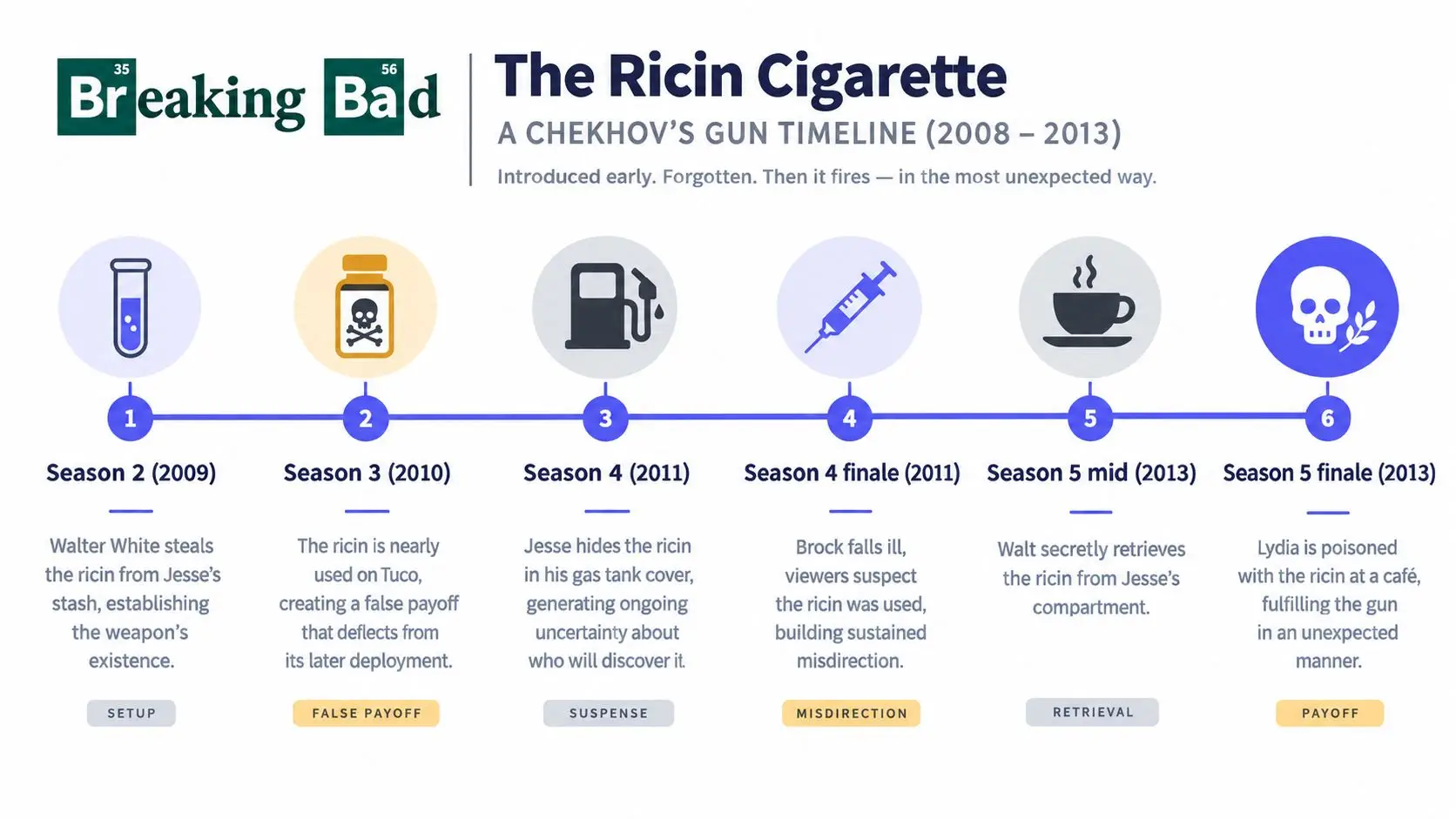
Apply the same record to a hidden document, poison, recording, or secret technical skill. Note custody separately from character awareness. That check prevents a continuity error in which someone uses an inaccessible object or reacts to information they have not received.
The detail should remain active between appearances. Each return must alter the audience's estimate of what it can do, while the final consequence still follows the story's established conditions.
7. Beloved and the tin tobacco box as a sensory trigger
The tin tobacco box in Beloved shows how a planted object can carry a character's history into the present. Its payoff belongs to the sensory and psychological payoff category. Touch, texture, smell, or visual recognition can reopen buried pain, so the object affects the story through sensory memory and character psychology.
A sensory detail becomes a Chekhov's gun when a later reaction reveals the history that its first appearance concealed.
Follow the box across three stages. First, it may appear as ordinary description, with little explanation of its importance. Later, its return can produce discomfort, avoidance, or a fragmented recollection. The final appearance need not solve an external problem. It can clarify why the character reacts, make an emotional decision possible, or show how the past still shapes present experience.
The object's meaning should accumulate through changed responses. Repetition alone creates a motif. Repetition with variation creates a trigger.
Track the trigger's changing charge
Create one row for each appearance and record the detail's physical form, the character's first association, the response it provokes, and the memory or decision attached to that response. Add a final column for what the reader understands that the character may still resist. This separates sensory activation from simple description and shows whether each return adds information, pressure, or emotional depth.
Storyloft's notes panel can store these observations, while character profiles connect each trigger to a specific history. Tone analysis can help you check whether repeated scenes intensify the emotion or merely restate it. Focus mode is useful during revision when the object must gain meaning without becoming an obvious announcement.
The distinction is description and activation. Description names the box. Activation makes the character's response prove that it has a past.
8. Inception and the spinning top as an ambiguity tool
The spinning top in Inception turns a plot device into a test of interpretation. Early in the film, it gives characters a mechanical rule for distinguishing waking reality from a dream. It also reflects Cobb's psychological need for certainty. When the top returns at the ending, its movement creates no single answer for the audience.
Classify this planted element as an ambiguous payoff. A mechanical payoff would reveal information or solve a problem. The top does something different: it intensifies the film's thematic question about reality, guilt, and certainty. The evidence supports competing readings, while the emotional payoff comes from Cobb's choice to stop demanding proof.
Establish the rule clearly, then let the unresolved meaning test the character.
Ambiguity needs a stable foundation. If readers do not know what the top normally indicates, the ending feels arbitrary. If its behavior changes without explanation, it becomes decoration rather than a meaningful test.
Track the evidence and its pressure
For each appearance, record four linked points in a tracking sheet. First, state the established rule and what the object normally tells characters. Next, name the thematic question beneath that rule. Then list the competing readings that the evidence can support. Finally, note the emotional resolution, including what changes for the character while the factual answer remains open.
A planning binder can store the rules, and character profiles can show how different people interpret the same object. Use notes to separate deliberate ambiguity from missing information. The final appearance should deepen the question and complete the character's movement, rather than conceal uncertainty behind an undecided plot.
9. Harry Potter and the Philosopher's Stone and the Mirror of Erised as thematic setup
The Mirror of Erised first appears as a magical curiosity, but its deeper function is to reveal desire. Harry sees what he longs for, while the mirror also exposes the danger of becoming absorbed in an image of fulfillment rather than acting in the actual world.
This is a thematic and character-based payoff. The mirror doesn't just provide a useful object for a later action. It establishes a question about what people want, what they mistake for happiness, and whether desire can become a trap. Its importance grows as the wider series develops questions about choice, loss, power, and the temptation to seek simple solutions.
A thematic setup should do work in the scene where it first appears. The mirror reveals character immediately. That means its later significance feels earned even when no direct mechanical action depends on it.
Track the question beneath the object
Write one sentence for the element's thematic purpose, then test every later appearance against it. For example: “This object shows what a character desires before the character understands the cost of that desire.”
Storyloft's planning binders can preserve the series-level question, while tags can mark scenes that echo it directly or indirectly. Side-by-side review is useful when comparing the first encounter with later appearances. Eddy's manuscript-aware suggestions can help keep dialogue appropriate to each character's current understanding, so later discussions don't sound as though everyone already knows the final interpretation.
The practical lesson is to track not just what the object does, but what it teaches the reader about the characters.
10. Parasite and the basement flood as a planted consequence
In Parasite, the Kim family's semi-basement home is introduced through its low window, street-level view, and direct connection to the surrounding space. These details establish poverty and social position before they create a plot problem. Later, flooding transforms the home into a source of danger, so the setting becomes part of the catastrophe.
The payoff is an environmental and consequential payoff. Unlike a symbolic object, the basement does not mainly reveal an idea or desire. It supplies a physical weakness that external conditions can activate. The flood works mechanically because water enters a space the film has already shown to be exposed, while it also carries social meaning: the family's living conditions determine how severely the disaster affects them.
A planted consequence should make the crisis feel activated, not invented.
The sequence is easy to track:
- Physical weakness: The low position makes flooding, blocked access, or damaged belongings possible.
- Social meaning: The home's position reflects the family's place in the wider social order.
- Character choice: Decisions about where people live, work, or seek safety bring them closer to the hazard.
- Escalation path: An outside event turns a visible condition into an immediate crisis.
For a writing exercise, record these four elements beside each important setting. Then mark every scene that reinforces the same vulnerability. A timeline can place weather, social pressure, and character decisions in one view. Storyloft's planning binders can store the setting map, while notes can connect early descriptions to later consequences. Tone analysis can test whether the opening scenes create unease without explaining the future flood.
The practical lesson is specific: track what the environment permits, who bears the cost, and which planted condition the crisis activates.
Chekhovs Gun, Comparison of 10 Examples
| Example | Implementation Complexity 🔄 | Resource Requirements ⚡ | Expected Outcomes 📊 | Ideal Use Cases 💡 | Key Advantages ⭐ |
|---|---|---|---|---|---|
| The Great Gatsby, The Green Light | Moderate, plant early, maintain thematic weave | Low–Medium, tracking & revisions (notes/char) | Emotional payoff; layered symbolism; reread depth | Literary/character-driven fiction | Deep emotional resonance; sustained thematic consistency |
| Jaws, The Mechanical Shark | High, rely on implication, sustained tension | Low material, high craft, strong dialogue/scene work | Heightened psychological suspense; implied threat | Thrillers, suspense, horror without spectacle | Implied danger amplifies fear; efficient pacing |
| The Lord of the Rings, The Ring | Very high, long-range planning and consistency | High, worldbuilding, continuity, revision effort | Structural coherence; epic stakes; interwoven arcs | Epic fantasy; multi-volume series | Anchors long-form narrative; varied character consequences |
| Gone Girl, Unreliable Narrator Contradictions | High, meticulous cross-perspective tracking | Medium–High, timelines, voice edits, revisions | Puzzle-like reveals; active reader engagement; reread payoff | Psychological thrillers, dual/multiple narrators | Encourages analysis; layered deception that rewards attention |
| The Sixth Sense, Wedding Ring | Moderate, subtle motif placement across scenes | Low–Medium, careful scene revision and cueing | Strong twist "aha"; rewarding rewatch/reread | Twists and mysteries relying on visual/descriptive clues | Powerful, memorable reveal via subtle detail |
| Breaking Bad, Ricin Cigarette | Very high, multi-season misdirection and false payoffs | High, long-term tracking, consistent motivations | Sustained tension; unpredictable resolution; long engagement | Serialized drama, long-form storytelling | Maintains suspense over time; payoff via misdirection |
| Beloved, Tin Tobacco Box (Sensory Trigger) | High, layered sensory repetition and restraint | Medium, prose craft, iterative revision | Deep emotional resonance; thematic/psychological depth | Literary fiction about memory, trauma | Sensory anchors create profound cumulative meaning |
| Inception, Spinning Top | Moderate, establish clear rules then allow ambiguity | Medium, rule documentation, thematic framing | Ambiguity-driven discussion; interpretive engagement | Experimental/literary fiction, philosophical SF | Ambiguity as satisfying thematic payoff; prolonged debate |
| Harry Potter, Mirror of Erised | High, seed themes across series from Book 1 | High, series planning, consistency checks | Series-wide thematic cohesion; intertextual rewards | Series/YA fantasy with long arcs | Establishes foundational themes; cumulative significance |
| Parasite, Basement Flood (Environmental Detail) | Moderate–High, integrate setting as plot mechanism | Medium, setting documentation, escalation planning | Tragic inevitability; thematic + mechanical payoff | Social drama, literary narratives linking environment & plot | Environmental detail becomes earned catalyst; multi-layered impact |
Turn Every Planted Detail Into a Promise
These Chekhov's gun examples show that “firing” doesn't always mean a weapon discharges or an object solves the final problem. The green light pays off through symbolism and longing. The shark creates suspense through absence. The Ring carries plot, psychology, and theme across an extended narrative. The contradictions in Gone Girl revise the reader's understanding of earlier testimony. The wedding ring in The Sixth Sense becomes visual evidence. The ricin cigarette sustains uncertainty about threat and custody. The sensory details in Beloved reveal memory, while the spinning top in Inception produces deliberate ambiguity. The Mirror of Erised exposes desire, and the flooded home in Parasite turns environmental detail into consequence.
A useful revision test begins with attention. Ask why the audience notices the element in the first place. Is it described unusually precisely, repeated, isolated visually, connected to a character reaction, or given a strange position in the scene? If the answer is no, it may just be atmosphere or ordinary texture. Not every cup, coat, street, or passing remark creates a promise.
Then define the intended function. Choose among plot mechanics, character psychology, visual revelation, sensory memory, environmental consequence, thematic development, or ambiguity. The category doesn't have to remain fixed. A prop can begin as a symbol and later become evidence. A location can first reveal class and later cause physical danger. What matters is that the shift feels connected rather than invented at the last moment.
Use this working sequence during outlining and revision:
- Introduce naturally: Give the element an immediate purpose in its first scene. Let it reveal character, create a small conflict, or belong to the environment before it becomes important later.
- Record the promise: Write down what the audience might reasonably expect after noticing it. Don't confuse your private backstory with information the manuscript has actually planted.
- Repeat with variation: Bring the element back often enough to remain legible, but change its context, pressure, or meaning so the repetitions develop rather than stall.
- Track custody and knowledge: Note who possesses the element, who knows about it, and when that knowledge changes. Continuity failures often come from losing track of these state changes.
- Connect it to character or theme: A payoff feels stronger when it reveals something about the person who uses, fears, desires, misunderstands, or rejects the element.
- Test proportionality: A detail given a paragraph of close attention may promise more than one given a passing mention. Match the eventual payoff to the emphasis.
- Separate setup from explanation: Readers should be able to recognize the connection after the payoff. They don't need a speech explaining why the object mattered.
- Check hindsight: The ending should feel prepared when readers look back, but the result shouldn't be so obvious that the story loses tension.
- Remove unpaid promises: If an element never earns its narrative weight, either give it a function, reduce the emphasis, or cut it.
A practical long-form workflow starts with a dedicated binder for planted elements. Give each one a name, category, intended payoff, first appearance, reinforcement scenes, current holder, character knowledge state, and final consequence. Tag every appearance in the manuscript. During revision, compare the setup and payoff side by side, then inspect the scenes between them for continuity. Storyloft's planning workspace, notes, tags, character creator, side-by-side tools, and edit history can support this process in one writing environment.
The final question is not, “Did I make every detail important?” It is, “Did I control the attention I asked the reader to give it?” A story can contain ordinary details, atmosphere, and symbolic echoes without turning each one into a puzzle. But when you deliberately point to an element, readers will remember. Give that memory a purpose.
Storyloft combines long-form manuscript drafting with notes, comments, edit history, character profiles, planning binders, tags, and AI-assisted revision tools that can help you track planted details across a story. Visit Storyloft to organize your setup-and-payoff threads and keep continuity visible during revision.