Rising Action in a Story: How to Build Unstoppable Tension
You know this feeling. Your opening works, your ending has real energy, but the middle of your draft turns soft and repetitive. Scenes happen, yet the story doesn't feel like it's moving. You keep adding obstacles, but the tension stays flat.
That problem usually isn't a lack of events. It's a lack of compounding consequences.
A strong rising action in a story doesn't just throw trouble at the protagonist. It builds a chain where each choice changes the next problem. One mistake costs trust. One small win creates a bigger threat. One solution closes an easy path and forces a harder one. That's how the middle stops sagging and starts pulling the reader forward.
Table of Contents
- What Is Rising Action in a Story?
- Why Rising Action Is Your Story's Longest Act
- Building Your Story's Staircase of Tension
- See Rising Action in Action with Examples
- Common Rising Action Pitfalls and How to Avoid Them
- Plan and Draft Your Rising Action in Storyloft
What Is Rising Action in a Story?
Rising action in a story is the stretch after the inciting incident and before the climax. It's the part where the central conflict stays active, pressure builds, and the protagonist faces increasingly difficult problems.
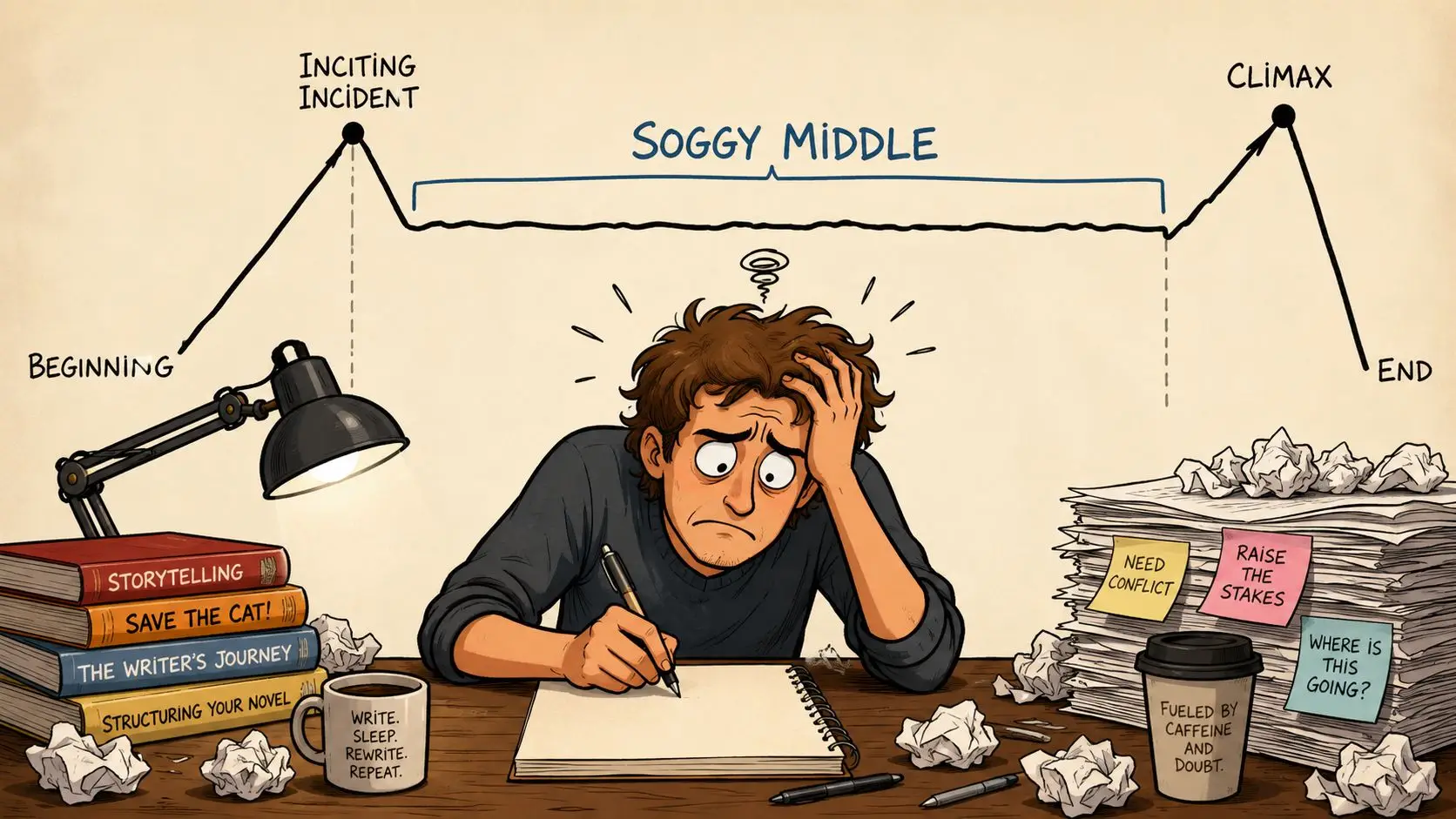
Many new writers hear that definition and still feel stuck. They think, "So I just add more obstacles?" Not quite. Random obstacles create noise. Rising action creates movement.
Think of it as the story's engine
Your opening starts the car. Your climax is the crash, escape, confession, duel, or decision you've been driving toward. Rising action is the engine that keeps the story from rolling to a stop halfway there.
The key word is because.
- This happens because the hero made a risky choice.
- That goes wrong because the villain notices.
- A new problem appears because the earlier fix had a hidden cost.
When scenes connect that way, readers feel momentum.
Practical rule: If you can swap two middle scenes without changing the story, your rising action probably isn't doing enough work.
What rising action should accomplish
A good middle does more than fill space. It should:
- Intensify conflict so the protagonist can't solve the problem the same easy way twice.
- Test character by forcing choices under pressure.
- Deepen stakes so failure means more later than it did earlier.
- Prepare the climax so the final turning point feels earned.
This idea goes back to classical dramatic thinking. Historical analysis traces the concept to Aristotle's Poetics, which established the basic principle that plot moves from beginning to middle to end, with tension building toward climax, as discussed in Backstage's overview of rising action.
Writers often get confused because the middle doesn't always need bigger explosions. It needs bigger consequences. A quiet argument can raise tension more than a car chase if it destroys an alliance the hero will need later.
Why Rising Action Is Your Story's Longest Act
The middle feels hard partly because it carries the most weight. In a classic three-act structure, Act I takes roughly 25% of the story, Act II takes 50%, and Act III takes the remaining 25%, which means rising action usually fills the bulk of the narrative, according to The Write Practice on rising action.
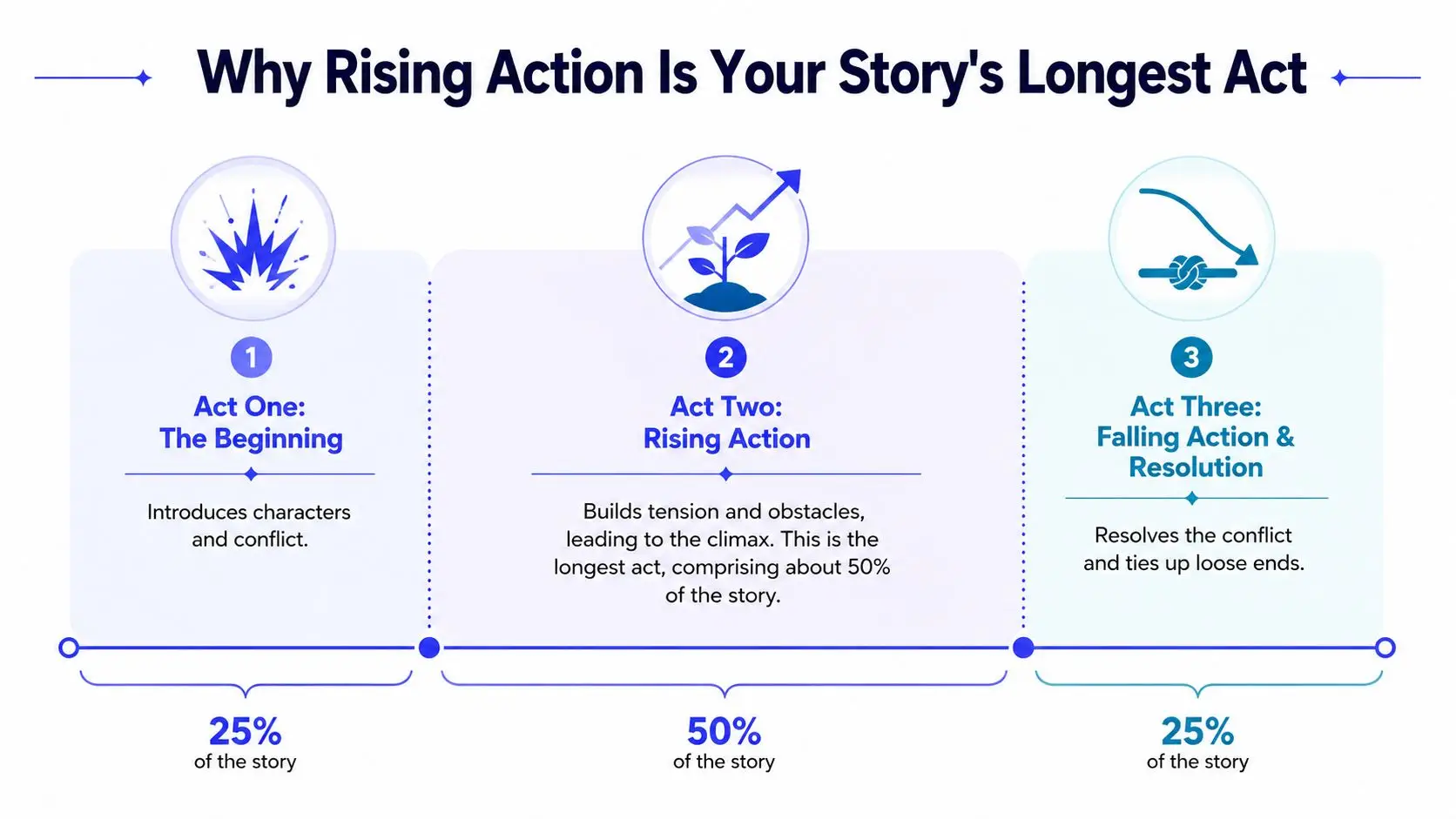
That same breakdown gives a practical scale. In a 100,000-word novel, roughly 50,000 words often belong to this phase. That's why the middle can't survive on filler scenes or repeated setbacks. It needs architecture.
Why this section takes so much space
Act I asks the story question. Act III answers it. Act II makes the answer matter.
Think of your plot like a pressure cooker. The opening puts in the ingredients and locks the lid. The rising action turns up the heat. Every attempt, setback, alliance, betrayal, and discovery increases pressure inside the story.
If the heat doesn't rise, the climax feels unearned. If the heat jumps too fast, the story feels rushed.
A visual overview helps:
What belongs in the long middle
Because rising action occupies so much of the story, it has to do several jobs at once.
| Story job | What it looks like in practice |
|---|---|
| Conflict growth | The protagonist's problems keep getting harder to solve |
| Character pressure | Flaws, fears, and habits start affecting outcomes |
| Subplot development | Secondary relationships and tensions complicate the main goal |
| Stakes escalation | The cost of success and failure both rise |
Frequently, many drafts go wrong. Writers understand that the middle is long, but they treat that length like open land to fill. It isn't. It's structured terrain.
The middle isn't the space between interesting parts. It's where the story earns them.
If you're working with act design, a three-act structure guide for novel planning can help you place pressure points so the middle keeps tightening instead of drifting.
A quick reality check for your draft
Ask yourself:
- Does each new obstacle change the situation? If not, you're circling.
- Does the protagonist pay a higher cost over time? If not, stakes may be static.
- Do subplots add pressure to the main problem? If not, they may be distractions.
A long act works when every scene either raises risk, narrows options, or forces a more difficult choice.
Building Your Story's Staircase of Tension
Rising action works best when you picture it as a staircase, not a treadmill. A treadmill keeps you moving in place. A staircase changes your level every step.
That difference matters. Effective rising action works through a structured escalation where each obstacle becomes a problem that is bigger and worse than the precedent, creating a cause-and-effect chain in which the protagonist's attempted solution often makes things worse, as explained in About Writing's escalation and switches article.
Step one means consequences arrive fast
One of the easiest ways to flatten a middle is to delay consequences. The hero lies in chapter five, but nobody reacts until chapter eight. The tension leaks out.
Try this instead. Let the story answer actions quickly.
- A secret slips out early and damages trust before the protagonist is ready.
- A clever shortcut works but alerts an opponent.
- A personal win lands and creates a public loss.
When one scene triggers the next, readers stop asking whether the story is moving. They feel it.
Use yes but and no and
A practical tool for scene design is the yes, but / no, and pattern.
- Yes, but means the character gets part of what they want, but the success creates a cost or complication.
- No, and means the character fails, and the failure opens a worse problem.
Here is the difference in plain language:
| Scene outcome | Flat version | Escalating version |
|---|---|---|
| Success | She finds the key | She finds the key, but her brother sees her steal it |
| Failure | He misses the train | He misses the train, and the witness leaves town |
| Victory | They win the debate | They win the debate, but lose their sponsor |
| Escape | He gets out safely | He gets out, and leaves evidence behind |
That pattern keeps scenes from ending in neutral.
If your protagonist succeeds, charge them for it. If they fail, make the failure spread.
Build side threads that squeeze the main plot
Subplots help rising action when they add pressure, not when they pause the story. A romance subplot can complicate loyalty. A family problem can steal time from the mission. A rival can force the protagonist into public choices they wanted to keep private.
If you work across different narrative formats, it can help to organize your video and podcast content with scene-level breakdowns. The same habit sharpens fiction because it makes you check whether each beat changes the next beat.
For broader planning, a seven-point story structure resource can help you place reversals and pressure shifts in a more deliberate sequence.
A simple staircase test
Review five consecutive middle scenes and ask:
- What changed?
- What did it cost?
- Why can't the protagonist go back to the old plan?
If you can't answer all three, that step may be flat.
See Rising Action in Action with Examples
Examples make this easier because you can watch pressure stack in real time. A strong rising action usually includes multiple major turning points or setbacks before the climax. Backstage describes this as an industry standard and ties the idea back to the long tradition of building tension systematically from Aristotle onward.
Rising action beats by genre
| Genre | Story Example | Key Rising Action Beat |
|---|---|---|
| Fantasy | The Hunger Games | Katniss adapts to new rules and alliances that force harder moral choices |
| Thriller | Hamlet | Hamlet's investigation leads to actions that deepen danger around him |
| Romance | Pride and Prejudice | Misread intentions and social pressures keep changing what love will cost |
Fantasy example
In a fantasy story, rising action often expands the world while tightening survival.
Take The Hunger Games. Katniss doesn't just face one challenge after another in isolation. Training affects perception. Perception affects alliances. Alliances affect survival. Rule changes don't merely surprise her. They force new decisions under harsher emotional pressure.
A useful way to read those beats is:
- Initial danger puts the protagonist in a hostile system.
- Temporary adaptation creates a fragile advantage.
- New conditions make the earlier plan incomplete.
- Emotional ties raise the cost of survival choices.
That's why the middle feels active. Each development changes what winning means.
Thriller example
A thriller often uses rising action to trap the protagonist inside their own investigation.
In Hamlet, the prince begins with suspicion and a need for proof. He then stages actions to test that suspicion. Those actions do more than gather information. They expose him, provoke reactions, and increase the threat around him. By the time he makes a catastrophic mistake, the story has moved far beyond the original problem.
The best thriller middles don't add incidents at random. They make inquiry itself dangerous.
Romance example
Romance rising action isn't weaker because it may look quieter on the surface. It's often sharper because emotional consequences can escalate with every conversation.
In Pride and Prejudice, attraction grows alongside misunderstanding, pride, social pressure, and changing judgments. New information doesn't settle the relationship. It redefines it. That's the key. A good romance middle keeps changing what each person thinks love would require.
If you outline by beats, a fiction beat sheet for mapping turning points can help you see whether your midpoint, reversals, and late complications build on each other.
What these examples share
Across genres, the pattern stays the same:
- The protagonist wants something clearly
- Their actions create new conditions
- Each turn raises pressure or changes the goal
- The climax grows out of those changes
That's the heart of rising action in a story. The genre changes the surface. The mechanism underneath stays remarkably similar.
Common Rising Action Pitfalls and How to Avoid Them
Most weak middles don't fail because nothing happens. They fail because the same kind of thing keeps happening.
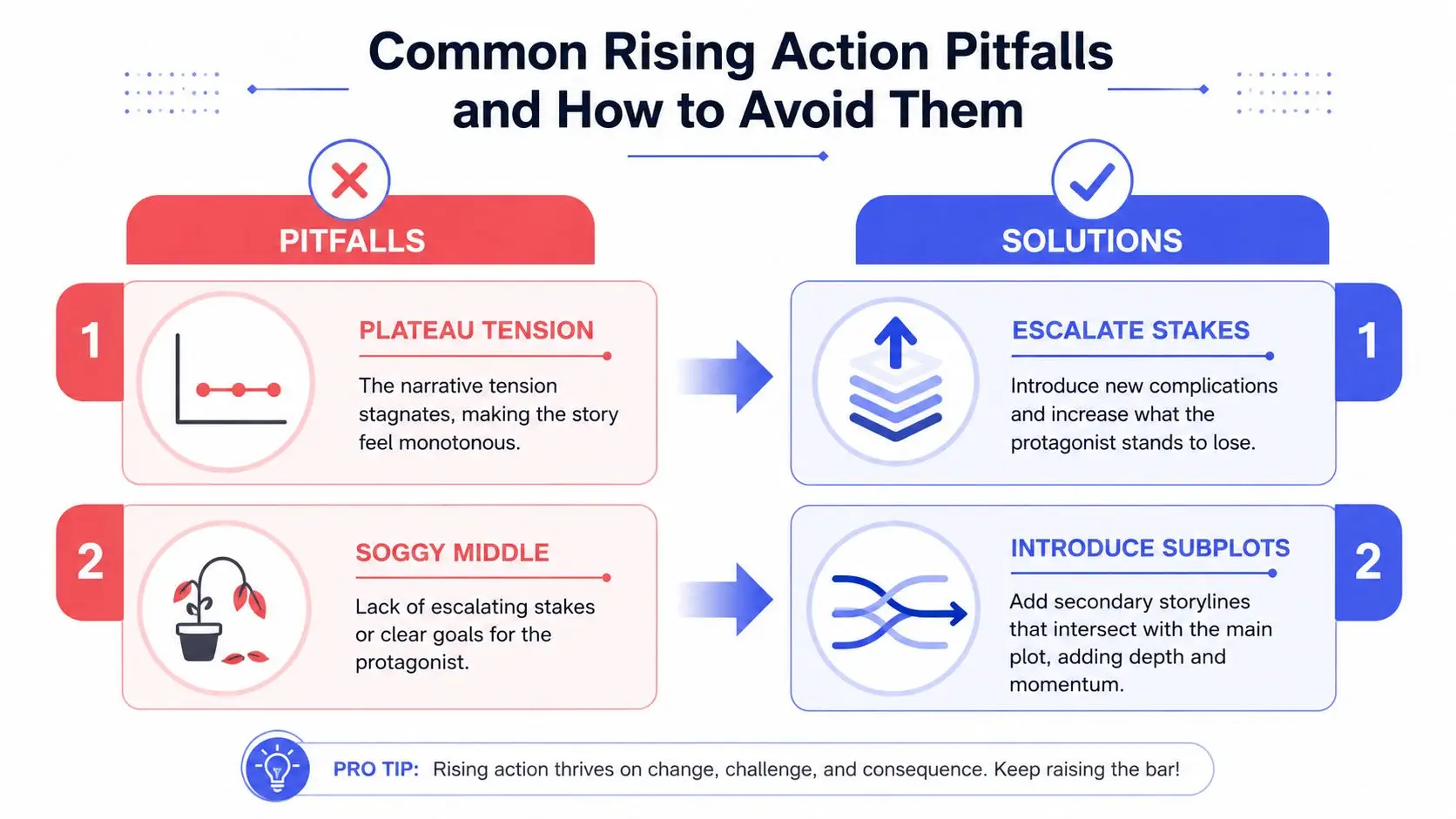
That's plateau tension. The protagonist hits obstacle after obstacle, but the obstacles feel equivalent. The reader stops sensing escalation.
Literature and Latte highlights this exact gap in writing advice. Effective rising action avoids plateau tension through upgraded sacrifices and consequences that alter the next objective, rather than repetitive setbacks that leave the middle feeling flat, as described in its guide to rising action.
The difference between repetition and escalation
Look at these side by side.
| Flat middle | Escalating middle |
|---|---|
| The hero keeps getting blocked | The hero gets blocked in ways that remove options |
| Each setback feels similar | Each setback changes the terms of the conflict |
| Success has little cost | Success costs something valuable |
| The goal stays basically the same | The next objective shifts because of what just happened |
A plateau often hides behind busy scenes. Chases, arguments, discoveries, and reveals can still feel stagnant if none of them changes the larger situation.
A manuscript checklist
Use these questions on any middle chapter:
- Does this event force a harder choice? If not, it may only be motion.
- Does success carry a sacrifice? If not, tension may drain out after the win.
- Does failure create a new problem immediately? If not, the consequence may be arriving too late.
- Does this scene alter the next objective? If not, the plot may be looping.
- Has the protagonist lost something they can't easily replace? Trust, time, safety, advantage, or self-control all count.
Repetitive trouble tires a reader. Compounding trouble hooks a reader.
Three fixes that usually help fast
Move consequences earlier
Don't let fallout wait around for the next convenient chapter.Upgrade the cost of progress
Let a win damage a friendship, expose a secret, or close off an easier route.Tie pressure to character weakness
If the protagonist is controlling, proud, avoidant, or reckless, let that trait shape the next complication.
When writers repair those three areas, the middle usually stops feeling mushy and starts feeling inevitable.
Plan and Draft Your Rising Action in Storyloft
Drafting rising action gets easier when you stop treating it like inspiration and start treating it like sequence design. The most useful benchmark for scene-to-scene escalation is the yes but, no and structure, where every move toward a goal creates a fresh obstacle and every setback spawns new complications that keep the plot unresolved, as explained in Fictionary's article on rising action.
Map the pressure before you draft prose
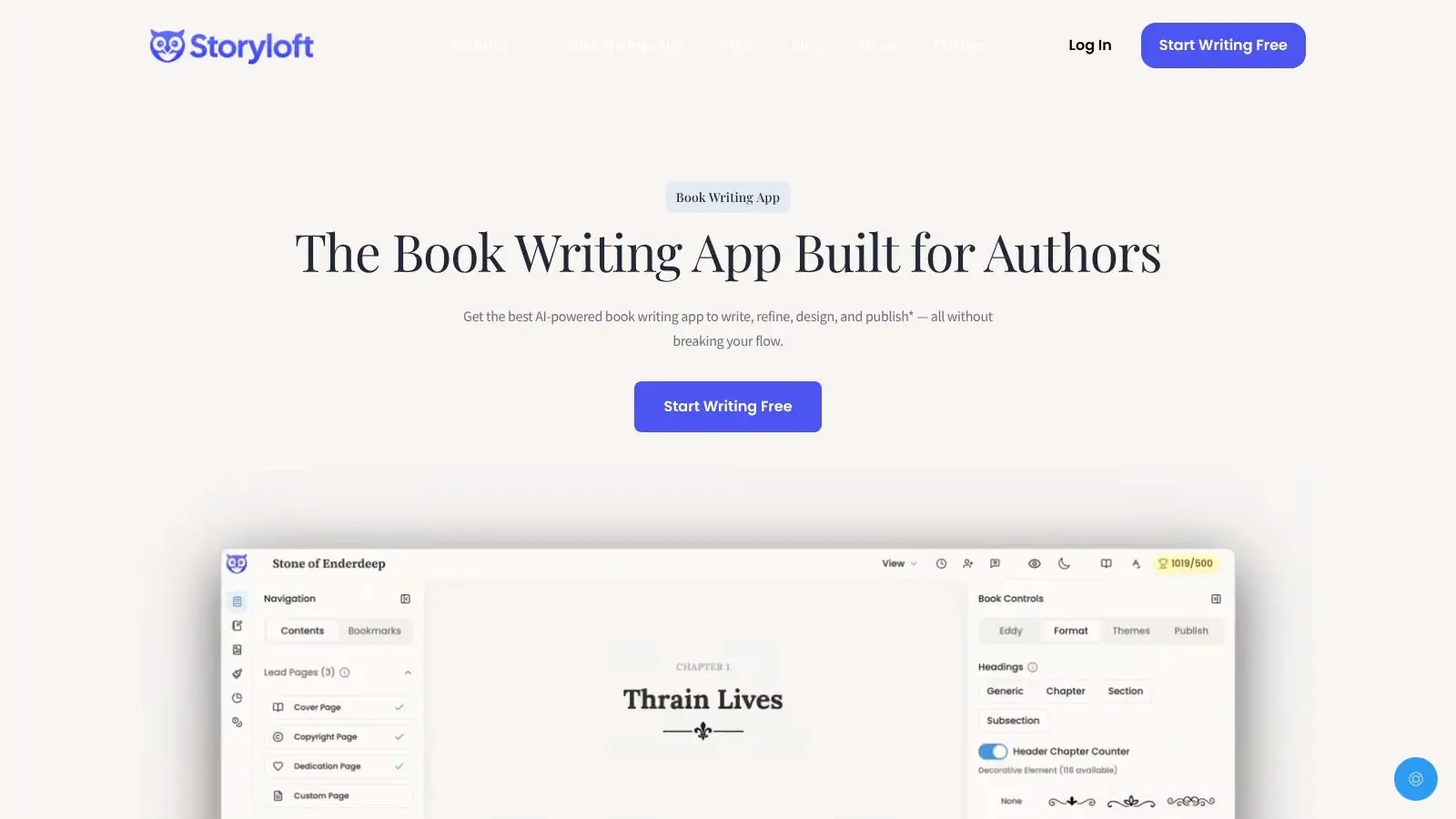
In Storyloft's planning workspace, you can arrange plot beats as cards and check whether each one creates a consequence that affects the next card. That matters because rising action breaks down when scenes exist beside each other instead of because of each other.
A simple planning pass looks like this:
- Name the protagonist's current objective
- Write the obstacle
- Add the immediate consequence
- Note how that consequence changes the next objective
If a card doesn't create a new problem, combine it with another beat or cut it.
Use AI prompts for escalation, not replacement
Writers often use AI for idea generation, then get generic scenes back because the prompt is generic. Be specific. Ask for a consequence, not "more tension."
For example, in a manuscript-aware assistant such as Eddy, stronger prompts sound like:
- Give me a yes-but consequence if my detective gets the file but loses her source
- Suggest a no-and complication caused by my hero's need for control
- Rewrite this paragraph so the victory feels costly instead of clean
If you're exploring broader workflows, this guide on how to write a book using AI offers useful ways to think about where AI can support planning and drafting without replacing your narrative judgment.
Keep your outline tied to the manuscript
One reason middles flatten during drafting is that the outline lives in one place and the prose lives in another. When your notes, scene goals, and manuscript sit together, it's easier to test whether a chapter still serves the pressure curve you planned.
A practical outline method is to build your middle around irreversible shifts:
| Beat type | Question to ask |
|---|---|
| Reversal | What just got harder? |
| Costly win | What did success damage? |
| Setback | What new threat appears now? |
| Shift in goal | What does the protagonist need next because of this? |
If you want a hands-on framework for that process, Storyloft's novel outlining guide is a helpful place to start.
If you want one place to outline your rising action, draft scenes, test consequences, and revise with AI support inside the manuscript, try Storyloft. It's built for long-form writing, which makes it easier to keep your middle tense, connected, and moving.