What Is a Beat Sheet?
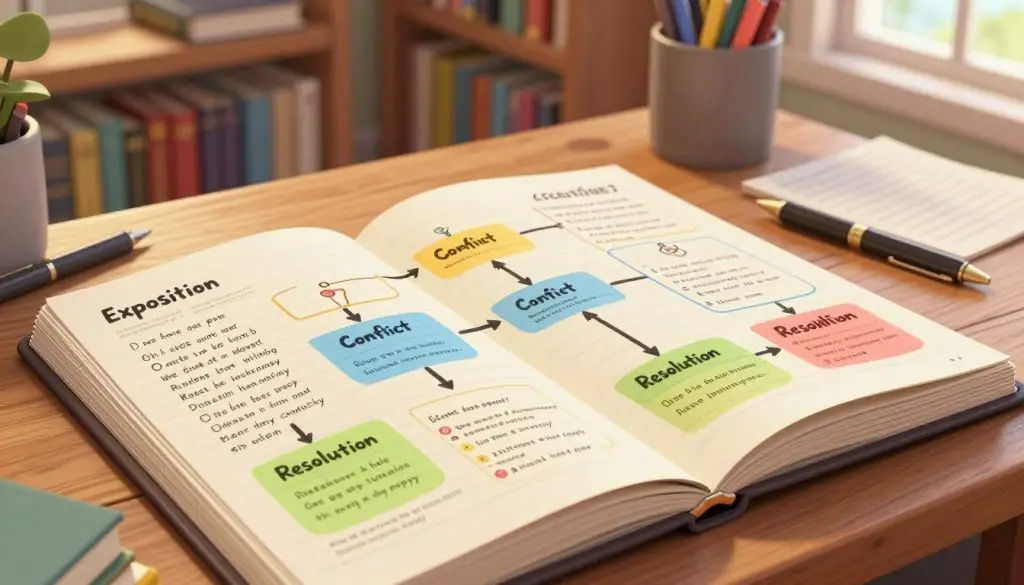
When I first started writing, I often found myself staring at a blank page, wondering how to turn my ideas into a coherent story. That’s when I discovered the magic of a beat sheet. This tool became my roadmap, breaking my entire narrative into manageable moments called beats. Each beat serves as a stepping stone, pushing the story forward like a chain reaction.
A beat is essentially any moment that propels the narrative, whether it’s a small interaction or a major plot twist. In the world of screenwriting, a beat sheet outlines these critical moments before you even begin typing your script. I learned that the Save the Cat method by Blake Snyder offers a fantastic template for structuring these beats effectively.
The beauty of a beat sheet lies in its flexibility. It can be as simple as jotting down ideas on index cards or as detailed as a multi-page document. By creating my first beat sheet, I transformed my overwhelming ideas into a clear plan, making the writing process feel almost effortless.
Key Takeaways
- A beat sheet is a roadmap for your story, breaking it into manageable moments.
- Each beat propels the narrative forward, ensuring coherence.
- Blake Snyder’s Save the Cat method provides a solid template for structuring beats.
- The process helps transform overwhelming ideas into actionable plans.
- Flexibility in format allows for creativity in planning your story.
Understanding the Purpose Behind the Beat Sheet
Navigating the complex world of storytelling can be overwhelming without a solid framework. A beat sheet serves as that framework, offering a bird’s-eye view of your entire story. This overview allows you to see how the pieces fit together before you invest months in writing scenes that might end up in the digital trash bin.
When I first started using a beat sheet, I realized that it helps identify plot holes and sagging sections. It also highlights character arcs that might fizzle out before they catch fire. This clarity is invaluable for writers who want to streamline their writing process.
Many writers, including myself, have found that using a beat sheet reduces the time spent rewriting. By stress-testing the structure of your narrative early on, you can address issues before they become larger problems.
For those who think visually, a beat board with index cards or sticky notes can be a great alternative. It allows you to rearrange events until the flow feels just right. Production companies often request these sheets because they reveal whether a writer understands the fundamental architecture of storytelling.
Moreover, a beat sheet acts as a communication tool. It helps collaborators and beta readers grasp your story’s skeleton without needing to wade through hundreds of pages. The process of creating one forces you to distill your narrative down to its essential moments, clarifying what your book or script is truly about.
By embracing the purpose of the beat sheet, I transformed my approach to writing. I stopped viewing it as homework and began to see it as the cheat code that lets me write faster and with more confidence.
| Purpose of a Beat Sheet | Benefits |
|---|---|
| Provides an overview | Helps visualize the entire story structure |
| Identifies plot holes | Reduces time spent on rewrites |
| Clarifies character arcs | Ensures character development is compelling |
| Facilitates collaboration | Enables easier communication with partners |
| Encourages creativity | Allows for flexible rearrangement of ideas |
What Exactly Is a Beat Sheet?
As I ventured into writing, I quickly realized that having a guiding framework is essential for transforming ideas into compelling narratives. A beat sheet is a vital document in the world of screenwriting and film development. It outlines the crucial story beats for a script you either plan to write or have pitched to a production company.
Think of story beats as the building blocks of your narrative. Each beat represents a moment that moves the story forward, whether it’s a small interaction or a significant plot twist. These beats are like the molecules of a screenplay or television script, essential for keeping the narrative alive.
I like to think of a beat sheet as the architectural blueprint for your story. You wouldn’t build a house by randomly nailing boards together, so why would you write a novel that way? At its core, a beat sheet is a chronological list of key moments, turning points, and emotional shifts that make up your narrative from beginning to end.
In the film industry, a beat sheet is often the first document a screenwriter creates after the logline. It serves as the bridge between a vague idea and a fully-fledged script. I discovered that beat sheets can range from a simple one-page document with 15 major beats to an exhaustive 40-page breakdown that maps every scene in granular detail.
The term “beat” comes from the rhythmic pulse of storytelling. Each beat is like a heartbeat that keeps your narrative alive and pumping toward the climax. Unlike a traditional outline, a beat sheet focuses on emotional and structural turning points rather than just listing chronological events.
When I examined the beat sheets of successful films, I noticed that each beat seamlessly sets up the next one. This creates an unbroken chain of cause and effect, making the story feel cohesive and engaging. The beauty of a beat sheet is that it works for any medium—novels, screenplays, graphic novels, memoirs, and even non-fiction books all benefit from this structural approach.
By defining exactly what a beat sheet is, I finally understood that it wasn’t a creative straitjacket but rather a trampoline that launched my imagination higher than ever before.
Why Story Structure Matters: The Backbone of Every Great Story
Every great story needs a solid backbone to keep it from crumbling under pressure. I used to believe that raw talent and inspiration were enough to carry a story. But then I learned that even Mozart followed the structural rules of sonata form when composing his symphonies.
Story structure is the invisible scaffolding that supports every memorable tale. From ancient myths told around campfires to the latest blockbuster dominating the box office, structure plays a crucial role. Without it, a story can become a meandering collection of events. Beautifully written, perhaps, but ultimately leaving readers feeling unsatisfied and disoriented.
Audiences have been conditioned by thousands of years of storytelling to expect certain structural beats. When those beats are missing, they sense something is wrong, even if they can’t articulate it. The three-act structure—setup, confrontation, and resolution—forms the backbone of Western storytelling. It appears in everything from Shakespearean tragedies to Pixar animated films.
A strong structure ensures that your character’s internal journey mirrors the external plot. This creates a satisfying resonance that makes stories feel complete and meaningful. I learned that structure doesn’t make stories formulaic; it makes them functional. Just like the rules of grammar don’t make language boring, they make communication possible.
When I started applying structural principles to my own writing, I noticed a change. My beta readers stopped saying, “something feels off,” and started saying, “I couldn’t put it down.” The Hero’s Journey, popularized by Joseph Campbell, demonstrates that story structure is hardwired into the human psyche across cultures and centuries.
By embracing story structure as the backbone of my work, I transformed from a writer who occasionally stumbled into good scenes to one who could consistently deliver compelling narratives.
Introducing Blake Snyder’s ‘Save the Cat!’ Beat Sheet
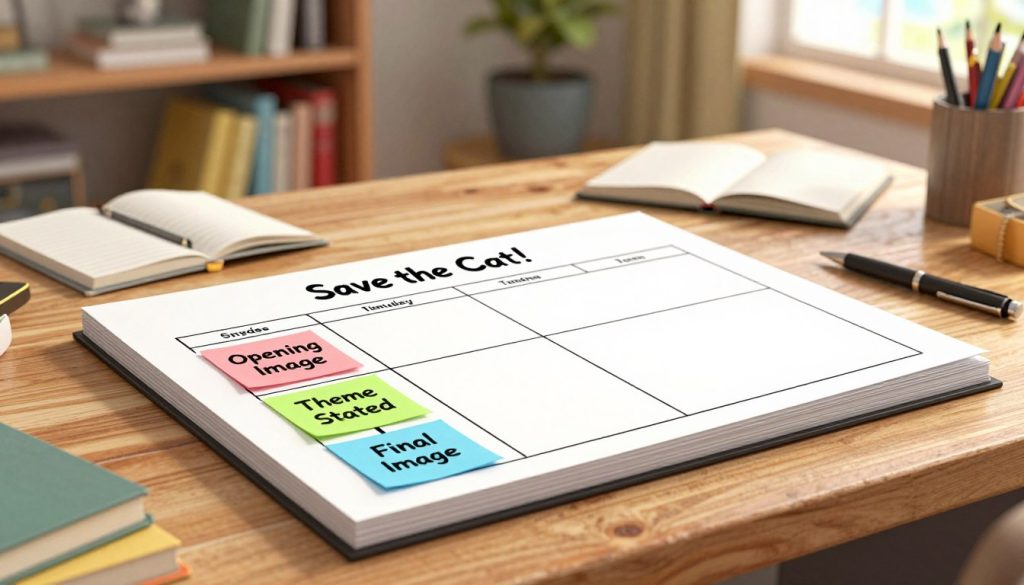
The first time I delved into Blake Snyder’s ‘Save the Cat!’ was like unlocking a treasure chest of storytelling secrets. This guide breaks down the three-act structure into bite-sized, manageable sections, each with a specific goal for your overall story.
Let’s dive into the essential beats of Snyder’s framework:
Opening Image: Setting the Tone
The Opening Image is your story’s first impression. It’s a visual snapshot that establishes tone, mood, and the protagonist’s problem before the adventure even begins. Think of Luke Skywalker staring at the twin suns of Tatooine.
Theme Stated: The Story’s Big Idea
When the Theme Stated beat arrives, usually through a secondary character’s offhand comment, the protagonist hears the truth they’ll spend the entire story learning to understand. It’s like when Morpheus tells Neo about the Matrix.
Set-Up: The Ordinary World
The Set-Up section gives us the protagonist’s ordinary world in all its flawed glory. This part shows us what’s missing in their life and why they desperately need the journey ahead.
Catalyst & Debate: The Call to Adventure
The Catalyst is the explosive moment that demolishes the status quo. Think of Hagrid telling Harry he’s a wizard or the shark eating the swimmer in Jaws. Following this, the Debate beat captures the protagonist wrestling with the call to adventure, asking themselves, “Can I really do this?”
Break Into Two and the B Story: New Worlds and Subplots
The Break Into Two is that glorious moment when the hero actively chooses to cross the threshold, leaving the familiar world behind. Meanwhile, the B Story often introduces the love interest or a mentor figure, providing the emotional grounding that makes the action meaningful.
Fun and Games to Midpoint: The Heart of the Story
In the Fun and Games section, we get what the movie poster promised. This is where the protagonist explores the new world, engaging in exciting adventures. However, at the Midpoint, everything either seems perfect or absolutely disastrous.
Bad Guys Close In to All is Lost: Dark Times
As the Bad Guys Close In, doubt, jealousy, and fear regroup to challenge the protagonist’s goal. The All is Lost moment hits like a punch to the gut, leaving the hero feeling hopeless.
Dark Night of the Soul to Break Into Three: Finding Hope
During the Dark Night of the Soul, the protagonist wallows in despair, mourning what’s been lost. However, this moment leads to the Break Into Three, where a fresh idea or inspiration sparks hope.
Finale and Final Image: Resolution and Growth
The Finale is where everything comes together. The protagonist applies everything they’ve learned, defeats the antagonist, and proves through action that they’ve internalized the story’s theme. Finally, the Final Image mirrors the Opening Image, showing how profoundly the character has changed.
Other Popular Beat Sheet Structures: Hero’s Journey & Syd Field’s Three-Act
As I delved deeper into storytelling, I uncovered a treasure trove of narrative structures that could guide my writing. While Blake Snyder’s Save the Cat beat sheet became my first love, I soon discovered that the storytelling world offers multiple structural frameworks, each with its own unique strengths and applications.
One of the most renowned structures is Joseph Campbell’s Hero’s Journey. This monomyth traces the hero’s path from the ordinary world through trials and transformation to a triumphant return. I found that the Hero’s Journey works brilliantly for epic fantasies and adventure stories—George Lucas famously used Campbell’s framework as the blueprint for the original Star Wars trilogy.
The Hero’s Journey breaks down into stages like:
- Call to Adventure: The hero is invited to leave their ordinary world.
- Refusal of the Call: The hero hesitates, fearing the unknown.
- Meeting the Mentor: A guide appears to assist the hero.
- The Ordeal: The hero faces their greatest challenge.
Another popular framework is Syd Field’s Three-Act Structure, introduced in his 1979 book Screenplay: the Foundations of Screenwriting. Field streamlined Campbell’s work into a more practical framework specifically designed for film scripts. His approach divides stories into:
- Act 1: The Setup – Introduces characters and sets the stage.
- Act 2: The Confrontation – The hero faces obstacles and challenges.
- Act 3: The Resolution – Conflicts are resolved, and the story concludes.
I appreciate how Field’s structure emphasizes the importance of the Midpoint and the lowest point at the end of Act Two. This creates a rhythmic rise and fall that keeps audiences emotionally invested. What fascinates me is how all these structures—Snyder’s, Campbell’s, and Field’s—describe essentially the same underlying story rhythm, just with different terminology and granularity.
The choice between these beat sheet structures often comes down to genre and personal preference. Epic fantasies might lean toward the Hero’s Journey, while romantic comedies might fit Snyder’s template more naturally. By studying multiple structural frameworks, I developed a deeper understanding of why stories work, which allowed me to mix and match elements to suit my unique creative vision.
How to Create Your Own Beat Sheet: Tips and Tricks
Creating a beat sheet can feel daunting at first, but it doesn’t have to be. I’ve learned that the key to a successful beat sheet is to start simple and build from there. By focusing on the essential beats, you can lay a solid foundation for your story.
One of the best pieces of advice I received was to concentrate on major beats like the Catalyst, Midpoint, All is Lost, and Finale. These pivotal moments serve as anchors for your narrative, allowing you to fill in the gaps later. This approach prevents the overwhelming feeling of needing to map out every single scene before writing a word.
Start Simple: Essential Beats Only
When I first tried creating my own beat sheet, I made the classic rookie mistake of trying to map out every scene in excruciating detail. The result? A lifeless, over-engineered mess. Instead, I learned that a beat sheet should function like a basic road map—detailed enough to keep you from getting lost but flexible enough to accommodate inspired detours along the way.
Allow Room for Inspiration and Flexibility
One of my favorite tricks is to write each major beat on a separate index card. Then, I spread them across the floor and physically rearrange them until the emotional rhythm feels right. This tactile process allows for a more intuitive understanding of how the beats flow together.
It’s also crucial to remember that your beat sheet should evolve alongside your story. Some of your best ideas will emerge during the actual writing process. Allowing room for inspiration means accepting that your initial beats may shift as your characters develop and your plot unfolds.
Mixing and Matching Frameworks to Fit Your Story
Mixing and matching frameworks became my secret weapon. For instance, I might use Snyder’s Save the Cat beats for the main plot while borrowing elements from the Hero’s Journey for character development. This blend creates a richer narrative that feels both structured and organic.
Using tools like Storyloft’s AI writing companion Eddy transformed the beat sheet creation process from a solitary struggle into a collaborative conversation. This sparked ideas I never would have discovered alone.
Ultimately, the key to flexibility is remembering that a beat sheet is a descriptive tool, not a prescriptive prison. If your character wouldn’t make a particular choice at a moment, trust your instincts and adjust the beats accordingly. By refining my approach to creating beat sheets, I developed a personalized system that gives me the confidence of structure without sacrificing the spontaneity that makes writing feel alive.
| Tip | Description |
|---|---|
| Start Simple | Focus on essential beats before filling in details. |
| Use Index Cards | Write each major beat on a card for easy rearrangement. |
| Allow Flexibility | Let your beat sheet evolve as your story develops. |
| Mix Frameworks | Combine elements from different storytelling structures. |
| Trust Your Instincts | Adjust beats if they don’t align with character choices. |
The Storyloft Advantage: Using AI for Faster Outline Creation
When I first learned about the power of AI in writing, I was surprised by how it could reshape my creative process. Storyloft’s Free Book Outline Generator completely changed my perspective on what technology can do for storytellers.
Instead of staring at that soul-crushing blank page, I found myself in a guided conversation with Eddy, Storyloft’s AI writing companion. Eddy asked me thoughtful questions about my story that I hadn’t even considered asking myself.
The genius of Storyloft is that it doesn’t just spit out generic chapter titles. It builds a complete, usable outline with detailed subpoints, chapter descriptions, and creative notes that feel tailored to my specific project.
I was genuinely impressed when Storyloft generated intelligent planning notes and even a concept book cover inspired by my idea. Suddenly, my half-formed story concept felt tangible and real.
This guided experience works for both fiction and non-fiction books. Whether I was plotting a fantasy epic or structuring a self-help manifesto, the tool adapted seamlessly to my needs.
What sets Storyloft apart is the supporting context it provides. Reader direction notes, thematic suggestions, and structural guidance help me understand not just what happens in my story but why it matters.
By the end of my first session with Storyloft, I had a working book foundation. It included sections, chapters, and a clear path forward, allowing me to continue developing my ideas inside the platform.
The time savings alone were staggering. What used to take me weeks of agonizing over index cards and half-finished outlines now came together in a single focused afternoon.
I love that Storyloft eliminates the complicated setup that usually accompanies writing software. There’s no steep learning curve—just an intuitive conversation that guides you from idea to outline to manuscript.
For any writer who has ever felt paralyzed by the gap between a great idea and a structured plan, Storyloft offers the fastest, most supportive bridge I’ve ever encountered.
| Feature | Benefit |
|---|---|
| Guided Experience | Helps writers develop ideas without the stress of a blank page. |
| Custom Outlines | Generates tailored outlines with detailed notes and descriptions. |
| Creative Assets | Provides concept book covers and planning notes to visualize projects. |
| Supports Multiple Genres | Adapts to both fiction and non-fiction writing needs. |
| Time Efficiency | Reduces the time needed for outlining from weeks to hours. |
Helpful Tools, Templates, and Worksheets for Beat Sheets
Throughout my writing journey, I’ve stumbled upon a variety of tools that simplify the beat sheet creation process. Over the years, I’ve collected an arsenal of beat sheet resources that have saved me countless hours of structural headaches and creative despair.
One of my go-to resources is Jami Gold’s collection of free beat sheet worksheets. Her Save the Cat Beat Sheet spreadsheet, originally developed by Elizabeth Davis, translates Blake Snyder’s teachings into a practical, fillable format. This makes it easy to visualize my story’s structure.
I also discovered Larry Brooks’s Story Engineering beat sheet, which offers a complementary approach focused on plot points and “pinch points” that keep tension escalating throughout the narrative. It’s a great way to ensure my story remains engaging.
The Master Beat Sheet combines elements from both Save the Cat and Story Engineering. This versatile tool has become my Swiss Army knife for story planning, providing the best of both structural worlds in a single document.
For writers who find traditional beat sheets overwhelming, Jami Gold’s Basic Beat Sheet strips everything down to just four major beats and four optional minor beats. This simplicity is perfect for those of us who prefer a more relaxed approach to structure.
Michael Hauge’s Six Stage Plot Structure beat sheet opened my eyes to the importance of character arcs. It shows how internal transformation should mirror external plot progression, which is crucial for creating a compelling narrative.
I was thrilled to discover K.M. Weiland’s Story Structure Database, which breaks down popular movies and books into their fundamental beats. This provides real-world examples I can study and learn from, enhancing my understanding of effective storytelling.
For those using Scrivener, many of these beat sheets come with matching templates, allowing seamless integration between structural planning and actual drafting. The Romance Beat Sheet became essential when I tackled love stories, helping me track not just the plot arc but the delicate progression of the relationship itself.
Between these worksheets, Storyloft’s AI-powered outline generator, and good old-fashioned index cards, I now have a complete toolkit. This makes beat sheet creation feel less like homework and more like creative play.
| Resource | Description |
|---|---|
| Jami Gold’s Save the Cat Beat Sheet | A fillable spreadsheet based on Blake Snyder’s teachings. |
| Larry Brooks’s Story Engineering Beat Sheet | Focuses on plot points and tension-building elements. |
| Master Beat Sheet | Combines elements from Save the Cat and Story Engineering. |
| Jami Gold’s Basic Beat Sheet | Stripped down to four major and four minor beats. |
| Michael Hauge’s Six Stage Plot Structure | Emphasizes character arcs alongside plot progression. |
| K.M. Weiland’s Story Structure Database | Breaks down popular narratives into their basic beats. |
| Romance Beat Sheet | Tracks plot and relationship arcs for love stories. |
Common Mistakes When Writing Beat Sheets—and How to Avoid Them
In my writing journey, I learned that crafting a beat sheet can be a double-edged sword, often leading to missteps if not approached thoughtfully. Nothing kills a story faster than treating your structural template like holy scripture that cannot be questioned or modified.
The most common mistake I see—and one I’ve been guilty of myself—is over-outlining. This occurs when every single moment is mapped out beforehand, leaving zero room for the spontaneous magic that makes writing feel alive. It’s essential to allow for creative flow.
I learned the hard way that forcing characters to hit predetermined beats, regardless of whether those choices feel organic, results in stories that read like mechanical exercises rather than living, breathing narratives. This can lead to a disconnection between the audience and the characters.
Another trap is slavishly following page counts and percentages. While Blake Snyder’s page ranges work brilliantly for 110-page screenplays, your book or script might need a different rhythm entirely. Don’t let rigid templates dictate your creative process.
I’ve watched writers become so obsessed with hitting every beat perfectly that they forget the most important rule: if it serves the story, keep it; if it doesn’t, cut it, even if it’s a “required” beat. This flexibility is crucial for maintaining narrative integrity.
The mistake of ignoring character motivation in favor of plot mechanics creates stories where protagonists seem to make decisions because the beat sheet demands it rather than because it makes psychological sense. Always prioritize emotional truth over structural perfection.
I discovered that industry professionals can spot a formulaic beat sheet from a mile away. Throwing in the occasional structural curveball keeps your work feeling fresh and unpredictable. It’s essential to surprise your audience.
Beginners often try to cram every single beat from every single framework into one story, resulting in an overstuffed narrative that collapses under its own structural weight. Instead, treat your beat sheet as a conversation partner rather than a dictator.
By embracing the principle that beat sheets should serve the story—not the other way around—I finally started creating outlines that enhanced my creativity instead of suffocating it.
| Mistake | Solution |
|---|---|
| Over-outlining | Leave room for spontaneity and creative flow. |
| Forcing characters into beats | Ensure character choices feel organic and true. |
| Slavishly following page counts | Adapt structure to fit your unique narrative rhythm. |
| Ignoring emotional truth | Prioritize character motivation over rigid mechanics. |
| Cramming every beat into one story | Use your beat sheet as a flexible guide, not a strict rule. |
Moving from Beat Sheet to Manuscript: Your Story Takes Shape
As I prepared to transform my ideas into a full-fledged narrative, I faced the thrilling challenge of turning my completed outline into a manuscript. The moment of truth arrived when I had my completed beat sheet in hand and faced the exhilarating—and slightly terrifying—task of transforming those structural bones into actual prose.
I discovered that the transition from my beat sheet to manuscript works best when I treat each beat as a writing prompt rather than a rigid instruction. This approach allows the scene to breathe and surprise me. My beat sheet became my anchor during the drafting process. Whenever I felt lost in the weeds of a complicated chapter, I could glance at my beats and remember exactly where I was headed.
Using my beat sheet’s chapter descriptions and creative notes as launching pads was a game-changer. I learned to write toward each major beat while staying open to the unexpected discoveries that emerged along the way. The structured outline that Storyloft generated for me included reader direction notes and supporting context, which proved invaluable when I needed to remember not just what happens but why it matters to the audience.
One of the most liberating realizations was that my beat sheet could evolve during the writing process. If a scene took an unexpected but brilliant turn, I could adjust the remaining beats accordingly. I found that writing the major beat scenes first—the Catalyst, the Midpoint, the All is Lost moment—gave me tentpole scenes that made filling in the connecting tissue much easier.
The detailed subpoints in my outline served as trail markers, ensuring that even when I wandered off the main path for a bit, I could always find my way back to the story’s core. Moving from beat sheet to manuscript stopped feeling like a daunting leap and started feeling like a natural progression once I accepted that the outline was my collaborator, not my taskmaster.
By the time I typed the final words of my manuscript, I realized that the beat sheet hadn’t constrained my creativity—it had liberated it by handling the structural heavy lifting so my imagination could run free.
| Key Transition Steps | Description |
|---|---|
| Treat Beats as Prompts | Use each beat to inspire rather than restrict your writing. |
| Anchor Yourself | Refer back to your beat sheet when feeling lost in the writing process. |
| Utilize Creative Notes | Leverage chapter descriptions to guide your writing. |
| Embrace Evolution | Allow your beat sheet to adapt as your story unfolds. |
| Focus on Major Scenes | Write pivotal scenes first to create a solid framework. |
Why Being Witty and Flexible Makes Your Beat Sheet Shine
Embracing both wit and flexibility in your beat sheet can transform your writing process. I’ve learned that the best beat sheets have a certain spark—a wit and flexibility that turns structural planning from a dry technical exercise into a genuinely creative act.
Being witty with your beat sheet means crafting beat descriptions that capture the tone and voice of your story. This way, even your outline reads like something you’d actually want to consume. I started injecting humor and personality into my beat descriptions, making the outlining process more enjoyable and helping me maintain a consistent tonal thread throughout the planning phase.
Flexibility became my superpower when I realized that the best stories often emerge from the tension between structural intention and creative improvisation. It’s like being a jazz musician who knows the chord changes but isn’t afraid to riff. I discovered that rigid adherence to any beat sheet template produces stories that feel manufactured, while a flexible approach allows your unique authorial voice to shine through the structural framework.
The most memorable stories I’ve encountered follow basic structural principles but do so with enough wit and originality that audiences never feel like they’re watching a paint-by-numbers exercise. I learned to ask myself at every beat: “Is this the most interesting version of this moment?” If the answer was no, I gave myself permission to subvert expectations.
Being flexible also means recognizing when a particular beat sheet framework simply doesn’t fit your story. Having the courage to adapt or abandon it rather than forcing a square peg into a round hole is crucial. The wit in my beat sheet came from treating each beat as an opportunity for surprise. Even within the familiar structure, I could find unexpected angles that kept the story feeling fresh.
By embracing both wit and flexibility, my beat sheets evolved from mere planning documents into creative artifacts that genuinely excited me about the writing journey ahead.
My Personal Experience: From Blank Page to Beat Sheet Bliss
I vividly recall the moment I hit a wall as a writer—three months into a novel draft that had spiraled into chaos. My manuscript had become a meandering, plot-hole-riddled disaster with no end in sight. It was then that I finally admitted my “I’ll just figure it out as I go” approach wasn’t working. Instead of crafting a brilliant masterpiece, I was facing a structural train wreck.
My first attempt at creating a beat sheet was clumsy and awkward. I stared at Blake Snyder’s 15 beats, puzzled about how my quiet literary novel about a librarian could possibly include “Bad Guys Close In.” The breakthrough came when I stopped treating the beat sheet as a rigid formula. I began to see it as a conversation—a dialogue between my creative instincts and the time-tested principles of storytelling.
During a particularly frustrating period, I discovered Storyloft’s AI writing companion, Eddy. The guided experience of answering simple questions while watching a complete outline materialize felt nothing short of magical. The concept book cover that Storyloft generated for my project made my amorphous idea suddenly feel real and achievable, like a published book I was working toward rather than a fantasy I was chasing.
My beat sheet went through seven revisions before I was satisfied. Each iteration brought me closer to the story I actually wanted to tell rather than the one I thought I should tell. The first time I showed my completed beat sheet to a trusted writer friend, her response—”This actually makes me want to read the book”—told me I was finally on the right track.
Writing the manuscript from that beat sheet was the smoothest drafting experience of my life. I finished the first draft in six weeks, a personal record that still stands. Looking back, my journey from blank page paralysis to beat sheet bliss taught me that structure isn’t the enemy of creativity. It’s the delivery system that brings your creative vision to readers in a form they can actually receive and enjoy.
| Experience | Outcome |
|---|---|
| Initial chaos | Recognized the need for structure |
| First beat sheet attempt | Transformed confusion into clarity |
| Discovery of Storyloft | Created a tangible outline |
| Seven revisions | Refined the narrative focus |
| First draft completion | Achieved a personal record |
Conclusion
Reflecting on my writing journey, I realize how pivotal a simple planning tool has been in shaping my storytelling. The beat sheet gave me the confidence to start writing, knowing my story had a solid foundation beneath it, even when the path ahead felt uncertain.
I’ve learned that the best narratives emerge from the balance between structural intention and creative spontaneity. A beat sheet provides that structure while allowing for inspired detours. Whether you choose Blake Snyder’s Save the Cat template or another framework, find one that supports your creative vision.
Tools like Storyloft’s Free Book Outline Generator have made the process of creating a beat sheet more accessible than ever. I encourage every writer to explore different approaches until they find what resonates. The time spent crafting a thoughtful outline pays off throughout the writing process.
Remember, your beat sheet is a living document. It should evolve as your understanding of your characters and story deepens. Ultimately, the goal is to create a narrative that resonates with readers, leaving a lasting impression long after they’ve turned the final page.
So grab a template, fire up Storyloft, or spread some index cards across your floor—whatever method speaks to you. Start building the skeleton of your next great story, one beat at a time.
FAQ
What is a beat sheet?
A beat sheet is a tool that outlines the key moments or “beats” in your story. It helps you visualize the structure and flow, ensuring that your narrative hits all the right notes.
Why should I use a beat sheet?
Using a beat sheet can streamline your writing process. It serves as a roadmap, guiding you through the twists and turns of your plot while keeping your characters on track.
How detailed should my beat sheet be?
The level of detail can vary based on your preference. Some writers prefer a high-level overview, while others dive deep into character arcs and subplots. Find what works for you!
Can I mix different beat sheet structures?
Absolutely! Feel free to blend elements from various structures, like Blake Snyder’s method and the Hero’s Journey, to create a beat sheet that fits your unique story.
What common mistakes should I avoid when creating a beat sheet?
Watch out for overcomplicating things. Keep it simple and focused. Also, avoid getting too attached to your beats; flexibility is key in storytelling!
How can AI help with my beat sheet?
AI tools can assist in generating ideas and organizing your thoughts, making the outline process faster and more efficient. It’s like having a brainstorming buddy at your fingertips!
What is the “dark night of the soul” in a beat sheet?
This is a pivotal moment when your protagonist faces their greatest challenge. It’s the low point before they find the strength to rise again and move towards resolution.
How do I transition from a beat sheet to a full manuscript?
Use your beat sheet as a foundation. Expand each beat into scenes, fleshing out dialogue and descriptions. This will help you transform your outline into a full-fledged story.