Worldbuilding software for authors

Worldbuilding Software Built Into Your Manuscript.

Storyloft is worldbuilding software for authors that connects characters, locations, factions, timelines, magic systems, and lore directly to your manuscript—so you can organize your world, track relationships, and keep every detail consistent in one place.

Free to start. No credit card required.

Characters connected
Canon checked
Lore beside your manuscript
Eddy the Owl exploring worldbuilding lore in Storyloft
Storyloft worldbuilding lore cards for organizing characters, locations, factions, magic systems, technology, history, and fictional worlds
Organize your characters, locations, factions, history, and world lore with Storyloft’s visual worldbuilding tools.

One home for your whole world

Your world should be part of your book.

Most worldbuilding tools help you store notes. Storyloft helps you use them. Keep the people, places, histories, cultures, rules, and systems behind your story close to the words you are writing.

Characters Locations Factions Magic Systems Timelines Species Technology Artifacts Lore Rules Governments Resources Star Systems

Complete worldbuilding tools

Worldbuilding Tools for Characters, Locations, Timelines, and Lore

Start with helpful structure, then shape each lore card around your story. Storyloft gives you room to build without forcing your ideas into a rigid template.

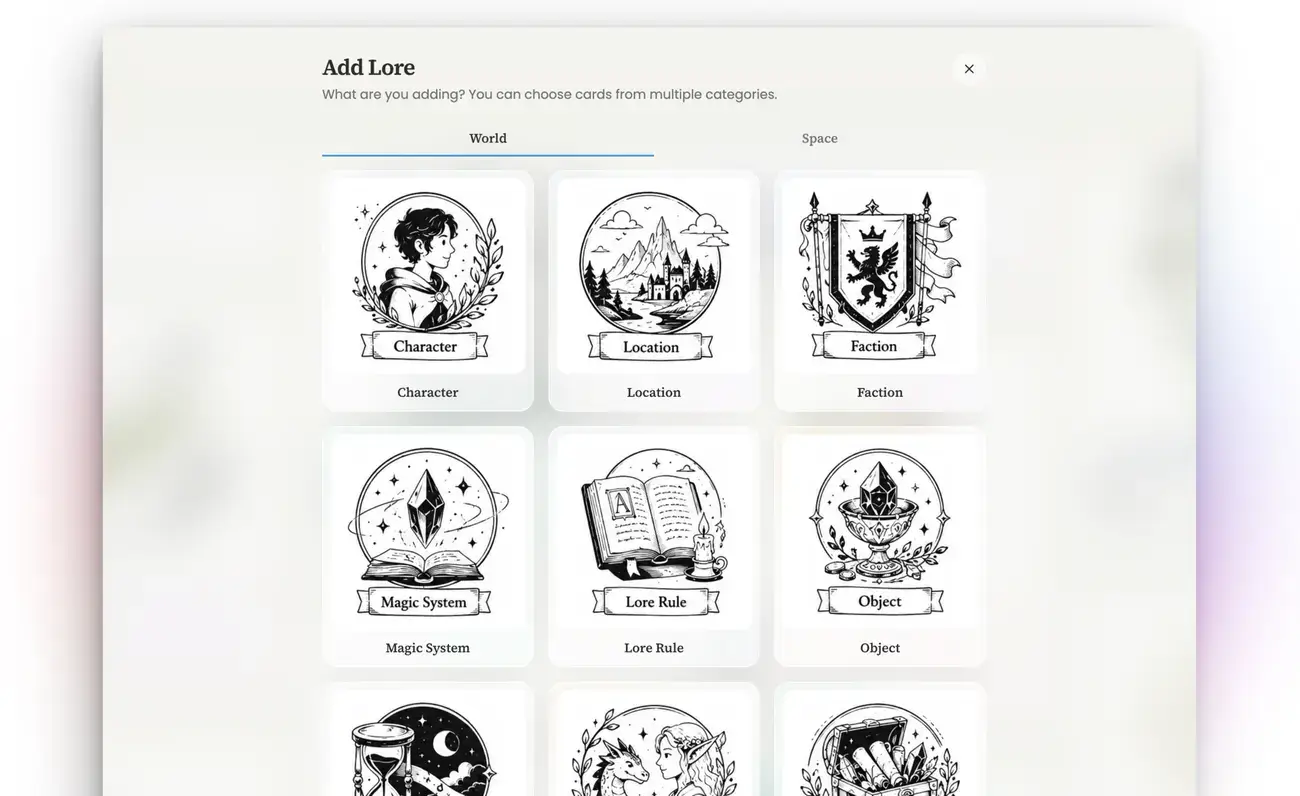
Storyloft worldbuilding lore categories menu for creating characters, locations, factions, technology, history, magic systems, artifacts, and other manuscript lore
Choose a lore category in Storyloft to create and organize the characters, locations, factions, history, technology, magic systems, and rules behind your manuscript’s fictional world.

Characters and Species

Track names, appearances, goals, abilities, histories, and relationships so your characters stay consistent.

Locations and Civilizations

Build cities, kingdoms, planets, landmarks, cultures, governments, and the places where your story unfolds.

Factions and Governments

Define groups, leaders, alliances, rivalries, beliefs, and the conflicts that move your story forward.

Magic, Science, and Technology

Create magic systems, scientific rules, ships, weapons, energy sources, AI, and other important systems.

Timelines and History

Record wars, discoveries, migrations, disasters, political changes, and key moments from the past.

Rules, Objects, and Canon

Save universal laws, social customs, resources, artifacts, tools, relics, and the truths your story must follow.

Build your way

Visual Worldbuilding with Cards, Tables, Relationship Maps, and 3D

Some authors think in pictures. Some love tables. Others need to see how every part connects. Storyloft lets you move between each view without rebuilding your work.

Collect your ideas

Create a visual home for your lore.

Add the people, places, events, systems, images, notes, links, and references that shape your world.

  • Visual cards with covers and useful details
  • Tags, groups, filters, and fast search
  • Images, video links, notes, and references

Fantasy and science fiction worldbuilding

Fantasy and Science-Fiction Worldbuilding Software

Choose a helpful starting point, then make it your own. Storyloft supports rich fantasy worlds, deep science-fiction settings, and everything between.

Build a world

Fantasy worldbuilding

Create the people, powers, places, cultures, and histories behind your story.

  • Characters
  • Locations
  • Factions
  • Magic systems
  • Species
  • Lore rules
  • Artifacts
  • Timelines

Build a universe

Science-fiction worldbuilding

Design the systems, discoveries, worlds, and powers that hold your universe together.

  • Star systems
  • Planets
  • Species
  • Governments
  • Technology
  • Universal laws
  • Economies
  • Ecology
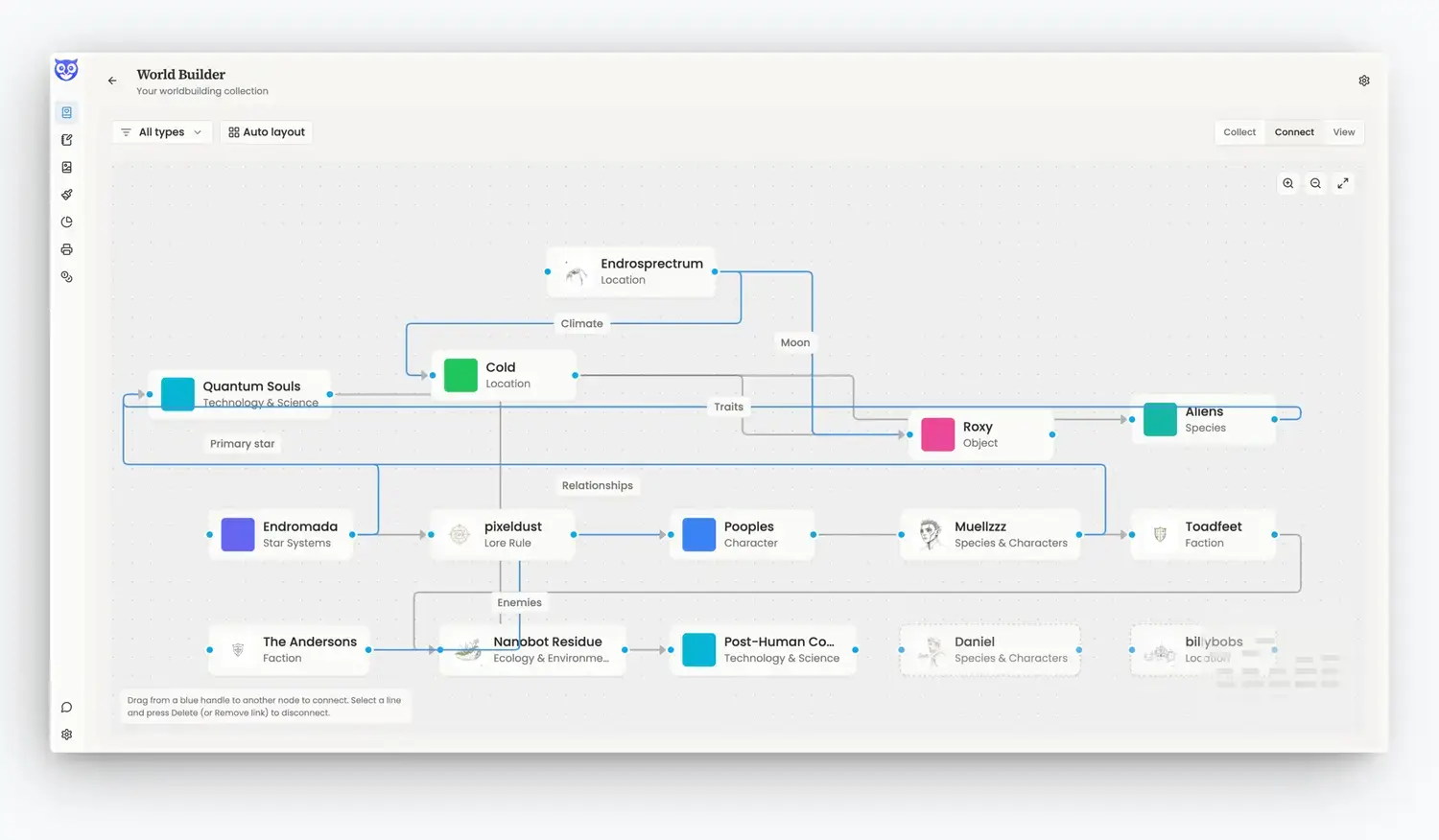
Storyloft worldbuilding flowchart connecting characters, locations, factions, lore, and chapter plans to help authors analyze complex story relationships
Visualize how characters, locations, factions, lore, and manuscript chapters connect with Storyloft’s worldbuilding flowchart and story-planning tools.
Lore visuals

Create Worldbuilding Images and Visual References

Worldbuilding feels more real when you can see it. Upload your own art, save visual references, or let Storyloft create an image from the name and description you provide.

Build portraits for characters, picture important locations, and give ships, artifacts, and inventions a look of their own.

Eddy the Owl with a visual worldbuilding character in Storyloft
Tech Tree Studio

Build Science-Fiction Technology Trees

Great science-fiction technology should feel connected. One discovery leads to the next. A new ship needs a better engine. A powerful weapon may need a new energy source.

Map those steps in Storyloft’s Tech Tree Studio. Build branches, set required discoveries, and work through new ideas with Eddy.

Where Storyloft is different

Build your world inside your manuscript.

Connect your characters, locations, factions, timelines, and lore directly to your book—so you can write, revise, and check continuity in one workspace.

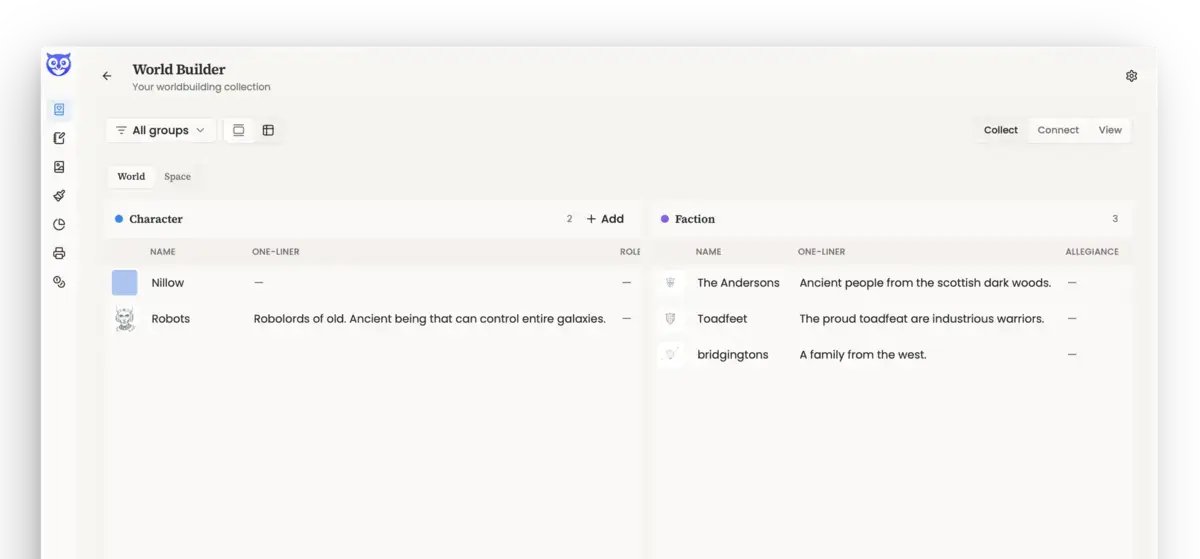
Storyloft worldbuilding lore table view for managing and editing characters, locations, factions, timelines, and other story elements in an Excel-like grid
Storyloft lets authors manage worldbuilding lore in an editable table view. Updating a cell automatically updates the connected lore entry throughout the project.

Worldbuilding inside your manuscript

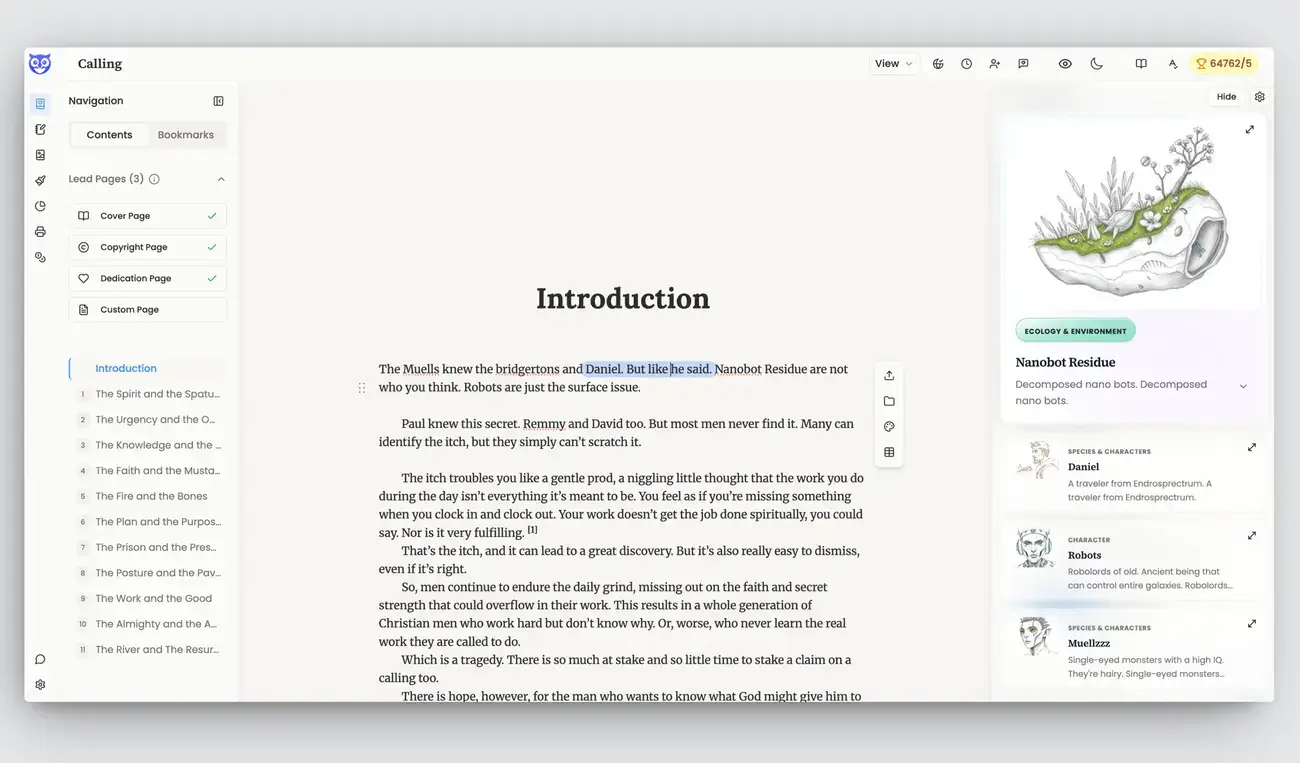
Your canon can help while you write.

The right details stay close at hand, so you can keep writing instead of digging through another app.

In-manuscript lore

See your lore when it matters.

When your manuscript mentions a known character, location, faction, object, or other part of your world, Storyloft can recognize it.

Open the connected lore card without leaving the editor. Check a detail, review a relationship, or jump into the larger world around it.

Continuity checks

Catch mistakes before your readers do.

A character should not have blue eyes in one chapter and green eyes in another. A magic power should not break the rules you set earlier.

Storyloft can compare a passage with the lore in World Builder and offer a gentle continuity check. You choose whether to review it, dismiss it, or turn it off.

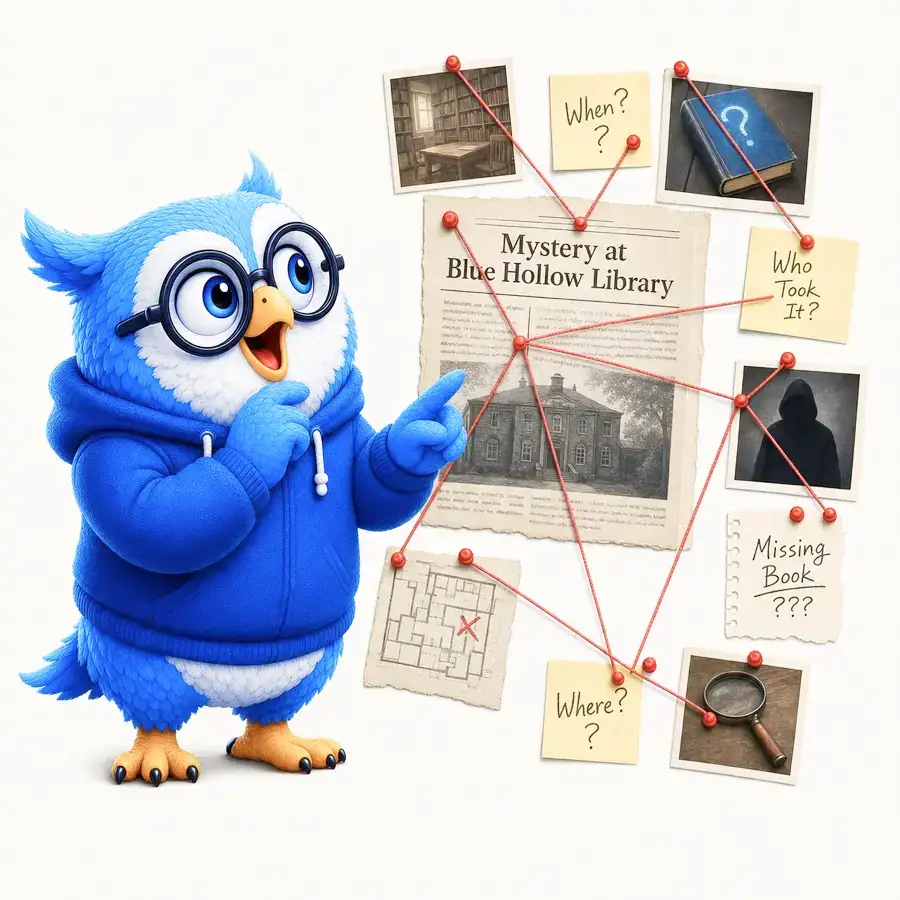
Eddy the Owl checking story lore and continuity in Storyloft World Builder
Lore Update

Change your canon without losing track of the book.

Worlds change while we write. You may rename a character, move a city, or add a new limit to a magic system.

Storyloft can find places in the manuscript that may need to change too. Clear updates can be made for you. When the meaning is not clear, Eddy shows you the passage and asks what to do.

Eddy + World Builder

Ask questions about your world and your book.

Eddy can search your manuscript, World Builder lore, and notes together. It can show where details agree, where they conflict, and where something may be missing.

Does this scene break a rule in my world?
How are these two factions connected?
Where have I mentioned this artifact?
What lore has not appeared in the book?

Built for growing stories

Worldbuilding Software for Book Series

Your world may start with one character and one location. Then it grows. Storyloft helps your canon stay clear as the story becomes bigger.

Keep a large world easy to understand.

Move from the big picture to one small detail. Browse, filter, compare, connect, and explore without losing the thread of your story.

Filter by type Find the exact group of lore you need.
Compare details Use tables to review many items at once.
Map relationships See how people, places, and events connect.
Explore in 3D Step back and see the larger shape of your world.

World Builder questions

Frequently asked questions

What is Storyloft World Builder?

World Builder is Storyloft’s worldbuilding software for authors. It helps you create, organize, connect, and explore the people, places, rules, histories, and systems behind a manuscript.

Can I use it for fantasy and science fiction?

Yes. Storyloft includes flexible starting points for fantasy worlds and science-fiction universes, including characters, factions, magic, planets, technology, species, timelines, artifacts, and more.

How is Storyloft different from other worldbuilding tools?

Your worldbuilding is connected to the manuscript. Storyloft can surface lore while you write, compare passages with your canon, and help update the book when important lore changes.

Can Storyloft help with story continuity?

Yes. Storyloft can compare a passage with the lore saved in World Builder and offer a continuity check when details may not agree.

Can I add images and reference material?

Yes. Lore cards can include images, notes, links, videos, and other reference material. Storyloft can also create a visual from the name and description of a lore item.

Does World Builder work for a book series?

World Builder is designed to keep growing lore organized. Authors can filter by type, compare details in tables, map relationships, and explore large networks in 3D.

One world. One manuscript. One source of truth.

Build a world that writes with you.

Keep your characters, places, histories, rules, relationships, and systems in one connected workspace—then take that world with you into every chapter.

Free to start. No credit card required.
Eddy the Owl with Storyloft lore notes
Worldbuilding software comparison

Storyloft vs. World Anvil, Campfire, Plottr, Novelcrafter, and Scrivener

The best worldbuilding software depends on whether you primarily want to publish an interactive world, build detailed lore, visually outline a series, organize a manuscript, or connect your story canon directly to the writing process.

Storyloft is worldbuilding and book-writing software for authors. It combines structured lore, manuscript writing, visual relationship mapping, AI-assisted continuity checks, canon updates, illustrations, and book production in one connected workspace.

Feature comparison of Storyloft, World Anvil, Campfire, Plottr, Novelcrafter, and Scrivener for authors and worldbuilders
Capability Storyloft World Anvil Campfire Plottr Novelcrafter Scrivener
Structured world bible and lore database Included Lore cards, custom categories, tables, tags, media, references, filters, and search. Included Wiki-style articles, templates, cross-links, family trees, calendars, maps, and timelines. Included Modular tools for characters, cultures, languages, locations, magic, religions, species, and other lore. Included Character sheets, places, notes, custom attributes, tags, and a series bible. Included Codex entries, custom categories, custom details, references, aliases, tags, and shared series lore. Manual setup Authors can organize lore with folders, documents, research, metadata, keywords, and templates.
Full manuscript editor Included Write, revise, edit, and organize the manuscript beside the connected world. Included Manuscripts supports writing, plotting, editing, exporting, and publishing on eligible plans. Included Manuscript writing is integrated with Campfire’s modular worldbuilding environment. Separate app required Outlines export to Microsoft Word or Scrivener for manuscript drafting. Included Drafting, planning, reviewing, and AI-assisted writing are built into the platform. Included Long-form writing, outlining, research, revision, and compiling are core Scrivener functions.
Lore available inside the manuscript Automatic recognition Storyloft recognizes known lore and opens its connected card without leaving the editor. Integrated World Anvil Manuscripts integrates directly with its world bible. Linked references Worldbuilding elements can be linked and opened while drafting. External reference Plottr is generally kept open beside the manuscript as a planning and reference tool. Automatic mentions Names, aliases, locations, and objects can be detected and linked to Codex entries. Manual reference Writers use project documents, split view, search, notes, and metadata to reference story information.
Visual relationship and story mapping Included Connect characters, locations, factions, events, technology, lore, and manuscript chapters in visual networks and flowcharts. Included Diplomacy webs, family trees, whiteboards, timelines, and interactive maps visualize connections. Included The Systems Module builds flowcharts connecting systems, groups, scenes, and plot beats. Included Visual timelines, scene cards, family trees, series views, and character-arc tools support story planning. Entry relations Codex relations connect related entries and control which context is supplied to the AI. General outlining Corkboards and outliners organize scenes; freeform relationship mapping is available through the separate Scapple application.
Interactive 3D worldbuilding view Included Explore lore as an interactive 3D constellation and follow relationships across the world. Not publicly listed World Anvil emphasizes maps, timelines, trees, whiteboards, and interconnected articles. Not publicly listed Campfire emphasizes modular panels, interactive maps, timelines, calendars, and flowcharts. Not publicly listed Plottr focuses on two-dimensional timelines, cards, trees, and series-planning views. Not publicly listed Novelcrafter emphasizes the Codex, planning matrices, manuscript mentions, and AI context. Not included Scrivener uses document, corkboard, and outliner views.
AI using manuscript and worldbuilding context together Included Eddy can search the manuscript, notes, and World Builder lore together. Not a core listed feature World Anvil’s public materials emphasize world organization, presentation, writing, and community tools. Not a core listed feature Campfire’s public worldbuilding materials emphasize modular planning, writing, collaboration, and publishing. No built-in AI Plottr publicly positions itself as a non-AI outlining and planning platform. Included AI can use Codex entries, manuscript context, chats, and selected story information. No built-in AI Scrivener is primarily a manuscript-writing and project-management application.
Continuity checks against established canon Built in Storyloft can compare a manuscript passage with saved lore and identify possible contradictions. Author-managed The integrated world bible keeps canon available, but automated passage-to-canon checks are not publicly listed. Author-managed Linked worldbuilding supports manual review; automated canon checks are not publicly listed. Manual planning Series bibles, editing notes, timelines, and character sheets help authors review consistency manually. AI-assisted Codex context, progressions, mentions, planning modes, and AI can help identify inconsistent story information. Manual review Writers rely on search, notes, metadata, project documents, and external editing tools.
Find manuscript passages affected by a canon change Built in Lore Update finds passages that may need revision after a character, location, rule, or other canon detail changes. Search manually Integrated articles and manuscript search can support the process, but automated canon-change updates are not publicly listed. Search manually Linked lore can be referenced while revising, but automated affected-passage updates are not publicly listed. External manuscript The author updates Plottr and then revises the manuscript in the separate writing application. Mentions and progressions Automatic mentions show where entries appear, while progressions track how details change over time. Search manually Project search can locate terms and references, but canon changes remain author-managed.
Specialized visual worldbuilding tools Broad visual system Cards, tables, flowcharts, relationships, generated visuals, 3D exploration, and science-fiction technology trees. Broad visual system Interactive maps, timelines, calendars, family trees, diplomacy webs, whiteboards, and multimedia articles. Broad modular system Maps, timelines, calendars, systems, languages, cultures, magic, religions, items, and species. Planning-focused Timelines, scene cards, templates, family trees, character sheets, and series views. Codex-focused Codex cards, custom details, entry relations, progressions, mentions, and planning matrices. Manuscript-focused Corkboards, outliners, collections, labels, metadata, and research organization.

Storyloft vs. World Anvil

World Anvil is especially strong for interactive world encyclopedias, maps, timelines, RPG campaigns, and publishing lore for an audience. Storyloft is designed around the author’s manuscript, with continuity checks, canon-change workflows, visual relationship analysis, AI assistance, and finished-book production in the same platform.

Storyloft vs. Campfire

Campfire offers one of the deepest modular worldbuilding systems for cultures, languages, religions, maps, timelines, and fictional systems. Storyloft places more emphasis on using that lore inside the manuscript through AI analysis, continuity checking, canon updates, 3D exploration, illustrations, and publishing tools.

Storyloft vs. Plottr

Plottr is primarily visual outlining and series-bible software. It is a strong option for timelines, scene planning, templates, and character organization, but authors generally export their plan and write in Word or Scrivener. Storyloft keeps the outline, lore, and manuscript in one connected writing environment.

Storyloft vs. Novelcrafter

Novelcrafter is the closest comparison for manuscript-aware worldbuilding and Codex-informed AI. Storyloft extends that connected approach into visual cards, comparison tables, relationship flowcharts, interactive 3D exploration, generated lore visuals, technology trees, continuity workflows, cover design, and book formatting.

Storyloft vs. Scrivener

Scrivener is built for organizing and drafting long manuscripts. Authors can create their own worldbuilding structure with folders, notes, metadata, and research documents. Storyloft adds a dedicated lore database, automatic manuscript connections, relationship mapping, continuity checks, and manuscript-aware AI.

Which worldbuilding software is best for authors?

Authors should choose based on their workflow. World Anvil emphasizes expansive and publishable worlds. Campfire emphasizes detailed modular lore. Plottr emphasizes visual planning. Novelcrafter emphasizes an AI-connected Codex. Scrivener emphasizes manuscript control. Storyloft is built for authors who want to worldbuild, write, check continuity, revise canon, illustrate, format, and publish without moving between separate applications.

Feature comparison based on publicly available product information reviewed August 1, 2026. Features may vary by subscription level, platform, and product version. “Not publicly listed” means the feature was not identified in the vendor’s published feature materials; it does not necessarily mean the capability is impossible through manual workflows or integrations.

Build the world. Write the manuscript. Keep them connected. Storyloft brings your lore, chapters, relationships, continuity, editing, illustrations, and finished book into one author workspace.

Start Building Your World
Worldbuilding resources

Worldbuilding guides for authors

Learn how to create believable fictional worlds, organize your story canon, develop memorable characters, plan fantasy and science-fiction settings, and keep every detail connected to the manuscript.

Worldbuilding is the process of creating the characters, locations, cultures, histories, systems, rules, and relationships behind a fictional setting. These practical guides help authors build richer worlds without allowing lore to overwhelm the story.