What Is Man vs Nature Conflict and Why It Still Matters
You're halfway through a novel, essay, or film, and a character suddenly has nowhere to go. A storm cuts off the road. The sea turns hostile. The temperature drops, food disappears, or an animal begins tracking the group. The question isn't merely whether the character will survive. It's whether the natural world will force that person to abandon an old way of thinking.
That's the heart of man vs nature conflict. It's one of the most recognizable patterns in storytelling, but the familiar label hides important complications. Nature may act as an antagonist, a condition, a mirror for human choices, or a living system that resists the idea of human control. Contemporary climate fiction has pushed the conflict even further, toward adaptation, responsibility, coexistence, and non-human perspectives.
Table of Contents
- A Clear Definition of Man vs Nature Conflict
- Where the Idea Came From
- How the Conflict Actually Works on the Page
- Famous Examples Worth Studying
- Why the Label Is Changing
- Writing Man vs Nature Conflict Well
- The Environmental Framing Question
- Common Questions About Man vs Nature Conflict
A Clear Definition of Man vs Nature Conflict
A sailor sees a squall building across the horizon. The wind changes direction, the deck tilts, and the route toward harbor becomes dangerous. The sailor can't persuade the storm to wait, expose a secret weakness in it, or defeat it in the way a hero might defeat a rival. The only possible response is to read the conditions, make decisions, and survive the consequences.
Man vs nature conflict is a narrative opposition between a human protagonist and forces of the natural world. Those forces may include storms, wilderness, predators, disease, famine, difficult terrain, or isolation. The conflict becomes central when the environment actively obstructs what the protagonist wants, placing survival, goal completion, or personal transformation at risk.
The word “man” means humankind in this traditional phrase. It isn't limited to male characters, and many writers now prefer terms such as person vs nature, character vs environment, or humanity vs the natural world. “Nature” also has a broad meaning. It can refer to weather and the environment, but it can include animals, disease, the ocean, extreme temperatures, or ecological systems.
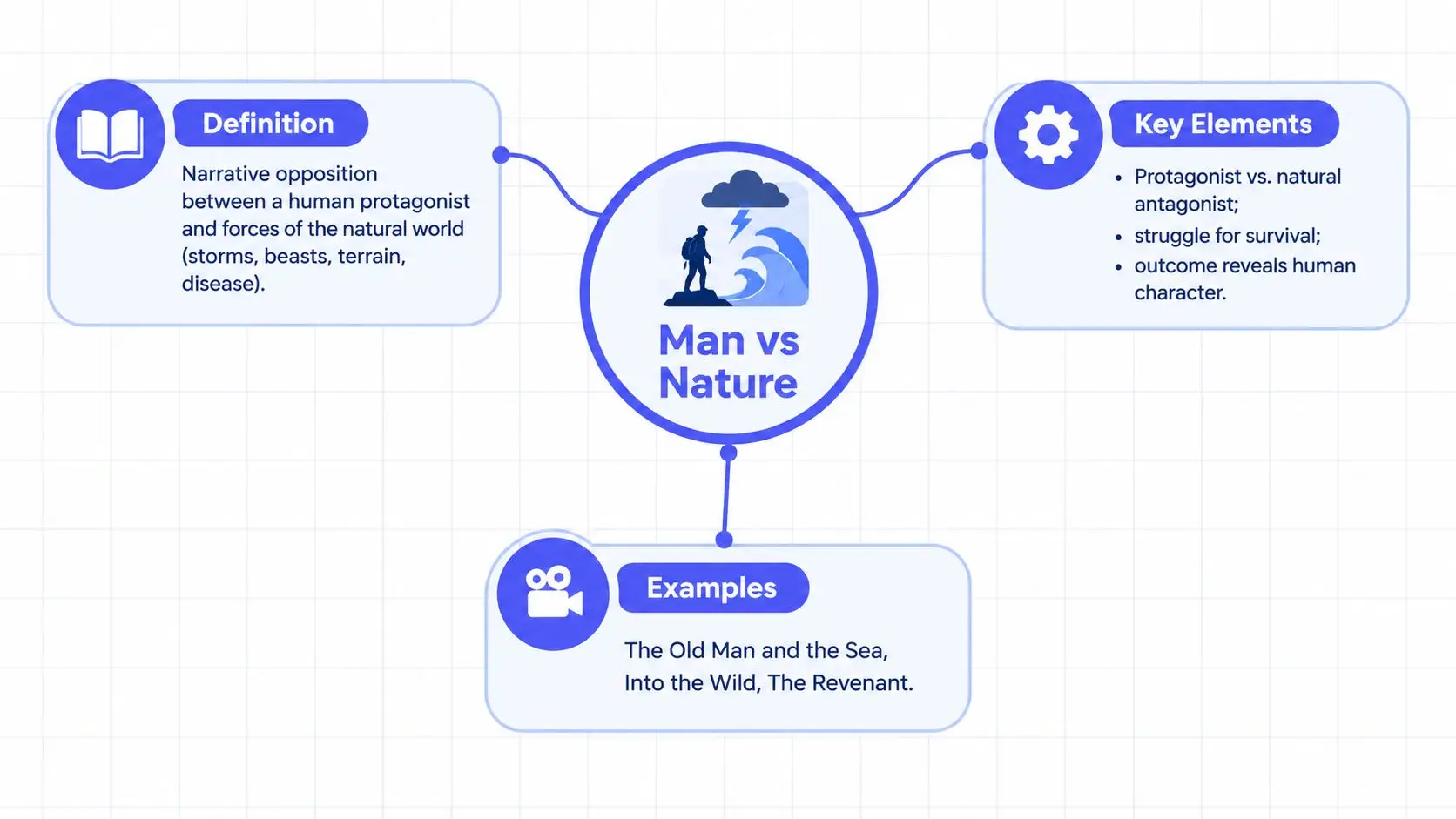
The environment must resist
A forest in the background doesn't automatically create man vs nature conflict. A novel can contain beautiful nature writing, a detailed setting, or a peaceful rural countryside without placing the character in opposition to the environment. Nature qualifies as an opposing force when it interferes with the protagonist's goal.
A character trying to cross a flooded river faces man vs nature. A character remembering childhood beside a river may be involved in memory, identity, or family conflict instead. The same setting can support different conflict types, depending on what it does in the plot.
Where it sits among literary conflicts
This conflict belongs to the classic family of narrative oppositions, alongside man vs man, man vs self, and man vs society. A survival story may contain all four at once. A stranded character might fight the weather, doubt their own judgment, resist a group's rules, and compete with another survivor.
The useful test is simple: What force keeps the protagonist from reaching the goal? If the answer is a natural condition or non-human force, man vs nature is part of the story's structure.
Where the Idea Came From
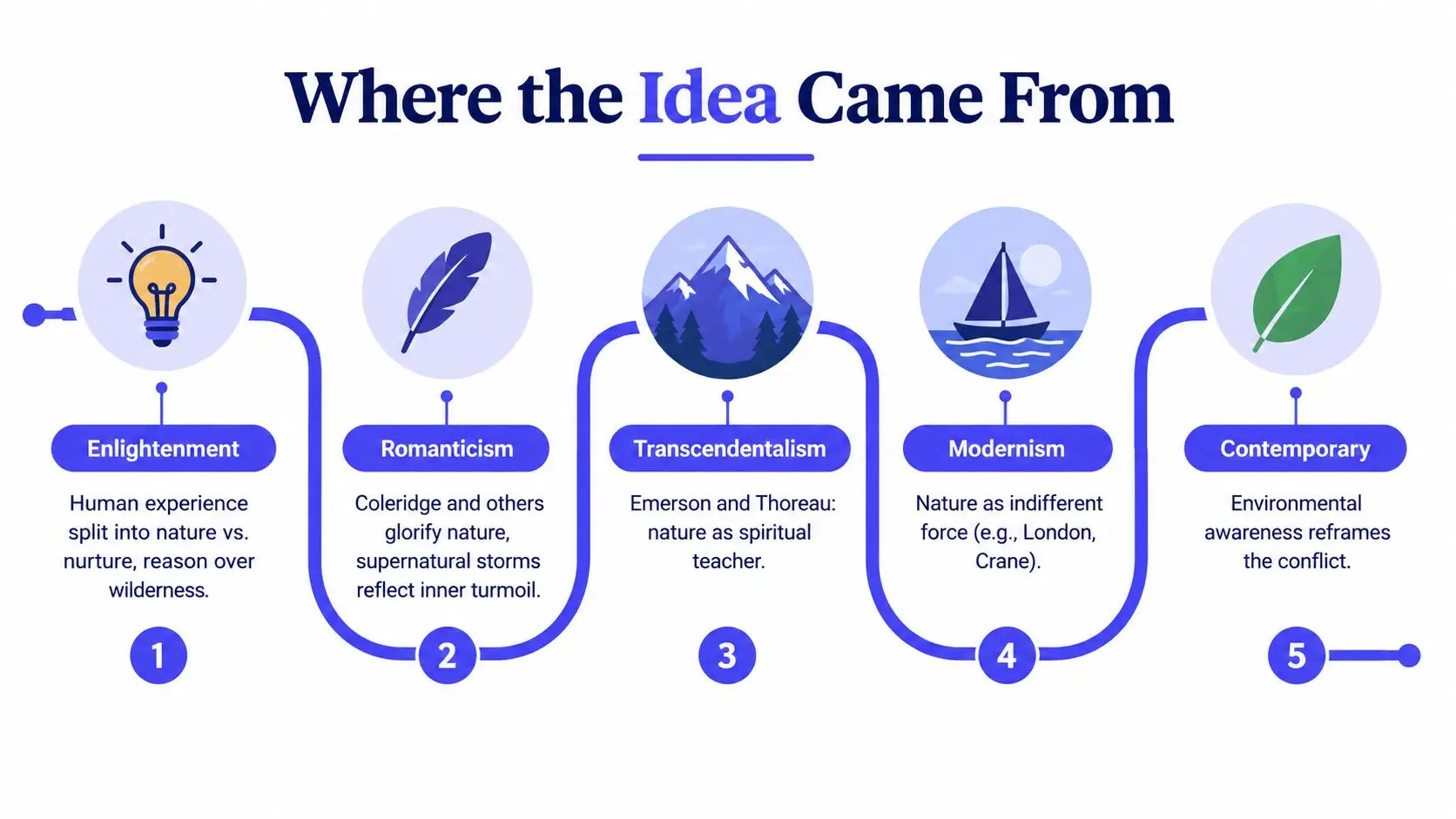
The literary pattern didn't appear in isolation. It grew from a wider intellectual tradition that asked how much of human life comes from internal qualities and how much comes from forces outside a person's control. In European thought, the older nature versus nurture debate was popularized through John Locke's 1690 work An Essay Concerning Human Understanding and later became associated with Francis Galton's nineteenth-century coinage of the phrase “nature versus nurture.” The connection matters because it placed environment, heredity, and survival pressure inside broader arguments about human development. (Conflict in narrative))
Literature gradually turned those abstract questions into physical situations. Daniel Defoe's Robinson Crusoe, published in 1719, gave English-language fiction a durable template for isolation and resourcefulness. Crusoe doesn't merely admire the island. He inventories it, builds shelter, finds food, and turns unfamiliar surroundings into a sequence of practical problems.
From survival to existential struggle
Later writers changed what the natural world meant. In Herman Melville's Moby-Dick, published in 1851, the sea and the white whale become more than obstacles. They challenge the possibility that human beings can impose a clear meaning on an indifferent world. Jack London's “To Build a Fire,” published in 1908, strips the pattern down to cold, judgment, and bodily limitation. Peter Benchley's Jaws, published in 1974, uses the ocean and an unseen shark to turn an ordinary public space into a source of dread.
The progression reveals a changing view of human agency. Crusoe treats nature as a problem that disciplined labor can organize. Melville questions whether organization and determination are enough. London emphasizes the limits of intelligence when the body fails. Benchley shows how fear grows when people cannot see or understand the force threatening them.
The tradition remains active because later writers have added ecological consequences. The Intergovernmental Panel on Climate Change Sixth Assessment Report concluded across its 2021 to 2023 assessment cycle that human influence has warmed the atmosphere, ocean, and land, with many changes already widespread and rapid. Contemporary stories therefore often present nature not as a fixed backdrop but as an unstable system affected by human action.
Historical insight: The conflict has evolved from “Can a person master the wilderness?” to “What happens when human choices alter the system that sustains everyone?”
How the Conflict Actually Works on the Page
Nature behaves differently from a human villain because it doesn't negotiate. A storm can't be bribed. A glacier doesn't care about a protagonist's moral argument. An animal may respond to movement or scent, but it doesn't usually pursue a social objective that the hero can uncover and defeat.
That creates an adversarial system with asymmetric constraints. The protagonist acts under uncertainty while environmental conditions reduce the available choices through fatigue, hypothermia, dehydration, displacement, or injury. Literary survival narratives often place characters in natural disasters, wildlife encounters, or situations where they're lost at sea or in the wilderness. (A practical guide to man vs nature conflict)
A survival model
A strong story usually gives the character a clear goal, such as reaching shelter, finding another person, protecting a community, or escaping an environment. The natural force then obstructs that goal and raises the cost of every attempted solution.
| Dimension | Human Antagonist | Natural Force |
|---|---|---|
| Intention | Usually has a conscious objective | May have no human intention |
| Communication | Can threaten, deceive, bargain, or explain | Offers signs, patterns, or silence |
| Weakness | Often personal, emotional, or strategic | Usually tied to conditions and limits |
| Escalation | Driven by choices and retaliation | Driven by worsening conditions or consequences |
| Resolution | Defeat, reconciliation, escape, or compromise | Adaptation, survival, loss, or changed understanding |
The protagonist's choices still matter. Conserving energy, improving shelter, preserving heat, and prioritizing life-critical resources can change the outcome. But success usually means adapting behavior to local conditions, not defeating nature outright. A character's motivation determines which risks seem acceptable, and a useful guide to what makes a character's motivation work can help writers connect physical survival to emotional purpose.
Obstacle or condition
Nature can operate as an obstacle, such as a predator, storm, avalanche, or flood. It can also operate as a condition, such as prolonged isolation, scarcity, darkness, or entropy. The first mode produces visible confrontations. The second creates pressure that accumulates until the character's habits, beliefs, or body begin to break down.
The strongest examples often combine both modes. The storm blocks the route, while exhaustion changes the sailor's judgment. The animal creates immediate danger, while the surrounding wilderness removes every easy place to hide.
Famous Examples Worth Studying
Canonical examples are valuable because each one makes a different decision about how nature should appear. Some stories make the environment practical and manageable. Others make it mysterious, symbolic, or terrifying precisely because it refuses to become fully knowable.
| Work | Antagonist | Personification | Stakes | Narrative Effect |
|---|---|---|---|---|
| Robinson Crusoe | Isolated island and its conditions | Low to moderate | Survival and self-sufficiency | Turns wilderness into a practical system |
| Moby-Dick | The sea and white whale | High but unstable | Revenge, life, and meaning | Expands survival into philosophical obsession |
| “To Build a Fire” | Extreme cold | Minimal | The body's survival | Makes environment feel indifferent and final |
| Jaws | The ocean and shark | Limited | Public safety and human fear | Uses what remains unseen to create suspense |
Robinson Crusoe
Defoe's island becomes a workshop for human resourcefulness. Crusoe measures, gathers, builds, stores, and plans. His response gives nature a practical shape, as though the environment were a problem that could be divided into tasks.
Craft lesson: Specific labor creates credibility. The reader believes survival because the character performs visible, difficult work.
Moby-Dick
Melville's whale is an animal, but Captain Ahab's obsession gives it a symbolic charge. Ahab treats the whale as if it were a personal enemy, yet the whale doesn't share that emotional framework. The resulting irony is central: Ahab's attempt to conquer nature reveals more about human rage than about the whale.
Craft lesson: Personifying nature can deepen a story, but it can also expose the protagonist's projection.
For a broader overview of how different works use opposing forces, compare these examples with conflict in literature examples.
“To Build a Fire”
Jack London removes much of the comfort that human language provides. The cold doesn't need a personality. It only needs to remain cold while the protagonist makes one wrong decision after another. The environment becomes powerful because it follows consistent physical rules rather than dramatic intention.
Craft lesson: An impersonal force can create intense suspense when the reader understands its consequences before the character does.
Jaws
Benchley makes the ocean threatening partly through absence. The reader and characters can't always see the shark, so ordinary water becomes psychologically charged. The natural antagonist operates both as a physical animal and as an uncertainty that changes how people interpret every movement on the surface.
Craft lesson: Concealment turns setting into suspense. The less the character knows, the more carefully the writer must control clues.
Why the Label Is Changing
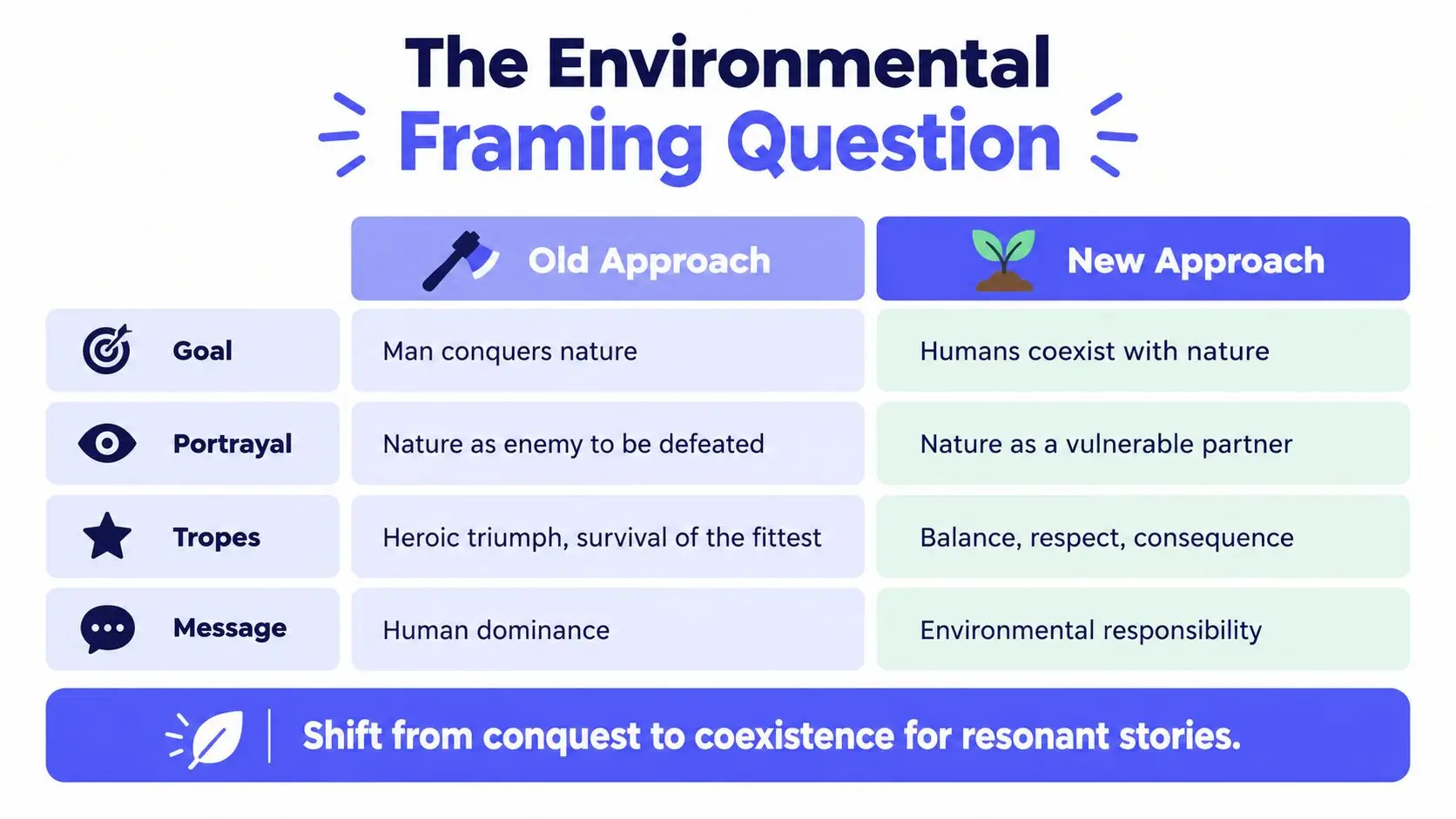
The phrase man vs nature carries a built-in image of domination. It sounds as though a human stands on one side and the natural world stands on the other, with victory belonging to whoever proves stronger. That framing suited many older adventure narratives, but it can flatten stories in which people depend on land, animals, weather, and ecological systems rather than existing outside them.
Contemporary ecological fiction often shifts the central question from conquest to relationship. A forest isn't merely an obstacle between a character and a destination. It may be a home, a source of food, a damaged community, or a system whose survival is linked to the protagonist's own. This approach also creates room for non-human perspectives and narratives in which adaptation matters more than triumph.
The terminology debate
Many writers prefer person vs nature because it avoids the gendered sound of “man.” Others use character vs environment because it identifies the narrative function more precisely. “Ecological conflict” may be even more useful when the story focuses on pollution, resource extraction, climate disruption, or the consequences of human systems.
No single term solves every problem. The older phrase remains widely understood, while newer terms remind readers that humans aren't automatically separate from the environments they inhabit. The label is therefore both a classification tool and an ethical choice.
Beyond a simple binary
Indigenous and postcolonial writing can complicate the opposition by presenting land as relation, ancestor, community, or responsibility rather than empty wilderness. These perspectives challenge the assumption that a protagonist arrives in nature as an isolated individual with the right to claim, measure, or conquer it.
The most compelling contemporary stories often ask not whether humans can defeat nature, but whether humans can learn to live without treating relationship as ownership.
That shift doesn't erase danger. Storms still destroy homes, animals still threaten people, and disease still creates suffering. It changes the moral meaning of the struggle, making coexistence, reciprocity, and accountability central to the narrative.
Writing Man vs Nature Conflict Well
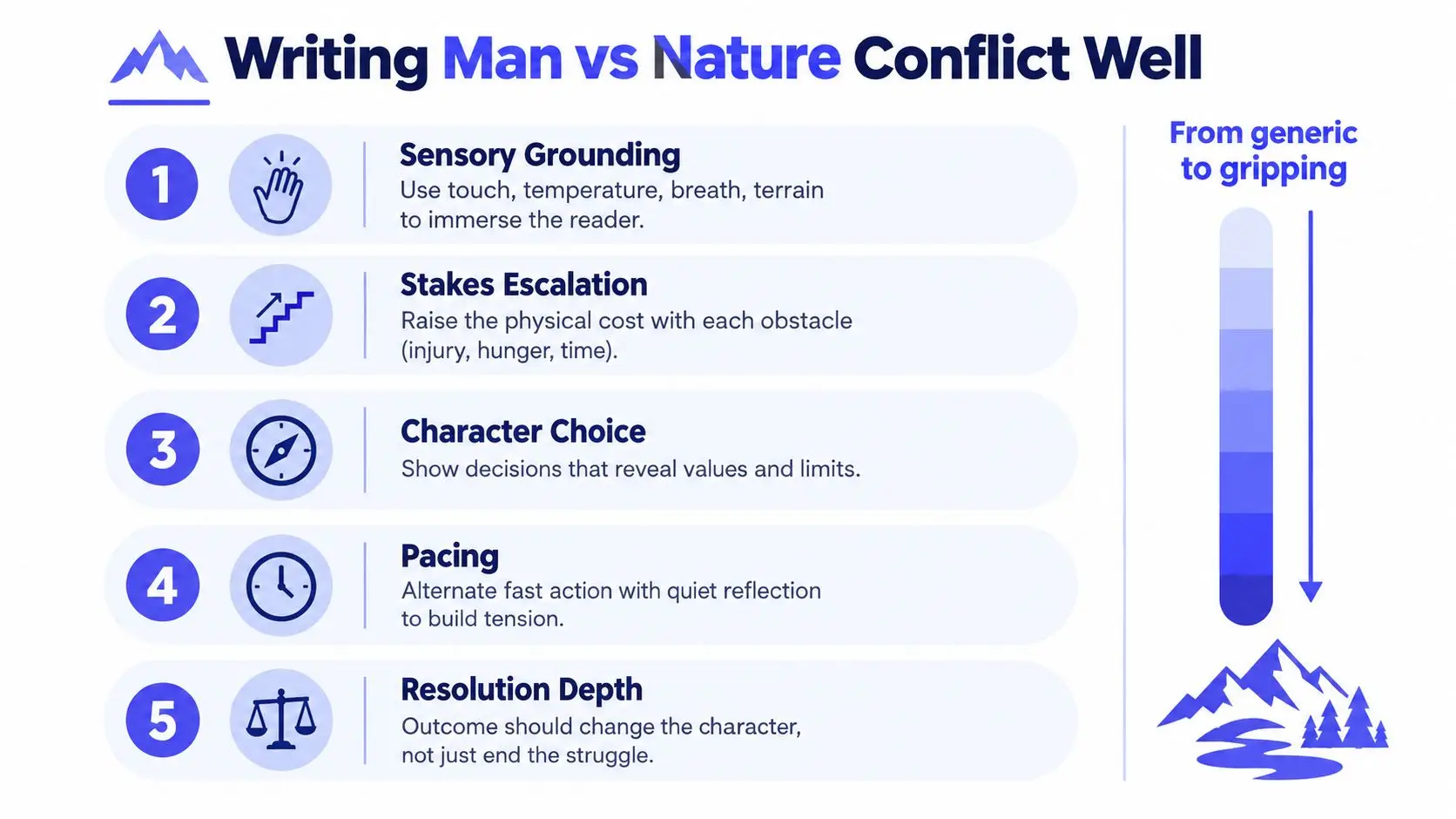
A convincing environmental conflict begins in the body. Give the reader the character's wet sleeves, shallow breath, numb fingers, unstable footing, or the sound of loose stones under a boot. “Bad weather” is an idea. A character whose breath freezes against a scarf is an experience.
Ground the reader in physical evidence
Choose sensory details that affect decisions. Cold should influence dexterity, energy, and judgment. Rough terrain should alter speed and route. Smoke, salt, insects, darkness, or rising water should change what the character can perceive.
Then give the environment consistent behavior. Random danger feels like authorial punishment, while a recognizable pattern allows readers to understand cause and effect. If the tide rises according to a visible rhythm, the protagonist can plan around it. If the plan fails, the failure feels earned.
Escalate through choices
A useful sequence might look like this:
- Establish a goal: The character needs to reach shelter before nightfall.
- Introduce a constraint: A damaged map forces a detour.
- Make the cost physical: The detour consumes energy or damages equipment.
- Create a moral choice: The character can save supplies or help someone else.
- Change the character: Survival reveals what the character values more than comfort.
The environment should respond to decisions without becoming a mindless bully. If every attempt fails only because conditions become harsher, the story loses shape. Let the character succeed sometimes, but make each success temporary and dependent on continued attention.
Avoid two common failures
Nature as decoration appears when the setting looks vivid but never affects the plot. Remove the scenery and the story would unfold almost unchanged.
Nature as bully appears when the writer piles on disasters without giving the character meaningful agency. The solution isn't to make nature kinder. It's to make the protagonist's decisions more consequential.
Use pacing with care. Fast action can show immediate danger, while quiet reflection reveals the psychological cost of isolation. A resolution shouldn't merely end the storm. It should show what the character now understands, accepts, or refuses.
For writers managing research, character details, and scene revisions in one place, Storyloft combines a long-form manuscript editor with planning tools, AI-assisted revision, illustration, cover design, and publishing workflows. Its character and villain guidance can also help distinguish a natural force from a human antagonist.
Before revising, ask whether the environment changes the plot, whether each obstacle follows an understandable rule, and whether the outcome transforms the character rather than rewarding endurance.
The Environmental Framing Question
Environmental responsibility changes how writers should frame this conflict. The older “human conquers wilderness” model can produce a clear adventure arc, but it often treats the natural world as a blank opponent waiting to be subdued. That approach can also reduce complex ecosystems to a single punishing force, sometimes described through the cliché of “Mother Nature” as a deliberate enemy.
Three framing modes help clarify the difference.
| Framing mode | Central idea | Common risk |
|---|---|---|
| Survival as spectacle | The environment supplies danger and excitement | Nature becomes scenery for heroic suffering |
| Conquest and triumph | The protagonist proves mastery | Human dominance replaces ecological complexity |
| Ecological reckoning | Human choices and natural consequences interact | The story may become symbolic without enough character pressure |
Replace mastery with adaptation
A writer can preserve suspense without celebrating domination. Show people learning local patterns, sharing resources, repairing damage, or accepting limits. Let the environment contain many forms of life instead of serving as an empty stage for one human hero.
An ecological story also benefits from non-human agency. That doesn't require giving a forest human dialogue. It can mean showing how water moves, how animals respond to noise, how a damaged habitat changes behavior, or how human infrastructure redirects natural processes.
For readers interested in how creative work has shaped public ideas about the environment, this overview of environmental art meaning and history offers useful context beyond literary fiction.
Make consequences visible
Climate fiction has made it harder to pretend that nature is separate from human systems. A flood may be natural in its immediate force, but the vulnerability of a neighborhood can depend on planning, inequality, infrastructure, and political choices. A drought can become a conflict about migration, labor, food, or ownership as much as water.
Writers can therefore ask two questions at once: What does the environment do, and who has helped create the conditions of danger? Keeping both questions active produces stories that feel less like contests between isolated opponents and more like accounts of shared consequences.
This doesn't make the conflict less dramatic. It gives the conflict a wider moral field. Tools for organizing characters, worldbuilding, and research inside a manuscript can help writers track those connections without reducing ecology to background information.
Common Questions About Man vs Nature Conflict
Why does the term still use “man”?
The phrase has a long history in literary education, so readers recognize it quickly. In this context, “man” refers to humanity rather than men specifically, but person vs nature is a clear modern alternative.
Should writers replace it with “person vs nature”?
Use the term that best describes the story and audience. “Person vs nature” is more inclusive, while “character vs environment” may be more precise when the conflict involves built spaces, climate systems, or ecological conditions.
How is it different from man vs society?
Man vs society places the character against laws, customs, institutions, or collective expectations. A character fleeing a discriminatory government faces society. A character trying to survive a blizzard faces nature. A story can contain both when social decisions create environmental danger.
How is it different from man vs self?
Man vs self centers on internal conflict, such as guilt, fear, addiction, or indecision. The environment may intensify that struggle, but it becomes man vs nature only when an external natural force actively blocks the character's goal.
Do animals count as natural antagonists?
Yes. Sharks, bears, predators, insects, and disease can all function as natural opposing forces. The key question is whether the story treats them as part of the natural world rather than as a humanlike villain with a social agenda.
Do magical landscapes count?
They can. A supernatural forest, living planet, or enchanted sea fits the category when the environment itself creates the opposing pressure. If the main conflict concerns a wizard, empire, or family, nature may be secondary even if the setting is magical.
Can man vs nature carry an entire novel?
Yes, especially when the environment keeps generating new decisions and the character changes in response. It also works well in short fiction, where one survival problem can reveal a complete pattern of judgment, fear, and acceptance. The conflict needs more than repeated danger. It needs a meaningful relationship between condition, choice, consequence, and transformation.
Storyloft gives authors one workspace for drafting long manuscripts, organizing research, refining scenes with AI-assisted editing, creating illustrations and covers, and preparing ebook or paperback outputs. Visit Storyloft to develop your own man vs nature story with its manuscript planning and publishing tools.