How to Write an Unreliable Narrator Readers Believe
You've written a narrator who sounds confident, vivid, and just slightly wrong. The problem is that “slightly wrong” can mean two very different things: a character with a limited point of view, or a narrator whose account actively misleads the reader. If you haven't decided which one you're writing, revision becomes guesswork. You add a suspicious detail, then another, then a dramatic revelation, hoping the final chapter will make the earlier uncertainty feel deliberate.
The stronger approach treats unreliability as a manuscript-wide design problem. The narrator's distortions need a cause, a recognizable pattern, and enough opposing evidence for readers to question the account without feeling tricked. The aim isn't to hide the truth at all costs. It's to make readers believe the narrator's version first, then understand why they believed it after the truth changes everything.
Table of Contents
- Why Unreliable Narrators Hook Readers When Done Right
- Choosing Your Narrator Type and Distortion Engine
- Building Voice and Planting Detectable Signals
- Structuring Clues and Timing the Reveal Without Cheating
- Revising and Testing Your Unreliable Narrator in Storyloft
- Keep Readers Trusting You After the Twist
Why Unreliable Narrators Hook Readers When Done Right
A narrator becomes compelling when readers can feel the gap between what the character says and what the story shows. The narrator may insist that a conversation went well, while the other person leaves shaken. They may describe themselves as protective, while their actions reveal control. They may remember an event with absolute confidence, even though small details refuse to stay consistent.
That gap creates active reading. Readers stop receiving information passively and start comparing testimony with behavior, dialogue, setting, and other characters' responses. The story becomes a negotiation between the narrator's account and the reader's growing interpretation.
The device has a longer history than the modern twist ending. The term unreliable narrator was coined by Wayne C. Booth in 1961 in The Rhetoric of Fiction, a milestone in the concept's formal study. Literary histories also trace important precursors to ancient Greek drama and the rise of realist fiction in the late 18th century, showing that the technique developed as a structural tension between a narrator's account and the work's implied norms, as discussed in this literary history of unreliable narration.
The difference between limited and unreliable
A limited narrator doesn't know everything. An unreliable narrator gives readers reason to distrust how they interpret, remember, select, or explain what they know. A child might misunderstand an adult conversation because of limited knowledge. A self-deceiving adult might understand every word and still describe the exchange as an act of kindness because admitting the truth would threaten their identity.
The distinction matters because a limited narrator creates uncertainty through absence, while an unreliable narrator creates uncertainty through distortion. You can combine both, but you need to know which pressure drives the story.
Unreliable narration became especially prominent in modernist fiction from the late 19th century through the 20th century. Its development is often discussed alongside works such as Gulliver's Travels from 1726, Wuthering Heights from 1847, and experiments by James Joyce, Gertrude Stein, and William Faulkner, as summarized in this overview of the unreliable narrator tradition.
Surprise needs a stable surface
Readers can't detect distortion if every element is unstable. Give them something firm to hold: a repeated location, a character whose reactions remain consistent, a physical object, a timeline, or a social rule the narrator keeps violating. That stable context lets readers identify the narrator's evasions without requiring an early explanation.
A reveal feels earned when it changes the meaning of earlier scenes rather than cancelling them. The narrator's words should still be accurate to their psychology, even when they aren't accurate as an account of events.
Practical rule: Readers will forgive a narrator for lying. They won't forgive the author for changing the rules after the fact.
Choosing Your Narrator Type and Distortion Engine
Before drafting scenes, write down what bends the narrator's version of reality. Don't begin with “What secret are they hiding?” Begin with “What can this person not bear to know, admit, or notice?”
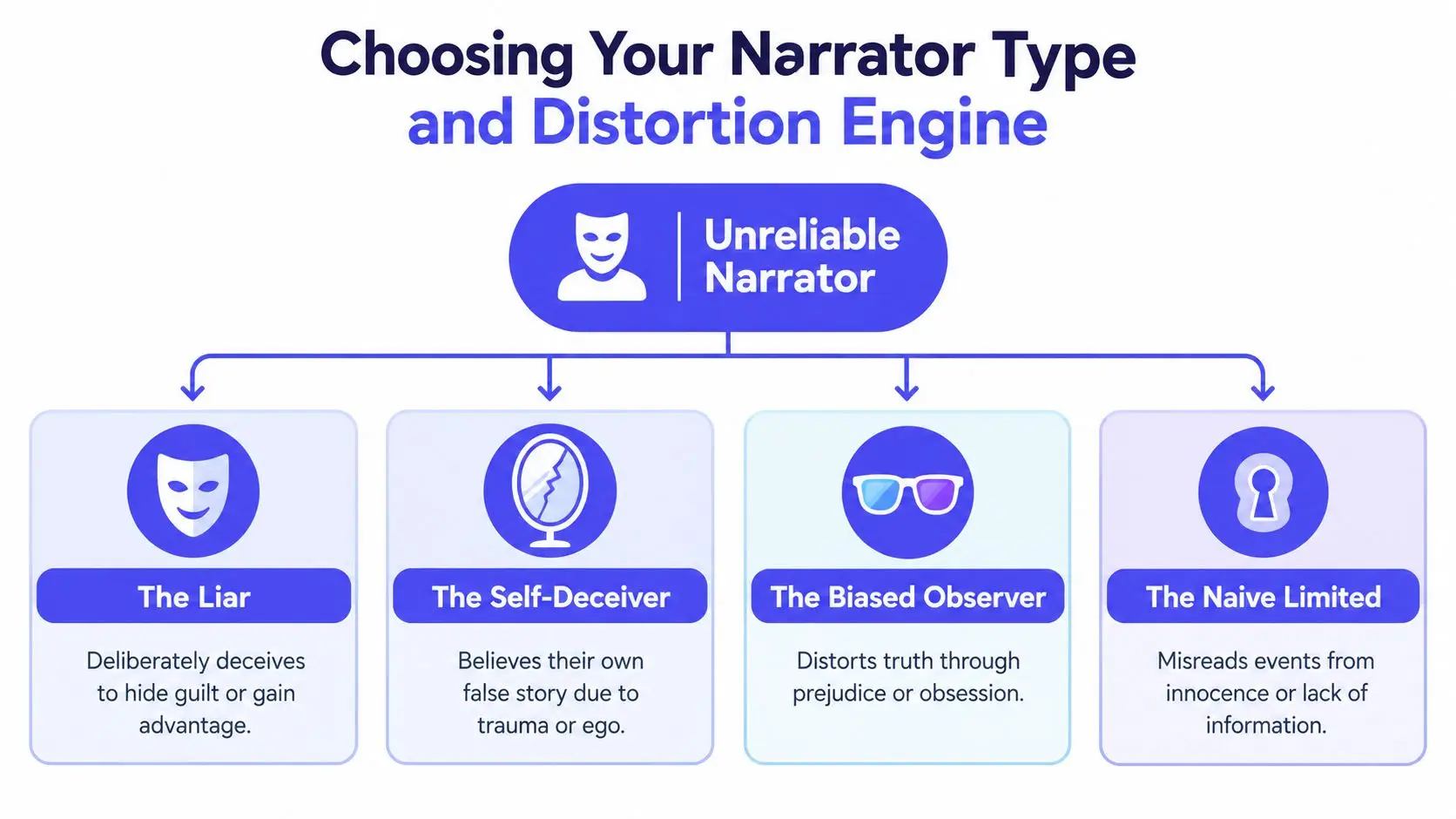
The most useful distinction is between deliberate deception and unconscious distortion. A liar knows the truth and chooses to conceal it. A self-deceiver protects a cherished version of the self. A biased observer interprets everything through prejudice, obsession, loyalty, or resentment. A naive limited narrator misreads events because information remains outside their grasp.
These engines produce different voices. The liar controls language, manages impressions, and may anticipate objections. The self-deceiver sounds sincere but overexplains emotionally dangerous moments. The biased observer notices details that support their fixation and overlooks evidence that would weaken it. The naive limited narrator may report facts accurately while assigning them the wrong meaning.
Pick one dominant engine
You can layer motives, but one should dominate the narrator's distortions. If every contradiction comes from a different cause, readers won't perceive a pattern. Random confusion isn't the same as designed unreliability.
Use these questions to test your choice:
- What does the narrator believe? A character who believes their own version requires different clues from a character who knowingly fabricates evidence.
- What identity are they defending? “I'm a good parent,” “I'm the victim,” or “I'm the only person who sees clearly” can determine which facts disappear.
- What kind of pressure breaks the pattern? Intimacy, public exposure, grief, guilt, or a direct contradiction may force the narrator to revise their story.
- Who benefits from the distortion? The narrator, someone they love, an institution, or a worldview can all serve as the protected object.
- What remains reliable? Sensory details, physical actions, another character's testimony, or the narrator's emotional reactions can provide an anchor.
The psychological range is wider than the familiar “villainous liar” model. Unreliability can arise from self-protection, memory distortion, emotional bias, or selective attention, and the reader's judgment depends on how the narration deviates from expectations, as explored in this discussion of psychological and identity-based unreliability.
Align the engine with the point of view
First person gives the distortion immediate intimacy, but it also makes concealment difficult to manage. A first-person narrator can't omit every relevant fact without sounding artificial. Third-person limited can create more distance, while an epistolary form can make selection and presentation part of the unreliability.
Your working sentence might read:
My narrator insists they rescued their sibling, but they repeatedly reinterpret controlling behavior as protection because they can't accept their fear of abandonment.
That sentence gives you a test for every scene. If a detail doesn't relate to the engine, it may be ordinary characterization rather than evidence. For a broader grounding in viewpoint choices, consult this point-of-view fiction guide.
Building Voice and Planting Detectable Signals
Unreliability has to exist in the prose before it exists in the plot twist. Readers should hear the narrator's habits of avoidance, selection, and justification even while they still accept the overall account.
Start by writing a clean version of a key scene from the narrator's perspective. Then identify the truth they resist. Don't replace every statement with an obvious lie. Instead, alter what the narrator notices, the order in which they present information, and the explanation they attach to each action.
Make the signals repeat
A single contradiction can look like an error. A recurring pattern looks intentional. Literary analysis commonly identifies discrepancies between statements and actions, contradictions with other characters, omissions, memory gaps, and shifts in self-justification as signals of unreliable narration, according to this academic discussion of textual markers.
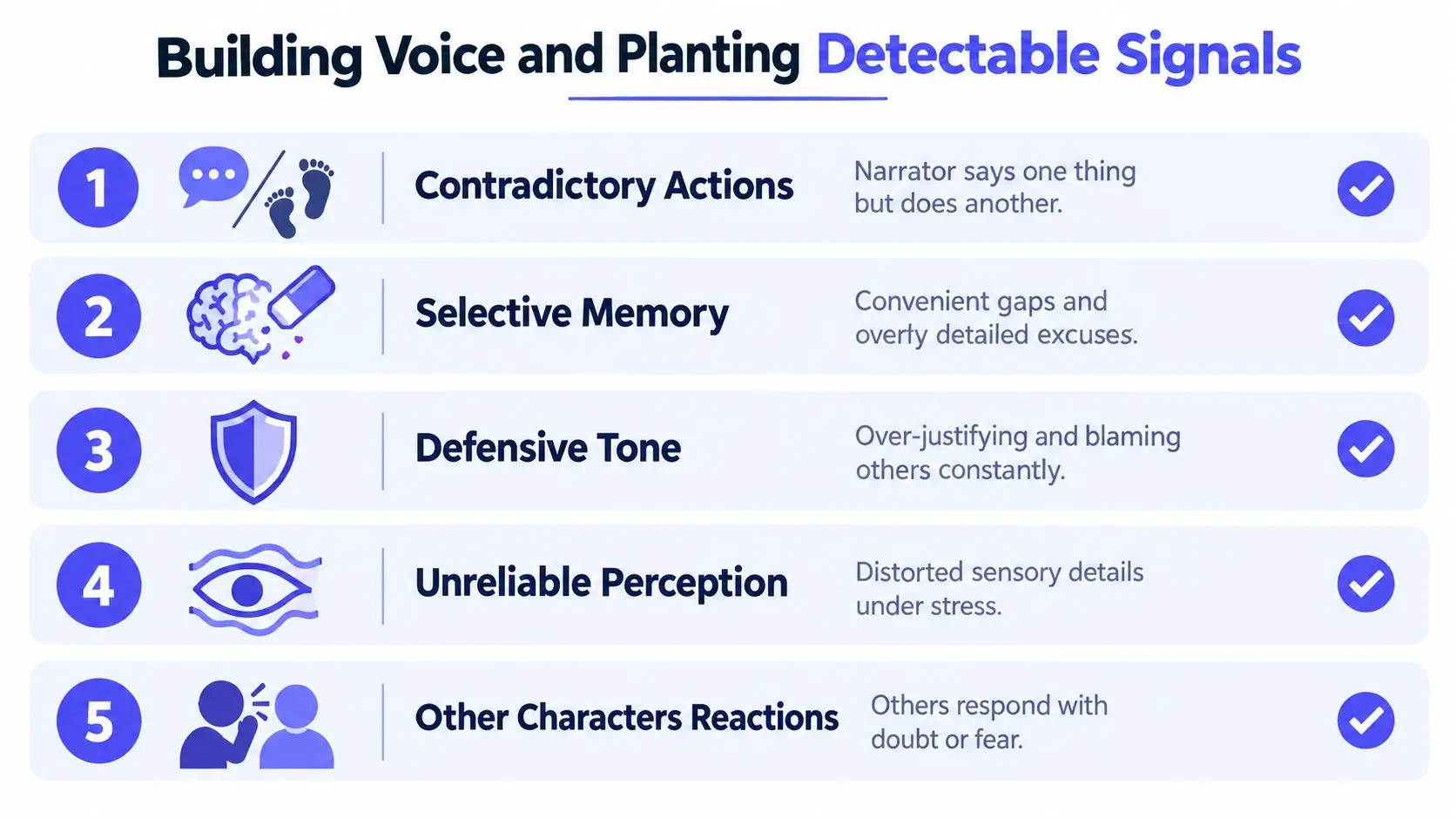
Plant those signals at the scene level:
- Contradictory action: The narrator says they don't care whether a former friend attends the party, then checks the door whenever it opens.
- Selective memory: They recall the insult in exact language but can't remember what they said immediately before it.
- Defensive explanation: They answer an accusation nobody has made yet, revealing the charge they fear.
- Perceptual distortion: Under stress, a neutral expression becomes contempt, or a familiar room seems threatening.
- Other characters' reactions: People pause, avoid eye contact, correct the narrator, or respond to a version of events the narrator hasn't disclosed.
The signal should serve the distortion engine. A liar might polish a timeline. A self-deceiver might use passive constructions to remove agency. A biased observer might describe one character's clothing with contempt while treating identical behavior from an ally as charming.
Let the voice remain coherent
The narrator can be wrong without sounding incoherent. Give them a stable vocabulary, rhythm, and moral logic. Their explanations should make sense from inside their worldview.
A self-deceiving narrator won't think, “I'm concealing my responsibility.” They might think, “There was no point in correcting her. She'd already decided to misunderstand me.” That sentence doesn't announce the truth, but it exposes the narrator's preferred position. They aren't responsible for the conflict. They're merely being misread.
Dialogue can expose the gap too. In revision, study not only what characters say but what they refuse to answer. This guide to writing better dialogue can help you examine evasions, defensive replies, and conversational pressure without making every exchange sound like a clue delivery system.
Place the video after the reader has the signal framework, so the visual material supports rather than replaces the craft explanation.
On reread, the strongest clues feel obvious but not conspicuous. The reader thinks, “Of course that detail was there,” rather than, “The author hid the only relevant fact until the final page.” Reverse-engineer from the reveal, then rewrite the earlier scenes so the narrator's original account remains psychologically natural.
Structuring Clues and Timing the Reveal Without Cheating
A good clue can fail if it arrives at the wrong moment. Too little evidence leaves readers feeling ambushed. Too much evidence turns the narrator into a transparent puzzle box whose every sentence announces the trick.
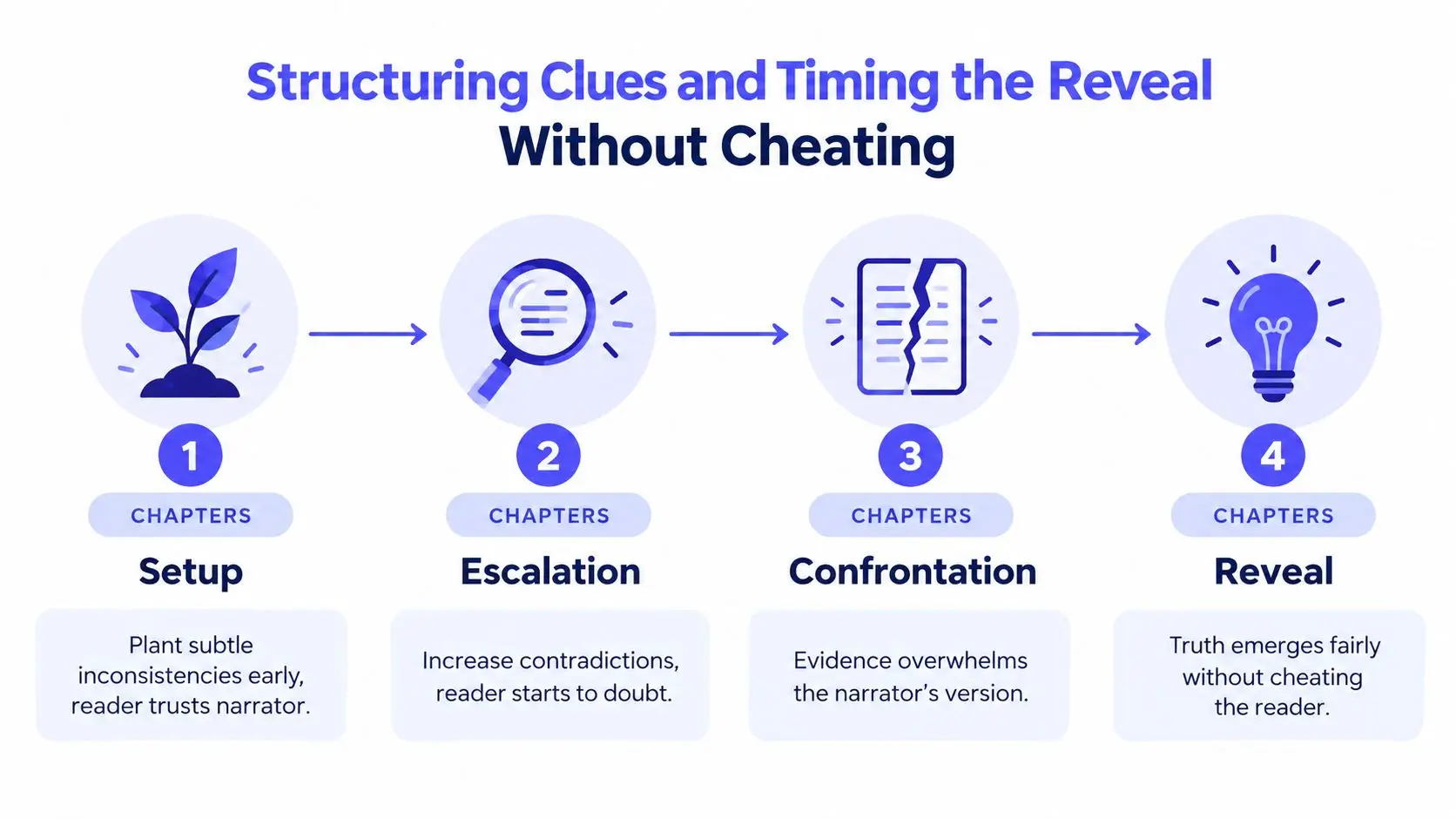
Treat the manuscript as a progression of reader confidence. Early scenes should establish why the narrator seems credible. The first inconsistencies should remain explainable. Later contradictions should force readers to revise their working theory. The reveal then confirms or complicates what the evidence has already made possible.
Use a four-stage escalation
Setup gives the reader a baseline. Show the narrator functioning within a recognizable world, with a voice that has strengths as well as weaknesses. Trust grows because the narrator gets some things right and responds to ordinary pressures in understandable ways.
Escalation introduces contradictions that can still be dismissed. A memory differs from another account. A supposedly casual decision has consequences the narrator refuses to acknowledge. The key is variation. Don't repeat the same kind of clue until it becomes mechanical.
Confrontation brings evidence into direct contact with the narrator's version. Another character produces a record, repeats a conversation, or reacts to the narrator's behavior in a way that can't be explained away. The narrator may still resist, but the reader should no longer need to do all the interpretive work.
Reveal identifies what the narrator has misunderstood, concealed, or manipulated. It should answer the central question while leaving room for moral or emotional consequences. A reveal that explains the plot but says nothing about the narrator's inner life usually feels thin.
Calibrate clue density
Count clues by function, not just by chapter. A manuscript may contain many suspicious phrases but no external confirmation, or plenty of contradictory evidence with no insight into why the narrator distorts it.
Create a simple tracking sheet with columns for the scene, signal type, reader-facing interpretation, hidden truth, and distortion engine. Look for gaps. If the same hidden fact appears only in the finale, the structure is underprepared. If every scene points directly toward it, the structure is overexposed.
A fair reveal doesn't require readers to predict the answer. It requires them to recognize that the answer was available.
Standalone fiction can resolve the central distortion within the book while preserving emotional ambiguity. Series fiction has more room to sustain uncertainty, but each installment still needs meaningful movement. Don't postpone every answer because a later volume exists. Readers will tolerate an unresolved mystery more readily than a narrator whose contradictions never produce consequences.
The problem of fair-play clueing, especially around clue density, reveal timing, and ambiguity in standalone and series fiction, remains a frequently neglected part of practical unreliable-narrator advice, as noted in this craft guidance on writing unreliable narrators.
For planning, a manuscript timeline can help you place evidence, reversals, and red herrings without losing track of what the reader knows. This timeline and red-herring outlining toolkit is especially relevant when the narrator's account controls the flow of information.
Revising and Testing Your Unreliable Narrator in Storyloft
Revision should separate first-read plausibility from reread legibility. A scene can work on the first pass because the narrator's explanation feels natural, yet fail on rereading because the hidden truth has no support. It can also contain so many conspicuous clues that readers identify the mechanism before they care about the character.
Start with a narrator audit. Write the distortion statement at the top of your notes, then review every scene where the narrator describes the central event, relationship, or decision. Mark statements that are factually false, emotionally evasive, incomplete, or accurate but misleading. The categories matter because they create different reading experiences.
Track the evidence scene by scene
Use comments or a separate planning binder to record:
- The narrator's claim: What version does the reader receive?
- The observable evidence: What action, object, or reaction complicates that version?
- The protected belief: What does the narrator need to remain true?
- The reader's likely explanation: Why can the contradiction still be dismissed here?
- The later payoff: What will this detail mean after the reveal?
Check the sequence for escalation. Early clues should establish a habit. Middle clues should challenge the habit. Late clues should make continued denial costly. If a clue doesn't change the reader's interpretation or deepen the narrator's psychology, cut it or give it a clearer job.
Test the voice, not just the plot
Read the narrator's passages aloud without surrounding action. Defensive diction, sudden formality, excessive certainty, and unexplained tonal shifts become easier to hear. Then read only the dialogue and reactions from other characters. If the narrator's account is the only place where the conflict exists, the manuscript may be relying on concealment rather than dramatic evidence.
A targeted editing workflow can compare alternative versions of a scene, preserve earlier drafts, and help you test whether a revision changes the narrator's established voice. Tools inside Storyloft's draft-editing workspace include manuscript editing, comments, edit history, and AI-assisted targeted revisions, which can support this kind of focused pass.
Use beta readers as perception tests
Don't ask readers only whether they liked the twist. Ask what they believed after each major movement, which details they distrusted, and whether the final explanation felt consistent with the narrator's behavior. A reader who predicts the exact reveal may indicate over-signaling. A reader who feels betrayed because no evidence existed may indicate under-clueing.
The best feedback often sounds like, “I didn't know the truth, but I knew something was wrong.” That response means the narrator has remained believable while the manuscript has preserved a detectable pattern.
Keep Readers Trusting You After the Twist
The reveal doesn't end the trust relationship. It changes the terms of it.
Readers can accept that a narrator lied, forgot, misunderstood, or protected themselves. They struggle when the author uses unreliability to erase consequences. If the narrator's account changes whenever the plot needs a new surprise, the character stops feeling psychologically motivated and starts functioning as a trapdoor.
Keep three things stable after the reveal. First, preserve the narrator's distortion engine. A self-deceiver may finally admit one fact while still misjudging its emotional meaning. A liar may confess the central deception but continue managing how others see them. A biased observer may recognize their prejudice without instantly becoming impartial.
Second, let earlier scenes retain their emotional truth. The narrator may have misunderstood a friend's anger, but the loneliness they felt was real. They may have described an act as generous when it was controlling, but the desire to be needed still shaped their behavior. These layers prevent the reveal from turning the whole book into meaningless misinformation.
Third, give the reader a meaningful position after the truth emerges. They should be able to judge the narrator, sympathize with them, condemn them, or hold several responses at once. The story earns that complexity by showing not only what happened, but why the narrator couldn't tell it plainly.
Before you draft, commit to a distortion statement, a stable voice, a recurring signal pattern, and a reveal that reinterprets rather than invalidates the evidence. Then test the manuscript with readers who can tell you both when they started doubting the narrator and whether they still cared about what happened.
Storyloft brings long-form drafting, comments, edit history, research binders, and AI-assisted manuscript revisions into one writing environment, so you can track unreliable-narrator clues without scattering your evidence across separate tools. Visit Storyloft to develop your narrator's distortion engine, revise the voice, and test the reveal inside the manuscript where the clues belong.