What Is a Character’s Motivation: The Engine of Your 2026
You're probably here because something in your draft feels off. Your protagonist makes decisions, scenes happen, dialogue moves, but the character still feels thin. Maybe they storm out of a room because the plot needs conflict. Maybe they accept a dangerous mission because chapter three needs momentum. On the page, those actions work mechanically. Emotionally, they don't.
That gap usually comes down to one missing piece. Motivation.
When you know what your character wants and why they want it, scenes stop feeling arranged and start feeling inevitable. Your character no longer behaves like a puppet being pulled from beat to beat. They begin to act like a person with pressure, history, fear, and desire. If you listen to working storytellers break this down in conversation, collections like Flexwork Studios storytelling podcasts can be useful because they expose how often strong story choices come back to character drive. If you want a broader set of writing references to keep nearby while drafting, Storyloft also keeps a library of storytelling resources for writers.
Table of Contents
- The Why Behind Every Great Story
- What Character Motivation Really Means
- The Two Layers of Motivation Want vs Need
- Why Compelling Motivation Matters for Your Plot
- How to Discover Your Character's Motivation
- Weaving Motivation into Your Manuscript with Storyloft
- Motivation Is the Heartbeat of Your Story
The Why Behind Every Great Story
A strong story doesn't begin with action. It begins with pressure inside a person.
Your reader can forgive a strange setting, an unusual premise, even an unlikely coincidence or two. What they won't forgive for long is a character who acts without a believable reason. When a character's choices feel arbitrary, readers sense the author's hand forcing events into place.
Hollow action versus driven action
Take a simple scene. A woman quits her job in the middle of a staff meeting.
That action could mean almost anything. If she quits because she's always wanted freedom, that's one story. If she quits because staying means betraying a friend, that's another. If she quits because failure terrifies her and she'd rather leave first than be judged, the same scene suddenly carries pain.
The action stays the same. The meaning changes because the motivation changes.
Practical rule: If you can swap your character's action for three other actions and the story barely changes, the motivation probably isn't clear enough yet.
Motivation is your story engine
When writers ask, “What is a character's motivation?” they often expect a short definition. The more useful answer is this: motivation is the force that makes your character's choices feel connected instead of random.
It affects small moments as much as dramatic ones. The way your character answers a text, lies to a sibling, avoids eye contact, or says yes too quickly can all reflect the same inner drive. Once you identify that drive, your revision process gets easier. You stop inventing scenes just to keep the plot moving and start building scenes that test what matters to the character.
That's where this concept becomes practical. You need to know the core idea, but you also need a way to carry it from your notes into the manuscript itself.
What Character Motivation Really Means
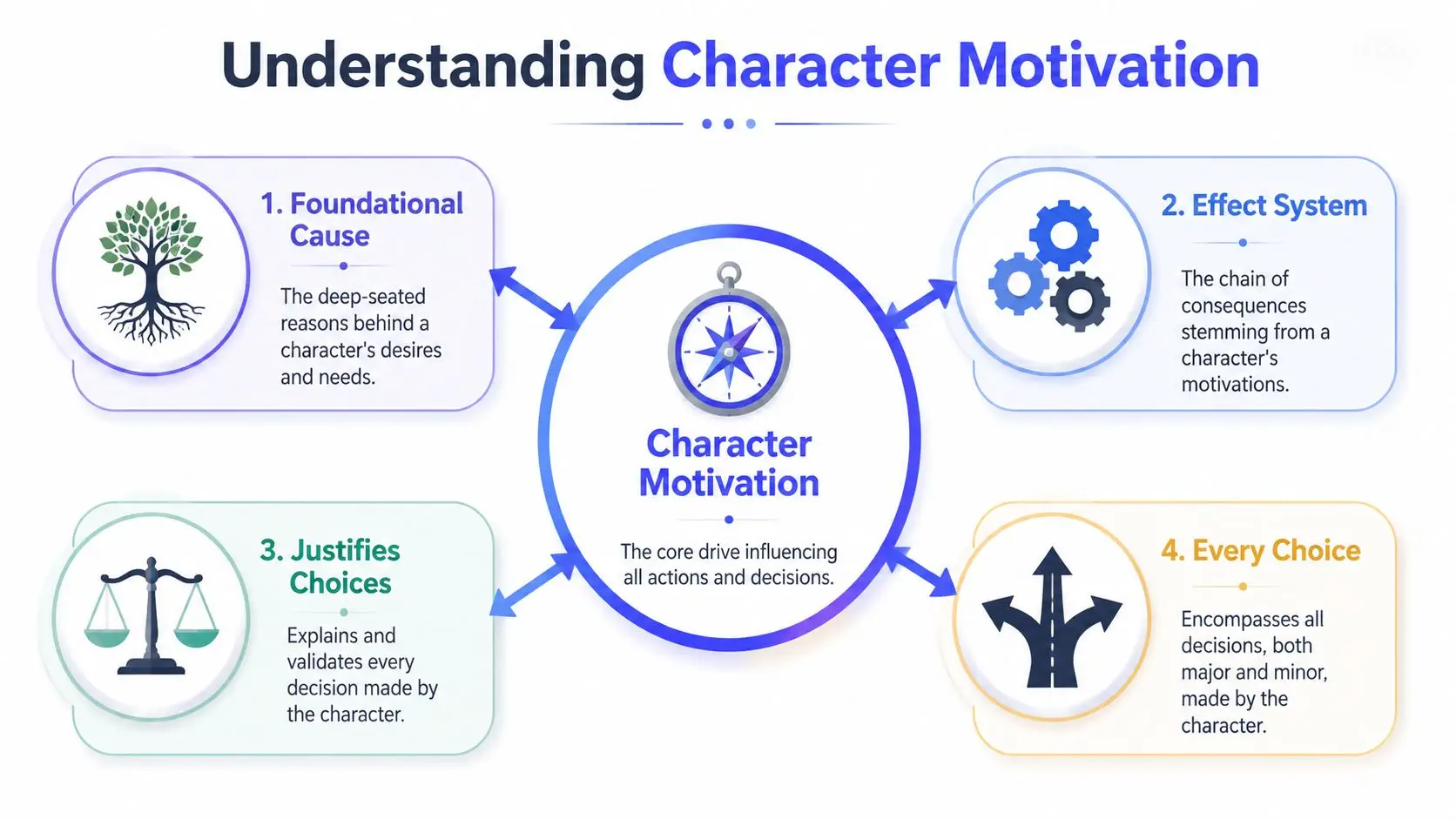
Character motivation is the reason behind your character's choices. It's the cause that creates the effect.
If the goal is the destination, motivation is the fuel in the engine. A character may want to solve a murder, win a tournament, get married, or leave town. Those are goals. Motivation answers the more important question. Why does this matter so much to them?
Goal is what, motivation is why
Many new writers often get tangled here. They write “My character wants revenge” and assume that's motivation. It isn't. That's the objective.
Motivation sits underneath the objective. Maybe your character wants revenge because they can't bear powerlessness. Maybe they need to restore family honor. Maybe punishing someone else feels easier than facing their own guilt. Each version creates a different person, even if the plot goal looks identical from the outside.
Historical and teaching frameworks in screenwriting and acting describe motivation as the foundational cause-and-effect mechanism behind action, and note that a character is built on past “triggers” and inner struggles that create natural reactions. They also treat motivation as the variable that makes behavior feel credible rather than random, as discussed in Backstage's explanation of character motivation in acting and screenwriting.
Past pain often shapes present choices
Your character doesn't need a tragic backstory. But they do need some internal logic.
That logic often comes from prior experience. A person who grew up ignored may chase praise. A person who lost control once may become rigid and demanding. A person who was abandoned may keep sabotaging closeness before someone else can leave first.
A believable character doesn't just choose. They choose from a history.
Here's a simple test:
- Weak version: “He wants to become class president.”
- Stronger version: “He wants to become class president because being overlooked at home has taught him that visibility equals safety.”
- Stronger still: “He wants to become class president because if people admire him, maybe he won't have to feel invisible the way he does with his father.”
The more specific the why, the more natural the behavior on the page.
A working definition you can use while drafting
When you're stuck, use this sentence stem:
My character does this because they believe it will help them avoid, gain, protect, prove, repair, or become something important.
That phrasing pushes you past plot summary and into emotional logic. Once you have that, your scenes start making sense.
The Two Layers of Motivation Want vs Need
Most compelling characters run on two layers at once. The outer layer is visible. The inner layer is harder to admit, sometimes even to themselves.
That's where the distinction between want and need becomes useful.
The want and the need side by side
A character's want is conscious. They can usually say it out loud. Their need is deeper. It often comes from a wound, fear, or buried longing.
According to Hearth's guide to character motivation, motivation works as a dual-layer system where the surface want is energized by the emotional need beneath it. When those two layers conflict, the character reaches a decision point. That tension is one of the main reasons a fictional person starts to feel psychologically alive.
| Attribute | The Want | The Need |
|---|---|---|
| Awareness | Usually conscious | Often partly hidden or resisted |
| Role in plot | Drives external action | Drives internal change |
| Language | “I need to win the case” | “I need to feel worthy” |
| Stakes | Concrete success or failure | Emotional truth or healing |
| Typical form | Job, quest, relationship, victory | Safety, belonging, self-respect, forgiveness |
| Reader experience | Creates momentum | Creates depth |
Examples that make the difference clearer
A chef enters a televised cooking competition.
- Want: Win the competition.
- Need: Prove to herself that her voice matters after years of being controlled by a demanding parent.
A detective hunts a missing person.
- Want: Solve the case.
- Need: Redeem himself after failing someone in the past.
A prince wants to reclaim the throne.
- Want: Take back political power.
- Need: Earn an identity separate from the parent who shaped him.
The want gives you plot movement. The need gives you emotional meaning.
Conflict between the two is where story heat appears
The richest scenes often happen when a character's want pushes one way and their need pulls another.
A woman wants to keep her company afloat. She needs to admit she can't do everything alone. A soldier wants to obey orders. He needs to reclaim his moral judgment. A teenager wants popularity. She needs self-respect.
Key insight: If your protagonist only wants one thing and nothing inside them resists that pursuit, the story may move, but it won't cut very deep.
When readers say a character “felt real,” they're often responding to this split. Real people don't move through life with a single clean line of intention. They chase one thing while aching for another.
A quick drafting check
Ask these two questions for every major character:
- What do they think will fix their life?
- What has to change inside them?
If your answers are identical, that may be fine for a simple story. But if you want stronger tension, let the answers diverge.
Why Compelling Motivation Matters for Your Plot
Plot isn't a chain of events. Plot is a chain of choices under pressure.
If those choices don't grow from clear motivation, your scenes may still be dramatic, but they won't feel earned. The explosions can be loud. The breakups can be painful. The courtroom reveal can be clever. Yet the story will still feel thin if readers can't sense why the character keeps going.
Motivation creates stakes without extra explanation
Writers often try to raise stakes by adding bigger obstacles. More danger. More secrets. More time pressure.
Sometimes the stronger move is simpler. Clarify what the character's pursuit means to them. The same job interview becomes far more gripping if failing it means returning to the family system that crushed their confidence. The same rescue mission matters more if the person being rescued represents the one relationship the protagonist hasn't ruined.
When the motivation is clear, stakes stop feeling decorative. They become personal.
Readers engage when desire and struggle are visible
Research published in Media Psychology found that a character's motivation is the primary statistical driver of narrative engagement, and that visible struggle plus strong desire intensity increase engagement and link to the feeling of being moved by the story, as described in the study summary on Taylor & Francis Online.
That matters for your draft in a very practical way. Readers don't just want to know what your character is doing. They want to feel the force of what the character is trying to do and what it costs them.
If you're shaping a novel around this principle, Storyloft's article on character-driven story structure is a useful companion because it keeps the focus on desire in the moment, not just abstract backstory notes.
Motivation also generates conflict naturally
You don't need to manufacture conflict once motivation is solid. Conflict appears on its own.
- External conflict: The world blocks what your character wants.
- Interpersonal conflict: Another character wants something incompatible.
- Internal conflict: The pursuit itself threatens the character's deeper need.
That third form is the one many drafts miss. Your protagonist can't just encounter obstacles. They should also pay a psychological price for the path they've chosen.
A chase scene gets exciting because of motion. It gets memorable because of motive.
Plot becomes inevitable instead of convenient
Convenient plotting sounds like this: “She went there because I needed her in that location.”
Inevitable plotting sounds like this: “Given who she is, what she fears, and what she wants, she couldn't stay away.”
That difference changes everything. One version looks assembled. The other feels alive.
How to Discover Your Character's Motivation
You don't always find motivation by staring harder at your outline. Often you find it by asking sharper questions.
The first answer your brain gives you is usually superficial. “He wants to win.” “She wants to leave.” “They want revenge.” Fine. That's a start, not the truth.
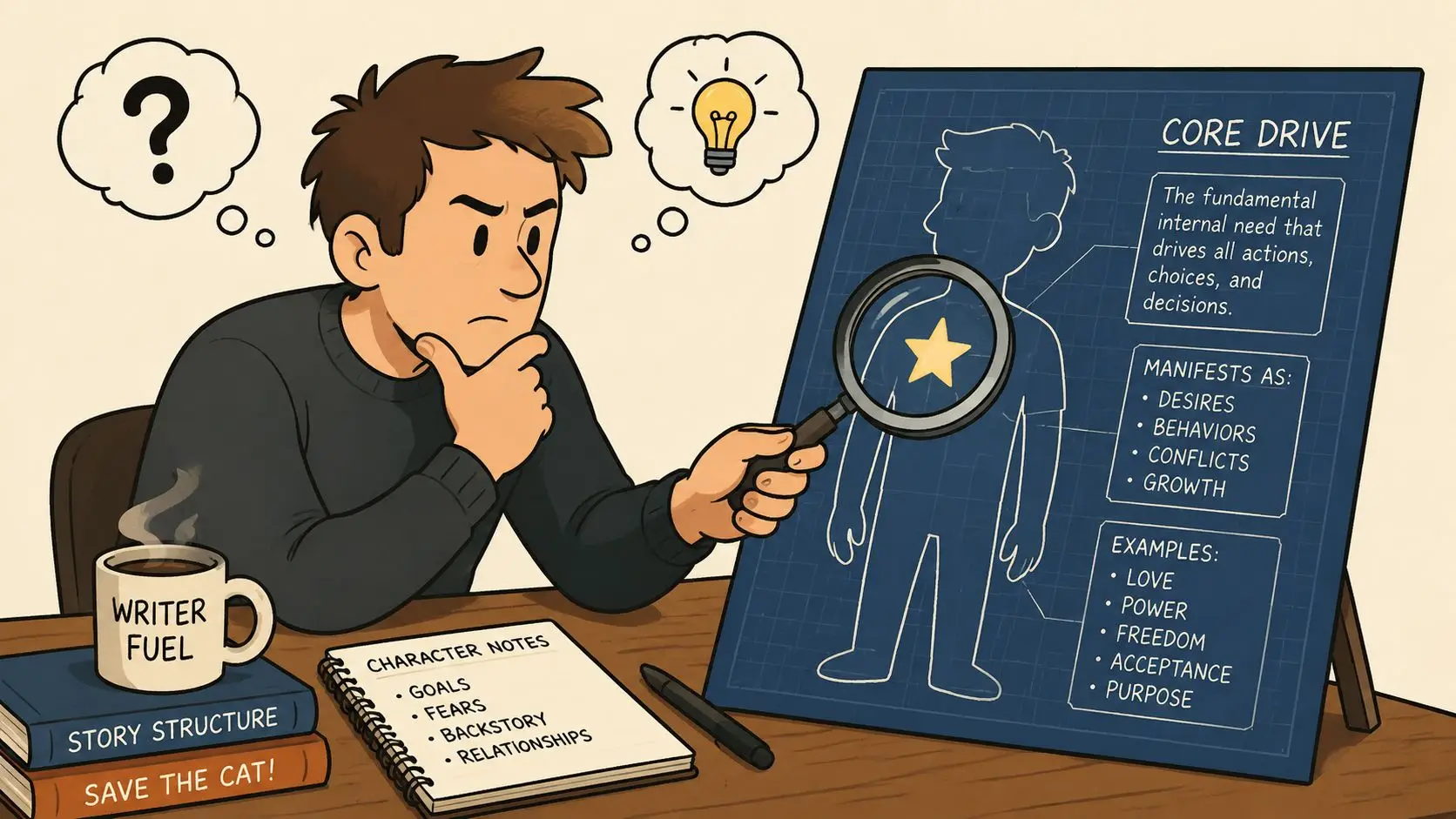
Questions that dig below the surface
Use questions that force the character into emotional territory:
- What are they most afraid of losing? Status, love, control, dignity, safety, freedom.
- What secret are they protecting? Secrets often reveal shame, and shame drives behavior.
- What do they misinterpret about the world? A false belief can shape every decision.
- Who do they still want approval from? The answer is often messy and useful.
- What do they refuse to admit they need? This often points straight to the internal layer.
- What kind of pain feels familiar to them? People often repeat what they know.
If you work better with prompts and collaborative ideation, even resources outside fiction circles can help. A structured brainstorming guide for agencies can be adapted for character work by turning team prompt methods into solo discovery exercises.
Try the but why exercise
This is one of the simplest tools I know, and it works.
Start with the obvious statement, then keep asking but why?
Example
She wants to win the race.
But why?
Because she needs the scholarship.
But why does that matter so much?
Because without it, she can't leave her town.
But why does leaving matter?
Because staying means living under her father's view of her as a failure.
But why is that unbearable?
Because she has built her identity around proving she is stronger than the story her family tells about her.
Now you have something you can write from.
The race isn't just a race anymore. It's a fight over identity.
Watch this process in action
Sometimes it helps to hear character reasoning unpacked aloud before trying it in your own pages.
Put the answer into scene language
Once you uncover the deeper drive, translate it into behavior.
Don't stop at “She wants respect.” Ask what respect makes her do in a room. Does she interrupt? Overprepare? Refuse help? Dress precisely? Read insults into neutral comments?
If you need a concrete model for turning abstract traits into page-ready detail, studying a character description example for fiction writers can help connect inner motive to visible action.
Don't keep motivation trapped in your notes. Make it show up in posture, choices, deflections, and mistakes.
Weaving Motivation into Your Manuscript with Storyloft
Knowing the answer in your notebook isn't enough. Your reader can only feel motivation through what appears on the page.
That means you need methods for planting it, testing it, and tracking it across scenes. Here, many drafts wobble. The writer knows the character's backstory, but the manuscript doesn't consistently translate that knowledge into behavior.
Use backstory anchors and scene pressure
Start by choosing a few backstory anchors. These are specific memories, patterns, or relationships that shape your character's reactions.
A backstory anchor might be a mother who praised achievement but ignored emotion. It might be the public failure your character still replays in private. It might be a childhood promise they're still trying to keep. You don't need to explain all of it directly. You need to let it affect decisions.
Then build scene pressure around that anchor.
- In dialogue: Let the character flinch at certain topics, overreact to certain words, or chase reassurance too aggressively.
- In action: Force them to choose quickly when the pressure hits the exact wound beneath the scene.
- In subtext: Let them say one thing while wanting something else.

Track motivation beat by beat
A practical workflow helps. One option is Storyloft's workspace for organizing characters, worldbuilding, and research inside your manuscript. It includes a planning workspace, character tools, tags, and manuscript-side notes, which makes it possible to keep a character's core drive visible while drafting scenes.
Here's a simple way to use tools like that well:
Define the core motive once
Write one sentence for the outer want and one sentence for the deeper need.Tag the reveal scenes
Mark every chapter where the motivation is exposed, challenged, hidden, or contradicted.Add a pressure note to each major scene
Ask: what does this moment threaten or promise emotionally?Use targeted prompts while revising
Prompts such as “What is this character afraid of right now?” or “What are they trying not to admit in this exchange?” sharpen weak scenes fast.
If you write for audio, scripts, or dialogue-heavy fiction, resources from adjacent formats can sharpen your scene instincts. SparkPod's guide for creators is useful because audio drama writing depends heavily on motive-driven speech and action.
Show motivation through choice, not explanation
The cleanest way to reveal motivation is pressure plus decision.
Your character says no when yes would be easier. They lie when honesty would cost them admiration. They stay in the room when every instinct tells them to leave. Those moments reveal motive better than paragraphs of explanation.
The reader believes motivation most when a character pays for it.
When revising, scan each important scene and ask: What choice in this moment proves what matters most to this character? If the scene doesn't answer that, the motivation may still be living outside the manuscript instead of inside it.
Motivation Is the Heartbeat of Your Story
By now, the question “what is a character's motivation” should feel less abstract.
It's not a decorative note on a character sheet. It's the reason your character's actions hold together. It explains why one person chases love through control, why another mistakes achievement for self-worth, and why a third keeps sabotaging the very thing they claim to want.
The core ideas to keep in mind
Three reminders matter most:
- Motivation is the why behind the action. Goals tell you what the character pursues. Motivation tells you why the pursuit matters.
- Strong characters usually operate on two layers. The visible want moves the plot. The deeper need creates inner tension.
- Readers respond to struggle tied to desire. They care when they can feel what the character is reaching for and what it costs.
Use motivation as a revision lens
When a scene feels flat, don't only ask whether enough happens. Ask whether the right thing is happening for this character.
When a plot turn feels forced, ask whether the choice grows naturally from the person you've built.
When dialogue feels generic, ask what each speaker wants from the exchange and what deeper need is driving that effort.
Those questions can rescue a draft.
A memorable character isn't defined by quirks, wardrobe, or clever dialogue alone. They're defined by the pressure of wanting something for a reason they can't easily escape.
If your character still feels blurry, that isn't failure. It's a signal. You probably don't need more plot first. You need a clearer why.
Once you have that, your scenes gain shape. Your conflict gains weight. Your story gains pulse.
If you want one place to draft, organize character notes, track motivation across scenes, and revise inside the manuscript, Storyloft is built for that kind of writing workflow.