How to Overcome Writer’s Block: A Practical Guide for 2026
You open the document, read the last sentence you wrote, and feel your whole body tense. The cursor blinks. Your notes are scattered across tabs, a half-finished outline lives in another app, and a sentence you meant to “fix quickly” has eaten half an hour. At that point, writer's block doesn't feel like a creative problem. It feels like proof that you can't do this.
That feeling is common. It's also misleading.
Most blocks aren't signs that you've lost your talent or picked the wrong project. They're usually a mix of pressure, fatigue, perfectionism, and friction in the way you work. If you want to learn how to overcome writer's block, the fastest path is to stop treating every block as the same problem. Some blocks need momentum. Some need recovery. Some need a better writing routine. Some need you to fix the workflow that's making every sentence harder than it should be.
Table of Contents
- Why You're Really Stuck Unpacking the Causes of Writer's Block
- Break the Inertia Immediate Exercises to Start Writing Now
- Building a Resilient Writing Routine
- Your Workflow as the Cure Using Tools to Dissolve Blocks
- Troubleshooting Specific Writing Nightmares
- From Blocked to Unstoppable Your Path Forward
Why You're Really Stuck Unpacking the Causes of Writer's Block
Most writers describe the problem as “I'm stuck,” but that label hides the underlying issue. A blank page caused by fear needs a different response than a blank page caused by exhaustion. If you don't diagnose the block, you'll keep applying random fixes and blaming yourself when they fail.
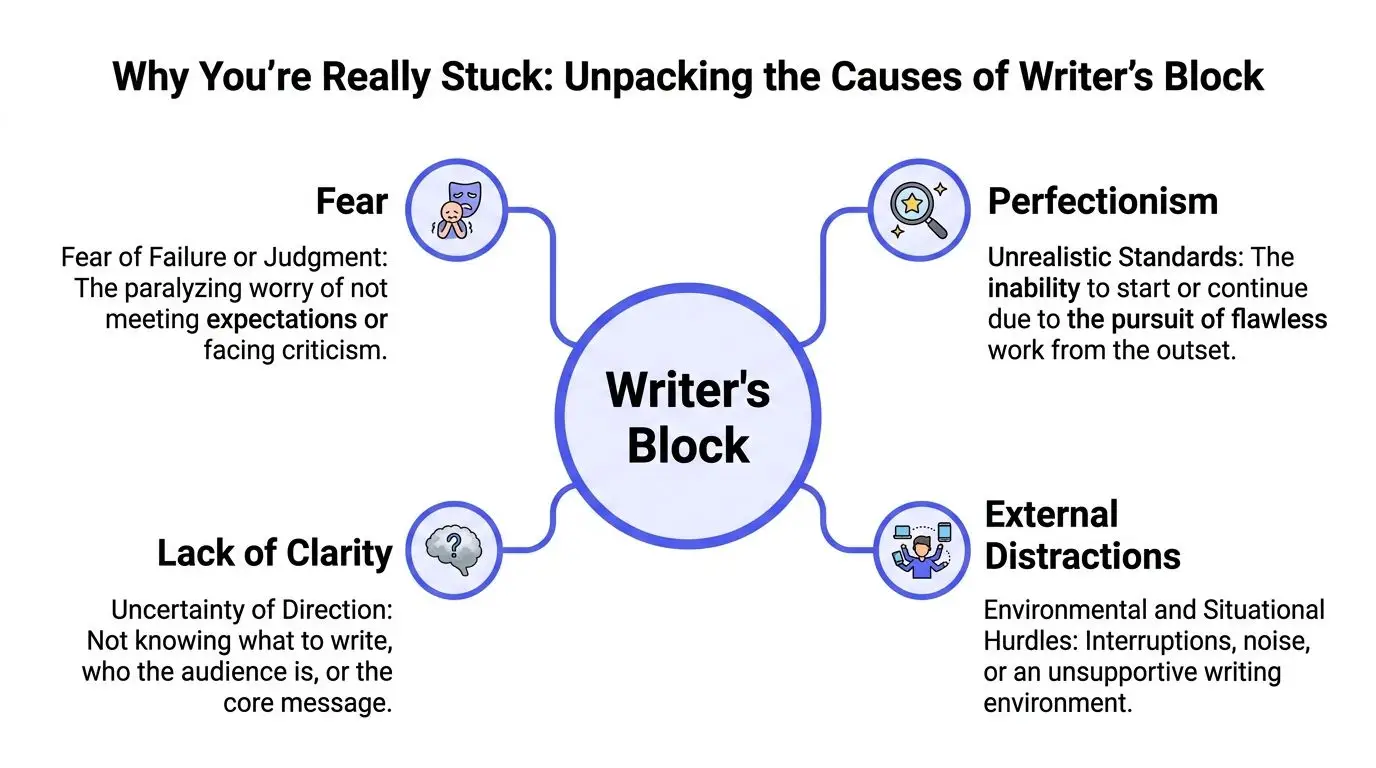
A useful first pass is to sort the block into four buckets: fear, perfectionism, lack of clarity, and external distractions. That framing is simple, but it helps because each one shows up in a different way at the keyboard. If you want a companion read on preventing stalls before they start, Storyloft has a helpful piece on how to avoid getting stuck while writing.
Fear and perfectionism often look similar
Fear usually shows up before the writing begins. You avoid opening the file. You reorganize notes, rename folders, or reread old pages instead of drafting new ones. Often, the thought under the surface is, “If I try and it comes out bad, I'll have to face that.”
Perfectionism shows up after you begin. You write one sentence, then rework it five times. You spend an hour tuning the first paragraph and never reach the second page. Research on writer's block identifies “perfect draft syndrome” as a major pitfall, where writers keep hunting for the right word or sentence instead of allowing the draft to move forward. Experts recommend leaving those problem spots highlighted for later so the writing flow stays intact, as discussed in this analysis of writer's block and writing anxiety.
Practical rule: If you can't start, suspect fear. If you can start but can't continue, suspect perfectionism.
There's also lack of clarity, which many writers mistake for laziness. You sit down ready to work, but you don't know what the scene must do, what the chapter is arguing, or who the reader is on the other side. That kind of block isn't emotional first. It's structural. You don't need motivation. You need a clearer next move.
Burnout and external pressure create a different kind of block
Then there's burnout, which feels heavier than fear. You read the page and nothing sparks. Every idea feels dull. This isn't always resistance. Sometimes your brain has run out of fuel. When that happens, pushing harder can make the block worse.
A final trigger is external pressure. Deadlines, family expectations, client revisions, school submissions, or the pressure of “this book has to matter” can turn writing into a performance review. You stop hearing your own voice and start imagining everyone else's reaction.
Use this quick self-check:
- You're avoiding the document entirely. Fear is the likely driver.
- You're trapped revising early lines. Perfectionism is probably in charge.
- You don't know what comes next. Lack of clarity is the main obstacle.
- You feel flat, irritable, and mentally drained. Burnout or overload is the better diagnosis.
Once you name the block accurately, it becomes manageable. Writer's block feels mysterious when you call it one thing. It gets easier to solve when you call it what it is.
Break the Inertia Immediate Exercises to Start Writing Now
When you're frozen, the goal isn't to write beautifully. The goal is to restore motion. That means choosing exercises that lower the stakes, silence the internal editor, and produce raw material fast.

One of the clearest data points here is the keep writing approach. In surveys of coping strategies, forcing yourself to keep writing to a specific page number accounted for 12% of reported strategies, the highest single-frequency response in that dataset, according to this discussion of common writerly coping mechanisms. That matters because it points to a practical truth. Momentum often beats judgment.
If you need a bank of starting sparks instead of a blank page, browse these actionable prompt journal ideas. Good prompts don't solve the whole draft. They just give your mind something concrete to push against.
Use motion before quality
The biggest mistake blocked writers make is trying to solve quality first. Quality comes later. Right now, you need words, direction, and evidence that the draft can move again.
That's why many of the best exercises feel almost mechanical. They replace “write something good” with a narrower instruction your brain can obey. If you want more drills after this session, Storyloft also collected strong creative writing exercises that work well when your draft has gone stale.
Bad writing on the page is progress. Perfect writing in your head is not.
Three fast exercises that work
1. Freewrite for 5 to 10 minutes.
Research on writing blocks recommends freewriting for 5 to 10 minutes to generate raw material without self-editing. Set a timer. Write continuously. Don't stop to fix grammar, spelling, or logic. If you run out of things to say, write “I don't know what to write” until a real sentence appears.
This works because it interrupts the habit of evaluating every line as it arrives.
2. Try invisible writing.
The same research also recommends invisible writing, where you cover the screen or otherwise hide the text while typing. You can dim the monitor, switch to full-screen focus mode, or place another window over the page so you can't constantly reread the last sentence.
Use this when your eyes keep dragging you backward.
3. Set a tiny target with a clear finish line.
Don't tell yourself to “work on the chapter.” Tell yourself to write one paragraph, one scene beat, or one page of rough material. The point is not ambition. The point is completion.
This is a good moment to watch someone else break the freeze into a manageable task:
4. Write the easiest piece first.
If the opening is blocking you, skip it. Start with the argument you already understand, the scene you can already hear, or the paragraph whose shape is obvious. A draft doesn't have to be written in the order a reader will see it.
Use this when the first page has turned into a gatekeeper.
Here's the common thread in all four methods:
| Problem at the desk | Better immediate response |
|---|---|
| You keep judging every sentence | Freewrite or use invisible writing |
| You feel overwhelmed by the whole project | Set one tiny target |
| The opening won't move | Start with the easiest section |
| You want to quit after a bad line | Keep writing until the target is met |
These exercises don't promise brilliance. They do something more useful. They get your hands moving again.
Building a Resilient Writing Routine
Writers who rely on inspiration usually write in bursts, then disappear for long stretches. Writers who build a routine get blocked too, but they recover faster because the work has a place to go. A repeatable system turns writing from a mood-dependent event into a practice.
Treat writing like a repeatable practice
A strong example is the Pomodoro Technique. In writing guidance, 25-minute bursts are widely recommended because they make large projects feel finite and approachable. One resource on dealing with writer's block describes 25 minutes as “a great starting point” for uninterrupted writing sessions in this guide to using time-boxed writing sessions.
That recommendation works because it shrinks the threat. “Write the book” is intimidating. “Write for 25 minutes” is a clear instruction.
Here's a simple routine that's easier to sustain than heroic marathon sessions:
- Choose a fixed cue. Sit down at the same time of day, or attach writing to an existing habit like coffee or a walk.
- Use one 25-minute block first. If the session goes well, continue. If it doesn't, you still kept the appointment.
- Track process, not mood. Record that you showed up, what you worked on, and what the next sentence might be.
If you want a practical framework for making that consistent, Storyloft's advice on a writing routine that actually sticks is worth reading.
The routine matters because it carries you on days when confidence doesn't.
Rest is part of the writing system
A lot of blocked writers secretly believe rest is a reward they haven't earned yet. That belief causes trouble. Research on writing blocks argues that rest, input, and recovery are the interventions that address underlying cognitive depletion. In plain language, sometimes the right move is not to push harder but to let your brain refill.
That doesn't mean drifting into avoidance. It means using deliberate recovery instead of guilty procrastination.
A resilient routine has room for both output and input:
- Read with attention. Not as homework, but as fuel.
- Leave the desk on purpose. Walk, cook, clean, or do something repetitive that loosens your attention.
- Capture ideas during rest. Keep a note nearby so recovery still feeds the work.
Many writers fail because they build routines around effort alone. Sustainable writing needs rhythm. Drafting pulls from the well. Reading, observing, and resting refill it.
The most dependable answer to how to overcome writer's block isn't “be more inspired.” It's “build a practice your future self can re-enter tomorrow.”
Your Workflow as the Cure Using Tools to Dissolve Blocks
Some writer's block has nothing to do with confidence or talent. The problem is the way the work is arranged. You're drafting in one app, outlining in another, keeping research in browser tabs, moving notes through copy and paste, and trying to hold the whole project in your head while the tools keep pulling you sideways.
When the block is really workflow friction
That kind of friction has a name now. Tool fatigue and context switching have become a bigger part of the conversation around stalled projects. One recent source notes that emerging data from 2024–2025 shows these are rising causes of stalled work for indie authors, especially when drafting, research, and formatting are split across separate apps, as described in this discussion of modern barriers behind writer's block.
That tracks with what many working writers already feel. Every switch costs attention. Open the notes app, find the character detail, return to the draft, reopen the research tab, fix the formatting glitch, answer a comment, then try to remember the sentence you meant to write. By the time you return, the thread is gone.

What a cleaner writing system looks like
A better workflow reduces decisions at the moment of writing. It keeps the manuscript, notes, goals, and revision tools close enough that you can stay inside the draft instead of constantly rebuilding context.
For authors exploring AI support without flattening their voice, this overview of ethical AI assistance workflows is useful. The key question isn't whether to use assistance. It's how to use it narrowly, intentionally, and without outsourcing judgment.
A cleaner setup usually includes these elements:
- Draft and reference side by side. When your research and notes sit next to the manuscript, you stop burning energy on tab switching.
- Targeted brainstorming inside the draft. If you're stuck on a transition, a scene beat, or alternative phrasing, a manuscript-aware assistant is more useful than pasting isolated text into a separate chatbot.
- Visible goals. Daily targets, streaks, and progress markers help when motivation is low because they turn vague intention into a measurable task.
- One home for project assets. Character notes, scene fragments, visual references, and formatting decisions are easier to use when they live inside the same environment.
Storyloft is built around exactly that kind of author workflow. Its best author workflow tools page gives a good overview of how integrated drafting, planning, goal tracking, and manuscript-aware assistance can reduce the friction that fragmented toolchains create.
If your writing improves whenever your tools get simpler, the block was never only in your head.
That distinction matters. A scattered workflow creates fake resistance. It makes ordinary drafting feel harder than it is. When you remove that friction, you don't become magically disciplined overnight. You just stop wasting creative energy on preventable switching costs.
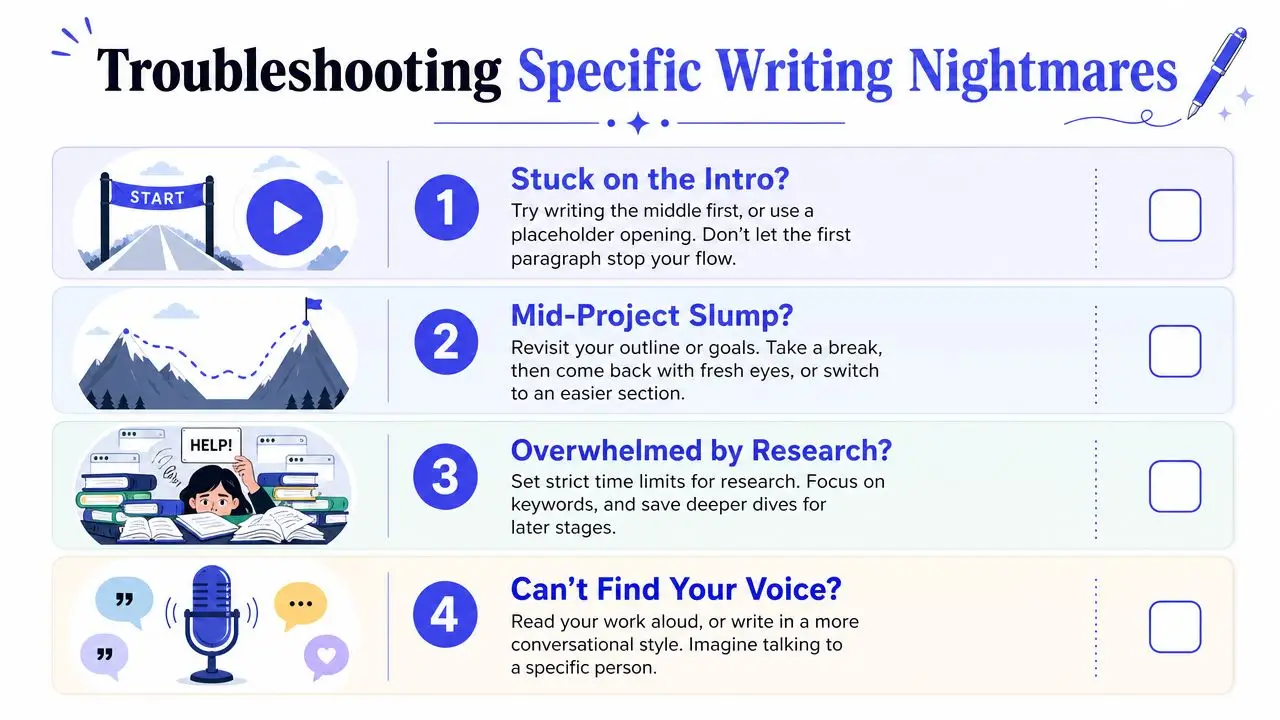
Troubleshooting Specific Writing Nightmares
Some blocks are so specific they don't respond to general advice. You don't need another speech about persistence when the actual problem is yesterday's awful draft or a chapter middle that has collapsed on itself.
When yesterday's draft looks terrible
Problem: You reread what you wrote yesterday and hate all of it.
Diagnosis: This is often a perfectionism hangover, not an actual verdict on the work.
Solution: Don't start the session by line-editing the old pages. Mark the worst trouble spots and keep moving. Research on writer's block recommends leaving problematic sections highlighted for later revision so you can preserve flow. If the disgust is really fatigue in disguise, step away and recover before judging the draft.
Yesterday's draft had one job. It gave you material to work with today.
Problem: You know the chapter matters, but you can't begin the opening.
Diagnosis: The opening is carrying too much pressure.
Solution: Start with the easiest usable piece. Research on writing blocks notes that beginning with the easiest section or using “piecework” can reduce the friction of the opening page. Write the middle argument, the clearest scene beat, or even a placeholder paragraph that says what the section needs to accomplish.
When the middle collapses and the words won't come
Problem: The middle of the project feels shapeless and boring.
Diagnosis: You may not be blocked by emotion. You may be blocked by weak orientation.
Solution: Return to the local purpose of the section. Ask what must change here. Who learns something, decides something, loses something, or argues something? If you still feel mentally dull after that, take recovery seriously. The same research argues that rest, input, and recovery are necessary when cognitive depletion is the underlying problem.
Problem: You know what you mean, but you can't find the right words.
Diagnosis: You're stopping for precision too early.
Solution: Insert a rough placeholder and continue. Use blunt language, brackets, or a highlighted note to yourself. You're not failing the sentence. You're postponing it.
Here's a quick-reference version:
- Hate yesterday's pages: Mark problems, don't rewrite immediately.
- Stuck on the intro: Begin with the easiest part.
- Middle section feels dead: Clarify what must change in that passage.
- Right words won't come: Leave a placeholder and keep drafting.
Most writing nightmares get smaller when you stop treating them as moral failures. They're usually process problems with practical fixes.
From Blocked to Unstoppable Your Path Forward
Writer's block isn't one enemy. It's a cluster of problems that happen to feel the same from the chair. Sometimes you need immediate motion. Sometimes you need a routine sturdy enough to hold the work. Sometimes you need to repair the workflow that's turning every writing session into a maze.
That's the practical path for how to overcome writer's block. Diagnose the underlying cause. Use a low-stakes exercise to restart movement. Build a routine that doesn't depend on inspiration. Reduce the friction in your writing environment so your attention stays on the page.
One more thing matters here. Don't fight the whole thing alone for too long. Research discussed in this academic-focused article on overcoming writer's block indicates that accountability partners and writing groups show higher efficacy than isolated productivity tools for sustaining long-term output. A good writing partner doesn't write the chapter for you. They reduce the isolation that makes blocks feel permanent.
If you want another solid perspective on rebuilding momentum, this guide to boosting writing productivity is a useful follow-up.
Pick one action today. Not five. One.
Open the draft. Set a short timer. Write badly on purpose. Highlight the hard sentence and move on. Ask a trusted reader to check in tomorrow. Small actions break blocks because they return control to you.
If your block keeps getting worse every time you jump between notes, drafts, research, formatting, and revision tools, it may be time to simplify the whole process. Storyloft gives authors one place to draft long-form work, organize planning materials, track goals, use manuscript-aware AI support, and move toward publishing without the usual tool sprawl.