How to Begin Writing a Book: A Complete Author’s Guide

The cursor blinks on the empty page. You've got the story in your head, the ideas swirling, maybe even some characters whispering their secrets. Yet something holds you back from typing that first sentence. If you're struggling to begin writing a book, you're not alone. Thousands of aspiring authors face this exact moment every day, caught between their vision and the daunting reality of turning thoughts into words. The good news? That first step is simpler than you think, and the path from blank page to finished manuscript becomes clearer once you understand what actually stops writers and what propels them forward.
The Real Reason You Haven't Started Yet
Most advice about how to begin writing a book focuses on techniques and tools. But before we dive into process, we need to address the elephant in the room: fear.
The resistance you feel isn't about lacking time or talent. It's about the vulnerability of creating something that matters to you. When I speak with authors who've been "planning to write a book" for years, they rarely lack ideas. They lack permission to write imperfectly.
Here's what typically holds writers back:
- Perfectionism paralysis: Believing the first draft must be brilliant
- Comparison syndrome: Measuring your beginning against someone else's polished final product
- Impostor feelings: Questioning whether you have the right to tell this story
- Overwhelm: Seeing the entire project instead of the next sentence
The breakthrough happens when you realize that every published author you admire once sat exactly where you're sitting now. Their first drafts were messy. Their initial chapters got rewritten. The difference? They started anyway.
Permission to Write Badly
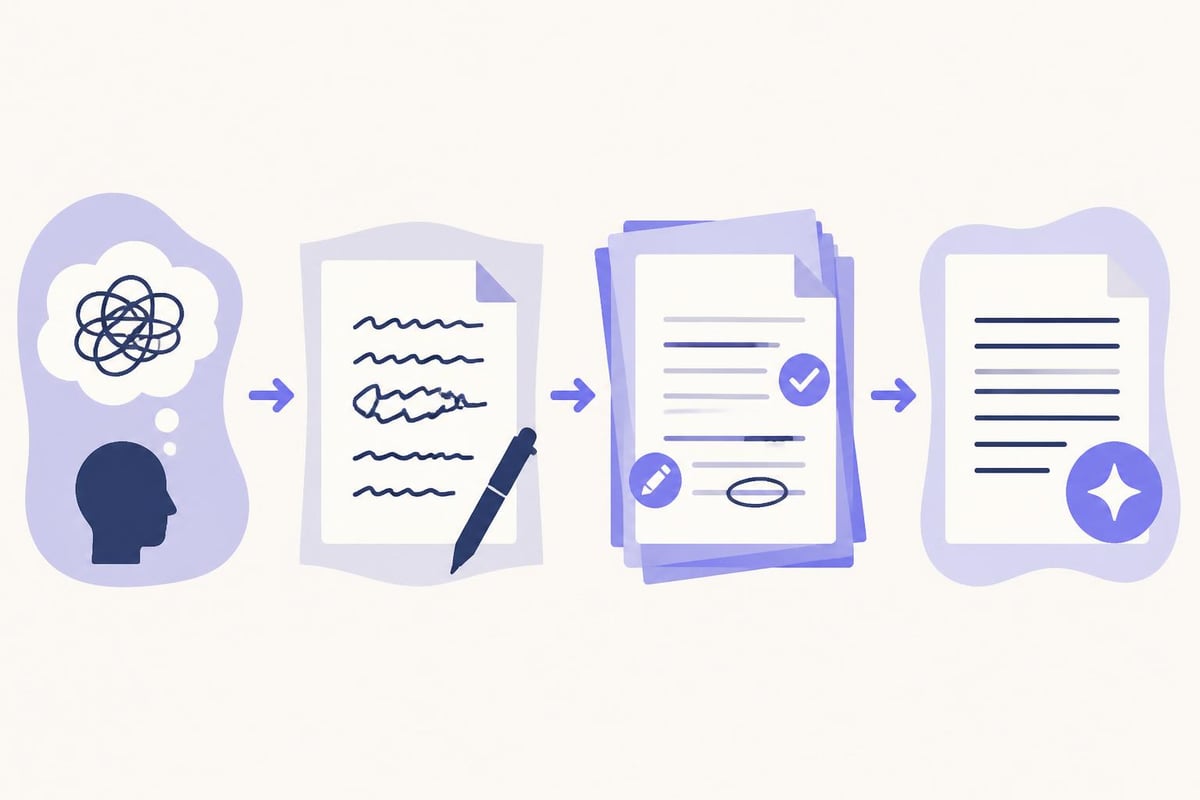
Before you begin writing a book, give yourself explicit permission to create a terrible first draft. Research shows that understanding the writing process includes accepting that revision is where the magic happens, not in the initial creation.
Anne Lamott calls them "shitty first drafts." Hemingway said "the first draft of anything is garbage." These aren't discouraging statements. They're liberating truths that free you from the pressure of immediate brilliance.
Setting Up Your Writing Foundation
Once you've mentally prepared yourself to begin writing a book, you need three foundational elements: a clear enough idea, a realistic schedule, and a supportive environment.
Clarifying Your Book Idea
You don't need every detail plotted before you start. But you do need what I call "compass clarity," a sense of direction even if the exact path remains uncertain.
Answer these core questions:
- What's the central story or message? (One sentence)
- Who needs this book? (Your ideal reader)
- What transformation or experience will readers have? (The journey)
- What makes your perspective unique? (Your angle)
For fiction writers, this might mean knowing your protagonist's desire and the obstacle standing in their way. For nonfiction authors, it's understanding the problem you're solving and the solution you're offering.
Finding your motivation helps shape your idea into something concrete enough to pursue. You don't need a full outline yet, though some writers find that helpful. You just need enough clarity to write the next scene or chapter.
Building a Sustainable Writing Schedule
The difference between people who talk about writing and people who finish books is habit. Not talent. Not inspiration. Habit.
| Schedule Type | Best For | Example Routine |
|---|---|---|
| Daily sprints | Morning writers, habit builders | 30-60 minutes before work |
| Block writing | Busy schedules, weekend warriors | 3-4 hours on Saturdays |
| Word count goals | Competitive personalities | 500 words daily, any time |
| Time-based sessions | Process-focused writers | 45 minutes, 4x weekly |
Start smaller than feels comfortable. Seriously. If you think you can write for an hour daily, start with 20 minutes. The goal is consistency, not heroics. You can always expand a habit that's working. It's much harder to revive one that burned you out.
When you begin writing a book with realistic expectations, you build momentum instead of guilt. Those 20-minute sessions add up to thousands of words over weeks, tens of thousands over months.
Creating Your Writing Environment
Your environment shapes your output more than you realize. Some writers need silence. Others thrive with background noise. The key is intentionally designing conditions that support your focus.
Physical space considerations:
- Dedicated writing spot (even a specific chair counts)
- Minimal visual distractions in your sightline
- Comfortable temperature and lighting
- Phone in another room or on airplane mode
Digital environment:
- Writing software that doesn't overwhelm you with features
- Browser blockers during writing sessions
- Single-tasking instead of multi-tasking
- Cloud backup for peace of mind
Modern writing tools make it easier than ever to begin writing a book without technical friction. Storyloft for Authors gives you everything needed to write, edit, format, and publish in one place, eliminating the need to juggle multiple apps while you're trying to stay in creative flow.

The First Page Strategy
Now we arrive at the practical moment: how do you actually begin writing a book on the page itself?
Starting With Scene, Not Setup
New writers often make the mistake of opening with backstory, world-building, or explanation. Readers want to be dropped into a moment that matters.
Crafting compelling beginnings means introducing character, world, and conflict through action and dialogue, not exposition. Even in nonfiction, starting with a specific scene or example hooks readers better than abstract concepts.
Ask yourself: what's the most interesting moment I could show readers first? Start there. You can always weave in necessary context later through the natural flow of the story.
The Opening Sentence Test
Your first sentence doesn't need to be perfect, but it should create movement. Compare these openings:
Static: "The world of Eldoria had existed for thousands of years."
Dynamic: "The arrow missed Kara's head by three inches, close enough to feel the wind of its passing."
Static: "This book will teach you about productivity."
Dynamic: "I wasted the first decade of my career doing work that didn't matter."
The second examples in each pair create immediate questions in the reader's mind. Who's shooting at Kara? Why did the author waste years? Questions create engagement. Engagement creates page-turning.

Overcoming the Initial Resistance
The hardest part of any writing session is the first five minutes. Your brain will generate countless reasons why now isn't the right time to begin writing a book, or to continue the one you've started.
The Two-Minute Rule
Tell yourself you'll write for just two minutes. That's it. No pressure beyond that tiny commitment.
What happens? Usually, once you start, you keep going. The resistance was about starting, not continuing. But even if you only write for two minutes, you've maintained the habit. You've proven to yourself that you can write on days when it feels impossible.
This matters more than you might think. Trust builds slowly.
Managing the Inner Critic
That voice telling you your writing isn't good enough? It's trying to protect you from vulnerability and potential failure. Thank it for trying to help, then write anyway.
Strategies that actually work:
- Separate creation from editing: Never revise while drafting
- Use a timer: When it goes off, you're done for the day, no judgment
- Share nothing until the first draft is complete: Premature feedback kills momentum
- Remember your why: Connect to the reason this story matters
The inner critic loses power when you expect it to show up and choose to write despite its protests.
Building Your Writing Muscle
Writing a book isn't a single action. It's thousands of small sessions accumulated over time. Understanding the complete writing process helps you see each session as part of a larger journey rather than an isolated event.
The Snowflake Effect
Start with a sentence. Expand it to a paragraph. Grow that paragraph into a scene. Build that scene into a chapter. Before you know it, you have sections, then parts, then a complete manuscript.
This approach prevents overwhelm because you're never thinking about "writing a book." You're writing the next 500 words. That's manageable. That's achievable. That's how books actually get written.
Tracking Progress Visually
There's something powerful about seeing your word count climb or your completed chapters stack up. Data visualization for your manuscript can show you patterns in your productivity, helping you identify your best writing times and stay motivated through the middle sections.
| Milestone | Typical Word Count | Psychological Impact |
|---|---|---|
| First chapter | 3,000-5,000 | Proof you can do this |
| Quarter mark | 20,000-25,000 | Momentum builds |
| Halfway point | 40,000-50,000 | The hard middle begins |
| Three-quarters | 60,000-75,000 | The end becomes real |
| First draft complete | 80,000-100,000 | Major achievement unlocked |
Every milestone matters. Celebrate them. You're doing something most people only dream about.
When You Get Stuck
You will get stuck. Not if. When. Every writer faces moments when the words won't come or the story loses its way. This doesn't mean you've failed. It means you're writing.
The Skip-Ahead Technique
Can't figure out how to write the scene you're on? Skip it. Leave a note like "[SOMETHING HAPPENS HERE WHERE THEY ESCAPE]" and move to the next scene you can see clearly.
This feels like cheating, but it's actually professional. You're maintaining momentum instead of stalling out. You'll fill in those gaps during revision when you have better perspective on what the scene needs to accomplish.
Research and Inspiration Boundaries
Research can be procrastination in disguise. If you're writing historical fiction, yes, you need accurate details. But don't let research become an excuse to avoid writing.
Set clear boundaries:
- Research specific questions, not general topics
- Time-box research sessions (30 minutes maximum)
- Take notes but don't disappear down rabbit holes
- Mark places in your draft to fact-check later
The same applies to seeking inspiration. Reading craft books and studying your genre matters, but it's not writing. When you begin writing a book, the goal is words on the page, not endless preparation.
Developing Your Author Voice
Your voice is the unique way you see and express ideas. It's not something you create artificially. It's something you discover through the act of writing itself.
Write Like You Talk (Then Refine)
First drafts written in your natural voice, the way you'd tell the story to a friend, have more authenticity than carefully constructed prose that sounds like "how books should sound."
You can always elevate and polish during revision. But you can't add personality to sterile, over-edited prose. Start with your natural rhythm and vocabulary. Let AI editing tools help you strengthen structure and clarity while preserving what makes your voice distinctly yours.
Reading to Write
The books you consume shape your creative output. Read widely in your genre to understand conventions. Read outside your genre to bring fresh perspectives. Pay attention to what you admire in other writers' work, then experiment with those techniques in your own.
But don't read while you're actively drafting. That's when other voices can drown out your own. Save reading for revision phases and between projects.
Making Real Progress
Books don't get written through perfect conditions or unbroken inspiration. They get written through regular practice despite imperfect conditions and fluctuating motivation.
The Anti-Binge Approach
Our culture celebrates binge-writing stories: the author who locked themselves away for a month and emerged with a finished novel. These stories are rare, often exaggerated, and usually unsustainable.
Instead, embrace the steady approach. Write 500 words four times a week, and in six months you'll have an 80,000-word manuscript. That's a complete novel from consistent, modest effort.
Weekly writing math:
- 500 words × 4 sessions = 2,000 words per week
- 2,000 words × 26 weeks = 52,000 words (short novel)
- 2,000 words × 52 weeks = 104,000 words (long novel + revision time)
The numbers prove it's possible. Now you just need to begin writing a book with this timeline in mind.
Finding Your Writing Community
Writing is solitary work, but it doesn't have to be lonely. Other writers understand the struggles and victories in ways non-writers can't. They can offer encouragement when you doubt yourself and accountability when motivation wanes.
Look for:
- Local writing groups or library workshops
- Online communities specific to your genre
- Writing partners for regular check-ins
- Author forums and Discord servers
Choose communities that celebrate progress over perfection. Avoid spaces where writers primarily complain or compare in toxic ways. You need support, not additional pressure.
Tools and Technology That Actually Help
The right tools won't write your book for you, but they can remove friction from the process. When you begin writing a book in 2026, you have more options than ever before.
Choosing Writing Software Wisely
Don't let tool selection become procrastination. Pick something that offers:
- Distraction-free writing mode for focused sessions
- Organizational features for managing chapters and scenes
- Backup and sync so you never lose work
- Export options for when you're ready to publish
Some writers swear by specific software. Others write in Google Docs or Word. What matters is that the tool serves your process instead of complicating it. Modern writing apps integrate multiple features so you're not constantly switching between platforms.
AI as a Writing Partner
Artificial intelligence has transformed how authors approach their craft. Used properly, AI can help you overcome blocks, strengthen weak sections, and maintain consistency throughout your manuscript.
The key word is "partner." AI isn't here to write your book for you. It's here to provide feedback, suggest improvements, and help you see blind spots in your work. AI editors built specifically for authors understand narrative structure and can offer insights while preserving your unique voice.
Moving From Start to Finish
Beginning is crucial, but finishing is everything. The distance between those two points is bridged by middle sections where excitement fades and the work feels hardest.
Navigating the Muddy Middle
Around the 30,000 to 50,000-word mark, most writers hit what feels like quicksand. The initial excitement has worn off. The ending still seems distant. Characters who sparked with life now feel flat. This is normal.
Push through by:
- Reminding yourself this phase is temporary and universal
- Breaking the remaining work into smaller chunks (one chapter at a time)
- Revisiting your original vision and why this story matters
- Taking a short break if needed, but setting a specific return date
The muddy middle is where persistence matters more than talent. Authors who develop consistent writing practices are the ones who emerge on the other side with completed manuscripts.
Writing Through Doubt
Your inner critic will tell you the book is terrible, that you should start over, that you've wasted your time. These thoughts intensify in the middle sections.
Don't restart. Don't delete everything. Don't read your early chapters and judge them harshly. Keep moving forward. You can fix anything during revision, but you can't revise blank pages.
Setting Yourself Up for Completion
When you begin writing a book with completion in mind from day one, you make different choices than someone who's "just seeing where this goes."
The Endpoint Vision
Know what "done" looks like for your first draft:
- A specific word count range for your genre
- All major plot points or argument sections included
- Character arcs or thematic threads completed
- Beginning, middle, and end written (however roughly)
"Done" doesn't mean perfect. It means you've told the complete story or presented the full argument. Everything else can be refined in revision.
Preparing for What Comes Next
Before you begin writing a book, understand that the first draft is only one phase. After it comes revision, editing, feedback incorporation, and eventually publication preparation.
Professional formatting tools become important when you're ready to publish, but don't think about that during the drafting phase. One step at a time. Right now, your job is to get the story out of your head and onto the page.
The journey to begin writing a book starts with a single decision: to value progress over perfection and consistency over inspiration. Every finished book in existence began as a blank page and a writer brave enough to fill it with imperfect words. With the right tools, support, and mindset, you can join the ranks of authors who transformed their ideas into completed manuscripts. Storyloft combines everything you need in one platform, from AI-powered editing that preserves your voice to professional formatting for publication, so you can focus on what matters most: telling your story. Start writing today, and six months from now, you'll have something real to show for it.