8 Examples of Archetypal Heroes for Writers
Archetypes don't make characters predictable. Predictable writing comes from stopping at the label. A hero becomes memorable when a recognizable drive collides with a private contradiction, a difficult relationship, and a choice that carries a real cost. Katniss Everdeen isn't compelling merely because she fits the Hero pattern. Her protectiveness, distrust, anger, and resistance to becoming a political symbol give that pattern a specific shape.
The examples of archetypal heroes in this guide include the Hero, Mentor, Shadow, Sage, Innocent, Everyman, Lover, and Caregiver. Each one works best as a story engine. Define what the character wants, apply pressure to expose the weakness inside that desire, then track the transformation through decisions, relationships, and consequences.
The idea has deep roots. Joseph Campbell's The Hero with a Thousand Faces, published in 1949, formalized the monomyth as a recurring movement of separation, initiation, and return, a framework later teaching traditions often map into 17 stages through the Joseph Campbell Foundation's explanation of the Hero's Journey. But writers don't need to copy one structure. Storyloft can help organize character details, research, drafting, revision, illustrations, and long-form continuity while you adapt an archetype to your own story.
Table of Contents
- 1. The Hero
- 2. The Mentor
- 3. The Shadow
- 4. The Sage
- 5. The Innocent
- 6. The Everyman
- 7. The Lover
- 8. The Caregiver
- Comparison of 8 Archetypal Heroes
- Turn an Archetype Into a Specific Protagonist
1. The Hero
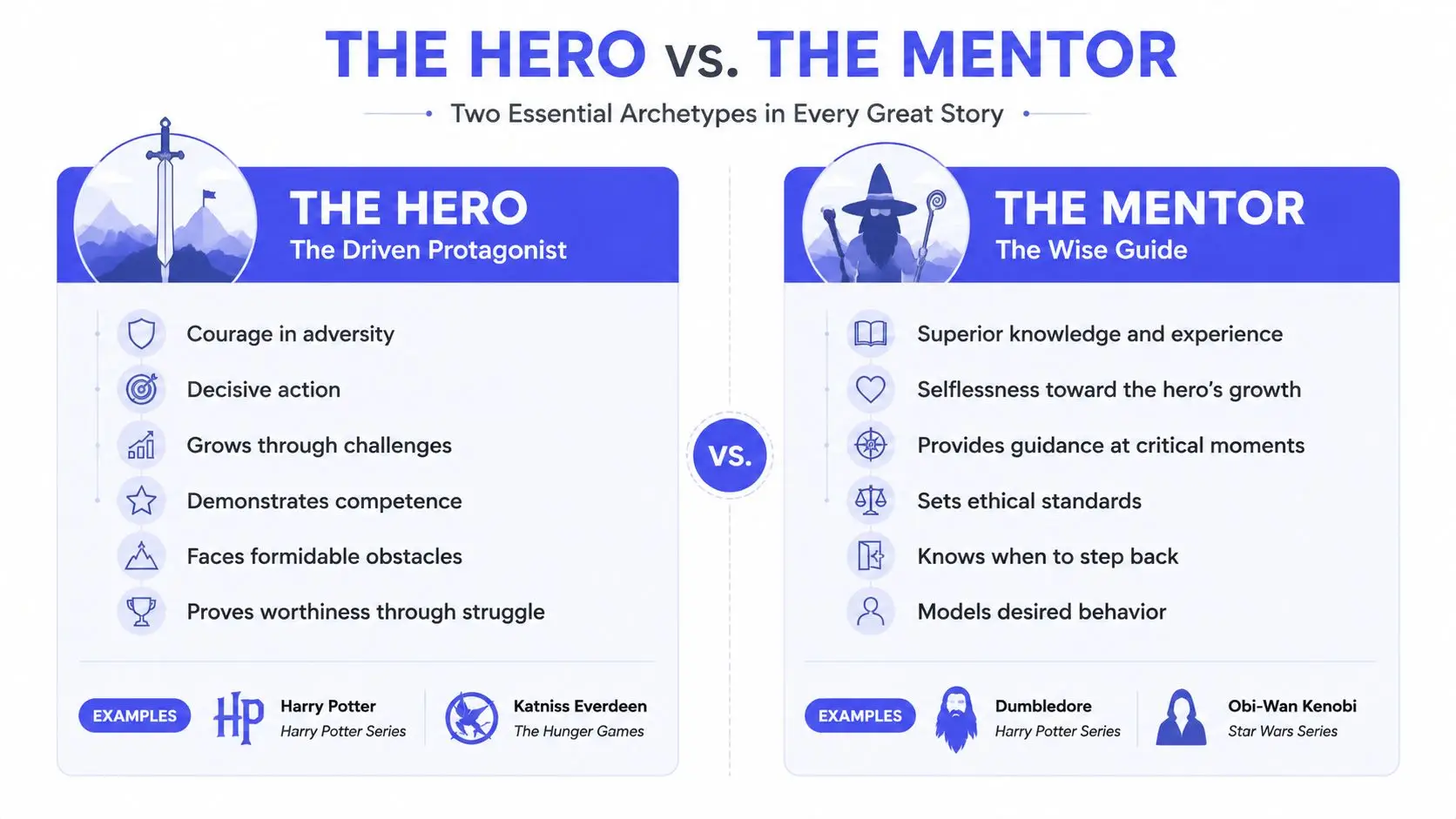
The Hero acts when action becomes unavoidable. This archetype usually carries the story's main burden, confronting danger outside the character and fear within it. The Hero may begin as an ordinary person, as Luke Skywalker does on his farm, or as someone already capable of resistance, as Katniss Everdeen is under an oppressive regime in The Hunger Games.
The core motivation is to protect, overcome, restore, or prove oneself. That motivation gives the plot forward motion, but it also creates risk. A character who believes courage means facing every challenge alone may reject help. A character who equates victory with moral worth may become ruthless or collapse after failure.
Consider Elizabeth Bennet. Her conflict isn't physical warfare, yet she still functions as a Hero because she must challenge social expectations, revise her judgments, and act with intellectual and emotional courage. Harry Potter similarly grows through confrontations with dark forces, but his defining development involves friendship, loyalty, grief, and the meaning of choice.
Turn courage into pressure
Don't give your Hero an obstacle that tests only skill. Test the belief behind the skill.
- Governing drive: Protect someone, defeat an injustice, or recover what was lost.
- Strength: Persistence under pressure and the willingness to act.
- Risk: Isolation, recklessness, self-righteousness, or dependence on external victory.
- Transformation: The Hero learns what kind of person they must become, not merely what enemy they must defeat.
Practical rule: Make the decisive victory depend on a change in judgment, loyalty, or self-knowledge. A stronger weapon alone won't complete the arc.
Use this Hero's Journey outline for authors to test whether your protagonist's external journey reflects an internal one. Storyloft's character creator can hold physical traits and behavioral patterns, while focus mode supports concentrated confrontation scenes. Eddy can help revise dialogue without losing the character's changing voice, and notes, comments, goals, and illustrations can track the Hero from the ordinary world to the final choice.
For a different creative reference, explore the AI version of Heroes We Could Be.
2. The Mentor
The Mentor gives the protagonist access to knowledge, discipline, tools, or perspective. Dumbledore guides Harry through a dangerous moral and magical world. Morpheus challenges Neo's assumptions about reality. Mufasa shapes Simba's understanding of responsibility, while Obi-Wan Kenobi trains Luke to recognize a purpose larger than his isolated life.
The Mentor's governing motivation is to prepare another person for a task they can't yet complete. That purpose makes the character useful, but usefulness isn't the same as wisdom. A Mentor may hide information, impose an outdated lesson, or confuse control with protection. Their experience can become a limitation when the student faces a new kind of problem.
Marlin in Finding Nemo demonstrates a less conventional version. He isn't a sage handing down ancient knowledge. Through the journey, he and Nemo learn from one another. That makes the relationship more dynamic than a one-way transfer of advice.
Give the lesson a cost
A Mentor shouldn't appear only to explain the world. Let the Mentor's teaching create a dilemma.
- Core motivation: Equip the protagonist to survive, choose, or lead.
- Narrative function: Supply knowledge while exposing the values behind that knowledge.
- Strength: Experience, patience, and a broader perspective.
- Risk: Secrecy, paternalism, rigidity, or emotional distance.
- Transformation: The Mentor accepts that the student must eventually act independently.
A useful Mentor scene changes what the protagonist can do, but it should also change what the protagonist believes. The lesson may be correct in principle and wrong in application. A warning about trust, for example, might save a character from betrayal while preventing a necessary alliance.
Build the relationship in a character profile workspace before drafting major lessons. Storyloft's binders can hold the Mentor's history, principles, aphorisms, and unresolved regrets. Notes and comments can mark the moments when the protagonist follows, resists, or surpasses the Mentor's teaching.

3. The Shadow
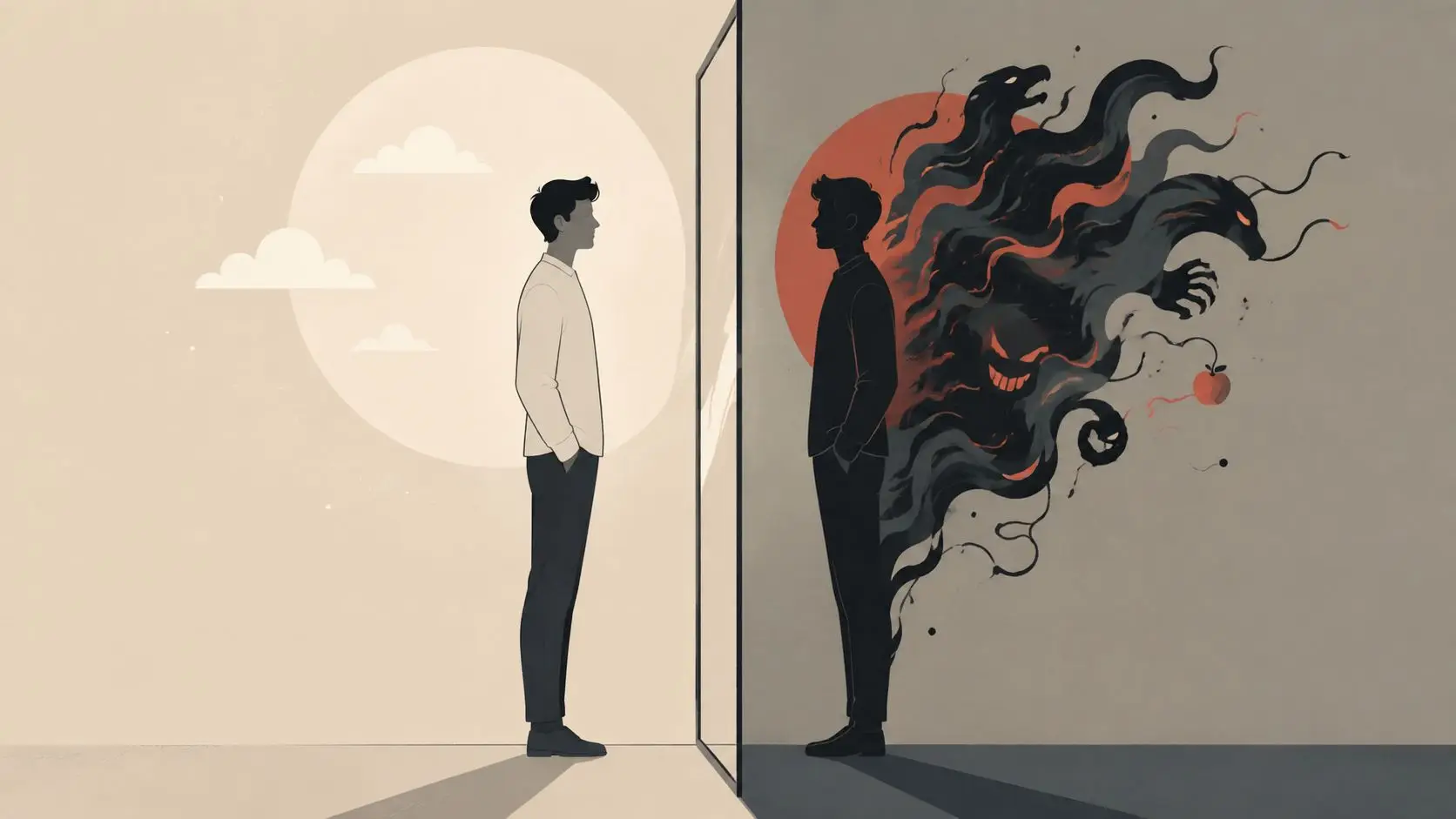
The Shadow represents opposition, but reducing it to “the villain” wastes its dramatic power. Voldemort embodies Harry's fear of death and the temptation to treat power as protection. Darth Vader represents what Luke might become if fear and anger overtake compassion. Iago's manipulation in Othello exposes jealousy and resentment without offering the comfort of a simple physical monster.
The Shadow's governing motivation is often control, revenge, survival, recognition, or the refusal to accept vulnerability. That desire may be understandable even when the character's methods are destructive. Sauron's corrupting power externalizes a threat that can infect anyone who seeks mastery. Nurse Ratched represents authoritarian control within an institution that claims to provide care.
A strong Shadow presses on the Hero's hidden contradiction. If the protagonist claims to value freedom, the Shadow might reveal the protagonist's desire to control others. If the Hero wants justice, the Shadow might demonstrate how easily justice becomes punishment.
Make opposition personal
Write the Shadow with the same seriousness you give the protagonist. You don't need to excuse harmful behavior, but you should understand the logic that makes the behavior feel necessary to the Shadow.
- Governing drive: Preserve power, avoid helplessness, or force the world to acknowledge a wound.
- Narrative function: Externalize the protagonist's fear, temptation, or rejected possibility.
- Strength: Conviction, strategic intelligence, and the ability to identify weakness.
- Risk: Dehumanization, obsession, manipulation, and moral blindness.
- Transformation: The Shadow may repent, intensify, collapse, or reveal that the Hero must reject its worldview.
Develop the Shadow's perspective in this guide to flawed characters. A dedicated binder can hold monologues, private records, and scenes that clarify internal logic. Eddy can help establish a distinct speech pattern, while comments can identify where readers gain sympathy or recognize the Shadow's argument.
4. The Sage
The Sage pursues truth through observation, research, deduction, and disciplined reasoning. Sherlock Holmes notices patterns other characters miss. Hermione Granger turns preparation and research into practical power. Dr. Ian Malcolm uses mathematical analysis to challenge the confidence of people who believe they can control complex systems.
The Sage differs from the Mentor in emphasis. A Mentor teaches from lived experience and often cares about the student's formation. A Sage wants to understand what is true, how the evidence connects, and what a conclusion implies. Jessica Jones investigates through persistence and distrust, while Atticus Finch uses reason and moral clarity to pursue justice in a hostile social environment.
The governing motivation is to know what is real. That drive can move a mystery, expose a conspiracy, or provide philosophical depth. It can also create distance. A Sage may analyze grief instead of feeling it, pursue an answer after the answer has become dangerous, or mistake intelligence for wisdom.
Let knowledge create danger
Information should complicate the story, not merely solve it. A discovery can force the Sage to choose between truth and safety, evidence and loyalty, or public exposure and private protection.
- Core motivation: Understand the system, event, person, or mystery.
- Narrative function: Investigate, interpret, challenge assumptions, and reveal consequences.
- Strength: Curiosity, pattern recognition, precision, and intellectual independence.
- Risk: Arrogance, emotional detachment, paralysis through analysis, or ethical overreach.
- Transformation: The Sage learns that knowledge requires responsibility and sometimes action.
Use a character design template to distinguish the Sage's expertise from their emotional blind spot. Storyloft's planning workspace can organize case files, evidence logs, research notes, and revelation points. The notes feature can track clues, while tone analysis helps analytical dialogue stay clear rather than becoming a lecture.
A Sage doesn't need to be the smartest person in every room. The character becomes more convincing when another person understands a social or emotional truth the Sage has overlooked.
5. The Innocent
The Innocent brings hope into a story that might otherwise become morally or emotionally unbearable. Scout Finch begins with a child's assumptions and gradually discovers how prejudice and injustice operate. Newt Scamander retains wonder and trust while moving through a world that treats difference as a threat. Bran Stark is forced to grow beyond an earlier innocence as his understanding of danger expands.
The Innocent's governing motivation is to preserve goodness, safety, belonging, or the possibility of happiness. That motivation can make the character a moral anchor. It can also make the character vulnerable to deception. Innocence isn't the same as stupidity. A perceptive Innocent may understand cruelty and still refuse to let cruelty define every relationship.
Lennie Small in Of Mice and Men shows the archetype's darker potential. His childlike trust exists inside an adult body and an adult world, creating a painful mismatch between emotional innocence and physical consequence. The story's tension comes partly from the fact that good intentions can't prevent harm.
Treat disillusionment as transformation
Don't assume the Innocent must become cynical. A stronger arc asks what the character can learn without surrendering the value that made them hopeful.
- Governing drive: Believe in goodness, protect simple belonging, or preserve wonder.
- Narrative function: Show what the conflict threatens and why the stakes matter emotionally.
- Strength: Trust, resilience, openness, and moral clarity.
- Risk: Naivety, denial, dependence, or susceptibility to manipulation.
- Transformation: The Innocent develops discernment while retaining a chosen form of hope.
Mark moments of discovery, betrayal, and renewed commitment with notes and comments in Storyloft. Eddy's voice-aware rewrites can help dialogue mature as the character's worldview changes. Goal tracking can identify scenes where assumptions shift, and illustrations can contrast the character's early openness with later vulnerability.
The most effective Innocent doesn't merely ask other characters to protect them. Their faith can challenge hardened characters, reveal hypocrisy, or inspire action when experienced characters have stopped believing change is possible.
6. The Everyman
The Everyman enters extraordinary circumstances without a destiny that announces itself. Bilbo Baggins begins with a strong preference for comfort and routine, yet the journey draws out courage he didn't recognize in himself. Andy Dufresne relies on patience, planning, and endurance rather than supernatural gifts. Peeta Mellark remains emotionally legible because his strength grows through kindness, loyalty, and moral resistance inside an impossible situation.
The Everyman's governing motivation is to preserve ordinary life, protect familiar relationships, or find the courage to participate. That gives the archetype immediate accessibility. Readers don't need to share a special lineage or rare talent to understand the fear of leaving safety.
The risk is blandness. “Ordinary” doesn't mean undefined. A vivid Everyman has habits, irritations, practical abilities, embarrassing preferences, and a history that shapes how they respond under stress. Odysseus is more skilled than a modern Everyman, yet his exhaustion, longing, cunning, and vulnerability keep him human rather than invulnerable.
Make ordinary competence dramatic
The Everyman often succeeds because they notice what specialists ignore. A mechanic understands a failing machine. A parent recognizes a child's silence. A clerk knows how a bureaucratic system hides information.
- Core motivation: Keep loved ones safe, return home, or build a decent life.
- Narrative function: Give the audience an accessible viewpoint inside an unfamiliar conflict.
- Strength: Adaptability, persistence, practical judgment, and human connection.
- Risk: Fear, passivity, resentment, or reliance on stronger personalities.
- Transformation: The character accepts responsibility without needing to become extraordinary in every other way.
Use Storyloft's character creator to record mundane details, then explore the character's ordinary life in the planning workspace before the inciting incident. Eddy can support conversational dialogue, while notes and comments can identify the moments when everyday skills become unexpected advantages.

7. The Lover
The Lover is driven by connection. Juliet defies family duty because her bond with Romeo becomes more important than the social order around her. In Wuthering Heights, Heathcliff and Cathy turn passion into a force that can nourish, possess, and destroy. Lily Potter's maternal love gives the wider Harry Potter story one of its central emotional meanings.
The archetype isn't limited to romantic desire. A Lover may devote themselves to family, friendship, art, a natural setting, a craft, or a community. The governing motivation is to experience intimacy, beauty, belonging, or emotional truth. This makes the Lover especially useful when a plot needs sensory richness and vulnerability rather than constant action.
The risk is fusion. A Lover may abandon personal judgment, idealize another person, confuse intensity with compatibility, or accept harm to preserve a bond. Daisy Buchanan in The Great Gatsby shows how desire and beauty can become entangled with privilege, performance, and the longing for a past that can't be restored.
Put desire against responsibility
The Lover becomes a story engine when connection demands a choice. Does the character tell the truth and risk abandonment? Does loyalty require sacrifice? Can the character love someone without surrendering identity?
- Governing drive: Create or protect a meaningful bond.
- Narrative function: Raise emotional stakes and make abstract conflict personal.
- Strength: Empathy, devotion, sensual awareness, and emotional courage.
- Risk: Possessiveness, dependency, idealization, or self-erasure.
- Transformation: The Lover learns to build connection without abandoning boundaries or truth.
Define sensory preferences, emotional triggers, and relationship patterns in Storyloft's character creator. The manuscript editor can support detailed scenes, while Eddy's tone analysis can keep vulnerability specific instead of overwrought. Notes and comments can track the relationship arc from attraction or loyalty through rupture, repair, or release.
A Lover's decisive moment doesn't always end in union. Sometimes the transformation is learning that love can remain real even when possession, secrecy, or dependence must end.
8. The Caregiver
The Caregiver responds to suffering by offering protection, labor, comfort, or practical help. Molly Weasley extends maternal care across family and community. Atticus Finch protects children and vulnerable people through presence, principle, and difficult action. Bob Parr, or Mr. Incredible, learns that caring for a family requires more than performing as a public hero.
The Caregiver's governing motivation is to reduce another person's pain and help them survive. That differs from the Mentor, who prepares someone for growth, and from the Lover, who seeks emotional connection. The Caregiver focuses on immediate need, though the best versions also understand that rescue can become control.
The archetype has a clear shadow. A person who defines their worth through service may ignore exhaustion, resent those they help, or use care to make others dependent. Nurse Ratched presents a distorted form of institutional care, where authority disguises control as treatment. The contrast shows why compassionate intent doesn't automatically make a caregiving role ethical.
Show who cares for the caregiver
A Caregiver needs needs, limits, and a private life. If the character never refuses a request, the story loses the pressure that makes compassion meaningful.
- Core motivation: Relieve suffering, protect the vulnerable, or keep a group together.
- Narrative function: Establish moral stakes through concrete acts of service.
- Strength: Empathy, patience, reliability, and practical generosity.
- Risk: Martyrdom, control, burnout, resentment, or neglect of self.
- Transformation: The Caregiver accepts mutual dependence and learns to receive care.
Track emotional cost with Storyloft's notes and comments. A binder can document the Caregiver's relationships, promises, and unspoken resentment, while illustrations can show moments when the person is vulnerable and needs support. Eddy can help shape compassionate dialogue that remains grounded in action rather than sentimentality.
Give the Caregiver a choice between helping immediately and protecting a larger responsibility. That conflict reveals whether service is a freely chosen value or a compulsion the character has never examined.
Comparison of 8 Archetypal Heroes
| Archetype | 🔄 Implementation Complexity | ⚡ Resource / Effort | 📊 Expected Outcome | Ideal Use Cases | ⭐ Key Advantages |
|---|---|---|---|---|---|
| The Hero | 🔄 Medium, clear arc but needs subversion to avoid cliché | ⚡ Medium–High, sustained development, action scenes | 📊 High engagement and momentum; clear transformation | Epic fantasy, adventure, coming-of-age, long-form fiction | ⭐ Drives narrative momentum; relatable growth. 💡 Subvert tropes to stay fresh. |
| The Mentor | 🔄 Low–Medium, credibility and timing are key | ⚡ Medium, consistent voice and background work | 📊 Credible character growth; natural exposition | Training arcs, multi-chapter sagas, moral/coming-of-age stories | ⭐ Provides guidance and moral anchor; eases exposition. 💡 Give clear limits to preserve hero agency. |
| The Shadow | 🔄 High, must balance believable motives with antagonism | ⚡ High, deep motivation and perspective development | 📊 Strong tension, moral ambiguity, catalyst for hero growth | Psychological drama, thrillers, complex character studies | ⭐ Deepens conflict and theme; creates memorable opposition. 💡 Humanize motives to avoid flat villainy. |
| The Sage | 🔄 Medium, research-heavy, risk of info-dump | ⚡ Medium, investigation, clue tracking, logical consistency | 📊 Intellectual depth; drives revelations and plot logic | Mystery, thriller, investigative and idea-driven fiction | ⭐ Solves problems via reason; adds thematic clarity. 💡 Break exposition into discoveries. |
| The Innocent | 🔄 Low–Medium, needs consistent voice and believable growth | ⚡ Low–Medium, emotional beats and evolution tracking | 📊 Emotional resonance and moral contrast; pathos when threatened | Coming-of-age, dark narratives, emotionally driven stories | ⭐ Provides hope and emotional heart; contrasts darker elements. 💡 Show evolution to avoid victimhood. |
| The Everyman | 🔄 Low, conceptually simple but needs distinctiveness | ⚡ Medium, craft mundane detail and authentic voice | 📊 High reader identification; believable underdog stakes | Contemporary fiction, thrillers, relatable character arcs | ⭐ Maximizes reader empathy and accessibility. 💡 Add specific quirks to avoid blandness. |
| The Lover | 🔄 Medium, balance passion with plot and nuance | ⚡ Medium, sensory description and emotional nuance | 📊 Strong emotional and sensory impact; deep relationship dynamics | Romance, literary fiction, character-driven narratives | ⭐ Adds intimacy, sensory richness, and emotional stakes. 💡 Avoid melodrama; favor specific details. |
| The Caregiver | 🔄 Medium, must show compassion and personal cost | ⚡ Medium, layered emotional development and boundaries | 📊 Deep empathy and moral grounding; powerful supportive scenes | Family sagas, redemption arcs, literary character drama | ⭐ Demonstrates compassion through action; builds trust. 💡 Reveal caregiver vulnerability to avoid martyr trope. |
Turn an Archetype Into a Specific Protagonist
An archetype should give your protagonist direction, not a complete personality. Start by choosing the central motivation that powers the story. The Hero may want to protect a sibling. The Sage may want to prove a theory. The Caregiver may want to keep a community alive. The Everyman may want to return home. A concrete desire produces better scenes than a label such as “brave” or “wise.”
Then define the contradiction inside that motivation. A protective Hero may resent the people they protect. A truth-seeking Sage may fear what the truth will reveal. An Innocent may recognize cruelty but choose hope. A Lover may crave intimacy while distrusting dependence. This contradiction gives the character a private problem that external events can repeatedly expose.
Use this adaptation sequence:
- Choose the governing drive: State what the character wants in an active phrase.
- Name the contradiction: Identify the belief, fear, or habit that undermines the drive.
- Apply pressure: Create an antagonist, relationship, institution, or decision that targets the weakness.
- Assign a narrative function: Decide what the archetype contributes to plot, conflict, theme, or audience perspective.
- Track decisive change: Mark the choices that show the character becoming different, whether through growth, refusal, compromise, or collapse.
Campbell's framework remains useful because it gives writers a way to compare stories across cultures and genres. Comparative mythology sources discuss heroic figures including Gilgamesh, Jesus, Quetzalcoatl, Heracles, Cuchulainn, Theseus, Hainuwele, and Draupadi through quest patterns that involve departure, ordeal, transformation, and return in an overview of the hero-quest tradition. But universality doesn't require sameness. A 2024 comparative analysis argues that modern science-fiction and fantasy adapt the underlying journey to contemporary concerns, which supports preserving the core pattern while localizing conflicts, moral tests, and surface details in its analysis of heroic archetypes in global literature.
You can combine traits, but don't create a generic blend. Give one motivation priority, then let the secondary traits interfere with it. A Hero with Caregiver instincts may refuse a necessary sacrifice. A Sage with Lover instincts may distort evidence to protect someone. A Caregiver with Shadow qualities may turn protection into possession. The combination becomes meaningful when it produces choices the single archetype couldn't produce alone.
Real people and public narratives can also use these patterns beyond fiction. A case study framing Malala as a contemporary heroine connects adversity, public commitment, courage, purpose, and social impact to transformational leadership in the University of San Francisco of Quito repository. That example suggests a useful application for memoir, advocacy, education, and brand storytelling. The story engine remains the same, but the stakes and consequences belong to a specific life.
Current heroic storytelling also doesn't need to follow a strictly lone-adventurer model. Recent work on remediating heroic archetypes describes updated forms that preserve values such as loyalty, sacrifice, and courage while changing plot structure, gender dynamics, and social function. Its dataset reports 12% of cultural-worker narratives and 21% of female-hero narratives as updated hero forms, figures that should be read in the context of that study rather than generalized to all fiction in the Frontiers study on remediated heroic archetypes. The practical lesson is simple. Let your character's community, identity, relationships, and social purpose reshape the pattern.
Storyloft can support that process from outline to finished manuscript. Use the character creator for motivations and behaviors, the planning workspace for research and continuity, notes and comments for turning points, tone analysis for voice consistency, illustrations for visual development, and goal tracking for steady drafting. You can also study how visual storytelling communicates character transformation in AI shorts, then apply the same principle to scenes, cover concepts, and recurring imagery.
Finish by testing every major scene against one question: What does this character choose when the governing motivation becomes costly? The answer will reveal whether you've created a living protagonist or merely attached a familiar label.
Storyloft combines long-form manuscript drafting, AI-assisted editing, character development, illustration, cover design, and publishing workflows in one cloud-based workspace. Visit Storyloft to organize your archetypal protagonist, track transformation across scenes, and develop the manuscript and visual materials together.