Character Creation for Writers That Actually Sticks
Forty thousand words into a novel, your protagonist makes a joke that belongs to the sidekick. You reread the exchange and realize the problem isn't only the joke. Her sentence rhythm is wrong, her posture has changed, and the private fear that drove her through the opening chapters has vanished. Somewhere between drafting and revising, the character became a convenient instrument for the scene instead of the person who was supposed to be living through it.
That kind of drift is common in long-form fiction. Character creation for writers isn't finished when the profile is complete. The main work is keeping motivation, voice, behavior, relationships, and appearance coherent while the manuscript keeps changing.
Table of Contents
- Why Characters Drift Mid-Draft and What to Do About It
- The Core Character Sheet That Actually Gets Used
- Questions That Force Real Depth Beyond Surface Traits
- A Character in Three Scenes Showing How Traits Become Behavior
- Testing Your Character Through Iterative Dialogue
- Locking In Visual Consistency With Persona and Illustration Tools
- A Maintenance Routine to Keep Characters Consistent Across Revisions
Why Characters Drift Mid-Draft and What to Do About It
The joke itself is usually the symptom, not the cause. A writer may have decided early that the protagonist avoids emotional exposure by becoming precise and practical. Under pressure, however, a later scene needs energy, so the character suddenly delivers a bright, sarcastic line. The sentence works in isolation. It may even be funny. But it belongs to a different person.
Three failures usually sit underneath that moment.
First, the backstory was written once and then buried in a planning document. The writer knows the wound, desire, and false belief intellectually, but doesn't consult them when composing a new scene. Second, the voice was never tested under pressure. A few notes such as “dry,” “guarded,” or “intelligent” can't tell you how the character speaks when grieving, lying, flirting, or losing control. Third, physical details remain vague. If the character's hands, hair, clothing, and habitual posture aren't anchored, they can change without notice from chapter to chapter.
Practical rule: A character sheet is useful only if you open it while drafting and change it when the manuscript teaches you something new.
This maintenance problem matters because modern character creation moved toward individualized inner life rather than fixed archetypes and plot functions. The historical shift was affirmed in the 19th century, when characterization and realist fiction increasingly treated characters as central, while psychology further strengthened the emphasis on motivation and plausibility. The history of characterization helps explain why a role label such as “detective” or “devoted sister” isn't enough for a contemporary novel.
Treat your profile as a living reference. Keep a lean version beside the manuscript, update it after major scenes, and maintain a separate record of discoveries that haven't yet been integrated. Four tools make this workable: a short core sheet, pressure questions, dialogue simulation, and visual anchors. Together, they turn character creation from a prewriting exercise into a continuity practice.
The Core Character Sheet That Actually Gets Used
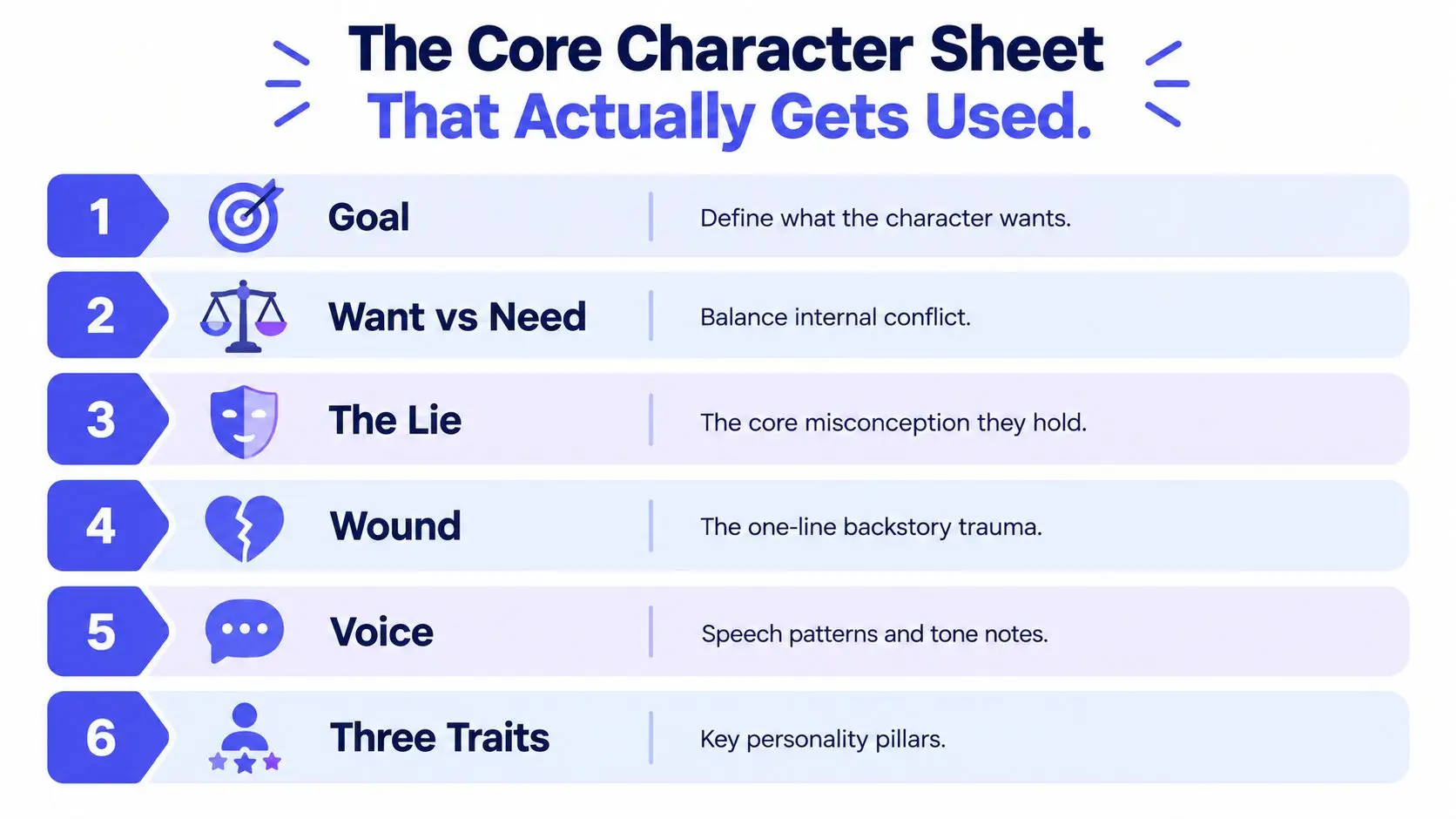
A useful sheet should fit in a sidebar or a single working document. If it becomes an encyclopedia, you won't reread it when a scene gets difficult. Fill it in the following order, because each answer gives the next one something to push against.
Start with the engine
Goal: What does the character actively pursue in the story? This earns a line because the goal drives plot decisions, including what the character refuses, risks, and misunderstands.
Want versus need: What do they think will solve their problem, and what change would help them? The want creates forward motion. The need creates the arc, and the friction between them creates scenes.
The lie they believe: What conclusion about themselves, other people, or the world do they treat as fact? A specific lie is more useful than “they have trust issues.” Try, “If I need help, people gain the right to control me.”
One-line wound: What past experience taught them that lie? Keep this to one sentence. The wound isn't a biography. It's the emotional origin of a recurring reaction.
Make the page audible and visible
Voice notes: Record sentence length, favorite kinds of comparisons, degree of directness, vocabulary they avoid, and what happens when they don't know an answer. “Sarcastic” is a label. “Answers emotional questions with logistics, then regrets the precision” is a writing instruction.
Three signature mannerisms: Choose behaviors that can recur without becoming a tic. One might involve the hands, one the gaze, and one the way the character handles objects. Variation matters. The same gesture in every scene becomes stage direction.
Two surface contradictions: Pair traits that create friction, such as “generous with money, suspicious of favors” or “socially polished, privately superstitious.” Contradictions make behavior less predictable without making it random.
One recurring image: Choose an object, texture, color, or visual pattern that carries emotional association. This gives illustrations and scene descriptions a stable anchor, but it also gives your prose a motif to return to.
Leave off the childhood timeline, favorite foods, blood type, and dozens of trivia answers unless they affect a scene. Store those details elsewhere. A working sheet should answer one urgent question quickly: What would this person do here, and why?
If you're building a reusable planning system, this character profile template can help keep the essential fields in one place. Writers who manage manuscripts, notes, research, and supporting assets across several applications may also benefit from comparing the best content software for workflows, especially when the character sheet needs to remain available beside the draft rather than buried in a separate folder.
Use the sheet as a decision tool, not a test you have to pass before writing. The character will become clearer through scenes, and the best profiles record that discovery.
Questions That Force Real Depth Beyond Surface Traits
Most character questionnaires stop at the first answer. The character is loyal, ambitious, lonely, or brave, and the writer moves on. Depth begins when you ask what that attractive quality costs, protects, or conceals.
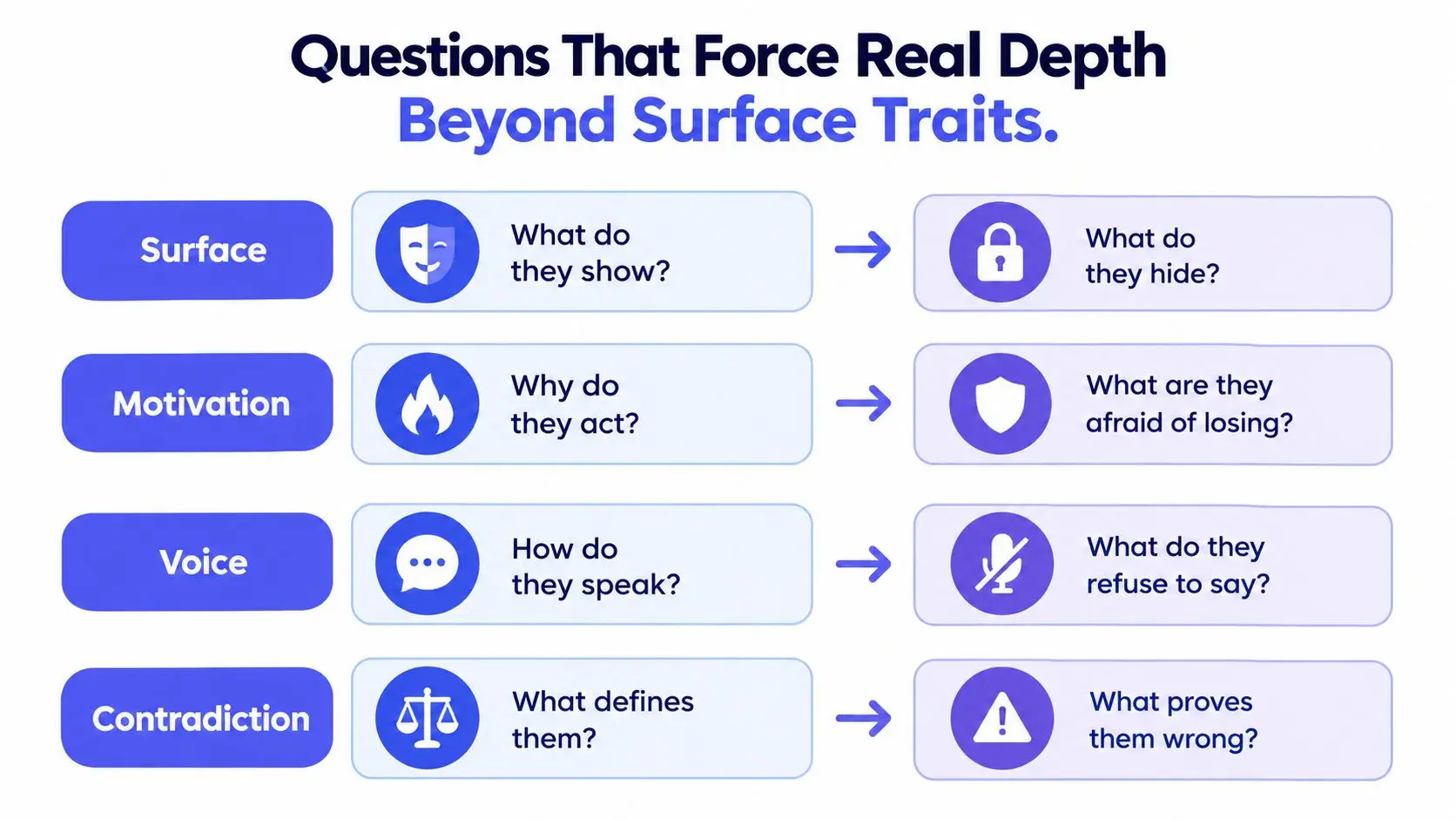
Surface and pressure
Ask the easy question first: What do they show other people? Maybe they present themselves as calm, competent, and generous.
Then apply pressure: What do they hide, and who is allowed to see it? A character who displays competence may conceal panic about being ordinary. A generous person may keep careful score. A calm person may be postponing an outburst.
Try these pairs:
- What do they value publicly? What private behavior contradicts that value?
- What do they want people to notice? What detail would embarrass them if someone noticed it instead?
- What role do they perform in a group? What happens when somebody else performs that role better?
Motivation and loss
“Justice” is not a motivation until it produces a choice. Ask, What do they want? Then ask, What would they sacrifice to get it, and what are they afraid of losing?
A character seeking justice might risk a career, betray a friend, or destroy evidence that would protect someone they love. Those choices reveal priorities more effectively than an explanation of their principles. You can find more ways to separate external desire from internal need in this guide to what a character's motivation is.
Voice and silence
Ask, How do they speak when relaxed? Then ask, What subject makes them go quiet, over-explain, or change the topic?
Don't reduce voice to accent. Track rhythm, metaphor, formality, interruptions, and silence. A character might use technical language to avoid emotional language. Another might answer questions with stories because direct statements feel dangerous. Read the dialogue aloud and mark the places where the character sounds like the author.
Contradiction and relationships
Ask, What defines them? Follow with, What would prove that definition wrong? The person who calls themselves independent may become possessive. The pacifist may be excellent at violence and terrified by that competence.
Before drafting the first scene, ask three relationship questions:
- Who owes whom, and what does each person believe the debt means?
- Who misunderstands whom, and what evidence keeps the misunderstanding alive?
- Whose approval is each character secretly chasing?
Return to these questions at chapter breaks. A character shouldn't answer them identically after every event. The change may be subtle, but the pressure should leave a trace. In practice, the questions become most valuable when they produce a behavior you can put on the page.
A Character in Three Scenes Showing How Traits Become Behavior
Maren is a freelance cartographer who makes maps for clients she doesn't trust. Her core sheet says she wants financial independence, needs to accept that control can't prevent loss, believes reliance makes her vulnerable, and deflects emotional discomfort by discussing borders, scale, and routes. Her mannerisms include folding receipts into tiny squares, tracing lines with her thumbnail, and correcting geographic terms when she feels cornered.
Scene one involves a contract
A client claims Maren's map contains an error and withholds payment. She doesn't say, “I refuse to be intimidated.” Instead, she opens the file, enlarges the disputed section, and explains three possible readings of the boundary. When the client says he needs a simple answer, she replies, “Simple isn't the same as accurate.”
The scene tests her voice notes, goal, and surface contradiction. She wants the money, but she also wants to remain ungoverned. Her refusal arrives disguised as logistics. If the sheet only said “Maren is stubborn,” the scene might become a generic argument. The specific behavior gives the trait a mechanism.
Scene two moves to the family table
At dinner, her brother mentions that their mother has been asking whether Maren is seeing anyone. Silence follows. Maren reaches for the salt, aligns it with the edge of the table, and starts explaining why the restaurant's framed map uses an outdated coastline.
The subject isn't the map. She's trying to regain control of the room. Her need has entered the scene through an ordinary object and a sideways explanation. If her physical habits were vague, the writer might make her pace, cross her arms, or leave, actions that could belong to anyone. The receipt-folding and line-tracing make her avoidance recognizable.
Scene three brings a crisis
A storm separates Maren from a search party in unfamiliar terrain. She finds shelter but can't reach anyone. Her private coping ritual is drawing borderlines, so she sketches the room's walls, then the route she took, then the places where the map ends.
At first, the ritual steadies her. Then it reveals the flaw. She has drawn the boundary around herself and left no route out. When another person finally arrives, Maren must accept directions instead of correcting them.

The progression is small but legible. The same traits create professional resistance, family deflection, and survival behavior. That's the difference between listing characteristics and dramatizing them. A good field on the sheet predicts action, but it shouldn't dictate identical action in every chapter.
Testing Your Character Through Iterative Dialogue
A static sheet can tell you that a character is guarded. Dialogue simulation shows how that guardedness sounds when somebody asks a question they can't evade.
Start with a high-stakes situation the novel may never use. Give the character a difficult request, an accusation, or an unexpected offer. Write a short exchange in their voice without checking the profile. Then reread it for three kinds of drift: a line that sounds like you, a line that belongs to another character, and a polished quip that no human in that emotional state would say.
Next, make three columns in your notes:
- What the character said.
- What they refused to say.
- What the exchange forced you to invent.
The third column is where the missing backstory appears. Perhaps the character knows exactly how to comfort strangers but can't tolerate being comforted. Add that discovery to the sheet, then run the same situation again with a different emotional register, such as grief instead of anger.
| Pass | Sample line | Voice drift detected | Sheet field to update |
|---|---|---|---|
| First | “You can keep the apology. Send the revised contract.” | Sounds too controlled and generic | Voice notes, emotional avoidance |
| Second | “Don't make this about the contract.” | The character reveals more than intended | Wound and refusal pattern |
| Third | “If you apologize, I have to decide whether I still need you.” | Distinctive logic and relational threat | Want versus need, relationship |
The value isn't producing perfect dialogue. It's creating a trace of decisions. User-centered research on CharacterChat found that writers preferred iteratively turning a chatbot into an imagined character through conversation rather than completing a static profile in one pass. The work involved a survey of 30 writers, followed by qualitative studies with 7 and 8 participants, as described in the CharacterChat research. The sample is small, but the practical lesson is strong: conversation exposes gaps that a finished-looking form can hide.
Run the dialogue test before a major drafting push and after a scene changes the character's relationships. If you want craft guidance on making the resulting exchanges sharper, use this resource on how to write better dialogue. The sheet should become more accurate because the character spoke, not because you filled in more boxes.
Locking In Visual Consistency With Persona and Illustration Tools
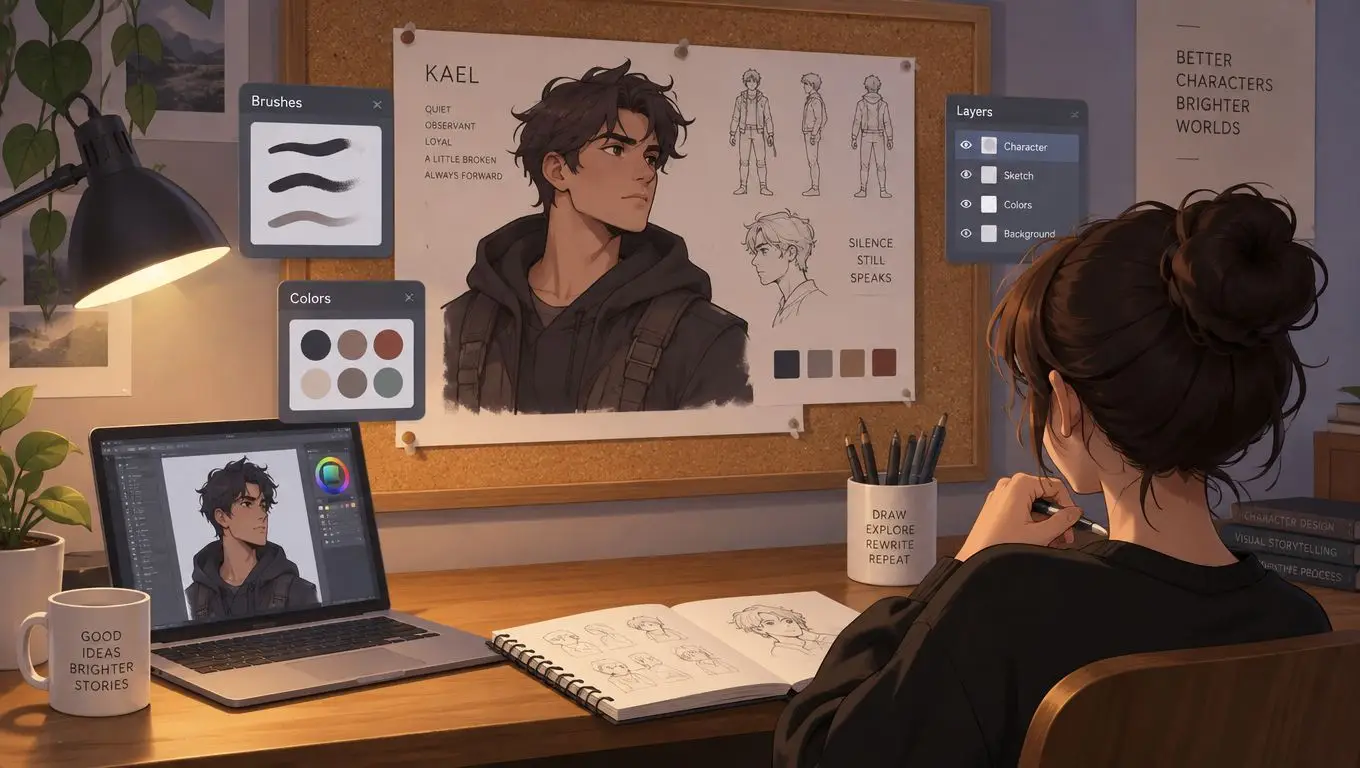
Visual references earn their place when they solve a continuity problem. A stable persona can remind you that a character favors a watch with a damaged strap, raises their shoulders when lying, or wears colors that fit their work and emotional state. It also gives collaborators a shared reference for illustrations, cover discussions, and scene planning.
Treat the image as evidence gathered during revision, not as a fixed answer about who the character is. A polished portrait created too early can make you protect the face instead of following the character's behavior. You can also lose an afternoon refining clothing while the chapter's central conflict remains unresolved. Stylized AI faces may flatten ambiguity, while prose often needs the reader to imagine an expression that resists a clean interpretation.
Use visual tools after the first pass has shown what the character repeatedly does. Lock in details that recur in the manuscript, rather than every feature you might mention someday. A scar, watch, coat, color family, or posture becomes a useful visual motif when it connects to memory, class, profession, or plot. Guidance on character development in animation helps here because animated design connects silhouette, repeated visual cues, and behavior instead of treating appearance as decoration.
Three practical rules
- Generate during the second pass: Use a character creator such as the one in this character design template to stabilize core appearance after the draft supplies evidence.
- Sketch during discovery: Make rough, changeable drawings while you are still finding the character. Imperfection keeps the design flexible.
- Keep prose in charge: Let the manuscript decide which visual details matter. Remove an image detail if the story provides no reason to keep it.
A visual persona supports interior life by giving you a consistent external reference during long revisions. Pair it with dialogue simulation when a character's behavior or relationships shift, then update the image only when the manuscript supports the change. If the persona helps you catch an appearance contradiction or remember how the character occupies space, it is doing useful work. If it becomes an excuse to avoid writing the scene, close the image and return to the draft.
A Maintenance Routine to Keep Characters Consistent Across Revisions
Character drift behaves like any other continuity error. It starts small, then forces explanation later. A changed eye color becomes a changed appearance, which becomes a changed impression of the character, which can make an entire relationship scene feel false. The remedy is a short maintenance routine attached to each writing session.
Before you write
Read the last scene in the relevant point of view. Don't reread the whole manuscript. Recover the emotional temperature, the unresolved intention, and the physical state the character carries into the next scene.
Then run three checks:
- Intent: Complete the sentence, “Right now, this character wants to…”
- Voice: Read a recent exchange and note one vocabulary choice or rhythm pattern to preserve.
- Continuity: Confirm the character's location, clothing, injuries, objects, and immediate relationships.
After you write
Ask what changed. A scene may reveal that the character is more jealous than expected, that a supposedly casual object carries emotional weight, or that a relationship has crossed a line. Record the discovery before moving to the next chapter.
Use this compact log:
| Check | Question | Action |
|---|---|---|
| Emotional state | What are they refusing to feel? | Add the pressure point to the scene notes |
| Behavior | What did they do instead of explaining themselves? | Keep the action if it is specific |
| Dialogue | Which line could another character say? | Rewrite or assign a stronger voice marker |
| Appearance | Did the body and objects remain continuous? | Correct the sheet and manuscript |
| Arc | Did the scene reinforce or challenge the lie? | Mark the next consequence |
Writers often resist this because it feels slower than drafting forward. In practice, a brief gate at the start and end of a session is cheaper than discovering several chapters later that the protagonist's motivation no longer explains the plot. The routine also protects against overcorrection. You aren't forcing the character to remain unchanged. You're documenting the change so it feels earned.
The strongest character creation for writers is therefore recursive. The profile proposes a person, the scene tests that proposal, the dialogue exposes a gap, and the revision records what the manuscript has learned. Keep the verbal sheet and visual reference close enough to consult, but let behavior on the page outrank every early assumption.
Storyloft brings long-form drafting, manuscript-aware AI assistance, research organization, character profiles, illustration tools, and publishing workflows into one writing environment. Visit Storyloft to keep your character references beside the manuscript and maintain consistency as the story changes.