
8 Descriptive Words About Rain for Writers
You're halfway through a scene when the rain begins. In one version, it taps against the window and makes the room feel safe. In another, it keeps falling until the characters feel trapped. The weather hasn't changed, but the language has. Gentle, persistent, cleansing, and threatening rain each lead the reader toward a different emotional response.
The best descriptive words about rain don't just tell readers that water is falling. They establish atmosphere, pacing, sensory detail, and narrative pressure. Some words work as adjectives, others as verbs, metaphors, or sound-based phrases. A novelist may need an intimate drizzle, while a thriller writer may need rain that lashes, batters, or floods the setting.
Use a simple process. Identify the scene's emotional temperature, choose a rain descriptor that supports it, and test the word in a complete sentence. Read the sentence aloud to check its rhythm. You can also use Storyloft's manuscript editor, tone analysis, and research workspace to compare phrasing while keeping each choice inside its narrative context. For a useful refresher on how adjectives function in sentences, see this guide to adjectives in English.
Table of Contents
- 1. Gentle Rain
- 2. Refreshing Rain
- 3. Steady Rain
- 4. Nourishing Rain
- 5. Cleansing Rain
- 6. Abundant Rain
- 7. Penetrating Rain
- 8. Transformative Rain
- 8 Descriptive Rain Types Comparison
- Turn Rainfall Into the Right Words
1. Gentle Rain
Gentle rain creates a quiet, softened atmosphere. It usually suggests small droplets, limited force, and a weather pattern that doesn't demand immediate action. The word is familiar, but that familiarity can be useful when you want the reader to understand the mood without stopping to interpret an unusual expression.
A character might sit beside a window while “gentle rain blurred the garden into green and silver.” That sentence slows the scene. The soft consonants in gentle rain and the muted colors encourage a reflective pace, making the weather feel comforting, private, or slightly melancholy.
The descriptor also works well in intimate scenes. It can support a conversation, a memory, or a moment of recovery because it gives the setting presence without overpowering the characters. If the scene involves danger, however, gentle may feel too reassuring unless you use it ironically.
When gentle works best
Use it when rain should:
- Create intimacy: Place two characters indoors, close together, while the weather forms a quiet boundary around them.
- Slow the pace: Let a character notice small details, such as water sliding down glass or leaves bending under droplets.
- Support calm: Pair it with warm interiors, low light, sleep, reading, or thoughtful conversation.
- Suggest vulnerability: A gentle shower can make a solitary figure seem exposed without making the weather itself threatening.
Practical rule: If the rain should remain in the background, choose a soft adjective and give the foreground to a character's thoughts, gestures, or dialogue.
Don't use gentle automatically for every pleasant rainy scene. It describes force more clearly than sound or temperature, so add a sensory detail if you want readers to hear or feel the rain. Storyloft's tone in writing guide can help you think about whether the word supports the emotional effect of the surrounding passage.

2. Refreshing Rain
Refreshing rain emphasizes the effect rain has after it arrives. The word implies relief, renewed energy, and a noticeable improvement in the air or surroundings. Unlike gentle, which describes the rain's force, refreshing describes its emotional and physical result.
Consider the difference between “rain fell over the garden” and “refreshing rain lifted the heat from the garden.” The second sentence gives the weather a restorative role. It tells readers that the characters welcome the change, perhaps after a tiring journey, a tense argument, or a long period of stagnation.
This descriptor can also support a moment of creative or emotional release. A blocked character may step outside after the rain begins and feel that the world has become easier to enter. That interpretation is a metaphor, so use it with care. If the character is grieving, refreshing rain may feel too optimistic unless the contrast is intentional.

Match the word to the character's response
The most convincing use of refreshing comes from a visible change:
- Physical relief: The air cools, dust settles, or a character stops sweating.
- Visual renewal: Leaves brighten, pavement darkens, or a dry stream begins to run.
- Emotional release: A character exhales, leaves the house, or starts speaking plainly.
- Narrative movement: The rain marks a turning point after hesitation or conflict.
A fantasy writer might use brainstorming tools, character planning, or scene illustration to explore how a setting changes after rain. Storyloft's guide to using metaphors can help you decide whether the rain should remain literal or carry a deeper meaning.
Be cautious with the word in scenes where rain causes immediate harm. Refreshing may understate the weather if roads are becoming dangerous or characters are struggling to stay warm. It's a word of welcome, not a neutral measurement.
3. Steady Rain
Steady rain describes consistency. It doesn't necessarily mean heavy rain, and it doesn't tell readers that the weather is pleasant or unpleasant. Instead, it gives the rainfall a reliable pattern, one that continues without sudden breaks.
That quality makes steady especially useful for pacing. “Steady rain filled the afternoon” creates a sustained rhythm. The scene may feel patient, repetitive, or suspended. Characters can travel through it, work beside it, or wait for it to end, but the weather keeps time in the background.
Compare these sentences:
- “Rain struck the roof in bursts.”
- “Steady rain softened the sound of the village.”
- “Rain stopped, then returned in sudden sheets.”
The first suggests interruption and irregularity. The second creates continuity. The third gives the scene a stop-start rhythm. A single adjective changes how quickly readers expect events to unfold.
Use continuity without losing tension
Steady rain works well when a writer wants to show:
- Routine: A character walks the same route beneath familiar weather.
- Accumulation: Water gathers in gutters, fields, containers, or footprints.
- Waiting: Someone watches a road, door, or phone while the rain continues.
- Emotional persistence: A worry or memory remains present rather than erupting.
The word can feel plain, and that's sometimes its strength. It won't draw attention away from an important revelation or exchange. If the weather needs more personality, combine it with a precise verb: “steady rain threaded through the branches” feels more distinctive than “steady rain fell.”
Use steady for duration and regularity, not intensity. If water is overwhelming the setting, choose a stronger term such as torrential, lashing, or deluge. Creative-writing resources commonly separate light terms such as drizzle and sprinkle from heavier terms such as cloudburst, torrent, and battering, which helps writers avoid treating every type of rain as interchangeable. This rain vocabulary guide from Novlr offers that kind of practical grouping.
4. Nourishing Rain
Nourishing rain focuses on growth. It presents rainfall as something that feeds roots, restores dry ground, and makes future flourishing possible. The descriptor is more interpretive than steady or gentle, so it often carries a metaphorical meaning.
A sentence such as “nourishing rain darkened the fields” directs the reader toward hope and renewal. The rain matters because of what it enables later. Seedlings rise, rivers refill, or a family returns to land that had seemed exhausted. The word creates a forward-looking atmosphere, even if the current scene remains quiet.
This choice can also reveal a character's worldview. A farmer may regard rain as nourishment, while a traveler on a damaged road may see the same weather as an obstacle. Showing both responses can give a scene more depth than declaring that the rain is just good or bad.
Let the setting prove the adjective
Because nourishing makes a claim about the rain's effect, support it with an image:
- In a rural scene: Mud receives water, plants straighten, and fields regain color.
- In a city: Community gardens recover, trees shine, and dry pavement releases a fresh smell.
- In a fantasy world: Rain may awaken dormant plants or restore a threatened water source.
- In a personal scene: The character may interpret the weather as permission to begin again.
A writer working on a complex cast can use a character description example to keep each person's response consistent. One character may welcome nourishing rain, while another may distrust anything that promises renewal.
Don't use the word for a scene where the rain's benefits remain invisible. Without evidence in the setting or the character's response, nourishing can sound decorative. It also has a warm, almost pastoral tone, so it may feel mismatched in urban noir, military fiction, or a scene built around immediate danger.
5. Cleansing Rain
Cleansing rain suggests removal. It can wash dust from streets, clear smoke from the air, or give a character the sensation that an old burden has been lifted. The word is often symbolic, so it works best when the scene contains a genuine transition.
“Cleansing rain washed the chalk from the pavement” stays close to the physical world. “She stood beneath the cleansing rain and let the accusation leave her” moves into emotional symbolism. Neither approach is automatically better. The first is concrete and restrained, while the second is more openly dramatic.
The adjective affects pacing by creating a sense of completion. A storm may arrive after an argument, a confession, or a period of disorder. Once the rain passes, the writer can show a changed space. Windows are clear, streets are empty, and characters must decide what comes next.
Avoid automatic symbolism
Cleansing can feel familiar because fiction often uses water as a symbol of purification. Give the image a specific object or action to make it less predictable:
- A character removes paint, ash, or soil from their hands.
- Rain exposes writing that someone tried to erase.
- A flooded path forces two people to abandon an old route.
- The weather changes how a character sees a place they thought they knew.
For revision work, the same principle applies to prose. Storyloft's manuscript editor includes tools such as tone analysis, comments, targeted revision, and Eddy, its AI writing assistant. These tools can help identify repeated tonal patterns or tighten a passage, but they shouldn't replace your judgment about whether a symbolic word belongs.
The word cleansing is strongest when the scene earns it. If nothing has been removed, resolved, or reconsidered, choose a less loaded descriptor.
6. Abundant Rain
Abundant rain communicates quantity without automatically making the weather violent. It suggests plenty, supply, or an overflowing presence. That makes it more flexible than torrential, which strongly implies force and possible danger.
“Abundant rain filled the cisterns” presents the weather as useful. “Abundant rain covered the valley for days” emphasizes scale and duration, but it leaves the consequences open. The reader may expect lush growth, swollen rivers, muddy roads, or a community preparing for disruption.
The word has a formal, slightly grand quality. It may suit historical fiction, nature writing, reports within a story, or a narrator who observes the world carefully. In casual dialogue, a character might be more likely to say “a lot of rain” or “rain that wouldn't stop,” unless their voice is deliberately formal.
Quantity is not the same as force
Use abundant when you want to show:
- Generosity: Rain provides water for crops, reservoirs, or wildlife.
- Accumulation: Containers overflow and low ground becomes saturated.
- Regional pattern: A scene appears shaped by repeated wet conditions.
- Narrative possibility: The weather creates resources, obstacles, or new routes.
Merriam-Webster's rainfall adjective list demonstrates how widely English distinguishes rain by amount, timing, and geographic pattern. It includes terms ranging from light and moderate to copious, monsoonal, orographic, and erratic, showing why writers should choose a descriptor that names the specific dimension they mean. See the rainfall adjective list from Merriam-Webster for further comparison.
Storyloft brings drafting, research organization, illustration, cover design, and publishing workflows into one cloud-based writing environment. If you're describing a large story world, keeping those materials together can make it easier to return to the same setting and maintain consistent details.
7. Penetrating Rain
Penetrating rain emphasizes depth. It suggests droplets that pass through clothing, soil, leaves, or defenses. The word creates a more physical and intrusive experience than gentle, even if the rainfall itself isn't described as loud or violent.
“Penetrating rain found its way through his coat” gives readers an immediate tactile response. They can feel cold fabric, damp skin, and the discomfort of remaining outside. The rain has become an active pressure on the body, which often makes the scene feel more exposed.
The descriptor also works figuratively. A penetrating question reaches beneath a surface explanation, and penetrating rain can perform a similar function in a narrative. It may expose a character's fear, reveal weaknesses in a shelter, or force hidden details into view.
Use depth to increase vulnerability
A writer might choose penetrating when:
- Clothing fails: Water reaches the skin despite a coat, hood, or gloves.
- Shelter fails: Rain enters through a roof, tent, window, or damaged wall.
- The ground absorbs water: Soil becomes dark and saturated rather than merely wet.
- A character's defenses weaken: Physical discomfort creates emotional honesty.
The word carries more severity than steady, but it isn't as openly catastrophic as battering or torrential. That middle position makes it valuable in scenes where discomfort gradually becomes conflict.
A fantasy novelist can make the effect more precise by connecting the rain to established world details. In Storyloft, manuscript-aware editing, side-by-side research, binders, and character planning can help writers preserve those details while revising. The important principle is context. Penetrating rain should reach something. If it only appears as an impressive adjective, the sentence may feel overstated.
Try reading “penetrating rain soaked through her sleeves” beside “penetrating rain blurred the harbor lights.” The first is tactile and intimate. The second is visual and atmospheric. The surrounding noun and verb determine where the reader's attention lands.
8. Transformative Rain
Shifting rain marks change. It doesn't merely fall on an unchanged setting. It alters the setting, the character, or the direction of the story. The term has a broad emotional range, from hopeful renewal to destructive upheaval.
"Rain that transformed the cracked earth" suggests recovery. "Rain that transformed the road" suggests loss and forced adaptation. In both examples, the rain changes what characters can do next. That consequence is what gives the word its narrative force.
Because transformation is abstract, pair it with concrete evidence. Show the bridge becoming unsafe, the dry well filling, the old paint running from a wall, or a character stepping into the street after years of avoidance. The physical change lets readers experience the transformation instead of being told that it happened.
Make the change specific
Use the descriptor when rain:
- Rearranges the setting: Paths vanish, rivers expand, and familiar landmarks become difficult to recognize.
- Changes a decision: A character must stay, leave, confess, or take another route.
- Reframes the past: A washed-out object or newly visible surface reveals something previously hidden.
- Begins a new phase: The scene closes one emotional pattern and opens another.
Rain vocabulary has accumulated across English for centuries. Historical and linguistic evidence records expressions such as rain dance, rain date, rain-gauge, rain on someone's parade, and rain cats and dogs across different periods, while figurative uses of come in out of the rain reach back to the 1590s. This historical overview of rain expressions shows that people have long developed sharper ways to describe rain's intensity and impact.
Storyloft can support this kind of long-form transformation with manuscript drafting, goal tracking, research organization, AI-assisted editing, illustration, and publishing tools. For writers refining a scene's emotional change, its show, don't tell writing guide offers a useful reminder to make the result visible through action and detail.
8 Descriptive Rain Types Comparison
| Descriptor | Core focus & features | UX / Quality ★ | Value & Price 💰 | Target audience 👥 | Unique / Standout ✨🏆 |
|---|---|---|---|---|---|
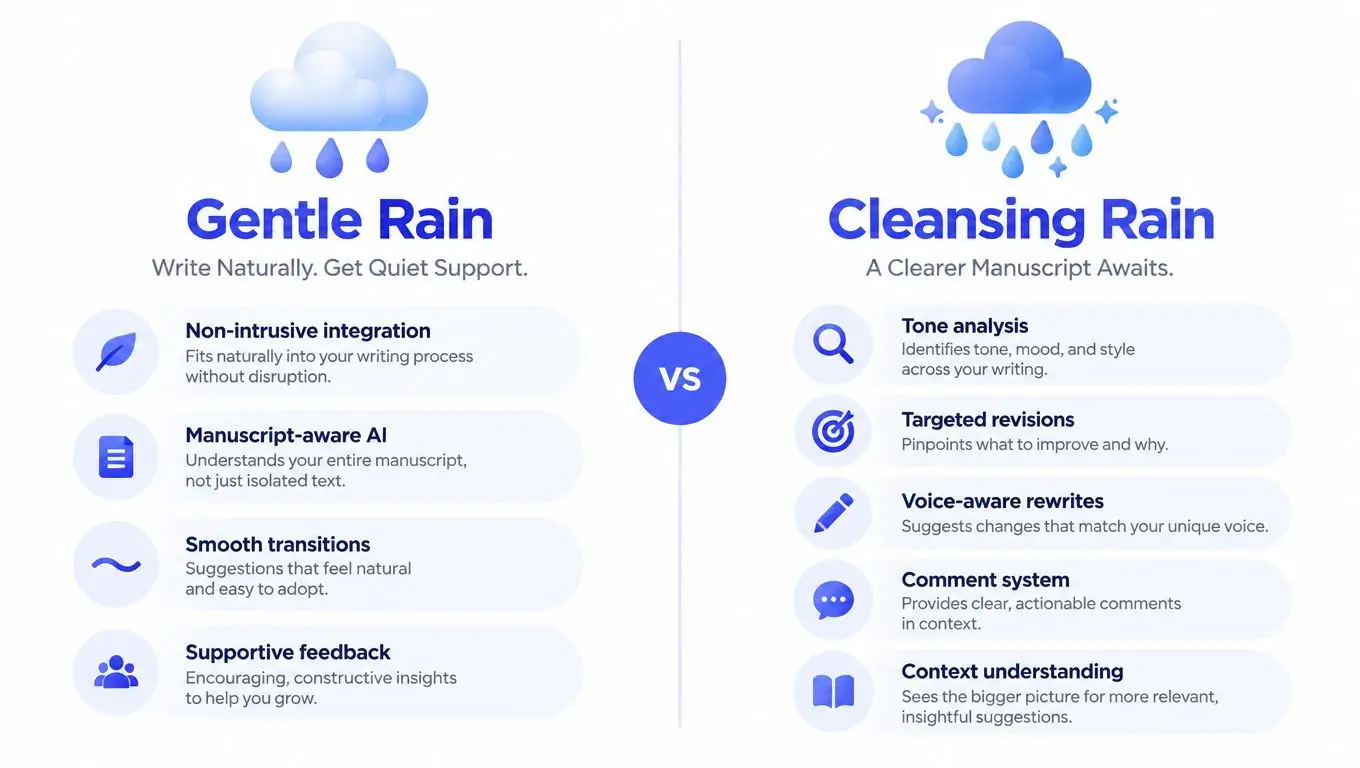
| Gentle Rain | Non‑intrusive AI editing; seamless drafting → illustration → cover flow | ★★★★, subtle, flow‑preserving feedback | 💰 Free tier + paid upgrades; lowers tool fatigue | 👥 Novelists & writers who prefer gentle guidance | ✨Manuscript‑aware Eddy in‑editor; smooth transitions |
| Refreshing Rain | Brainstorming, character creator, scene illustrations & style controls | ★★★★, rejuvenating ideation & visuals | 💰 Free trial; accelerates creative breakthroughs | 👥 Authors with blocks; visual storytellers | ✨Scene‑to‑image + style presets for rapid inspiration |
| Steady Rain | Daily goals, streaks, progress records, reliable export & themes | ★★★★★, dependable, consistent workflow | 💰 Free tier; high ROI for long projects | 👥 Serial writers & disciplined planners | 🏆Consistent themes + print‑ready exports; full edit history |
| Nourishing Rain | Binders, tags, side‑by‑side research, source management, collaboration | ★★★★, organized, research‑friendly UX | 💰 Free→paid; centralizes research and citations | 👥 Research‑heavy, series authors, editorial teams | ✨Role‑based collaboration + source tracking |
| Cleansing Rain | Tone analysis, targeted revisions, voice‑aware rewrites, comments | ★★★★★, sharp editing & clarity improvements | 💰 Free features; reduces need for external editors | 👥 Authors seeking polish and clarity | 🏆Tone diagnostics + surgical revision suggestions |
| Abundant Rain | All‑in‑one writing, AI art, cover studio, ISBN & export tools | ★★★★, comprehensive feature set, fewer apps | 💰 Free tier; replaces multiple subscriptions | 👥 First‑time & indie authors wanting full stack | ✨Integrated cover↔manuscript sync; ISBN/barcode tools |
| Penetrating Rain | Deep manuscript‑aware AI, character patterns, scene authenticity | ★★★★★, context‑rich, narrative‑aware assistance | 💰 Free start; best value for long‑form projects | 👥 World‑builders & character‑driven novelists | 🏆Eddy learns manuscript context; character‑informed visuals |
| Transformative Rain | End‑to‑end pathway: free tier → drafting → publishing support | ★★★★★, enables author growth to publishable output | 💰 Free → paid tiers; democratizes editing & design costs | 👥 Aspiring authors aiming to self‑publish | ✨All‑in‑one transformation pipeline + goal tracking |
Turn Rainfall Into the Right Words
Choosing among descriptive words about rain becomes easier when you separate physical intensity from emotional effect. Gentle and refreshing often suit intimacy, calm, or relief. Steady supports continuity and waiting. Nourishing and cleansing suggest growth or renewal, but they need concrete details to avoid sounding sentimental. Abundant describes plentiful rain, while penetrating emphasizes how far it reaches. Revolutionary belongs to scenes where the weather changes what happens next.
Start with the effect you want readers to feel. If the scene should feel private, a soft descriptor may work better than a dramatic one. If characters are trapped by duration, choose a term that emphasizes persistence. If the rain should expose a weakness, use a word that describes contact, depth, or intrusion rather than just calling it heavy.
Then test the word in a full sentence. Compare “gentle rain touched the roof” with “steady rain filled the night” and “penetrating rain chilled his hands.” The first creates delicacy, the second creates duration, and the third creates physical discomfort. The nouns and verbs matter as much as the adjective, so don't evaluate the descriptor in isolation.
A useful revision pass can follow this sequence:
- Name the function: Decide whether the rain creates mood, blocks movement, marks time, reveals character, or changes the setting.
- Choose the sensory channel: Use sound for pacing, touch for discomfort, sight for atmosphere, and smell for memory or place.
- Check the strength: Make sure the word matches the actual force and consequence of the rainfall.
- Test the register: Ask whether the word sounds natural for the narrator, character, genre, and region.
- Read aloud: Listen for whether the sentence moves slowly, steadily, sharply, or heavily enough for the scene.
You can also combine one visual adjective with a precise verb or sensory detail. “Refreshing rain silvered the leaves” feels different from “refreshing rain drummed against the shutters.” The first opens the setting, while the second introduces sound and a more enclosed mood.
Some rain terms are widely understood, while others are more formal, regional, literary, or context-dependent. A broad vocabulary is useful, but precision matters more than novelty. The most memorable description may be a familiar word placed beside an unexpected, exact detail.
Storyloft's tone analysis and manuscript-aware editing tools can serve as optional review aids when you're checking whether a passage feels too soft, too dramatic, or inconsistent with the surrounding chapter. Keep the final stylistic decision with the writer. Rain should support the scene, not compete with it.
Storyloft combines long-form manuscript drafting, AI-assisted editing with Eddy, research organization, illustration, cover design, and publishing workflows in one writing environment. Use it to test rain descriptions in context, review tone across a passage, and keep your story materials connected as the manuscript develops. Visit Storyloft to explore the platform and start shaping weather that does more than fill the background.