What Is Tone in Writing and How to Master It
You can feel it before you can name it. You send a paragraph, reread it, and realize the words are technically correct, but they sound colder, sharper, or more casual than you meant. That mismatch is usually a tone problem, and once you know how to spot it, you can fix it without rewriting your whole draft.
Table of Contents
- What Tone in Writing Really Means
- How Tone Differs from Voice and Mood
- The Five Elements That Create Tone
- Tone Across Genres With Before and After Examples
- How to Diagnose and Adjust Tone in Your Own Drafts
- Using AI Tone Analysis and Storyloft to Edit Faster
- Building a Tone Practice You Can Carry Forward
What Tone in Writing Really Means
A writer finishes a draft, reads it back, and thinks, “This says what I meant. So why does it sound annoyed?” That's the moment many encounter tone for real. The content can be accurate, but the attitude that comes through the wording may be distant, defensive, playful, formal, or even dismissive.
Tone in writing is the author's attitude toward the subject and the reader, made visible through diction, sentence structure, and style. The Purdue OWL defines tone that way, and NIH writing guidance notes that tone can range from “devoted” to “dismissive” and “collaborative” to “confrontational”. This range matters because tone lives beneath literal meaning. Two sentences can share the same facts and still land very differently.
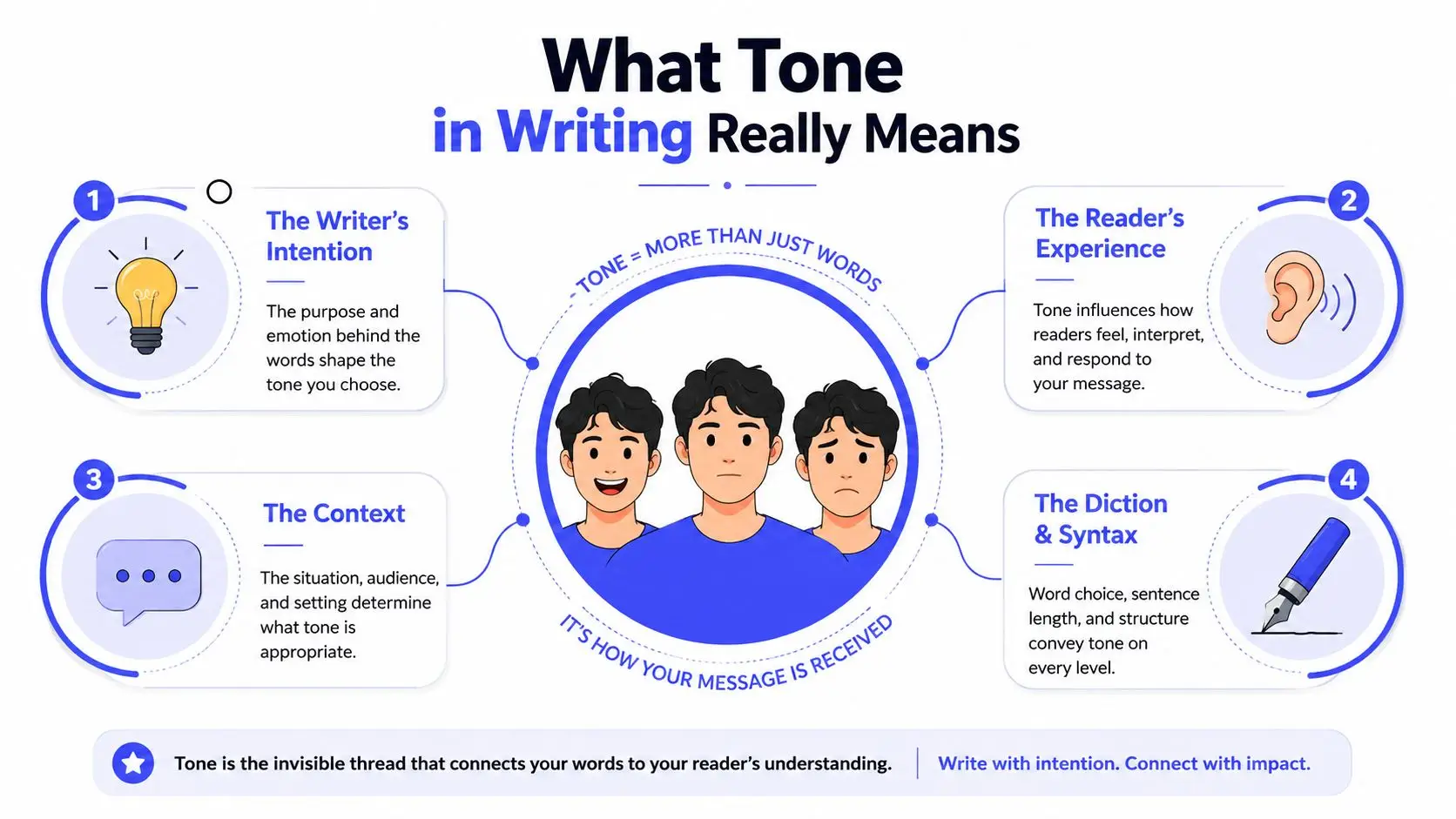
Tone is one of those rare writing skills that travels well. It shows up in academic papers, business updates, fiction, email, and blog posts because readers use it to infer stance before they've fully processed the argument. That's why a neutral sentence in one draft can feel scholarly in one version and curt in another.
For character-driven writing, tone also affects how dialogue and narration feel on the page. If you want a practical companion to that side of craft, character voice performance tips can help you hear how delivery changes the emotional read of the same words.
Practical rule: if you can change the feeling of a paragraph without changing the facts, you're working on tone.
The easiest way to think about it is this. Tone is not the topic. It's the attitude carried by the language around the topic. That is why the same subject can sound warm, skeptical, urgent, or detached depending on how you write it.
How Tone Differs from Voice and Mood
Writers often use tone, voice, and mood as if they mean the same thing. They don't, and once you separate them, it gets much easier to diagnose what feels off in a draft. A useful shortcut is to think of voice as who is speaking, tone as how that speaker sounds right now, and mood as what the reader feels while reading.
Voice tends to stay recognizable across a writer's work. Tone changes with purpose, audience, and scene. Mood belongs to the reader's experience, not the writer's intent, which is why a serious tone can still produce a tense mood, while a playful tone can produce relief or irony.
| Element | Who controls it | Where it shows up | Example cue |
|---|---|---|---|
| Tone | The writer | Word choice, syntax, punctuation, formality | “Could you review this when you have a moment?” |
| Voice | The writer | Overall personality on the page | Distinct phrasing that feels like the same person wrote it |
| Mood | The reader | Emotional response to the passage | The reader feels calm, uneasy, amused, or wary |
A fiction writer can keep a narrator's voice consistent while shifting tone inside a scene to match the emotional moment. A nonfiction writer can keep a recognizable voice while changing tone to suit a skeptical audience, a client update, or a research summary. The distinction matters because it tells you what to edit. If voice feels generic, you need more personality. If tone feels wrong, you need different language choices.
For dialogue-heavy scenes, how to write better dialogue is a useful companion because conversations are one of the fastest ways tone changes on the page. A character can say the same factual sentence in a polite, blunt, or defensive way, and the reader will hear three different attitudes.
Tone and mood also diverge in a simple but important way. A paragraph can create a gloomy mood while still carrying a calm, controlled tone. That's one reason readers sometimes say a draft feels “off” without being able to explain why. They're sensing a mismatch between the writer's attitude and the emotional field the scene creates.
The Five Elements That Create Tone
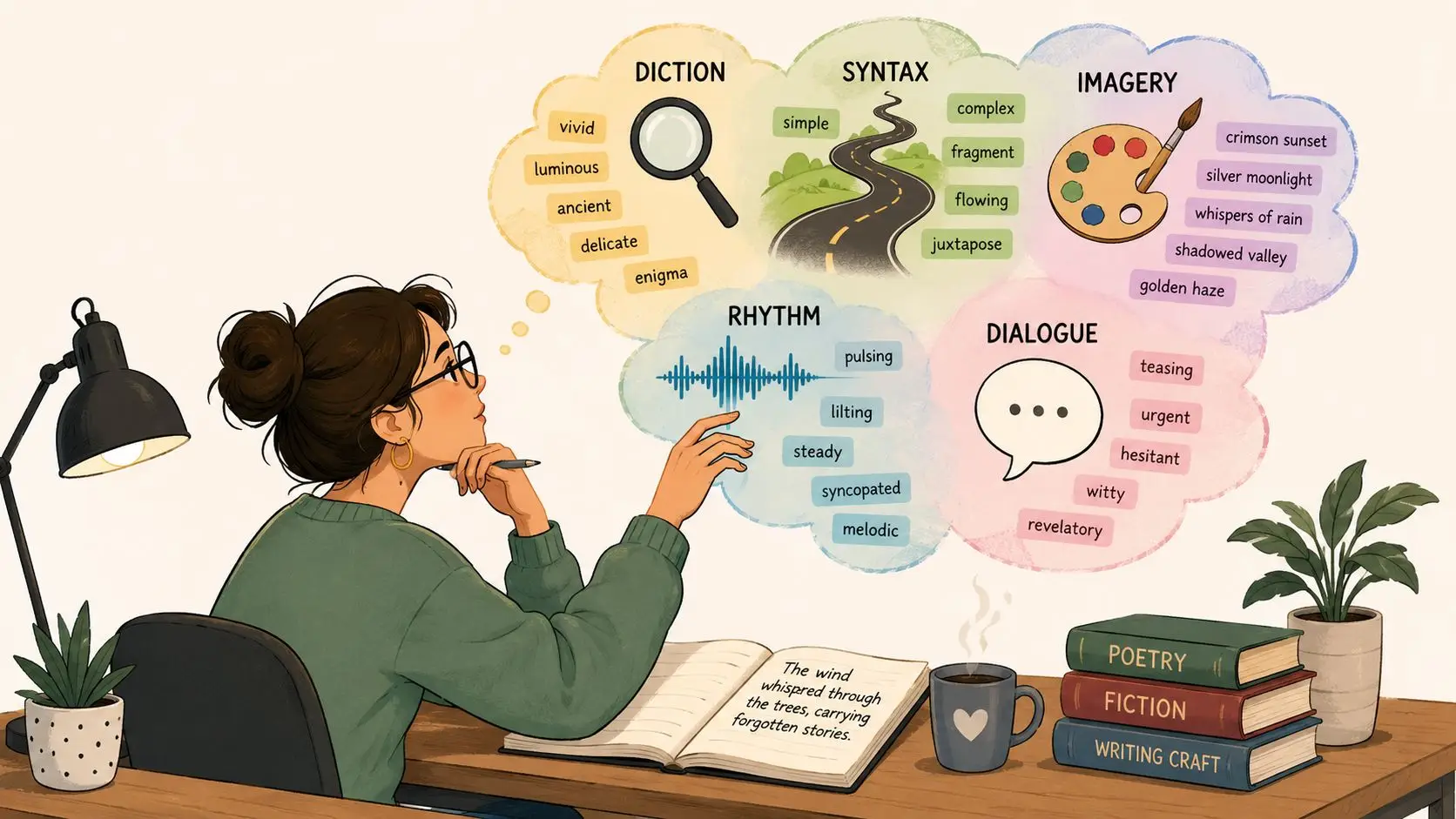
Tone feels intangible until you break it into parts. Then it starts to look like a set of craft choices instead of a mysterious aura. Five levers shape it most often: diction, syntax, imagery, point of view, and formality.
Diction and syntax do the heaviest lifting
Diction is word choice. Swap “assist” for “help,” and the sentence instantly feels more formal. Swap “claim” for “say,” and the writer sounds more cautious or precise. The same idea can sound warmer, colder, or more authoritative depending on which words you pick.
Syntax is sentence structure and rhythm. Longer, layered sentences tend to read as more formal or reflective, while shorter sentences can feel urgent, blunt, or conversational. A sentence like “We reviewed the draft and made several changes after the meeting” sounds steadier than “We met. We changed the draft. We moved on.”
Imagery, point of view, and formality refine the signal
Imagery controls what the reader sees, hears, or senses. If you describe the scene through concrete, restrained details, the tone often feels controlled. If you choose vivid sensory language, the tone can feel more intimate, dramatic, or emotional.
Point of view shapes distance. First person can feel immediate and personal. Third person can feel objective, detached, or expansive depending on how close the narration stays to a character's thoughts. That perspective changes tone even when the facts stay the same.
Formality is the last major layer. It's the register you choose, from conversational to scholarly. If you're writing dialogue or scenes where pacing matters, what is a character's motivation is a helpful lens because a character's reason for speaking often determines how formal or guarded the line sounds.
Useful test: if a paragraph feels too stiff, look at the register first, then trim sentence length, then replace any inflated vocabulary with plain terms.
Tone works like a stack, not a single dial. A formal word can be softened by a short sentence. A casual phrase can be made more serious by adding precise evidence. Writers often try to change tone by adjusting only one element, but the cleanest revisions usually touch two or three at once.
Tone Across Genres With Before and After Examples
A neutral sentence can wear very different clothes in different genres. That's why tone is easier to understand through rewrites than through definitions alone. The sentence below stays factually simple, but each version asks the reader to hear a different relationship between writer and audience.
Before: The team reviewed the results and made changes to the draft.
Academic: The team reviewed the results and revised the draft accordingly.
This version uses formal diction and a more restrained, evidence-minded rhythm. It sounds measured rather than chatty.
Business: After reviewing the results, the team updated the draft.
This version feels direct and efficient. The sentence is shorter, cleaner, and more action-oriented, which fits workplace communication.
Literary fiction: They studied the results in silence, then returned to the draft and began again.
This rewrite slows the pace and adds atmosphere. The tone becomes more reflective because the sentence gives the reader room to feel the moment.
Brand or marketing: The team reviewed the results, refined the draft, and kept moving toward a stronger message.
This version leans forward. It sounds confident and polished, which is one reason crafting a powerful brand story often depends on matching tone to audience expectations rather than just listing benefits.
You can see the same idea becoming more formal, more efficient, more evocative, or more persuasive without changing the underlying facts. That's the practical power of tone. The writer is not changing the message. The writer is changing the experience of receiving it.
A good habit is to compare versions side by side and ask what changed. Did the sentence get shorter? Did the verbs get stronger? Did the vocabulary become more specialized? Did the writer step closer to the reader or farther away? Those questions train your ear fast.
How to Diagnose and Adjust Tone in Your Own Drafts
Most tone problems show up as discomfort before they show up as clarity issues. A paragraph may read cleanly, yet still feel too cold, too gushy, too rigid, or too casual for the audience. The fix usually starts with diagnosis, not wholesale rewriting.
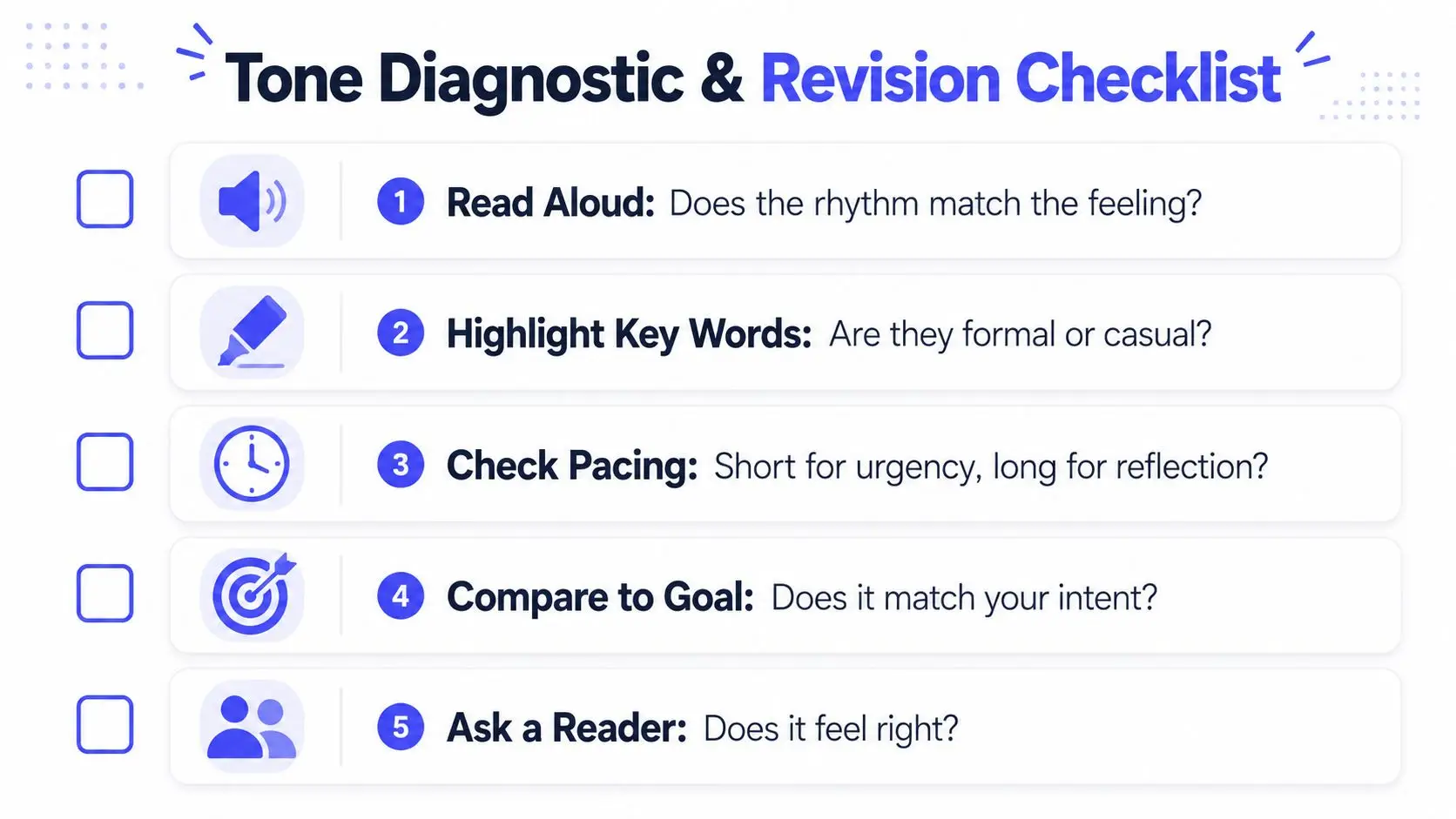
A quick tone audit
- Read aloud. If your mouth trips over a sentence, the rhythm may be fighting the intended feeling.
- Highlight loaded words. Terms that sound sarcastic, gushy, judgmental, or inflated often create the wrong tone first.
- Check sentence length. A string of long sentences can sound formal. A run of tiny ones can sound abrupt.
- Compare the attitude to the audience. Ask whether the writing sounds respectful, defensive, distant, or too familiar for the reader.
- Test the paragraph against your goal. If you wanted calm confidence and got nervous over-explaining, the tone needs revision.
The process becomes more useful when you use a target. Rewrite a paragraph as if you were speaking to a skeptical colleague. Then rewrite it for a first-time reader. Then rewrite it as if you were trying to reassure someone who's already overwhelmed. Each prompt changes tone without forcing you to invent new content.
If a sentence sounds wrong, don't assume the idea is bad. Often the idea is fine, and the tone choices around it need adjustment.
That's why a revision tool can be so helpful. It gives you a second set of eyes on the sentence-level choices that create tone. For a practical editing workflow, editing a draft becomes easier when you treat tone as something you can isolate, test, and retune instead of something you either “have” or “don't have.”
When you revise, look for three common fixes. Tighten over-explaining. Replace emotionally loaded terms with precise ones. And adjust sentence shape until the paragraph sounds like the person you intended to be on the page.
Using AI Tone Analysis and Storyloft to Edit Faster
Tone revision used to depend on a sharp-eyed editor or a patient friend who could say, “This line sounds harsher than you meant.” Now some writing tools treat tone as something you can review inside the drafting process itself. That shift matters because it turns tone from a vague impression into a practical editing target.
AI content tools from maxijournal.com are one example of the wider trend toward machine-assisted drafting and revision. In a long manuscript, that kind of feedback can help you catch tonal drift, especially when a chapter starts formal and ends conversational without meaning to.
Storyloft's manuscript editor includes tone analysis, along with focus mode, goal settings, and edit history. Its AI assistant, Eddy, supports targeted revisions and voice-aware rewrites directly in the document, so you can adjust wording without copying text into a separate app. Storyloft also tracks tone shifts across chapters, which is useful when a long project starts to drift from the voice you established early on.
For authors working through scene-level revisions, how authors can use AI to rewrite scenes without losing their voice is relevant because the point isn't to replace judgment. The point is to preserve the writer's intent while tightening the language that carries tone.
A useful workflow is simple. Draft first. Review tone second. Then compare the AI suggestion with your own ear. If the rewrite sounds clearer but loses your intended relationship with the reader, keep the original structure and borrow only the best phrase or sentence pattern.
That's the most important part. AI can flag drift and offer options, but tone is still a human decision. The tool can show you where the voice wobbles. You decide whether the wobble is a mistake or a deliberate shift.
Building a Tone Practice You Can Carry Forward
Tone gets easier when you treat it like a habit instead of a mystery. Choose the intended attitude before you draft, read the strongest passages aloud, and check the wording again after the full piece is finished. That routine keeps your prose aligned with your audience and makes revisions less painful.
The core idea is simple. Tone is an editable layer of prose. It isn't a personality test, and it isn't locked into your first draft. You can change it by adjusting diction, sentence shape, perspective, and formality until the writing sounds like you intended.
A steady tone practice helps in every kind of writing, from emails to novels to research-driven articles. Once you can diagnose a tonal mismatch quickly, you stop guessing and start revising with purpose.
If you want a writing space that keeps tone visible while you draft, revise, and compare changes, try Storyloft. It brings manuscript editing, tone analysis, and voice-aware AI revisions into one place, so you can work on tone without losing the thread of your draft.