6 Acrostic Poem for Love Ideas to Personalize
You want to tell someone you love them, but a generic text message feels too thin. An acrostic poem gives you a useful starting point: each line begins with a chosen letter, and those letters form a hidden word, name, or message when read vertically. That simple framework can sound intimate, playful, concise, seasonal, expansive, or inward-looking, depending on the poem's length, tone, audience, imagery, and placement. The six ideas below show how to use an acrostic poem for love as a distinct writing tool, from a private romantic note to a self-love affirmation or a longer narrative poem. If you're developing a poetry collection, romance manuscript, or illustrated fiction project, Storyloft can help you draft, revise, organize, illustrate, and format the work in one writing workspace.
Table of Contents
- 1. Romantic Acrostic for Longing Hearts Entwined
- 2. Playful Acrostic for Laughter, Lightness, and Joy
- 3. Short Form Acrostic for Minimal Yet Meaningful Language
- 4. Extended Acrostic for Layered Storytelling in Verse
- 5. Valentine's Day Acrostic for a Celebration of Connection
- 6. Self-Love Acrostic for Empowerment Through Verse
- 6 Love Acrostic Styles Comparison
- Turn a Template Into Something Personal
1. Romantic Acrostic for Longing Hearts Entwined
A romantic acrostic works best when the visible poem expresses a feeling and the hidden word reinforces it. The familiar four-letter structure of LOVE gives you four lines, but the lines shouldn't all make the same declaration. Give each one a different emotional job, such as longing, vulnerability, commitment, and connection.
Practical rule: Let the hidden word provide the structure, while specific memories provide the intimacy.
Try this starting point:
Longing for your presence in the morning light
Opening my heart, vulnerability made right
Vows unspoken, yet felt in every glance
Entwined forever in this sacred dance
The example uses elevated language, so it could suit a Valentine's card, a romance scene, or a character's private monologue. For a more believable personal message, replace broad phrases such as “sacred dance” with something only the recipient would recognize. A shared train ride, a chipped blue mug, or the way someone reaches for your hand in a crowded room can carry more emotional weight than a string of grand adjectives.
Metaphor can deepen the poem, but it should clarify the feeling rather than decorate it. Storyloft's guide to using metaphor in writing can help you develop an image that feels connected to the relationship.
Personalize the emotional distance
Write one concrete detail beside each letter before drafting the lines. For L, recall a moment when you missed the person. For O, name something they made safe enough for you to share. For V, describe a promise, spoken or implied. For E, choose an image of togetherness that doesn't overstate the relationship.
If you're writing a romance manuscript, save several versions in a binder and compare their emotional temperature. A tender poem for a new relationship should sound different from a vow between long-term partners. Authors preparing a gift or dedication can also explore personalised marriage poems from GiftSong for another application of individualized romantic verse.
2. Playful Acrostic for Laughter, Lightness, and Joy
Not every love poem needs to sound solemn. A playful acrostic uses the hidden word as a frame for teasing, shared habits, comic details, and affectionate exaggeration. It suits a partner who would rather receive a joke than a grand declaration, and it can also give a rom-com scene or a children's story a warm emotional beat.
Start with the same letters, but change the promise of the form:
Laughing at terrible jokes we both pretend are funny
Obviously you're my favorite, even when we're low on money
Very much like pizza, better when we share
Easily the weirdest pair, and frankly, we don't care
The humor comes from recognizable imperfection. The speaker doesn't claim that the relationship is flawless. Instead, the poem celebrates the couple's private logic, including bad jokes, shared food, and an identity as an unusual pair. That makes the affection feel lived-in.
Build the joke around a true detail
Choose one ordinary habit and push it slightly past reality. Maybe one person always steals the blanket, treats every errand as an adventure, or insists on explaining the plot while you're watching a film. Keep the underlying affection clear, then let the final line deliver the warmest turn.
A character's voice matters as much as the punchline. A dry speaker might use understatement, while an excitable speaker might pile up energetic verbs and surprising comparisons. Storyloft's explanation of examples of voice in writing can help you distinguish the person speaking from the poem's basic structure.
Read the finished version aloud. Playful lines often depend on pacing, and a sentence that looks funny on the page may sound flat when spoken. If you're writing dialogue, test whether the poem could plausibly come from that character. If it couldn't, simplify the vocabulary or add a phrase from the couple's actual conversations.
3. Short Form Acrostic for Minimal Yet Meaningful Language
A short acrostic removes nearly everything except the emotional core. It can appear in a text message, a chapter epigraph, a social post, a handwritten card, or a dedication where space is limited. The constraint forces you to choose words that carry more than one shade of meaning.
A word-based version might look like this:
Light
Open
Vital
Eternal
Or you can make each line a compact thought:
Life, offered
Often,
Valued, completely
Evermore
The first example feels abstract and polished. The second suggests an exchange between two people, even though it uses very few words. Neither needs rhyme. The line breaks and initial letters already create the form, so the writer's main task is choosing language with emotional precision.
“Short doesn't mean empty. It means every word has to earn its place.”
Match length to placement
For a chapter epigraph, choose language that hints at the chapter's conflict without explaining it. For a social post, use a phrase that can stand beside an illustration or a photograph. For a private message, select a word that carries personal history, even if another reader would find it ordinary.
Begin by writing ten possible words for each letter. Then remove anything that could describe almost anyone. “Beautiful” may be affectionate, but “brave” becomes more personal when it refers to how someone handled a difficult morning. A compact acrostic can still include an image, such as “Lantern,” “Open window,” “Voice,” and “Early light.”
Storyloft's guide to starting your writing is useful when the blank page feels larger than the poem. Draft quickly, then revise by asking whether each line adds a new emotional angle. If two lines say the same thing, keep the sharper one.
4. Extended Acrostic for Layered Storytelling in Verse
An extended acrostic turns a hidden word into a recurring architecture. Instead of writing only four lines for LOVE, create several stanzas, with each stanza returning to the letters in sequence. The repeated pattern gives the poem a pulse, while the content can move through a relationship's changing circumstances.
For example, the first stanza might introduce two people meeting:
Late trains carried us toward the same small station
One shared umbrella made room for two
Voices softened beneath the rain
Everything began with a borrowed sleeve
A later stanza can revisit the same letters after conflict, distance, or reconciliation. The structure stays recognizable, but the images change. That contrast lets readers feel development without requiring the poem to announce every emotional shift.
The form also works when the hidden word is a name, place, or phrase. A longer keyword creates more lines per cycle, while a phrase such as FOREVER US can become a deliberate refrain across sections. The poet must decide whether spaces disappear, whether punctuation reveals the pattern, and whether each stanza should stand alone.
Plan the narrative before polishing lines
Assign a purpose to each stanza. One might hold the first encounter, another a misunderstanding, another a remembered gesture, and another a future intention. Within every cycle, make the letters do different work. The L line might introduce an image, the O line might reveal a thought, the V line might add tension, and the E line might change the direction of the scene.
Acrostics have a long history as a flexible structural technique. Encyclopedia.com's account of the acrostic traces examples back more than 2,000 years, including an early Greek example from the beginning of the 2nd century BCE. The form also appears in Hebrew alphabetic verse and later medieval and Renaissance writing, so an extended love acrostic belongs to a durable literary tradition.
For a long project, use Storyloft's brainstorming workspace for story ideas to collect memories, images, and stanza purposes before drafting. A planning board can prevent the hidden pattern from becoming more important than the human story.
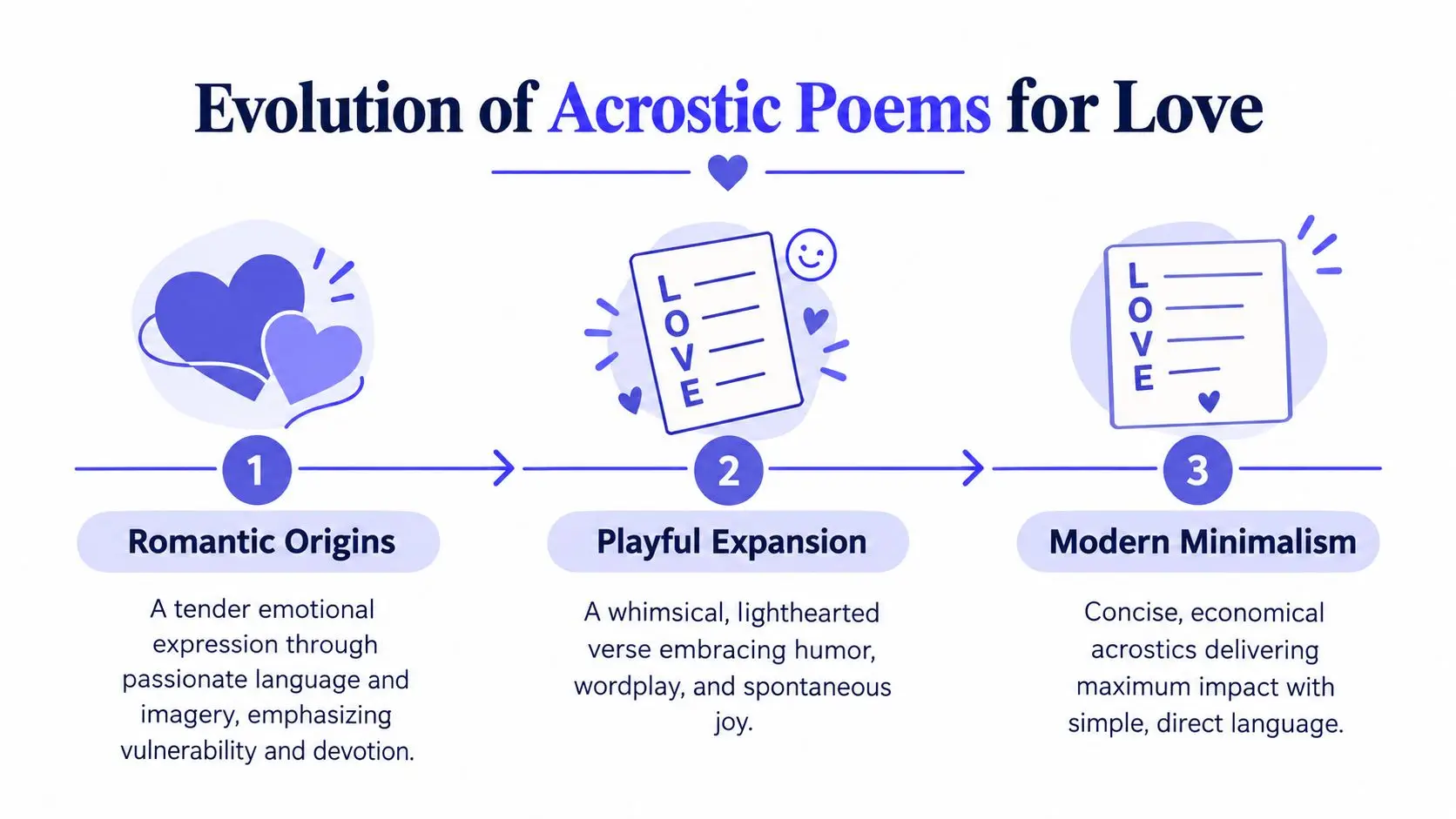
Here's a visual timeline of the form's development:
This short video offers another way to approach the structure:
5. Valentine's Day Acrostic for a Celebration of Connection
A Valentine's Day acrostic has a clear setting, so its imagery can be festive without becoming impersonal. Use the holiday as a backdrop, not as a substitute for knowledge of the recipient. Hearts, candles, flowers, and red envelopes establish the occasion, but a small shared detail makes the message belong to one person.
A greeting-card version might begin like this:
Love arrives in the coffee you leave beside my book
Our evening plans begin with one familiar look
Valentine wishes feel warmer when they're true
Every celebration means more when I share it with you
This format can work beyond a private card. An author might place a short acrostic in a signed gift edition, use one as an introduction to a seasonal poetry collection, or adapt it for a social post. In each setting, consider how much context the reader has. A partner can understand an unexplained reference, while a public audience may need an image that communicates on its own.
Adapt the poem to the occasion
For a new relationship, keep the tone warm and open rather than promising permanence. For a spouse or long-term partner, include a domestic ritual, a difficult season you endured, or a small act of care. For a family Valentine, remove romantic language and focus on belonging, gratitude, and shared celebration.
If you're creating several seasonal pieces, draft them together and vary the emotional angle. One can focus on anticipation, another on memory, and another on ordinary companionship. Save the strongest versions with the intended format, such as card insert, caption, gift-book page, or back-cover text.
Seasonal writing also benefits from visual consistency. Pair the poem with an illustration, cover color, or typography that supports its mood, but make sure the words remain understandable without decoration. The most effective Valentine's acrostic still sounds like a person speaking to another person, not like a collection of holiday slogans.
6. Self-Love Acrostic for Empowerment Through Verse
A self-love acrostic directs the message inward. Instead of spelling a partner's name, the letters can organize an affirmation about self-acceptance, resilience, healing, or personal growth. This makes the form useful for a journal entry, memoir passage, wellness collection, or a young adult character who is learning to speak about their own worth.
Begin with a gentle, active version:
Learning to embrace my imperfect journey
Owning my voice and stories untold
Valuing strength found in vulnerability
Evolving into the person I'm meant to be
Each line moves slightly forward. The speaker learns, owns, values, and evolves. That sequence avoids presenting confidence as a fixed condition. It treats self-love as a practice that can include uncertainty, repair, and change.
Replace performance with honest evidence
Self-affirmations can sound generic when they rely only on words such as “powerful,” “beautiful,” or “strong.” Give each line a small piece of evidence instead. You might write about making a difficult phone call, resting without guilt, asking for help, returning to a creative practice, or setting a boundary.
Self-love becomes convincing when the poem names what the speaker has done, not only what the speaker hopes to believe.
You can also use the acrostic to shape a character arc. At the beginning of a memoir or novel, the L line might express reluctance. Near the end, the same letter can carry a more assured image. Repeating the structure allows the reader to notice growth in diction, rhythm, and emotional permission.
For a classroom exercise, ask writers to draft the required letters first, then revise for imagery and specificity. One action-research study reported average writing scores rising from 63.82 before instruction to 73.24 after the first cycle and 80.88 after the second cycle, while reported interest in poetry writing rose from 29.41% to 58.82% and then 88.23% across those stages, as described in the classroom study on acrostic poetry instruction. The results concern classroom writing and interest, not guaranteed literary quality, but they support structured prompts for beginners.

6 Love Acrostic Styles Comparison
| Acrostic Type | Implementation Complexity 🔄 | Resource Requirements ⚡ | Expected Outcomes ⭐📊 | Ideal Use Cases | Key Advantages 💡 |
|---|---|---|---|---|---|
| Romantic Acrostic: "Longing Hearts Entwined" | Moderate, careful tone, imagery, and integration required | Moderate, editing time, beta readers, tone-analysis/voice tools | High emotional resonance; deep character development. ⭐⭐⭐⭐ 📊 | Romance, literary fiction, YA intimate moments, embedded narrative passages | Authentic emotional depth; reusable romantic-tone template |
| Playful Acrostic: "Laughter, Lightness, and Joy" | Low–Moderate, relies on wordplay and comedic timing | Low, brainstorming tools, character voice setup, optional illustrations | High engagement and pacing relief; culturally time-sensitive. ⭐⭐⭐ 📊 | Children's lit, YA comedy, rom-coms, dialogue-heavy scenes | Voice versatility; tension-breaker; easily illustrable |
| Short Form Acrostic: "Minimal Yet Meaningful" | Low, demands precision of single-word or brief lines | Low, focus-mode sprints, word-goal tracking, minimal assets | Quick, shareable impact but limited depth. ⭐⭐ 📊 | Social media, chapter epigraphs, promo snippets, flash fiction | Highly quotable; fits design/promo needs; easily translatable |
| Extended Acrostic: "Layered Storytelling in Verse" | High, requires narrative cohesion and sustained momentum | High, planning workspace, long revision cycles, editorial control | Rich thematic and voice development; substantial literary content. ⭐⭐⭐⭐ 📊 | Poetry collections, verse novels, literary fiction with embedded poetry | Supports long-form character/voice development; publishing-ready depth |
| Valentine's Day Acrostic: "Celebration of Connection" | Low, formulaic structure but needs personalization to avoid cliché | Moderate, seasonal marketing coordination, cover/illustration tools | Strong seasonal shareability and marketability; limited year-round use. ⭐⭐⭐ 📊 | Gift books, greeting cards, seasonal marketing campaigns | Timely market reach; easily packaged for gift editions |
| Self-Love Acrostic: "Empowerment Through Verse" | Moderate, requires authentic introspection without platitudes | Moderate, beta feedback, voice-aware rewrites, time for emotional honesty | Strong resonance in wellness/memoir contexts; risk of performative tone. ⭐⭐⭐⭐ 📊 | Memoir, YA, wellness books, personal essays, author platform content | Aligns with mental-health trends; shareable and platform-building |
Turn a Template Into Something Personal
Choose the recipient and purpose before choosing the keyword. A romantic acrostic suits a private confession or an intimate scene. A playful version fits a partner who values humor, a comic character, or a light exchange in dialogue. The short form works when the poem must share space with an image, caption, dedication, or epigraph. An extended acrostic gives a relationship room to develop through scenes and recurring images. A Valentine's version connects the message to a particular occasion, while a self-love poem turns the structure toward reflection and personal growth.
Next, decide how much emotional distance the poem should have. A new relationship may call for curiosity and warmth. A long partnership can support references to routines, shared difficulties, and private jokes. A self-directed poem may need less praise and more evidence of effort. The letters don't determine the emotional result on their own. They only give you places to begin.
Use this revision sequence:
- Collect specific material: Write down two or three memories, sensory details, habits, or actions connected to the recipient.
- Assign each letter a role: Let one line hold an image, another an observation, another a feeling, and another a wish or decision.
- Draft without forcing perfection: A slightly awkward but truthful line is often stronger than a polished cliché.
- Read the poem aloud: Listen for repeated rhythms, unnatural wording, and lines that sound unlike the speaker.
- Remove general praise: Replace “you are amazing” with the detail that proves why the speaker feels that way.
- Check each line's contribution: Every line should add a distinct image, movement, or emotional insight.
The strongest acrostic poem for love balances visible meaning with hidden design. Its letters create a small discovery for the reader, but its details create recognition for the person receiving it. Relationship-focused expressive writing research also connects writing about a romantic relationship with later relationship stability and changes in positive and negative emotion language, although those findings concern expressive writing rather than acrostic poetry specifically. The relationship-writing experiment therefore supports using concrete memories and emotional balance, not promising that a particular poetic form will change a relationship.
If you're developing a longer manuscript, keep alternate drafts, notes, comments, and voice decisions together rather than scattering them across separate applications. Storyloft can support that process alongside illustration, cover design, collaboration, and print-ready formatting. Its AI-assisted tools can suggest revisions, but your own memories and language should control the final poem. Writers exploring related creative workflows can also compare approaches in AI tools for songwriters.
Begin with the person, not the acronym. Choose the word that matters, gather the details only you would know, and let the structure help you say what a generic message cannot.
Storyloft brings manuscript drafting, AI-assisted editing, illustration, cover design, and publishing workflows into one workspace for authors developing poetry, fiction, and longer projects. Use it to draft several versions of your acrostic, refine the voice, organize related scenes or notes, and prepare the finished work for digital or print publication. Visit Storyloft and start shaping your next personal poem or manuscript in one place.