
What Is the Physical Features in Writing and Geography
A physical feature is a visible, real-world characteristic. In geography, that includes things like mountains, rivers, and coastlines, and mountains alone cover about 25% of Earth's land surface while about 15% of the world's population lives in mountain regions.
You're probably here because the phrase keeps showing up in two very different places. One page talks about landforms for a geography class. Another talks about a character's face, posture, or scars for a story. Both uses are valid, and the confusion isn't your fault. The phrase does double duty.
That matters if you're a student, a teacher, or a writer. If you ask, “what is the physical features,” you might be trying to define a terrain, describe a person, or figure out which details belong in a scene. The useful answer depends on which job the phrase is doing.
Table of Contents
- Why Two Different Meanings Show Up in One Search
- The Geography Meaning of Physical Features
- Core Categories of Physical Features in Geography
- The Character Description Meaning of Physical Features
- Writing Physical Details Without Killing Your Pacing
- Common Mistakes Writers Make With Physical Detail
- How Setting and Character Detail Work Together
- Key Takeaways and a Pre-Draft Checklist
Why Two Different Meanings Show Up in One Search
Type the phrase into a search bar and the split appears immediately. Some results define physical features as parts of the natural world. Others use the same words for a person's visible traits, like hair, height, or facial structure.
That split is real. A geography reference can mean natural Earth-surface features, while science and description-focused uses can also mean measurable or observable traits of a person or object, as explained in this discussion of the term's ambiguity at NCESC's overview of physical features.
Why both meanings make sense
In geography, the phrase helps people separate natural features from human-built ones. A mountain is a physical feature. A bridge is a human feature.
In writing, the phrase usually means what a reader can notice about a character from the outside. A bent nose, ink-stained fingers, and a careful gait are all physical features in that sense.
Where readers usually get stuck
Most confusion comes from one silent question:
Do physical features mean landscapes or human appearance?
The honest answer is either one, depending on context.
A student reading a map needs one definition. A novelist drafting a first chapter needs another. What helps is to stop treating the phrase as a single rigid term and start asking what kind of thing is being described.
Here's the practical distinction:
- Geography meaning: landforms, water bodies, climate-shaped terrain, vegetation, ecosystems
- Character meaning: visible bodily traits, movement, surface details, distinctive marks
- Writing use: chosen details that help a reader picture a place or person quickly
The Geography Meaning of Physical Features
A student looking at a map and a writer sketching a setting can use the same phrase, but in geography physical features has a narrow meaning. It refers to the natural parts of Earth's surface and near-surface environment, shaped by forces such as tectonic movement, erosion, weathering, water flow, and climate rather than by human building.
The simplest way to get the definition clear is to ask one question: did nature form it, or did people make it?
Physical features are the natural forms and systems of a place, such as its land, water, and climate-shaped terrain.
That classroom distinction matters because geography uses the term as a sorting tool.
- Physical feature: river
- Human feature: dam
- Physical feature: valley
- Human feature: highway
- Physical feature: coastline
- Human feature: port
A good shortcut is to picture a map with the labels removed. The ridges, shorelines, plains, and lakes would still exist without us. Roads, apartment blocks, canals, and train stations would not.
Mountains make the idea easy to see because they do more than rise above the ground. They redirect travel, affect temperature and rainfall, and often determine where settlement is hard or possible. For writers, that matters because a physical feature is never just background. A mountain pass creates pressure. A marsh slows movement. A dry basin changes what survival costs. That is the same kind of setting pressure explored in man vs. nature conflict.
Earth's surface also does not stay fixed. As noted in this Earth overview, tectonic forces, erosion, and weathering keep reshaping terrain over time. So in geography, physical features are not decorative labels. They are the natural structures that influence movement, climate, resources, and the feel of a place before any human detail enters the scene.
Core Categories of Physical Features in Geography
A useful way to sort the geography meaning of physical features is to ask four simple questions about a place: What is the land shaped like? Where is the water? What kind of climate has formed it? What is living there?
That framework helps because geography uses the phrase more broadly than casual conversation does. A student may hear physical features and picture mountains only. A writer may hear the same phrase and think of a character's face. Here, the word means the natural parts of a region itself.
Relief and landforms
Relief refers to the shape and height of the land. This includes mountains, hills, valleys, plains, canyons, and plateaus.
These features affect how a place works before anyone builds on it. A steep ridge slows travel. A wide plain makes movement easier. A valley can channel roads, rivers, wind, and settlement into the same narrow space.
Large mountain systems make this easy to see. The Andes run along much of western South America, and their scale helps shape climate patterns, travel routes, and where settlement is easier or harder.
Water features
Water features include rivers, lakes, wetlands, glaciers, seas, and oceans.
They often act like the circulatory system of a region. Water carries sediment, feeds crops, supports wildlife, and creates routes people tend to follow. It also creates limits. An island, a floodplain, and a dry inland basin each produce different kinds of pressure on movement and survival.
For writers building settings, water changes the feel of a place fast. A harbor city suggests exchange and arrival. An inland lake suggests enclosure, local weather, and a different kind of boundary.
Climate-shaped features
Some features are best grouped by the long-term weather that forms and maintains them. Deserts, tundra, ice fields, and dunes belong here.
This category can confuse readers because a desert is not just empty ground. It is a whole physical environment shaped by low moisture, temperature patterns, and wind. Tundra works the same way. The surface, plant life, soil behavior, and travel conditions all come from climate.
So if relief tells you the skeleton of a place, climate-shaped features tell you what that skeleton has been exposed to over time.
Ecosystems and vegetation
Geography often includes vegetation, soils, and ecosystems in the physical makeup of a place, not only the bare landforms, as described in this Fiveable explanation of physical features.
That wider definition is useful because living cover changes what a place feels like on the ground. A forest reduces visibility and softens sound. Grassland opens sightlines. A mangrove coast slows entry and changes where boats can land. A reef can protect a shoreline while also making approach dangerous.
| Category | What it helps you notice | Real-world example |
|---|---|---|
| Relief and landforms | Height, slope, and surface shape | Mountain range or plateau |
| Water features | Routes, barriers, and water supply | River, lake, or glacier |
| Climate-shaped features | Long-term environmental conditions | Desert or tundra |
| Ecosystems and vegetation | Living cover and habitat | Forest, grassland, or reef |
If you want a place to feel clear in your mind, classify more than the obvious skyline. Land, water, climate, and living cover work together.
The Character Description Meaning of Physical Features
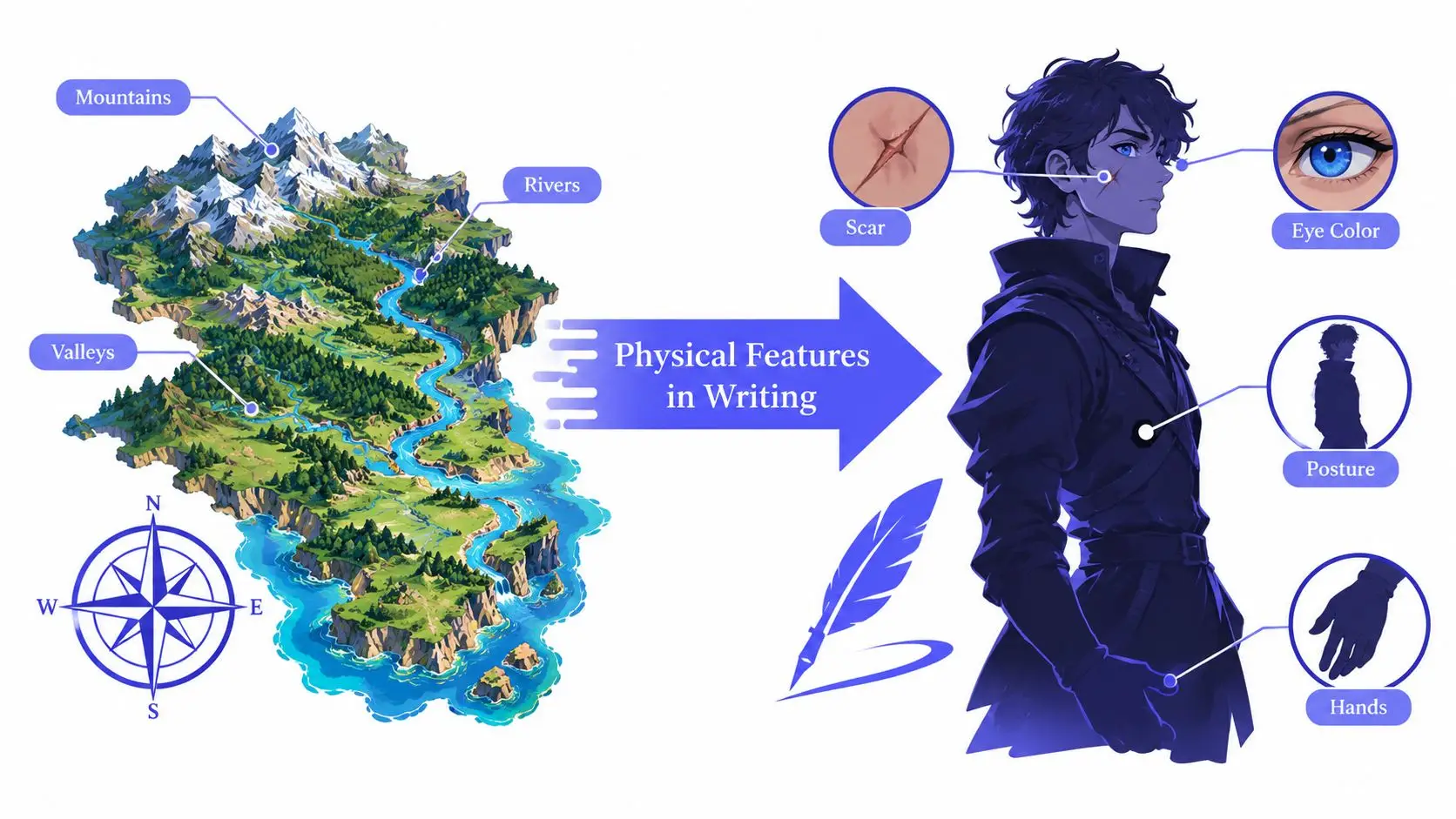
In writing, physical features usually means the visible details a writer chooses to give a reader about a character's body. These are not personality traits. They're the outward clues a reader can picture.
That can include face shape, hair, posture, scars, hands, gait, clothing wear, and any other observable feature that matters in context. The key word is chosen. A draft can contain many possible details, but only a few deserve space on the page.
Face and head
Readers often expect face-level detail first, but they rarely need a full inventory. A narrowed eye, bitten lip, or uneven haircut can do more than a complete catalog of features.
For example, “Her hair was cut with kitchen scissors” tells us something more active than “She had short brown hair.”
Frame and build
Height, posture, proportions, and movement live here. Build becomes useful when it affects action.
A tall character matters more when he has to duck through a low doorway. A compact character matters more when she slips through a crowd without being noticed.
Skin and surface
Surface detail can carry history. Sunburn, calluses, scars, tattoos, cracked nails, and weathered hands often suggest work, stress, region, habit, or age without naming those things directly.
A line like “the backs of his hands were nicked white from old cuts” gives the reader texture and implication at once.
Distinctive marks
A single unusual feature can anchor memory. That might be a missing fingertip, a habit of rubbing one wrist, or a permanent crease at the corner of the mouth.
You can see this principle at work in strong character description examples for fiction. The memorable detail isn't random. It usually reveals pressure, routine, or contradiction.
A list of features is still only a list until those details start doing story work.
Writing Physical Details Without Killing Your Pacing
Most pacing problems don't come from description itself. They come from when the description lands and how long the scene has to stop in order to carry it.
If a chapter brakes for a portrait paragraph the moment a character enters, the reader feels the stall. If the same details arrive through action, reaction, and attention, the scene keeps moving.
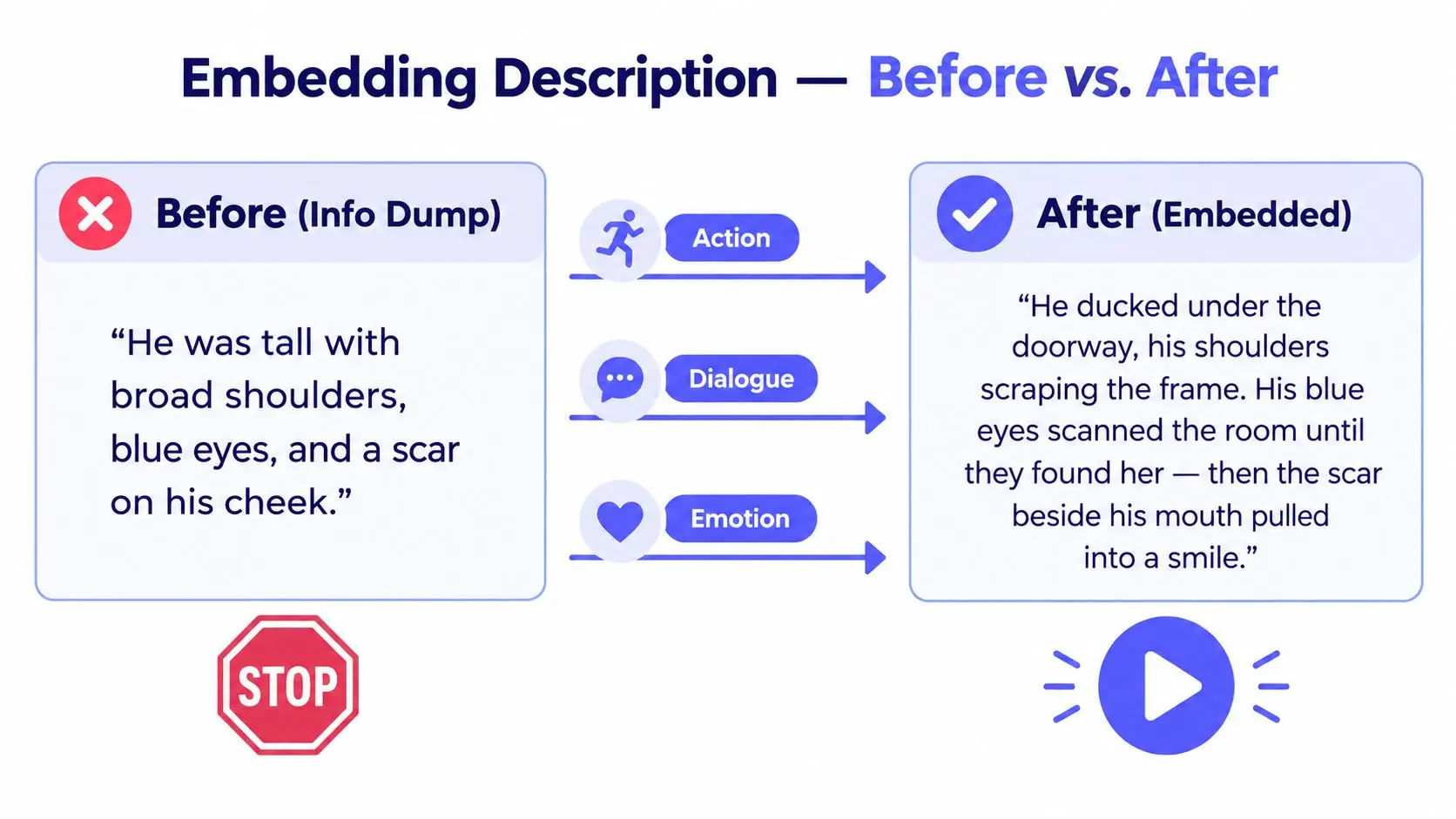
A before and after example
Static version:
He was tall with broad shoulders, pale eyes, dark hair, and a scar near his mouth.
Embedded version:
He ducked through the doorway. One shoulder brushed the frame. When he looked up, his pale eyes swept the room once, and the scar near his mouth tightened before he spoke.
The second version gives nearly the same information, but it arrives inside movement.
Four reliable ways to embed detail
- Load it onto action: Let the body reveal itself through movement. A limp, quick hands, or a stiff back shows up naturally when someone crosses a room.
- Attach it to an object: Hands become visible when a character folds a letter, grips a mug, or drops a key.
- Use another person's reaction: A child staring at someone's tattoo or a clerk hesitating over a damaged face can surface detail cleanly.
- Time it to emotion: Readers notice mouths, shoulders, and eyes more sharply when a scene tightens.
Writers looking for broader scene-level advice can use these tips for compelling content as a reminder that clarity and reader attention depend on delivery, not just information.
A useful scene principle is this: describe late enough that the detail has a job.
Here's a craft lesson worth watching in action:
A simple default that keeps scenes clean
For secondary characters, one clear detail per scene is often enough. For a point-of-view character on first appearance, two clustered details usually carry farther than a paragraph of inventory.
If you draft inside a planning-heavy tool, some writers keep these choices in a note panel instead of forcing all of them onto the page at once. For example, Storyloft's rising action guide fits this same idea of releasing details when tension makes them matter, and Storyloft itself includes manuscript drafting and research organization tools that let authors store extra description outside the scene until it earns a place.
Common Mistakes Writers Make With Physical Detail
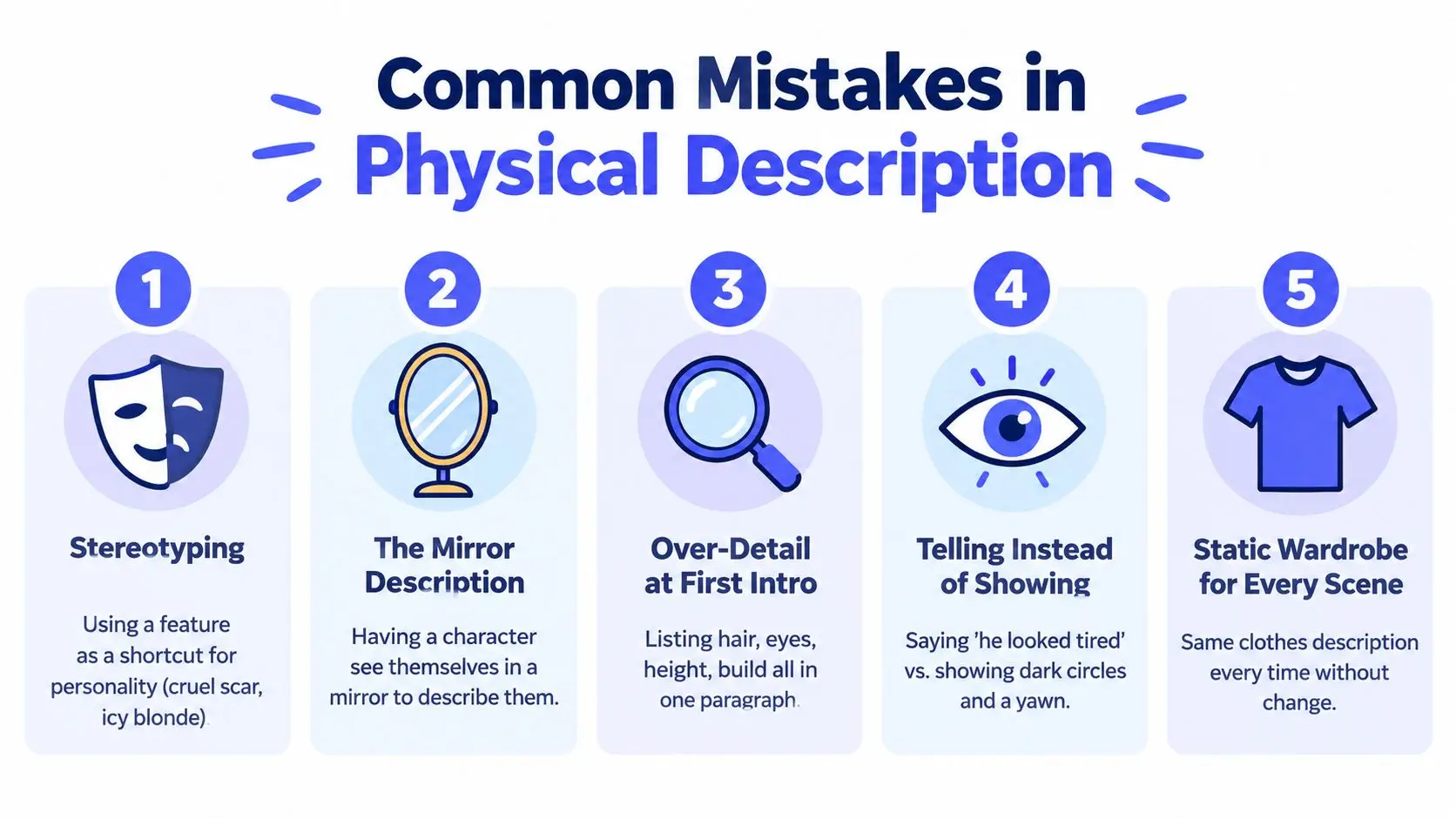
The first mistake is treating a feature like a shortcut for morality or personality. A scar doesn't make someone cruel. Blonde hair doesn't make someone cold. A foreign accent or body type should never do the work of characterization by stereotype.
Let behavior carry meaning. Contradiction helps more than shorthand. A boxer with delicate handwriting is more alive than a stock tough guy with a broken nose.
The info-dump problem
Another common habit is piling every visible trait into the first paragraph after introduction. That often reads like a police report.
Scatter details instead. Let one show up at the door, another in dialogue, and a third under stress. The reader usually builds a stronger image that way.
Vague detail that costs space
Some details feel specific but say almost nothing. “Average height.” “Brown hair.” “Pretty.” “Looked normal.” These aren't wrong, but they often don't earn their word count.
Try this replacement checklist:
- Choose one telling detail: Pick the feature a stranger would remember an hour later.
- Add one contradiction: Pair a rough feature with a delicate habit, or a polished feature with visible strain.
- Scan for cliché: If a detail sounds borrowed from stock fiction, revise the association, not just the adjective.
One memorable detail beats five forgettable ones.
Physical features serve the story. The story doesn't exist to carry a list of physical features.
How Setting and Character Detail Work Together
A place and a body often do similar work on the page. Both create mood. Both imply history. Both can hint at pressure before anyone names it.
Write a harbor at dawn with cold gray water slapping the pilings, ropes gone stiff with salt, and fog hanging low over the moored boats. Then let the character entering that harbor carry weathered hands, a cracked thumbnail, and a coat polished shiny at the cuffs from years of use. The shoreline and the person begin to echo each other. The place suggests endurance. So does the body. The setting stops being backdrop, and the character stops being a label.
A useful drafting prompt
Pick one physical feature of place and one physical trait of character. Put them in the same sentence so they share emotional weight.
Examples of pairings might include:
- Steep cliff and guarded posture
- Marsh ground and hesitant gait
- Wind-cut field and chapped hands
Writers who juggle these connections across many chapters often need a clean place to track them. A practical method is to keep setting notes, character traits, and scene snippets together, as described in this guide on organizing characters, worldbuilding, and research inside your manuscript.
Key Takeaways and a Pre-Draft Checklist
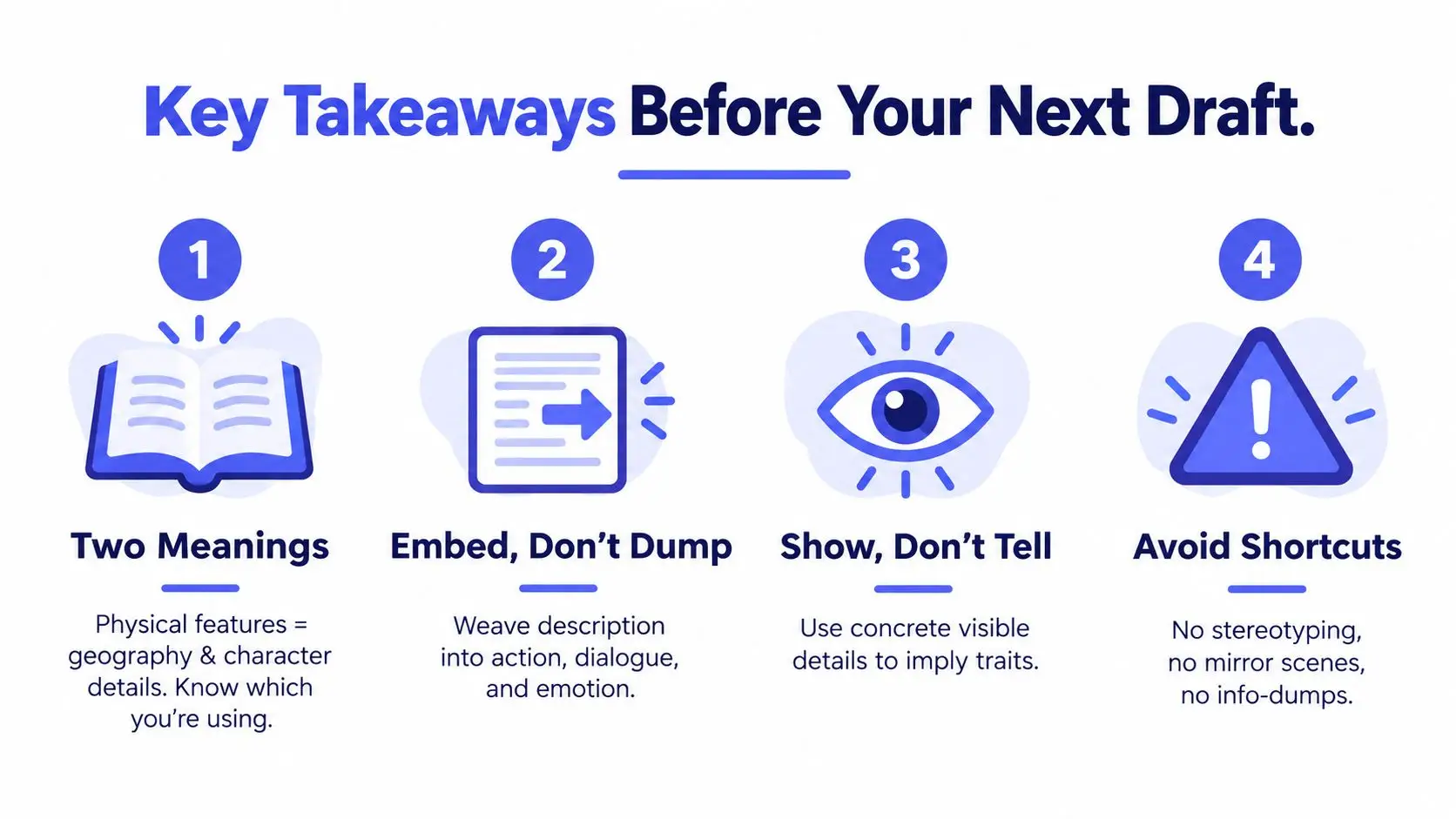
When readers ask what are the physical features, they usually mean one of two things. In geography, the phrase points to the natural features of a place. In writing, it points to visible details of a person. In both cases, the strongest details are the ones that do work.
That work might be clarity, mood, tension, contrast, or memory. A mountain range can shape a setting's pressure. A scarred hand can suggest a lived history. Neither belongs on the page just because it exists.
Pre-draft checklist
- Name the meaning first: Decide whether you mean geography, character description, or both.
- Choose the category: For place, think landform, water, climate, or ecosystem.
- Pick visible details only: For character, use what a reader can observe.
- Embed, don't pause: Put description inside action, dialogue, or reaction.
- Favor the telling detail: Choose the feature that carries history or tension.
- Check for stereotype drift: Remove any trait that stands in for lazy judgment.
- Ask one final question: Does this detail move the reader forward?
If the answer is yes, keep it. If it only sits there, waiting to be admired, cut it or move it to your notes.
If you want one place to draft scenes, track character traits, organize research, and prepare print-ready pages, Storyloft gives authors those tools inside a single writing workspace. It's especially useful for this kind of detail work because you can keep extra description, setting notes, and manuscript revisions close to the scene instead of scattering them across separate apps.