How Professional Authors Outline Books
When I first embarked on my journey to write a novel, I was filled with excitement but also confusion. I had a few scenes in my mind, but they quickly turned into a chaotic mess. Characters lost their motivations, and plot holes appeared like unwelcome guests. It was a 300-page disaster that taught me a valuable lesson.
Over time, I realized that successful authors don’t just wing it. They build a solid framework, and that framework is the outline. This unsung hero transforms vague ideas into structured narratives. It’s not about stifling creativity; it’s about giving your story a spine so it can stand tall.
In this guide, I’ll share my approach to outlining. From the first spark of inspiration to a detailed chapter plan, you’ll see how a clear roadmap can save you from the dreaded revision process. Plus, I’ll introduce you to Storyloft’s Free Book Outline Generator, which can help you craft a usable plan in just minutes.
Whether you prefer to meticulously plot every detail or let the story unfold organically, there’s a method here for everyone. Get ready to discover the strategies that separate published authors from those still dreaming of their first draft.
Key Takeaways
- Outlining provides structure to your story, making it easier to navigate.
- A clear plan helps prevent plot holes and character inconsistencies.
- Using tools like Storyloft’s generator can streamline your outlining process.
- Different approaches exist, catering to both planners and pantsers.
- Effective outlining can transform chaotic drafts into polished manuscripts.
Why Authors Outline Books: Avoiding the Blank Page and Plot Chaos
Writing a novel can feel like an exciting adventure that soon leads to confusion. With the vast landscape of ideas and characters swirling in your mind, it’s easy to lose your way. This is where an outline comes in, acting as a compass to guide you through the maze of your story.
A clear roadmap in novel writing isn’t just helpful; it’s the difference between arriving at your destination and ending up in a narrative ditch somewhere in chapter fourteen. Without an outline, I once spent six months writing a subplot about a stolen garden gnome that had absolutely nothing to do with my thriller’s central mystery. That’s what happens when you navigate a novel without a map!
The value of a clear roadmap in novel writing
Outlining saves time by forcing you to solve plot problems before you’ve invested 50,000 words in a direction that leads nowhere. This is like realizing you built your house on a sinkhole. Knowing where your story is headed allows your brain to focus on the details that truly matter.
How outlining saves time, maintains focus, and boosts creativity
When you have a plan, the blank page stops being terrifying. Instead of an abyss, it becomes a canvas where you can play with language, voice, and those delicious little details that make readers dog-ear pages. Every hour spent planning upfront saves roughly three hours of revision later.
My personal journey from chaotic drafts to structured success
My journey involved a humbling moment where I had to delete 40,000 words because my protagonist’s motivation changed halfway through. It was a painful lesson, but it taught me that structure liberates creativity. The fear that outlining kills creativity is like fearing that recipes ruin cooking.
| Benefit of Outlining | Description |
|---|---|
| Time Efficiency | Planning saves time by preventing wasted words on irrelevant scenes. |
| Focus | Maintains narrative direction, keeping characters and plots aligned. |
| Creativity Boost | Allows for experimentation without fear of losing the plot. |
| Reduced Anxiety | Transforms the blank page into a manageable task with a clear direction. |
Ultimately, outlining provides a framework that not only organizes your thoughts but also enhances your writing process. With a solid plan, you can confidently embark on your writing journey, transforming ideas into compelling stories.
Storyloft’s Free Book Outline Generator: Turning Ideas into Outlines in Minutes
Embarking on the journey of writing a book can feel thrilling, yet daunting without a clear direction. Luckily, there’s a tool designed to guide you through the maze of ideas and plot points. Let me introduce you to Eddy, Storyloft’s AI writing companion.
Meet Eddy: Your AI companion in book planning
Eddy is not just a digital assistant; he’s your brainstorming partner. He doesn’t judge your half-baked ideas or question why your protagonist shares a name with your childhood hamster. Instead, he helps you transform those scattered thoughts into a coherent plan.
How Storyloft builds outlines beyond chapter titles
Unlike other tools that merely spit out chapter titles like a literary fortune cookie, Storyloft creates a comprehensive workspace. As you answer a few simple questions about your story, Eddy crafts a detailed outline that includes:
- Structured sections and chapters
- Detailed subpoints and chapter descriptions
- Creative notes to inspire your writing
- Reader direction to keep your audience engaged
- Supporting context for deeper understanding
Creative assets and concept covers to inspire your manuscript
One of my favorite features is the creative assets Eddy generates along the way. These include intelligent planning notes that spark new ideas and a concept book cover that makes your project feel real enough to brag about at parties. By the end of your session, you’ll have a solid foundation to continue developing your manuscript.
| Feature | Description |
|---|---|
| AI Assistance | Eddy guides you through the outlining process, making it easy and enjoyable. |
| Comprehensive Workspace | Creates a detailed outline with sections, chapters, and notes to enhance your writing. |
| Creative Assets | Generates planning notes and concept covers to inspire and visualize your story. |
| Reader Direction | Includes notes to help maintain engagement and focus throughout your narrative. |
The whole experience is designed to eliminate the blank-page paralysis that sends so many aspiring authors spiraling into social media instead of writing. With Eddy, you can confidently move from idea to outline to manuscript without the hassle of complicated setups. Say goodbye to scattered notes and hello to a structured plan!
From Idea to Blurb: Finding the Heart of Your Story
Before diving into writing, it’s essential to take a moment to craft your blurb. This might seem counterintuitive, like putting on socks after shoes, but trust me—it’s a game changer. A well-written blurb serves as a compass, guiding your entire outline and the subsequent writing process.
Your blurb should ideally be around 250 words. This concise summary forces you to pinpoint the heart of your story. To achieve this, consider these pivotal questions:
- Who is the main character?
- What do they want?
- What obstacles stand in their way?
- What choice will they make to overcome these challenges?
- What do they truly need?
Writing your blurb first can reveal whether your ideas are merely cool premises or if they have the necessary depth to sustain a novel. I learned this the hard way; many of my “brilliant” ideas lacked a true narrative engine. Better to discover that in 250 words than after writing 80,000!
Why writing your blurb first guides your entire outline
A strong blurb can illuminate the difference between what a character wants and what they truly need. This gap is where compelling fiction lives. By hinting at both without revealing everything, your blurb can entice readers and keep them asking questions they need answers to.
Key questions to discover your protagonist’s goals and obstacles
As you draft your blurb, keep it visible—taped above your monitor, perhaps. This way, when you’re tempted to chase shiny narrative squirrels, you can quickly ask yourself: Does this scene serve the story I promised? This practice keeps your writing focused and on track.
Using your blurb as a compass throughout writing
Your blurb becomes a touchstone throughout the writing process. Whenever you feel lost in the murky middle of your manuscript, glance at it to remind yourself of the story you set out to tell. A strong blurb not only clarifies your goals but also excites readers about your story.

| Aspect | Description |
|---|---|
| Purpose | Guides the overall direction of your writing and outlining. |
| Length | Aim for a concise 250 words to distill your story’s essence. |
| Key Questions | Focus on your character’s desires, obstacles, and choices. |
| Visibility | Keep your blurb handy to maintain focus and direction. |
In conclusion, writing your blurb first is a powerful technique that can transform your approach to outlining and writing. By clearly defining your story’s heart, you set the stage for a compelling narrative that resonates with readers.
Developing Characters and Emotional Arcs: The Heartbeat of Your Book
Characters are the lifeblood of any story, breathing life into every page. They shape the narrative and engage readers on a deeper level. Each character carries an internal arc that must unfold as the story progresses. This development is crucial, as it allows readers to connect with them on a personal level.
One effective method to create believable characters is to base them on real people. For instance, I once modeled a villain after my passive-aggressive former boss. Readers later told me he was the most terrifying antagonist they’d encountered in years. Real life is the best character development workshop you’ll ever attend.
Building believable, consistent characters based on real people
When crafting characters, remember that nobody wakes up evil or heroic. They are shaped by their backstory. Understanding this backstory is vital, even if only a fraction makes it onto the page. This depth gives your characters authenticity.
Mapping internal character growth and emotional journeys
Mapping internal character growth isn’t about ticking off a checklist of emotional milestones. Instead, it’s about grasping the lie your protagonist believes at the start and the truth they must embrace by the end. This transformation keeps readers invested in their journey.
How emotional beats drive plot and reader investment
The emotional beats of your story are what make readers cry on public transportation and recommend your book to everyone they know. Treat these moments with care. I keep a separate document for each major character, interviewing them about their deepest fears and desires. The answers often surprise me!
Consistency is the secret sauce of character development. If your commitment-phobic protagonist suddenly trusts a stranger in chapter three, your readers will revolt—and rightly so. The internal arc and external plot should dance together like partners in a tango. Each plot event should challenge your character’s emotional wounds, while each emotional shift drives the next plot decision.
Without characters who feel like people you might bump into at a grocery store, your plot is just a series of unfortunate events happening to cardboard cutouts. Nobody stays up late reading about cardboard!
| Character Development Aspect | Description |
|---|---|
| Realism | Base characters on real people to enhance authenticity. |
| Backstory | Understand characters’ histories to create depth. |
| Internal Growth | Focus on the character’s emotional journey and transformation. |
| Consistency | Ensure character actions align with their established traits. |
| Emotional Beats | Craft moments that resonate with readers and drive engagement. |
In conclusion, developing characters and their emotional arcs is essential for creating a compelling story. When characters feel real, their journeys become captivating, drawing readers into your narrative world.
Understanding Genre and Plot Beats: Crafting a Compelling Structure
Each genre offers a unique playground for writers, filled with rules and surprises. Readers pick up a book with certain expectations. If you’re holding a thriller, you might expect a ticking clock, a bad guy threatening the hero in a personal way, and unexpected plot twists. Every genre has its tropes and story beats that readers anticipate, and the trick is to make them surprising and compelling.
Recognizing genre expectations and popular tropes
Genre expectations are like the rules of a board game—you can bend them, subvert them, or play them straight. But if you ignore them entirely, your readers will flip the table and walk away. I learned this the hard way when I tried to write a romance where the couple didn’t meet until chapter twelve; my beta readers were ready to form a mob with torches and pitchforks.
Customizing beats to fit your unique story voice
The popular story structures—like Dean Koontz’s Classic Story Structure, the Three-Act Structure, and the Hero’s Journey—are popular for a reason: they mirror the way human brains crave narrative. Customizing beats to fit your unique voice means taking the “meet cute” or the “dark night of the soul” and filtering it through your specific characters, setting, and thematic obsessions.
Maintaining tension and pacing through a solid plot framework
Maintaining tension isn’t about constant explosions and car chases; it’s about ensuring every scene either advances the plot or deepens character. Ideally, it should do both while the reader’s pulse ticks up a notch. I use a beat sheet for every novel now, marking where the inciting incident, midpoint reversal, and climax should land, then building the rest of the story around those load-bearing walls.
The best plot framework is invisible to the reader—they should feel the momentum without seeing the scaffolding, like a roller coaster that thrills without showing you the engineering. If your beats aren’t working in your plot, don’t just delete them; figure out why they’re not landing. Reshape the story to fit the genre or reshape the genre to fit your story.
World-building and Setting the Scene: More Than Just Backdrop
Every story, regardless of its genre, unfolds in a specific world that shapes its characters and themes. The place where your characters live isn’t just a setting; it’s a living entity that can reveal their inner struggles and aspirations.
The role of setting in revealing character and theme
Setting isn’t just where your characters stand while they deliver dialogue; it’s a mirror that reflects their inner state, social position, and the themes you’re exploring. For instance, a rainy alley in Seattle conveys a different mood than a sunny piazza in Rome.
Once, I set a breakup scene in a fluorescent-lit DMV waiting room. The soul-crushing bureaucracy of that place did half my emotional work for me before anyone said a word!
Creating immersive worlds even in contemporary fiction
Creating immersive worlds in contemporary fiction means noticing the details most people overlook. Think about the way the light hits the dust on a windowsill or the specific hum of a refrigerator in a quiet kitchen at 3 a.m. These sensory details breathe life into your scenes.
Research tips for authentic and believable environments
Research isn’t just for historical fiction and fantasy. If your character is a marine biologist and you’ve never been near an ocean, your readers will smell the fraud faster than week-old fish. I spend at least a week researching before I outline any setting-heavy scenes. I dive into Google Earth, YouTube walking tours, and local blogs until I can describe the place as if I’ve lived there for years.
The weather in your story should do more than fill space between dialogue tags. It can foreshadow disaster, reflect emotional turmoil, or provide the exact obstacle your protagonist needs to face their fears.
Every location in your outline should earn its place by revealing something about character or advancing the plot. If a scene could happen anywhere, you haven’t thought hard enough about where it should happen.
Authentic environments come from specific, sensory details—not just what a place looks like, but how it smells, sounds, and feels against the skin. Readers experience fiction with their whole imagined bodies.
Crafting Chapter Outlines and Scene Structure: Building Your Story’s Skeleton
As you prepare to outline your chapters, remember that each one is a vital piece of your story’s puzzle. By now, you should have your major story beats and the emotional arcs of your characters plotted out. The next step is to place these elements into your chapter breakdown at the right points.
Aim for anywhere from a sentence to a paragraph for each chapter in your outline. This way, you don’t feel pressured to go into too much detail. Your outline shouldn’t be set in stone; it should be a living, breathing document that evolves and allows your story to bloom.
Personally, I aim for a decent paragraph per chapter with the beats highlighted at the top. This becomes my “draft zero”, which I copy and paste into a new document from which to build draft one.
Placing major and emotional beats strategically across chapters
Placing major beats strategically across chapters is like arranging furniture in a room—you need the big pieces in the right spots before you start accessorizing with throw pillows and side tables. In a romance, the meet-cute should land in the first few chapters. In a thriller, the inciting incident should hit within the first twelve to fifteen percent of the book. These aren’t arbitrary rules; they’re reader psychology baked into narrative tradition.
Balancing detail and flexibility in chapter summaries
I keep my chapter summaries flexible because characters have a habit of surprising me mid-draft. The last thing I want is an outline so rigid it snaps when my protagonist decides to take an unexpected left turn. Each chapter in your outline should answer three questions:
- What happens?
- How does it change the protagonist’s situation?
- What emotional shift occurs?
If you can’t answer all three, that chapter might be dead weight.
Using outlines as “draft zero” to catalyze manuscript drafting
The beauty of a solid chapter outline is that it lets you write out of order when inspiration strikes. You can jump to the climax on a day when you’re feeling dramatic and then circle back to the setup when you’re in a more patient mood. Your outline is a living document, not a legally binding contract. If you discover a better story along the way, revise the outline to match. The goal is a great novel, not perfect adherence to a plan you made before you knew your characters.
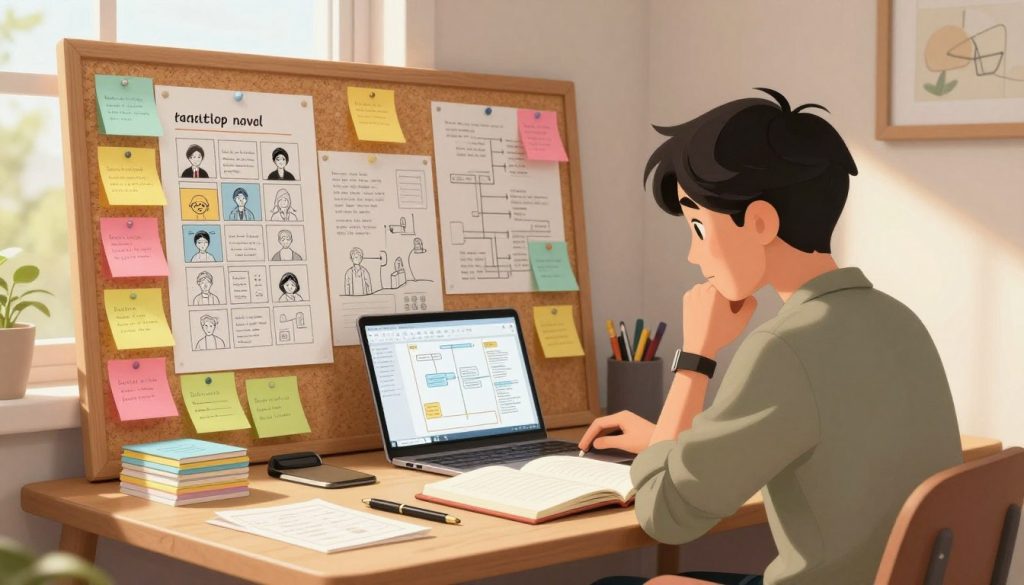
How Authors Outline Books: Balancing Planning and Creativity in Your Process
In the world of writing, you often hear the terms “plotter” and “pantser.” Plotters meticulously plan every detail before writing a single word. On the other hand, pantsers prefer to dive in and discover their story as they go. But the truth is, many writers, including myself, find a happy medium between these two approaches.
About half of all novelists, including the likes of Stephen King, identify as pantsers. Understanding where you fall on this spectrum can help you choose an outlining method that fuels your creativity rather than stifling it.
The plotter vs. pantser debate — which camp are you?
The plotter versus pantser debate is akin to the classic cats versus dogs discussion. People have strong opinions, but both can be wonderful if approached correctly. I spent years insisting I was a pure pantser, convinced that outlining would strangle my creativity. However, that fear faded once I gave planning a shot.
Stephen King may write by the seat of his pants, but J.K. Rowling meticulously plotted Harry Potter using spreadsheets. The only wrong approach is the one that prevents you from finishing your novel.
Hybrid approaches and finding your ideal balance
The hybrid approach I’ve adopted involves writing about fifty discovery pages. This allows my characters to introduce themselves. After that, I create a detailed outline for the rest of the journey, once I know who I’m traveling with. This balance between planning and discovery can make a world of difference.
It’s essential to keep your outline adaptable. Think of it as a GPS that recalculates when you take a detour, not a rigid train track that derails you at the slightest deviation. Some of my best plot twists emerged mid-draft when a character did something unexpected. Because my outline was flexible, I could weave that surprise back into the structure without collapsing the whole thing.
Keeping your outline adaptable as story evolves
If you’re unsure whether you’re a plotter or a pantser, try outlining one novel and pantsing another. Your productivity and enjoyment levels will tell you everything you need to know. The goal isn’t to be a perfect plotter or a pure pantser; it’s to understand your own creative process well enough to build a system that leads you to “The End” with your sanity mostly intact.
Ultimately, finding your ideal approach to outlining can help you write more effectively. A balanced method allows you to maintain your creative spark while providing enough structure to guide your writing journey. For more tips on planning your book without stifling creativity, check out this insightful guide.
Practical Tips to Make Outlining Fun, Fast, and Effective
Outlining a novel doesn’t have to be a tedious chore; it can actually be an exciting part of the writing process. With a few practical tips, you can turn this phase into a productive and enjoyable experience.
Using AI tools like Storyloft to speed up outlining
AI tools like Storyloft have revolutionized the outlining process. You can generate a complete book plan in the time it takes to watch an episode of your favorite show. This means you have no excuse left for not starting that novel!
Along the way, Storyloft also creates:
- Intelligent planning notes that inspire your writing.
- A concept book cover that makes your project feel real.
Trying alternative methods: mind maps, reverse outlines, and beat sheets
There are many alternative outlining methods that can make the process more dynamic:
- Mind Maps: Perfect for visual thinkers, mind maps show connections between characters, subplots, and themes like a beautiful narrative spiderweb.
- Reverse Outlines: This method starts at your story’s ending and works backward. It’s like solving a maze from the finish line, making paths to your conclusion clear.
- Beat Sheets: Popularized by “Save the Cat! Writes a Novel,” beat sheets give just enough structure to keep your pacing tight without overwhelming detail.
- Zettelkasten: Using index cards to jot down scenes and dialogue snippets allows you to shuffle and rearrange until the story’s rhythm feels right.
Embracing imperfection and iterative revision
Embracing imperfection in your outline is crucial. Accept that your first plan will have gaps and logical flaws. That’s perfectly fine! Outlines are meant to be revised.
The Snowflake Method by Randy Ingermanson starts with a single sentence and expands outward like a crystal forming. This approach is perfect if traditional outlining feels overwhelming.
Whatever method you choose, remember this: the most important step is the first one. Stop thinking about your novel and start planning it. A mediocre outline beats a brilliant daydream every single time!
Conclusion
As you wrap up your writing journey, remember that there’s no single way to craft a novel. Each story begins uniquely, and the process of outlining can take many forms. The key is to keep writing. A solid outline serves as a sturdy framework, guiding your narrative from the beginning to the end.
If you take away one thing from this guide, let it be this: outlining isn’t about stifling creativity; it’s about laying a foundation for your story to soar. Every novel I’ve completed started with some form of planning, while those I abandoned often stemmed from the hubris of thinking I could hold everything in my head.
The tools are at your fingertips—whether it’s Storyloft’s free generator, mind maps, or index cards. They’re all waiting for you to dive in and start planning the book you’ve dreamed of writing. Your outline will evolve as you write, and that’s a sign of a living, breathing story.
So, don’t let the blank page intimidate you. With a solid outline, it transforms into an invitation to create. Whether you identify as a plotter, a pantser, or a blend of both, your goal remains the same: to tell a story that resonates and characters that feel real. The world is waiting for your unique tale, so take that first step from idea to outline to manuscript!
FAQ
Why should I bother outlining my novel?
Outlining is like having a GPS for your writing journey. It keeps you on track, prevents you from wandering into plot chaos, and helps you avoid the dreaded blank page syndrome.
Can outlining really save me time?
Absolutely! A well-structured outline acts as a roadmap, allowing you to maintain focus and boost creativity. You’ll spend less time rewriting and more time enjoying the writing process.
What’s the deal with character arcs?
Character arcs are essential for emotional engagement. They show how your characters grow and change throughout the story, making them relatable and memorable for readers.
How do I create a compelling setting?
Think of your setting as a character itself. It should reveal themes and influence character actions. Research and vivid descriptions can transport readers into your world.
What if I get stuck during the outlining process?
No worries! Outlining isn’t set in stone. Embrace flexibility and let your ideas evolve. If something isn’t working, don’t hesitate to revise your outline.
Are there tools to help with outlining?
Yes! Tools like Storyloft can make outlining a breeze. They help turn your ideas into structured outlines in no time, so you can focus on the fun part—writing!
What’s the difference between a plotter and a pantser?
Plotters meticulously plan their stories, while pantsers prefer to write by the seat of their pants. Both approaches have their merits; the key is finding what works best for you.
How do I keep my outline engaging?
Infuse your outline with major emotional beats and character development. This keeps the reader invested and ensures that each scene contributes to the overall narrative.
Should I write my blurb before outlining?
Yes! Crafting your blurb first can serve as a guiding star for your outline, helping you stay focused on your protagonist’s goals and the story’s essence.
Can I use different outlining methods?
Definitely! Experiment with mind maps, beat sheets, or even reverse outlines. The more tools you have in your toolbox, the more fun outlining can be!