10 Other Words for Said in Writing: Author’s Guide
The best dialogue tag is often the quietest one. Writers are frequently told to search for other words for said in writing, as if every repeated “said” signals weak prose. That advice misses the point. Said and asked usually keep the reader's attention on the character's actual words, while a stronger verb should earn its place by adding information the dialogue alone doesn't provide.
Modern writing guidance treats “said” as nearly invisible and warns against replacing it with ornate verbs to create variety. One guide recommends ordinary speech verbs such as said, asked, murmured, whispered, shouted, answered, replied, and continued, while another writing handout collects hundreds of possible alternatives, from “acknowledged” to “yelled,” as a reference rather than a command to use them all.
The ten choices below are organized by the effect they create for the reader. Some clarify a response, some reveal emotion, some establish authority, and others expose conflict. Each includes a comparison with a neutral tag and an action beat, because the right solution may not be a more vivid verb at all. You'll also find common misuse patterns and a practical editing pass you can apply inside a manuscript editor.
Table of Contents
- 1. Asked
- 2. Exclaimed
- 3. Whispered
- 4. Replied
- 5. Muttered
- 6. Declared
- 7. Insisted
- 8. Groaned
- 9. Confessed
- 10. Snapped
- 10 Alternatives to Said: Quick Comparison
- Edit for Meaning, Not Just Variety
1. Asked
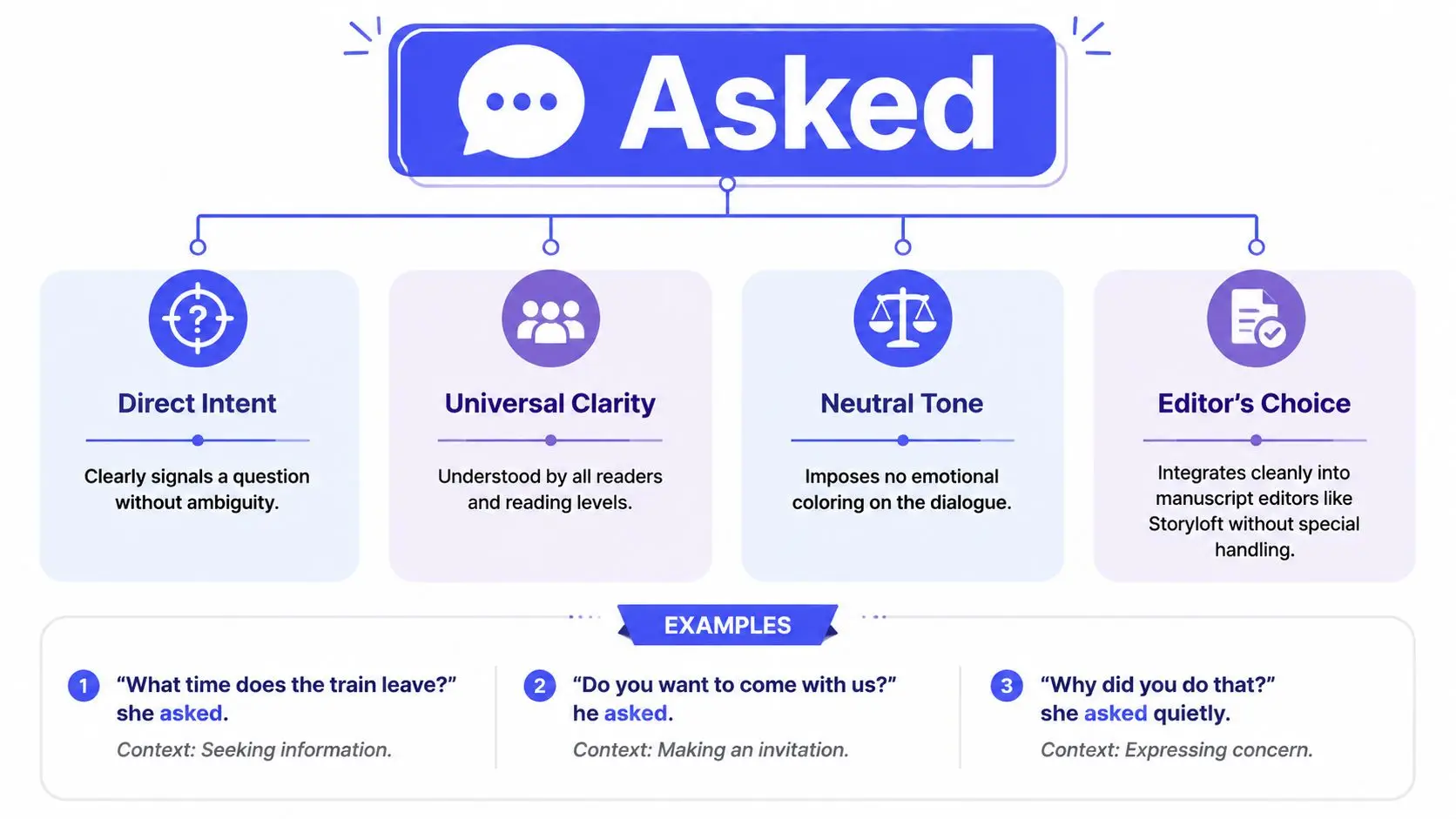
“Asked” is one of the safest alternatives to “said” because it identifies a question without drawing attention away from the exchange. In most scenes, the punctuation already tells readers that a line is a question, so the tag can remain simple:
“Where are you going?” she asked.
The verb works especially well when the question carries no unusual emotional force. Compare “Do you believe me?” he asked nervously with “Do you believe me?” he asked. The first version adds anxiety, but the adverb may be less effective than showing the character's behavior:
“Do you believe me?” He kept his hands flat on the table.
The neutral tag tells readers who is speaking. The action beat shows tension, posture, and control. That distinction matters. A tag describes the manner of speech, while an action beat gives the scene another physical or psychological layer.
When asked earns its place
Use “asked” when:
- The line is a genuine question: “What time is the meeting?” the manager asked.
- The exchange needs a clean rhythm: Short questions and answers can become heavy if every tag tries to perform.
- The emotion is already clear: A question followed by a character backing away may not need “pleaded” or “demanded.”
Use a more specific verb only when the question's intention would otherwise be unclear. “Challenged” suggests confrontation, “pleaded” suggests urgent dependence, and “wondered” may signal private uncertainty rather than a direct request for information.
For practical guidance on keeping exchanges readable, see this resource on writing natural dialogue. In Storyloft's manuscript editor, you can test “asked” beside an adverb or an action beat, then use tone analysis to notice whether a conversation is becoming overly tense, flat, or repetitive. The tool should support the decision, not force variation.
2. Exclaimed
“Exclaimed” tells the reader that a line arrives with heightened energy, surprise, or emphasis. It can suit a sudden discovery, a warning, or a burst of joy:
“Look out!” the guard exclaimed.
The verb has more force than “said,” but it shouldn't appear whenever a line ends with an exclamation mark. Punctuation shows intensity on the page. “Exclaimed” should add a meaningful performance or reaction, such as a character's abrupt shock or uncontrollable excitement.
Compare these versions:
“We've won the lottery!” he exclaimed in disbelief.
“We've won the lottery!” He jumped away from the desk, staring at the screen.
The first version names the emotion. The second lets the body reveal it. Both can work, but the action beat may give the scene more movement and avoid stacking an expressive verb with an explanatory adverb. “Exclaimed in disbelief” tells readers how to interpret the line, while the character's reaction lets them draw the conclusion.
Use intensity selectively
“Exclaimed” earns its place when the moment changes the scene's energy. A guard spotting danger, a child announcing unexpected news, or a character making a sudden emotional objection can all justify it. In a quiet conversation, however, the same verb may make a normal reaction feel theatrical.
Character voice matters too. A naturally restrained character might rarely exclaim, making the occasional use significant. A naturally exuberant character may exclaim more often, but repeated high-energy tags can still flatten the contrast between ordinary excitement and genuine shock. Storyloft's tone in writing guide can help you examine the emotional register of a passage, while its character creator can help you keep a character's reactions consistent.

A useful test is simple: remove “exclaimed” and read the line with “said.” If the scene loses a specific sense of sudden intensity, restore the stronger verb. If nothing changes, the action or dialogue may already be doing the work.
3. Whispered
“Whispered” changes how readers hear a scene. It signals a deliberately quiet voice, perhaps because a character is sharing a secret, avoiding danger, protecting an intimate moment, or struggling to speak openly.
“Don't tell anyone,” she whispered.
The verb also raises practical questions: who can hear the character, how close are the others, and what sounds surround them? A whisper in a crowded station has a different effect from one in a dark bedroom. Let the setting make the low volume necessary, rather than using the verb as decoration.
Whispering needs context
Compare these versions:
“They're coming,” the spy whispered urgently.
“They're coming.” The spy leaned close enough for his breath to warm her ear.
The first labels both volume and emotional pressure. The second shows proximity and sensation, allowing the reader to infer urgency from the action. If the surrounding scene already establishes danger, “whispered” alone may carry enough information.
A whispered line can clarify delivery without deciding the character's emotion. When someone says “I love you” in darkness, the moment might express tenderness, fear, or uncertainty. The verb establishes the sound. The action, setting, and earlier conflict reveal the feeling. For practical guidance on making exchanges clear and purposeful, use this guide to write better dialogue.
An action beat can also show whether a whisper is secretive or intimate:
“I love you,” he whispered, pressing his forehead to hers.
The beat gives readers a relationship and a physical arrangement. That information usually does more work than adding “tenderly” or “urgently” to the dialogue tag. During revision, Storyloft's manuscript editor, tone analysis, comments, edit history, and character tools can help you check whether the verb matches the scene and the speaker's established voice.
4. Replied
“Replied” points backward. It tells readers that the line responds directly to something already said, which makes it useful in interviews, arguments, negotiations, and quick exchanges between several characters.
“I agree completely,” she replied.
The word is neutral enough to preserve conversational momentum, but it carries a small amount of structure that “said” doesn't. In this exchange, the second line clearly answers the first:
“When does the train leave?”
“At noon,” she replied.
“Answered” could work too, especially if the response solves a question or supplies important information. “Replied” focuses more broadly on the turn-taking. It can introduce agreement, correction, evasion, or resistance:
“That's not what I meant,” he replied defensively.
The adverb explains attitude, but an action beat may make the defense more specific:
“That's not what I meant.” He folded the receipt into smaller and smaller squares.
Let the exchange breathe
Not every line needs a tag. If two characters have distinct voices and alternate cleanly, readers can often follow the conversation without constant attribution. Overtagging can interrupt the rhythm, while too little orientation can make a multi-character scene confusing. “Replied” is most valuable when the response relationship matters or when a new speaker needs a clear anchor.
Storyloft's comments panel can help you mark a dialogue arc, such as a question that receives an evasive answer before the conversation turns. Its binders and character tools can also keep complex exchanges connected to the right scene and speaker. During revision, search for repeated “replied” instances, but don't replace them automatically. A clean response is often better than a colorful interruption.
5. Muttered
“Muttered” reveals that speech is indistinct, low, begrudging, or partly withheld. It's a characterization-rich choice because it can show frustration without turning a small reaction into open confrontation.
“Whatever,” he muttered under his breath.
The phrase “under his breath” may be redundant because “muttered” already suggests low volume. Try the line without it:
“Whatever,” he muttered.
If the scene needs a physical detail, replace the redundant phrase with a meaningful beat:
“Whatever.” He shoved the papers into the drawer and muttered something the others couldn't hear.
Now the action shows irritation, and the final detail clarifies why the speech is hard to hear.
“Muttered” can also signal self-directed thought spoken aloud:
“This is ridiculous,” she muttered while organizing files.
Here, the verb separates the character's private commentary from a statement addressed to another person. It can make a character seem frustrated, introverted, distracted, or conflicted.
Don't use muttered to hide necessary information
A writer may choose “muttered” because the character is shy, but if the reader needs to understand the line, indistinct delivery can create an unnecessary problem. Use the verb when the lack of clarity has a purpose. Perhaps another character mishears the words, ignores them, or realizes that the speaker doesn't want a response.
“I don't care what they think,” he muttered dismissively.
The word “dismissively” may be unnecessary if the dialogue and action already establish the attitude. Consider:
“I don't care what they think.” He kept sorting the files, though his fingers had begun to shake.
This version introduces a contradiction. The character claims indifference while the body suggests pressure. Storyloft's tone analysis and character creator can help you check whether muttering supports a stable voice or marks a deliberate change.
6. Declared
“Declared” gives a statement public weight. It suggests a formal pronouncement, a firm commitment, or a conclusion that the speaker expects others to recognize. The word is stronger than “said” because it frames the line as an announcement.
“I'm taking over this project,” she declared.
That sentence establishes authority, but the context determines whether the authority is deserved. A manager making a decision in a meeting may declare it confidently. An inexperienced character declaring the same thing may sound presumptuous, which could be exactly the point.
The verb works especially well at turning points:
“We will not surrender,” the general declared solemnly.
“This ends now,” he declared with finality.
Both examples carry weight, but both also risk overstatement. “Declared solemnly” and “declared with finality” explain qualities that “declared” already suggests. An action beat can make the moment more concrete:
“We will not surrender.” The general raised the torn flag above the barricade.
Authority should come from the scene
“Declared” doesn't create authority by itself. The setting, audience, character history, and consequences need to support the announcement. A private comment to one friend may sound oddly grand if tagged with “declared,” unless the exaggerated formality reveals personality or humor.
Use “said” when the character is reporting a decision. Use “declared” when the manner of presentation matters, particularly when the line becomes a public position that others may accept or challenge. Storyloft's binders can help you mark scenes containing commitments, announcements, or thematic statements. Reviewing those scenes together can show whether declarations form a meaningful pattern or have become a habitual substitute for “said.”
7. Insisted
“Insisted” tells readers that a character refuses to yield. The speaker may be repeating a claim, pressing for trust, or resisting another person's interpretation.
“I'm telling you, I saw it,” he insisted.
Unlike “declared,” which establishes a statement's public force, “insisted” exposes a relationship under pressure. Someone else doubts the speaker, interrupts them, or continues to disagree. The verb therefore carries conflict even when the words look calm.
“You have to trust me,” she insisted desperately.
The adverb gives the emotion directly, but an action beat can reveal how determination affects the body:
“You have to trust me.” She blocked the doorway, refusing to let him pass.
Now the insistence has a physical consequence. The character isn't only repeating an idea. She's controlling the interaction.
Show what repetition costs
Insistence becomes more interesting when it changes across a scene. A character may begin with confidence, shift into irritation, and finally sound frightened. The same verb can appear at different points, but each use should reflect the evolving relationship rather than merely label repeated dialogue.
“That's not how it happened,” he insisted stubbornly.
“Stubbornly” may be useful if the narrator has a reason to name the attitude, but it can also duplicate the verb's meaning. Try an action beat:
“That's not how it happened.” He wouldn't meet her eyes.
That version introduces doubt or shame, which may complicate the claim. Storyloft's edit history can help you compare these targeted revisions, while its character creator can keep the behavior connected to established traits. If a character begins to insist more often, ask whether the pattern reflects an arc, a worsening conflict, or an editing habit.
8. Groaned
“Groaned” brings physical sound into dialogue. It can convey complaint, exhaustion, pain, reluctance, or defeat, depending on the line and situation.
“Not again,” he groaned.
The verb is effective when the character's voice seems to come from a bodily reaction rather than a deliberate statement. A tired traveler, an overwhelmed parent, or a defeated athlete might groan before answering.
“Do we have to go?” she groaned from the couch.
The setting adds context, but the action can make the moment more vivid:
“Do we have to go?” She let her head fall against the cushion.
The second sentence avoids treating “groaned” as a shortcut for every kind of reluctance. It also lets the reader see the character's energy level.
Use groaned as a noticeable texture
“Groaned” is more conspicuous than “said,” so repeated use can make every complaint sound alike. Reserve it for moments when the physical quality of the response matters. If the character is unhappy, “said” plus a revealing action may be cleaner
“Why me?” he said. He stared at the wreckage and rubbed both hands over his face.
If the line is “Why me?” and the character's defeat is central, “groaned” may fit. If the scene needs a more restrained tone, the action beat may carry the emotion without making the prose sound comic or melodramatic.
Character consistency matters here. Some characters complain openly, while others compress frustration into silence or clipped answers. Storyloft's character creator can help record those tendencies, and its scene-building tools can keep gestures aligned with the character's physical state. Don't choose “groaned” because a list of alternatives recommends it. Choose it because the reader should hear the strain in the voice.
9. Confessed
“Confessed” signals an admission with emotional or moral weight. It implies that the character has held something back, feared the response, or crossed a boundary they can no longer maintain.
“I've always been afraid,” she confessed quietly.
“I lied to protect you,” he confessed finally.
The word changes how readers interpret the information. “I lied to protect you,” he said is a statement. “I lied to protect you,” he confessed frames it as a difficult release of truth. That framing can be powerful, but it must be supported by the story. If the secret has no cost, calling the line a confession may exaggerate the moment.
Give the admission a history
A confession earns its place when the withheld information affects trust, identity, or the direction of the relationship:
“I love you,” she confessed after years of silence.
The line suggests a long emotional barrier. To make the scene less explanatory, use an action beat that carries the delay:
“I love you.” She gripped the edge of the table until her knuckles paled.
The action doesn't tell readers exactly how long she has been silent, but it gives the admission physical pressure. You can also keep the tag and remove the extra explanation:
“I love you,” she confessed.
The surrounding scene may already establish the years of hesitation.
Storyloft's character creator can help you connect a confession to backstory, while binders and tags can group secrets, revelations, and relationship milestones across a manuscript. During revision, ask whether the admission changes anything. If it does, “confessed” may focus the reader on the breakthrough. If it doesn't, “said” may be more honest and less inflated.
10. Snapped
“Snapped” describes a quick, sharp response shaped by anger, impatience, or defensiveness. It makes the exchange feel sudden, as though the character's restraint has broken.
“Leave me alone!” she snapped.
“That's none of your business,” he snapped back.
The phrase “snapped back” emphasizes a direct retaliation. It works when one line provokes the next, but it can become repetitive in an argument where every response is tagged with the same emotional temperature.
Compare:
“I've had enough of this,” the manager snapped at the team.
“I've had enough of this.” The manager closed the laptop and stood.
The first version names the delivery. The second lets the action interrupt the meeting and gives the anger a consequence. You can also combine the two when the verbal sharpness matters and the action adds new information:
“Leave me alone,” she snapped, backing toward the door.
Track volatility, not just vocabulary
“Snapped” can reveal an emotional pattern. A normally patient character who snaps once may be reaching a breaking point. A character who snaps in every scene may need more variation in behavior, or the repeated verb may be hiding the fact that each conflict has the same shape.
Use show, don't tell writing guidance as a revision prompt, not as a ban on direct emotional language. A clenched fist, abrupt movement, silence, or a change in eye contact can sometimes do more than “snapped,” but the verb remains useful when the sharpness of the voice is the information readers need.
Storyloft's edit history lets you compare versions after replacing a tag with an action beat. Its character tools can help you check whether the reaction fits the speaker's established temperament and triggers. Keep “snapped” when it identifies a real rupture. Remove it when the dialogue and scene already make the anger unmistakable.
10 Alternatives to Said: Quick Comparison
| Tag | 🔄 Complexity | ⚡ Editorial effort | ⭐ Effectiveness | 📊 Expected outcome | 💡 Ideal use cases / Tip |
|---|---|---|---|---|---|
| Asked | Low, simple attribution | Very low, plug-and-play | ⭐⭐⭐, clear, neutral | Keeps dialogue readable and focused | Use as default; vary only for emphasis |
| Exclaimed | Low, clear emotional cue | Low, conveys intensity without extra text | ⭐⭐⭐⭐, high emotional clarity | Heightens dramatic or surprise beats | Reserve for genuine high-emotion moments |
| Whispered | Low-medium, needs context for volume | Medium, may need scene-setting | ⭐⭐⭐⭐, strong for intimacy/tension | Creates secrecy, closeness, or suspense | Pair with beats/environmental detail |
| Replied | Low, signals response flow | Very low, structural clarity aid | ⭐⭐⭐, neutral and reliable | Clarifies turn-taking in multi-speaker scenes | Use to maintain conversation structure |
| Muttered | Low-medium, implies mumbling/attitude | Medium, may require action beats for clarity | ⭐⭐⭐⭐, good for characterization | Conveys frustration, reluctance, or mood | Use sparingly to develop voice; track patterns |
| Declared | Medium, formal tone, thematic fit needed | Medium, best for weighty moments | ⭐⭐⭐⭐, strong for authority/confidence | Lends weight and formality to statements | Reserve for pivotal or public pronouncements |
| Insisted | Medium, implies repetition/force | Medium, may require pacing/context | ⭐⭐⭐⭐, communicates persistence/conflict | Advances negotiation/relationship tension | Combine with action beats to show resolve |
| Groaned | Low, expressive but situational | Low, quick to convey mood | ⭐⭐⭐, effective for exasperation/humor | Adds physicality and relatable reaction | Use sparingly for comedic or weary beats |
| Confessed | Medium, requires narrative payoff | Medium-high, needs setup to avoid melodrama | ⭐⭐⭐⭐⭐, powerful for vulnerability | Deepens character, builds empathy and stakes | Reserve for genuine breakthroughs with setup |
| Snapped | Low-medium, abrupt emotional cue | Medium, benefits from contextual beats | ⭐⭐⭐⭐, effective to show sudden anger | Signals conflict escalation or breaking point | Track occurrences to avoid one-note volatility |
Edit for Meaning, Not Just Variety
Start a dialogue revision by keeping “said” or “asked” wherever the exchange is already clear. Those tags often preserve the reader's attention on the words, the subtext, and the characters' choices. Contemporary guidance treats “said” as a standard default because it tends to disappear during reading, while ornate substitutions can call attention to the writing itself. The older inverted form, “said he” or “said she,” is also now archaic and rare in modern prose. In The Lord of the Rings, the modern form appears 764 times compared with 10 instances of the older form, as documented in this dialogue-tag style guide.
Next, replace a neutral tag only when the alternative adds precise information. “Whispered” tells readers about volume. “Replied” clarifies the relationship between lines. “Confessed” frames speech as a difficult admission. “Snapped” identifies a sharp, reactive delivery. If the proposed verb merely repeats what the dialogue, punctuation, or surrounding action already shows, leave the simpler tag in place.
Then test an action beat. Compare “I won't let you leave,” she exclaimed with “I won't let you leave.” She planted herself between him and the door. The second version gives the reader movement, position, and an obstacle. It may also create more room for subtext. A character can claim to be calm while gripping a glass too tightly, or insist on trust while refusing to meet someone's eyes.
Use this sequence during a focused manuscript pass:
- Keep the neutral tag: Start with “said,” “asked,” “replied,” or no tag when speaker identity and delivery are clear.
- Name only specific meaning: Choose “whispered,” “declared,” “insisted,” or another alternative when it contributes information the line doesn't carry alone.
- Try an action beat: Show posture, movement, hesitation, distance, or physical response when the scene benefits from more than vocal description.
- Remove duplicate cues: Cut combinations such as “snapped angrily” or “whispered softly” when the adverb merely repeats the verb.
- Review contradictions: Check whether the tag, adverb, action, and dialogue point in the same direction. Contradiction can be deliberate, but accidental mixed signals confuse readers.
- Search in context: Find repeated verbs across the manuscript, then review each result inside its scene rather than replacing every instance mechanically.
A large college handout titled “Synonyms for Said” spans five pages and includes hundreds of alternatives. That abundance can help you find a precise word when a scene needs one, but it shouldn't turn revision into a hunt for novelty. The important question isn't how many dialogue verbs you can collect. It's what the reader should understand at that exact moment.
Storyloft's manuscript editor supports targeted revision inside a long-form project. You can use tone analysis to inspect the emotional register of a scene, comments to record why a tag needs changing, and edit history to compare a neutral version with one built around action beats. Its character tools can keep speech habits and emotional triggers consistent, while binders and tags can help you track recurring revelations, arguments, and commitments. For authors who are also preparing visual material, the platform combines manuscript work with illustration, cover design, and publishing workflows, but the dialogue decision still belongs to the writer.
A final read-aloud pass can catch problems that a synonym search can't. Listen for dialogue that sounds too formal, too heavily tagged, or too emotionally uniform. If the characters' words already reveal the moment, let “said” do its quiet work. If the reader needs to hear a whisper, feel a confession, recognize an authority claim, or register a sudden rupture, choose the stronger verb or action beat that delivers exactly that information. For authors refining presentation alongside the manuscript, this author headshot guide can support the wider author platform without changing the voice on the page.
The best dialogue revision doesn't maximize variation. It protects clarity, preserves character voice, and controls scene momentum one line at a time.
Storyloft gives authors a long-form manuscript editor with tone analysis, comments, edit history, character tools, and AI-assisted phrasing revisions inside the document. Use it to compare “said” with a precise alternative, test an action beat, and keep dialogue choices consistent across your manuscript. Visit Storyloft to begin refining your next scene in one writing workspace.