How to Structure a Story with Frameworks and AI Tools
You can usually feel the problem before you can name it. The pages are there, the scenes are vivid, the prose has bite, and yet the draft still feels like it's walking in circles. Characters keep moving, but nothing tightens. Events happen, but the reader doesn't feel the pull that carries one moment into the next.
That's the point where structure matters more than another round of sentence polishing. Story structure gives the reader a way to track change, anticipate consequence, and understand why each scene belongs. The strongest guidance across storytelling and data-writing circles keeps returning to the same basic pattern, a beginning, middle, and end built around context, conflict, and resolution, with the most important information placed first and the scope deliberately narrowed to one or two core findings when the material is dense. HBS Online's data storytelling guidance and Eurostat's writing advice both point toward the same reader need, reduce overload, guide attention, and make the payoff easier to remember.
That's why the right answer to how to structure a story isn't a single template. It's knowing which framework fits the material you have, a clean premise, a mythic arc, a scene that needs repair, or a pile of notes that still need shape. The useful frameworks are the ones that help you decide what changes, what stays in view, and what has to land at the end.
Table of Contents
- Why Structure Is the Layer Most Drafts Are Missing
- The Four Frameworks That Cover Most Modern Stories
- Inside a Scene How Structure Works at the Smallest Unit
- Turning Scattered Notes Into a Working Outline
- Matching the Right Framework to the Story You're Actually Writing
- Keeping Structure Visible Inside Your Manuscript Workflow
- A Final Revision Pass That Tests the Structure
Why Structure Is the Layer Most Drafts Are Missing
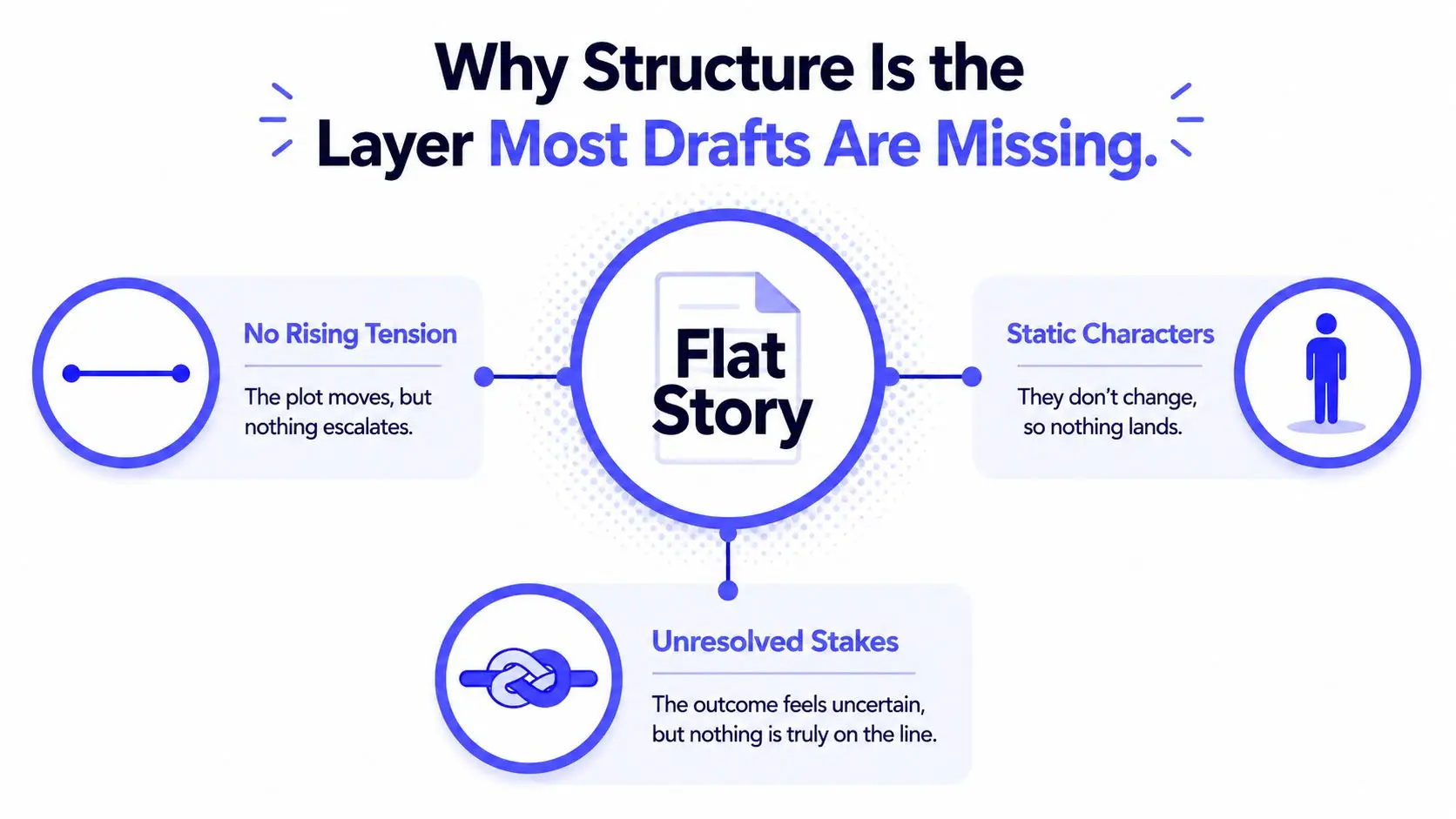
A draft can have strong characters and still feel flat if the reader cannot feel escalation. It can have sharp dialogue and still drift if each scene lands at the same emotional temperature. In practice, the missing layer is often not voice or description, it is the architecture that tells the reader what changed and why it matters.
What structure does for the reader
Structure reduces cognitive load. A reader does not want to sort through every detail in the order the writer discovered them, they want a path that moves them from setup to pressure to payoff. That is why the most durable guidance keeps returning to a three-part narrative arc, setup, conflict, resolution, because it helps readers track movement instead of just accumulating scenes.
The strongest structural advice also narrows the message. Eurostat's “Making Data Meaningful” says to focus on one or two findings and keep paragraphs to no more than three sentences, while executive storytelling advice from Kissmetrics says presentations should use no more than five slides, audiences lose engagement in more than 10 minutes, and each slide should carry one insight with one supporting visual. Those limits are not just for slides or dashboards. They describe the same reader experience writers are trying to create, keep the message narrow, keep the tension visible, and make the ending feel earned rather than piled on.
Practical rule: if a scene, chapter, or essay section does not change what the reader knows, wants, or fears, it is probably doing atmosphere work when it should be doing structural work.
The patterns worth keeping in mind
The four frameworks below all answer the same core question, what changes for the protagonist and why. They just answer it with different levels of detail and different strengths. One is broad and flexible, one is beat-driven, one is archetypal, and one is compact and circular.
- Three-act structure gives you the cleanest backbone for setup, complication, and resolution.
- Save the Cat helps when you need a more granular beat sheet and want to control pacing.
- The Hero's Journey works well when transformation is the engine of the story.
- Dan Harmon's Story Circle is useful when the story needs a tight loop of want, challenge, adaptation, and return.
If the draft feels shapeless, do not start by rewriting every paragraph. Start by asking where the structure is supposed to turn.
For a clean premise, that turn is often easy to spot. For messy notes or research-heavy nonfiction, the problem is usually not invention, it is sorting the material until the shape becomes visible. A framework only helps if it matches the kind of draft you have, and a manuscript-centered workspace such as Storyloft's three-act structure resource can keep that shape beside the pages instead of buried in a separate document.
The Four Frameworks That Cover Most Modern Stories
The mistake many writers make is treating every framework as a religion. They're not. They're tools, and each one is good at a different job. The quickest way to choose is to ask whether your story needs a broad skeleton, a beat-by-beat roadmap, a transformation arc, or a compact cycle that keeps the story moving.
What each framework is best at
Three-act structure is the default choice for most novels and long-form narrative because it cleanly separates setup, confrontation, and resolution. It's especially useful when the story needs a clear midpoint shift and a decisive final turn. For example, The Hunger Games is easy to map in three acts, because Katniss's decision to enter the Games, the pressure of the arena, and the final confrontation all mark distinct structural changes. A useful internal guide for that shape is Storyloft's three-act structure resource, which aligns naturally with this backbone.
Save the Cat is more specific. It's strongest when you need a dependable sequence of beats that keeps momentum visible scene by scene. That makes it a practical fit for commercial fiction, screen-adjacent work, and stories that need regular turning points. Legally Blonde is a familiar example, because the setup, catalyst, debate, break into two, midpoint, and finale are easy to feel even without diagramming every beat.
The Hero's Journey suits stories built around identity change, initiation, or departure and return. The Lord of the Rings works well in this frame because the protagonist moves out of a known world, faces trials, and returns changed. The framework's strength is not just adventure, it's the sense that external conflict and inner change are happening together.
Dan Harmon's Story Circle is the most compact of the four. It works well for stories with a strong central want, a contained arc, or a clear before-and-after contrast. Groundhog Day is a classic match because the character starts in comfort, enters an unfamiliar loop, adapts, pays a price, and returns transformed.
| Framework | Core Shape | Best Suited For | Key Strength |
|---|---|---|---|
| Three-act structure | Setup, confrontation, resolution | Novels, essays, long-form narrative | Clear backbone and broad flexibility |
| Save the Cat | A sequence of fixed beats | Commercial fiction, screen-oriented plotting | Precise pacing and dependable turning points |
| Hero's Journey | Departure, ordeal, return | Mythic, transformational, coming-of-age stories | Strong identity-change arc |
| Story Circle | Want, challenge, adaptation, return | Tight, concept-driven stories | Simple loop with clear motion |
The question every framework answers
Each model forces the same decision. What changes for the protagonist, and what pressure causes that change? If you can't answer that plainly, no framework will rescue the draft. If you can answer it, the framework just gives you a stable path through the material.
Inside a Scene How Structure Works at the Smallest Unit
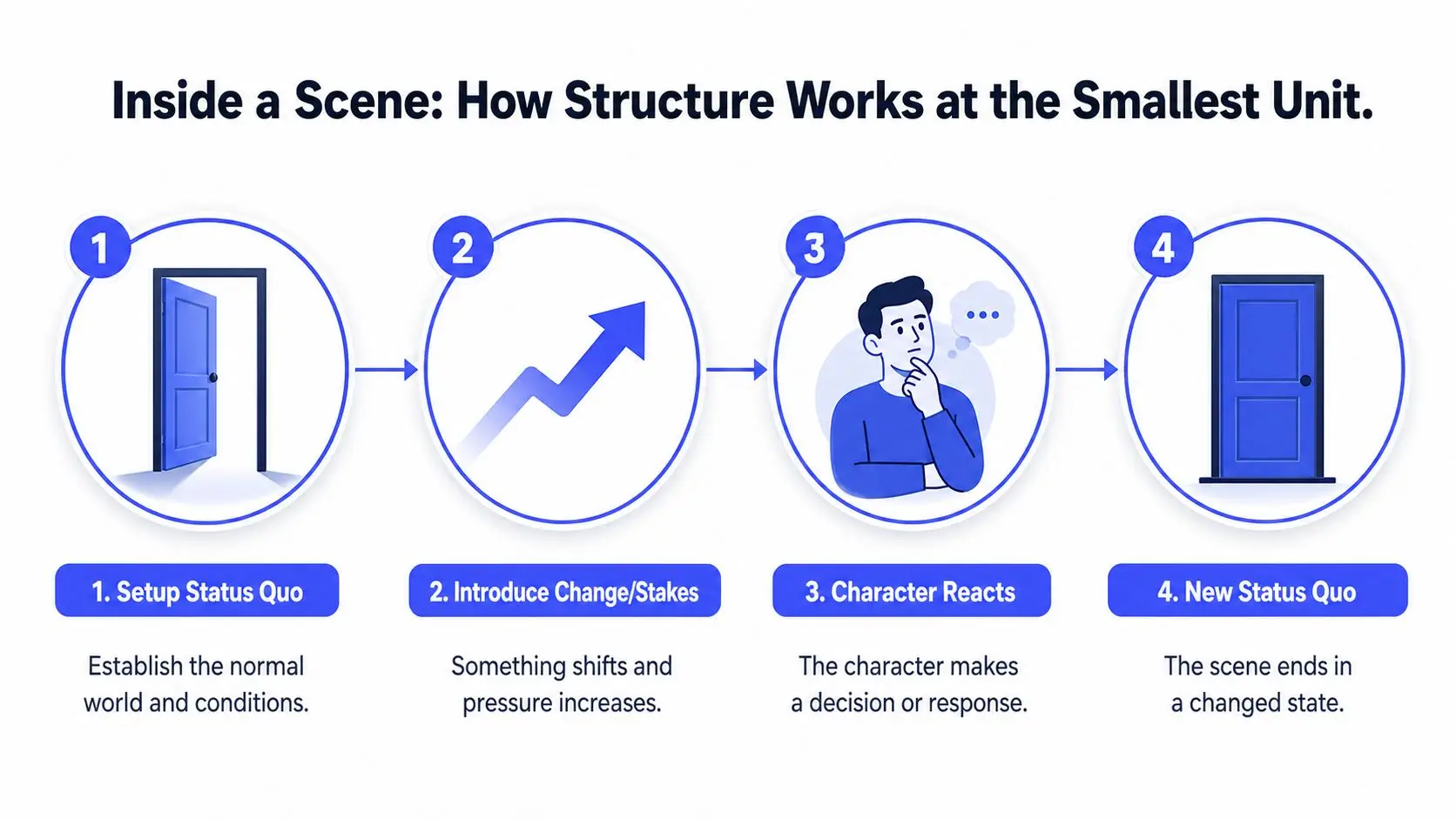
A lot of writers overthink the act level and underwork the scene level. That's a mistake, because readers feel structure most directly in the scene they're inside right now. A scene succeeds when it turns something, stakes, knowledge, relationships, or the protagonist's willingness to continue.
The parts a scene has to move through
A strong scene usually starts with a status quo, then introduces a change, then lets the character react, and then leaves the reader in a new situation. That's true whether the scene is a confrontation, a discovery, or a quiet exchange with consequences. If nothing is altered by the end, the scene may still be pleasant, but it isn't pulling its weight structurally.
A clean way to test the scene is to ask what shifted. If the answer is “nothing, but it was interesting,” the scene needs revision. If the answer is “the character learned something, lost something, or committed to something new,” the scene is doing real work.
The reader should leave a scene with a new question, not just a completed action.
A published novel scene often shows this clearly. A character enters with one assumption, gets new information or resistance, makes a choice under pressure, and exits with the situation altered. If you remove the setup, the reader can't feel the baseline. If you remove the turn, the scene becomes static. If you remove the consequence, the scene doesn't echo into the next chapter.
For authors who also think visually, turn scripts into storyboards is a useful way to see how setups and turns translate into beats. The same logic applies on the page. You're not just arranging events, you're arranging change.
Why scene logic and manuscript logic need to match
When the scene structure is strong, chapter structure becomes easier to manage. A scene can be short and still matter if it alters the story's direction. It can be long and still fail if it never creates a new pressure point. Revision gets easier when the scene is treated as the smallest unit of narrative consequence, not as a place to dump exposition or polish mood.
Storyloft's guidance on rewriting scenes without losing voice fits this problem neatly, because the core question isn't just how to improve prose, it's how to preserve the scene's turn while changing the language. That distinction matters more than most writers realize.
Turning Scattered Notes Into a Working Outline
A pile of notes rarely turns into a draft on its own. Interviews, research folders, scraps of dialogue, and half-formed scenes all point in different directions, so the first job is not to force a structure onto them. The job is to sort the material until the shape starts to show.
A usable workflow for rough material
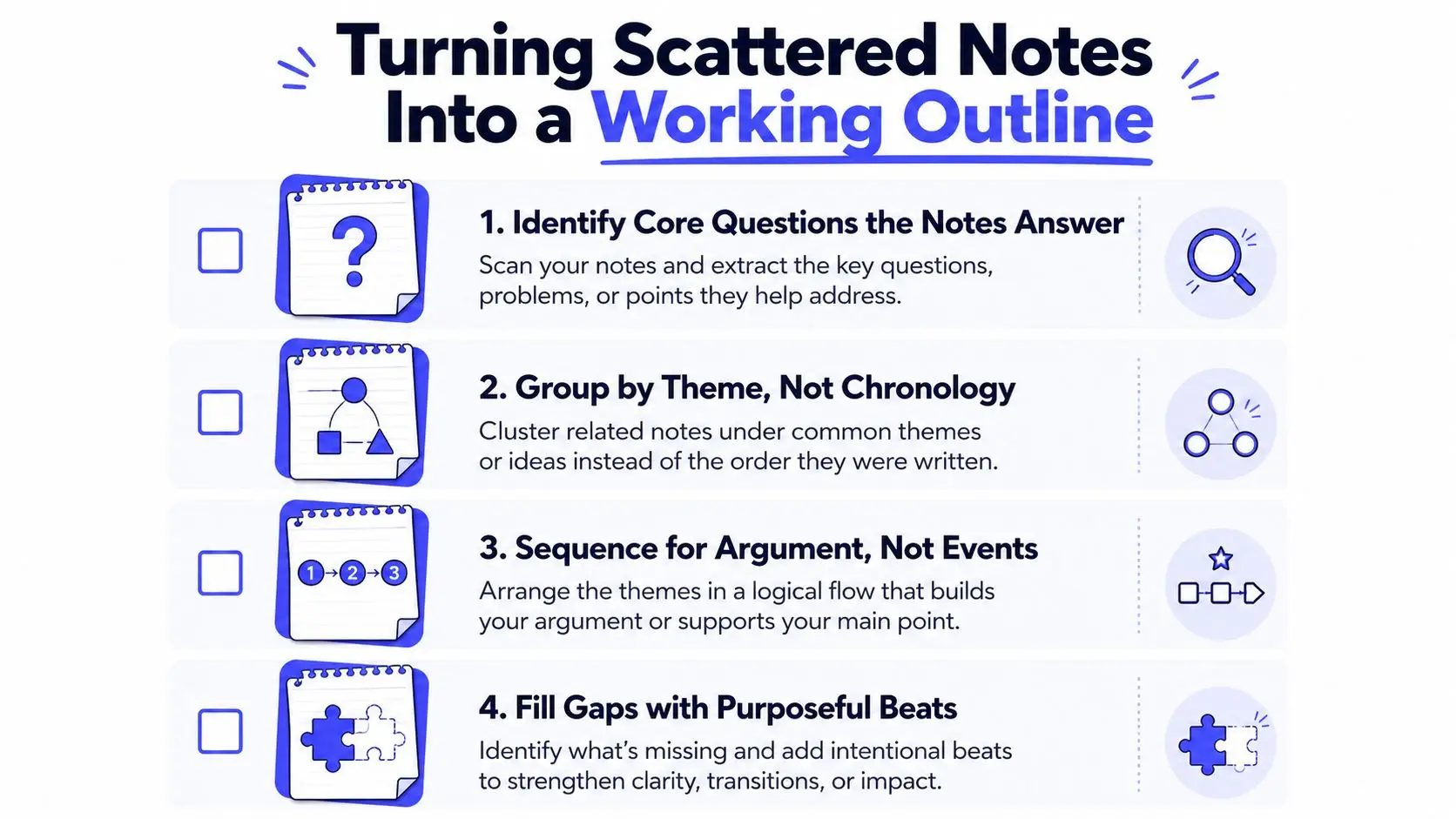
Read everything once without trying to solve it. Then cluster the material into three to five sub-themes. Those clusters usually reveal what the project is really about, and that is often clearer than the original note pile. From there, pull out one premise sentence that can hold the whole project together.
After that, write a one-page summary, then expand it into a four-page outline. That progression matters because it forces compression before expansion. A long outline built too early usually preserves confusion in a more organized format.
Next, mark the inciting incident, the midpoint shift, and the climax directly in the outline so you can see whether the project turns where it should. That helps with nonfiction and research-heavy work, where the raw material may be modular rather than linear. If you are building from sources, notes, and argument fragments, the outline has to create motion that the source pile does not naturally provide.
For a deeper look at organizing research, see Storyloft's guide on how to organize your book notes and research. It is easier to make sense of material once the notes, excerpts, and references live in a system you can search and rearrange without losing the draft.
Here is a simple test prompt you can use in a planning tool:
Does this premise create a clear setup, a meaningful disruption, and a resolution that changes what the reader understands?
If the answer is fuzzy, the outline needs another pass before drafting begins.
What to prioritize when the material is not clean
The main mistake is sorting every note by chronology. That only works when the material already behaves like a linear story. For fragmented nonfiction or research-led books, sequence the material by argument, revelation, or cause and effect. A chapter plan can still feel narrative without pretending the material arrived in neat dramatic order.
Moonb's tips on writing a script are useful here because script planners face the same problem, raw material has to become an intentional sequence of beats. The medium changes, but the structural question remains the same.
Matching the Right Framework to the Story You're Actually Writing
The framework you pick should match the material, not the other way around. A writer can force any story into almost any structure, but that doesn't mean the fit is good. The better question is what kind of motion the premise already wants.
Three practical tests
First, look at genre fit. A thriller or quest story with a single driving objective often benefits from the clean pressure of Save the Cat or a standard three-act shape. A mythic or character-driven story leans toward the Hero's Journey because the character's identity shift is the main event. A contained, idea-driven story often fits the Story Circle because it keeps the arc tight and repeated pressures easy to track.
Second, look at premise type. If the story begins with one protagonist, one goal, and one central obstacle, you don't need a highly elaborate machine. If the premise is more diffuse, or if the narrative depends on accumulating meaning from several sources, a simpler frame usually survives revision better.
Third, look at revision need. If the draft already has strong beats but weak momentum, a beat sheet can expose where the drag starts. If the draft has a satisfying shape but no emotional shift, a transformation framework may help more than a plotting framework.
A quick comparison helps:
- Use Save the Cat when the story needs clearer turning points and a stronger pace map.
- Use the Hero's Journey when the arc is about becoming someone new.
- Use the Story Circle when you want a compact, repeatable loop.
- Use three-act structure when you need a flexible backbone without too many moving parts.
Two premise checks
A story about a junior detective chasing one case in a single city usually wants a tighter commercial framework, because the goal is concrete and the pressure escalates visibly. A memoir about leaving a family system and rebuilding identity often fits the Hero's Journey better, because the deepest change is internal and the external events serve that transformation.
For writers experimenting with draft shapes, starryai's AI story tool can be a useful way to brainstorm premise variants before committing to a structure. That's most helpful when the question is not “can the tool write the story,” but “what kind of arc does this idea naturally invite?”
Keeping Structure Visible Inside Your Manuscript Workflow
Structure breaks when it lives in a separate document that the draft never looks at again. The outline starts strong, then the manuscript grows in a different direction, and by chapter six the writer is improvising around old notes. The fix is to keep the structure visible where the prose happens.
Storyloft is one option for that kind of workflow because its planning workspace, binders, notes, and manuscript editor keep the outline and draft in the same environment. Its in-editor AI assistant, Eddy, can be used for premise brainstorming, scene-level stakes checks, and voice-aware rewrites that stay inside the document instead of forcing copy and paste between apps. That matters because structure is easier to maintain when the draft and the roadmap are always one click apart.
What to keep side by side
A practical setup is simple. Keep the beat sheet or outline open beside the chapter you're drafting. Use notes and binders to store research, character details, and structural checkpoints where you'll see them. If the next scene is supposed to escalate pressure, the outline should remind you before you drift into another low-stakes exchange.
The same environment also helps with feedback. Editors and beta readers can comment against structure rather than only against prose, which means they can flag a midpoint that doesn't reverse anything or a resolution that answers the wrong question. That's much more useful than vague notes like “this feels slow.”
Habits that support the structure
Goal tracking and writing streaks matter because structure doesn't survive on insight alone. It survives when the writer keeps returning to the manuscript long enough to see whether the turn works. Daily momentum is what turns a promising outline into a finished draft.
Working rule: if the outline and the draft live in different places, the draft will eventually ignore the outline.
That's why a manuscript-centric workflow helps. It doesn't replace judgment, and it doesn't choose the story for you. It just keeps the structure close enough to check while you write, which is where it belongs.
A Final Revision Pass That Tests the Structure
The last pass should be brutal in a useful way. Don't ask whether the prose is pretty. Ask whether each scene earns its place by changing something the reader can feel. If it doesn't, it's padding, no matter how polished it sounds.
The three questions that catch weak structure
Run every major scene through this check:
- Does this scene change something? If the answer is no, the scene probably needs a new consequence, decision, or reversal.
- Does it advance the stakes? If the situation stays emotionally flat, the story may be moving but not tightening.
- Does it end on a shift or revelation? If it ends where it began, the reader has no reason to turn the page.
Those questions work because they force structural clarity at the scene level. They also expose common draft problems early. Scenes that exist only for character atmosphere can usually be folded into stronger moments. Midpoints that don't reverse direction often need a sharper reveal or decision. Resolutions that answer the wrong question usually mean the story has been chasing the wrong center of gravity.
For a tighter revision pass, editing a draft is only useful if the structure is checked before line edits become a distraction. Otherwise, writers end up making the language smoother while the underlying shape stays broken.
Prompts to pressure-test weak scenes
Use these prompts with any AI assistant or with your own notes:
- What changed by the end of this scene?
- What new question does the reader now have?
- What would be lost if this scene were removed?
If you can't answer those quickly, the scene isn't ready.
If you want a workspace that keeps your outline, scene notes, and draft in one place while you revise, try Storyloft. It's built for manuscript drafting, planning, and editor feedback in the same environment, which makes it easier to keep structure visible all the way to the final draft.