How to Organize Research Notes for Long-Form Writers

Most advice about how to organize research notes starts in the wrong place. It begins with folders, tags, and color coding, as if the main problem were visual tidiness. In practice, the problem is whether a note can still prove where it came from when you're three revisions deep, the editor asks for the source, and you've long since stopped thinking in file names.
That's why strong note systems don't just store information, they preserve chain of evidence. A durable historical method like the index-card system worked because every source had a full bibliography card and every note card carried the author's last name plus page numbers. The University of Idaho's Writing Center also describes a manuscript-style layout with bibliography data at the top, the topic in the left margin, page numbers in the right margin, and abbreviated notes in the center, which shows how long writers have relied on structured metadata for fast retrieval and accurate citation (University of Idaho Writing Center PDF).
A novelist learns this the hard way. One historical fiction writer I've worked with had a promising subplot built around a period detail she'd clipped months earlier. When she couldn't verify the original source, she had to scrap the subplot rather than risk anachronism. A pretty folder system would've made her feel organized. A traceable note system would've kept the scene alive.
Table of Contents
- Why Research Notes Fail Most Long-Form Writers
- Set Up a Folder and Binder Architecture That Scales
- Build a Tag Schema With Three to Five Primary Categories
- Templates for Scene Notes, Source Cards, and Character Dossiers
- Treat Every Note as Evidence You Will Have to Defend
- Sync Research Notes With the Manuscript Without Breaking Flow
- Backup, Collaboration, and a Weekly Review Rhythm
Why Research Notes Fail Most Long-Form Writers
The most common failure mode is lost provenance. A writer can keep a clean folder hierarchy, useful tags, and a notebook full of strong material, then still get stuck when an editor, fact-checker, or beta reader asks, “Where did this come from?” If the note does not preserve source, location, and note type, the system has already failed, even if it looks tidy.
The filing-cabinet problem
Folders make retrieval feel like organization. That works for a short article. Long-form projects create a different burden. A 400-page draft needs notes that can survive reordering, chapter splits, and late-stage cuts without breaking the link between claim and source.
Notes are not storage, they're evidence packets. Mainstream guidance often centers on folders, tags, templates, and cleanup, but it usually treats note organization as a filing task. Historical research guidance is stronger here, because it emphasizes bibliographic details, page or location references, and the difference between quotes, paraphrases, summaries, observations, and questions (University of Texas historical research notes guide).
Practical rule: if a note cannot tell you where it came from without memory, it is not ready for manuscript use.
That is why attractive structure can still fail. A folder full of unlabeled PDFs is ugly, but the source file is still there. A color-coded system that strips away context is worse, because it makes a note look usable when it is not.
Why this matters in fiction and nonfiction
Nonfiction writers need claims they can defend. Novelists need historical texture, geographic detail, and character continuity they can trust. Both need notes that can move from research into a draft without leaving uncertainty behind.
The problem shows up in different ways. Fiction projects usually need evidence tied to scenes, character dossiers, and setting details. Nonfiction projects usually need evidence tied to arguments, source trails, and quotation accuracy. If you want a source-driven workflow before drafting, Storyloft's research guide gives one workable path, but it is only one valid approach. The larger point is simpler. Collect notes that can survive later questions from the manuscript itself.
Set Up a Folder and Binder Architecture That Scales
The best folder system is the one that matches the shape of the project. A novel with multiple POV characters doesn't want the same structure as a nonfiction book built from interviews and source documents. The mistake is making the folder tree too clever, then watching it collapse under its own flexibility.
Use three levels, not endless branching
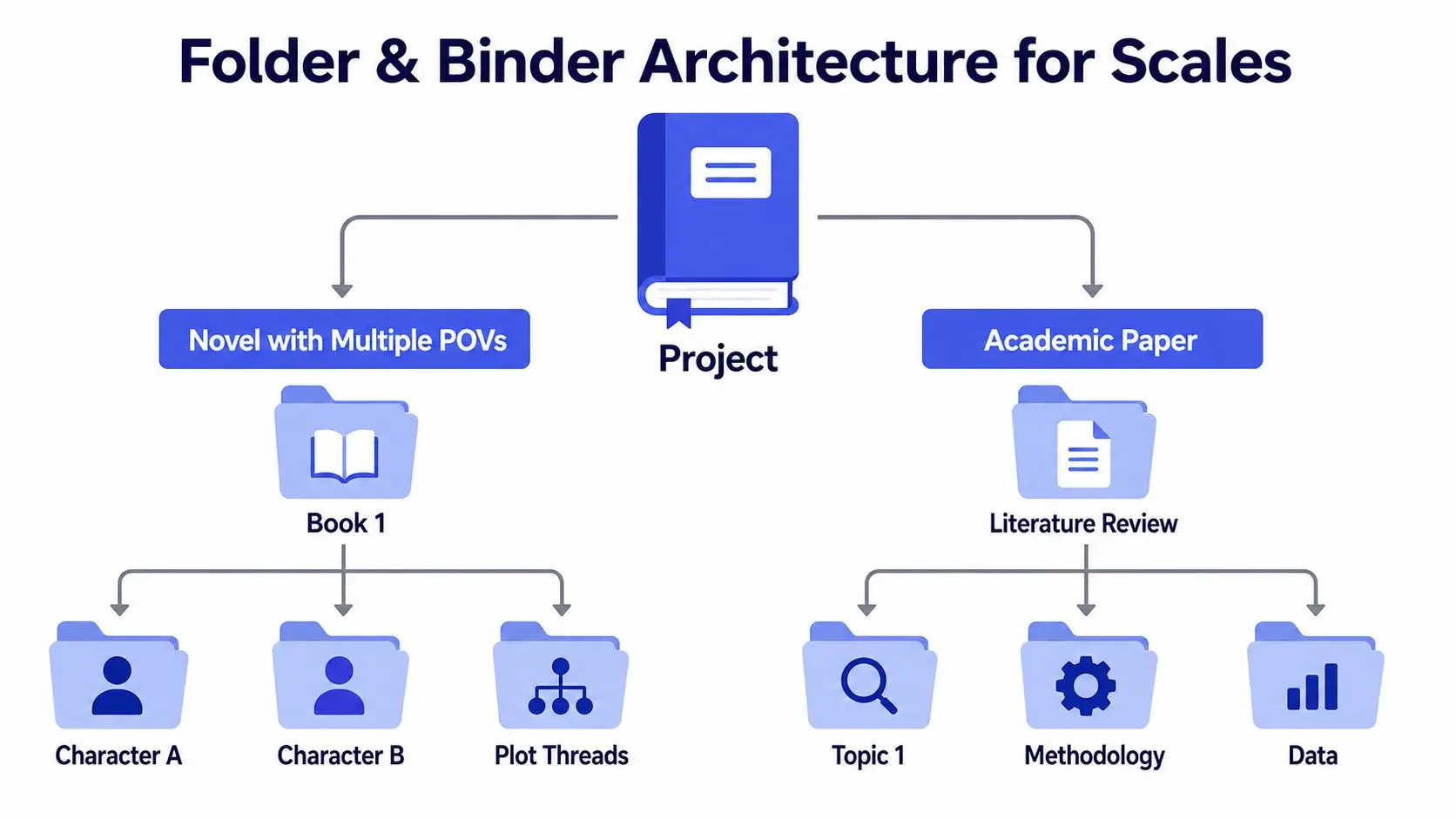
For long projects, a 3-level hierarchy is usually enough, project name, sub-theme, individual source or note. That structure stays readable when the project grows, and it keeps you from nesting yourself into a maze you won't want to reopen six months later. Research guidance that leans toward a three-level hierarchy also pairs it with a filter-and-annotate rule, which means keeping only what answers the research question and adding your own thoughts immediately instead of dumping raw material into a pile (WriteAtlas on organizing research notes).
For a novel, that might look like this:
- Project
- Book 1
- Character A
- Character B
- Plot Threads
- Book 1
For a nonfiction manuscript, it can be:
- Project
- Literature Review
- Topic 1
- Methodology
- Data
- Literature Review
The difference is simple. Fiction folders usually orbit people, places, and plot movement. Nonfiction folders usually orbit arguments, evidence, and source types.
Separate living research from archive research
Living research is still being mined. Archive research has already been absorbed into the draft or ruled out. Keep them apart. If everything stays in one hot pile, you'll keep rereading the same source cards and wondering whether a note is still active or just taking up space.
Keep the active material close, and make the finished material boring to revisit. That's how you stop reprocessing the same source forever.
The same logic carries into planning workspaces like Storyloft. If your binder names are vague, retrieval slows down. If they're specific enough to reflect the project's actual structure, they become usable under pressure. Good names are boring on purpose, for example, Book 1 Research, Chapter 4 Sources, Character Dossier, Mara, or Archive, Historical Context.
Build a Tag Schema With Three to Five Primary Categories
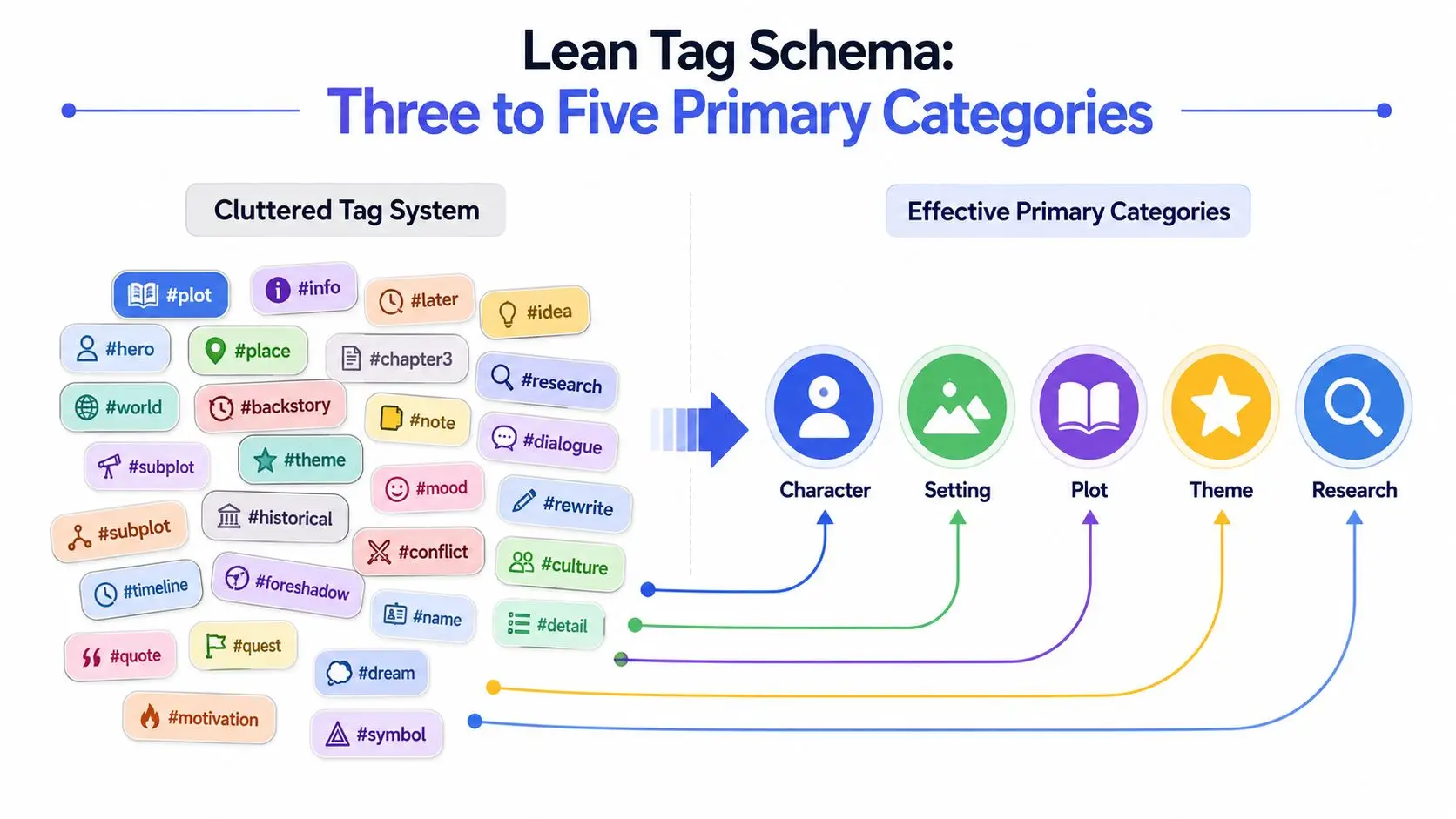
Tags fail when writers turn them into a second filing cabinet. A tag should describe the role a note plays in the manuscript, not just the topic it mentions. A source on note organization recommends defining a small set of primary categories, then supporting them with templates and consistent tagging. That approach fits long-form work because a tight taxonomy stays searchable and does not collapse under revision pressure. Ponder on note organization systems
Make the primary tags functional
A practical tag set for long-form writing often looks like this:
- Character
- Setting
- Plot
- Theme
- Research
That is one workable set, not a universal one. The point is stability. A tag like Research can cover source material that supports a scene, a claim, or a worldbuilding decision. A tag like Plot can hold scenes, causes, consequences, and turning points without forcing you to guess where a note belongs.
Subject tags such as 1900s, Victorian London, steam power, and social class look precise, but they split the archive into too many small corners. Each new subtopic creates another branch. After a while, you have a tag list that looks detailed but behaves like clutter.
Use secondary tags for project-specific detail
Once the primary layer is fixed, add a narrow second layer only when the project needs it. A historical novel might use shipboard life, court protocol, or dress. A nonfiction project might use interview, archival record, or counterargument. That second layer should help you sort evidence, not create a taxonomy that only makes sense on a good day.
Naming matters too. Keep note titles short and sortable, like Scene 12, Market confrontation, Source, rail chronology, or Character dossier, Elias. Titles should help you find the note later without opening it. Storyloft follows the same practical logic in its novel note and character organization workflow, but the larger principle is the same in any system. If a name cannot survive a stressful search, it is too vague.
A simple test helps here. If a tag can attach to almost anything, it is probably too broad to matter. If a tag is so specific that you cannot remember to use it twice, it probably belongs in the note title instead.
Templates for Scene Notes, Source Cards, and Character Dossiers
Templates save time because they cut decisions at capture time. When you are reading, interviewing, or outlining, you should not have to invent a format from scratch. You need a structure that already knows what kind of information belongs where, so the note becomes part of the evidence chain instead of a loose reminder.
Scene note template
A scene note works best when it ties research to story function.
Scene Note
- Scene:
- Character stakes:
- Research question:
- Supporting source:
- Key detail to use:
- Follow-up needed:
Example:
Scene Note
- Scene: Mara confronts the magistrate at the river gate
- Character stakes: She needs access before the courier leaves
- Research question: What would a river checkpoint plausibly inspect?
- Supporting source: Archive photo and city record
- Key detail to use: Cargo inspection happens before identity checks
- Follow-up needed: Confirm whether lanterns were standard after dusk
This template forces the note to do narrative work, not just factual work. If a detail cannot connect to a scene, it probably does not deserve a place in the working draft yet. For a writer, that matters more than perfect categorization.
Source card template
For source cards, use a manuscript-style layout with bibliography data at the top, topic in the left margin, page numbers in the right margin, and abbreviated notes in the center. The University of Idaho Writing Center PDF describes that kind of layout, and the practical value is simple, it keeps citation data close to the note and makes later verification faster.
Source Card
- Full citation:
- Topic:
- Relevant page or location:
- Type:
- Notes:
Example:
Source Card
- Full citation: Smith, Lena. Harbor Cities and Trade Routes. 2nd ed.
- Topic: River checkpoints
- Relevant page or location: p. 114
- Type: Book
- Notes: Inspection order, cargo first, identity second, useful for gate scene
A source card has one job. It should let you tell at a glance whether the material supports a claim, a scene detail, or a line of dialogue. If it does not do that, the card is too vague to help under deadline pressure.
Character dossier template
Character notes need a different split. Separate canon from uncertainty.
Character Dossier
- Canonical facts:
- Behavioral patterns:
- Known contradictions:
- Questions to resolve:
If your draft depends on a person's age, rank, accent, injury, or timeline, the dossier has to preserve those facts cleanly. That is what keeps a character consistent across chapters instead of drifting each time the draft grows. Storyloft uses the same practical split in its character and worldbuilding guide, but the workflow is still only one valid option, not the only way to build a usable dossier.
The trade-off is straightforward. A lighter template is faster to fill out, but it can hide gaps until revision. A heavier template gives you more control, but it slows capture. Use the smallest version that still preserves the evidence you will need when the manuscript starts pushing back.
Treat Every Note as Evidence You Will Have to Defend
The weak point in many note systems is not storage, it is provenance. Writers keep the content and lose the chain that shows where it came from, what it means, and how confidently they can use it. The safer habit is to treat every note as evidence, not as a loose reminder.
Capture the same fields every time
A usable standard usually includes source type, author, title, location or page, archive or URL identifier, capture date, and note type. Note type matters because it stops a paraphrase from being read as a direct quote during revision. A source that focuses on note organization recommends marking each note as quote, paraphrase, summary, or observation at the top of the note to reduce attribution errors (SpeakNotes on organizing research notes).
| Metadata field | Book or article | Interview or transcript | Web source | Archive or photo |
|---|---|---|---|---|
| Author or speaker | Yes | Yes | Yes, if named | If known |
| Title or description | Yes | Yes | Yes | Yes |
| Page or location | Yes | Yes, timestamp if needed | Optional | Archive box, folder, or identifier |
| URL or archive ID | Optional | Optional | Yes | Yes |
| Capture date | Helpful | Helpful | Helpful | Helpful |
| Note type | Yes | Yes | Yes | Yes |
Use the table as a minimum standard
The table is there to prevent omissions, not to look polished. A book note needs page numbers. An interview note needs who said what and when. A web source needs enough identifier data that you can find the exact page again. Archive material needs a stable reference, because screenshots and photos are easy to misplace.
Audit rule: if you can't reconstruct the source path from the note itself, the note is incomplete.
That standard matters most for nonfiction authors, academic writers, and research-heavy novelists. A source card with its own metadata can survive being copied, pasted, exported, or moved into a draft. A note without metadata turns into a memory test, and memory is a weak citation system.
Separate the evidence trail from the draft trail
A writer's notes need one more layer once the manuscript starts to move. The evidence trail should show where the material came from. The draft trail should show how the material was used. If those two trails collapse into one mess, revision gets slower because every sentence has to be re-verified from scratch.
That separation is why some authors pair manual source cards with tools that generate citations or extract usable references from messy files. For a practical look at that side of the workflow, see an analysis of auto-citation tools for authors. The point is not automation for its own sake. It is reducing the chance that a detail loses its source when the note gets reused in a chapter, scene, or character file.
Keep scene notes, source cards, and dossiers distinct
Writer-specific notes need different jobs. A scene note records what belongs in the chapter. A source card records where the fact came from. A character dossier records what stays true across the book. Mainstream productivity advice often flattens all of that into one academic-style system, but fiction and hybrid work need cleaner separation.
If a note is going to support a scene, it should preserve the scene context, the source context, and the reason you saved it. If it is going to support a character dossier, it should preserve canon facts and flag uncertainty separately. If it is going to support a source card, it should make attribution easy to check under deadline pressure. The trade-off is plain. More structure slows capture a little, but it prevents the larger cost of hunting through vague notes during revision.
Sync Research Notes With the Manuscript Without Breaking Flow
A research system only works if it stays close to the draft. If notes live in a separate app, a separate folder, or a separate mindset, writers stop consulting them. By chapter three, they're back to writing from memory because reaching for the source feels slower than trusting the vague version already in their head.
Keep the note and the draft side by side
The most practical setup is side-by-side work. Pin the relevant binder open, link it to the chapter or scene file, and keep the active research visible while you draft. In Storyloft, the manuscript, binders, tags, and side-by-side multitasking live in the same workspace, so the handoff from note to draft doesn't require a separate tool hop. Used well, that kind of setup keeps the research adjacent to the paragraph it supports.
A useful workflow looks like this:
- Open the source card for the detail you need.
- Pull one fact or quotation into a scene note.
- Tag that scene note as evidence or research.
- Draft the paragraph from the scene note, not from memory.
- Leave the source link attached so the trail stays intact.
If you want a helper for converting PDFs into usable notes before you tag them, the Cramberry PDF-to-notes tool is worth testing on a dense source batch. The advantage isn't magic summaries, it's reducing the friction between reading and capture.
Decide what gets inlined and what stays separate
Not every research detail belongs in the draft. Some material should live as a source card or a comment until the chapter needs it. A quote gets inlined only when the exact wording matters. A historical fact usually belongs in a scene note first, then in the draft if it affects narration or dialogue. A question can stay as a comment if it's not resolved yet.
The point is to reduce context switching, not eliminate judgment. A clean research-to-draft workflow gives you enough structure to move quickly, but not so much structure that every scene becomes a filing exercise.
For writers who want a tighter manuscript-centered setup, Storyloft's workspace guide shows how notes, binders, and manuscript drafting can stay connected without forcing the research into a separate app.
Backup, Collaboration, and a Weekly Review Rhythm
A research system decays when nobody maintains it. Backups protect the archive, collaboration keeps other people from breaking the structure, and a weekly review keeps stale notes from clogging the draft. The work is maintenance, not a heroic cleanup session. It has to be repeatable without becoming a chore you avoid.
Protect the system before you need it
Keep cloud sync on. Keep version history available. Keep one offline copy somewhere you can reach if the app is unavailable. That matters more on long projects, because a half-finished manuscript cannot afford a lost source trail or a damaged binder structure.
If you work with editors, co-writers, or beta readers, give each role a different level of access. Editors need comments and corrections. Co-writers need shared visibility. Beta readers usually need a narrower view, since they do not need your full source archive to understand the draft.
For teams that want a broader approach to private knowledge systems, LocalChat's note on AI for knowledge management is a useful companion piece, especially if you are thinking about private, structured retrieval rather than public note dumping.
Use the weekly review as synthesis
A weekly review is not a cleanup chore. It is the moment you decide what the research now means. The review can follow three questions:
- What is stale?
- What is missing?
- Which notes should graduate into the draft?
That last question matters most. Notes should not sit forever in the research layer if they already belong in a chapter, an outline, or a character arc. The same review-oriented guidance that recommends regular processing and weekly reviews also warns against keeping irrelevant material and pushes you to categorize by relevance to the thesis (Ponder on note organization systems).
A good weekly pass also surfaces redundancy before it spreads. If two notes say the same thing, merge them. If a source no longer supports the current draft, archive it. If a question keeps recurring, turn it into a research task instead of leaving it to clog the binder.
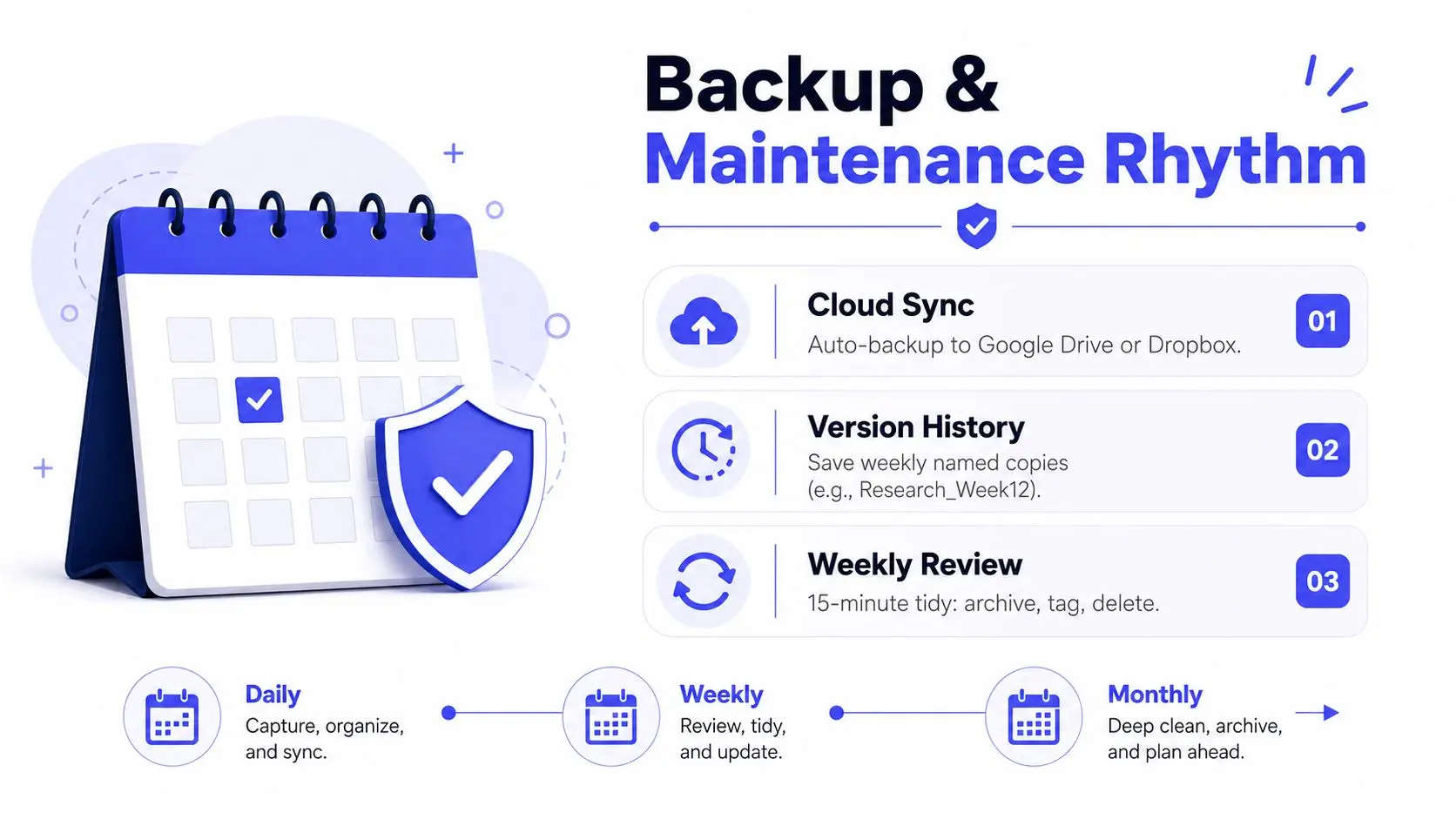
Treat the review as a synthesis habit, not a housekeeping habit. That is what keeps your notes audit-ready long enough for an editor, fact-checker, or curious reader to challenge the manuscript without breaking it.
For writers who want a tighter manuscript-centered setup, Storyloft's workspace guide shows how notes, binders, and manuscript drafting can stay connected without forcing the research into a separate app.