Character vs Self Conflict Explained with Examples
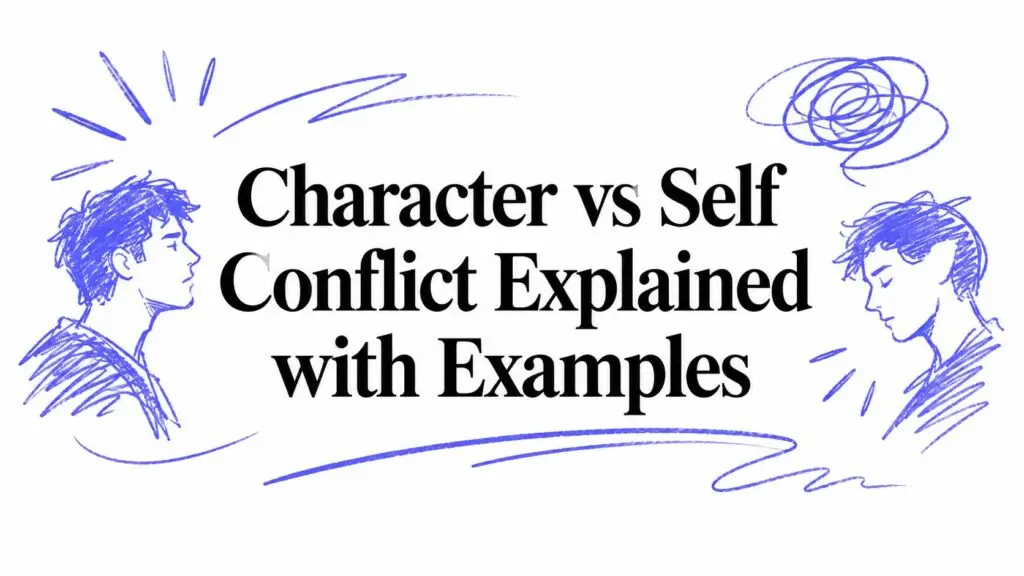
You've written a character into a room with one impossible choice. They can tell the truth and lose the person they love, or stay silent and protect the relationship while betraying what they believe. Their hand rests on the door. They rehearse both answers. Nothing outside them moves, yet the scene feels charged because the obstacle is inside.
That pressure is the heart of character vs self conflict. It turns private fear, guilt, desire, identity, or belief into a force that shapes the plot. The character doesn't think about a problem. They make choices that reveal who they are, what they're avoiding, and what they may need to become.

This guide will move from the basic definition to the underlying want versus need engine, then to common forms, practical techniques, examples, and revision checks. If you're also studying broader narrative patterns, these conflict in literature examples can help you compare internal struggles with external forms of opposition.
Table of Contents
- Introduction to Character vs Self Conflict
- What Character vs Self Conflict Really Means
- How Internal Conflict Works as a Story Engine
- Core Types of Inner Struggle Every Writer Should Know
- Techniques for Showing Internal Conflict on the Page
- Powerful Examples of Character vs Self Conflict in Stories
- Common Pitfalls That Weaken Internal Conflict
- Bringing Your Character Inner Journey to Resolution
Introduction to Character vs Self Conflict
A character can face a locked door, a rival, a storm, or a monster. Those obstacles are visible. Readers can point to them and understand what stands in the protagonist's way.
Character vs self conflict behaves differently. The obstacle may be a belief such as “I'm only valuable if I succeed,” a fear of rejection, guilt over an earlier choice, or a desire that contradicts the character's principles. The reader sees the consequences first: a confession interrupted, an opportunity rejected, a promise broken, or a person helped for the wrong reason.
That difference makes internal conflict easy to mishandle. Beginners often write a character who repeatedly asks what they should do, then call the repetition tension. Indecision becomes conflict only when it changes behavior, delays an important action, or forces a meaningful sacrifice. Otherwise, the scene may contain thought without pressure.
A useful test is to ask what the character wants right now and what they would need to understand, accept, or surrender to become whole. If both can be obtained without difficulty, the inner struggle has little force. The character must face a choice that exposes the gap between the person they believe they are and the person the story requires them to become.
Inner conflict earns its place when a private struggle produces a public decision.
A strong arc may begin with a character protecting an old belief because that belief once helped them survive. Later, circumstances make the belief costly. The character's transformation then arrives through action, not a sudden speech explaining that they've changed.
What Character vs Self Conflict Really Means
The broadest distinction is simple. External conflict places a character against something outside them, such as another character, society, nature, technology, or a dangerous situation. Internal conflict takes place within the character's thoughts, emotions, values, or sense of identity.
Think of a person holding both ends of a rope. One side pulls toward safety, comfort, or a familiar identity. The other pulls toward risk, honesty, growth, or an uncomfortable truth. No second person needs to stand opposite them. The struggle exists because the character's competing impulses cannot move in the same direction.
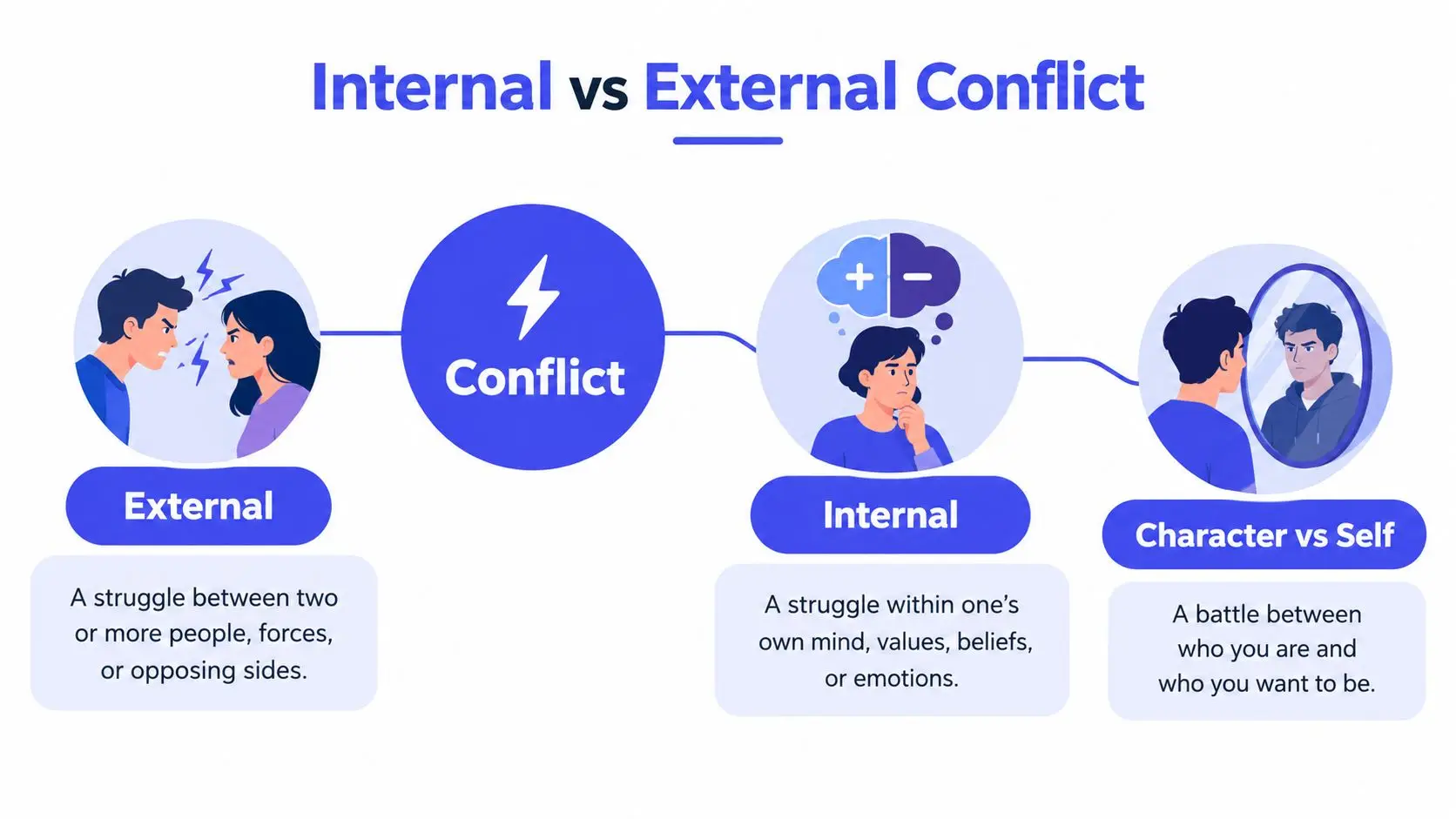
In literary scholarship, character vs self is generally treated as a form of internal conflict. The familiar “man against man, man against nature, man against self” framework became influential in writing instruction and fiction criticism, although it isn't universally accepted as a complete classification. More formal summaries still divide conflict into external and internal forms, with internal conflict describing a struggle within a character's “heart or soul,” as outlined in the historical overview of narrative conflict).
The self becomes the opposing force
Calling the self an antagonist doesn't mean the character has a separate personality or a literal enemy inside their mind. It means the protagonist's own beliefs, fears, desires, or moral commitments prevent them from reaching a goal.
The phrase intrapersonal conflict is useful here. It distinguishes a struggle within one person from interpersonal conflict between people or intergroup conflict between communities. Hamlet's “To be or not to be” remains a standard literary example because the pressure comes from competing thoughts about existence, action, suffering, and responsibility, not from a physical opponent in the scene. Contemporary writing guides also treat character vs self as a core conflict type involving fear, doubt, guilt, identity, or competing values, as summarized in this overview of conflict types in literature.
External events can trigger the struggle, but they don't replace it. A rival may offer the protagonist a bribe, yet the character vs self conflict lies in whether the protagonist will trade integrity for security. The storm may trap the character, but the internal question might be whether they're willing to trust someone they've spent years blaming.
How Internal Conflict Works as a Story Engine
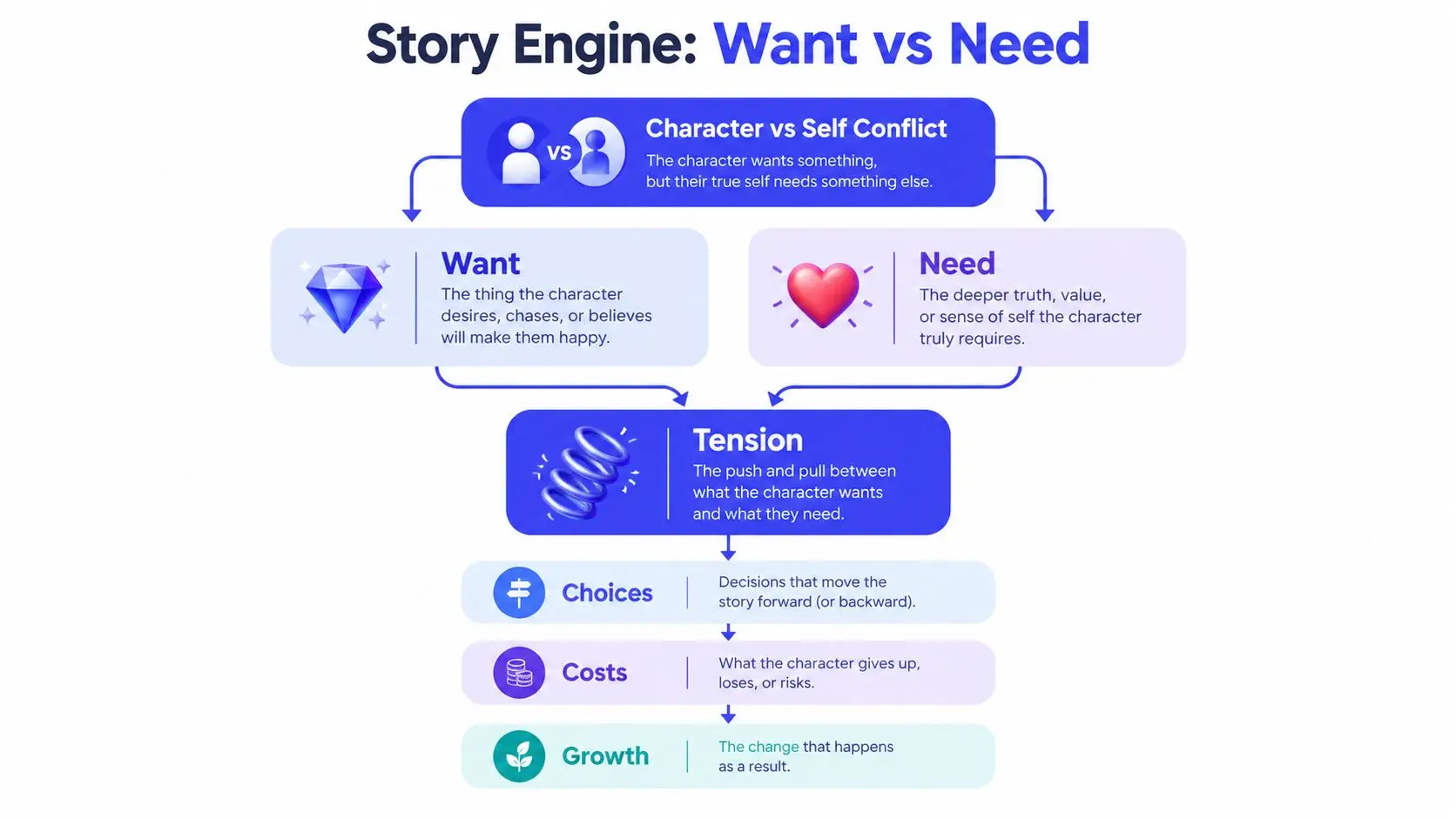
Character vs self conflict works best as a control problem. The protagonist's conscious system pursues a visible goal, while a deeper need points toward a different kind of change. The story gains energy from the mismatch.
The want is usually concrete. The character wants the promotion, the relationship, the escape, the victory, or the truth. The need is more personal. They may need to accept vulnerability, release resentment, value themselves without approval, or stop confusing control with safety.
The pressure appears when the want and need become mutually exclusive. A character who can achieve the goal while avoiding growth may face discomfort, but they don't face a strong internal dilemma. A character who must risk rejection to build a genuine relationship has a sharper problem because protection and intimacy demand opposite actions.
A practical control model
You can model the arc as a repeating decision loop:
- The character identifies a want. They pursue something they believe will solve their problem.
- The inner obstacle interferes. A fear, false belief, wound, or competing value changes how they interpret the situation.
- The character chooses. Their action protects the old self or moves toward the deeper need.
- The choice creates a cost. The result makes the next decision harder or more urgent.
- The character adapts. Repeated consequences challenge the belief that controlled their earlier behavior.
This is why internal conflict needs more than a private monologue. A thought becomes dramatic when it controls an action. A character who fears abandonment might reject a friend before the friend can leave. A character who values justice but craves belonging might remain silent when their group harms an outsider.
For a useful companion concept, see this guide to character motivation. Motivation helps you identify the visible target. Character vs self conflict explains why the protagonist can't pursue that target cleanly.
If the character can satisfy both the want and the need without sacrifice, the story has tension in theory but not enough pressure in practice.
Core Types of Inner Struggle Every Writer Should Know
Not every internal conflict feels the same. Fear creates a different pattern from guilt, and an identity struggle asks a different question from a moral dilemma. Naming the pattern can help you choose scenes that fit the character's arc rather than adding vague distress.
| Conflict Type | Core Question | Story Function |
|---|---|---|
| Fear versus courage | Can I act while I'm afraid? | Forces the character to risk safety, rejection, or failure. |
| Guilt versus redemption | Do I deserve forgiveness, and can I repair the harm? | Turns past wrongdoing into present responsibility. |
| Identity versus belonging | Do I remain myself, or change to be accepted? | Tests loyalty, authenticity, and social pressure. |
| Values versus desire | Will I do what I believe is right or take what I want? | Creates moral dilemmas with visible consequences. |
| Control versus vulnerability | Can I trust another person or situation? | Makes intimacy, teamwork, and surrender difficult. |
| Duty versus personal freedom | What do I owe others, and what do I owe myself? | Places private desire against responsibility. |
Matching the struggle to the arc
A fear-based conflict suits a protagonist who knows the right action but keeps avoiding it. The central movement is from avoidance to risk. A guilt-based conflict needs a history that makes the guilt specific. The character shouldn't merely feel bad. They should believe a particular action caused harm, then face a chance to respond differently.
Identity versus belonging works especially well when the character receives approval for performing a version of themselves. The pressure rises when authenticity threatens the community they depend on. Values versus desire, by contrast, becomes strongest when both options feel emotionally persuasive. If one choice is obviously good and the other is obviously cruel, the protagonist has a test, but not a divided self.
Writers often combine these forms. A character may fear rejection because of an identity they've hidden, then lie to protect belonging, creating guilt that forces a later moral choice. For more guidance on how flaws shape these patterns, explore what makes a flawed character.
Techniques for Showing Internal Conflict on the Page
Readers can't directly inspect a character's mind. They understand the struggle through what the character notices, says, avoids, repeats, and finally does. The craft challenge is to convert invisible pressure into observable decisions.
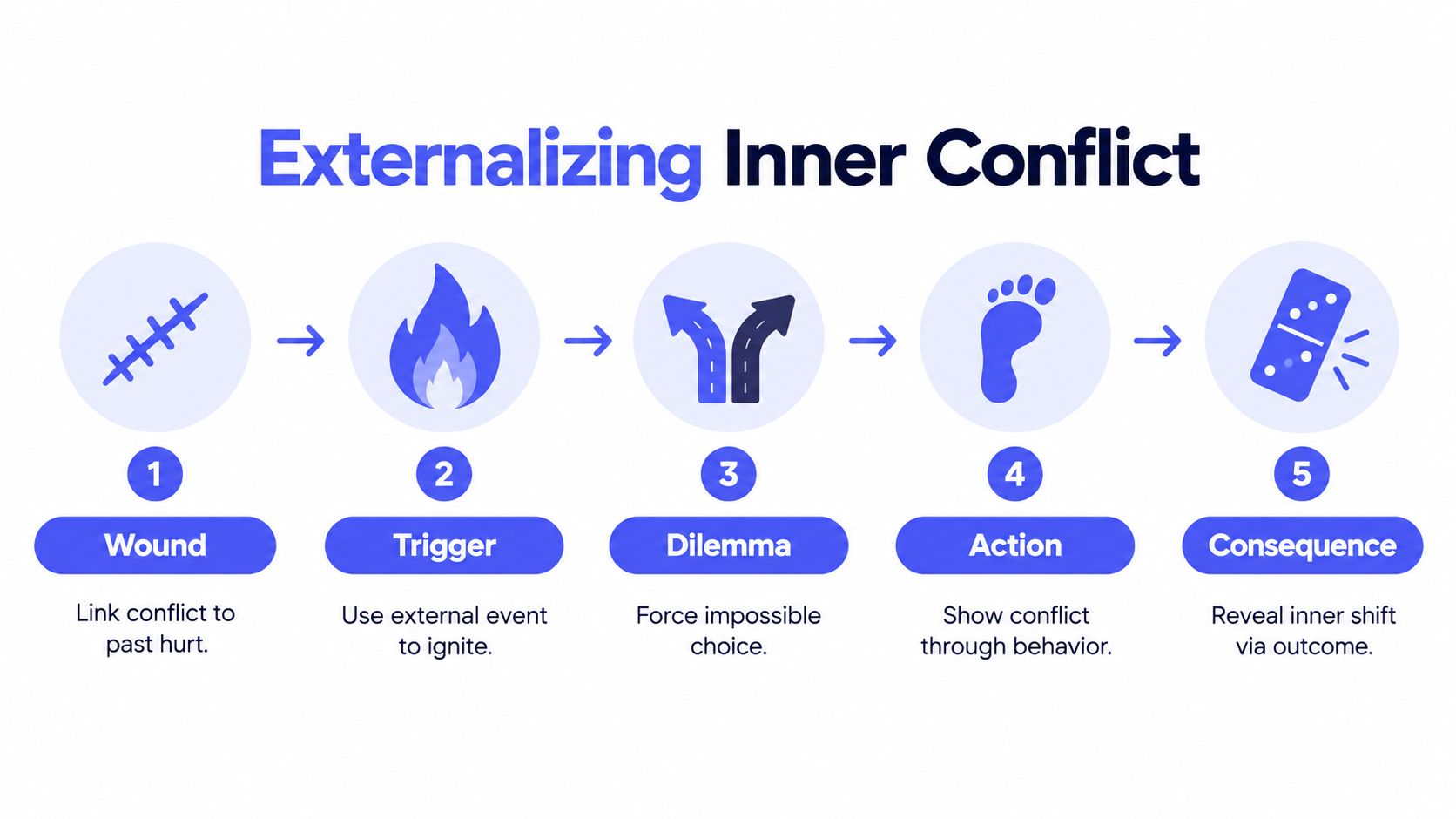
Start with the background wound. This doesn't need to be dramatic or explained in full. It can be a humiliation, betrayal, loss, failure, or family rule that taught the character a damaging lesson. The wound should explain why the character's current belief once seemed reasonable.
Then add a trigger. An external event should activate the old belief and make avoidance difficult. A former friend returns, a promotion requires public trust, or a child asks an innocent question the protagonist can't answer.
Build the conflict through decisions
Use the following sequence when planning a scene:
- Wound: Give the character a past reason for the belief.
- Trigger: Put a present event directly against that belief.
- Dilemma: Make the available choices protect different values.
- Action: Show the character choosing through behavior.
- Consequence: Make the result alter the next decision.
A character who fears vulnerability might delete a sincere message, then arrive in person when the other character is leaving. The action communicates more than a paragraph about anxiety. If the character fails, the consequence should reveal the cost of protection. If they succeed, the success should still require a new level of honesty.
Dialogue can carry the same tension through subtext. Let the character answer a different question, change the subject, offer an unnecessary joke, or make a promise they don't intend to keep. Their words should perform the defense while their behavior exposes the need underneath. These choices also make better dialogue more specific because every exchange has an emotional objective.
Use repetition with variation
Repeat a meaningful situation, but change the pressure each time. The protagonist may first avoid a confession, later offer a partial truth, and eventually state the full truth while accepting the consequence. The pattern lets readers track transformation without requiring the character to announce it.
A manuscript editor with focus mode, notes, and character-focused revision tools can help you mark each decision and compare how the inner arc develops across scenes. Storyloft is one option that combines long-form drafting, manuscript-aware editing, character notes, and planning tools in a single writing environment.
Powerful Examples of Character vs Self Conflict in Stories
Hamlet provides the classic pattern. His visible problem involves his father's death and the demand for revenge, but the deeper struggle concerns whether he can trust appearances, accept responsibility, and act despite uncertainty. His desire for certainty conflicts with the need to make a moral choice in an imperfect world. The famous soliloquy remains useful to writers because it shows that internal conflict can involve philosophy, fear, duty, and action at the same time.
Pip in Great Expectations offers a social version of the same structure. He wants status because he believes wealth will make him worthy of love and respect. His deeper need is to recognize that dignity doesn't come from class performance. The forcing pressure arrives when his new identity separates him from people who treated him with genuine loyalty, making the cost of his desire impossible to ignore.
The conflict can involve opposing parts of the self
In Black Swan, Nina wants to perform perfectly and earn the lead role. Her training has made discipline and control central to her identity, yet the role demands qualities she has repressed, including sensuality, spontaneity, and danger. The external performance becomes a test of whether she can integrate those parts of herself, and the story makes clear that achieving the want without balance carries a destructive cost.
Inside Out presents the struggle through personified emotions. Joy tries to preserve happiness by excluding Sadness, believing that sadness will damage Riley's ability to adapt. Riley's deeper need is emotional integration, because honest sadness allows her to seek comfort and reconnect with her parents. The story turns an abstract psychological conflict into visible characters, but the underlying structure remains the same: one protective belief blocks a more complete way of living.
These examples differ in genre and tone, yet they share a pattern:
- Surface want: The character pursues a recognizable goal.
- Inner resistance: An old belief defines what they're willing to sacrifice.
- Forcing situation: Events make the belief harder to maintain.
- Revealing choice: The protagonist acts, and the action exposes change or collapse.
Use the pattern, not the details. Your protagonist doesn't need a royal tragedy, an elite performance, or personified emotions. They need a desire that collides with a truth they've been avoiding.
Common Pitfalls That Weaken Internal Conflict
Mistaking hesitation for conflict is the most common problem. A character can think about a choice for pages without becoming more interesting. Give the hesitation a consequence. Someone leaves, an opportunity closes, evidence disappears, or trust weakens because the character delayed.
Letting both sides win also drains pressure. If the protagonist can keep their rigid independence and receive genuine intimacy, the dilemma has no real cost. Make the choices incompatible long enough that the character must surrender a protection, privilege, relationship, or self-image.
Explaining every feeling creates distance. Statements such as “she felt guilty” tell readers the conclusion without letting them interpret behavior. Show her hiding the receipt, returning the money anonymously, avoiding the person she harmed, or defending herself too quickly.
Adding a sudden resolution makes transformation feel unearned. A character shouldn't abandon a central belief because another person gives a persuasive speech. Let failed attempts expose the flaw, and let escalating consequences make the old strategy impossible to sustain.
Use this revision checklist:
- Does the character want something concrete in each major scene?
- What belief, fear, or value interferes?
- What choice makes the conflict visible?
- What does that choice cost?
- Does the next decision become more difficult?
- Does the final action prove change rather than merely describe it?
Bringing Your Character Inner Journey to Resolution
A satisfying character vs self arc connects belief, pressure, choice, consequence, and transformation. Begin with the want and the deeper need. Give the character an old wound that explains the false belief, then create external events that force the belief into action.
During revision, track decisions instead of counting introspective passages. Mark where the protagonist protects the old self, where that strategy fails, and where the character finally chooses with a different understanding. The resolution should answer the inner question through behavior.
The character doesn't need to become perfect. They need to become capable of making a choice they couldn't have made at the beginning. That's payoff of self-conflict: not the disappearance of fear, but a changed relationship with it.
Use Storyloft to draft and revise your character arc with long-form manuscript tools, planning notes, focus mode, and manuscript-aware editing in one workspace. Map your protagonist's want, need, wound, and scene-level decisions, then use the editor to keep the internal struggle consistent from the opening choice to the final transformation.