What Is Plot Development? a Writer’s Guide
You've got a scene that should be pulling hard, but the middle keeps drifting. The characters move, the pages fill, and still the story feels like a row of events instead of a chain with pressure in it. That's usually the moment writers start asking what plot development really is, because the problem isn't that nothing happens, it's that one thing doesn't force the next.
Plot development is the design of that force. It's the difference between a story that reports events and a story where each event changes the situation, narrows the choices, and pushes the narrative toward a turning point. In older plot theory, this is the difference between a sequence of incidents and a plot that shows how one event leads to another, a distinction still central to modern craft discussions of structure and causality (plot structure overview)).
Table of Contents
- Understanding Plot Development as Causal Architecture
- The Six Core Stages of Plot Development
- Mastering Pacing with Percentage-Based Milestones
- Building Depth with Subplots and Thematic Layers
- Common Plot Development Mistakes and How to Fix Them
- Practical Exercises to Strengthen Your Plot
- How Storyloft Supports Your Plot Development Process
Understanding Plot Development as Causal Architecture
A lot of writers first notice plot trouble in the same place, the sagging middle. The setup is solid, the characters are active, but the scenes start to feel like they're circling instead of advancing. That's the signal that the draft has events, but not yet causal architecture.
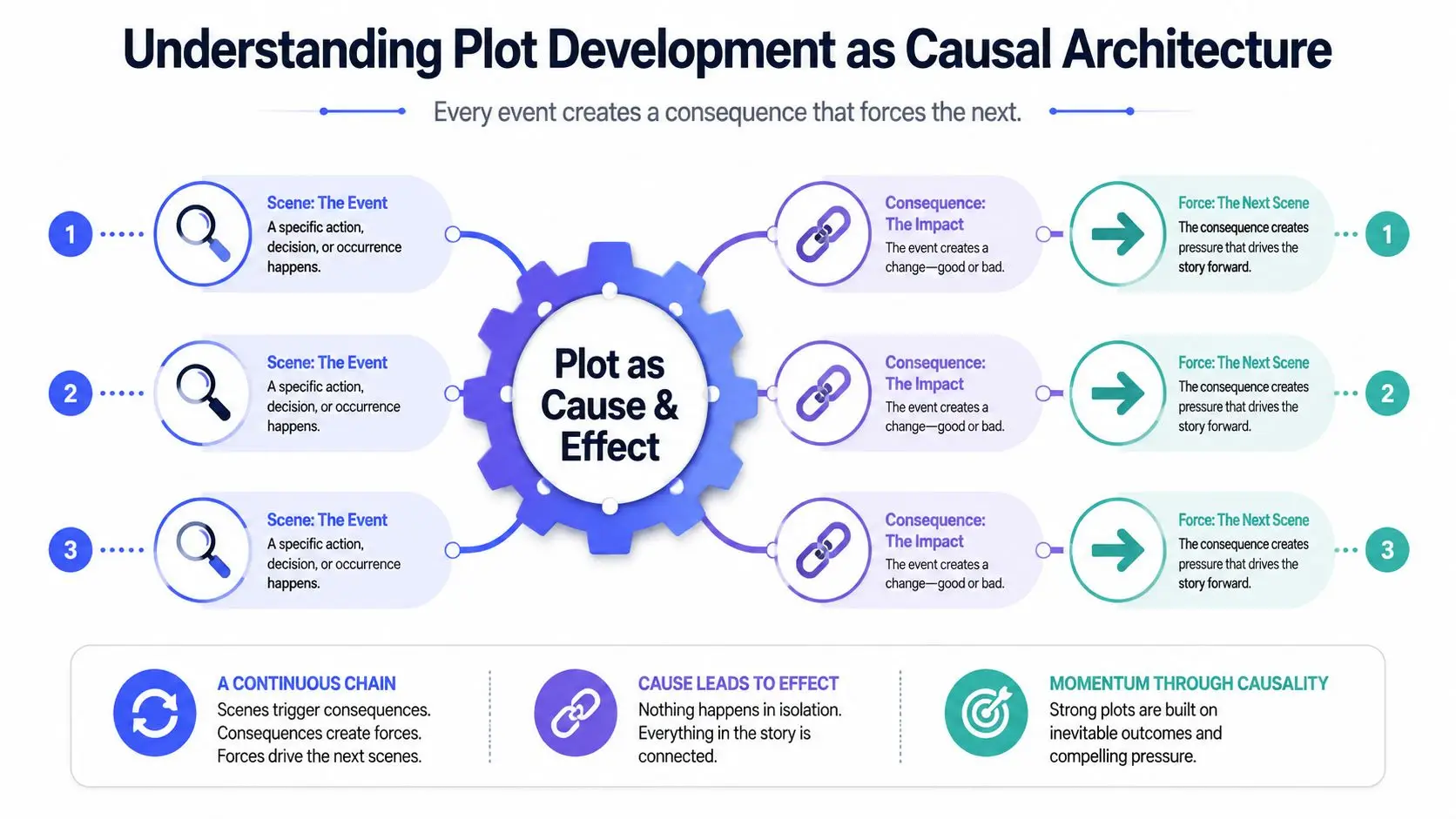
E. M. Forster's old distinction still helps here, because it separates a mere list of happenings from a chain where one thing leads to another. A marble on a table is just a marble. A row of dominoes becomes a pattern of consequences the moment the first one falls. Plot works more like the dominoes, because every meaningful beat should tip the next one over.
Why cause and effect matters
When readers feel that scenes are connected by necessity, they keep turning pages because they want to see what the new condition will force next. If the hero lies to protect a friend, that lie should damage trust. If the detective uncovers a clue, that clue should change the investigation, not just decorate the chapter.
Practical rule: if a scene doesn't change the story's state, it's probably exposition, texture, or filler, not plot development.
That doesn't mean every scene has to explode with action. Quiet scenes can still carry plot if they create a decision, reveal information, or tighten a conflict. The point is that the story must progress through consequence, not merely through motion.
For a useful companion framework, see how to structure a story. The core idea is the same across most craft systems, setup creates disruption, disruption creates pressure, and pressure creates choice.
The Six Core Stages of Plot Development
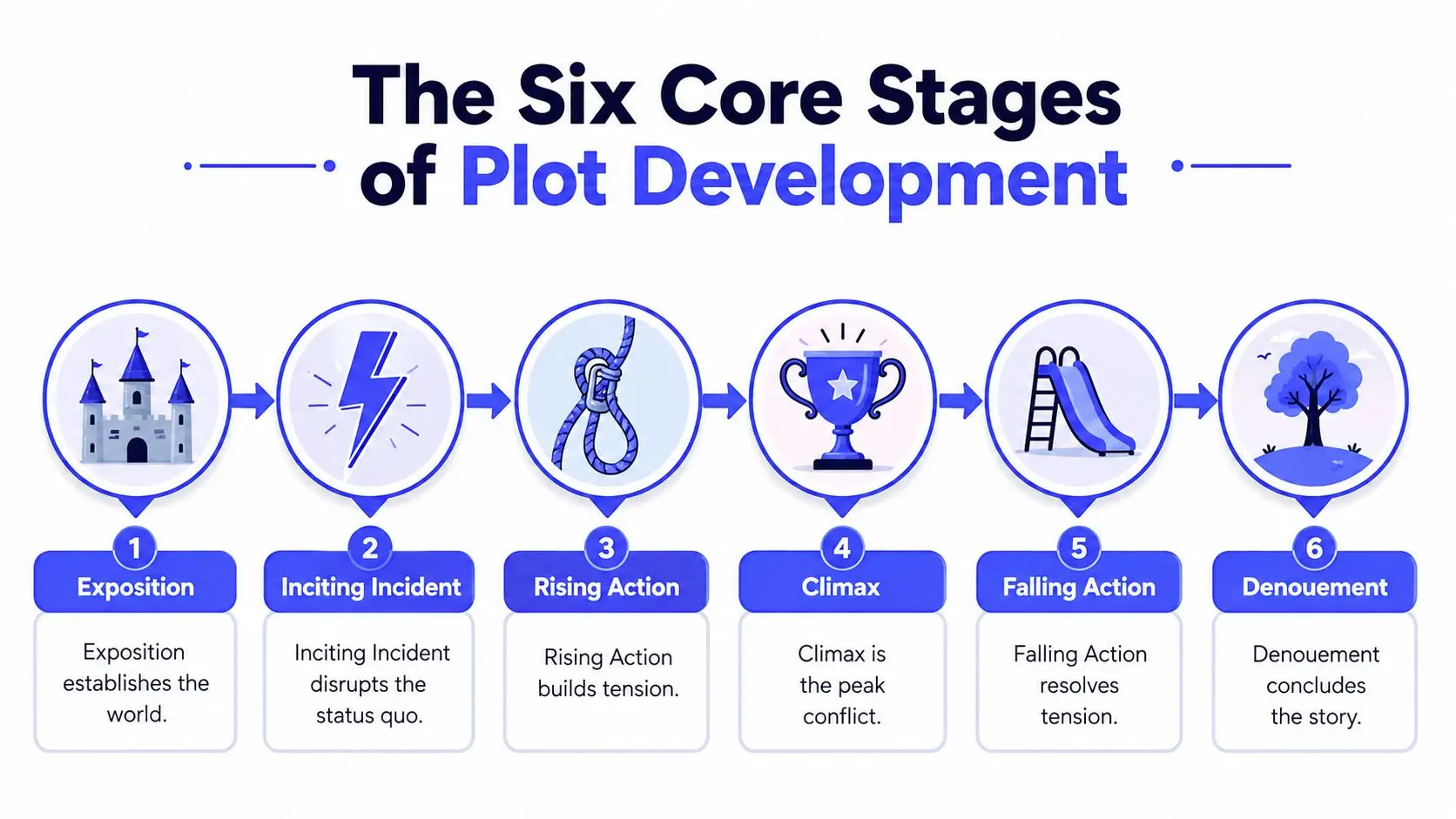
Most writing guides reduce plot structure to a small number of stages, and that's useful because it gives you labels for diagnosing a draft. A common six-part model uses exposition, inciting incident, rising action, climax, falling action, and denouement (plot structure reference)). Those stages matter most when you treat them as links in a chain, not as boxes to check off.
Exposition and inciting incident
Exposition establishes the world, the relationships, and the normal pattern of life. Then the inciting incident interrupts that pattern and creates the story problem. In many craft guides, that interruption is placed early, and one commonly cited recommendation is to put the inciting incident within the first 10% of the story so momentum starts quickly (plot structure and pacing discussion)).
That early break matters because it gives the reader a reason to keep reading. If the disturbance comes too late, the opening can feel like setup without pressure.
Rising action and climax
Rising action is where the story turns into effort under pressure. The character tries, fails, adapts, and makes choices that create new problems. The climax is the decisive turning point, and it works best when it feels earned by everything that came before it, not dropped in as a standalone event (causal plot structure).
Falling action and denouement
After the climax, falling action shows the consequences. The world has changed, and the character has to live in that change. The denouement ties off the remaining tension and reveals the shape of the ending.
If you like a visual walkthrough of this arc, this three-act structure guide helps map the same logic in a different framework. A helpful way to remember the whole pattern is simple, exposition sets the stage, the inciting incident breaks it, rising action tests the break, the climax settles the central conflict, and the ending shows what remains.
Mastering Pacing with Percentage-Based Milestones
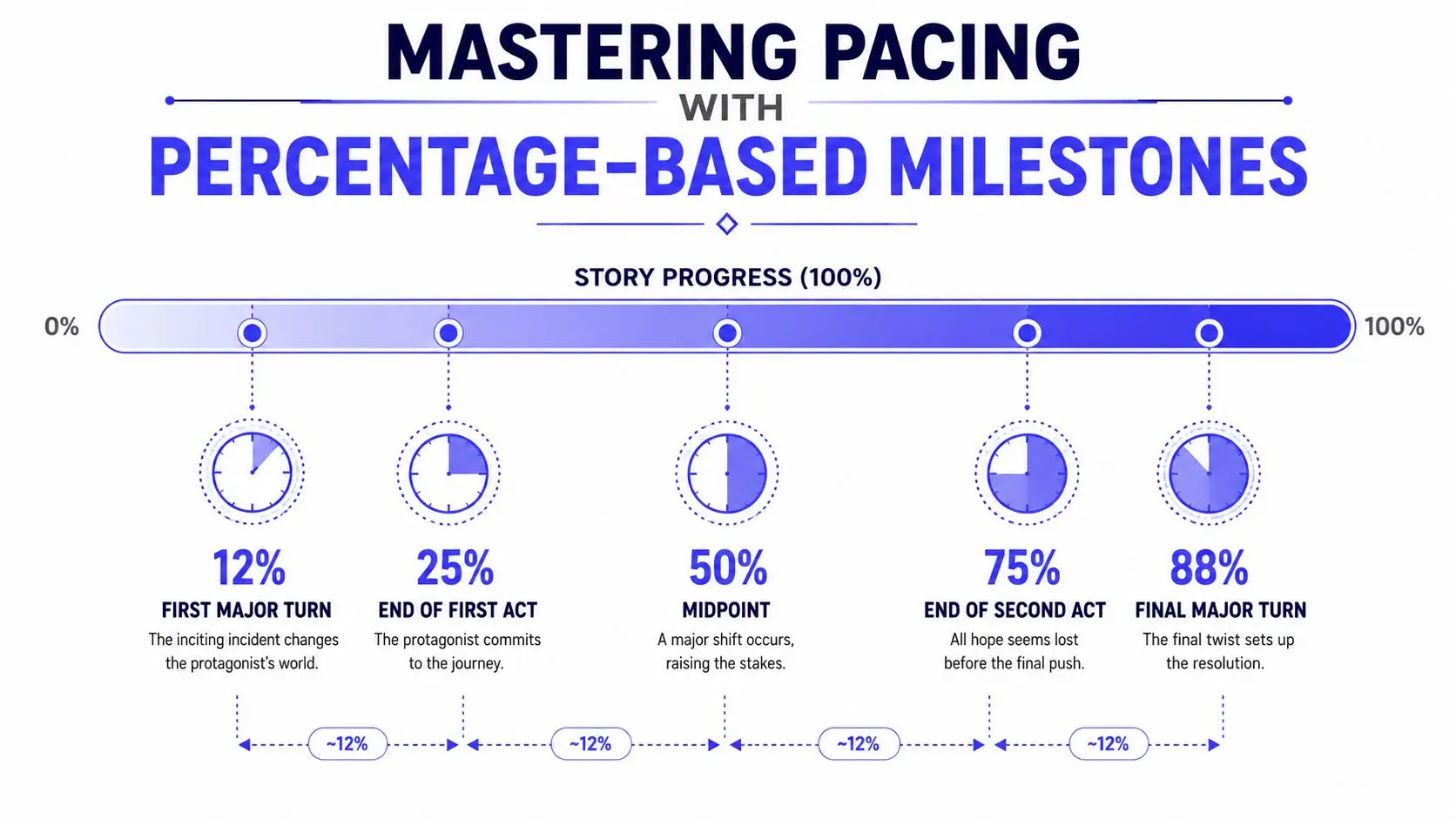
Plot development becomes easier to revise when you stop treating pacing as intuition alone. One practical story-structure rule says successful stories contain a notable turn about every 12% of the narrative, with larger shifts near quarter marks (percentage-based story structure). That kind of milestone thinking gives you checkpoints instead of guesswork.
Using milestones as revision markers
If your inciting incident lands around the 10% mark and major turns keep arriving with regular pressure after that, you can locate pacing problems more quickly. A chapter that feels slow may not be weak in prose; it may be missing a turn. A chapter that feels rushed may be carrying too many turns without enough consequence.
A milestone doesn't write the story for you, but it tells you where the story should bend.
That's why percentage-based planning is popular in long-form fiction and serialized work. It gives you a map for act breaks, cliffhangers, and reversals without flattening the story into formulas. You can use the same lens when reviewing chapters, scene cards, or a reverse outline.
A simple way to audit your draft
- Mark major beats: Identify where the setup ends, where pressure rises, and where the climax lands.
- Check scene spacing: Look for long stretches where nothing changes in the conflict.
- Test every turn: Ask whether a turn creates a new problem, a new choice, or a new cost.
For another craft reference point, rising action in a story is the section where pressure should keep accumulating rather than flattening out. When the middle drags, the issue is usually not the amount of text, it's the absence of fresh consequence.
Building Depth with Subplots and Thematic Layers
A strong main plot can still feel thin if nothing else is moving beneath it. Subplots, thematic undercurrents, and quiet shifts in character perception create texture, and craft sources often describe subplots as connective tissue rather than detachable extras (story angles and subplot discussion). The best layered stories don't just advance a single line, they braid several forms of change together.
Subplots as pressure lines
A subplot works when it affects the main story's choices. A sibling conflict can complicate a rescue plan. A political disagreement can alter who the protagonist trusts. If the subplot never changes the primary line of action, it's decoration, not structure.
That's also where covert progression comes in. The surface plot may stay still for a chapter, but theme can still advance through a new realization, a shifted relationship, or a repeated image that now means something different. The reader senses movement even when no major event fires.
Texture without clutter
Long-form and series fiction often need more than one rising line, but layered structure doesn't mean endless complication. It means each layer should add a different kind of tension. One line can track external conflict, another can track loyalty, and a third can track identity or fear.
For writers managing research, character notes, and world details together, this organizing approach can help keep those layers visible without scattering them across too many files. The practical goal is simple, every subplot should either raise stakes, reveal character, or sharpen theme.
Common Plot Development Mistakes and How to Fix Them
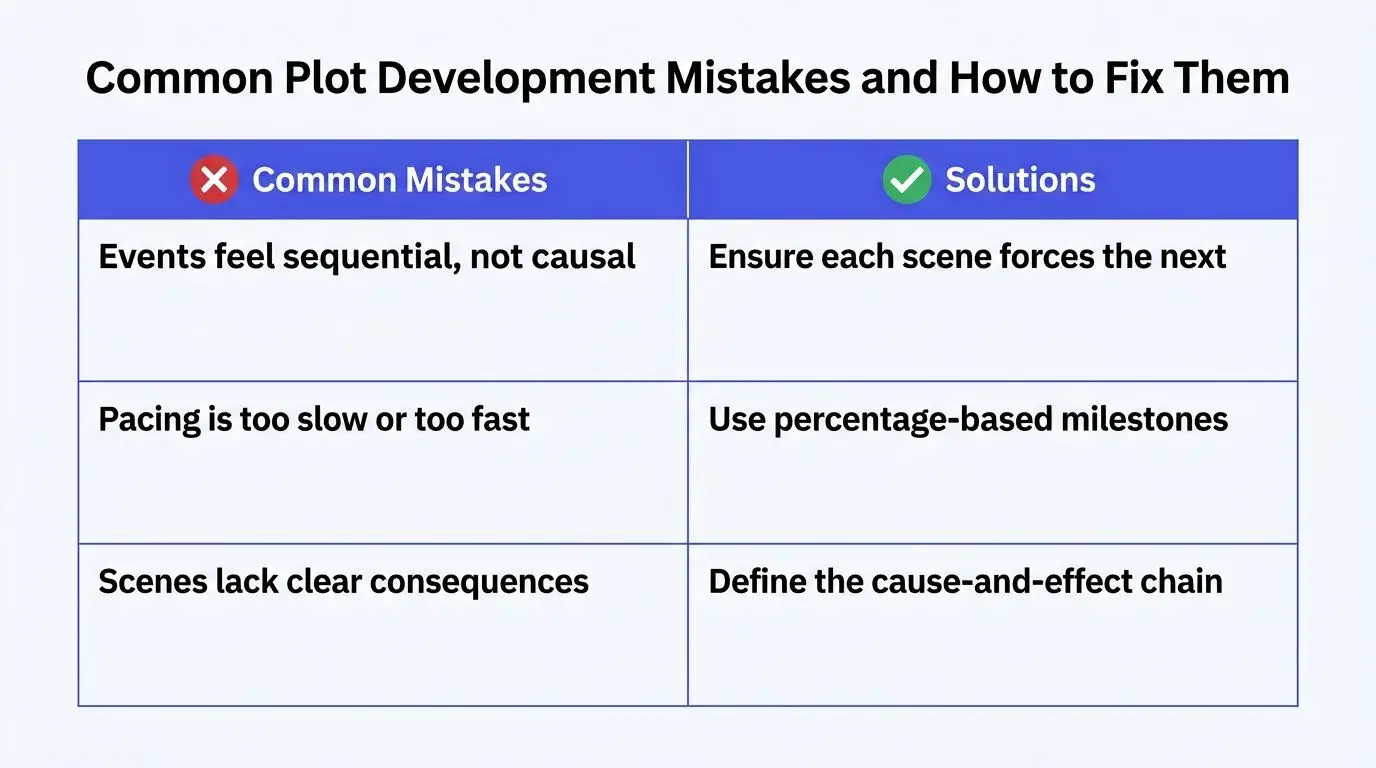
The biggest misunderstanding about plot development is thinking a story only needs the right stages in the right order. A manuscript can hit exposition, rising action, and climax and still feel flat if the events don't create real consequences. The gap many beginner guides leave is the jump from structure labels to causal inevitability (cause and effect in plot development).
Three problems that show up fast
| Common Mistakes | Solutions |
|---|---|
| Events feel sequential, not causal | Ensure each scene forces the next |
| Pacing is too slow or too fast | Use percentage-based milestones |
| Scenes lack clear consequences | Define the cause-and-effect chain |
A useful test is to read a scene and ask three direct questions. Does it change the story's state? Does it force a new decision? Does it raise the cost of failure? If the answer is no to all three, the scene probably needs revision.
Before and after logic
A weak version of a scene often looks like this, the hero gets new information, has a conversation, and leaves unchanged. A stronger version makes that same information force a choice, and the choice creates a problem that the next scene has to answer. That's the difference between movement and development.
If you're comparing craft resources for workflow as well as structure, the CodeDesign.ai SEO guide is useful as a model for how clear organization helps readers scan and act on advice. The lesson transfers directly to fiction planning, clarity beats clutter, and a scene only earns its place when it changes what comes next.
Practical Exercises to Strengthen Your Plot
A draft gets clearer when you stop reading it like a story and start tracing it like a chain of decisions. One of the fastest tools is reverse outlining, where you summarize each finished scene in a sentence and note what changed because of it. If the answer is vague, the scene may be atmospheric but not structural.
Three exercises you can do on any draft
Use the therefore/but test.
Write each scene summary with “therefore” or “but” between beats. If your summaries rely on “and then,” the story is probably drifting through coincidence instead of consequence.Map the manuscript against milestones.
Mark where the opening break lands, where the pressure turns, and where the climax begins. You're not trying to force a template, you're checking whether the draft has enough movement at the right moments.Sort scenes on index cards or in a digital board.
Move cards around and see whether the story still makes sense. If a scene can be removed without changing the chain, it may need a stronger consequence or a tighter link to the central conflict.
Write the cause first, then the effect. If you can't name both, the scene isn't finished yet.
A second useful habit is testing subplot intersections. Ask where a side conflict touches the main arc, and what new pressure that touch creates. That exercise often reveals whether the book has depth or just parallel material.
How Storyloft Supports Your Plot Development Process
Writers often lose the shape of a plot because the work is spread across too many places. Notes sit in one app, chapters live in another, and revision comments end up somewhere else entirely. Storyloft brings drafting, planning, and editing into one environment, so you can keep plot notes, research, and manuscript pages connected while you work.
Tools that help you track story movement
The planning workspace uses binders and tags to organize research and plot material, which matters when you're tracking subplots, character threads, or revision notes. Its side-by-side multitasking also lets you keep an outline visible while drafting, so you can compare a scene against the structure you planned instead of relying on memory. Storyloft also includes integrated plot timeline tracking and plot point tracking as part of the novel-writing workflow, which helps authors verify story events and monitor major beats as the manuscript grows.
The platform's AI assistant, Eddy, can brainstorm twists and offer plot feedback inside the manuscript, which is useful when a scene feels weak but you're not sure why. The scene creator can also turn selected passages into visual moments, while the character creator helps keep behavior consistent across key turning points. Goal tracking adds another layer, because daily targets and streaks help you keep returning to the draft often enough for structure to stay fresh in your head.
For authors working across drafting, revision, and publication, that integrated setup reduces the friction that usually breaks plot momentum. You're not moving between separate apps to see whether a scene connects, a character choice aligns, or a subplot still matters. You stay inside one workflow long enough to notice whether the story is developing, not just accumulating pages.
If you want a single place to plan scenes, track plot points, and revise chapters without losing the thread, try Storyloft. It brings outlines, manuscript drafting, and plot-tracking tools into one workspace, so you can keep checking whether each scene creates the next one. That kind of setup makes it easier to turn scattered ideas into a plot that feels inevitable.