How to Write a Successful Novel: My Proven Guide

I stared at a blank screen for three hours when I started my first novel. My coffee went cold. My cat lost interest. I typed one sentence, deleted it, and typed it again. That was ten years ago.
Writing a novel is different from short stories or essays. It takes more time, emotional depth, and structure. When I wrote “When You Read This,” I focused on a big question. What happens when you realize your life hasn’t started yet, but it’s already ending?
Every great novel starts with a deep question. Think of books that stayed with you. They asked something painful and human. Can we truly recover from trauma? What do we choose when desire and responsibility pull us in opposite directions?
To write a successful novel, start with knowing your purpose. Then, follow a roadmap for premise writing, character development, and more. These techniques have helped me complete every book.
In this guide, I’ll share my step-by-step process for writing a new book. Let’s get started.
Key Takeaways
- Every successful novel begins with a big, emotional question that makes readers care deeply about the story.
- The fiction writing process for novels is vastly different from short stories and requires a structured, step-by-step approach.
- Strong novel writing techniques include premise development, character arcs, plot outlining, and scene blocking before drafting.
- Knowing your purpose — why you’re writing this specific book — keeps you motivated through the long months of work.
- Revision and editing are just as critical as the first draft when learning how to write a successful novel.
- Building tension from the very first page gives readers a reason to keep turning pages until the end.
Understanding Why You’re Writing Your Novel
Before you start outlining or naming characters, ask yourself: why does this story matter to you? This is the base of all successful writing strategies. Your reason for writing drives every page. It keeps you going through hard times.
Discovering Your Big Question
Every great novel begins with a big question. You’ll spend months exploring this question. It doesn’t have to be scary. It just needs to touch your heart.
In When You Read This by Mary Adkins, the big question is: how do we find meaning in an unlived life when time runs out? This question is worth exploring for hundreds of pages. Your story starts with a question that shapes your characters and plot.
Finding Your Emotional Core
Your big question must have emotional depth. Imagine a character who gets a terminal diagnosis at 33. She never opened her bakery or started a family. The crisis is realizing her life has just begun.
This emotional core makes readers keep reading. You don’t need the whole plot yet. Just a premise that sets up your question about a real person in a specific situation.
Connecting with Your Purpose
Bestselling authors write what they care about. Your purpose guides you through the long writing journey.
| Element | What It Does | Example |
|---|---|---|
| Big Question | Guides story structure development | How do we find meaning when time is short? |
| Emotional Core | Creates reader connection | A young woman facing an unlived life |
| Personal Purpose | Sustains your motivation | A theme you can’t stop thinking about |
Once you know your why, you’re ready to build your novel’s premise. That’s where we’re going next.
How to Write a Successful Novel
Starting to write a novel can seem scary at first. I know it does. The blank page looks back at you, and the journey seems too big. But trust me, every published author was once in your shoes.
The journey is broken into easy steps. From coming up with your first idea to making your story come alive, each step is important. This roadmap is for every writer, no matter your style.
- Brand-new writers who find the idea of a full novel daunting
- Pantsers who prefer to write by the seat of their pants
- Planners who love detailed outlines before typing a single word
First, make a key habit: protect your writing time. Find a quiet place to write. Don’t feel bad for taking this time. If writing makes you happy, enjoy it fully.
“You can always edit a bad page. You can’t edit a blank page.” — Jodi Picoult
This framework is amazing because it lets you create something truly unique. Your story comes from your own life, feelings, and views. No one else has your story.
This guide gives you structure but also lets you be creative. If you feel like trying something new, go for it. The framework is a tool, not a limit. It helps you tap into your creativity so you can write a book that’s only you can write.
Developing Your Novel’s Premise
Your premise is the base of your story. It’s the seed that grows into your full manuscript. A strong premise connects your big question to a character, conflict, and situation that grabs readers.
Testing Your Story Idea
Not every idea is worth a full novel. I check mine for five key elements:
- A clear main character
- A specific situation they’re thrown into
- Something they desperately want
- Obstacles blocking their path
- Disasters that raise the stakes
If your idea checks all five, it’s a keeper. Tools like the Novel Factory app can aid in this process. Author Katja Kaine used it for Blood of Gods and Girls, scoring a big publishing deal.
Creating the Perfect Setup
Your setup doesn’t need the whole plot. It just needs to put your character in a situation that explores your core question. Think of novel writing techniques as framing your premise to draw readers in from the start. The setup is your promise to the reader that this story is worth their time.
Building Tension from the Start
I give my protagonist an unsatisfied want right away. Imagine being stuck in traffic for 45 minutes with no AC, dying of thirst. Or having a broken leg while your crutches are across the room. This immediate frustration grabs readers before they even know the character well.
This early want doesn’t have to last the whole draft. It’s a temporary hook that gives you time to reveal the bigger stakes ahead.
| Premise Element | Weak Example | Strong Example |
|---|---|---|
| Main Character | A person living life | A grieving firefighter returning to duty |
| Situation | Something bad happens | Trapped in a collapsed building with a stranger |
| Want | Wants to be happy | Wants to save one life to make up for the one lost |
| Obstacle | Things go wrong | Oxygen is running out and rescue is 12 hours away |
| Stakes | Could fail | The stranger is the child of the person they couldn’t save |
Choosing Your Spirit Guide Book
Choosing a “spirit guide” book is a smart move. It’s a novel you love that helps you during your writing journey. It answers questions about chapter length, pacing, and backstory.

You’re not copying another author. You’re learning from them. This is a common practice in writing that has been around for centuries.
“Good artists borrow, great artists steal.” — Pablo Picasso
For When You Read This, my spirit guide was Where’d You Go, Bernadette by Maria Semple. Both stories use emails to tell their stories. I studied the first 20–30 pages to learn about pacing and placement.
Here’s what I looked for in my spirit guide book:
- How long were the chapters or sections?
- Where did the author place key reveals?
- How was backstory introduced without slowing the pace?
- What kept me turning pages in those opening scenes?
| Craft Challenge | What to Study in Your Spirit Guide | Pages to Analyze |
|---|---|---|
| Pacing | Scene length and chapter breaks | First 20–30 pages |
| Backstory integration | Flashback placement and dialogue reveals | First 50 pages |
| Structure and format | Overall narrative framework | First quarter of the book |
| Tension building | Conflict escalation between scenes | First 30–40 pages |
Having a spirit guide book makes writing less lonely. It’s like having a mentor on your bookshelf. Choose a book that matches your novel’s tone, format, or genre. Let it guide your writing from the start.
Character Development Methods That Work
Characters are the heart of your novel. Without them, even the best ideas fail. Good character development makes your story feel real and keeps readers hooked. Here’s what I focus on when creating my characters.
Creating Your Protagonist
In most novels, the first person we meet is the protagonist. I start with big questions: who is this person, and why should anyone care? Then, I add unique details that make them stand out. Your protagonist is the key to drawing readers into your world.
Giving Characters Unsatisfied Wants
Every great character wants something they can’t get easily. It doesn’t have to be a big deal. Maybe they dream of a job they can’t get. This want drives the story and keeps readers interested.
Building Three-Dimensional Personalities
I think about three parts when making characters:
| Layer | What It Covers | Example Questions |
|---|---|---|
| Voice | What they say and how they say it | Do they use humor as a shield? Speak in short bursts? |
| Inner Self | Motivations, flaws, greatest fears | What keeps them up at night? What lie do they believe? |
| Background | Childhood, family, pivotal experiences | What shaped their worldview? Who influenced them most? |
I use detailed questionnaires to explore these layers. The more I learn, the more real they become.
Developing Character Arcs
Character development works when characters struggle. It’s like parenting — they need challenges to grow. Your protagonist must face struggles, learn, and change. This growth is what makes your story emotionally rewarding.
Story Structure Development Essentials
A great character needs a solid story structure to carry them. This structure is key to a successful novel. It makes the journey from start to end satisfying for readers.
Most stories have a setup, an inciting incident, and challenges that grow. They also have a peak conflict and a climactic resolution. These elements are familiar to us because they mirror life.
Start with a basic plot template. This ensures you cover all the basics. Then, you can add your own creative touches.
Using the Goal to Decision Cycle
I use a six-part cycle to guide my scenes. It looks like this:
| Action Phase | Element | What It Does |
|---|---|---|
| Scene | Goal | Gives the character a clear objective |
| Scene | Conflict | Introduces obstacles blocking that goal |
| Scene | Disaster | Makes things worse than expected |
| Sequel | Reaction | Shows the emotional fallout |
| Sequel | Dilemma | Presents difficult choices |
| Sequel | Decision | Drives the character toward the next goal |
This cycle makes character actions seem logical. It’s also a great tool for checking your work. Too much action or too much thinking can be bad. This makes it easier to revise your manuscript.
Plot Outlining Techniques
Start with a loose outline and refine it over time. List your main plot points in order. Ask if each event raises the stakes. If not, change it.
“Structure is not the enemy of creativity. It’s the launch pad.” — Shonda Rhimes
Creating Your Synopsis
Write a one-page synopsis of your story. Describe the setup, major turning points, and resolution. Keep it concise. Then, expand each sentence into a detailed description.
Let your imagination fill in the gaps. This gives you a clear overview of your story. It makes editing easier. Your hard work in story structure will pay off as you write.
Fiction Writing Process and Daily Habits
Let’s get real: vague goals can kill your novel. Saying “I’ll finish my book someday” is a sure way to leave it unfinished. Your writing needs clear daily habits.
First, decide when and how long you can write. Then, figure out how many words you can write in that time. This helps you set a real finish date. Here’s how the math works:
| Weekly Writing Hours | Estimated Words Per Week | Weeks to Reach 70,000 Words | Projected Completion |
|---|---|---|---|
| 4 hours (e.g., Tues & Thurs) | 3,000 | 23 weeks | About 6 months |
| 7 hours (1 hour daily) | 5,250 | 13 weeks | About 3 months |
| 14 hours (2 hours daily) | 10,500 | 7 weeks | Under 2 months |
Set a specific date, like October 15th, not “sometime in the fall.” The publishing world expects you to be disciplined. This starts before you even submit your work.
If daily routines don’t fit you, write every day. Even if it’s just one sentence. This keeps your story alive and builds momentum.
Your writing space is crucial. I’ve written in cafés, gardens, and even next to a sleeping baby. The place doesn’t matter. What’s important is that it’s your special, distraction-free spot.
- Block social media with apps like Freedom during writing sessions
- Turn off all notifications on your phone
- Carve out even 15 minutes from a packed schedule
- Reserve the same time slot each day when possible
Mastering your writing process through daily habits builds discipline. This discipline helps with scene blocking and drafting your first pages—your next big step.
Following Tension Throughout Your Story
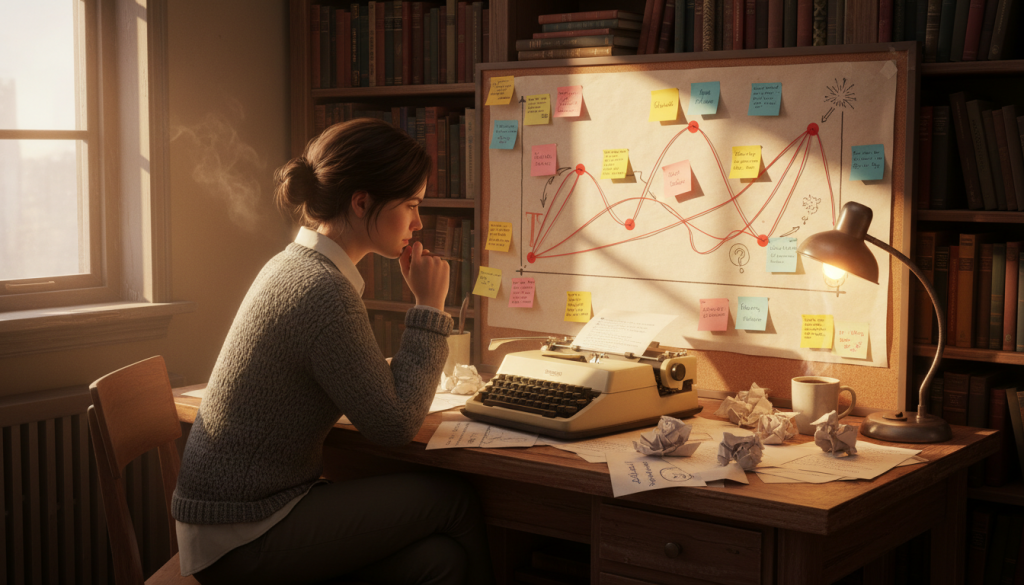
Tension is like a thread that pulls readers through your story. When I write, I use my big question as a guide. Every time I face a choice, I ask: which path raises the tension? This is a key novel writing technique I’ve found.
I suggest letting tension lead you in the first half of your draft. Outlines can feel too strict early on. After the midpoint, you can plan the rest more clearly.
Making Characters Suffer for Growth
We want to help characters avoid pain. But in fiction, that’s a mistake. Characters must face challenges. They need to struggle and earn their victories.
Suffering teaches them. Growth is the reward. This makes readers connect with your characters, keeping them interested.
Building Conflict Scene by Scene
Great tension in writing builds slowly. It’s not just one big moment. Here’s how I do it:
- Give characters opposing goals in every interaction
- Raise the stakes before resolving any conflict
- Use short sentences during high-pressure moments to quicken the pace
- Balance internal doubt with external obstacles
- Introduce time pressure—a ticking clock forces snap decisions
These techniques keep your story exciting between big moments.
Letting Characters Surprise You
The best endings come from my characters, not my outline. When characters learn through struggles, they make their own choices. They tell you how the book should end.
Trust this process. Good reader engagement comes from authenticity. Readers can feel when a character’s resolution feels earned.
Write toward what scares your characters most, and you’ll find the story waiting on the other side.
With tension guiding you, you’re ready to craft polished scenes. Scene blocking and first draft strategies will help you do just that.
Scene Blocking and First Draft Strategies
Before I start writing, I plan out each scene like a director. I write down the main actions, key lines, and sensory details. This makes my writing process clear and focused.
After planning, I write the draft quickly. I don’t worry about perfecting sentences or choosing the right words yet. That comes later. My goal is to get the story down on paper.
“The first draft is just you telling yourself the story.” — Terry Pratchett
Here’s what I include in each scene block before drafting:
- The point-of-view character and their emotional state
- A rough sketch of what happens, beat by beat
- Two or three lines of essential dialogue
- The scene’s purpose in the larger story arc
- Sensory details that ground the reader in the setting
This preparation makes writer’s block almost impossible. I know where each scene is going. I just need to figure out how to get there.
Every published author, from Stephen King to Toni Morrison, started with a messy first draft. The work I do before writing saves me from a lot of rework later. A strong first draft means my writing stays efficient, and future revisions are about fine-tuning, not starting over.
Manuscript Revision Tips for Success
Your first draft is just the start. As author Shannon Hale said, it’s like shoveling sand into a box. Revision is where you build the sandcastle. I want to share my best tips to shape your draft into something publishers want.
The key rule? Separate your writing brain from your editing brain. Draft without worrying about perfection. Then, put on your editing hat. This shift helped me write more each day.
Structural Editing Approaches
Start big. Look at your story as a whole before fixing small things. Ask yourself these questions:
- Does every scene push the plot or reveal character?
- Are there chapters that drag or feel disconnected?
- Does the pacing build toward a satisfying climax?
Cut or add scenes at this stage. Publishing standards demand tight, purposeful stories. Agents and editors spot bloated manuscripts quickly.
Polishing Your Prose
Once the structure is solid, focus on sentences and word choices. Every word should count. Trim filler phrases and replace vague verbs with vivid ones. Read your dialogue out loud. Your writing should feel alive.
| Revision Stage | Focus Area | Typical Number of Passes |
|---|---|---|
| Structural Edit | Plot, pacing, character arcs | 1–3 |
| Line Edit | Sentence flow, word choice, dialogue | 2–4 |
| Copyedit | Grammar, spelling, consistency | 1–2 |
| Proofread | Final typos, formatting errors | 1 |
Getting Valuable Feedback
Share your work with other writers — not just friends or family. You need honest feedback, not vague praise. Join local writing groups or online communities like Critique Circle or Scribophile. Their feedback will help your book get closer to publication.
Expect several drafts before you’re done. Each revision makes your story sharper. Trust the process — your hard work will pay off as you prepare your book for publication.
Creating Compelling Subplots and Locations
A great novel feels like a living, breathing world. This happens when subplots and settings work together. They support your main story. Compelling plot creation needs layering multiple threads in locations that feel real. Let me show you how to do this important step.
Weaving Multiple Story Threads
Your protagonist isn’t the only one with a life. Every key character should have their own story. This makes your world feel real and full.
I try to see the action from each major character’s point of view. No character should just pop into a scene and vanish. Ask yourself these questions about your subplots:
- What is each character doing off-screen during the main plot?
- What romances, rivalries, or political pressures shape their choices?
- Where are the clues hidden, and which character unknowingly carries them?
- How does each character’s background affect their relationships?
Compelling plot creation means checking that every thread connects. No dangling storylines. No major holes. Each subplot should echo or challenge your novel’s central theme.
Using Settings to Enhance Atmosphere
Locations are not just backdrops. A great setting shifts in mood as your character changes. A sunny park can feel sinister when your protagonist is afraid. A cramped apartment can feel warm when love arrives.
Engage all five senses when you build a scene. Smell, texture, sound — these details pull readers deeper into the story. Strong reader engagement tactics rely on atmosphere that mirrors your character’s internal arc. The setting becomes a silent partner in your storytelling.
“Place is character. When you get the setting right, the story almost tells itself.”
With subplots adding texture and locations breathing life into every chapter, your manuscript will feel rich and impossible to put down.
Overcoming Common Writing Obstacles
Every writer hits a wall. Stephen King has announced retirement almost every time he finishes a book. He has written over 60 novels and has a $400 million net worth. Even he feels completely spent after a project.
I’ve felt the same way. After finishing a manuscript, I couldn’t imagine writing another word. King’s advice? Don’t make decisions or announcements right after finishing a book.
Rest is not laziness. It’s one of the most overlooked bestselling author strategies. Sleep more. Watch TV. Read for pure fun.
Let your brain wander until a what-if question quietly forms. Inspiration struck famous authors in unexpected ways:
| Author | Famous Work | Inspiration Source |
|---|---|---|
| Stephenie Meyer | Twilight | A vivid dream |
| J.R.R. Tolkien | The Hobbit | Grading student papers |
| Suzanne Collins | The Hunger Games | Channel surfing between reality TV and war coverage |
| J.K. Rowling | Harry Potter | A delayed train ride |
| E.B. White | Charlotte’s Web | Watching spiders on a farm |
Distraction is another beast. I turn off all electronics and use the Freedom app to block social media. A clutter-free space and a strict writing schedule keep me focused.
Making yourself unavailable during writing hours is one of the strongest reader engagement tactics. It’s because you’re protecting the time that creates something worth reading.
Work before play, but play every single day. Take walks. Have dinner with friends. Go fishing. Watch a movie.
These activities aren’t distractions — they’re fuel. Strong reader engagement tactics start with a well-rested writer. They bring genuine energy to the page.
The bestselling author strategies I trust most all share one truth. Take care of yourself so your next story can take care of your readers.
Conclusion
Learning to write a successful novel is a long journey. It starts with knowing your purpose and ends with hard work. You need a strong idea, deep characters, and tension to keep readers interested.
Every step, from finding your emotional core to revising, is important. Show up every day, and your book will grow.
When your book is ready, you’ll face the publishing world. If you go traditional, research agents well and follow their rules. Be patient. Every “no” brings you closer to a “yes.”
If you self-publish, treat it like a business. Have a marketing plan ready before you launch.
Dean Koontz sold over 450 million books. He said the best writing comes from humility and pushing through limits. Fear can drive you to work harder.
Plan your day to include time for procrastination. But keep your deadlines. Don’t give up when things get tough. The writers who make it are those who never quit.
FAQ
What is the first step in how to write a successful novel?
The first step is to find your big question. This is a deep, emotional question at the heart of your book. It’s what makes readers care about your story.
For example, my big question in “When You Read This” was about finding meaning in an unlived life. Your plot, premise, and characters should all lead to this question. It gives your novel a clear purpose from the start.
How do I develop a strong premise for my novel?
A strong premise puts your character in a situation that explores your big question. It should have key story elements like who your main character is and what they want.
For instance, my premise involved a 33-year-old protagonist facing a terminal diagnosis. She realizes she never started the bakery or family she wanted. You don’t need the whole plot mapped out yet. Tools like The Novel Factory app can help refine your premise.
What are the best character development methods for fiction writing?
Start by deciding who your protagonist is. Give them an unsatisfied want right from the start. Then, build their personality by exploring what drives them and what they need to learn.
Consider their voice, inner-self, and background. Use character questionnaires to get detailed. Remember, characters must suffer to grow and feel authentic to readers.
What is the goal to decision cycle in story structure development?
The goal to decision cycle breaks your story into six parts: Goal, Conflict, Disaster, Reaction, Dilemma, and Decision. It ensures your character’s actions are logical and keeps your plot on track.
This cycle helps you avoid too much action or too much pondering. It’s a reliable tool for keeping your story engaging from start to finish.
How do I choose a touchstone or spirit guide book for my novel?
Pick a novel you love and return to it for craft questions. It’s not plagiarism to use it as inspiration. When I wrote “When You Read This,” I used “Where’d You Go, Bernadette” as my guide.
I studied Semple’s pacing and email placement. Just the first fourth of the book gave me enough insight to solve craft challenges.
What are the best manuscript revision tips after finishing a first draft?
Revision is where the real writing happens. It’s where you build your story. My editing process includes structural edits and sentence-level polishing.
I separate writing from editing completely. Get feedback from other writers to improve your work. Local writing groups and online communities are great for honest feedback.
How do I establish effective daily writing habits and a fiction writing process?
Set specific goals for when and how long you write. Determine your target word count. Use apps like Freedom to block distractions during writing time.
If daily routines don’t work for you, write every day, even if it’s just one sentence. Protect your writing time as it brings you joy.
How should I handle tension and compelling plot creation throughout my draft?
Decide which direction or scenes enhance tension. Let your big question guide you, especially in the first half of your draft. Build tension by giving your protagonist unsatisfied wants.
This initial hook draws readers in. The key is to create tension, let characters struggle, and make them grow authentically.
What is the best approach to scene blocking before writing a first draft?
Outline each scene with what happens, including stage directions and key dialogue. This preparation makes your first draft strong and fast.
Don’t worry about editing or perfection at this stage. Focus on getting the story out. This approach makes writer’s block unlikely.
How do I create compelling subplots and use locations effectively in my novel?
Locations should add atmosphere and theme to your story. Use all five senses to develop settings. Think about romances, significant items, and cultural influences.
Use character viewpoints to make your story feel grounded and real. This prevents characters from feeling out of place.
How do I overcome writer’s block and common writing obstacles?
Even famous authors like Stephen King feel spent after writing. Take rest and recovery time. Ideas come unexpectedly, so be open to inspiration.
Build procrastination into your schedule and use apps to block distractions. The publishing industry demands perseverance, so keep writing every day.
What are the best bestselling author strategies for getting published?
Decide between approaching agents or self-publishing. Both paths require preparation. When approaching agents, research and follow guidelines carefully. Be patient with rejections.
Self-publishing requires understanding the business side. Have a solid marketing plan from the start. Embrace fear and never quit.