The Seven Point Story Structure Explained
Have you ever found yourself staring at a blank page, feeling lost with your novel idea? I certainly have. It was during one of those frustrating moments that I discovered the seven point story framework. Suddenly, everything clicked into place, like a well-crafted plot twist.
This guide will take you through my personal journey with this surprisingly simple framework. It transformed my chaotic brainstorming into a coherent narrative that captivated readers from start to finish. I will share the quirky origins of this method, tracing it back to a Star Trek RPG guide and Dan Wells’s influential talk at a 2013 conference.
You will learn why this method is a game-changer for writers who feel overwhelmed by more complex models. I will break down each of the essential plot points using examples from beloved novels like The Hunger Games and Harry Potter. By the end, you’ll have a clear path to turn your own ideas into a structured, compelling narrative.
Key Takeaways
- This framework simplifies the writing process, making it accessible for all authors.
- Understanding its origins can enhance your appreciation of storytelling.
- Concrete examples from popular novels illustrate its effectiveness.
- It encourages a unique approach to plotting by working backwards.
- Tools like Storyloft’s Free Book Outline Generator can aid in this creative journey.
Understanding The Seven Point Story Structure
Ever find yourself wrestling with how to shape your ideas into a compelling story? If so, you’re not alone. Many writers have turned to a specific framework that simplifies the process of storytelling. This method, first popularized by the talented sci-fi author and RPG enthusiast, Dan Wells, at the 2013 Life, the Universe, & Everything conference, has changed the game for many.
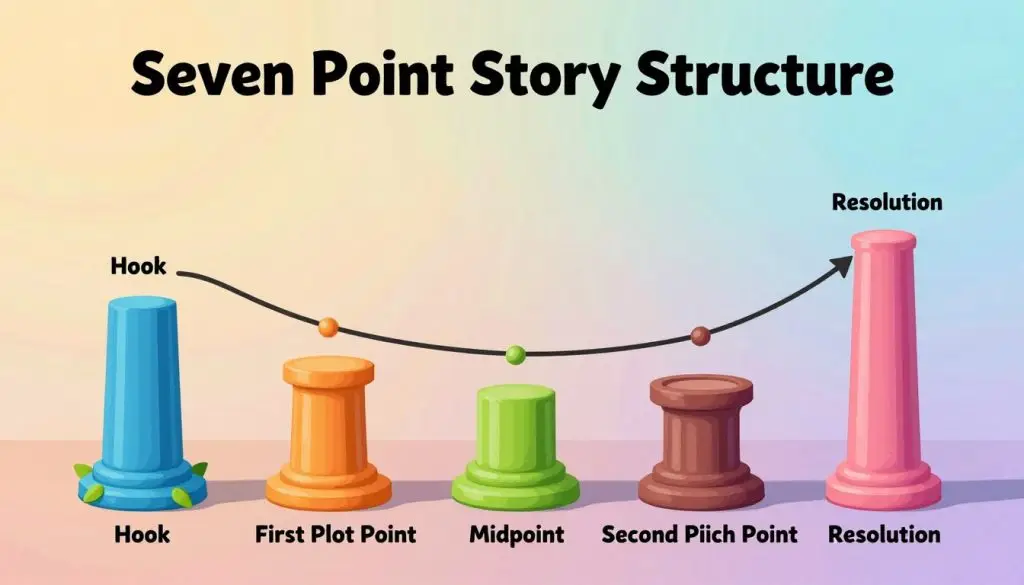
Wells took inspiration from the Star Trek Roleplaying Game Narrator’s Guide and adapted it into a clear and practical system. His approach resonates with writers who seek a structured way to navigate their narratives. The beauty of this framework lies in its almost mathematical symmetry. You start at the end, circle back to the beginning, and then fill in the middle with escalating pressure points that keep readers glued to the page.
Here are some reasons why this framework has gained such popularity:
- I have to admit, when I first heard that one of the most practical frameworks came from a Star Trek roleplaying game manual, I laughed out loud—but then I tried it, and the joke was on me because it worked brilliantly.
- Dan Wells, with his deep love for RPGs, presented this structure so clearly that it spread through the writing community like wildfire, and for good reason.
- Writers appreciate how it strips away the overwhelming complexity of other models. It gives you just seven essential beats to hit—no more, no less—which feels manageable even when you are drowning in plot ideas.
- This structure resonates especially well with genre fiction writers—fantasy, science fiction, YA, thriller—because its emphasis on pinch points and escalating stakes creates the kind of tension-driven narrative that keeps readers turning pages.
- Unlike some older models that can feel academic or prescriptive, this framework emerged from a working writer’s practical need to get stories down on paper efficiently. It speaks directly to authors who are tired of theoretical advice and just want a system that works.
In summary, the seven essential beats of this framework offer a clear path for writers. It not only provides structure but also empowers them to craft engaging narratives that resonate with readers. Understanding its origins and why it appeals to so many can help you appreciate its value in your own writing journey.
| Feature | Description |
|---|---|
| Origin | Popularized by Dan Wells at a 2013 conference. |
| Inspiration | Based on the Star Trek RPG Narrator’s Guide. |
| Structure | Consists of seven essential beats. |
| Appeal | Strips complexity, making it accessible for all writers. |
| Best For | Genre fiction writers: fantasy, sci-fi, YA, thriller. |
Why I Love Using The Seven Point Story Structure for Writing
Ever sat down to write and felt like your ideas were trapped in a fog? I certainly have. But then I discovered this framework, and it was like someone turned on the lights. In just under an hour, I transformed my chaotic thoughts into a clear blueprint.
The moment I shifted my focus to the resolution first, everything snapped into place. Suddenly, I could see the arc my protagonist needed to travel from the opening hook to the final page. It was a revelation!
From Blank Page to Clear Blueprint in Minutes
What I love most about this approach is how it forces me to think about character and plot simultaneously. Each plot point isn’t just an event; it’s a transformation in my protagonist’s journey from a reactive victim to a proactive hero.
When I pair this framework with a tool like Storyloft’s Free Book Outline Generator, the process accelerates even further. I simply answer a few questions, and Eddy, my AI writing companion, builds a complete workspace. This includes structured chapters, detailed subpoints, and creative notes that make the transition from planning to writing almost seamless.
How It Helps Shape Characters and Plot Effectively
Storyloft doesn’t just spit out generic chapter titles. It generates chapter descriptions, reader direction, and supporting context. This makes the whole project feel real and tangible long before I write the first sentence.
Thanks to this structure, I can avoid the dreaded “saggy middle.” The midpoint and pinch points act as load-bearing walls, keeping the narrative tension from collapsing under its own weight. It’s a game-changer!
Whether I’m crafting a standalone novel or planning a multi-book series, this framework works beautifully. Each book can have its own arc while contributing to a larger overarching narrative. With this method, I feel empowered to create stories that truly resonate with readers.
The Seven Essential Plot Points Explained
Can you recall the last time a story’s beginning pulled you in and made you crave more? The hook is that magical moment when you grab your reader’s attention and refuse to let go. It sets the stage for the entire narrative, introducing intriguing characters and a captivating world. This is where the journey begins, and the stakes start to rise.
1. The Hook: Setting the Stage
I think of the hook as the moment I grab my reader by the collar and whisper, “You are not going to believe what is about to happen.” It introduces a compelling character in a fascinating world, creating just enough tension to make putting the book down feel physically impossible.
2. First Plot Point: The Inciting Incident
The first plot point, originally called Plot Turn 1 by Dan Wells, is the inciting incident that kicks the story into motion. It forces my protagonist out of their comfortable normal world, whether they like it or not—and they usually do not like it one bit!
3. Pinch Point 1: Raising the Stakes
Pinch Point 1 is where I get to be genuinely mean to my characters. This is the moment the antagonist or major conflict shows up in full force, applying pressure that makes the stakes feel terrifyingly real. It reminds readers exactly what the protagonist stands to lose.
4. The Midpoint: From Reaction to Action
The midpoint is my favorite beat to write. It’s the exact moment my protagonist stops reacting to the chaos around them and starts making active choices. They switch from defense to offense, and the entire energy of the story shifts dramatically.
5. Pinch Point 2: The Darkest Hour
Pinch Point 2 is the darkest hour. Everything goes catastrophically wrong, and my protagonist hits rock bottom so hard they can hear echoes. This is where I pile on the pressure until the situation seems genuinely hopeless.
6. Second Plot Point: The Turning Discovery
The second plot point, or Plot Turn 2, is the turning discovery. It’s the moment my protagonist uncovers the final piece of information, inner strength, or crucial insight they need to face the antagonist and resolve the major conflict once and for all.
7. The Resolution: Climax and Wrap-up
The resolution brings everything crashing together in a climax that delivers on every promise I made to the reader. It’s followed by a wrap-up that shows how my protagonist has been transformed by their journey through all seven points.
Step 1: Starting with the Resolution
Do you sometimes find yourself unsure of where your narrative is headed, like a ship lost at sea? When planning a novel, starting with the resolution can be a game-changer. By first determining your story’s resolution—where everything is headed—you’ll always have a sense of direction throughout your outlining and writing process.
The resolution can signify the end of a narrative arc where the main problem is solved. It also represents the final stage of your protagonist’s character arc, showcasing how they evolve into a changed person. For instance, in The Hunger Games, the protagonist, Katniss, wins the Games, but the resolution goes beyond survival; it highlights her defiance against the Capitol.
Why Beginning at the End Sets a Strong Direction
I’ll be honest: the first time someone suggested plotting my novel by writing the ending first, I thought they had lost their mind. However, this counterintuitive approach turned out to be the most powerful plotting technique I’ve ever adopted.
Beginning at the end provides a clear target. Every scene, character decision, and plot twist I write exists to move my protagonist closer to that final, transformative moment. The resolution is not just about solving the external plot problem; it’s about completing the protagonist’s character arc. It shows how they have changed from who they were in the Hook to someone fundamentally different by the final page.
Examples of Satisfying Endings That Guide Your Plot
When I know my ending, I can plant foreshadowing seeds throughout the earlier sections with surgical precision. This creates that delicious “aha!” moment when readers realize the clues were there all along. A satisfying ending typically delivers on the story’s central promise while also surprising the reader in some way. It feels both inevitable and unexpected, like the perfect punchline to a joke you didn’t see coming.
In The Hunger Games, Suzanne Collins knew from the start that Katniss would win the Games. However, the real resolution was not just about survival; it was about her defiance of the Capitol’s rules and emerging with Peeta by her side. This setup established the entire thematic arc of the series.
As I craft my resolution, I always ask myself two questions: “What does my protagonist want?” and “What do they actually need?” The gap between those two answers is where the most satisfying endings live.
| Element | Description |
|---|---|
| Resolution | The end of the narrative arc where the main problem is solved. |
| Character Arc | Shows how the protagonist evolves throughout the story. |
| Foreshadowing | Hints planted throughout the story that lead to the resolution. |
| Satisfying Ending | Delivers on the story’s promise while surprising the reader. |
| Thematic Arc | Underlying message that connects the resolution to the character’s journey. |
Step 2: Crafting the Hook – Your Story’s Magnetic Start
Do you ever wish you could bottle that initial excitement of a new idea and translate it into a captivating start? With your resolution in mind, it’s time to circle back to the beginning of your narrative. This is where the hook comes into play.
Juxtaposing the start of your story with its end creates a promise of transformation that readers find satisfying. By the end of the first chapter, you need to engage your audience with three essential elements: curiosity, tension, and emotion.
Juxtaposing Start and End for Maximum Impact
Once I have my resolution locked in, I circle back to the hook and ask myself: “What is the exact opposite of where my protagonist ends up?” The wider the gap between the start and end, the more satisfying the transformation arc becomes.
Juxtaposing the beginning and ending is like drawing back a slingshot. The further you pull the protagonist from their final destination, the more momentum and emotional impact the story gains as it snaps forward.
For instance, in The Hunger Games, Katniss starts as a resourceful but powerless girl struggling to feed her family in the poorest district. This makes her eventual victory and defiance of the Capitol feel monumental rather than inevitable.
Writing an Opening That Grabs Readers with Curiosity, Tension, and Emotion
A compelling first chapter needs three ingredients working in harmony:
- Curiosity: Make readers ask questions they desperately want answered.
- Tension: Create a sense of worry about what might happen next.
- Emotion: Ensure readers care deeply about the protagonist’s fate.
I avoid cliché openings like waking up, looking in mirrors, or describing the weather. Instead, I drop readers into a moment that reveals character, hints at conflict, and raises questions that can only be answered by turning the page.
The hook should establish not just the protagonist’s external circumstances but also their internal flaws and desires. These elements are the raw materials that the rest of the narrative will shape and transform.
As I craft my first chapter, I always aim to end with a promise of trouble brewing—an unanswered question, a looming threat, or a discomfort that tells the reader, “Stick around, because things are about to get much more interesting.”
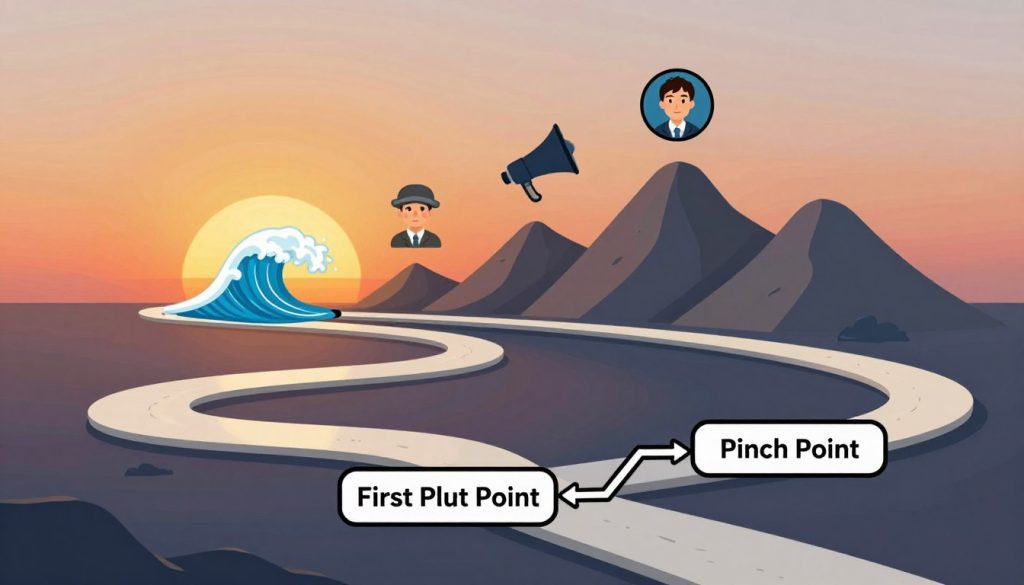
Step 3: The First Plot Point and Pinch Points – Raising the Stakes
Have you ever felt the thrill of pushing your characters into the unknown? This is where the first plot point comes into play. It’s the moment I shove my protagonist out of their comfortable normal world and into the story’s central conflict. Think of it as the phone call, the knock on the door, or the letter from Hogwarts that changes everything irrevocably.
When crafting this inciting incident, I ensure it’s not something my protagonist can ignore or easily resolve. It must be a point of no return, committing them to the journey ahead, whether they feel ready or not. This is where the excitement begins!
Forcing Characters Out of Their Comfort Zones
The first plot point is crucial. It propels the protagonist into the adventure, igniting the narrative. This moment sets the tone for everything that follows. For instance, in Harry Potter, when Harry learns he is a wizard, it’s not just a revelation; it’s the spark that ignites his journey.
Once the plot point is established, the stakes must be raised. This is where pinch points come into play. Pinch points are my secret weapon for maintaining narrative tension. They remind readers exactly what is at stake by bringing the antagonist or major conflict crashing into the protagonist’s path with terrifying force.
Pinch Points: Why They’re Critical Moments of Pressure
The first pinch point typically introduces the true scope of the threat. In Harry Potter, when Harry faces a troll, he realizes the dangers at Hogwarts are far more real and personal than he ever imagined. This moment is pivotal, as it heightens the tension and keeps readers engaged.
I think of pinch points as pressure valves that keep the story from going flat. Without them, the middle of a novel can sag into a series of events with no sense of escalating danger or consequence. The second pinch point is where I really twist the knife. This is the darkest hour when the protagonist loses allies, resources, or hope, and the antagonist seems unstoppable.
Both pinch points serve the same essential function—they force the protagonist to confront the reality of their situation. This confrontation leads to difficult choices that reveal their true character under pressure.
| Element | Description |
|---|---|
| First Plot Point | The inciting incident that pushes the protagonist into the central conflict. |
| Pinch Point 1 | Introduces the true scope of the threat and raises the stakes. |
| Pinch Point 2 | The darkest hour when everything seems lost for the protagonist. |
| Character Development | Reveals the protagonist’s true nature under pressure. |
| Narrative Tension | Maintained through strategic pinch points that escalate conflict. |
Step 4: The Midpoint – Turning Point of Action
What if I told you that a single moment in your plot could completely change your character’s trajectory? That moment is the midpoint. It serves as a turning point where the protagonist shifts from being reactive to proactive. This is the point where they take charge of their own fate, and it often comes with a twist—a false victory.
In many narratives, this false victory is crucial. It’s that moment when the protagonist seems to win something they desperately wanted. However, this win often comes at a steep cost. For instance, in The Wizard of Oz, Dorothy reaches the Emerald City, but the Wizard demands she defeat the witch. Similarly, in Star Wars, Luke rescues Leia but loses Obi-Wan in the process. The stakes are raised, and the plot thickens.
Switching from Reactive to Proactive Storytelling
The midpoint is when my story takes a deep breath and pivots hard. My protagonist stops being a pinball bounced around by external forces. Instead, they start making deliberate, proactive choices that drive the narrative forward. I love writing this part because it’s where my character finally grows a spine. They realize that waiting for rescue or following orders won’t cut it anymore.
Using False Victories and New Goals to Deepen Your Narrative
One of my favorite techniques at the midpoint is the “false victory.” I let my protagonist achieve something they desperately wanted, but I attach a devastating cost that complicates everything. In The Hunger Games, Katniss’s midpoint comes when she stops performing for the Capitol’s cameras. She decides to team up with Rue and later Peeta, transforming from a reactive tribute into an active rebel who writes her own rules.
This false victory pattern appears everywhere in great stories. After the midpoint, the story accelerates because the protagonist is now driving the action rather than merely reacting. Every decision they make carries the weight of their newfound agency and the consequences of their false victory. This turning point deepens the narrative because it raises the thematic stakes. The protagonist is no longer just trying to survive; they are now fighting for something they have chosen, making their eventual triumph or failure matter so much more.
Step 5: The Second Plot Point and Climax Lead-up
What if your narrative could pivot on a single moment of clarity for your main character? This is the essence of the Second Plot Point. It’s the moment when everything clicks into place for the protagonist, leading them toward their final confrontation.
This pivotal event often reveals crucial information or inner strength. It can even introduce an unexpected ally that empowers the protagonist to overcome their greatest challenge. The stakes have never been higher, especially after the devastation of the second pinch point.
Building Toward the Final Confrontation
As I craft this moment, I ensure it feels earned. The discovery should be the natural outcome of everything my protagonist has learned and suffered through the previous six plot points. It’s not a random twist; it’s a well-deserved reward for their journey.
Take Harry Potter as an example. In Harry Potter and the Philosopher’s Stone, Harry’s Second Plot Point occurs when he gazes into the Mirror of Erised. He realizes that his pure heart makes him worthy of possessing the Stone. This moment directly enables his final confrontation with Voldemort.
Preparing Readers for a Satisfying Resolution
The lead-up to the climax is where I pay off every thread woven throughout the narrative. The skills my protagonist developed in Act One, the allies they earned at the Midpoint, and the hard lessons learned during the pinch points all converge in this final sequence.
To prepare readers for a satisfying resolution, I ensure the stakes are crystal clear. The outcome should remain genuinely uncertain until the very last moment. Even if readers suspect the protagonist will win, they should still doubt how and at what cost.
The climax itself is the release of all the tension built since the Hook. It’s the moment of truth where my protagonist faces the antagonist, makes the ultimate choice, and proves through action how they have changed.
A truly satisfying resolution does more than resolve the external plot. It completes the protagonist’s internal arc, showing that they have gained not just what they wanted but what they needed—even if those two things turned out to be very different.
| Element | Description |
|---|---|
| Second Plot Point | The moment of discovery that empowers the protagonist. |
| Climax | The final confrontation where the protagonist faces the antagonist. |
| Resolution | Completes the protagonist’s journey and internal growth. |
| Stakes | Clear and uncertain until the very end. |
| Transformation | Shows the difference between what the protagonist wanted and needed. |
How to Use the Seven Point Story Structure Alongside Other Story Models
Have you ever wondered how to blend various storytelling techniques to create something unique? The beauty of writing lies in its flexibility. While the seven-point framework is a powerful tool, it doesn’t have to stand alone. I often combine it with other models like the Hero’s Journey and Save the Cat to enrich my narratives.
These frameworks can work in harmony, enhancing the depth of my characters and the complexity of my plots. By integrating elements from different structures, I can craft stories that resonate on multiple levels. Let’s explore how these models can be blended effectively.
Blending With The Hero’s Journey and Save the Cat
The Hero’s Journey is a classic framework that outlines a hero’s transformation through various stages. I find that it aligns well with the seven-point model. For instance, the Call to Adventure in the Hero’s Journey corresponds to the First Plot Point in my framework. Similarly, the Ordeal aligns with the Midpoint, while the Return with the Elixir mirrors the Resolution.
By using both structures, I can ensure my protagonist undergoes a meaningful transformation while also hitting essential plot points. This approach keeps my writing fresh and engaging.
Maintaining Creativity While Using Structured Templates
It’s crucial to remember that frameworks are guides, not cages. I think of the analogy of cooks versus chefs: a cook follows a recipe precisely, while a chef knows the recipe well enough to improvise. I aim to be that chef, adding my own flair to the story while adhering to the basic framework.
When I use tools like Storyloft’s Free Book Outline Generator, I can quickly establish a solid foundation for my narrative. The AI helps me generate planning notes and even a concept book cover. This allows me to focus on creativity while ensuring I have a structured outline to follow.
Why Knowing the Rules Means You Can Break Them
Understanding the rules of storytelling empowers me to break them intentionally. When I deviate from the structure, I do so with purpose, enhancing the reader’s experience. For example, if my story demands a scene that doesn’t fit neatly into the outline, I embrace that moment. It’s about crafting a narrative that feels organic and emotionally resonant.
Every story has a beginning, middle, and end—this fundamental truth remains constant. Blending models is not cheating; it’s recognizing that various frameworks describe the same underlying narrative DNA from different angles. By mastering these structures, I can create stories that feel both familiar and original.
| Framework | Description |
|---|---|
| Hero’s Journey | A classic narrative arc focusing on the hero’s transformation. |
| Save the Cat | A structure emphasizing relatable protagonists and engaging hooks. |
| Seven-Point Framework | A streamlined approach to plot development with essential beats. |
| Creative Blending | Combining elements from various frameworks for unique narratives. |
| Understanding Rules | Mastering frameworks allows for intentional deviations. |
My Favorite Examples: The Seven Point Structure in Harry Potter and The Hunger Games
When it comes to understanding the seven-point framework, there are no better examples than Harry Potter and The Hunger Games. Both series showcase how this structure can create powerful narratives that resonate with readers.
In Harry Potter, we see a young boy’s transformation from an isolated child to a celebrated hero. His journey is a perfect illustration of the seven essential points, which I love to analyze.
Harry Potter’s Journey Through the Seven Points
Harry starts as an abused boy living under the stairs, feeling he has no place in the world. This hook sets the stage for his remarkable transformation.
The first major event, or Plot Turn, occurs when Hagrid reveals that Harry is a wizard. This revelation pulls him from the mundane world of the Dursleys into the magical realm of Hogwarts.
Pinch Point 1 arrives when Harry and his friends face a troll. This moment raises the stakes, showing Harry that the dangers of the wizarding world are real and life-threatening.
The Midpoint is pivotal; Harry realizes that Voldemort is after the Philosopher’s Stone and makes the conscious decision to protect it. This moment marks his shift from a reactive character to an active protector.
Pinch Point 2 strips Harry of his support system. Ron and Hermione are trapped, forcing him to confront Voldemort alone. This pressure-filled moment heightens the tension and makes his eventual victory feel genuinely earned.
The Second Plot Turn occurs when Harry gazes into the Mirror of Erised. He discovers that his pure heart makes him worthy of possessing the Stone, enabling the final confrontation with Voldemort.
Finally, the Resolution sees Harry defeating Voldemort, transforming from a lonely boy into someone with friends and purpose.
Katniss’s Story Arc as a Perfect Illustration
The Hunger Games offers an equally compelling narrative. Katniss starts as a resourceful hunter in District 12, struggling to care for her family. This hook contrasts sharply with her eventual victory in the Hunger Games.
Her Midpoint moment occurs when she stops following the rules set by the Capitol and decides to team up with Rue and Peeta. This decision marks her transition from a survivor to a proactive rebel.
Katniss’s journey, like Harry’s, is supported beautifully by the seven-point framework. Both characters undergo significant transformations, illustrating how this structure can enhance character arcs.
Lessons Learned from These Blockbuster Novels
The biggest takeaway from these narratives is that the seven-point framework does not stifle creativity. Instead, it channels it, allowing authors like J.K. Rowling and Suzanne Collins to craft rich worlds and complex characters.
With a clear structure, writers can focus on building their stories without worrying about what should happen next. This freedom fosters creativity and innovation, making their novels not just stories but unforgettable experiences.
Conclusion
Looking back at my writing journey, I can pinpoint the exact moment everything changed: the day I embraced a solid framework to shape my novels. No longer did I stare at blank pages; instead, I transformed vague ideas into compelling narratives. This method has been my trusted companion through every draft and revision.
Its beauty lies in its flexibility. Once you internalize the essential beats, you can adapt and blend them with other models, like The Hero’s Journey, to create something uniquely yours. If you’re ready to stop dreaming about your novel and start writing, I highly recommend Storyloft’s Free Book Outline Generator. Answer a few simple questions, and Eddy, your AI writing companion, will build a complete outline with chapter descriptions and creative notes in minutes.
With this tool, the blank page becomes a structured workspace, transforming your idea into a working book foundation. Your story deserves to be told, and with the right structure and tools, you can captivate readers from the first hook to the final resolution.
Ready to take the plunge? Check out the seven-point story structure and discover how it can enhance your writing journey!
FAQ
What is the purpose of this writing framework?
This method provides a clear roadmap for crafting engaging narratives, ensuring that key elements are included for a compelling read.
How does the structure help with character development?
By defining essential plot points, it allows for deeper exploration of characters, their motivations, and growth throughout the story.
Can this framework be used for different genres?
Absolutely! Whether you’re diving into fantasy, romance, or science fiction, this approach is versatile enough to adapt to any genre.
Is it necessary to follow the structure exactly?
Not at all! Think of it as a guideline. Feel free to bend the rules and add your unique flair to the narrative.
How do I start implementing this in my writing?
Begin by outlining your resolution, then work backward to create the hook and other key points. It’s like building a puzzle!
What if I get stuck at a certain point?
No worries! Take a break, revisit your characters’ motivations, or brainstorm alternative plot developments to reignite your creativity.
Are there any famous books that use this framework?
Yes! Many bestsellers, including popular series, utilize this method to create captivating and structured narratives.