How to Outline a Romance Novel

Have you ever found yourself staring at a jumble of brilliant scene ideas, with characters bantering in your head but no clear path to shape it all into a compelling story? This guide is designed to provide you with the blueprint I wish I had years ago. We’ll explore how a well-crafted outline can transform chaos into a page-turning tale that readers will love.
Skipping the outline is like trying to bake a soufflé without a recipe—possible, but messy. Together, we’ll delve into the three-act structure that forms the backbone of most engaging stories. From introducing your main characters to crafting their relationships, I’ll show you how to create protagonists that feel real.
By the end of this journey, you’ll have a roadmap that takes you from that first spark of inspiration to a finished manuscript. No more blank-page anxiety! So grab your favorite beverage, settle in, and let’s turn that story in your mind into a captivating book your readers can’t resist.
Key Takeaways
- Learn the importance of outlining for effective storytelling.
- Understand the three-act structure and its role in pacing.
- Discover how to create relatable characters and engaging relationships.
- Utilize tools like Storyloft’s Free Book Outline Generator for efficiency.
- Transform your initial ideas into a structured manuscript.
Why You Need a Romance Novel Outline (And How It Can Save Your Story)
Imagine having a treasure trove of characters and scenes, but lacking the map to navigate through them. That’s where a solid outline comes in. It’s not just a roadmap; it’s your secret weapon against the dreaded blank page. When you start with a clear plan, you can craft a story that resonates with your audience.
Your readers come with specific expectations. They crave the tension of a first charged glance, the thrill of an almost-kiss, and the emotional rollercoaster that leads to a hard-won happily ever after. Understanding these elements isn’t about following a formula; it’s about delivering the emotional beats your audience longs for in a fresh and engaging way.
I’ve seen too many promising stories falter because the writer assumed passion alone could carry them through. It’s like trying to build a house without a foundation. An outline serves as your sturdy base, guiding you through the intricate dance of plot and character development.
Here’s why outlining is essential:
- It helps you spot pacing problems early on.
- It allows you to identify where romantic tension may be lacking.
- It keeps your protagonist actively pursuing love rather than waiting for it to happen.
Tools like Storyloft’s Free Book Outline Generator can make this process even easier. Instead of staring at a blinking cursor, you can engage with Eddy, your AI writing companion, who helps you create a structured outline in minutes. This approach not only saves time but also prevents the frustration of rewriting large sections of your manuscript later.
Think of your outline as the scaffolding that supports your emotional love story. While it may not be visible to readers, it’s crucial for keeping your narrative from collapsing. The time you invest in crafting a detailed outline will pay off tenfold when you can confidently write your first draft without second-guessing your direction.
| Benefits of Outlining | Impact on Writing |
|---|---|
| Clarifies plot structure | Reduces confusion during writing |
| Identifies character arcs | Enhances character development |
| Improves pacing | Keeps readers engaged |
| Sets up emotional beats | Delivers satisfying reader experience |
In summary, outlining is not just a step in the writing process; it’s a vital tool that ensures your story flows smoothly and meets reader expectations. So, grab your favorite beverage, and let’s turn those brilliant ideas into a captivating book!
The Three-Act Story Structure: The Backbone of a Killer Romance Novel Outline
Every compelling story unfolds like a carefully choreographed dance, with each act leading to a crescendo of emotions. The three-act structure is not just a guideline; it’s a roadmap to keep your readers engaged from start to finish. Let’s break down each act and explore how it contributes to a captivating tale.
Act One: The Setup – Introducing Characters & Setting the Stage
In Act One, which covers the first quarter of your story, the groundwork is laid. This is where you introduce your main characters and establish the setting. Your protagonists should feel like real people, complete with jobs, friends, and their own unique challenges.
Don’t forget the inciting incident—the moment that sparks the story. This usually happens within the first 12% of your narrative. It’s often a meet-cute that hints at the chemistry between your leads without making it feel like love at first sight. The first plot point occurs around the 25% mark, where your protagonist takes a step forward, setting the stage for the romantic journey ahead.
Act Two: The Confrontation – Building Romantic Tension and Conflict
Act Two is where the real magic happens. This section, spanning from 25% to 75% of your story, is all about building tension. You’ll want to bring your characters together, allowing their relationship to develop amidst external conflicts and personal challenges.
The midpoint is crucial—it’s a turning point that can either present a false victory or a false defeat. This moment keeps readers on their toes, eager to see how the characters will navigate their growing feelings and the obstacles in their way. By the time you reach the second plot point at 75%, your protagonist should have a revelation about their own flaws that have been hindering their chances at love.
Act Three: The Resolution – Climax, Breakup, and Happily Ever After (or Not)
In Act Three, you’ll deliver the climax of your story, often featuring a breakup or a moment of betrayal that feels inevitable. This is where all the seeds you’ve planted throughout the narrative come to fruition. Your characters must confront their issues and ultimately find a way to resolve them.
Whether you opt for a traditional happily ever after or a bittersweet ending, the resolution should leave readers satisfied. A brief denouement can provide a glimpse into the couple’s future, allowing readers to close the book with a sense of fulfillment.
| Act | Purpose | Key Events |
|---|---|---|
| Act One | Introduce characters and setting | Inciting incident, first plot point |
| Act Two | Build romantic tension and conflict | Midpoint reversal, second plot point |
| Act Three | Resolve conflicts and deliver climax | Breakup, resolution, denouement |
By understanding the three-act structure, you can craft a narrative that resonates with readers. This framework not only enhances pacing but also ensures that your characters’ journeys are compelling and satisfying.
Crafting Your Characters: The Heartbeat of Your Romance Novel Outline
Crafting memorable characters is the secret ingredient that elevates any story. These individuals are not just names on a page; they are the emotional anchors that keep readers invested. Understanding your characters deeply is essential to weaving a captivating narrative.
To start, let’s focus on your two main leads. For each character, consider their physicality, desires, and flaws. You want to know not just how they look, but how they carry themselves in a room. Are they confident, or do they shrink back? This physical presence sets the tone for their interactions.
Next, delve into their desires. What do they want on the surface? Maybe one lead aspires to make partner at their law firm, while the other yearns to save their family’s ranch. However, the real gold lies in understanding what they actually need. This is often something they are afraid to admit, like the courage to be vulnerable or the ability to trust someone else.
Developing Your Two Main Leads – Physicality, Desires, and Flaws
Character flaws are crucial in building tension. Think about what they can’t control. This could be a behavior pattern that triggers under pressure. Maybe one character has a fear of abandonment, causing them to push away their love interest just when things start to heat up.
Also, consider their core wounds—those deep-seated issues that shape how they navigate the world. For instance, if one character has experienced betrayal in the past, it will affect their ability to form new relationships. This internal conflict is what makes the story compelling.
Identifying Your ‘Villain’ – Internal and External Obstacles
In many stories, the villain doesn’t have to be an external character. Often, the most powerful obstacles are internal. A character’s fear of intimacy or a need for control can suffocate the budding relationship. When using an external villain, like a disapproving parent, ensure their actions amplify the protagonist’s core wounds.
Creating tension is essential. If your characters’ fears are perfectly designed to trigger each other’s defense mechanisms, you’ll have a rich ground for conflict. This dynamic keeps readers on the edge of their seats, eager to see how it all unfolds.
The Supporting Cast: Friends, Family, and Side Characters
Don’t forget about your supporting cast! Each side character should serve a specific function in the story. The best friend can provide comic relief or a sounding board for the protagonist’s feelings. Meanwhile, a sibling might embody the golden-child status that pressures your lead to prove themselves.
Remember, every supporting player should illuminate something about the main relationship, not compete with it. If a side character is too interesting, they might hijack the narrative. Balance is key.
Finally, the physical details you choose for your leads should be intentional. A simple action, like how one character makes terrible coffee but drinks it anyway because it reminds them of their late mother, can convey deep emotional layers without lengthy exposition.
| Character Element | Importance |
|---|---|
| Physicality | Sets the tone for interactions |
| Desires | Drives character motivation |
| Flaws | Creates conflict and tension |
| Core Wounds | Shapes character behavior |
| Supporting Cast | Enhances main relationship |
Before you write a single scene, ensure you understand what each character loves and hates. These visceral details are what make readers feel like they’re falling in love right alongside your protagonists.
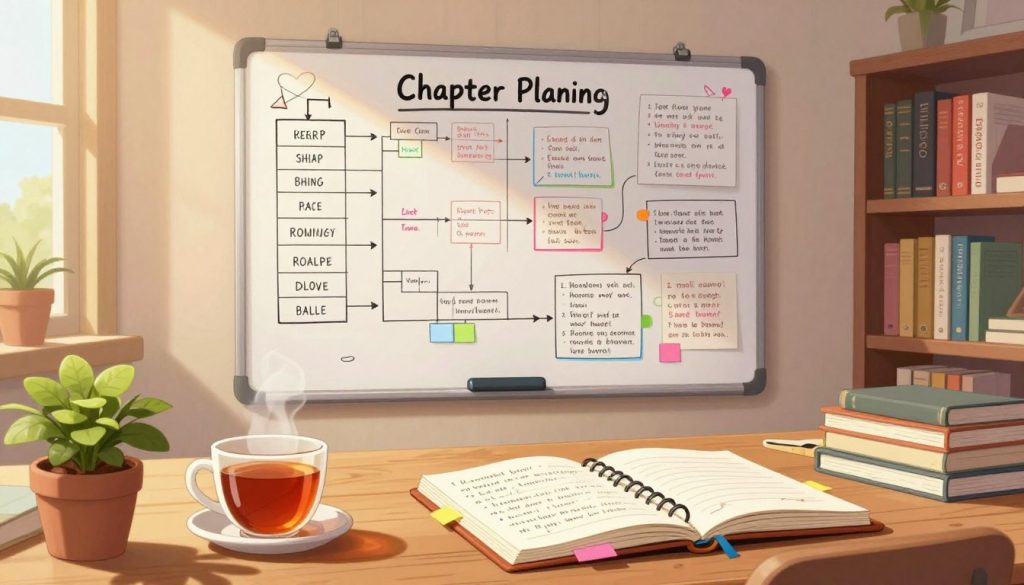
Chapter Planning and Pacing: The Math Behind Your Romance Novel Outline
Planning the chapters of your story is like laying the foundation of a house; without it, everything else can crumble. Understanding how to structure your chapters is essential for keeping readers engaged and invested in your characters’ journeys.
Setting Your Word Count and Chapter Length
A standard book typically runs between 70,000 and 100,000 words. For a well-paced story, aim for chapters that are 2,000 to 3,000 words long. Occasionally, you might stretch to 3,500 words, but rarely more than that. Shorter chapters keep the pace moving, making it easier for readers to devour your story.
Using 2,500 words per chapter as a baseline, an 80,000-word book gives you about 32 chapters. Think of your book in four sections of eight chapters each:
- Chapters 1-8: Setup and meeting
- Chapters 9-16: Building tension, with a midpoint shift around chapter 16
- Chapters 17-24: Relationship deepens and gets complicated
- Chapters 25-32: Collapse and resolution, with the black moment hitting around chapters 26-28
Every scene should end in a slightly different place than it started. Every step forward should cost something, and every moment of intimacy should come with complications or new layers of risk.
Using Pacing to Build Desire and Keep Readers Hooked
I think of pacing as the art of managing desire—my job is to make readers desperate to see the couple together while doling out satisfaction slowly enough that the payoff actually means something when it finally arrives. Shorter chapters are my secret weapon for keeping the pace moving. Readers often tell themselves, “just one more chapter,” and before they know it, it’s 3 a.m., and they’re crying into their pillows because the black moment just destroyed them.
However, beware of common pacing pitfalls. The dreaded middle slump is a frequent issue in debut stories, where the same push-pull dynamic repeats for too long without escalation. This can lead readers to check how many pages are left instead of being lost in the story.
Common Pacing Pitfalls and How to Fix Them
My rule of thumb is that every chapter must end with the relationship in a slightly different place than it started—closer, further, more complicated, or more vulnerable—but never exactly the same. Stasis is the enemy of page-turning. I’ve also learned to watch out for the opposite problem, where characters meet, experience instant connection, and confess their undying love by chapter eight, leaving nothing for readers to anticipate for the remaining two-thirds of the book.
When outlining, I review my chapter list and ask myself what each chapter’s function is. If three chapters in a row are doing the same thing, like “building tension,” I know I need to combine two of them and introduce something new to shake things up.
The four-section pacing framework has saved my sanity more than once. Chapters 1-8 for setup and meeting, 9-16 for building tension, 17-24 for deepening the relationship, and 25-32 for the collapse and resolution. This structure helps ensure that the black moment hits hard and the happily ever after feels earned.
Ultimately, I’ve stopped trying to fix pacing problems in the editing phase. Instead, I solve them in the outline. It’s infinitely easier to rearrange index cards or adjust a chapter map than to rewrite 20,000 words of a manuscript that’s dragging like a tractor pull.
Building Key Plot Points and Tropes Into Your Romance Novel Outline
Crafting the pivotal moments in your story can be the difference between a forgettable tale and one that resonates deeply with readers. Key plot points and familiar tropes are the framework that keeps your narrative exciting and engaging.
First up is the inciting incident, often referred to as the meet-cute. This moment typically occurs between 1-12% into your story. It should establish the potential for attraction without making it instantaneous. If your characters already know each other, this scene should be the first time we see them together on the page.
After the inciting incident, your protagonist should experience a moment of reflection. They need to agonize over whether they truly want to take that next step forward. This tension is crucial, as it adds depth to the characters and keeps readers invested.
Meet-Cute and The Inciting Incident: Lighting the Spark
The meet-cute is hands-down my favorite plot point to brainstorm. It’s the moment where everything begins, and it needs to be specific, active, and packed with chemistry. For example, imagine your character walking into a new job and discovering their boss is the person they left at the altar seven years ago. This creates an immediate, delicious problem with no easy escape.
Once the spark is lit, it’s time for the first plot point, which typically occurs around 25%. This moment should force your protagonist to make an active choice that locks them into proximity with their love interest. Whether it’s agreeing to a fake relationship for a family wedding or accepting a job in a town where their ex is the sheriff, this decision is pivotal.
The Midpoint and False Victories/Defeats
The midpoint reversal, occurring at about 50%, is where I get to play with readers’ emotions. This can be a false victory, like a first kiss that makes them think a happily ever after is imminent, or a false defeat, where a crisis forces them to deny their feelings. This tension is essential for keeping readers on the edge of their seats.
When crafting the climax, which happens around 75-90%, the conflict should come to a head. This is often where a breakup occurs, leaving readers believing it’s truly over. The climax needs to feel earned and believable, grounded in everything you’ve established throughout the story.
The Climax and Emotional Black Moment
After the climax, I never let my characters reconcile too easily. Someone must make a real sacrifice—whether it’s standing up to a controlling parent or dropping the emotional shields they’ve hidden behind for hundreds of pages. This resolution should demonstrate that both characters have grown throughout the story.
In summary, building key plot points and tropes into your narrative structure not only enhances pacing but also ensures that your characters’ journeys resonate with readers. When you finally give them that happily ever after, it feels like a reward they earned right alongside your protagonists.
| Plot Point | Purpose | Key Events |
|---|---|---|
| Inciting Incident | Establish attraction | Meet-cute, initial chemistry |
| First Plot Point | Active choice for protagonist | Locking into proximity |
| Midpoint Reversal | Emotional tension | False victory or defeat |
| Climax | Conflict resolution | Breakup, emotional black moment |
Using Storyloft’s Free Book Outline Generator to Jumpstart Your Romance Novel Outline
Navigating the complexities of your narrative can be daunting without a solid plan in place. That’s where Storyloft’s Free Book Outline Generator comes into play. This innovative tool helps authors transform their ideas into a structured book plan in mere minutes.
Instead of facing a blank page, you’ll collaborate with Eddy, your AI writing companion. Eddy guides you through a series of simple questions about your story idea, building a complete, usable outline that goes beyond just chapter titles.
Working With Eddy, Your AI Writing Companion
Working with Eddy feels like having a seasoned writing partner by your side. This guided experience is designed for both fiction and non-fiction, making it versatile for any writer. As you answer Eddy’s questions, you’ll find yourself moving seamlessly from concept to outline.
Generating Detailed Chapters, Subpoints, and Creative Notes
What truly impresses me about Storyloft is the level of detail in the generated workspace. Each chapter comes with:
- Detailed subpoints that clarify what happens and why it matters.
- Chapter descriptions that keep you focused on your plot’s direction.
- Creative notes that spark new ideas and keep your inspiration flowing.
- Reader direction that helps you understand how each scene will resonate with your audience.
Bringing Your Idea to Life with Concept Covers and Planning Assets
One feature I didn’t know I needed until I had it is the concept book cover generated based on your idea. Seeing your story visualized as a real book cover early in the process is incredibly motivating. It’s like the universe is giving you a nod, saying, “This thing is actually going to exist!”
Additionally, the intelligent planning notes have saved me from countless plot holes. They flag potential issues with pacing, character motivation, and romantic tension before I’ve even written a single word. This proactive approach ensures that your outline evolves with your story, rather than becoming a static document.
In short, Storyloft offers a faster, smarter way to go from that initial spark of inspiration to a complete outline and ultimately to a manuscript you can hold in your hands. So why not give it a try? With Eddy’s help, you can finally conquer that daunting blank page!

Conclusion: Your Roadmap from Romance Idea to Manuscript Masterpiece
In conclusion, your journey from a fleeting idea to a polished manuscript is now within reach. I’ve walked you through the essentials of crafting a compelling story, from understanding the need for a solid structure to developing characters that resonate with readers. Remember, your outline is a living document. It should evolve as your characters surprise you and the plot takes unexpected turns.
With tools like Storyloft’s Free Book Outline Generator, the process becomes faster and more enjoyable. You can transform your creative spark into a structured plan in no time. The blank page doesn’t have to intimidate you anymore. Embrace this journey, and give your characters the happily ever after they deserve!
FAQ
Why should I outline my story before writing?
Outlining helps you avoid the dreaded blank page syndrome. It’s like having a map for a road trip—without it, you might end up lost in a plot twist you never intended!
What’s the three-act structure?
It’s the secret sauce of storytelling! Act One sets the stage, Act Two throws in some conflict, and Act Three wraps everything up with a satisfying climax. Think of it as the ultimate love triangle, but with a plot!
How do I create compelling characters?
Focus on their desires, flaws, and physical traits. The more real they feel, the more your readers will root for their happily ever after. Remember, even the most charming characters have their quirks!
What’s the best way to plan my chapters?
Set a word count goal and keep chapters tight. Pacing is crucial—too slow, and readers might doze off; too fast, and they’ll miss the juicy details. Find that sweet spot!
How do I incorporate tropes without being cliché?
Tropes can be fun, but give them a twist! Play with expectations and surprise your readers. A meet-cute can be adorable, but how about a meet-disaster that leads to love?
What’s Storyloft’s Book Outline Generator?
It’s like having a personal writing assistant! Eddy, your AI buddy, helps you generate chapters and creative notes, turning your ideas into a structured outline faster than you can say “romantic tension.”