J.R.R. Tolkien Writing Style: A Deep Analysis of His Prose, Language, and Worldbuilding
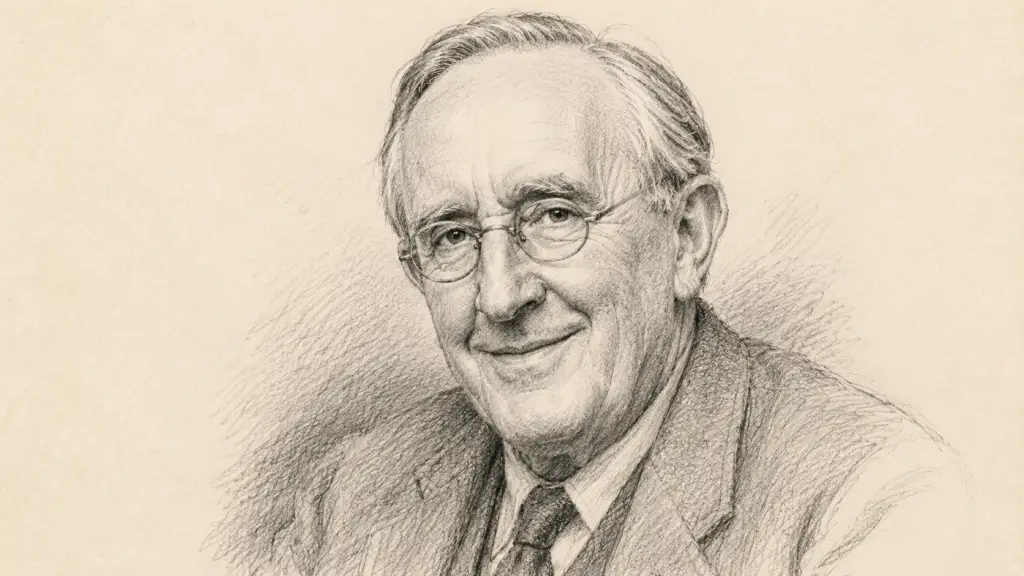
J.R.R. Tolkien did not write in one voice.
That fact gets lost surprisingly often. Discussions of “Tolkien’s style” tend to produce one image: solemn archaic prose, ancient kings, and somebody saying “lo” near a mountain. Open The Lord of the Rings, though, and the range is much wider. Hobbits gossip. Sam speaks plainly. Orcs bicker. Riders use elevated ceremonial language. Songs interrupt prose. Landscape passages slow into long cadences. Battle scenes tighten. The appendices sound like history. The prologue sounds almost ethnographic.
The variation is the point.
Tolkien was a philologist. He spent his professional life studying how languages change, how words carry history, how dialects mark communities, and how old texts sound. He did not merely invent fantasy names because fantasy requires several apostrophes and a map. He built linguistic histories and then let those histories shape culture, register, naming, poetry, and narrative depth.
This article looks beneath the surface features. We will examine his sentences, rhythm, vocabulary, dialogue, description, pacing, point of view, worldbuilding, and the strange but useful fact that a telephone directory could interest him if the names were good enough.
TL;DR: What Makes J.R.R. Tolkien’s Writing Style Unique?
- Tolkien changes register constantly. Homely hobbit speech, elevated heroic diction, historical narration, song, comic dialogue, and plain action prose coexist.
- Language creates history. Names and invented languages are not cosmetic. Tolkien designed linguistic relationships that imply migration, ancestry, contact, and cultural change.
- His prose often has an oral rhythm. His scholarship on medieval literature emphasized hearing language as sound and sense together.
- Archaic language is selective. Tolkien uses older syntax and vocabulary where a culture or scene calls for historical depth. He does not make every character speak like a rune stone.
- Landscape is active. Roads, woods, mountains, weather, water, ruins, and fields carry history and affect movement, mood, danger, and moral scale.
- He creates depth by allusion. Songs, old names, ruins, genealogies, half-explained legends, and references to earlier ages imply more history than the main plot needs to explain.
- His pacing alternates sharply. Long travel and descriptive passages sit beside compressed battles, sudden danger, songs, councils, and quiet domestic scenes.
- His best lesson for writers: worldbuilding feels deep when language, culture, history, landscape, and story imply one another. More lore is not automatically more world.
1. J.R.R. Tolkien’s Writing Style at a Glance
| Known for | Multiple registers, philological worldbuilding, mythic depth, landscape, songs and embedded history, moral seriousness, linguistic invention |
|---|---|
| Primary genres | Fantasy, children’s literature, mythopoeia, poetry, literary scholarship, translation |
| Sentence style | Highly variable; plain narrative clauses, long cumulative landscape sentences, ceremonial syntax, and archaic constructions |
| Vocabulary | Ranges from colloquial modern English to deliberately archaic and Germanic-rooted diction |
| Dialogue | Strongly differentiated by culture, class, age, region, and historical register |
| Description | Geographic, ecological, historical, atmospheric, and often directional |
| Point of view | Mostly third-person narration with variable distance; often anchored to hobbit perception |
| Pacing | Elastic; leisurely journeys and descriptions alternate with compressed danger and battle |
| Best works for studying the style | The Hobbit, The Lord of the Rings, The Silmarillion, “Leaf by Niggle,” “On Fairy-Stories,” and his letters and translations |
| Best lesson for writers | Do not merely invent a world. Invent the histories and habits that make its language sound as if people have been living there before page one. |
A Storyloft Style Profile
- Sentence length: Highly variable
- Vocabulary: Plain to archaic and elevated
- Narrative distance: Moderate, often tied to hobbit perception
- Description: Rich and geographically precise
- Dialogue: Extensive and strongly differentiated
- Pacing: Deliberately elastic
- Syntax: Flexible, sometimes consciously archaic
- Interiority: Moderate; often expressed through action, speech, and narrator proximity
2. Where Did J.R.R. Tolkien’s Writing Style Come From?
Language came before Middle-earth
The Tolkien Estate’s scholarship archive summarizes the professional foundation clearly: Tolkien taught Old English, Middle English, Old Norse, Gothic, Medieval Welsh, and Germanic philology. Language history was not a hobby added to his fiction. It was his field.
In a 1964 letter to Christopher Bretherton, Tolkien described himself as primarily a scientific philologist and traced his invented languages back to childhood. In another letter, to W. H. Auden, he explained how Welsh, Finnish, Gothic, and other languages gave him distinct forms of linguistic pleasure.
This reverses the normal fantasy-writing process. Tolkien did not finish a map and then ask what the elves should call the river. Languages often generated the stories that needed a world.
Medieval literature trained his ear
Tolkien’s work on Beowulf, Sir Gawain and the Green Knight, Old English verse, and medieval romance shaped his sense of rhythm, alliteration, heroic diction, elegy, and historical depth.
The Tolkien Estate’s material on Beowulf notes Tolkien’s taste for rhythmical prose based on natural speech patterns as well as selectively archaic diction and grammar.
World War I and the long shadow of loss
Tolkien served in the First World War and fought at the Somme. The Estate timeline records how war, illness, and the deaths of close friends overlapped with the beginnings of his legendarium.
It would be crude to reduce Mordor to the Somme or assign every fictional event a wartime counterpart. Tolkien resisted simple allegory. But loss, endurance, ruined landscapes, fellowship, mortality, and the collapse of old worlds are difficult to separate from the emotional weather of his century.
Nature was not scenery
Tolkien loved trees, countryside, gardens, and particular landscapes. His work repeatedly opposes forms of making that cultivate living things to forms that dominate and mechanize them. That distinction shapes both imagery and plot.
3. How J.R.R. Tolkien’s Style Developed
The early legendarium: high myth and compressed history
The stories that became The Silmarillion began as mythic and linguistic invention. Their narrative voice is often elevated, compressed, and historically distant. Generations can pass in paragraphs.
The Hobbit: the conversational storyteller
The Hobbit uses a much more openly conversational narrator. The voice jokes with the reader, comments on Bilbo, and handles danger with a storyteller’s flexibility. The book shows that Tolkien could be light, comic, and direct.
The Lord of the Rings: registers begin to stack
The sequel grows from the domestic speech of the Shire toward the older linguistic worlds of Rohan, Gondor, Mordor, Lórien, and the ancient past. The style rises and falls with that journey.
This is a major structural effect. Frodo does not simply travel farther across a map. The language moves farther from the modern familiarity of Bag End.
Later revisions: endless attention to language and history
Tolkien revised names, linguistic histories, genealogies, cosmology, chronology, and prose throughout his life. His letters repeatedly reveal a mind that did not regard invented facts as interchangeable. A name could force historical consequences elsewhere in the system.
4. Sentence Structure: Tolkien’s Range From Plain Narrative to High Style
The basic narrative sentence is often simpler than people remember
Many journey and action passages use straightforward subjects, verbs, conjunctions, and chronological movement. Tolkien needs the reader to know who went where, what they saw, and what happened next.
Long sentences accumulate landscape
When describing terrain, history, or a widening view, Tolkien often builds through coordinated phrases and clauses. The sentence itself travels. One feature leads the eye to another.
Archaic syntax marks register
In elevated speech, Tolkien may use inversions, older pronouns, formal clause order, or constructions uncommon in everyday twentieth-century English. These choices signal culture and historical depth.
The important point is selectivity. If every hobbit ordered breakfast in the syntax of an Anglo-Saxon elegy, breakfast would take until supper.
Parallelism creates ceremonial authority
Oaths, prophecies, songs, formal declarations, and moments of high emotion often rely on balanced clauses and repeated grammatical structures.
Sentence structure changes by speaker
Sam’s syntax, Gandalf’s, Théoden’s, Gollum’s, and an Orc’s are not interchangeable. Tolkien’s linguistic training shows not only in invented words but in how different speakers arrange ordinary ones.
5. Rhythm and Cadence: Tolkien’s Prose Was Built to Be Heard
Sound and sense belong together
In notes on translation published by the Tolkien Estate, Tolkien emphasizes the importance of “hearing” an old work rather than merely solving it word by word. He wanted the impact of sound and sense to arrive together.
That priority carries into his fiction. Alliteration, stress, repeated clause forms, and vowel patterns often make prose memorable before a reader consciously analyzes why.
Germanic stress patterns leave fingerprints
His long engagement with Old English and Middle English verse made him sensitive to strong-stress rhythm and alliteration. Elevated passages often gain power from stressed nouns and verbs rather than from a large quantity of decorative modifiers.
Songs change narrative time
Tolkien’s songs can summarize history, preserve memory, predict events, joke, mourn, teach names, or shift the emotional register. A song pauses ordinary plot while widening the world behind it.
Cadence distinguishes cultures
Rohan’s language can carry the flavor of Old English heroic tradition. Elvish material has different phonetic and rhythmic aims. Hobbit songs can be comic and domestic. Rhythm becomes cultural characterization.
6. Word Choice and Vocabulary
Tolkien cared about etymology
Words have histories. A philologist notices them. Tolkien’s diction often draws power from English words with deep Germanic roots, especially in passages of landscape, battle, kinship, weather, and grief.
Archaic does not mean obscure for the fun of it
Older words can create a historical register that modern slang cannot. But Tolkien generally uses enough context to keep the prose intelligible.
Names do structural work
In his 1951 letter to Milton Waldman, Tolkien explained that the linguistic relationships among his invented languages gave his naming system cohesion and an illusion of history.
That is the craft lesson. A name is more convincing when it belongs to a language, and a language is more convincing when it has neighbors, ancestors, sound changes, and speakers.
Different naming systems reveal cultural contact
One person or place may have several names in different languages. That tells us who met whom, who remembers what, and which culture is speaking now. The glossary is secretly doing history.
7. Paragraph Structure: How Tolkien Creates Depth and Orientation
Travel paragraphs orient the body
Tolkien often tells readers where characters are in relation to ridges, rivers, roads, gates, slopes, and horizons. Geography is not decorative description pasted between scenes. It determines the scene.
Historical allusion widens the paragraph
A ruin or name may trigger a brief reference to an older event. Tolkien frequently stops before giving the whole story. The partial explanation creates depth.
Action paragraphs tighten
When danger arrives, paragraph length often contracts. Dialogue and direct action replace panoramic description.
Ceremonial moments expand again
Funerals, councils, songs, farewells, coronations, and encounters with ancient figures receive more syntactic and paragraph space. Pacing reflects cultural importance, not only danger.
8. Description and Imagery: Why Middle-earth Feels Older Than the Plot
Landscape contains history
Ruins, old roads, mounds, abandoned towers, tree lines, place names, and altered terrain imply past civilizations and forgotten events. The present sits on layers.
Direction matters
Tolkien often describes where things lie relative to one another. Readers may not remember every coordinate, but the prose creates a sense that the map and the sentence agree.
Nature has moral and emotional agency
Forests, mountains, rivers, weather, and cultivated land are not passive stage flats. Different forms of landscape evoke hospitality, corruption, memory, danger, age, or restoration.
He often describes by succession
Characters move, and the landscape changes around them. This creates a cinematic effect without a cinematic narrator. The world is discovered at walking speed.
Historical depth is often unexplained
Tolkien learned from medieval literature that allusion can create the sense of a larger tradition even when the audience does not know every referenced story. The Tolkien Estate’s discussion of Beowulf explicitly connects this technique to The Lord of the Rings.
9. How J.R.R. Tolkien Writes Dialogue
Social register matters
Hobbits, Rohirrim, Gondorians, Elves, Dwarves, Wizards, Ents, and Orcs have different speech habits. Vocabulary, syntax, courtesy forms, humor, and metaphor reveal social worlds.
Plain characters are not stupid characters
Sam’s speech is less elevated than Aragorn’s, but that does not make his moral perception inferior. Tolkien repeatedly separates linguistic prestige from wisdom.
Formal speech can make status visible
Titles, names, lineages, greetings, and ritual forms matter in societies where ancestry and oath have political weight. Formal dialogue is worldbuilding in action.
Comic dialogue prevents the epic register from becoming airless
Hobbit complaints, Orc arguments, practical interruptions, and small jokes puncture solemnity. Tolkien understands that an epic with no one ever worrying about food would be less human and, frankly, suspicious.
Speakers can change register
Characters sometimes rise into more formal language under pressure, grief, ceremony, or courage. Register is not a permanent costume. It responds to situation.
10. Point of View and Narrative Distance
Hobbits are the reader’s scale
Much of The Lord of the Rings is experienced near hobbit perception. Ancient powers and great cities become more comprehensible because small provincial characters encounter them with curiosity, fear, appetite, and occasional confusion.
The narrator can widen into history
Tolkien can pull away from a character and speak with chronicle-like authority, then return to immediate action. That movement gives the story both intimacy and legendary scale.
Parallel narratives create dramatic irony
After the Fellowship divides, chapters follow different groups. Readers know things characters do not. The structure creates suspense while showing the war at different scales.
Distance often increases around the mythic
Ancient figures and legendary events may be presented with less psychological explanation than modern realist fiction expects. The distance preserves mystery and stature.
11. How J.R.R. Tolkien Controls Pacing
Walking is narrative work
Tolkien gives journeys time because travel changes what characters know, whom they trust, and what the landscape means. Distance becomes felt rather than merely stated.
He uses “slow” material to create attachment
Meals, songs, stories, houses, forests, and conversations make places worth defending. A world described only during battles gives the reader very little reason to care whether it survives them.
Battle can be surprisingly compressed
Some military events pass quickly compared with the pages spent approaching them. Tolkien is often more interested in courage, choice, loss, and aftermath than tactical choreography.
Alternating plot lines create propulsion
Once the Fellowship splits, switching between groups creates large-scale suspense. One storyline can pause at crisis while another advances.
Return matters as much as departure
Tolkien gives unusual weight to aftermath. The story does not simply end when the central enemy falls. Characters return to changed homes, carry wounds, say goodbye, and discover that victory does not restore time.
12. Seven Signature Techniques That Make Tolkien Sound Like Tolkien
1. Shift register with culture and circumstance
Technique: Let syntax, vocabulary, politeness, and rhythm change by speaker and setting.
Effect: Cultures sound historically distinct.
Lesson: Worldbuilding should be audible.
2. Let names imply history
Technique: Build naming patterns from linguistic relationships.
Effect: Places and people appear to belong to cultures older than the plot.
Lesson: Stop naming every fantasy town by combining “shadow,” “vale,” and a spare consonant.
3. Use unexplained allusion
Technique: Refer to earlier people, wars, songs, ruins, and stories without fully explaining each one.
Effect: The world appears larger than the current narrative.
Lesson: Backstory can be strongest when the reader sees the edge of it.
4. Make geography causal
Technique: Let terrain determine route, danger, culture, economy, and mood.
Effect: The map stops being a poster and becomes plot machinery.
Lesson: Ask what your mountains actually make difficult.
5. Alternate homely and heroic language
Technique: Place ordinary concerns beside mythic stakes.
Effect: The epic remains human.
Lesson: Let someone be hungry during history.
6. Write for sound
Technique: Use stress, alliteration, repetition, and cadence to reinforce meaning.
Effect: Elevated prose feels spoken rather than merely antique.
Lesson: Read high-style passages aloud. If your tongue files a complaint, revise.
7. Leave room for applicability
Technique: Build morally resonant situations without reducing them to one fixed allegorical code.
Effect: Readers can apply the story across times and experiences.
Lesson: A theme can be precise without turning every character into a labeled diagram.
13. What J.R.R. Tolkien Said About Writing
Languages and stories were inseparable
Tolkien repeatedly explained that invented languages were foundational to his mythology. His 1955 letter to W. H. Auden says languages and names were inextricable from the stories and that stories arrived comparatively late.
Fantasy creates a secondary world
In “On Fairy-Stories,” Tolkien develops the idea of sub-creation: the writer makes a Secondary World with an internal consistency capable of belief while the reader is inside it. The Tolkien Estate’s Verlyn Flieger essay gives an excellent introduction to this argument.
He preferred applicability to simple allegory
Tolkien distinguished fixed allegorical intent from the freedom of readers to apply stories according to their own experience. This helps explain why The Lord of the Rings can speak to industrialization, war, temptation, ecology, authoritarian power, friendship, mortality, and other concerns without functioning as a one-to-one code.
He obsessed over individual words
In his valedictory reflections, Tolkien said he would rather explore the implications of a single word or sentence than summarize an entire period. That temperament is visible everywhere in his naming and diction.
14. What Critics and Scholars Say About Tolkien’s Style
Philology is central, not peripheral
Tom Shippey’s essay on Tolkien and philology explains how language history, textual editing, etymology, dialect, story, and mythology were connected in Tolkien’s professional discipline and fiction.
Historical depth is partly an allusive effect
Scholarship connecting Tolkien and Beowulf highlights the way old poetry refers to histories the audience may only partly know. Tolkien uses a similar technique. Readers sense vast histories beyond the page because the story behaves as though those histories are already known somewhere.
The natural world is structurally important
Critical work on Tolkien and nature emphasizes how environmental detail contributes to the reality and moral imagination of Middle-earth. Landscape is not merely there to look picturesque between inns.
The style’s variety is part of its design
Modern readers sometimes object to a passage as “too archaic” without asking who is speaking, where, and under what circumstances. Tolkien’s strongest defenders have long argued that shifts in register are deliberate and culturally meaningful.
15. Learning From Tolkien Without Copying Him
Learn: language can make culture visible
You do not need to invent six complete languages. You do need to know how different communities name people, places, strangers, authority, food, family, and the sacred.
Learn: create depth through edges
Do not explain every ruin. Let some history exist beyond the current characters’ needs.
Learn: vary register
A king at a funeral and a gardener at breakfast should not automatically use the same syntax.
Learn: give landscape consequences
Terrain should affect movement, settlement, work, culture, risk, and memory.
Do not copy: archaic words as fantasy seasoning
“Thou” is not worldbuilding. Neither is “ere,” especially if nobody knows why that character would use it.
Do not copy: enormous lore before narrative necessity
Tolkien could spend decades on philology because Tolkien was Tolkien. Your reader is currently waiting for chapter two.
16. Writing Exercises Inspired by J.R.R. Tolkien
Exercise 1: Three registers
Write the same announcement as spoken by a farmer, monarch, and soldier. Change syntax and vocabulary without making any voice a caricature.
Exercise 2: The name family
Create ten place names from one culture. Give them two or three recurring sound patterns and a small set of historical roots. Then create neighboring names that sound related but not identical.
Exercise 3: The unexplained ruin
Write 400 words in which travelers pass a ruined structure. Give only three clues to its history. Do not explain the whole event.
Exercise 4: Walk the map
Choose two points in your fictional world. Write the journey using terrain, water, roads, weather, and available shelter. Let geography alter the plan.
Exercise 5: Hear the prose
Write an elevated paragraph, then read it aloud. Remove any word you chose mainly because it looked medieval on the screen.
Exercise 6: The homely interruption
Write a solemn scene and add one practical concern: hunger, wet boots, an animal, a missing tool, an inconvenient chair. Keep the stakes intact.
Exercise 7: The old song
Write eight lines of a song known by your characters. Make the song preserve one historical fact the current culture misunderstands.
Exercise 8: Applicability, not code
Choose a theme such as temptation, industrialization, grief, or power. Design a conflict that embodies it without making any character stand for a single real-world person or event.
17. Frequently Asked Questions About J.R.R. Tolkien’s Writing Style
What is J.R.R. Tolkien’s writing style?
Tolkien’s style is highly varied. It combines plain narrative prose, conversational humor, archaic and heroic registers, songs, historical allusion, detailed landscape, and language-based worldbuilding.
Why does Tolkien sound archaic?
Some speakers and scenes deliberately use older English vocabulary or syntax to evoke historical and cultural depth. The archaic register is selective. Much of his narrative and hobbit dialogue is comparatively plain.
Was Tolkien a linguist?
He was a professional philologist specializing in the history and literature of languages, especially Old and Middle English and Germanic traditions. His academic work deeply shaped his fiction.
Did Tolkien invent languages before writing the stories?
In important cases, yes. Tolkien repeatedly said that his linguistic invention preceded much of the mythology and that languages and names helped generate the stories and cultures around them.
Why are names so important in Tolkien?
Names belong to invented language histories. Their forms imply cultural relationships, migrations, ancestry, translation, and historical change. This gives the world linguistic coherence.
How does Tolkien create a sense of history?
He uses ruins, songs, genealogies, old roads, multiple names, stories within stories, references to earlier ages, and partially explained allusions. The reader sees evidence of a past larger than the current plot.
Why does Tolkien describe landscapes in so much detail?
Landscape controls travel, danger, settlement, culture, and atmosphere. The geographic detail also gives Middle-earth physical continuity and helps old history feel embedded in place.
Is Tolkien’s prose difficult?
It varies. Some elevated passages use unfamiliar words and syntax, while many action scenes and hobbit passages are straightforward. Difficulty often increases when the narrative enters older cultural registers.
How does Tolkien use dialogue?
He distinguishes characters and cultures through register, vocabulary, courtesy, humor, syntax, and naming conventions. Dialogue is one of his most important worldbuilding tools.
What did Tolkien mean by sub-creation?
In “On Fairy-Stories,” he describes fantasy as the making of a Secondary World with coherent internal laws that can sustain belief while the reader inhabits it.
Did Tolkien intend The Lord of the Rings as an allegory?
He resisted reducing the work to a fixed one-to-one allegory and preferred the idea of applicability, in which readers find resonances according to their own thought and experience.
What can fantasy writers learn from Tolkien?
Build cultures through language and history, let landscape affect plot, vary register, imply more history than you explain, and make invented details depend on one another. Do not assume the lesson is simply “write more lore.”
18. Methodology: How We Analyzed J.R.R. Tolkien’s Writing
This article combines close reading with Tolkien’s letters, essays, biography, philological scholarship, and materials published by the Tolkien Estate. The Estate’s archives were prioritized for Tolkien’s own statements and expert commentary on his academic work.
Core texts considered include The Hobbit, The Lord of the Rings, The Silmarillion, “Leaf by Niggle,” “On Fairy-Stories,” “Beowulf: The Monsters and the Critics,” selections from his letters, and material on translation and invented languages.
The analysis distinguishes Tolkien’s different registers instead of treating all prose under a single average. That matters more here than a simplistic sentence-length statistic. A hobbit conversation, a Rider of Rohan’s formal speech, and a passage from The Silmarillion are designed to sound different.
Extended copyrighted quotation has been avoided. The article links to authorized Tolkien Estate materials and paraphrases longer arguments.
19. Sources and Further Reading
Primary sources and letters
- J.R.R. Tolkien, Letter to W. H. Auden, 7 June 1955
- J.R.R. Tolkien, Letter to Milton Waldman, 1951
- J.R.R. Tolkien, Letter to Christopher Bretherton, 1964
- J.R.R. Tolkien, “Thoughts on Translation (Beowulf)”
Biography and context
Scholarship
What J.R.R. Tolkien’s Style Ultimately Teaches Writers
Compare the craft: Brandon Sanderson on modern worldbuilding systems, and Ursula K. Le Guin on language, culture, and anthropological worldbuilding.
Tolkien’s biggest lesson is not that a fantasy novel needs a map, an invented language, and a seventeen-page appendix explaining kings.
It is that invented things become convincing when they have relationships.
A name belongs to a language. A language belongs to a people. A people live in a landscape. The landscape shapes travel and work. History changes the language. Songs remember the history badly or well. Characters inherit those songs, names, grudges, roads, ruins, and mistakes.
Then the prose changes depending on who is speaking about all of it.
That is why Middle-earth feels larger than the trilogy. Tolkien did not merely put more information behind the page. He made the information exert pressure on the words that reached the page.
For writers, that is the useful ambition. You do not need Tolkien’s quantity of invention. You need his insistence that the parts belong to one another.