George Orwell Writing Style: A Deep Analysis of His Clear Prose, Essays, and Political Language
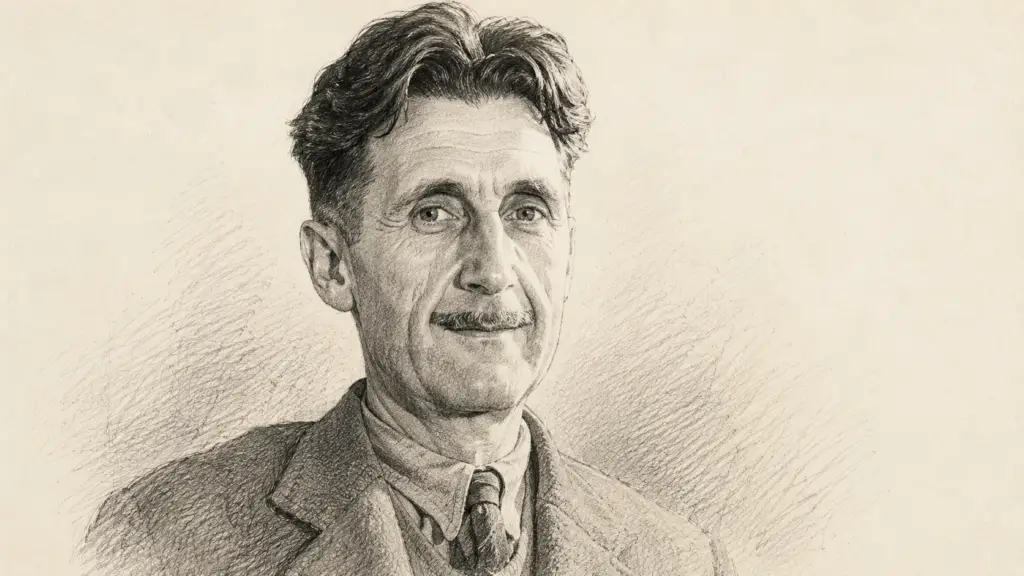
George Orwell is the patron saint of writers who would like everyone else to delete three adjectives.
That reputation is not entirely wrong. Orwell distrusted stale metaphors, inflated diction, unnecessary words, passive evasions, and phrases that allowed a writer to sound authoritative without saying anything. His 1946 essay “Politics and the English Language” remains one of the most quoted arguments for plain English.
But “Orwell wrote simply” is not enough. His best prose is clear because it is active thinking. He states a position, qualifies it, corrects himself, offers a concrete image, changes scale, and tests the idea against experience. The apparent simplicity is engineered.
Recent scholarship makes the point directly. The Oxford Handbook of George Orwell notes that Orwell praised plain style without following his own rules mechanically. Good. A writer who obeys six prose rules in every sentence has merely invented a seventh problem.
This article looks at what actually makes Orwell’s prose work: concrete nouns, argumentative movement, visual detail, self-correction, tonal control, rhythm, satire, and the close relationship he saw between clear language and honest thought.
TL;DR: What Makes George Orwell’s Writing Style Unique?
- Orwell aims for clarity, not blandness. His vocabulary is usually accessible, but the prose has personality, irony, rhythm, and sharp visual detail.
- Concrete images anchor abstract arguments. He repeatedly moves from politics, class, empire, or language to a physical object, body, smell, room, animal, meal, or action.
- His essays show thinking in motion. Orwell states, revises, concedes, contradicts, and tests his own claims. The reader watches judgment being made.
- He distrusts prefabricated language. Dead metaphors and ready-made phrases are dangerous because they let writers avoid choosing what they actually mean.
- Plain style is ethical for him. Vague language can hide responsibility. Euphemism can make violence easier to discuss without seeing it.
- His fiction uses the same precision differently. Animal Farm depends on fable-like compression; Nineteen Eighty-Four uses concrete realism to make ideological abstraction physically oppressive.
- He breaks his own rules. Orwell can write long sentences, use passive constructions, and employ elaborate rhetoric when the passage needs them.
- His best lesson for writers: know what you mean before reaching for a phrase that already means it for you.
1. George Orwell’s Writing Style at a Glance
| Known for | Plain style, concrete imagery, political essays, satire, eyewitness reporting, moral clarity, self-questioning |
|---|---|
| Primary genres | Essays, journalism, reportage, political fiction, satire, realist fiction, criticism |
| Sentence style | Usually direct and syntactically transparent, with longer argumentative sentences when qualification is needed |
| Vocabulary | Common, concrete, Anglo-Saxon-leaning when possible; technical or abstract terms used selectively |
| Dialogue | Functional and socially marked; less central than narrative and essay voice |
| Description | Concrete, sensory, observant, often deliberately unpleasant |
| Point of view | Strong first-person essay voice; observational reportage; close third-person fiction |
| Pacing | Argument-driven in essays; compressed in satire; steady and increasingly claustrophobic in Nineteen Eighty-Four |
| Best works for studying the style | “A Hanging,” “Shooting an Elephant,” “Politics and the English Language,” Homage to Catalonia, Animal Farm, and Nineteen Eighty-Four |
| Best lesson for writers | Concrete language forces you to see what your abstractions are actually claiming. |
A Storyloft Style Profile
- Sentence length: Short to moderate, with argumentative variation
- Vocabulary: Plain and concrete
- Narrative distance: Close in essays; controlled in fiction
- Description: Selective and physical
- Dialogue: Moderate
- Pacing: Brisk at paragraph level
- Syntax: Transparent but not simplistic
- Interiority: High in personal essays, moderate in fiction
2. Where Did George Orwell’s Writing Style Come From?
Eric Blair before George Orwell
George Orwell was born Eric Blair in India in 1903 and grew up in England. The Orwell Foundation traces his early life through imperial institutions, school, service in Burma, poverty, journalism, and war. Those experiences gave him a recurring subject: the gap between respectable language and physical reality.
Burma: seeing imperial language from the inside
Orwell served in the Indian Imperial Police in Burma. Later essays such as “Shooting an Elephant” turn empire into a scene rather than a slogan. A crowd watches. An animal stands in a field. A colonial officer performs authority while privately feeling trapped by it.
The scene teaches a lasting Orwellian method: if a political idea is real, it should be visible in what people actually do.
Poverty and documentary writing
Down and Out in Paris and London and The Road to Wigan Pier draw on observation of poverty, labor, lodging, food, smells, wages, rooms, and bodies. Orwell’s social argument is strongest when attached to material fact.
He does not write “poverty is dehumanizing” and consider the matter concluded. He shows the sink.
Spain and the politics of truth
The Spanish Civil War was decisive. In “Why I Write”, Orwell says the events around 1936–37 clarified his political direction. His later writing became increasingly concerned with propaganda, ideological distortion, and the possibility that language could make lies feel normal.
Literary ambition never disappeared
Orwell sometimes gets reduced to a journalist with strong opinions about adjectives. He wanted more than efficient communication. He explicitly wanted to make political writing into an art. The aesthetic ambition matters because his best essays depend on scene, timing, image, voice, and structure as much as argument.
3. How George Orwell’s Style Developed
Early novels: searching for the right form
Orwell’s early realist novels vary in success. The Cambridge Introduction to George Orwell argues that his essays and documentary works became the forms best suited to the clear, direct style he developed.
The essay becomes his natural instrument
In essays such as “A Hanging,” “Shooting an Elephant,” and “Such, Such Were the Joys,” Orwell joins personal experience to argument. He does not begin with a theorem and bolt an anecdote onto it. The argument grows from the scene.
Animal Farm: radical compression
Animal Farm strips political history into fable. Characters are types, but not merely labels. Repetition, slogans, rule changes, and simple narrative syntax show how language can mutate under power.
The plainness is strategic. A baroque allegory about propaganda would have been an impressive own goal.
Nineteen Eighty-Four: plain prose inside a distorted world
The novel’s language is generally accessible while the society it describes works to corrupt meaning. This creates a useful contrast. The narration gives readers enough concrete reality to recognize what Newspeak and propaganda are trying to remove.
4. Sentence Structure: Why Orwell’s Prose Feels Clear
Grammar usually reveals the actor
Orwell prefers sentences in which subjects do things. This is one reason his prose feels responsible. The grammar often makes agency visible.
But passive voice is not actually forbidden
“Politics and the English Language” criticizes habitual passive constructions because they can obscure action. Orwell himself still uses the passive when it serves the sentence. The rule is diagnostic, not criminal law.
Long sentences qualify arguments
Orwell can write long sentences when he needs to place a claim beside its limitation. Semicolons, subordinate clauses, and balanced structures let him think through exceptions.
That is why copying only his short sentences produces something that sounds less like Orwell, not more.
Lists turn abstraction into inventory
He often uses lists of concrete things to make an argument physical. Food, furniture, smells, jobs, clothes, plants, books, and habits become evidence.
Syntax supports self-correction
Orwell frequently builds a sentence that says, in effect: yes, but. The revision may happen after a dash, conjunction, or subordinate clause. That motion gives the prose intellectual honesty.
5. Rhythm and Cadence: The Beat Beneath the Plain Style
Plain does not mean rhythm-free
Orwell’s sentences often have a steady conversational beat. That steadiness makes a sudden short sentence or ugly concrete image land harder.
Parallel structures sharpen arguments
He likes balanced contrasts: one thing on one side, another on the other. The shape makes reasoning memorable without requiring decorative language.
Accumulation creates pressure
Lists and repeated clauses can build disgust, absurdity, or outrage. Orwell can sound almost biblical when he wants cumulative force. Again, the man who warned you about rhetoric knew how to use rhetoric.
Irony changes the cadence
Many Orwell sentences begin in the tone of calm explanation and end with a sting. The reader is carried through the reasonable surface before discovering the joke or accusation.
6. Word Choice and Vocabulary
Choose words for meaning, not prestige
In “Politics and the English Language”, Orwell attacks pretentious diction and ready-made phrases because they detach words from clear mental images.
Concrete nouns are moral tools
Orwell repeatedly replaces generalized suffering with physical facts. A person is hungry. A prisoner steps around a puddle. A body smells. A worker washes in bad facilities. Concrete language prevents the reader from keeping a comfortable distance.
He prefers familiar words but not childish ones
The aim is not to limit vocabulary. It is to avoid selecting a longer or more abstract word merely because it sounds official. Sometimes the technical word is the exact one. Use it. Sometimes “use” works better than “utilize.” Civilization survives either way.
Cliché is a thinking problem
Orwell’s objection to dead metaphors is not aesthetic snobbery. A stock phrase can arrive before the writer has pictured the thing being described. That lets language write the thought instead of the other way around.
7. Paragraph Structure: How Orwell Makes an Argument Move
One paragraph usually has one main job
Orwell’s essays are easy to follow partly because paragraph function is clear. A paragraph presents an example, develops a qualification, changes scale, or draws a conclusion.
He alternates scene and reflection
In narrative essays, concrete action is followed by interpretation, then often by another concrete detail that complicates the interpretation. This keeps the essay from becoming either pure memoir or pure argument.
Paragraph endings often sharpen the point
The final sentence may contain the irony, exception, or blunt restatement. Orwell knows the end of a paragraph is a position of emphasis.
Transitions are logical rather than decorative
He often signals opposition, consequence, or concession directly. The reader rarely needs a lantern to find the argument’s next room.
8. Description and Imagery: Orwell’s Concrete World
He notices the undignified detail
Dirt, bad food, smells, cheap clothes, bodily discomfort, broken furniture, weather, animals, and machinery occur throughout Orwell’s nonfiction. These details resist sanitized political language.
Visual images test political claims
Orwell famously argues that a fresh metaphor helps thought because it creates a visual image. His own prose follows that principle. If the sentence cannot be pictured, he becomes suspicious.
Nature creates a counter-register
Orwell also writes beautifully about ordinary pleasures: toads, spring, tea, gardens, countryside, food. Those passages matter because his political writing is not only against oppression. It is attached to things he thinks ordinary people should be free to enjoy.
Satirical images simplify power
In Animal Farm, physical behavior carries political meaning. Who eats what, sleeps where, walks on how many legs, or alters which words becomes enough to show a changing regime.
9. How George Orwell Writes Dialogue
Dialogue is usually subordinate to observation
Orwell is not primarily celebrated as a dialogue stylist. In nonfiction, quoted speech often supplies evidence of class, ideology, prejudice, or social awkwardness.
Speech exposes prefabricated thought
Characters and public figures may repeat slogans or inherited phrases. The language shows where individual thought has been replaced by group vocabulary.
Animal Farm turns slogans into plot
The repeated political formulas become shorter, more distorted, and more coercive. Dialogue and slogan are not simply characterization. They show the mechanics of propaganda.
Ordinary speech can puncture ideology
Orwell often values the common phrase or practical observation that cuts through an abstract argument. He can romanticize “common sense” at times, but as a prose technique the contrast is effective.
10. Point of View and Narrative Distance
The essay voice is personal but not confessional for its own sake
Orwell uses “I” to establish where he stood, what he saw, what he misunderstood, and what he now thinks. The self is evidence under examination.
He makes himself look bad when the argument requires it
In “Shooting an Elephant,” the narrator’s compromised motives are essential. The essay gains authority by refusing to cast its speaker as a spotless hero.
Observation can move toward generalization
A physical scene becomes a political insight, but Orwell usually shows the bridge. That transition is one of his great strengths as an essayist.
Fiction narrows the reader’s access
Nineteen Eighty-Four largely keeps readers close to Winston’s limited understanding. That closeness makes the state’s ability to reshape knowledge more frightening because the reader has no secure omniscient platform outside it.
11. How George Orwell Controls Pacing
Essays move by intellectual pressure
Each example creates the need for the next thought. The argument advances because the previous claim is insufficient, not because the writer has reached paragraph seven of the outline.
Scene gives the reader relief from abstraction
When an argument becomes conceptual, Orwell often returns to an object, person, or memory. This resets attention.
Animal Farm compresses years into repeated patterns
The speed is part of the satire. Revolutionary principles mutate quickly because the story shows a pattern rather than dramatizing every meeting.
Nineteen Eighty-Four tightens toward enclosure
The novel moves from daily life and private rebellion toward surveillance, capture, interrogation, and psychological control. The available world shrinks.
12. Seven Signature Techniques That Make George Orwell Sound Like George Orwell
1. Replace abstractions with physical facts
Technique: Move from a general claim to something visible, countable, smellable, or touchable.
Effect: The argument becomes harder to evade.
Lesson: If you write “conditions deteriorated,” show one condition.
2. Let the argument correct itself
Technique: State a judgment, then acknowledge the part that resists it.
Effect: The prose feels like thought rather than prosecution.
Lesson: Put the strongest complication inside your paragraph before a critic does it for you.
3. Distrust language you did not choose
Technique: Replace clichés, stock phrases, and prestige diction with exact words.
Effect: Meaning becomes specific.
Lesson: Highlight every phrase you could imagine appearing in 10,000 other articles. Rewrite half of them.
4. Use lists as evidence
Technique: Accumulate specific items.
Effect: An abstraction turns into a material world.
Lesson: A good list is compressed reporting.
5. Make the narrator answerable
Technique: Admit bad motives, uncertainty, or contradiction when relevant.
Effect: Authority comes from scrutiny rather than pose.
Lesson: Do not polish the narrator into the only intelligent person in the room.
6. Use satire through literal change
Technique: Let rules, slogans, routines, or objects change while characters normalize the change.
Effect: Political corruption becomes visible without a speech explaining it.
Lesson: Show the policy rewriting the sign on the wall.
7. End on the concrete sting
Technique: Let a paragraph’s last line return an argument to a physical or ironic fact.
Effect: The idea lands with force.
Lesson: Check whether your paragraph ends with its strongest sentence or merely the one you wrote last.
13. What George Orwell Said About Writing
He wanted political writing to be art
In “Why I Write,” Orwell says his mature ambition was to join political purpose with aesthetic purpose. That is a better summary of his career than “avoid adverbs,” which was someone else’s crusade anyway.
Good prose should not hide the subject
His famous windowpane metaphor describes prose that allows the reader to see through to meaning. It does not require the writer to have no voice. Orwell’s own voice is unmistakable.
His six rules are escape routes from bad habits
“Politics and the English Language” advises against stale metaphor, unnecessarily long words, extra words, passive constructions where active will do, and needless foreign or technical jargon. Then Orwell gives the most important rule: break the rules rather than write something barbarous.
Exactness mattered more than picturesque writing
In “Why I Write,” Orwell describes trying in later years to write less picturesquely and more exactly. That does not mean eliminating imagery. It means refusing imagery that competes with truth.
14. What Critics and Scholars Say About Orwell’s Style
The simplicity is manufactured
The Cambridge Introduction to George Orwell describes his apparently simple prose as the result of sophisticated artistic process. That matters because “just write plainly” is not much of a lesson. Plainness itself requires selection, rhythm, and revision.
The plain style contains tension
Alex Woloch’s work on Orwell, discussed in Modern Philology, emphasizes that Orwell’s prose can both orient and unsettle the reader. His essays often dramatize a mind trying to know its own position.
His rules and practice do not perfectly match
The 2025 Oxford Handbook chapter “Orwell the Stylist” stresses that Orwell did not rigidly obey the plain-style rules he proposed. This is not hypocrisy. It is evidence that prose principles are tools rather than commandments.
The essays create an experience of thinking
The Cambridge Companion to George Orwell argues that the movement of Orwell’s thought and feeling matters as much as his individual conclusions. Readers are asked to scrutinize their own habits of judgment.
15. Learning From George Orwell Without Copying Him
Learn: make agency grammatical
When responsibility matters, name who did what. Passive voice is useful, but it is also excellent camouflage.
Learn: use concrete detail as argument
Do not add detail merely for atmosphere. Choose details that test or embody the claim.
Learn: revise ready-made phrases
If a phrase arrived fully assembled, inspect it. Cliché often means the thinking stopped before the sentence began.
Learn: let yourself be implicated
Personal nonfiction becomes more credible when the narrator is not exempt from the problem.
Do not copy: short sentences everywhere
Orwell’s clarity depends on syntactic variety. A page of uniformly short sentences can sound like a telegram from an irritated robot.
Do not copy: performative plainness
Simple words can become mannered too. Use the exact word, not automatically the shortest one.
16. Writing Exercises Inspired by George Orwell
Exercise 1: The abstraction audit
Take 500 words of nonfiction. Circle abstract nouns. For every three, replace at least one with a concrete example or action.
Exercise 2: Name the actor
Find every passive sentence in a page. Ask whether the sentence hides or merely de-emphasizes the actor. Rewrite only the evasive ones.
Exercise 3: Cliché quarantine
Highlight phrases you have seen many times before. Rewrite them from a mental picture of what you actually mean.
Exercise 4: Scene to argument
Write a 300-word scene from something you witnessed. Then add 300 words explaining what larger idea the scene changed for you. Move back to one physical detail at the end.
Exercise 5: The hostile concession
Write your strongest argument. Then add the strongest fact that complicates it. Keep both.
Exercise 6: Cut the official language
Take a press release, policy sentence, or corporate paragraph. Rewrite it so a twelve-year-old could identify who did what to whom.
Exercise 7: The useful list
Describe a social class, workplace, neighborhood, or institution using ten physical objects. Do not explain the objects until the end.
Exercise 8: Break your own rule
Create one prose rule for the piece you are revising. Then identify the exact paragraph where violating it improves the writing.
17. Frequently Asked Questions About George Orwell’s Writing Style
What is George Orwell’s writing style?
Orwell is known for clear, direct prose built from concrete language, visible argument, controlled irony, and relatively transparent syntax. His best work combines plain style with strong narrative voice and moral pressure.
Why is George Orwell’s prose so clear?
He usually chooses familiar words, concrete nouns, active verbs, and logical paragraph structures. More importantly, he works to clarify the underlying thought before ornamenting the sentence.
What are Orwell’s six rules for writing?
In “Politics and the English Language,” Orwell warns against stale metaphors, unnecessarily long words, extra words, passive constructions when active will do, and avoidable foreign, scientific, or jargon terms. His final rule allows writers to break any of the others rather than produce ugly or inhumane prose.
Did George Orwell always follow his own writing rules?
No. Modern scholarship explicitly notes that he did not. He used long sentences, passive constructions, rhetoric, and specialized language when useful. The rules describe habits to question, not mechanical prohibitions.
What did Orwell mean by good prose being like a windowpane?
He meant that prose should allow meaning to be seen rather than obscured by inflated or self-conscious language. His own writing proves that transparent prose can still have a strong voice.
How did journalism influence Orwell’s style?
Reporting trained his attention on observable facts, scenes, people, labor, place, and material conditions. His essays often move from witnessed detail toward political interpretation.
How does Orwell use imagery?
He uses concrete, often unglamorous images to force abstract subjects into physical reality. Fresh images clarify; stale metaphors conceal.
How is Animal Farm written?
The novel uses compressed fable, accessible syntax, repeated rules and slogans, and increasingly distorted language to dramatize political corruption.
How is Nineteen Eighty-Four different from Orwell’s essays?
It retains his concrete clarity but uses close fictional viewpoint, atmosphere, and escalating psychological enclosure. Its language makes the destruction of independent meaning part of the plot.
What writers influenced George Orwell?
Orwell wrote extensively about authors including Swift, Dickens, Kipling, H. G. Wells, and others. His own prose combines English essay tradition, journalism, documentary observation, satire, and political argument.
What can fiction writers learn from Orwell?
They can learn to make institutions visible through ordinary behavior, use concrete detail to support themes, let slogans and language changes carry plot, and keep moral questions attached to physical consequences.
What can nonfiction writers learn from Orwell?
Be exact. Show evidence. Name agency. Test your own argument. Prefer words chosen for meaning over phrases chosen for prestige. And remember that clear prose can still be art.
18. Methodology: How We Analyzed George Orwell’s Writing
This article combines Orwell’s own essays on writing with close reading, biography, and recent Cambridge and Oxford scholarship. Primary texts from the Orwell Foundation were preferred because the Foundation is officially sanctioned by the Orwell Estate and provides authoritative access to many essays.
Core works considered include “A Hanging,” “Shooting an Elephant,” “Why I Write,” “Politics and the English Language,” Down and Out in Paris and London, The Road to Wigan Pier, Homage to Catalonia, Animal Farm, and Nineteen Eighty-Four.
The analysis distinguishes between Orwell’s prescriptions and his actual practice. That distinction matters. A writer’s craft advice is evidence about intention, not proof that every sentence follows the advice.
Extended copyrighted quotation has been avoided. The article instead links readers to authorized texts and scholarship where possible.
19. Sources and Further Reading
Primary sources
- George Orwell, “Why I Write,” The Orwell Foundation
- George Orwell, “Politics and the English Language,” The Orwell Foundation
- The Orwell Foundation, Essays and Other Works
Biography and context
Scholarship
What George Orwell’s Style Ultimately Teaches Writers
Compare the craft: Ernest Hemingway on declarative prose and omission, and Jane Austen on irony, narration, and social observation.
Orwell’s most durable lesson is not “use short words.” It is more demanding: make language answer to reality.
When a sentence grows vague, ask what happened. When a phrase sounds impressive, ask what it means. When a political or moral claim becomes abstract, ask who acts, who benefits, who pays, and what the room looks like afterward.
Then write that.
Orwell’s plainness works because it is full of observation and argument. He is not removing style. He is removing the parts of style that allow thought to go missing.
That is why his prose remains useful to novelists, journalists, essayists, marketers, historians, and anyone else who has ever written “leveraging strategic synergies” when they could have said “working together.”