Virginia Woolf Writing Style: A Deep Analysis of Her Sentences, Point of View, and Stream of Consciousness
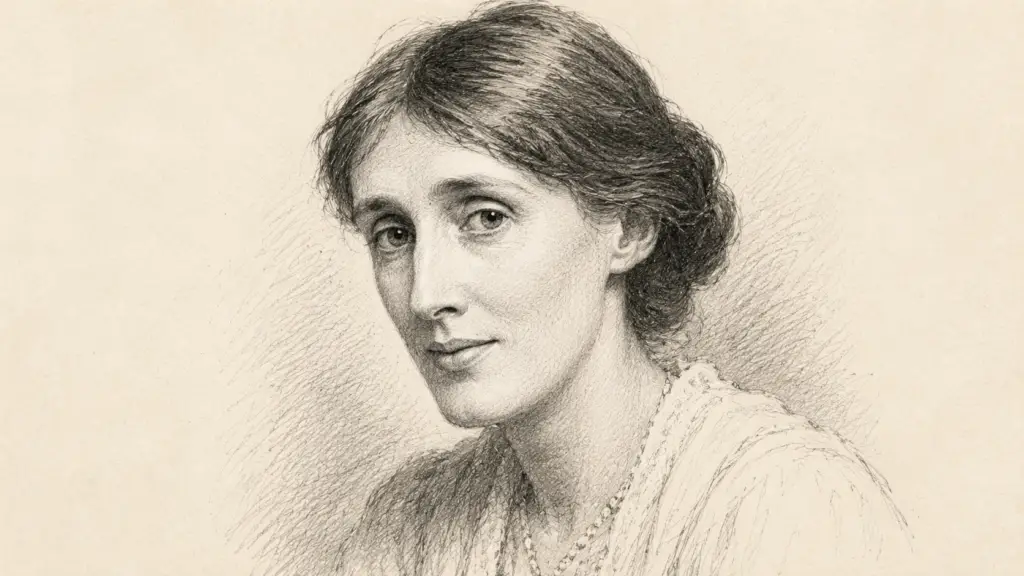
Virginia Woolf is frequently introduced with three words: stream of consciousness.
Those words are useful. They are also capable of flattening an astonishingly varied writer into a plumbing metaphor.
Woolf’s fiction does move through consciousness. But she does not simply transcribe an uninterrupted stream of private thought. She changes narrative distance. She slides into free indirect discourse. She moves from one mind to another through a sound, object, memory, street, clock, window, flower, wave, or passing car. She observes the external world closely, then lets perception alter it.
Her sentences are central to that movement. They stretch, balance, interrupt themselves, gather images, and return through rhythm. Her plots often replace conventional event chains with patterns of attention. A dinner can be a climax. A lighthouse can organize years of desire. A party can hold an entire social world. A walk across London can carry war, aging, love, class, memory, and death.
This article looks at how she does it. No mist, no reverent hand-waving. We are going into the sentences.
TL;DR: What Makes Virginia Woolf’s Writing Style Unique?
- Woolf moves fluidly among consciousnesses. Free indirect discourse lets third-person narration take on the vocabulary, rhythm, and judgments of individual characters without constant “she thought” framing.
- Her prose joins outer fact to inner perception. Streets, rooms, objects, weather, bodies, and sounds remain concrete while characters interpret them.
- Time is psychological as well as chronological. A clock may mark minutes while memory opens years inside a sentence.
- Her sentences are rhythmic structures. Repetition, parallelism, punctuation, clause length, and recurring sounds create movement that can approach poetry without ceasing to be prose.
- Objects connect isolated minds. A car, airplane, lighthouse, dinner table, flower, window, or sound may be perceived by several people, allowing the narrative to move among them.
- Plot is often redistributed into attention. Small moments become important because of what consciousness discovers in them.
- Her style changes across books. Mrs Dalloway, To the Lighthouse, Orlando, and The Waves use different formal solutions. There is no single Woolf machine.
- Her best lesson for writers: if the important event in a scene is a shift in perception, structure the prose around that shift rather than forcing an external incident to perform it.
1. Virginia Woolf’s Writing Style at a Glance
| Known for | Free indirect discourse, interiority, rhythmic prose, psychological time, shifting perspectives, modernist form, lyrical imagery |
|---|---|
| Primary genres | Literary fiction, essays, criticism, biography, memoir |
| Sentence style | Fluid and highly rhythmic; often long, parenthetical, balanced, recursive, or associative |
| Vocabulary | Concrete and sensory mixed with abstract reflection; recurring images and sound patterns |
| Dialogue | Often secondary to interior response; what is said and what is privately thought can sharply diverge |
| Description | Perceptual rather than merely objective; objects change meaning as viewpoint changes |
| Point of view | Fluid third person, free indirect discourse, multiple consciousnesses, experimental soliloquy |
| Pacing | Psychological and elastic; minutes can expand while years can collapse |
| Best works for studying the style | Mrs Dalloway, To the Lighthouse, Orlando, The Waves, “Modern Fiction,” and “Mr. Bennett and Mrs. Brown” |
| Best lesson for writers | A story can move because attention moves. External action is only one kind of event. |
A Storyloft Style Profile
- Sentence length: Moderate to long, with strong variation
- Vocabulary: Sensory, precise, lyrical
- Narrative distance: Extremely fluid
- Description: Rich but filtered through perception
- Dialogue: Moderate; often contrasted with thought
- Pacing: Highly elastic
- Syntax: Complex, rhythmic, associative
- Interiority: Very high
2. Where Did Virginia Woolf’s Writing Style Come From?
A literary household and an enormous private library
Virginia Woolf was born Adeline Virginia Stephen in 1882. Her father, Leslie Stephen, was a critic, editor, and man of letters. The Virginia Woolf Society of Great Britain describes the intellectual and literary environment in which she grew up. She was educated largely at home and had access to her father’s library.
That access mattered, but so did exclusion. Woolf became one of the great writers about who gets education, rooms, money, institutional authority, and literary inheritance because she knew those questions materially.
Victorian form gave her something to resist
Woolf admired many earlier writers, including Jane Austen and George Eliot. Her criticism of Edwardian novelists was not a declaration that older fiction had been useless. It was an argument that inherited techniques could become inadequate when they dictated where importance must appear.
Bloomsbury and cross-disciplinary modernism
Woolf’s intellectual world included painters, critics, economists, writers, and thinkers associated with the Bloomsbury Group. Visual art mattered. So did music and rhythm. Her fiction repeatedly asks how one art might teach another without simply becoming it.
The Hogarth Press expanded formal freedom
Virginia and Leonard Woolf founded the Hogarth Press in 1917. The press published Woolf’s experimental work and writers including T. S. Eliot and Sigmund Freud in English translation. Having a publishing apparatus close at hand did not make experimentation easy, but it changed what could be attempted without first persuading a conventional commercial gatekeeper.
James Joyce: influence through argument
The New York Public Library preserves Woolf’s notebook for “Modern Novels,” showing her serious engagement with Joyce’s Ulysses. She could admire phrases and the attempt to bring thought into literature while still criticizing the book. Influence often works best when the student argues back.
3. How Virginia Woolf’s Style Developed
Early novels: conventional structures begin to loosen
The Voyage Out and Night and Day retain more conventional narrative architecture than Woolf’s later fiction. They establish her interest in inner life, social performance, gender, and the limits of what people can say to one another.
Jacob’s Room: absence becomes form
Jacob’s Room breaks more decisively from traditional character presentation. Jacob is assembled indirectly through rooms, possessions, encounters, other people’s impressions, and absences. The technique asks whether a person can ever be fully possessed by narrative.
Mrs Dalloway: the city becomes a network of minds
In Mrs Dalloway, one day in London contains decades of memory. External events—a clock striking, a car backfiring, an airplane overhead—allow the narration to move among strangers and principal characters.
To the Lighthouse: time changes scale
The novel’s three-part structure makes one of Woolf’s boldest pacing decisions. Intimate domestic hours receive enormous space. Years of historical and family change are compressed into the middle section. Narrative importance is no longer proportional to clock time.
Orlando: directness, speed, and satire
Woolf’s style could also become playful and brisk. Scholarship on Orlando notes her own description of the book as an escape from some of her more solemn experiments and her sense that it taught her something about writing a direct sentence.
The Waves: rhythm becomes architecture
The Waves pushes furthest toward a hybrid of prose, lyric, dramatic voice, and recurring natural interlude. Woolf herself described writing the book to a rhythm. Critics continue to argue about what genre the result even is, which seems a respectable outcome for an experiment.
4. Sentence Structure: How Woolf Moves Through Thought
Clauses accumulate perception
Woolf’s longer sentences often begin with a physical fact, gather association or memory, shift emotional direction, and return to the world altered by what has been thought.
The sentence is not simply long. It has a route.
Parentheses create simultaneous layers
Parenthetical phrases can hold private qualification, memory, social commentary, or another angle on the main clause. They reproduce the feeling that attention has more than one channel open.
Semicolons and conjunctions maintain flow
Instead of stopping every perception with a period, Woolf often links units so that consciousness feels continuous. Punctuation controls whether a thought breaks, swells, turns, or brushes against another.
Direct sentences provide contrast
Woolf can also be blunt. Short statements gain strength because they interrupt more fluid textures. Her prose does not float continuously at one lyrical altitude.
Sentence shape is part of literary form
In A Room of One’s Own, Woolf famously imagines books as structures built from sentences rather than simple rows of them. Recent scholarship in Sentencing Orlando takes that idea seriously: sentence form is aesthetic, historical, and political material.
5. Rhythm and Cadence: Why Woolf’s Prose Approaches Poetry
Rhythm can organize a whole book
In The Waves, rhythm is not merely local musicality. Cambridge scholarship describes the book’s repeated surge-and-ebb pattern across soliloquies and interludes. Form itself behaves rhythmically.
Aural recurrence binds prose
Repeated words, consonants, vowel sounds, sentence openings, and image patterns create continuity across paragraphs. Oxford scholarship on Woolf and poetry identifies aural recurrence as one of the poetic tools increasingly important in her fiction.
Parallel syntax can imitate recurrence
A character returns to an idea with slightly different phrasing. A pattern repeats but changes. That mirrors one of Woolf’s central subjects: life is recurrent without being identical.
Rhythm can cross characters
In The Waves, different voices can share patterns even as their personalities remain distinct. Rhythm becomes a formal way to explore individuality and collective life at once.
Sound should not erase sense
Woolf’s best lyrical sentences remain attached to perception. Copying the music without the perceptual logic produces something closer to incense smoke in paragraph form.
6. Word Choice and Vocabulary
Concrete objects anchor abstraction
Flowers, gloves, windows, waves, clocks, lamps, streets, meals, hats, doors, trees, and water recur because consciousness needs something to perceive.
Ordinary words can become charged through repetition
Woolf does not require rare vocabulary to create lyric intensity. Repetition and context can make a common noun accumulate emotional force.
Metaphor models mental experience
Her figurative language often gives physical shape to attention, time, emotion, isolation, or social pressure. The metaphor is not merely visual decoration. It models an otherwise difficult mental relation.
Vocabulary changes with consciousness
Free indirect discourse allows the narration to pick up a character’s social vocabulary, assumptions, tastes, irritation, snobbery, longing, or fear without placing every thought in quotation marks.
Abstract thought and sensory detail remain in contact
Woolf can move quickly into philosophy, but her strongest passages return the abstraction to a room, body, sound, or object. Cambridge work on Woolf’s realism stresses this double process of fact and vision.
7. Paragraph Structure: How Woolf Moves Without Announcing Every Move
A shared object can become a bridge
One character notices a sound. Another hears it elsewhere. The paragraph or section moves with the stimulus. The city becomes a network rather than a sequence of isolated monologues.
Paragraphs can begin outside and end inside
A physical observation opens the passage. By its end, memory or private judgment has taken over. The boundary between description and interiority becomes porous.
White space changes temporal scale
Section breaks, chapter architecture, and the radically compressed “Time Passes” portion of To the Lighthouse show that Woolf’s pacing operates well above sentence level.
Paragraphs may follow association rather than topic
Traditional expository writing wants a paragraph to stay on subject. Woolf’s fictional paragraphs often stay on consciousness instead. The subject changes because the mind changes.
8. Description and Imagery: The World as Perceived, Not Merely Recorded
Objects are objective and subjective at once
A flower exists. So does what Clarissa thinks about it. Woolf does not force a choice between the external world and inner interpretation. Her realism depends on both.
Light changes meaning
Light, reflection, water, windows, and changing weather let Woolf describe perception as unstable. The same place becomes different because time and consciousness move.
Images connect people who cannot fully know one another
Cambridge scholarship on Woolf and intersubjectivity notes how shared external objects can create a functional relation among isolated consciousnesses. Characters may never literally enter one another’s minds. The reader can see the pattern between them.
The image often replaces explanation
Woolf may let an object or sensory event carry an emotion that a character cannot formulate directly. This keeps interior fiction from becoming a transcript of everyone explaining themselves.
9. How Virginia Woolf Writes Dialogue
Speech and thought rarely match perfectly
Social conversation is often a performance. A character says something polite while privately remembering, judging, panicking, or drifting elsewhere. The distance between spoken and unspoken material creates irony and sadness.
Dialogue can trigger interior movement
A simple remark may release a memory extending far beyond the conversation. The spoken line is small; its mental consequence is large.
Social class is audible
Vocabulary, assumptions, politeness, topics, and forms of address reveal education and status. Woolf’s social world remains sharply observed even when narration is highly interior.
Conversation can fail beautifully
People in Woolf often want connection and fail to say the thing that would create it. The failure is not wasted dialogue. It is the scene.
10. Point of View and Narrative Distance
Free indirect discourse is more accurate than “constant stream of consciousness”
Woolf is commonly grouped with stream-of-consciousness writers, but that label can blur technical distinctions. Cambridge scholarship on Woolf and realism emphasizes her preference for free indirect speech because it allows objective observation and imaginative interpretation to coexist.
The narrator can enter a mind without disappearing
In free indirect discourse, third-person narration takes on features of a character’s thought without explicit tags. That allows rapid changes in distance.
Viewpoint can migrate between people
Mrs Dalloway is famous for transitions in which a shared stimulus lets narration pass from one consciousness to another. The reader experiences a social world that no single character can see in full.
The reader knows the pattern characters cannot
Different minds remain private to themselves, but the novel can place them side by side. The reader becomes the location where the separate experiences meet.
Distance is emotional control
Woolf can move close to a sensation, then pull back toward social observation or panoramic narration. This prevents interiority from becoming claustrophobic in the same way at all times.
11. How Virginia Woolf Controls Pacing
Clock time and mental time compete
Mrs Dalloway repeatedly uses clock strikes to remind readers that public time continues even while private memory expands. Minutes are measurable. Experience is not.
Small events can occupy large space
Buying flowers, preparing dinner, knitting, looking through a window, or walking through a city can become narratively large because perception is active.
Years can disappear quickly
To the Lighthouse performs the reverse operation in “Time Passes.” Major events can be compressed while an empty house and the passage of time take prominence.
Rhythm replaces some conventional suspense
The reader may continue not because a mystery must be solved but because emotional and perceptual patterns are approaching a point of resolution.
Returns create structure
Repeated places, objects, memories, phrases, and desires make later scenes answer earlier ones. The climax can be recognition rather than surprise.
12. Seven Signature Techniques That Make Virginia Woolf Sound Like Virginia Woolf
1. Move through a shared stimulus
Technique: Use a sound, object, or public event to transfer narrative attention between characters.
Effect: Separate minds become part of one social field.
Lesson: POV transitions do not always need a chapter break and a name in bold.
2. Let syntax follow attention
Technique: Allow clauses, parentheses, and associations to expand or turn as thought changes.
Effect: The sentence feels mentally alive.
Lesson: Complex syntax needs a perceptual route, not just more punctuation.
3. Put public time against private time
Technique: Anchor scenes with clocks, schedules, meals, daylight, or appointments while memory alters experienced duration.
Effect: Time becomes both social and psychological.
Lesson: A five-minute scene can contain fifty years if the trigger is earned.
4. Make objects carry relationships
Technique: Let several characters perceive the same object differently.
Effect: The reader sees both common reality and private interpretation.
Lesson: One flower can do more work than four paragraphs explaining compatibility.
5. Use repetition as form
Technique: Return to images, sounds, phrases, and situations with variation.
Effect: Recurrence creates rhythm and thematic development.
Lesson: Repetition is not redundancy when the context changes the meaning.
6. Let conversation fail
Technique: Contrast spoken politeness with private thought.
Effect: Social scenes gain subtext and emotional tension.
Lesson: Sometimes the important line is the one the character edits before speaking.
7. Scale plot to consciousness
Technique: Give narrative space according to perceptual importance rather than external spectacle.
Effect: Ordinary life becomes capable of carrying major drama.
Lesson: You do not have to set the kitchen on fire because someone finally understands their mother.
13. What Virginia Woolf Said About Writing
Fiction should follow life where it actually seems important
In “Modern Fiction”, Woolf challenges inherited assumptions about proper plot and material. She argues for attention to the shifting impressions of an ordinary mind and resists the idea that fiction has one authorized method.
Character demanded new forms
In “Mr. Bennett and Mrs. Brown”, Woolf frames the novelist’s task around catching human character. Her disagreement with Edwardian fiction concerns not detail itself but which details reveal a person.
The novel’s shape matters
Woolf’s critical writing repeatedly imagines fiction architecturally. Sentences build a larger form. A novel is not simply a sequence of individually nice lines.
No method should become compulsory
Her modernist argument is sometimes mistaken for a new rulebook. It is almost the opposite. Woolf’s essays defend experiment because life is not obliged to conform to existing fictional machinery.
14. What Critics and Scholars Say About Woolf’s Style
Free indirect discourse joins fact and vision
Cambridge work on Woolf’s realism argues that free indirect discourse allows her to preserve the material world’s objectivity while also interpreting it through consciousness. She is not abandoning reality for thought. She is showing how the two interact.
Her narration explores intersubjectivity
Scholars have examined how Woolf moves among minds while preserving the fact that people cannot completely possess one another’s inner lives. Shared objects and narrative juxtaposition create connection without magical total understanding.
The Waves is structured by rhythm
Both Cambridge and Oxford scholarship emphasize the book’s rhythmic and poetic organization. Its alternation between natural interludes and character soliloquies creates formal recurrence across an entire lifespan.
Sentence form has political implications
Recent work on Woolf’s sentences connects formal experimentation to gender and literary inheritance. Her question is not only “How can I write a new sentence?” but also “Whose sentence did I inherit, and what experience was it built to contain?”
15. Learning From Virginia Woolf Without Copying Her
Learn: free indirect discourse is a precision tool
Use it to let narration absorb a character’s language and judgment without announcing every thought.
Learn: give perception a trigger
Memories feel more convincing when a sound, object, smell, place, or phrase releases them.
Learn: make time elastic on purpose
Spend more prose on what matters psychologically and less on what merely takes longer chronologically.
Learn: build patterns across scenes
Return to images and phrases so later contexts transform earlier meanings.
Do not copy: long sentences without architecture
Woolf’s clauses have relationships. A 78-word sentence is not automatically modernist. Sometimes it is simply lost.
Do not copy: interiority without external anchors
Her minds remain connected to rooms, streets, bodies, objects, clocks, weather, and other people. Pure abstraction quickly becomes fog.
16. Writing Exercises Inspired by Virginia Woolf
Exercise 1: The shared object
Place three characters in the same public space. Let each notice the same object. Move viewpoint among them through the object without using a section break.
Exercise 2: Five minutes, twenty years
Write a five-minute scene in which one sensory trigger opens a memory from decades earlier. Return clearly to present time by the end.
Exercise 3: Free indirect conversion
Write 300 words of close third person using repeated “she thought” and “he wondered” tags. Rewrite it using free indirect discourse while keeping viewpoint clear.
Exercise 4: Sentence route
Write one long sentence that moves from physical observation to memory to judgment and back to the physical world. Every clause must have a reason for following the previous one.
Exercise 5: Spoken versus thought
Write a polite conversation between two people who are privately furious. Alternate speech with close narration without letting either person say the central grievance.
Exercise 6: Time compression
Write 400 words covering five years. Give the largest historical event only one sentence. Let an ordinary object record the passage of time.
Exercise 7: Rhythmic revision
Read a page aloud. Mark repeated sentence lengths and stress patterns. Change three sentences so the rhythm responds more closely to emotion.
Exercise 8: The ordinary climax
Write a scene in which the decisive event is a change in perception. No death, explosion, confession, proposal, arrest, or surprise inheritance allowed.
17. Frequently Asked Questions About Virginia Woolf’s Writing Style
What is Virginia Woolf’s writing style?
Woolf’s style combines fluid point of view, free indirect discourse, interiority, rhythmic sentences, sensory imagery, psychological time, and modernist experimentation with narrative form.
Did Virginia Woolf use stream of consciousness?
Yes, but the label is broad. Much of her fiction is more precisely described through free indirect discourse and fluid third-person narration rather than continuous direct transcription of thought.
What is free indirect discourse in Virginia Woolf?
It is third-person narration that takes on the language, judgments, and rhythms of a character’s thought without explicit tags such as “she thought.” It lets narration move close to consciousness while retaining flexibility.
Why are Virginia Woolf’s sentences so long?
Long sentences allow perception, memory, qualification, and association to remain connected. Their length is functional. Woolf also uses short sentences when interruption or emphasis requires them.
How does Woolf use time?
She contrasts public chronological time with private psychological time. A few seconds can open decades of memory, while years can be compressed into a short section.
Why is Mrs Dalloway set in one day?
The narrow chronological frame lets Woolf show how a single day can contain multiple lives, memories, social structures, and histories. Clock time creates pressure against the expansiveness of consciousness.
What makes The Waves experimental?
The novel alternates recurring natural interludes with stylized soliloquies from six characters. Rhythm, repetition, and lyrical pattern take on structural roles normally handled by conventional plot and narration.
How does Virginia Woolf move between points of view?
She often uses shared sensory stimuli, objects, places, or public events as bridges. Free indirect discourse allows the narrative voice to absorb one character’s perspective and then shift toward another.
Is Virginia Woolf’s prose poetic?
Often, yes, in the sense that it uses aural recurrence, rhythm, figurative language, and patterned imagery. But it remains prose and is usually anchored to narrative perception and structure.
What did Virginia Woolf believe fiction should do?
Her essays argue for freedom from rigid conventions about proper plot and subject. Fiction should find forms capable of representing the shifting importance and texture of lived experience.
Who influenced Virginia Woolf?
Her literary formation included Shakespeare, Jane Austen, George Eliot, Russian novelists, and contemporaries such as James Joyce, among many others. Visual art and modernist experimentation also shaped her formal thinking.
What can writers learn from Virginia Woolf?
Writers can study her use of free indirect discourse, psychological time, rhythmic syntax, recurring imagery, external anchors for interior thought, and her willingness to let shifts in perception function as genuine plot events.
18. Methodology: How We Analyzed Virginia Woolf’s Writing
This article combines close reading with Woolf’s own essays, biographical resources, manuscript context, and scholarship from Cambridge, Oxford, and specialist Woolf sources.
Core works considered include Jacob’s Room, Mrs Dalloway, To the Lighthouse, Orlando, The Waves, “Modern Fiction,” “Mr. Bennett and Mrs. Brown,” and A Room of One’s Own.
The analysis deliberately distinguishes free indirect discourse from the broader label “stream of consciousness.” The latter remains useful as a literary-historical category, but it can conceal important technical differences in how narration represents thought.
Woolf’s copyright status varies by jurisdiction and edition. This article avoids extended quotation and uses public-domain or licensed access points for primary essays where appropriate, while linking to scholarship for technical claims.
19. Sources and Further Reading
Primary texts and archives
- Virginia Woolf, “Modern Fiction,” Great Writers Inspire / University of Oxford resource
- Virginia Woolf, “Mr. Bennett and Mrs. Brown,” Project Gutenberg
- New York Public Library, Woolf’s “Modern Novels” notebook
Biography and bibliography
Scholarship
- “Woolf and Realism,” Virginia Woolf in Context, Cambridge University Press
- “Sundered Waters: Isolated Consciousness and Ostensible Communion in Woolf’s Narration”
- “From Mrs Dalloway to The Waves: New Elegy and Lyric Experimentalism,” Cambridge
- Emily Kopley, “The Waves as ‘Saturated’ Novel,” Oxford University Press
- Sentencing Orlando: Virginia Woolf and the Morphology of the Modernist Sentence
- “The Rhythm of the Waves,” Cambridge University Press
What Virginia Woolf’s Style Ultimately Teaches Writers
Compare the craft: Jane Austen on free indirect discourse and Toni Morrison on memory, voice, and fragmented time.
Woolf’s fiction teaches that consciousness is not a pause in the story.
Attention can be action. Memory can change the stakes of a room. An object can connect people who never speak. A sentence can hold public fact and private interpretation at the same time. A novel can give ten pages to dinner and one line to a death if that is the shape experience demands.
Her work also teaches discipline. Fluid prose is not formless prose. The best Woolf sentences have direction. Her recurring images have patterns. Her viewpoint shifts have bridges. Her experiments are structures, not accidents.
That is the part worth learning.
Do not try to make your prose “Woolfian.” Decide whose mind the sentence is near, what that mind notices, what physical world remains outside it, and how time feels from inside the moment. Then choose the syntax that can carry that movement.
The result may look nothing like Virginia Woolf. Excellent. She would probably have preferred the experiment.