Ursula K. Le Guin Writing Style: A Deep Analysis of Her Prose, Rhythm, and Worldbuilding
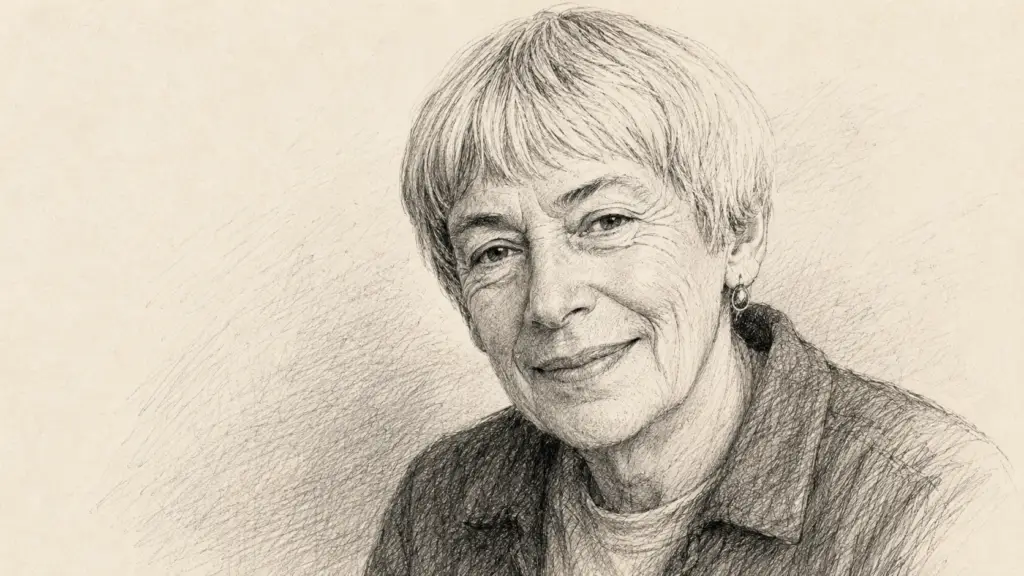
Ursula K. Le Guin could write about dragons, anarchist societies, gender, marriage, revolution, old age, magic, anthropology, grief, and household work without making any of them feel like topics assigned by committee.
That range came from a style built on a few durable habits. She listened to sentences. She treated point of view as an ethical choice, not just a camera position. She built worlds through social relations rather than inventories. She distrusted the idea that every story must be organized around conquest. And she believed craft was learnable.
Le Guin is often praised for worldbuilding. Fair enough. She was excellent at it. But the phrase can obscure what makes the worlds work. Earthsea, Gethen, Anarres, Urras, and the Kesh culture do not feel convincing because Le Guin wrote more lore than everyone else. They feel convincing because language, custom, labor, kinship, landscape, belief, and power fit together.
This article takes that method apart. The goal is not to turn your next paragraph into counterfeit Le Guin. That would miss the point rather spectacularly. The goal is to understand what her sentences and structures are doing, then steal the underlying questions.
TL;DR: What Makes Ursula K. Le Guin’s Writing Style Unique?
- Le Guin writes for the ear. Rhythm matters at sentence, paragraph, and narrative scale. She explicitly recommended reading prose aloud to hear problems in its flow.
- Her prose is clear without being flat. She can be plain, lyrical, formal, comic, mythic, or intimate, but the register is usually controlled rather than ornamental for its own sake.
- Point of view is one of her main tools. Le Guin argued that changing viewpoint is central to the modern novel because fiction can move readers among different perceptions of reality.
- Her worldbuilding is anthropological. Societies are built from relationships among language, work, family, ritual, economics, ecology, sex, politics, and belief.
- She treats alternatives seriously. A fictional society is not scenery behind an adventure. It is an argument that can contradict itself.
- Her stories are not always conquest machines. Le Guin challenged the assumption that narrative must center a heroic conflict, victory, or weapon-wielding protagonist.
- She respects silence and implication. Her fiction often leaves moral judgments, cultural explanations, and emotional conclusions partly in the reader’s hands.
- Her best lesson for writers: technique exists to enlarge perception. A sentence, narrator, world, or plot should let the reader see something from an angle they could not occupy before.
1. Ursula K. Le Guin’s Writing Style at a Glance
| Known for | Rhythmic prose, speculative societies, philosophical clarity, flexible point of view, mythic compression, social worldbuilding |
|---|---|
| Primary genres | Science fiction, fantasy, literary fiction, essays, poetry, children’s literature, criticism |
| Sentence style | Controlled and musical; ranges from spare declarative prose to longer meditative and ceremonial sentences |
| Vocabulary | Clear, exact, often elemental; shifts register according to culture, narrator, and genre |
| Dialogue | Economical, socially revealing, often concerned with misunderstanding across cultures or values |
| Description | Selective, ecological, physical, and culturally meaningful rather than decorative |
| Point of view | Highly flexible; first person, close third, omniscience, documentary frames, and multiple viewpoints |
| Pacing | Measured; often gives travel, thought, labor, and social observation as much weight as confrontation |
| Best works for studying the style | A Wizard of Earthsea, The Left Hand of Darkness, The Dispossessed, Tehanu, Always Coming Home, Lavinia, and Steering the Craft |
| Best lesson for writers | World, viewpoint, and sentence are connected. Change how the story sees and you change what the story can mean. |
A Storyloft Style Profile
- Sentence length: Moderate, with deliberate variation
- Vocabulary: Clear to lyrical
- Narrative distance: Flexible
- Description: Selective but resonant
- Dialogue: Moderate and purposeful
- Pacing: Measured rather than relentlessly propulsive
- Syntax: Controlled, rhythmic, often deceptively simple
- Interiority: Moderate to high, depending on work and viewpoint
2. Where Did Ursula K. Le Guin’s Writing Style Come From?
A childhood surrounded by anthropology, books, and stories
Le Guin was born Ursula Kroeber in Berkeley in 1929. Her father, Alfred Kroeber, was an anthropologist. Her mother, Theodora Kroeber, was a writer. The Oregon Encyclopedia describes the Kroeber home as full of books, music, storytelling, and discussion. Their summer home drew scientists, writers, students, and Native Californians. Myth and legend were part of family life.
It would be too neat to say: anthropologist father, therefore anthropological science fiction. Lives are messier than diagrams. Still, the connection is hard to miss. Le Guin learned early that customs are not universal, societies can be understood comparatively, and the observer’s assumptions are part of what is being observed.
That becomes a central engine of her fiction. When Genly Ai arrives on Gethen in The Left Hand of Darkness, he does not merely discover an alien culture. He discovers the limits of his own categories. The worldbuilding pushes back.
Romance languages, myth, and the long history of story
Le Guin studied Romance literature at Radcliffe and Columbia. Her formal literary education gave her a historical sense of narrative forms. Her imagination also drew on myth, folktale, fantasy, and speculative fiction. She did not treat genre as a lower shelf from which serious ideas had to be rescued.
Writers she measured herself against
In her Paris Review interview, Le Guin named Dickens, Jane Austen, and Virginia Woolf as writers she wanted to be as good as, though not necessarily like. That distinction is useful. Influence is not photocopying.
Austen helps explain Le Guin’s interest in social arrangements and the moral pressure of ordinary relationships. Woolf helps explain her attention to consciousness and fluid viewpoint. Dickens is a reminder that a novel can think seriously while still enjoying story, character, and invention.
Taoism and the suspicion of domination
Le Guin also described Taoism as deeply embedded in the structure of her thinking. Its influence appears less as doctrine than as a recurring preference for balance, reciprocity, non-coercion, change, and the limits of force.
This matters stylistically. Her plots often resist the fantasy that the strongest person solves the story by applying more strength.
3. How Ursula K. Le Guin’s Style Developed
Early speculative fiction: learning the available forms
Le Guin’s early published science fiction sometimes uses more familiar adventure structures than her later work. Even there, however, questions of culture, language, colonial contact, and moral perspective are already active.
Earthsea: compression and mythic authority
A Wizard of Earthsea is a lesson in narrative compression. Years can pass quickly. Journeys that another fantasy series might stretch across three volumes can be handled in pages. The prose has an oral, legendary quality without drowning the reader in antique furniture.
The style fits the material. Ged’s life is told as a story that has already entered history. That slight distance gives actions weight.
The Hainish novels: structure becomes argument
In The Left Hand of Darkness and The Dispossessed, Le Guin makes structure part of the philosophical work. Reports, myths, alternating chapters, documents, and shifts in perspective prevent one consciousness from owning the truth.
The Dispossessed famously organizes Shevek’s life through alternating temporal strands. That is not a clever wrapper around the plot. The structure makes readers compare beginnings with consequences and ideals with institutions.
Later work: revising earlier assumptions
One of Le Guin’s most valuable habits was her willingness to return to her own imaginative worlds and disagree with her younger self. Tehanu, written decades after the first Earthsea books, changes the center of attention. Domestic labor, women, children, injury, aging, and forms of power neglected by heroic fantasy move toward the foreground.
A mature style is not always a perfected version of the early style. Sometimes maturity means learning what your early style could not see.
4. Sentence Structure: How Le Guin Builds Clarity Without Flattening the Prose
The syntax usually carries one clear movement at a time
Le Guin can write complex sentences, but complexity rarely feels accidental. Clauses have relationships. Emphasis lands where it should. The reader is not asked to admire the scaffolding while the building is still going up.
Coordination supports balance
Her prose often places perceptions, actions, or alternatives beside one another. Coordination can create a sense of balance rather than hierarchy. That fits a body of work deeply interested in paired systems: light and darkness, freedom and obligation, masculine and feminine categories, self and other, individual and society.
Short sentences can carry mythic force
When Le Guin strips a sentence down, the result can sound proverbial. She knows the authority of a simple statement. The effect does not come from pretending to be ancient. It comes from removing whatever would weaken the stress.
Longer sentences accommodate thought
Her reflective passages often expand through qualification and comparison. The sentence becomes a place where a mind can change position while speaking. That is different from adding clauses because the writer owns several commas and feels obliged to use them.
Grammar is craft, not school punishment
In Steering the Craft, Le Guin argues that writers need technical language for grammar because these are names for their tools. Her point is practical. You cannot revise deliberately if every sentence problem is called “it sounds weird.”
5. Rhythm and Cadence: Why Le Guin’s Prose Sounds So Controlled
She listened to prose aloud
Le Guin was unusually explicit about rhythm. In a 2016 craft Q&A, she recommended reading narration aloud as one of the best ways to detect problems in the flow.
This is deceptively practical advice. The eye forgives repetition, clumsy stress, and overloaded syntax that the ear catches immediately.
Rhythm operates beyond individual sentences
Le Guin noted that prose rhythm works on larger scales than poetic meter. A paragraph can accelerate. A chapter can inhale and exhale. Repeated scene shapes can form a rhythm across a whole book.
Repetition creates ceremony
When Le Guin wants a mythic or ritual quality, she often uses repeated grammatical forms, names, images, or verbal patterns. Repetition makes language memorable because it turns information into recurrence.
Silence is part of the rhythm
Not everything is explained at the moment it appears. A cultural fact may arrive without a lecture. An emotional admission may be delayed. A section break can carry the weight of what nobody says.
6. Word Choice and Vocabulary
Elemental words do heavy work
Le Guin often favors nouns with physical or cultural weight: stone, sea, wall, hand, name, fire, road, house, cold, wind. In speculative fiction, familiar words can ground unfamiliar systems.
Invented language is selective
Her worlds contain invented names and terms, but she does not treat neologism as confetti. A new word usually marks something the culture actually needs to distinguish.
This is a useful rule for fantasy writers. If every spoon has a ceremonial Elvish name, the reader may begin rooting for the dishwasher.
Register belongs to culture
Earthsea can sound spare and legendary. The Dispossessed often uses a plainer social and political vocabulary. Always Coming Home can move among story, ethnography, song, recipe, record, and instruction. Style changes because the imagined culture changes.
Abstract ideas return to concrete life
Le Guin writes about freedom, possession, gender, ecology, and power, but her fiction usually gives those abstractions bodies. Who cooks? Who owns the room? Who crosses the border? Who has a name? Who can speak? Who listens?
7. Paragraph Structure: Thought, Image, and Movement
Paragraphs often turn on a perception
A Le Guin paragraph may begin with landscape and end in thought, or begin with an idea and resolve in a physical image. That movement keeps philosophical fiction from becoming an essay wearing a fake mustache.
She gives important images room
When an image carries thematic weight, Le Guin often avoids crowding it with explanation. The paragraph ends. The reader gets a second to look.
Exposition is distributed
World information is often spread through action, conversation, documents, customs, travel, and misunderstanding. This keeps paragraphs from becoming freight containers of lore.
Form can imitate the culture
In works such as Always Coming Home, the paragraph and section are part of a larger collage. The book does not merely describe a culture. Its documents imitate the way a culture leaves records behind.
8. Description and Imagery: How Le Guin Makes Imagined Worlds Feel Lived In
Landscape is not wallpaper
Mountains, islands, deserts, ice, walls, forests, and weather shape what people can do. Geography affects economy, movement, architecture, custom, and imagination.
She describes systems through details
A single meal can reveal scarcity. A form of address can reveal hierarchy. A room can reveal ownership. Clothing can reveal climate and gender expectations. Good worldbuilding often arrives disguised as ordinary life.
Images carry philosophical weight
Walls, shadows, journeys, hands, names, circles, and thresholds recur because they can be both physical and conceptual. Le Guin rarely needs to stop the story and announce that a symbol has entered the premises.
The unknown remains partly unknown
She does not explain away the strangeness of a world. Some customs remain opaque. Some myths contradict one another. That incompleteness makes cultures feel older than the plot.
9. How Ursula K. Le Guin Writes Dialogue
Conversation exposes assumptions
Le Guin’s dialogue is especially strong when two people believe they understand the same concept but do not. Words such as freedom, loyalty, property, sex, honor, and work change meaning across cultures.
Characters are allowed to be intellectually serious
People in Le Guin’s fiction can discuss politics or philosophy without every conversation turning into a lecture. The ideas matter because they affect friendship, hunger, sex, exile, family, ambition, and fear.
Restraint creates subtext
Her characters do not always name their feelings. Formality, silence, evasion, and changes of subject can do the work. This is particularly powerful in relationships shaped by cultural difference.
Voices reflect institutions
A bureaucrat, anarchist physicist, wizard, king, child, farmer, and envoy should not sound interchangeable. Their vocabulary and assumptions emerge from the worlds that trained them.
10. Point of View and Narrative Distance
Point of view is philosophical machinery
Le Guin did not treat POV as a formatting rule. In an online craft discussion, she argued that changing viewpoint is essential to the modern novel because it can move a reader from a single perception of reality toward multiple perceptions.
That idea describes much of her fiction.
Multiple viewpoints prevent easy certainty
A culture seen from outside looks different from the same culture seen from within. An institution can be generous to one person and suffocating to another. By changing perspective, Le Guin makes the reader perform the comparison.
Documentary forms create productive distance
Reports, myths, historical fragments, legends, field notes, and other embedded forms remind the reader that knowledge arrives through records made by somebody. There is no view from nowhere.
Narrative distance can change the emotional temperature
The Earthsea books can move from legendary distance toward painful intimacy. Later Earthsea, especially, changes what kinds of experience deserve narrative closeness.
11. How Ursula K. Le Guin Controls Pacing
She is willing to let travel take time
Walking, sailing, crossing ice, doing chores, waiting, and talking can occupy real narrative space. The journey changes the relationship among people. It is not dead air between plot points.
Compression handles what does not need dramatization
At the same time, Le Guin can move through years in a few paragraphs. She is not uniformly slow. She is selective.
Ideas can create suspense
In The Dispossessed, tension comes partly from whether an ideal society can remain true to its principles. In The Left Hand of Darkness, political and interpersonal understanding develops together. The question is not always “Who wins the fight?” Sometimes it is “Can these people learn what they are actually looking at?”
Climaxes can be recognitions
Le Guin often values understanding, sacrifice, naming, acceptance, return, or changed perception as much as physical victory. That broadens the available shapes of a climax.
12. Seven Signature Techniques That Make Ursula K. Le Guin Sound Like Ursula K. Le Guin
1. Build the world through relationships
Technique: Reveal social systems through family, labor, language, property, ritual, exchange, and daily behavior.
Effect: The setting feels inhabited rather than assembled.
Lesson: Before inventing another century of royal genealogy, ask who raises children and who washes the dishes.
2. Let point of view challenge the reader
Technique: Shift perspective so no single character’s categories remain automatically correct.
Effect: The reader must revise assumptions instead of merely collecting information.
Lesson: Use viewpoint to create epistemic tension: who can see what, and what do they misname?
3. Write for the ear
Technique: Vary stress, sentence length, repetition, and cadence.
Effect: The prose feels composed even when its vocabulary is plain.
Lesson: Read finished scenes aloud. Your mouth is an underrated copy editor.
4. Give speculative ideas ordinary consequences
Technique: Attach abstractions to work, sex, food, housing, friendship, weather, and power.
Effect: Philosophy becomes story.
Lesson: If your invented political system never affects breakfast, it may still be a PowerPoint deck.
5. Preserve ambiguity
Technique: Allow myths, cultures, motives, and institutions to remain partly contradictory.
Effect: The fictional world resists reduction to a thesis.
Lesson: Explain enough for orientation. Leave enough unresolved for life.
6. Change the scale of heroism
Technique: Treat care, endurance, compromise, learning, and relationship as narratively important actions.
Effect: Conflict is no longer the only available source of meaning.
Lesson: Ask what your story considers an action. You may have inherited a narrower answer than you need.
7. Revise your own worldview
Technique: Return to earlier fictional systems and expose what their original frame omitted.
Effect: The body of work develops intellectually rather than merely accumulating sequels.
Lesson: Consistency is useful. Intellectual fossilization is less so.
13. What Ursula K. Le Guin Said About Writing
Craft can be learned
Steering the Craft treats writing as a set of tools that can be named, practiced, tested, and improved. Le Guin’s exercises cover sound, sentence construction, repetition, point of view, and narrative control. Inspiration is welcome. It is not issued a management position.
Sound matters
Her advice to read prose aloud fits the fiction. Le Guin repeatedly returns to rhythm because the sentence exists in time. The reader may be silent, but the language still has a pulse.
Point of view changes reality
Her craft discussions insist that viewpoint is not a nuisance imposed by workshop etiquette. It is one of fiction’s great powers: the ability to inhabit more than one perception.
Story does not require a hero with a weapon
In “The Carrier Bag Theory of Fiction”, Le Guin challenges the heroic, linear story organized around domination and conquest. Her alternative values gathering, carrying, relation, and continuation.
For writers, the practical implication is enormous. Plot is not synonymous with combat. A story can be organized around keeping, finding, making, losing, caring, learning, or changing.
14. What Critics and Scholars Say About Le Guin’s Style
Anthropology is not background decoration
Biographical and critical accounts repeatedly connect Le Guin’s upbringing to her comparative approach to culture. The useful point is not that she “used anthropology.” It is that her fiction often makes the reader experience the instability of supposedly normal categories.
Philological and social detail cooperate
Le Guin’s invented terminology is embedded in social practice. Words matter because cultures classify reality differently. Naming can create power, limit perception, or reveal a relationship.
Structure carries political thought
Scholars of The Dispossessed have paid close attention to its temporal organization because the alternating structure makes comparison unavoidable. Form becomes an argument about revolution, memory, and institutional drift.
Late Le Guin revises heroic fantasy
Critical work on Earthsea often emphasizes the change represented by Tehanu and later books. The narrative center moves toward forms of labor and experience traditional heroic fantasy tends to push out of frame.
15. Learning From Ursula K. Le Guin Without Copying Her
Learn: worldbuilding is a system of relationships
Do not copy Earthsea’s islands or Gethen’s customs. Ask Le Guin’s better question: what does this society believe is normal, and who pays for that normality?
Learn: POV can test an idea
If your protagonist believes something important about the world, give the reader access to a viewpoint from which that belief looks incomplete.
Learn: rhythm deserves revision
Read the work aloud. Change sentence length on purpose. Listen for repeated stress, accidental monotony, and endings that sag.
Learn: speculation needs ordinary life
A government is not real because you named seven ministries. Show rent, work, meals, status, schools, sex, child care, travel, medicine, and argument.
Do not copy: the surface of mythic prose
Formal diction and solemn cadence can become costume. Use them only if the narrative position and imagined culture support them.
Do not copy: ambiguity without control
Le Guin leaves some things open because she knows what the competing meanings are. Confusion is not automatically mystery.
16. Writing Exercises Inspired by Ursula K. Le Guin
Exercise 1: The culture in the kitchen
Invent a society. Do not describe its government. Write 500 words about three people preparing a meal. Reveal hierarchy, property, family, gender expectations, scarcity, and belief through the scene.
Exercise 2: Two truths
Write the same public event from two characters in different social positions. Give neither narrator the final word.
Exercise 3: Read for rhythm
Read 600 words of your prose aloud. Mark every place your breath or attention stumbles. Revise only for sound and flow.
Exercise 4: Remove the lore lecture
Take a paragraph that explains your world. Delete it. Redistribute its necessary information into action, objects, speech, and misunderstanding.
Exercise 5: A nonviolent climax
Design a climax whose decisive action is a recognition, refusal, gift, confession, return, act of care, or change of allegiance.
Exercise 6: Change narrative distance
Write one moment at mythic distance, then rewrite it in close third person. Notice what each version can and cannot know.
Exercise 7: The invented word test
Circle every invented term in a fantasy or science-fiction scene. For each one, explain why ordinary English cannot do the job. Cut the terms that fail.
Exercise 8: Let the institution contradict itself
Write two scenes showing the same institution helping one person and constraining another. Do not announce the moral.
17. Frequently Asked Questions About Ursula K. Le Guin’s Writing Style
What is Ursula K. Le Guin’s writing style?
Le Guin’s style combines clear, rhythmic prose with flexible point of view, social and anthropological worldbuilding, philosophical depth, and selective lyrical language. Her register changes substantially by book, but control of cadence and perspective remains consistent.
Why is Ursula K. Le Guin considered such a good writer?
She joins ideas to narrative form. Her fiction does not merely discuss gender, power, freedom, ecology, or culture. Point of view, structure, language, and invented societies make the reader experience those questions from competing positions.
How did anthropology influence Ursula K. Le Guin?
Le Guin grew up in the household of anthropologist Alfred Kroeber and writer Theodora Kroeber. Her fiction often compares cultures without assuming the protagonist’s culture is the neutral standard. Kinship, ritual, language, labor, and social norms become central worldbuilding tools.
What writers influenced Ursula K. Le Guin?
Le Guin named Charles Dickens, Jane Austen, and Virginia Woolf as writers she measured herself against. She also drew on myth, speculative fiction, Taoist thought, anthropology, and a wide literary tradition.
How does Le Guin build worlds?
She builds from systems rather than lists. Geography, language, family, labor, politics, sex, ecology, religion, exchange, and history interact. Small daily details reveal the larger structure.
What is distinctive about Le Guin’s sentence structure?
Her syntax is usually clear and controlled, but it varies with register. She uses short declarative sentences for compression and authority, longer sentences for reflection, and deliberate rhythmic patterning across paragraphs.
Why is rhythm important in Le Guin’s prose?
Le Guin treated prose as something heard as well as seen. She recommended reading work aloud to detect problems in narrative flow and devoted substantial craft attention to the sound of language.
How does Le Guin use point of view?
She uses viewpoint to challenge certainty. Multiple narrators, embedded documents, myths, and shifts in narrative distance let readers see that the same culture or event can mean different things from different positions.
Is Ursula K. Le Guin’s prose minimalist?
Not exactly. It can be spare, but it can also be lyrical, ceremonial, humorous, or essayistic. “Controlled” is more accurate than “minimalist.” She uses as much language as the chosen narrative register requires.
What is the Carrier Bag Theory of Fiction?
It is Le Guin’s challenge to story models centered on a conquering hero and a linear conflict. She proposes a model based on containing, gathering, relation, and ongoing life. For writers, it expands what can count as plot-worthy action.
What book should writers read to learn Le Guin’s craft directly?
Steering the Craft is the clearest starting point. It covers sound, grammar, sentence construction, repetition, point of view, and revision through direct explanation and exercises.
How can writers learn from Le Guin without imitating her?
Borrow her questions, not her voice. Examine who gets a viewpoint, how culture shapes language, whether the world functions in ordinary life, what your plot defines as action, and whether the prose has an audible rhythm.
18. Methodology: How We Analyzed Ursula K. Le Guin’s Writing
This analysis combines primary craft statements, interviews, biographical material, close reading, and scholarship. Primary sources were given priority when Le Guin discussed her own method.
Core works considered include A Wizard of Earthsea, The Left Hand of Darkness, The Dispossessed, Tehanu, Always Coming Home, Lavinia, selected short fiction, essays, and Steering the Craft. The goal is not to pretend that one numerical profile can summarize a career spanning nearly six decades and many genres.
Because most of Le Guin’s fiction remains copyrighted, this article does not reproduce long passages or build a corpus from unauthorized full texts. Claims about craft are based on limited close reading, legally available source material, Le Guin’s own discussions of technique, and published scholarship.
The “Style Profile” is therefore interpretive, not a laboratory measurement. It is designed to help writers compare craft tendencies across this series without mistaking literature for a blood test.
19. Sources and Further Reading
Primary sources and interviews
- The Paris Review, “Ursula K. Le Guin, The Art of Fiction No. 221”
- Ursula K. Le Guin, Steering the Craft
- Ursula K. Le Guin, “The Carrier Bag Theory of Fiction”
- Le Guin, “Navigating the Ocean of Story,” Session 1
- Le Guin, “Navigating the Ocean of Story,” Session 2
Biography and context
- Molly Gloss, “Ursula K. Le Guin (1929–2018),” The Oregon Encyclopedia
- Official Ursula K. Le Guin website
Further critical reading
What Ursula K. Le Guin’s Style Ultimately Teaches Writers
Compare the craft: J.R.R. Tolkien on language and secondary worlds, and Brandon Sanderson on systems, rules, and modern fantasy plotting.
Le Guin’s deepest craft lesson is not about dragons, science fiction, invented languages, or even worldbuilding. It is about attention.
Pay attention to the sound of the sentence. Pay attention to who is looking. Pay attention to the assumptions hidden inside ordinary words. Pay attention to who works, who owns, who speaks, who is believed, and whose experience the conventional version of the story leaves outside the frame.
Then build form around that attention.
Le Guin’s fiction can feel spacious because it does not confuse narrative force with constant acceleration. It can feel wise because it does not confuse a strong idea with a final answer. It can feel strange because the strangeness is structural, not sprayed on afterward.
For a writer, that is liberating. You do not need to sound like Ursula K. Le Guin. You need to learn what she kept asking the page to do: see farther, listen harder, and make room for more than one way of being human.