How to Write a Perfect Novel: My Complete Guide

In 2016, I was in a coffee shop in Portland. A woman slammed her laptop shut. She laughed and said, “I’ve been trying to start my novel for three years.” This moment stuck with me.
Starting a novel seems impossible at first. The blank page is scary. Your characters and plot might feel weak.
I’ve been in that place before. I stared at a cursor, feeling like I was doing it all wrong.
After coaching many writers, I saw a pattern. Finishing a novel isn’t about being more talented. It’s about following a clear process.
This guide breaks the journey into ten easy steps. You won’t get lost or overwhelmed. These techniques come from my own experience and from watching writers succeed.
Whether your idea came suddenly or has been with you forever, this guide will help. Let’s get your novel written.
Key Takeaways
- Knowing how to write a perfect novel starts with a clear, step-by-step roadmap — not raw talent or a genius idea.
- The blank page, flat characters, and plot holes are normal challenges every novelist faces, not signs you should quit.
- Proven novel writing techniques can turn even a messy first concept into a compelling, finished manuscript.
- This complete novel writing guide covers ten essential steps, from finding your story idea to completing your first draft.
- Finishing a novel is about process and consistency, not waiting for perfect inspiration to strike.
- Every great novel starts somewhere — a dream, a character’s voice, or a single “what if” question that refuses to leave your mind.
Why I Started Writing Novels and What Drives Me Forward
Every novel starts with a reason. It’s a spark that makes you want to write. I learned that knowing why you write is key to finishing a book.
Finding My Personal “Why” for Storytelling
I tried many ways to write before I found my purpose. I wanted to show real love in messy relationships. This made all the difference in my writing.
Your “why” might be different. Here are some common reasons writers write:
- Sharing a message or experience that matters deeply
- Bringing vivid characters and worlds to life
- Building a long-term author career
- Proving to yourself that you can do it
No answer is wrong. Write your reason on a sticky note and place it where you write. It will anchor you on tough days.
Overcoming the Fear of the Blank Page
The blank page scared me. But I changed my view. I started to see writing as play, not performance. This helped me overcome my fear.
The Moment Everything Clicked for Me
My breakthrough was when I stopped chasing perfection. I used my own experiences and emotions in my writing. My first draft was written in just three months.
“Start writing, no matter what. The water does not flow until the faucet is turned on.” — Louis L’Amour
| Writer Motivation Type | Strength | Risk If Unclear |
|---|---|---|
| Message-driven | Deep emotional fuel | Preachiness without focus |
| World-building passion | Rich, immersive settings | Plot stalls without story goals |
| Career ambition | Consistency and discipline | Burnout from external pressure |
| Personal achievement | Strong finish-line drive | Loss of interest after the first draft |
With your “why” in mind, you’re ready to pick a story idea. This idea should be strong enough to carry your novel.
Choosing Your Novel-Worthy Story Idea
Not every idea can carry 80,000 words. I learned this the hard way after spending months on a concept that ran out of steam by chapter five. The truth is, story idea development is the foundation of your entire project. Get it right, and the writing flows. Get it wrong, and you’ll hit a wall you can’t climb over.
So how do you know if your idea has what it takes? Let me walk you through my process.
Testing Ideas with the “What If” Question
The best novel writing tips for beginners I ever received? Frame every idea as a “what if” question. This simple trick reveals whether your concept holds real tension. Think about it:
- What if a wizard school existed alongside our ordinary world? — That became Harry Potter.
- What if a woman disappeared and framed her husband for murder? — That became Gone Girl.
- What if a farm boy discovered he was part of a galactic rebellion? — That became Star Wars.
Each question hints at conflict, stakes, and a character with something to lose. If your “what if” doesn’t spark those elements, keep digging.
Identifying Stories with Enough Conflict to Sustain a Full Novel
A novel needs layers. Your plot structure development depends on having a main character with clear goals, real obstacles, and meaningful consequences for failure. Test your idea against these three pillars before committing months of your life to it.
Pick the idea that makes you feel both excited and terrified — that’s the one worth writing.
Why Some Ideas Work Better as Short Stories
A vampire moving to a small town is intriguing. But without deeper conflict or character complexity, it might be a great short story — not a novel. Simple concepts without room for thematic exploration will leave you struggling to fill pages. Choose ideas with enough depth for real story idea development across hundreds of pages.
Understanding Genre Expectations and Reader Promises
Genre is more than just a label. It’s a promise to readers before they start reading. Romance novels promise a love story with a happy ending. Thrillers promise fast action and suspense.
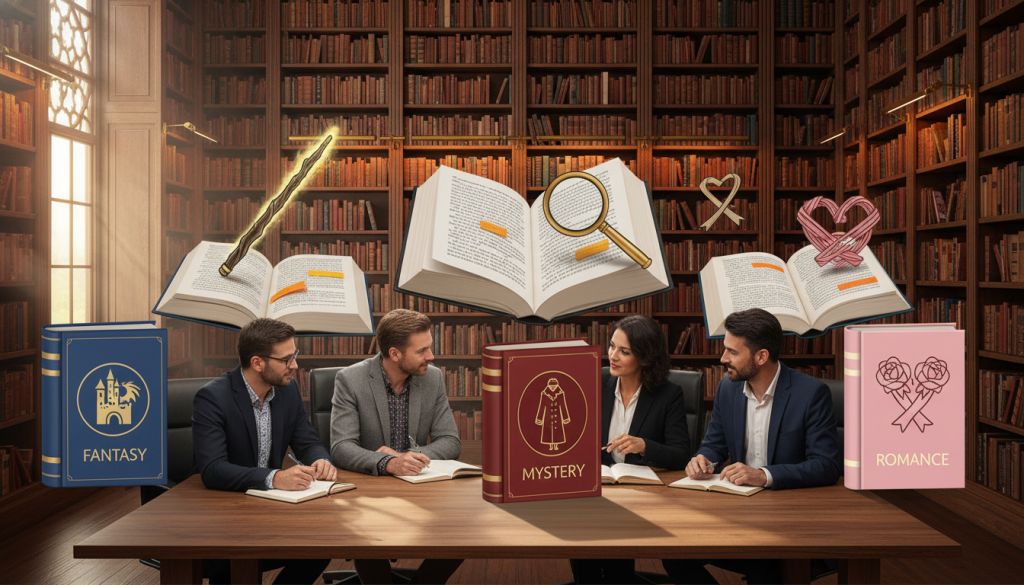
After choosing my story idea, I had to decide where it belonged. Each genre has its own rules and patterns. It’s about giving readers what they expect, not being too predictable.
“Genre is a set of reader expectations — a contract between you and your audience.” — Brandon Sanderson, bestselling fantasy author
Here’s a quick look at major genres and what readers expect:
| Genre | Core Focus | Key Reader Expectations | Typical Word Count |
|---|---|---|---|
| Romance | Central love story | Emotionally satisfying ending (HEA or HFN) | 50,000–90,000 |
| Mystery/Thriller | Suspense and crime | Clues, twists, resolution of the central puzzle | 70,000–100,000 |
| Fantasy | Magic and invented worlds | Detailed world-building, clear magic systems | 90,000–120,000 |
| Science Fiction | Technology and speculation | Plausible science, exploration of “what if” questions | 80,000–110,000 |
| Literary Fiction | Human condition | Rich prose, deep character development | 70,000–100,000 |
| Horror | Fear and dread | Escalating tension, genuine scares | 60,000–90,000 |
| Historical Fiction | Past events and eras | Accurate period details, immersive setting | 80,000–110,000 |
Early on, I did an exercise to improve my writing. I found three books similar to my idea. I studied them to learn what readers like.
Choosing a genre early helps with everything. It shapes character development, pacing, and point of view. It makes writing less scary and more focused.
Selecting the Right Point of View and Tense
Your story’s point of view and tense are key. They decide who tells your story and when. Before I start writing, I choose these carefully. Changing them later means rewriting everything.
First Person vs. Third Person Limited
Point of view writing is about how close you want readers to feel to your characters. First person makes it very intimate. You’re inside the narrator’s head, feeling their feelings.
Third person limited offers a bit more freedom. You still follow one character closely. But you can also describe things your character might not say about themselves.
“Every story whispers its own point of view to you, if you’re willing to listen.” — Ann Patchett
| Feature | First Person | Third Person Limited | Third Person Omniscient |
|---|---|---|---|
| Pronoun Used | I, me | He, she, they | He, she, they |
| Reader Intimacy | Very high | Moderate to high | Lower |
| Information Access | One character only | One character per scene | All characters |
| Popular In | YA, literary fiction | Fantasy, thrillers | Epic fiction, classics |
When to Use Present Tense for Immediate Impact
Tense selection is crucial. Past tense is common and feels natural. Present tense makes everything feel urgent, like it’s happening right now.
Suzanne Collins used present tense in The Hunger Games. It kept readers on edge.
Testing Different POVs with the Same Scene
Here’s a favorite exercise of mine:
- Pick one scene from your story
- Write it in first person, past tense
- Rewrite it in third person limited, past tense
- Try it once more in first person, present tense
See which version feels right to you. The best choice will match your voice and story.
How to Write a Perfect Novel Through Character Development
Characters are the heart of every great novel. Readers connect with them before they care about the plot. Crafting compelling characters is key for a novelist. Without strong characters, even the best ideas fail.
Creating Protagonists with Clear External Goals and Internal Needs
Creating a protagonist starts with two questions: What does this person want? and What do they actually need? The external goal is clear — like Katniss Everdeen wanting to survive the Games. The internal need is deeper — she needs to trust others.
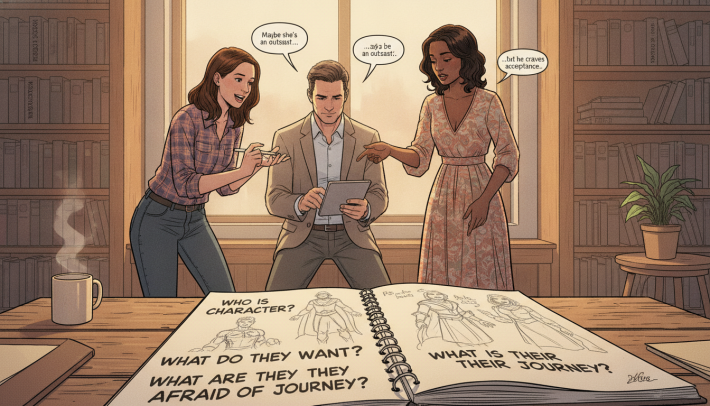
I make character profiles with background, fears, desires, and past moments. These details make their decisions feel real to readers.
Building Antagonists Who Believe They’re Right
The best antagonists aren’t evil for evil’s sake. They believe in their worldview. An antagonist can be a rival, a force of nature, or even self-doubt. What’s key is their goals clash with the protagonist’s.
The Power of Flawed Characters Over Likeable Ones
Developing characters isn’t about making them pleasant. Readers follow flawed people through many pages. A sci-fi writer said her protagonist became relatable after giving him a painful past.
| Character Element | Likeable Character | Flawed Character |
|---|---|---|
| Reader Connection | Surface-level admiration | Deep emotional investment |
| Conflict Potential | Limited internal tension | Rich internal and external tension |
| Growth Arc | Minimal room to evolve | Dramatic transformation possible |
| Memorability | Forgettable after finishing | Stays with readers for years |
Flawed characters add depth to your story. This is the secret to creating memorable protagonists.
Crafting Settings That Drive Your Story Forward
Settings are not just backdrops. They’re living, breathing elements that shape your entire narrative. I learned this the hard way when my early drafts suffered from what writers call “white room syndrome” — characters floating through vague, forgettable spaces. Once I committed to real setting development, my stories transformed.
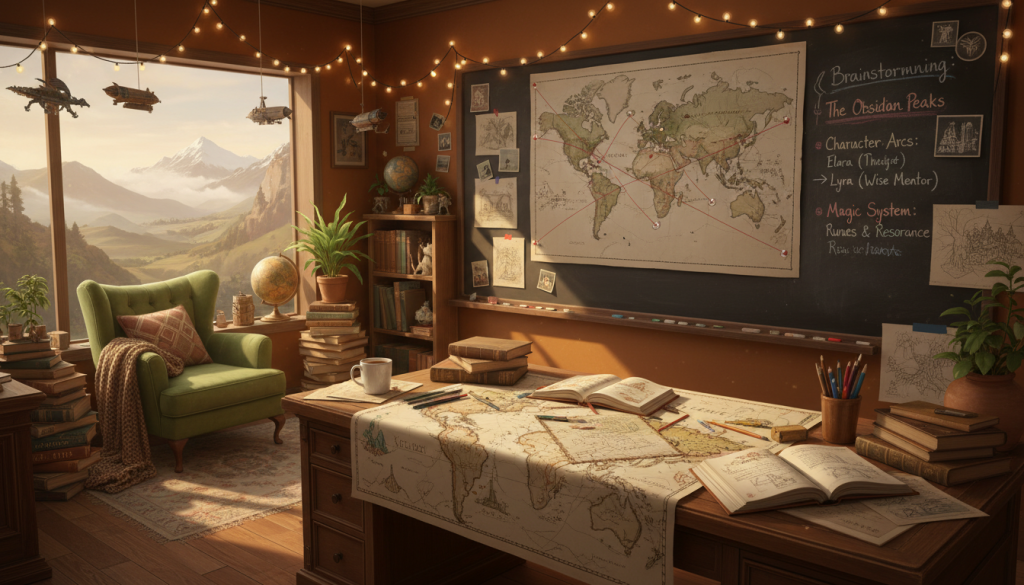
Think about it this way: a romance in a small Southern town creates completely different dynamics than the same love story in Manhattan. A mystery set in 1920s Chicago involves different laws and investigative tools than one set in present-day Los Angeles. Your setting shapes everything.
Strong world building doesn’t mean mapping out every detail before you start writing. Focus on elements that directly impact your characters and plot. Ask yourself these questions:
- Could my story happen anywhere, or does this specific place create unique challenges?
- Does my setting reflect my character’s emotional state?
- Am I using the environment to introduce natural conflict?
If your character fears water, set a crucial scene on a boat. If they’re broke, surround them with reminders of wealth. Atmospheric writing turns a location into a storytelling tool that heightens tension and deepens meaning.
Here’s a quick guide to what your setting should accomplish:
| Setting Element | Story Function | Example |
|---|---|---|
| Time Period | Defines rules and limitations | No DNA evidence in an 1890s mystery |
| Geographic Location | Shapes culture and conflict | Isolated Alaskan town limits escape routes |
| Physical Environment | Creates mood and atmosphere | A crumbling house mirrors a failing marriage |
| Social Context | Drives character motivation | Class divisions in Gilded Age New York |
The most memorable novels — think Daphne du Maurier’s Rebecca or Cormac McCarthy’s Blood Meridian — feature settings that feel like characters themselves. Through deliberate atmospheric writing and thoughtful world building, your setting becomes inseparable from your story. Now that your setting is working for you, let’s look at how to structure everything into a compelling narrative.
Mastering Story Structure Without Feeling Formulaic
A solid story structure is your best friend when writing a novel. It keeps readers hooked and prevents writer’s block. Structure is not a cage but a compass that guides you to a complete narrative.
The Essential Elements Every Novel Needs
Every great novel has key building blocks, no matter the framework. Your opening introduces a protagonist in their ordinary world. It also presents an inciting incident that disrupts everything.
The middle tests your characters with rising obstacles. The ending delivers emotional payoff through confrontation and change.
Understanding the Three-Act Structure
The three-act structure is the backbone of most successful novels. Here’s how I break it down for my own plot development process:
| Act | Portion of Novel | Purpose | Key Events |
|---|---|---|---|
| Act One (Setup) | First 25% | Introduce characters and stakes | Inciting incident, establish goals and obstacles |
| Act Two (Confrontation) | Middle 50% | Escalate conflict and test protagonist | Complications, rising stakes, difficult choices |
| Act Three (Resolution) | Final 25% | Resolve storylines and deliver emotional payoff | Climactic confrontation, character transformation |
Building Tension Through Escalating Complications
I’ve seen beautifully written drafts fall flat because the middle lacked escalation. Plot development is not just things happening. It’s things getting progressively harder for your protagonist.
Each complication should force tougher decisions and raise the personal cost of failure.
Creating Satisfying Climactic Moments
Your climax must feel earned. Readers need to see how your protagonist has changed. When you deliver that emotional resolution, readers walk away fulfilled.
When you skip it, they feel let down — even if they can’t pinpoint why.
“Structure is what allows you to be creative within a framework that actually serves your reader.”
For your first novel, map out major turning points before writing. Stay flexible enough to discover unexpected directions as your story unfolds. That balance between planning and spontaneity is something I’ll dig into next with my outlining approach.
My Approach to Outlining (And When to Ignore It)
I’m an outliner at heart. Before I start writing, I need a plan. But, my writing has shown me that plans can change. Not every writer needs a detailed plan, and that’s okay.
The Plotter vs. Pantser Spectrum
Writers fall on a spectrum between two extremes. Plotters plan every scene before writing. Pantsers start writing and find the story as they go. Stephen King said:
“Put interesting characters in difficult situations and write to find out what happens.”
Most writers are in the middle—”plantsers” who mix planning with surprises. Knowing where you are on this spectrum can help a lot.
| Writer Type | Planning Level | Best For |
|---|---|---|
| Plotter | Detailed scene-by-scene outline | Complex plots, multiple timelines |
| Plantser | Loose roadmap with key beats | Character-driven stories |
| Pantser | Minimal or no outline | Exploratory, voice-driven narratives |
Creating Flexible Roadmaps for Your Story
I like simple outlining methods. I list major events, characters, and themes. Then, I expand on them. I use Story Grid’s approach to find key scenes and jot down notes.
The key is to keep it flexible. An outline is a guide, not a rule.
Why I Sometimes Abandon My Outlines Completely
Here’s the truth: I ignore my outlines when the story changes. Characters surprise me, and new conflicts come up. The outline helps get ideas down, but once I’m writing, I follow the story.
Establishing a Sustainable Writing Routine
In a perfect world, I’d write for hours every day. But life gets in the way. Kids need feeding, bills need paying, and the laundry piles up.
My writing routine isn’t glamorous. Sometimes I write at my kitchen table before dawn. Other times, it’s on my phone during lunch. The goal is to make writing fit your life, not someone else’s dream.
Here are my top tips for keeping your writing time:
- Write every day, even if it’s just one sentence
- Turn off your phone and close your email
- Choose a regular time to write
- Let others know this time is for writing
- Don’t feel guilty — you deserve it
Your writing spot can be anywhere: a café, a garden bench, or even a closet. What matters most is being free from distractions. Protect your space fiercely. The only exception? Cats. They love to walk on keyboards, and we can’t stop them.
Taking care of yourself is the first step in taking care of the people you love.
If you feel guilty about writing, you’re probably already giving too much to others. You keep your family and coworkers going, but you barely take a break. Writing is not selfish; it’s necessary. Allow yourself to enjoy it. This joy will improve every area of your life.
Now that you have a writing routine, it’s time to start your first manuscript. Don’t look back.
Writing Your First Draft Without Looking Back
Now it’s time to start writing your first draft. Let go and write as fast as you can. Don’t worry about making it perfect yet. Just get your story down on paper.
Thanks to your planning, your draft will be strong. It would be much weaker if you started without a plan.
Embracing the Messy First Draft
Your first draft is not your final version. Think of it like building sandcastles after shoveling sand. You’ll refine it later.
Don’t worry about writing badly now. Write clunky sentences and skip unsure descriptions. Just keep writing. Your draft will shine later.
Setting Daily Word Count Goals
Set a daily word count goal to stay on track. Even 500 to 1,000 words a day helps a lot. The goal is to write every day.
When you wake up with ideas, jot them down. Ideas and connections will grow. Soon, you’ll have lots of details for your novel.
Dealing with Writer’s Block Mid-Draft
With good planning, writer’s block is easier to overcome. D.H. Lawrence started writing in anger. But you don’t need anger to write.
Use your notes and outlines to keep going. They help your imagination grow. If stuck, check your outline or jump to another scene. Keep moving forward.
FAQ
How do I find my personal motivation for writing a novel?
Ask yourself why you want to write a novel. Is it to share a message, bring characters to life, start an author career, or for personal achievement? There’s no wrong answer. Once you find your “why,” write it down and keep it where you write.
This secret ingredient keeps you going when excitement fades. A writer I know found her true motivation in sharing stories of healthy relationships. Once she knew her “why,” her writing flowed, and she finished her first draft.
How do I overcome the fear of the blank page as a first-time novelist?
The blank page is a common challenge for first-time novelists. It’s not about talent or ideas. It’s about having a clear roadmap through the process.
Focus on understanding your motivation, developing characters, choosing a genre, and building a structure before you write. This approach makes the blank page exciting, not terrifying.
How do I know if my story idea can sustain a full-length novel?
Test your idea by seeing if it has enough conflict, character development, and thematic exploration for 80,000+ words. A vampire in town might be intriguing but lacks substance without more development.
The best ideas start with “what if” questions that hint at conflict and stakes. For example, “Gone Girl” by Gillian Flynn explores a woman’s disappearance and framing her husband for murder. If you have a main character with clear goals, obstacles, and consequences, you likely have a novel-worthy idea.
Why is choosing a genre important before I start writing?
Genre helps you understand what readers expect and how to satisfy them. Each genre has its own conventions, word counts, and reader expectations. For example, Romance requires a central love story and an emotionally satisfying ending.
Choosing your genre early guides your creative decisions. It makes the writing process less overwhelming. I recommend identifying three published comp titles similar to your idea and studying what they have in common.
What is “white room syndrome” and how do I avoid it in my novel?
“White room syndrome” is when characters talk and act in vague, nondescript settings that don’t contribute to the story. To avoid this, ask if your story could happen anywhere. If it could, your setting isn’t doing its job.
The best settings create mood, reflect character emotions, introduce challenges, and provide unique opportunities for plot development. Choose settings that naturally create conflict. For example, if your character fears water, set crucial scenes on boats.
Do I need to follow the Three-Act Structure to write a good novel?
You don’t need to follow any single framework rigidly. Most successful novels naturally include certain fundamental elements. Your beginning introduces the protagonist, presents an inciting incident, and establishes goals and obstacles.
The middle develops complications, raises stakes, and forces difficult choices. The end delivers a climactic confrontation and emotional resolution. Structure is a tool for delivering the emotional payoff readers crave. Mastering plot structure while maintaining your unique voice is possible.
Should I be a plotter or a pantser when writing my novel?
Most writers fall somewhere on a spectrum between plotting and pantsing. Understanding where you land can save frustration. Plotters map out everything before writing. Pantsers put interesting characters in difficult situations and write to find out what happens.
Plantsers blend both, creating loose roadmaps while leaving room for discovery. My novel writing techniques lean toward flexible outlining. I list everything I know about the book in broad categories, expand it, print it out, and scribble on it, then begin writing.
How do I establish a writing routine when I have a busy life?
Stick to one simple rule: write every day, even if it’s just a single sentence. In an ideal world, you’d write for reasonable amounts of time at set hours. But for many of us with busy lives, that’s unrealistic.
The best you can do is carve out minutes from your schedule. You can write anywhere — in cafes, with a laptop balanced across a sleeping baby, in gardens, or in a dedicated office. What matters is protecting that space from distractions like phones, emails, and the internet.
How do I push through writer’s block when writing my first draft?
Let loose and steam through your first draft as fast as possible. This isn’t the time for reflection, editing, or perfection. Making prose tight and effective comes later during your manuscript revision strategies phase.
Because of the background preparation work you’ve done, writer’s block is far less likely to stop you. As Shannon Hale beautifully put it, you’re shoveling sand into a box right now — you’ll build the sandcastle later. When you wake with sudden insights about your characters, you have a spot to put them.
What’s the ideal word count for a first novel?
Word count expectations vary significantly by genre. Most novels run 80,000+ words. Different genres have different norms. Literary fiction and thrillers often land between 80,000 and 100,000 words, while fantasy novels can run considerably longer.
Romance novels frequently range from 70,000 to 90,000 words. For your first novel, research the typical word count for your specific genre by studying your comp titles. This gives you a realistic target and helps you understand the scope of storytelling methods your genre demands.
Can a simple idea really become a great novel?
Absolutely — and some of the most beloved stories in history prove it. “A farm boy discovers he’s part of a galactic rebellion” became Star Wars. “What if a wizard school existed alongside our ordinary world” became Harry Potter by J.K. Rowling.
Simple ideas work beautifully when they have potential for engaging conflict, meaningful character development, and thematic depth. I always tell writers to choose the idea that gives them both excitement and fear — the one that feels important enough to spend months or years bringing to life.