How to Write a Successful Novel: My Complete Guide
I still remember sitting at my kitchen table at 5 a.m. I stared at a blinking cursor on a blank screen. My coffee was getting cold, and my cat was judging me. I had a burning idea for a novel, but I didn’t know where to start.
That was six years ago. Since then, I’ve helped hundreds of writers finish their manuscripts as a book coach. The secret I’ve learned? Talent isn’t what separates writers who finish novels from those who don’t.
What makes the real difference is having a clear roadmap through the creative writing process. Writing a novel is both magical and messy. It’s thrilling one day and gut-wrenching the next. Without a plan, most writers hit a wall around chapter five and never recover.
In this guide, I’ll show you how to write a successful novel in 10 essential steps. We’ll cover everything, from finding your “why” and picking the right idea to building unforgettable characters and pushing through your first draft. I’ll share the novel writing techniques that actually work, not just the ones that sound good in theory.
I want to be upfront with you: steps five and seven — choosing your point of view and nailing story structure — are where most first-time writers get stuck. They’re tricky. But they’re where the real storytelling magic happens. I’ll break them down so they feel manageable instead of terrifying.
Blank pages, flat characters, plot holes, writer’s block — I’ve seen it all. And I’ve helped writers push past every single one of those obstacles. So grab your favorite drink, open a fresh document, and let’s get started.
Key Takeaways
- Learning how to write a successful novel starts with understanding your personal motivation and choosing a story idea strong enough to sustain a full-length book.
- The creative writing process involves 10 core steps, from identifying your “why” all the way through drafting your first manuscript.
- Point of view selection and story structure are the two areas where most new novelists struggle — and where breakthroughs happen.
- Proven novel writing techniques matter far more than raw talent when it comes to finishing a book.
- A flexible roadmap keeps you moving forward, even when writer’s block or self-doubt tries to slow you down.
- Building complex characters with real goals and flaws is what transforms a decent story into one readers can’t put down.
Understanding Your Writing Motivation
Before we get into the details of writing a novel, let’s talk about why you want to do it. The excitement you feel at first will fade. But, your motivation is what keeps you going.
Discovering Your Personal “Why”
Ask yourself: What drives me to write this book? Your answer might be:
- Sharing a meaningful message or life experience
- Bringing imaginary characters to life
- Launching an author career
- Conquering a personal Mount Everest
Your “why” shapes your writing process. It affects how you schedule writing and handle setbacks. Without a clear “why,” you might give up when things get hard.
Connecting Passion to Purpose
I once read about a writer who kept quitting novels. She realized her true passion was writing about healthy relationships. Once she connected her passion to her purpose, her writing improved.
Write what disturbs you, what you fear, what you have not been willing to speak about. Be willing to be split open. — Natalie Goldberg
Aligning your passion with purpose makes writing less of a chore. When your story matters to you, you’ll enjoy the process more.
Building Long-Term Writing Commitment
Writing a novel is a long journey. Write your motivation on a sticky note and keep it visible. On tough days, that reminder will help you stay focused.
With your “why” in mind, you’re ready to find and test ideas for your novel.
Finding and Testing Novel-Worthy Ideas
Not every spark of inspiration can carry a story for 80,000 words or more. I’ve learned this the hard way. A cool concept — like a vampire moving to a small town — falls flat without deeper layers beneath it. The key is knowing which ideas have real staying power before you commit months of your life to them. Let me walk you through the novel writing techniques I use to find and test ideas worth pursuing.
Developing “What If” Questions
The best stories I’ve encountered started as simple “what if” questions. J.K. Rowling asked, “What if a boy discovered he was a wizard and attended a secret school?” Gillian Flynn wondered, “What if a woman framed her own husband for murder?” Stephen King imagined, “What if a plague wiped out most of humanity?”
Each question hints at conflict, stakes, and room for compelling character development. I write down every “what if” that excites me and sit with it for a few days before judging its worth.
Evaluating Story Potential
Once I have a list, I test each idea against a set of criteria. Here’s the framework I rely on:
| Evaluation Criteria | Strong Idea | Weak Idea |
|---|---|---|
| Main character with clear goals | A farm boy joins a galactic rebellion (Star Wars) | A person lives a quiet, uneventful life |
| Significant obstacles | Powerful enemies, personal doubts, betrayal | Minor inconveniences with easy fixes |
| Meaningful consequences for failure | Death, loss of loved ones, world destruction | Mild disappointment, no real stakes |
| Room for compelling character development | Character transforms through struggle | Character stays the same throughout |
| Thematic depth | Explores love, power, identity, or morality | Surface-level entertainment only |
Choosing Ideas That Sustain Full-Length Fiction
I once bounced between five different ideas for years. It wasn’t until I evaluated each one for engaging conflict potential and personal connection that I picked the right one. The idea that creates both excitement and fear in your gut? That’s your novel.
Pick the concept you care about enough to develop through novel writing techniques over many months. With compelling character development baked into the premise, you’ll have fuel to reach “The End.” Now that you’ve locked in your idea, it’s time to figure out which genre fits it best.
Selecting the Right Genre for Your Story
Genre is like your novel’s address. It tells readers, bookstores, and publishers where your story fits. When I started learning from bestselling authors, I saw how genre affects everything. It shapes your pacing, characters, and word count.
Think of genre as a promise to your reader. Romance offers a love story with a happy ending. Thrillers give fast-paced tension and high stakes. Fantasy brings magical worlds that spark the imagination. If you break this promise, readers get upset and leave bad reviews.
Here’s a quick look at popular genres and what each one demands:
| Genre | Core Focus | Typical Word Count | Key Reader Expectation |
|---|---|---|---|
| Literary Fiction | Human condition, character depth | 70,000–100,000 | Beautiful prose and emotional insight |
| Romance | Central love story | 50,000–90,000 | Emotionally satisfying ending |
| Mystery/Thriller | Suspense, crime, puzzles | 70,000–90,000 | Twists and a resolved conflict |
| Science Fiction | Technology, futuristic concepts | 80,000–120,000 | Inventive world-building |
| Fantasy | Magic, supernatural elements | 90,000–130,000 | Rich, immersive settings |
| Young Adult | Coming-of-age themes | 50,000–80,000 | Relatable teen voice |
My top tip for your first novel? Find three comp titles — books similar to yours. Look at their Amazon categories and bookstore shelves. This shows what readers expect from a story like yours.
Knowing your genre makes creative decisions easier. You’ll have a clear plan for characters, plot, and pace. I’ll explain more in the next sections.
Mastering Point of View and Tense
Point of view (POV) and tense are key tools in writing. They shape every sentence. They decide what your reader feels and sees.
Before I start writing, I choose these carefully. Changing them later means rewriting everything.
First Person vs. Third Person Perspectives
First person (“I”) brings readers into your character’s mind. It’s close and real. Think of Katniss in The Hunger Games — you feel her fear because you’re inside her mind.
But, you can only share what that character sees and hears.
Third person limited (“she/he”) follows one character closely. Third person omniscient lets you see everything. As Jane Friedman explains, POV is about telling the story right to make it believable.
| POV Type | Pronoun | Best For | Watch Out For |
|---|---|---|---|
| First Person | I | Character-driven suspense | Limited knowledge scope |
| Third Person Limited | He/She | Balanced intimacy and flexibility | Staying in one perspective per scene |
| Third Person Omniscient | He/She (all characters) | Large casts and epic plots | Losing focus across too many viewpoints |
Past Tense vs. Present Tense Decisions
Past tense (“She walked into the room”) is traditional. Present tense (“She walks into the room”) makes events feel urgent. Both are great — it’s about the mood you want.
Testing Different Narrative Approaches
If you’re unsure, try this:
- Write the same scene in first person, past tense
- Rewrite it in third person limited, present tense
- Try one more version in third person omniscient, past tense
See which version pulls you in the most. Your gut feeling is key. These techniques are the base for every scene and character you’ll create.
Creating Compelling Characters
Characters are the heart of any great novel. Readers connect with them before they care about the plot. Once you’ve set your point of view and tense, it’s time to bring your characters to life. Good character development keeps readers up all night.
Developing Your Protagonist’s Goals and Flaws
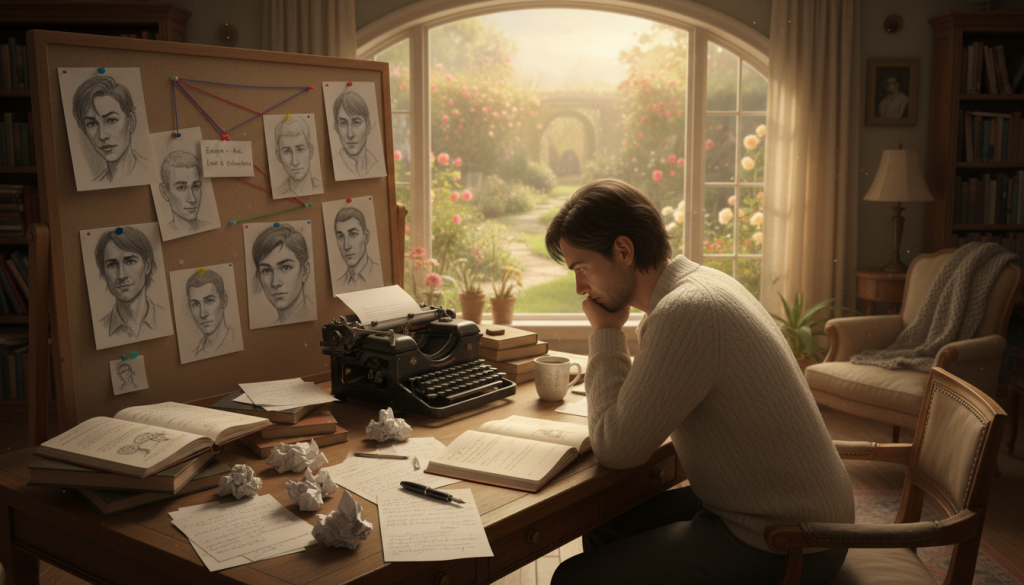
Every strong protagonist has two things: an external goal and an internal need. Katniss Everdeen wants to survive the Hunger Games. Her internal need is to learn to trust others. Elizabeth Bennet seeks independence and love, while fighting her own prejudice.
Flaws make characters interesting. A character doesn’t need to be likable—just fascinating. One science fiction writer made a character real by giving him a painful past.
Building Complex Antagonists
Your antagonist isn’t always a villain. They can be a rival, nature, or your protagonist’s self-doubt. The key is to give them goals that conflict with your hero’s. Great antagonists believe they’re justified in their actions. They should feel as real as your protagonist.
Crafting Character Backstories That Matter
Not every character needs a tragic past. Sherlock Holmes and Jack Reacher show that. But most readers like characters with depth. I suggest creating a simple character profile:
- Physical appearance and defining traits
- Core motivations and deepest fears
- A defining past moment that shapes present behavior
- Key relationships and emotional wounds
“When writing a novel, a writer should create living people; people, not characters.” — Ernest Hemingway
With your characters ready, you can now build the world they’ll live in. That’s what we’ll do next.
Building Your Story’s World and Setting
Your setting is more than just a background. It’s alive and shapes your story’s mood, conflict, and character. When I plan my story, I pick where and when it happens. This choice changes everything.
For example, a romance in a small Southern town is different from one in New York City. A mystery in the 1920s is different from one today. Your setting limits what characters can do and opens new doors.
When picking your world, think about these key things:
- Time period — contemporary, historical, or future
- Geographic location — real city, rural area, or fully imagined world
- Physical environments — the specific rooms, streets, and landscapes where scenes unfold
- Constraints and opportunities — how the setting pushes your characters into conflict
One great way to tell a story is to match setting to character struggle. If your hero fears water, put them near the ocean. If they’re poor, surround them with wealth. This creates natural tension.
Watch out for “white room syndrome” — scenes that feel like they happen in a blank void. If your story could take place anywhere without changing, you’re not using your setting well.
For fictional worlds, don’t plan every detail before you start. Focus on what impacts the story now. You can add more as you write. For real locations or historical periods, do your research. Readers will notice mistakes. But don’t let research stop you from writing.
A good setting works with your characters and plot, making a strong world. With your world set, it’s time to build your story’s structure.
How to Write a Successful Novel Using Story Structure
Structure is the backbone of your story. Without it, even the most beautiful words fall apart. To write a hit novel, you must know where your story goes and when.
Frameworks like the Three-Act Structure and Blake Snyder’s Save the Cat beat sheet are key. They help you place events right to build tension and emotional payoff.
Beginning Your Novel: The First 25%
Your first quarter is crucial. It introduces your hero in their ordinary world, shakes things up, and sets goals and obstacles. This part decides if readers will stick around.
Navigating the Middle: The Central 50%
The middle can be tough. Good stories escalate problems and raise stakes. Each scene should push your hero closer to a breaking point.
“Story is about the progressive development of conflict.” — Robert McKee, Story: Substance, Structure, Style, and the Principles of Screenwriting
A literary fiction writer once rejected structure. His writing was stunning, but his stories lacked punch. He added structure and kept his unique voice. Then, readers praised his work as “unique and powerful.”
Crafting Your Ending: The Final 25%
Your ending is the payoff. It includes a climactic showdown, shows how your hero has changed, and ties up loose ends. Without this, readers feel cheated, even if they can’t say why.
| Story Section | Percentage | Key Purpose | Reader Experience |
|---|---|---|---|
| Beginning | First 25% | Setup, inciting incident, goals | Curiosity and investment |
| Middle | Central 50% | Complications, rising stakes, hard choices | Tension and anticipation |
| Ending | Final 25% | Climax, transformation, resolution | Emotional satisfaction |
Plan your major turning points before writing. Be open to changes. Structure is your guide, not a prison. With your characters and world ready, structure drives your story forward.
Planning Your Novel: Outline Strategies
Before you start writing, you need a plan. But, planning is different for everyone. Finding an outlining method that fits you is key.
Plotters vs. Pantsers vs. Plantsers
Writers fall into three groups: Plotters, Pantsers, and Plantsers. Knowing which one you are is important.
| Approach | Description | Famous Example |
|---|---|---|
| Plotter | Maps every chapter, character arc, and plot twist before drafting | J.K. Rowling |
| Pantser | Writes by the “seat of their pants,” discovering the story as they go | Stephen King |
| Plantser | Creates a loose roadmap but leaves room for surprise and discovery | George R.R. Martin |
Stephen King writes by the seat of his pants. He drops characters into situations and sees what happens. I’m a plantsers myself.
Creating Flexible Roadmaps
Think of your outline as a road trip plan. You know where you start and end. You have some stops planned, but you can take detours too.
“No plan survives first contact with the enemy — and no outline survives first contact with actual writing.”
Start by listing what you know in broad categories:
- Major plot events — the wedding, the heist, the betrayal
- Characters — even if you only know them by role at first
- Themes and settings — grief, redemption, small-town Texas
Using Simple Outlining Methods
You don’t need fancy software. Old-school tools work well. Use a whiteboard, index cards, or a word processor.
Print your outline and carry it with you. Write new ideas in the margins. Bestselling authors often say to organize your thoughts. An outline helps channel your ideas, even if you change them later.
Setting Up Your Writing Space and Tools
Let’s be real: you don’t need a perfect writing sanctuary to start. Writing happens anywhere you sit and write. I’ve seen writers do great work on a couch with a typewriter on a plank. Even in noisy, smoky newsrooms, reporters wrote amazing stories every day.
But, making your space comfy and private helps you focus. The most important investment is an ergonomic chair. You’ll sit for hours, and back pain can stop you. A good chair might cost more, but it’s worth it for your back.
For publishing, the industry uses Microsoft Word. If you want to publish your first novel, use Word. Scrivener is great for organizing, but it’s hard to learn. Learn the basics first.
Stock your space before you start writing so you won’t get distracted. Here’s what I keep close:
- Quality notebook and pencils for quick ideas
- A fast, reliable computer you can afford
- Printer paper, stapler, and paper clips
- A good desk lamp and a beverage mug
- Cork board for pinning plot notes and character sketches
| Tool | Purpose | Estimated Cost |
|---|---|---|
| Microsoft Word | Industry-standard manuscript formatting | $70–$100/year |
| Scrivener | Organizing chapters, notes, and research | $49 one-time |
| Ergonomic Chair | Comfort during long writing sessions | $300–$1,500 |
| Cork Board | Visual plotting and scene tracking | $15–$40 |
| Desk Lamp | Reducing eye strain | $25–$75 |
Upgrade your space as you grow and make money from publishing. For now, get ready and start writing. Your outline is ready, and it’s time to make a writing schedule.
Establishing Your Writing Schedule and Deadlines
Writing a successful novel is not just about talent. It also needs a solid schedule. Once you have your writing space, it’s time to create a routine. This routine will help you reach your goal of finishing a manuscript.

Carving Out Weekly Writing Time
Try to set aside six hours per week for your novel. You can divide it however works best for you:
- Three two-hour sessions
- Two three-hour sessions
- Six one-hour sessions
Being consistent is key. Writing at the same times every week makes it a habit. You might need to cut back on other activities to make time for your novel.
Remember, family comes first. But you can find time for your novel by cutting back on other activities.
Setting Sacred Deadlines
Deadlines add urgency to your writing. Choose a finish date and tell someone you trust. This could be a spouse, friend, or writing partner. Having someone to answer to can make a big difference.
Jerry B. Jenkins, who has written over 190 books, meets every deadline. He even calls himself a procrastinator. But he treats deadlines as sacred, which keeps him on track.
Calculating Daily Page Goals
Here’s a simple way to stay on track. Break your manuscript into weekly page targets:
| Manuscript Length | Weeks Available | Pages Per Week | Pages Per Session (3x/week) |
|---|---|---|---|
| 300 pages | 50 weeks | 6 | 2 |
| 400 pages | 50 weeks | 8 | 2–3 |
| 500 pages | 50 weeks | 10 | 3–4 |
Always plan for two off-weeks for unexpected events. Make sure your goals are realistic and stick to them. This discipline will help you finish your first draft.
Overcoming Common Writing Obstacles
Every writer faces roadblocks. Whether you’re on your first manuscript or your tenth, obstacles will show up. Learning how to write a successful novel means learning to work through those tough moments — not around them.
I’ve found that most writing struggles fall into three categories. Let me walk you through each one and share what’s worked for me.
Embracing Productive Procrastination
Here’s something that changed my perspective: procrastination isn’t always the enemy. Jerry B. Jenkins, author of over 200 published books, once called himself the “king of procrastination.” Yet he still gets the work done.
The trick is to schedule your procrastination. Put it on your calendar. While you’re avoiding the page, your subconscious is still processing your story. Just increase your page count for the next session to stay on track with your deadlines.
Eliminating Digital Distractions
I used to check my email after writing a single sentence. Sound familiar? Social media, viral videos, random articles — they all steal your writing time.
These tools can help you stay focused during writing hours:
| App | What It Does | Cost |
|---|---|---|
| Freedom | Blocks websites, apps, and the internet across devices | Starts at $3.33/month |
| FocusWriter | Full-screen distraction-free writing environment | Free |
| StayFocusd | Chrome extension limiting time on distracting sites | Free |
Pushing Through Writer’s Block
Writer’s block often strikes when you don’t know what comes next. That’s why the outline strategies I covered earlier matter so much. A clear roadmap prevents the confusion that stops many first-time novelists cold.
“You can always edit a bad page. You can’t edit a blank page.” — Jodi Picoult
Once you push past these obstacles, you’ll be ready to tackle revision and editing tips for novelists that sharpen your manuscript into something publishers want to read.
Researching Your Novel Effectively
Good research brings your story to life. It’s key for both fiction and nonfiction. Getting the small facts right is crucial.
Lazy research can ruin a good story. A single mistake can break the reader’s connection. Credibility is fragile. Bestselling authors always fact-check their work.
Here are some top research tools:
- World Almanac — Full of facts, government data, and character names
- Merriam-Webster Thesaurus (online) — Fast word searches for the right word
- WorldAtlas.com — Info on places, money, weather, and more
| Resource | Best For | Cost |
|---|---|---|
| World Almanac | Historical facts, demographics, character names | Around $14 (annual edition) |
| Merriam-Webster Thesaurus | Word choice and natural vocabulary | Free online |
| WorldAtlas.com | Geography, culture, setting details | Free online |
Remember, don’t let research slow you down. Get the basics right and start writing. You can add more details later.
Writing Your First Draft
Learning to write a novel means getting words down on paper — no matter how messy they look. Think of your manuscript as a collection of sentences and paragraphs. It’s like eating an elephant, one bite at a time. After your research, the real magic starts.
Starting with Page One
The blank page can be scary. Start with a single sentence premise. This gives you a clear direction. Think of books like The Hunger Games or Harry Potter — they began with a single, exciting idea.
Call yourself a writer now. Don’t wait for some big achievement. If you’re writing, studying, and practicing, you are a writer.
Maintaining Writing Momentum
Don’t see your book as a huge task. Pages add up quickly. After a week, you’ll have double digits. After months, you’ll reach the second hundred. Writing daily makes storytelling easier.
| Daily Word Count | Days to 80,000-Word Draft | Approximate Months |
|---|---|---|
| 500 words | 160 days | 5–6 months |
| 1,000 words | 80 days | 2–3 months |
| 2,000 words | 40 days | 1–2 months |
Silencing Your Inner Editor
Turn off your inner critic during the first draft. Creativity flows best without judgment. Fixing sentences and plot holes comes later. Your job now is to write forward.
“The first draft is just you telling yourself the story.” — Terry Pratchett
The right idea keeps you writing. If it doesn’t excite you, you’ll lose interest. Choose something that grows in your mind. That passion drives your draft.
Revision and Self-Editing Techniques
Your first draft is done — congratulations! Now the real work starts. Becoming a ferocious self-editor is key. Before you dream of publishing, you must make your manuscript shine.
Approaching Your Manuscript Fresh
Step away from your draft. Take at least two to four weeks off. When you come back, you’ll see your work with new eyes.
Print it out or change the font. This makes it feel like someone else wrote it. You’ll spot problems you missed before.
Identifying Structural Issues
Start big before going small. Look for these red flags first:
- Plot holes that break reader trust
- Pacing problems — scenes that drag or rush
- Character inconsistencies in motivation or behavior
- Promises made early in the story that never pay off
Your story must deliver on the anticipation you build. Readers want that major payoff. Whether fiction, memoir, or narrative nonfiction, your structure should build toward a satisfying climax.
A mentor or trusted critique partner can help you.
Polishing Prose and Dialogue
Once your structure is solid, focus on sentence-level work. Tighten flabby prose, cut unnecessary adverbs, and make dialogue sound real. These tips matter because agents and editors notice sloppy writing.
“I’m not a very good writer, but I’m an excellent rewriter.” — James Michener
Professional editing comes after thorough self-editing. When serious about publishing, this effort saves time, money, and rejection letters. With your manuscript revised, you’re ready for the next steps toward publication.
Conclusion
Writing a successful novel is a journey. It starts with knowing why you’re doing it. It ends with a manuscript you’re proud of.
I’ve shown you how to find great ideas and pick your genre. You’ve learned to create characters and build a story that keeps readers interested. Each step helps you move forward.
Getting your first novel published requires dedication. You need a writing schedule and a good writing space. You also need to be brave on tough days.
Your first draft won’t be perfect, and that’s okay. Revision is where the magic happens. Write badly at first, and trust the editing to make your story strong.
I hope this guide makes you feel ready to start writing. Learning to build a strong story, create memorable characters, and master structure takes practice. You can publish your novel through a big publisher or on Amazon. Now it’s your turn to make your story come alive.
FAQ
How do I know if my idea is strong enough to sustain a full-length novel?
Test your idea by asking three questions. Does your main character have a clear goal? Are there big obstacles in their way? And are there serious consequences if they fail?
The best ideas start as “what if” questions. They hint at deep conflict and high stakes. Think of Harry Potter or Gone Girl. If your idea has enough depth for 80,000+ words, it’s worth writing.
What’s the most important step in learning how to write a successful novel?
The most critical steps are developing your characters and mastering plot structure for novels. These are where most first-time novelists get stuck. But they’re also where the magic happens.
A solid story structure and three-dimensional characters are key. They separate published manuscripts from abandoned drafts.
Should I outline my novel before I start writing, or just dive in?
It depends on your creative writing process. Some writers plan everything before writing. Others write by discovery.
Many successful authors blend both approaches. Try simple outlining methods and stay flexible. An outline organizes your anxiety and gives direction.
How do I choose the right point of view and tense for my novel?
Point of view and tense shape every sentence. They affect your story’s emotional tone. First person creates intimacy but limits what you can reveal.
Third person limited follows one character at a time. Third person omniscient gives access to every character’s thoughts. Try writing the same opening scene in different POV and tense combinations.
How many hours per week do I need to dedicate to writing a novel?
Schedule at least six hours weekly for writing. Regular patterns make writing a habit. To calculate your daily page goals, divide your target manuscript length by your available weeks.
Jerry B. Jenkins treats every deadline as sacred. He calls himself the king of procrastinators.
How do I create characters that readers actually care about?
Great compelling character development makes characters fascinating. For your protagonist, determine their goals, emotional needs, and flaws. Think of Katniss Everdeen or Elizabeth Bennet.
Your antagonist also needs clear goals and weaknesses. Create detailed character profiles with backstory, motivations, and fears. These details inform every decision your characters make.
What are the best strategies for overcoming writer’s block?
A clear roadmap through your story prevents writer’s block. Understand your strong narrative arc—major turning points, protagonist’s trajectory, and story direction.
Accept procrastination as part of the process. Use apps like Freedom, FocusWriter, or StayFocusd to block distractions. Turn off your internal editor during the first draft. Just write.
How important is genre selection, and how do I pick the right one?
Genre is crucial because it determines where your novel gets shelved. It shapes reader expectations and impacts every creative decision. Romance needs a central love story and an emotionally satisfying ending.
Thrillers demand fast pacing and high stakes. Fantasy often involves magic systems and invented worlds. Identify three published novels similar to your idea to understand what genre readers expect.
What revision and editing tips for novelists do you recommend after finishing a first draft?
Step away from your manuscript first. Approach it with fresh eyes after some time apart. Then tackle revision and editing in layers.
Start with structural issues like plot holes and pacing problems. Ask yourself if your story delivers on early promises and provides the major payoff. Only after addressing big-picture architecture should you polish prose and dialogue.
I strongly recommend finding a mentor or book coach for guidance. Professional editing should come after thorough self-editing. Publishing your first novel requires a polished manuscript.
Do I need a special writing space or expensive tools to write a novel?
Absolutely not. Real writers write anywhere. Jerry B. Jenkins started on a couch with a typewriter on a plank. Some writers thrive in coffee shops or noisy environments.
Equip yourself in advance so nothing interrupts your flow. The publishing industry runs on Microsoft Word for submissions. Scrivener offers powerful tools, though it has a steep learning curve. The single most important investment? An ergonomic chair.
How do I stay motivated through the entire novel-writing process?
Understanding your core motivation is key. Ask yourself honestly: Am I writing to share a meaningful message? To bring imaginary characters to life? To start an author career? To conquer my own personal Mount Everest?
Write down your motivation and keep it visible in your writing space. One writer found her true purpose in sharing stories about healthy relationships. With clarity, her engaging storytelling methods flowed naturally, and she finally finished her first draft.