Fiction Writing Tips I Use to Craft Better Stories

I once spent six months building a fantasy world for a short story. I drew maps and invented languages. But when I started writing, I realized I didn’t need any of it. The story was just about two people arguing at a kitchen table.
This taught me a lot about storytelling. A short story is not just a small novel. It’s a unique art form with its own rules. Every word, character, and scene must earn its place.
Louise Marburg, author of No Diving Allowed and The Truth About Me, has great advice. She says to keep exposition tight and show instead of tell. Stories under 7,000 words need focus and precision, and you must be willing to cut what doesn’t serve the story.
Over the years, I’ve learned many creative writing techniques. Most of my best stories happen in a day or a week. They focus on simple things like a crumbling marriage or a desire that can’t be fulfilled. The drama comes from the characters, not complex plots.
In this guide, I’ll share the fiction writing tips I use every time I write. These practical methods help me go from a blank page to a finished draft without losing my mind.
Key Takeaways
- Short fiction is its own art form — treat it with different rules than novel writing.
- Stories under 7,000 words demand tight, focused storytelling craft with no wasted words.
- Character-driven narratives built around simple conflicts create the strongest emotional impact.
- Research enough to stay accurate, but don’t let it become a way to avoid writing.
- A dedicated writing space — even a small corner — boosts your focus and output.
- Creative writing techniques like showing over telling keep readers engaged from start to finish.
Understanding the Foundation of Fiction Writing
Before I start writing, I build a strong foundation. It’s like building a house. You need blueprints and a clear plan. Fiction needs a solid structure and well-thought-out characters.
Developing Your Characters Before You Begin
Character development is more than looks. I explore their deepest desires and fears. These traits guide their actions.
I always choose unique names for characters. “Mark” and “Matt” are too similar. This helps readers follow the story better.
Knowing Your Story’s Direction and Purpose
Every story has a goal. I decide the ending before I start. Romance stories need happy endings, thrillers need twists.
Setting Clear Length Expectations for Your Work
Knowing the word count is key. It affects character and plot. Here’s a guide I use:
| Format | Word Count | Typical Scope | Cast Size |
|---|---|---|---|
| Short Story | 1,500–7,500 | Single incident or moment | 2–4 characters |
| Novella | 17,500–40,000 | One central plot, limited subplots | 5–10 characters |
| Novel | 50,000–100,000+ | Multiple subplots and arcs | 10+ characters |
A short story can’t handle many characters. But a novel can. Setting these limits early saves me from rewrites.
Pre-Writing Strategies That Set You Up for Success
Before I start writing, I prepare. This prep work makes writing easier and faster. It helps me avoid getting stuck in my project.
Research Without Getting Lost in the Details
Research is key, especially for historical or science fiction. But it can slow you down. I set a research deadline and stick to it.
Even for modern stories, fact-checking is important. This includes travel times, street names, and local slang.
I only gather enough research to write confidently. I can always add more later. Spending too long on research without writing is a mistake.
Creating Your Ideal Writing Space
A quiet space is essential for me. My desk is tidy with pens, notebooks, and books. My phone is on silent.
If my home is too distracting, I write elsewhere. Coffee shops, libraries, and hotels are good options. The goal is to focus on your story without interruptions.
Visualizing Scenes Before Writing Them
I close my eyes and imagine the scene before writing. I see the room, lighting, and where characters are. I notice their body language and emotions.
I focus on small details:
- What each character wears
- What they hold
- How they move
- The sounds and smells
This helps me enter the scene before writing. I don’t need to see every detail. Just enough to understand how characters will react. This clarity helps with better plot construction and storytelling.
Character Development Techniques I Swear By
Great characters carry stories. The most important skills for fiction authors are making people feel real on the page. Each character has a clear goal, a deep fear, and a burning desire. These drive their choices in every scene.
I love using showing to reveal who a character is. This means showing through action and dialogue, not telling with long descriptions. Instead of saying “she was impatient,” I show it through her actions.
Physical descriptions are kept short. Mention one striking detail, like unusual green eyes or a crooked smile. Let the reader’s imagination fill in the rest.
Here’s a quick breakdown of techniques I rely on:
- Use internal dialogue to reveal what characters think but won’t say out loud
- Give each character a distinct speech pattern or verbal quirk
- Let behavior contradict what a character claims about themselves
- Attach specific sensory details — a cologne, a nervous laugh — to make them memorable
I’m tough with characters who don’t push the plot forward. If someone doesn’t help the story, they’re out. A woman meeting a stranger on a train doesn’t need pages about her boss.
Strong fiction author skills mean trusting creative storytelling methods. By focusing on behavior over biography, my characters started to feel alive. And readers noticed.
Mastering Scene Structure for Narrative Drive
Scenes are the building blocks of every story. They’re not just random moments. Each scene is a link in a chain from start to finish. When I started seeing scenes as part of a chain, my writing improved a lot.
Understanding Goal, Conflict, Choice, and Consequences
Every scene I write follows a simple pattern. A character has a goal. Then, something blocks that goal, creating conflict. The character must make a choice, leading to consequences for the next scene.
This pattern keeps the story moving. It makes readers want to keep reading because each ending raises new questions.
Creating Tight Scene Chains That Keep Pages Turning
I test every scene with one rule: if I remove it, does the chain break? If the story still works without a scene, it’s not needed. This rule helps me focus my story and remove unnecessary parts.
| Scene Element | Purpose | Example |
|---|---|---|
| Goal | Drives the character forward | A detective needs a suspect’s alibi |
| Conflict | Creates tension and obstacles | The suspect refuses to talk |
| Choice | Reveals character values | The detective bends the rules to get answers |
| Consequences | Sets up the next scene | The alibi uncovers a bigger secret |
Linking Plot and Character Arc Through Scene Structure
The choices a character makes in each scene shape who they become. Scene goals show what the character wants. The choices they make under pressure show what they believe. Over time, those beliefs change, showing the character’s growth.
This way of writing ensures the plot and character arc grow together. It makes the story feel natural and easy to follow.
Writing Dialogue That Brings Characters to Life
Great dialogue is a key tool in creative writing. It shows personality, builds tension, and moves the story forward. Dialogue acts like a spotlight on each character’s inner world. When done well, it makes readers forget they’re reading.
Making Conversations Realistic Without Being Too Real
Real-life talks are messy. People often interrupt and repeat themselves. If I wrote down a real conversation, it would be boring.
In fiction, dialogue should feel real but not be exact. Here’s how I balance it:
- Use contractions — people say “don’t” and “can’t,” not “do not” and “cannot.”
- Add interruptions when a character is angry or excited.
- Give each character a distinct rhythm or favorite phrase.
- Keep speeches short — long monologues kill pacing.
Using Dialogue to Reveal Character and Move Plot Forward
Every line of dialogue should do double duty. One of my favorite techniques is the indirect answer. For example, instead of saying “Fine” when asked “How are you?”, someone might say “The store was closed when I went to get vodka.” This line shows disappointment, hints at a drinking problem, and moves the scene forward.
This method turns boring chats into exciting moments in fiction. Here’s a quick comparison:
| Flat Dialogue | Revealing Dialogue | What It Accomplishes |
|---|---|---|
| “How was your day?” / “It was bad.” | “How was your day?” / “They gave my parking spot to the new guy.” | Shows insecurity and workplace tension |
| “Are you okay?” / “No, I’m not.” | “Are you okay?” / “I just need the car keys.” | Implies avoidance and urgency |
| “Do you love me?” / “Yes, I do.” | “Do you love me?” / “I packed your favorite lunch this morning.” | Reveals love through action, not declaration |
Tight, purposeful dialogue cuts filler and keeps pages turning. It’s a skill that ties into scene structure techniques.
Building Compelling Story Arcs
Every hero needs a journey of change. This journey is shaped by the story’s events. Without it, the story feels empty. Readers love to see characters grow and change from start to finish.
Character arcs are the heart of the story. Your hero’s choices shape the story’s path. When they face fears or flaws, new conflicts arise. This keeps the story moving.
Here are common character arcs I use:
- Positive arc: A character overcomes a false belief, a hot temper, or a deep-rooted fear.
- Transformation arc: A character becomes who they were always meant to be — think Harry Potter discovering he’s a wizard and growing into that identity.
- Negative arc: A character gives in to their darker impulses. This works best for antagonists or tragic figures, not your main hero.
K.M. Weiland’s Creating Character Arcs is a great resource. She explains how internal growth and plot events must blend. I often turn to her when I’m stuck.
The secret is to mix your character’s inner journey with the plot. Every obstacle should push them toward self-discovery. Every change should prepare them for the next challenge. This makes a story arc that keeps readers hooked.
The Power of the Midpoint in Your Story
The midpoint is at the 50% mark of your story. It’s a key skill for fiction authors. This moment changes everything, adding drama and stakes.
It makes your protagonist face a truth they’ve been avoiding. This deep dive into the midpoint’s purpose shows it as a turning point. It’s like a sharp knife that changes the story’s direction.
Creating Mirror Moments That Transform Characters
James Scott Bell introduced the term mirror moment in Write Your Novel From the Middle. At the midpoint, your character looks inward. They ask: Who am I really?
This self-examination is a powerful tool. Blake Snyder’s Save the Cat! calls this a turning point. It can be a triumph or a defeat, depending on the story.
Shifting From Reactive to Active Protagonists
Before the midpoint, characters react to events. After, they take action. In The Hunger Games, Katniss starts by surviving and hiding.
At the midpoint, she kills her first tracker jacker and questions Peeta’s loyalty. This moment marks a change. She starts to drive the story forward.
Merging Internal and External Conflicts
A strong midpoint combines two conflicts:
- External: An event makes the protagonist’s problem worse
- Internal: The protagonist realizes what they must become to solve it
Mastering this is crucial for fiction authors. It makes the story compelling. When you mix these conflicts at the midpoint, readers feel the urgency. They keep reading into the second half.
Managing Perspective and Tense Consistency
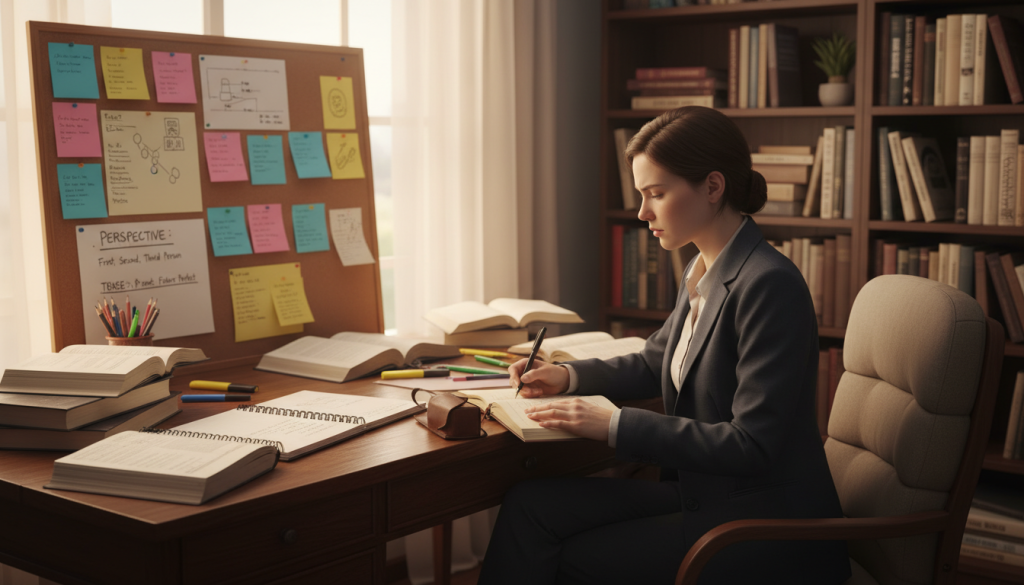
Two fast ways to lose a reader are head-hopping and tense shifts. They break the dream state you’ve worked hard to build. In my writing, I treat perspective and tense like guardrails. They keep the story on track and the reader immersed.
Sticking to One Viewpoint Per Scene
Modern commercial fiction uses first person (“I”) or third person limited for point of view. Both limit access to one character’s thoughts at a time. Third person omniscient is seen in older works, but most readers prefer a tighter view.
I follow a simple rule: one perspective per scene. Jumping between characters’ thoughts mid-scene disorients readers and weakens your story. If I’m writing first person with multiple narrators, I label each chapter with the current narrator’s name. In third person limited, I wait for a scene or chapter break before switching viewpoints.
- Pick one point-of-view character per scene and stay there.
- Change perspectives only at clear breaks—new chapters or marked scene transitions.
- Label narrators when using multiple first-person voices.
Avoiding Accidental Tense Shifts
Tense consistency is just as critical. Choose past tense (“I walked down the street”) or present tense (“I walk down the street”) and stick to it. Accidental shifts are common errors I catch during revision.
You can mix tenses on purpose. For example, using third-person past for the main story and first-person present for diary entries creates a contrast. The key is deliberate. Unintentional shifts show carelessness and pull readers out of the story.
Every time I slip from past to present tense without meaning to, I know my fiction writing process needs one more editing pass.
Read each scene aloud during revision. Your ear will catch tense shifts your eyes might miss. This small habit saves hours of cleanup later and keeps your prose clean for the strategic description work that comes next.
Creating Forward Momentum in Your Narrative
One of the best creative writing techniques I’ve learned is simple: always move forward. Readers pick up a book because they want to know what happens next. They crave answers that exist in the future, not in the past. Every scene I write needs to pull the reader deeper into the story, not pause to explain how we got here.
I think of my plot construction like an inverted pyramid. The opening is small, tight, and crystal clear. As readers settle in and trust the story, I let the world expand. I introduce complexity only after earning their attention. Starting with a ticking clock on page one is one of the most reliable ways to achieve this.
A common trap I watch for is disguised stagnation. A story can move forward in time yet feel stuck. This happens when new scenes exist only to dump backstory, context, or analysis. If a scene’s real purpose is to explain the past, it kills momentum—no matter where it sits on the timeline.
Here’s what I do instead to keep pages turning:
- Elongate scenes of discovery and revelation rather than rushing through them
- Add extra beats, setbacks, or false victories to key moments
- Hint at past mysteries instead of explaining everything upfront
- Build reader investment before dropping complex backstory
For example, if my character needs hospital records from a reluctant secretary, I don’t resolve it in two lines. I stretch the tension. I let the scene breathe with obstacles and small victories. These creative writing techniques transform a flat exchange into a gripping moment.
Strong plot construction depends on this kind of forward energy. Once I’ve locked readers into the present story, I can layer in the past—but only in small, strategic doses. The momentum I build here sets up everything that follows, from description choices to revision priorities.
The Art of Strategic Description
One big trap in writing fiction is describing everything in a scene. I’ve found that less is often better. A few key details can do more than listing out a room’s contents.
The true skill in storytelling is choosing the right details. Then, trust your readers to fill in the rest.
Choosing Vivid, Specific Details Over Exhaustive Lists
I aim for one or two sharp details for each character or setting. A smell of mothballs tells you a lot about an old house. Dead grass and peeling paint show a different home than a clean, polished one.
Here’s how I pick details:
| Weak Description | Strong Description | Why It Works |
|---|---|---|
| She had brown hair, blue eyes, a round face, and thin lips. | Her green eyes caught the light like sea glass. | One detail sparks the reader’s imagination. |
| The kitchen had a stove, fridge, table, and four chairs. | Grease stains climbed the wall above the stove like ivy. | Reveals character and lifestyle in a single image. |
| The yard was big with trees and flowers. | Dandelions pushed through cracks in the concrete path. | Shows neglect without stating it directly. |
Using Description to Reveal Character Perspective
The strongest trick in fiction writing is seeing through a character’s eyes. A real estate agent sees square footage. A grieving widow notices her husband’s coat.
This method makes each description work twice:
- It builds the setting your reader can see and feel.
- It deepens character without pausing for exposition.
- It sets mood and tone through selective focus.
Choose details that matter to the story. Let every image pull its weight. Your readers will thank you for the breathing room.
Revision Strategies That Transform First Drafts
Your first draft is never your final draft. Learning to revise is key. The real work starts after you finish writing.
Breaking Editing Into Three Distinct Stages
I edit in three stages. Each stage focuses on something different. Mixing them up makes me slow down.
| Stage | Focus | What to Look For |
|---|---|---|
| Rewriting | Structure | Pacing, character arcs, subplot connections |
| Line Editing | Sentences | Word choice, rhythm, clarity — read aloud or on paper |
| Proofreading | Mistakes | Typos, inconsistencies, formatting errors |
Getting Valuable Feedback From Other Readers
After working on a manuscript for a while, I can’t see it clearly. That’s why I share it with writer friends and readers. I look for at least three or four opinions.
If many readers point out the same issue, it’s a problem. A single complaint might be personal. But a pattern is a real issue.
Using Editing Tools Without Over-Polishing
Tools like Grammarly and ProWritingAid help me catch mistakes. They find passive voice and wordy sentences. But I don’t always follow their suggestions.
Some “corrections” can make the story feel less alive. It’s a delicate balance.
Knowing when to stop is a hard skill to learn. If I’m constantly changing words, I’m over-editing. I set deadlines for each stage. At some point, the story must leave my hands.
Maintaining Writing Focus and Productivity
One of the most underrated creative writing techniques I rely on is simply disconnecting. I turn off my wifi, silence my phone, and unplug from the digital world before I sit down to write. Opening a browser for a quick fact-check can spiral into thirty minutes lost on Wikipedia. Checking one email becomes replying to five. If going fully offline isn’t realistic, tools like Freedom or Cold Turkey can block social media and news sites during your writing sessions.
I set annual writing goals, not just daily ones. This keeps me on track even when inspiration fades. Waiting for the muse to strike is a recipe for an unfinished manuscript. When you’re working on fiction writing novels, you need a system that pushes you forward on both good and bad days.
Here’s what trips up so many writers: they go back to polish early chapters instead of pressing ahead. I’ve seen it happen too many times — beautifully crafted opening pages with nothing behind them. My rule is simple. If I spot a problem in chapter three while drafting chapter twelve, I make a note and keep going.
- Write your entire first draft before making structural edits
- Keep a separate “fix later” document for changes you want to revisit
- Set a daily word count that feels challenging but doable
- Track your weekly progress to stay accountable
“You can always edit a bad page. You can’t edit a blank page.” — Jodi Picoult
The creative writing techniques that matter most aren’t glamorous. They’re about discipline, consistency, and protecting your writing time. Finish the draft first. Revision — which I covered in the previous section — comes after you’ve reached the end. That complete first draft, messy as it may be, is the raw material you need when fiction writing novels that actually get done.
Common Pitfalls to Avoid in Your Fiction
Every writer falls into the same traps. I’ve been there too. Spotting these mistakes early can save you a lot of time and improve your storytelling.
Resisting the Urge to Edit While Drafting
This trap almost ruined my writing. I’d go back and change earlier chapters before finishing. It slowed me down every time.
It’s okay to clarify ideas as you go. But don’t keep rewriting the same parts over and over. Draft first, edit later. Louise Marburg once cut a 20,000-word novella down to just 5,000 words. That kind of editing is for later, not during the creative process.
Balancing Backstory With Present Action
Backstory is tempting. You’ve built a rich world and want to share it all. But too much history slows down your story.
“Writers often get stuck not from writer’s block but from not knowing their protagonists well enough to write their journey.” — Nicole Meier
Focus on the present moment. Add backstory in small bits. Show it through actions and dialogue, not long explanations.
Making Bad Things Happen to Good Characters
Comfortable characters don’t grow. Your main character needs challenges and setbacks. The right kind depends on your genre:
| Genre | Type of Challenge | Example |
|---|---|---|
| Action/Thriller | Physical danger | Injury, pursuit, capture |
| Romance | Emotional turmoil | Betrayal, misunderstanding, loss |
| Literary Fiction | Internal conflict | Moral dilemmas, identity crises |
Bad things can be deserved or unfair. Either way, they help characters grow. This tension keeps readers interested and turning pages.
Conclusion
Fiction writing is a mix of many skills. It involves creating real characters and crafting scenes with goals and conflicts. Every detail is important.
A strong narrative structure is key. It keeps the story moving and makes readers want to keep reading. This structure is like a backbone for your story.
Using creative writing techniques together is best. Good description, sharp dialogue, and a strong midpoint make a story come alive. Setting goals for length and following a three-stage editing process helps avoid mistakes.
Keep practicing and trying new things. Make your characters face tough challenges. Cut out backstory that slows things down. Seek feedback from trusted readers.
Fiction writing is a never-ending journey. Each story you write makes your voice stronger in ways you can’t expect.
FAQ
How long should my fiction writing be, and how does length affect my storytelling craft?
I always decide on the length before I start writing. A 2,500-word short story might focus on a single event. On the other hand, a 40,000-word novella usually has a smaller cast. A 75,000-word novel can handle multiple subplots.
Stories under 7,000 words need to be concise. This means using fewer characters and simpler plots. Knowing the length helps me plan my story better. It keeps my story focused and prevents it from getting too big.
What’s the best way to develop characters for fiction without relying on physical descriptions?
I focus on what my characters want, fear, and are ashamed of. This makes them more real than just their looks. I show their traits through their actions, words, and thoughts.
For example, mentioning unusual green eyes lets readers imagine the rest. Body odor, specific mannerisms, or how a character reacts under pressure reveal more than a description of their clothes. As Louise Marburg says, show rather than tell, and keep it short. This makes characters feel alive and real.
How do I structure scenes to maintain narrative drive and keep readers engaged?
Emily Golden teaches that each scene should start with a goal that gets disrupted by conflict. This forces a choice with consequences that lead to the next scene. This creates a chain reaction from start to finish.
If I can remove a scene without breaking the chain, it doesn’t belong. This method ensures every moment has a purpose. It’s a reliable way to keep the story moving.
What is the midpoint, and why is it so important in fiction writing?
The midpoint is around the 50% mark of your story. It’s where the main plot meets the character’s internal journey. James Scott Bell calls it a “mirror moment” where characters question who they want to be.
Blake Snyder and Jessica Brody say midpoints are moments of false triumph or failure. In *The Hunger Games*, Katniss starts to take action and form alliances. Nailing the midpoint reveals what your story is really about.
How do I write realistic dialogue without it sounding like an actual conversation transcript?
Real conversations are messy, but fiction dialogue needs to seem real without being a transcript. I use idioms, interruptions, and contractions to make it sound natural. Characters avoiding direct answers can reveal a lot without saying it.
This technique makes boring conversations interesting and moves the plot forward. It’s a skill that makes your story more engaging.
Should I edit my fiction as I draft, or wait until I finish?
I avoid editing while drafting. Clarifying ideas is okay, but rewriting early chapters slows you down. As Louise Marburg showed, you can always trim later.
I keep notes for changes but finish the first draft before revising. This way, you don’t get stuck on perfecting the beginning. Editing is divided into three stages: structure, line editing, and proofreading.
How much research should I do before writing fiction, and when does it become procrastination?
Research is key, but it can turn into procrastination if not managed. My rule is to research enough to be accurate, then start writing. If I need to check a detail, I leave a placeholder and keep writing.
Historical fiction needs more research, but don’t let it be an excuse to avoid writing. The goal is to produce pages, not gather notes forever.
What perspective and tense should I use for my fiction, and how do I stay consistent?
Modern fiction often uses first person or third person limited. I avoid third person omniscient unless it’s a literary style. Never change perspectives within a scene.
Choose between present or past tense and stick to it. Switching tenses can lead to editing mistakes. You can mix tenses, but stay consistent within each.
How do I create forward momentum and avoid getting bogged down in backstory?
Daniel David Wallace advises focusing on forward action. My stories start with a ticking clock from the beginning. Readers want answers in forward time, not backward.
I think of my novels as inverted pyramids. They start small and expand as readers get comfortable. I add beats, setbacks, or false victories to make scenes longer. Hint at past mysteries instead of explaining everything upfront.
How do I handle description effectively without slowing down my fiction?
I focus on one or two key details for characters or settings. A few words can suggest a lot. Describe settings through the character’s perspective to reveal their view of the world.
Trust your readers to fill in the rest with powerful imagery. This is especially important in short fiction where every word counts.
What tools and strategies help me stay focused and productive as a fiction writer?
I turn off the internet and silence my phone before writing. Opening a browser can lead to endless browsing. Use website-blocking software like Freedom or Cold Turkey if needed.
Having a dedicated writing space helps a lot. If home is too distracting, try a coffee shop or library. Set annual writing goals to keep yourself moving forward, even when it’s hard.
How do I build a compelling character arc that merges with my plot?
My protagonists need arcs that show change due to story events and their choices. Common arcs include overcoming false beliefs or growing into who they truly are. Follow K.M. Weiland’s advice to ensure your protagonist’s choices drive the plot.
Negative arcs work better for antagonists. The goal is to merge internal growth with external plot events. This creates a satisfying narrative progression.
How do I know when I’m over-editing my fiction and losing my unique voice?
Watch for constantly tweaking words and then changing them back. That’s a sign of over-editing. Break editing into three stages: structure, line editing, and proofreading.
Tools like Grammarly can help, but always verify suggestions. Set deadlines to finish edits. Over-polishing can strip away your unique voice and style.