
Character Profile Template: A Complete Writer’s Reference
You're deep in a draft, the plot is moving, and a supporting character suddenly walks into a scene. Then you pause. Was the scar above her eyebrow, or on her wrist? Did she speak in clipped sentences, or ramble when nervous? You search through earlier chapters, find three slightly different answers, and lose the momentum you had.
A character profile template gives you one dependable reference point. It gathers appearance, personality, backstory, goals, relationships, and other story-relevant details into a structured document, so you can make decisions without reopening the entire manuscript. A character profile template is best understood as a working document, not a form you complete once and forget.
This guide gives you a reusable structure, definitions for the fields that matter most, a completed example, and a practical method for checking character continuity throughout a long manuscript. You can use it before drafting, during discovery, or while revising a character who has changed under pressure.
Table of Contents
- Why Every Novel Needs a Character Profile Template
- What a Character Profile Template Is and Where It Comes From
- The Three Core Layers of a Character Profile
- Essential Template Fields with Definitions and Examples
- Matching Profile Depth to Character Role
- Tracking Character Consistency Across Your Manuscript
- A Completed Character Profile Example
- Quick-Reference Field Checklist for Your Next Profile
- Frequently Asked Questions About Character Profiles
Why Every Novel Needs a Character Profile Template
A long manuscript can turn small character details into continuity problems. You may understand your protagonist clearly, while a supporting character appears only after weeks of drafting. A once-guarded person starts meeting everyone's eyes. A cautious detective takes a reckless risk without a changed motive. An estranged sibling suddenly knows private family history.
These slips usually reflect a tracking problem rather than a lack of imagination. Fiction requires you to manage appearance, backstory, psychology, relationships, motivations, and narrative function at the same time. A character profile template keeps those layers together in a working reference document, so you can check a decision without searching the whole manuscript. Broader character-bible systems can also connect these details with plot and story planning, as explained in this guide to the contents of a character bible.
A reference sheet, not a personality quiz
A useful profile should answer practical questions quickly:
- Recognition: Which detail helps readers identify this character in a crowded scene?
- Cause: What past event helps explain the character's present behavior?
- Pressure: What does the character want, and what might they do when blocked?
- Continuity: Which traits should stay stable, and which can change through the story?
- Relationships: Who can influence, threaten, comfort, or expose them?
Suppose Mara repairs bicycles and hides a tremor in her left hand. Her occupation, physical detail, fear of judgment, and public confidence can converge in one scene where delicate work becomes difficult under pressure. The profile is useful because it connects facts to choices rather than storing isolated trivia.
Practical rule: Keep a detail in the profile only if it can affect what the character notices, says, chooses, or does.
The document can also preserve open questions. You might know that Mara left home after a family argument without deciding whether she was right to leave. Recording that uncertainty protects discovery and prevents you from forcing a premature explanation.
Used this way, the template becomes a continuity tool across the manuscript. Revisit it after major scenes, revisions, or character changes, and update the parts that the story has genuinely altered. You do not need an elaborate dossier. You need a dependable record that supports the next scene and keeps the character's appearance, history, psychology, and behavior working together.
What a Character Profile Template Is and Where It Comes From
A character profile template gives you a repeatable place to develop a fictional person. It gathers observations about appearance, history, desires, habits, and likely reactions. You might keep it to one page, expand it into several sections, write it by hand, or store it beside the manuscript. Its value depends less on length than on whether you can use it while drafting.
Several terms describe related tools:
- Character sheet: A term from tabletop role-playing games, where players record abilities, equipment, traits, and a character's current condition.
- Character profile: A writing-craft document focused on biography, psychology, relationships, and narrative function.
- Character template: A reusable blank structure that can support either purpose.
The categories overlap because fiction often needs both kinds of information. A fantasy novelist may record skills, powers, and equipment, while a literary novelist may focus on family history, private fears, and emotional conflict. A single working document can hold both when the story calls for it.
From notes to a structured development tool
A first profile may begin as scattered notes: a name, occupation, physical description, and a few lines about childhood. A template turns those fragments into fields you can compare and revisit. One worksheet organizes a 24-field structure that includes appearance, personality, motivation, relationships, and the character's condition at the story's beginning and end.
Digital writing systems extend the same idea through modular options. One platform describes 27 built-in character templates, showing how a paper worksheet can become a reusable digital framework, as explained in this explanation of character sheets and templates.
Use the structure as a filing system for creative decisions. A field earns its place when it helps you write a scene, check continuity, or understand a change in the character. Keep the document flexible: a new discovery in the manuscript may require you to revise an earlier answer. Over a long novel, that habit turns the profile from a one-time questionnaire into a living reference for the character's developing appearance, history, and inner life.
The Three Core Layers of a Character Profile
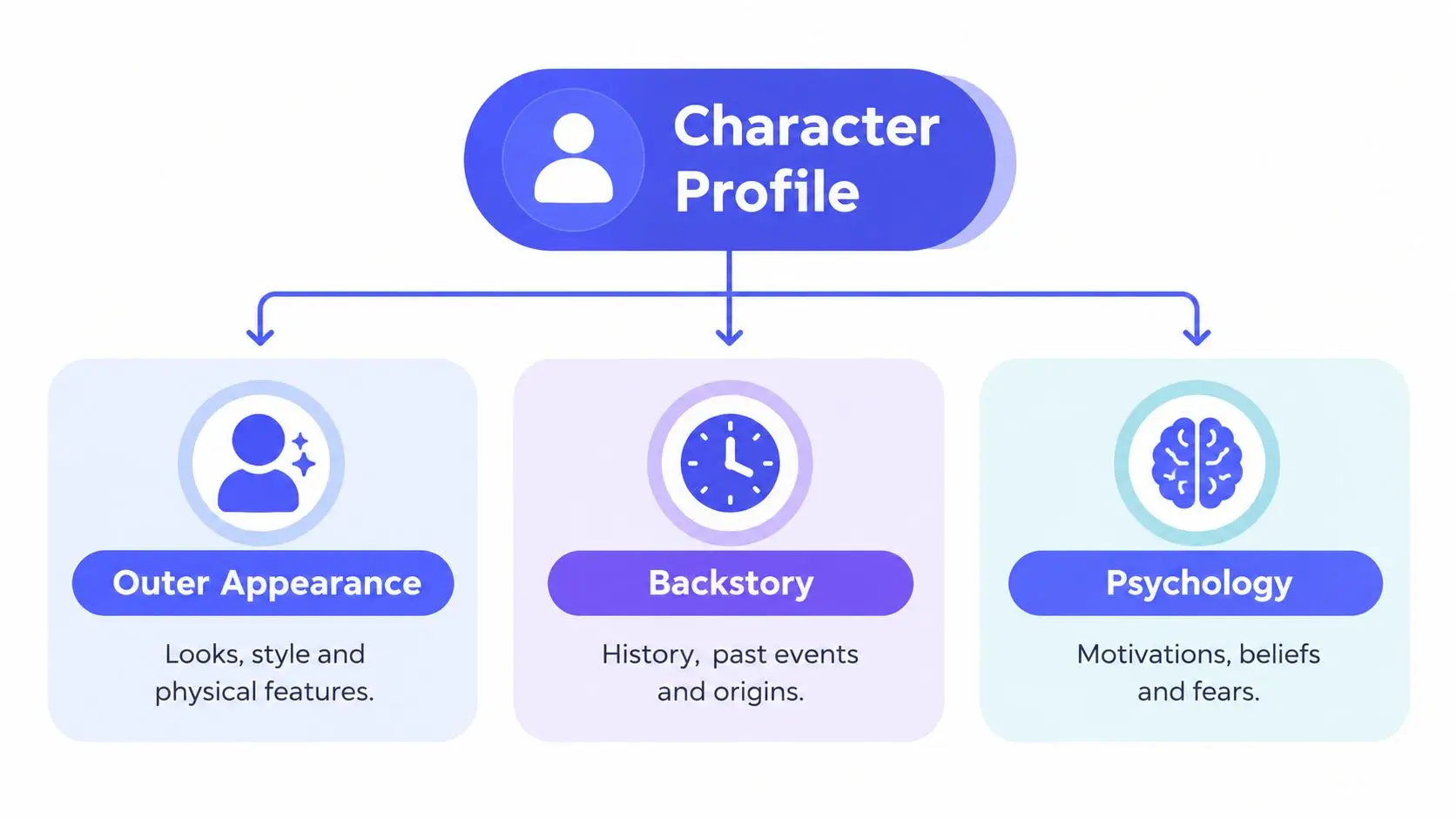
A flat questionnaire can collect plenty of information without helping you understand the character. A layered profile is more useful because each group of details answers a different creative question. A practical structure separates outer appearance, backstory, and psychology, capturing how the character looks, what shaped them, and why they behave as they do, as explained in Reedsy's character profile guidance.
Outer appearance answers what the reader can observe
This layer includes more than eye color and height. Record the details that affect how the character moves through a scene:
- Clothing and grooming
- Posture and gait
- Distinguishing marks
- Mannerisms
- Voice and speech rhythm
- The way the character uses space
- Physical limitations that matter to the story
Choose details with dramatic or sensory value. “Medium height” is easy to forget. “Keeps one sleeve buttoned over a scar” gives you an image, a habit, and a possible source of curiosity.
Backstory answers what shaped the present
Backstory is the chain of experiences that gives current behavior context. It can include family, birthplace, education, work, friendships, loss, achievement, and formative decisions. You don't need a complete biography. You need the events that explain the character's assumptions and emotional reflexes.
For example, a character who refuses help may have grown up in a household where dependence was used as a weapon. That history doesn't excuse every choice, but it gives the behavior a source. It also gives you material for conflict when another character offers sincere support.
Psychology answers why the character acts
Psychology includes wants, needs, values, fears, flaws, strengths, secrets, emotional triggers, and moral limits. This layer turns background into scene behavior. Two characters can share the same occupation and hometown while making completely different choices because they interpret risk, love, authority, or failure differently.
The layers should connect rather than sit in separate compartments. A burn mark in the outer layer should have a possible cause in the backstory and a consequence in the psychological layer. Perhaps the character hides the mark because it reminds them of a failed rescue, and that shame makes them overprepare before helping anyone again.
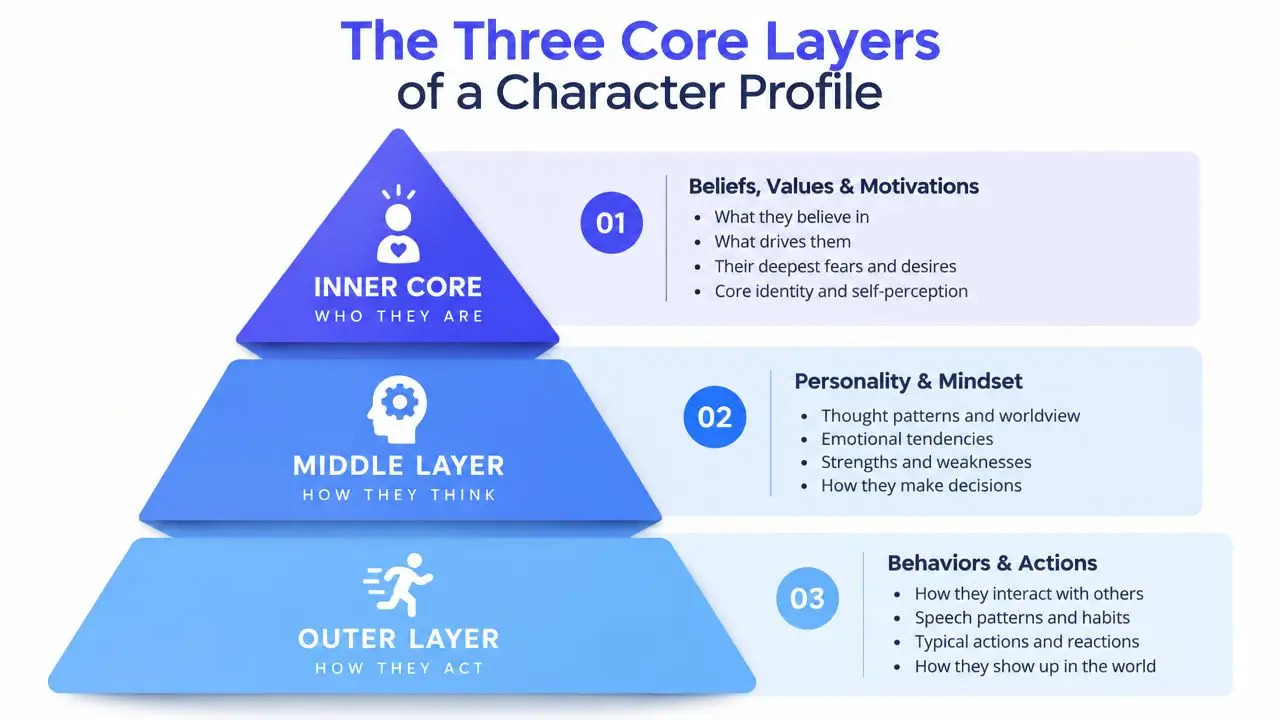
If you already have a scattered profile, sort every note into these three folders. Then mark details that connect two or more layers. Those connected details are often the most valuable because they can influence description, dialogue, action, and plot at the same time.
Essential Template Fields with Definitions and Examples
Start with the foundation, then add the fields that generate action. A name or age identifies a character, but a goal, motivation, flaw, fear, voice, and arc help you decide what that character will do in a scene. The examples below use one character, Lena Ortiz, so you can see how the entries support one another.
| Field | Definition | Example Entry | Story Decision It Drives |
|---|---|---|---|
| Name and role | The character's identity and narrative function | Lena Ortiz, protagonist | Determines whose choices shape the central conflict |
| Age and situation | The character's current life position | Thirty-four, municipal archivist | Influences experience, responsibilities, and available resources |
| Appearance | Observable traits that help readers recognize the character | Copper braid, ink-stained fingers, carefully mended coat | Shapes entrances, gestures, and sensory description |
| Relationships | Connections that create loyalty, pressure, or conflict | Protective of her younger brother, distrustful of her supervisor | Determines who she calls, confronts, or protects |
| Backstory | Past events that formed present assumptions | Her mother's records disappeared after a public scandal | Explains her obsession with preserving evidence |
| Goal | What the character actively wants in the story | Recover the missing records before the archive closes | Gives scenes a concrete direction |
| Motivation | Why the goal matters emotionally | She wants proof that her mother wasn't responsible | Raises the personal stakes behind the investigation |
| Flaw | A repeated weakness that complicates progress | She treats every disagreement as an attempt to erase her | Creates avoidable conflict with potential allies |
| Fear | The outcome the character most wants to avoid | Being publicly wrong about her mother | Makes discovery and exposure threatening |
| Voice | The recognizable pattern of speech and thought | Formal in public, precise and sarcastic with trusted friends | Guides dialogue, interiority, and reactions |
| Arc | The meaningful change in understanding, behavior, or self-perception | From defending a perfect version of her mother to accepting a complicated truth | Helps you shape turning points and the ending |
The difference between a weak entry and a useful one is specificity. “Lena is stubborn” labels her. “Lena rereads an opposing email until she finds one phrase she can challenge” shows how stubbornness becomes behavior. The second version gives you something to put on the page.
How to fill the fields without overexplaining
Write one or two sentences for the fields that drive scenes. For appearance, choose details that recur naturally. For backstory, identify causes rather than listing every childhood event. For psychology, pair the desire with the fear that makes pursuing it difficult.
A practical character outline template can help you connect these profile fields to beats, chapters, and turning points. If you prefer a guided creative exercise, an interactive story character builder can provide prompts before you shape the answers into your own prose.
Writing test: If an entry can't influence a choice, relationship, scene reaction, or reveal, leave it brief or leave it out.
Matching Profile Depth to Character Role
A novel doesn't need equally detailed files for every person who speaks. Giving a minor waiter a complete childhood history can consume attention that belongs to the protagonist, while giving an antagonist only a name and job may leave their decisions unmotivated.
The useful question is not “How many fields should every character have?” It's “How much information does this character need to perform their function?”
Full profiles for central opposition
Major protagonists and antagonists usually need fuller treatment across appearance, backstory, and psychology. Their choices create pressure throughout the story, so you need to understand what they want, what they fear, how they justify their actions, and what could change them. Their relationships also deserve detail because those connections often carry the emotional consequences of the plot.
A protagonist's profile might include a detailed arc and several competing values. An antagonist's profile might focus more heavily on ideology, methods, blind spots, and the private story they tell themselves about harm. Neither profile needs to answer every imaginative question. It needs to explain the decisions readers will see.
Functional profiles for supporting characters
A secondary character can often work with a compact record:
- Function: What does this person provide or complicate?
- Surface impression: How do they appear and speak?
- Relevant history: What explains their role in the current conflict?
- Connection: What do they want from the viewpoint character?
- Pressure point: What could make them help, resist, betray, or leave?
A nurse who appears in one hospital scene may need a distinctive voice, a clear practical function, and one relationship to the protagonist. She doesn't need a complete family tree unless that family affects the scene.
Leave room for discovery
A profile should support invention, not eliminate it. Keep contradictions, private and public selves, and unanswered questions visible. A character who presents as generous but secretly resents being needed has more narrative energy than one whose every trait agrees neatly.
Guidance for character templates in Reedsy Studio also emphasizes scaling profiles by role and using them as discovery tools. Let the document contain open questions. A blank space can be more useful than a forced answer because it gives the manuscript somewhere to surprise you.
Tracking Character Consistency Across Your Manuscript
A completed biography won't automatically keep a character consistent. Continuity depends on returning to the profile when the manuscript changes. A character may acquire a new secret in drafting, form an unexpected bond, or reveal a fear you didn't plan. The profile should record those discoveries instead of preserving an outdated version.
Use a simple continuity routine
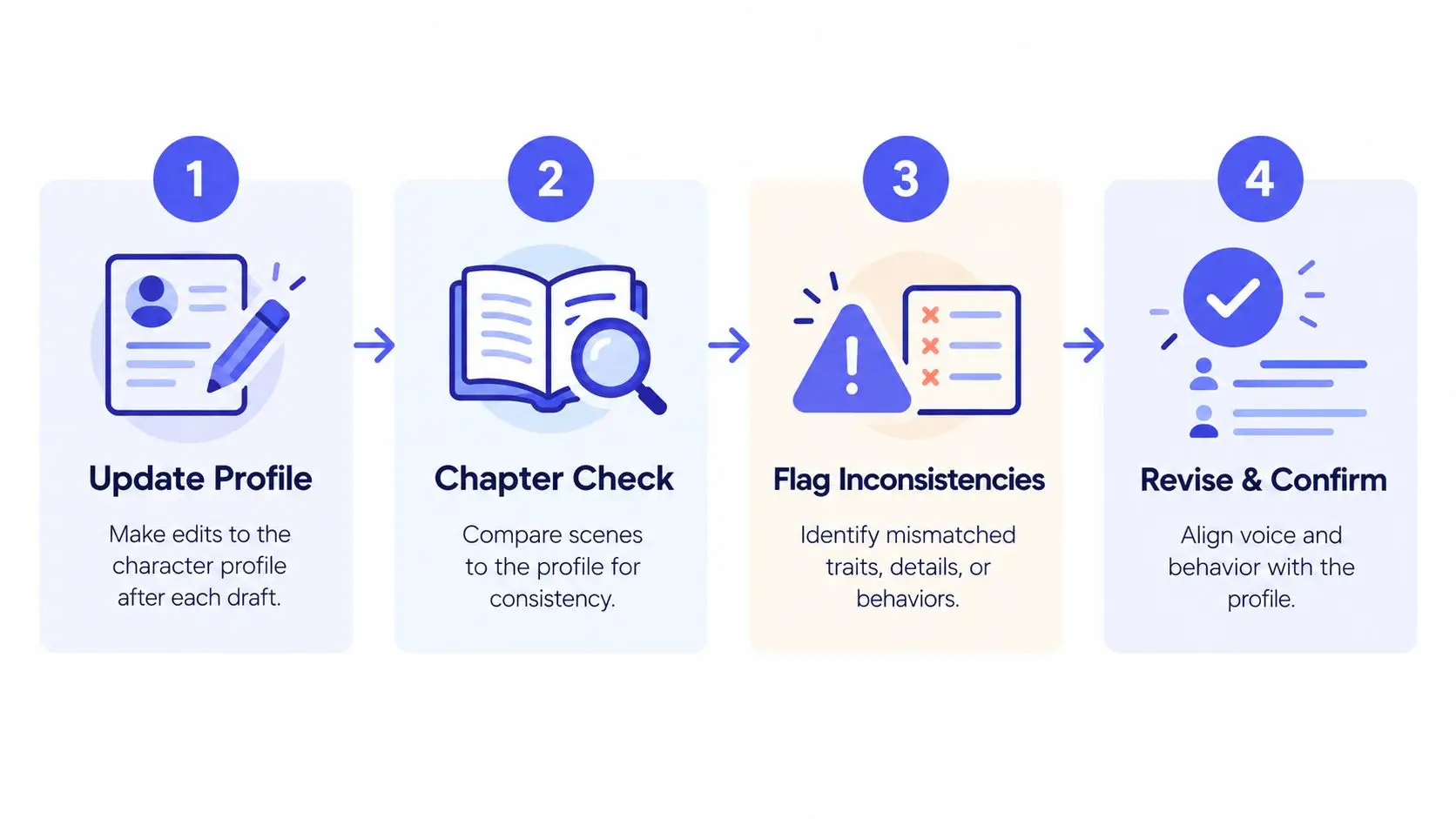
After each meaningful draft change, update the profile in plain language. Don't rewrite the entire document. Add the new fact, revise the affected field, and note whether the change belongs to the character's stable identity or their developing arc.
Before a dialogue-heavy scene, reread the voice, goal, motivation, and current emotional state. Ask what the character knows at that moment, what they're trying to conceal, and what they believe the other person wants. Those checks often prevent dialogue from becoming a generic exchange of plot information.
During revision, compare the profile with the manuscript rather than assuming the profile is correct. Search for repeated physical details, relationship labels, promises, fears, and changes in speech. If the draft shows a contradiction, decide whether it's an error or a deliberate development, then update the reference accordingly.
Detect drift instead of correcting blindly
Character drift happens when behavior changes without a cause the reader can understand. It may appear as a confident voice replacing a hesitant one, a relationship becoming warmer without a shared experience, or a fear disappearing whenever the plot needs a convenient action.
Newer template designs respond to this problem by including prompts for contradictions, arc checks, and revisions that take the manuscript into account, as described in this character profile planning resource. A digital workspace can also keep notes beside the draft, which reduces the chance that an important discovery remains buried in a separate file. For practical organization, see how to organize character notes and worldbuilding.
Revision question: Does the manuscript show the character changing, or did the writer simply change the character?
A Completed Character Profile Example
Lena Ortiz is a useful model because her profile connects visible detail, formative history, and psychological pressure. She's a municipal archivist investigating records connected to her mother, who was blamed for altering public documents. The profile doesn't try to explain every year of Lena's life. It concentrates on the information that can produce scenes.
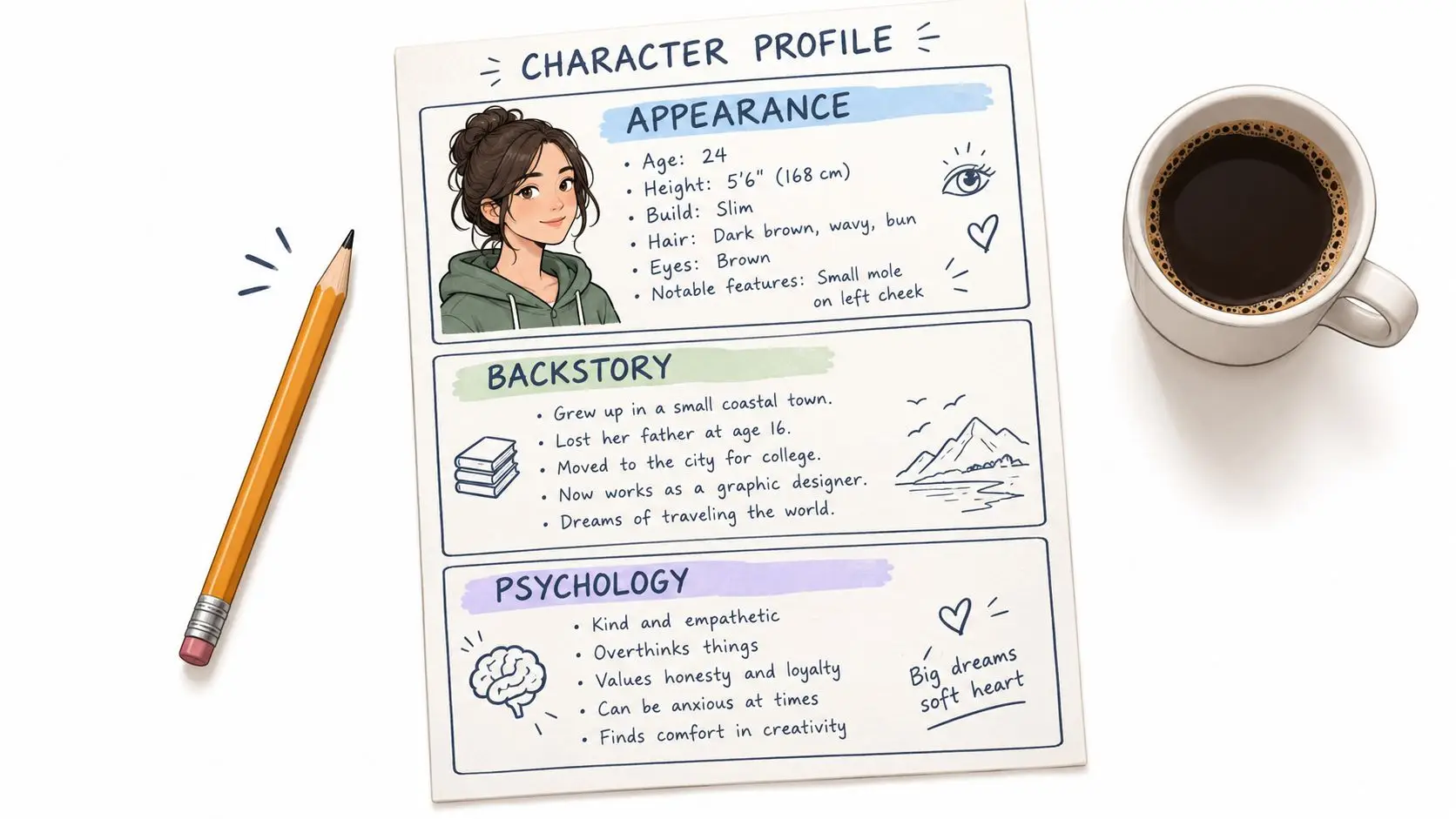
Lena Ortiz profile
Role: Protagonist and municipal archivist. She investigates missing records while trying to protect her younger brother from the family scandal.
Outer appearance: Lena wears a carefully mended charcoal coat, keeps her copper hair in a braid, and has ink stains on the sides of her fingers. She checks the position of her keys before leaving any room. When anxious, she speaks too quickly and corrects other people's dates.
Voice: In public, her sentences are formal and exact. With her brother, she uses dry jokes and unfinished thoughts. She rarely swears, but she becomes unusually polite when she's furious.
Backstory: Lena's mother worked in the same archive and lost her position after several records vanished. Lena remembers defending her mother as a child, then discovering that some evidence had been hidden from the family. She began working in archives because preserving documents felt safer than trusting people.
Relationships: Lena is protective of her brother but often treats him as a responsibility rather than an equal. She respects her supervisor's knowledge but assumes that every correction is an attempt to discredit her. A former friend offers information about the missing records, though Lena suspects the friend has a private reason for helping.
Goal: Recover the missing records before the archive's closure makes them inaccessible.
Motivation: Lena wants proof that her mother wasn't responsible for the scandal. She believes that evidence will restore her family's name and settle the uncertainty she has carried since childhood.
Flaw: She interprets disagreement as erasure. Instead of asking what another person means, she searches for the inconsistency that will prove they're unreliable.
Fear: She fears discovering that her mother did alter the records, and that her own loyalty has protected a comforting lie.
Arc: At the start, Lena believes love requires defending a perfect version of the past. By the end, she can accept her mother's complexity and protect her brother without deciding what he must believe.
The entries are specific because they create choices. Lena's key-checking can appear before a risky confrontation. Her formal politeness can signal anger. Her habit of correcting dates can alienate an ally. Her fear conflicts with her goal, which means success will not just give her what she wants.
One question remains open: why did the former friend return now? That ambiguity gives the plot room to develop. The profile also distinguishes Lena's public and private voices, so her dialogue can change according to relationship without becoming inconsistent.
For another way to study how physical and behavioral details work together, explore this character description example.
A profile can also support visual planning when a project includes illustrations or promotional artwork. The important point is that the visual details still serve the story. Copper hair matters less as decoration than as a recurring recognition cue, especially when Lena is seen from a distance or in a crowded archive.
Quick-Reference Field Checklist for Your Next Profile
Keep this checklist beside your draft, not hidden in a folder you never open. Fill the fields that affect the story first, then expand the profile when the manuscript asks for more.
Outer appearance
- Identity: Name, role, age, birthplace, current location, occupation.
- Recognition: Build, hair, eyes, clothing, distinguishing marks, accessories.
- Movement: Gait, posture, gestures, grooming, health, physical limitations.
- Communication: Speech rhythm, vocabulary, accent, eye contact, vocal habits, laugh.
Backstory
- Origins: Childhood, family structure, economic circumstances, education.
- Formative events: Important memories, losses, achievements, regrets, turning points.
- Connections: Friends, enemies, colleagues, authority figures, dependents.
- Present context: Work history, current relationships, secrets, reputation.
Psychology
- Values: Moral principles, worldview, strengths, sources of pride.
- Pressure: Emotional triggers, anger, private fears, deepest longing.
- Self-image: Public identity, private identity, contradiction, unresolved question.
Production fields
- Goal: What the character actively wants.
- Motivation: Why that goal matters.
- Flaw: The pattern that complicates progress.
- Fear: The outcome they most want to avoid.
- Voice: How they sound in thought and conversation.
- Arc: What changes, deepens, breaks, or becomes clear.
During revision, check the profile against the pages. Verify that the character's voice matches their relationship and emotional state, that actions reflect the information available at that point, that relationships develop through visible events, and that the arc appears in decisions rather than only in your notes.
Frequently Asked Questions About Character Profiles
Should I complete the profile before drafting?
You can, but you don't have to. Planners may build the central fields first, while discovery writers can begin with a name, role, desire, and pressure point, then update the profile as the character reveals more.
What if the character changes so much that the profile no longer fits?
Revise the profile instead of forcing the manuscript back toward an earlier version. Preserve the old entry in your notes if the change matters, and record the scene or discovery that caused the new direction.
Do exact ages and dates need to be final?
Lock them down when they affect chronology, legal status, education, family relationships, or other plot mechanics. If a detail has no story consequence yet, mark it as provisional rather than spending energy perfecting it.
How many character profiles does a novel need?
Create full profiles for the characters whose choices drive the central conflict. Give recurring secondary characters compact profiles, and record only the details needed for one-scene characters unless they return later.
Storyloft gives authors a place to draft a short character sheet beside the manuscript, with fields for identity, backstory anchors, contradictions, voice, and physical traits. Build your next profile there, keep it close during drafting and revision, and visit Storyloft to start organizing the character decisions your novel depends on.