What Is Protagonist and How to Write One Readers Love
A protagonist is the story's primary causal agent whose goals, decisions, and transformation drive the plot and focus the central conflict. The term entered English in the late 17th century, with one source recording use in the 1670s, and it originally meant the first or leading actor in Greek drama rather than "the main character."
You're probably here because you've written a few scenes, maybe even a few chapters, and something feels off. Your story has people in it. Things happen. Dialogue lands. But when you ask yourself, “Who is this really about?” the answer gets fuzzy.
That fuzziness causes bigger problems than most new writers expect. If you don't know your protagonist, you won't know whose goal should shape the plot, whose losses should matter most, or which scenes deserve space on the page. Revision becomes a maze because every choice starts to feel equally important.
A lot of this confusion comes from treating the protagonist as the hero, the narrator, or the person with the most page time. Sometimes those are the same person. Sometimes they aren't. The useful question isn't “Who shows up most?” It's “Who makes the choices that force the story forward?”
Think of your reader like a traveler entering unfamiliar terrain. They need an anchor. They need one character whose struggle gives shape to everything else. Once that anchor is clear, scenes tighten, stakes sharpen, and even side characters start behaving in relation to a stronger center.
Table of Contents
- Introduction Why Every Story Needs a Clear Protagonist
- What a Protagonist Really Means Beyond Main Character
- The Core Functions That Make a Protagonist Essential
- Understanding Different Types of Protagonists
- Memorable Protagonist Examples From Literature and Film
- How to Create a Compelling Protagonist Readers Remember
Introduction Why Every Story Needs a Clear Protagonist
A student once showed me a draft about a heist crew. The opening was slick. The banter worked. The setting had style. But by page ten, the story felt slippery because the draft kept handing the wheel to a different character.
One scene followed the planner. Another leaned on the hacker. Then the getaway driver got the emotional backstory. Each character was interesting, but the story had no single engine. It was like pushing a car from three sides at once. Plenty of effort, no clean direction.
That's why learning what is a protagonist matters so much. This isn't just a vocabulary term from English class. It's one of the most practical craft decisions you'll make as a writer. When you can identify the true protagonist, you can answer hard revision questions faster.
- Whose goal shapes the story? That character should pull scenes into a meaningful order.
- Whose conflict matters most? That's where your biggest dramatic energy usually belongs.
- Whose change gives the ending weight? That's often the emotional center readers carry away.
New writers also get tangled up because “protagonist” sounds moral. It sounds like the good person, the brave one, the role model. But story structure doesn't care about moral purity. Story structure cares about pressure, choice, and consequence.
When your protagonist is unclear, the plot often feels busy instead of purposeful.
A clear protagonist gives your draft a spine. Readers know where to invest. You know what to cut. Even your subplots become easier to manage because they either challenge that central figure or they don't belong.
What a Protagonist Really Means Beyond Main Character
The word protagonist has a history that clears up a lot of modern confusion. According to this etymology of protagonist, it comes from Ancient Greek prōtagōnistēs, built from prōtos meaning “first” and agōnistēs meaning “actor” or “competitor.” That same source notes that the term entered English in the late 17th century, with recorded use in the 1670s, and that its earliest dramatic sense meant the first or leading actor in Greek drama.
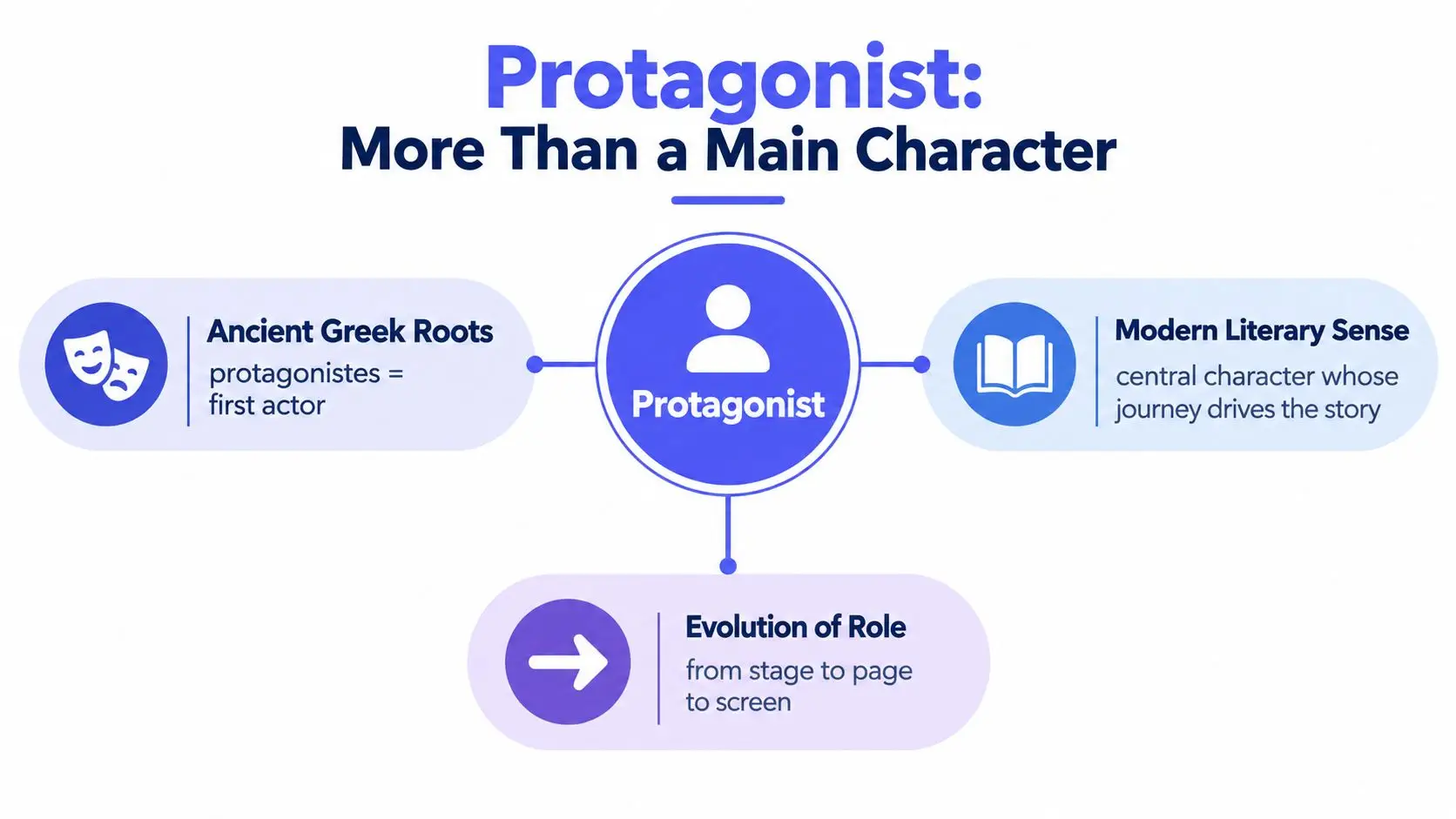
That older meaning matters. At first, the word pointed to a role in performance structure. It wasn't just “the person we like best.” It was the first actor, the one placed at the front of the dramatic struggle. The Greek root also connects to contest and public competition, which helps explain why the term grew into something active rather than passive.
The engine, not the passenger
A protagonist isn't just the most visible person in the story. The protagonist is more like the engine of the story. Other characters can ride in the vehicle, argue in it, damage it, or try to steal it. But if your protagonist isn't generating movement, the story coasts.
That's why a passive central figure often creates flat fiction. If events keep happening to the character, but the character rarely chooses, resists, pursues, or sacrifices, the plot starts to feel accidental.
A good way to test this is to ask whether your character has a live motivation that keeps pulling action out of them. If you're shaping that layer, this guide on character motivation can help clarify why a protagonist moves at all.
The word also exists outside fiction
Another source of confusion is that “protagonist” doesn't only belong to novels and films. As explained in Scribbr's definition of protagonist, the term can also refer to a leading participant in a real-life event or a supporter or leader of a cause. In journalism or public debate, someone can be called a protagonist without being fictional at all.
So the word has technical and metaphorical uses. In fiction, it names a structural role inside a narrative. In public discourse, it can mean a central actor in real events. That broader meaning is useful to know, but for writers, the structural meaning is the one that does the heavy lifting.
The Core Functions That Make a Protagonist Essential
The protagonist has jobs to do. If those jobs don't happen on the page, the story weakens, even if the prose is lovely.
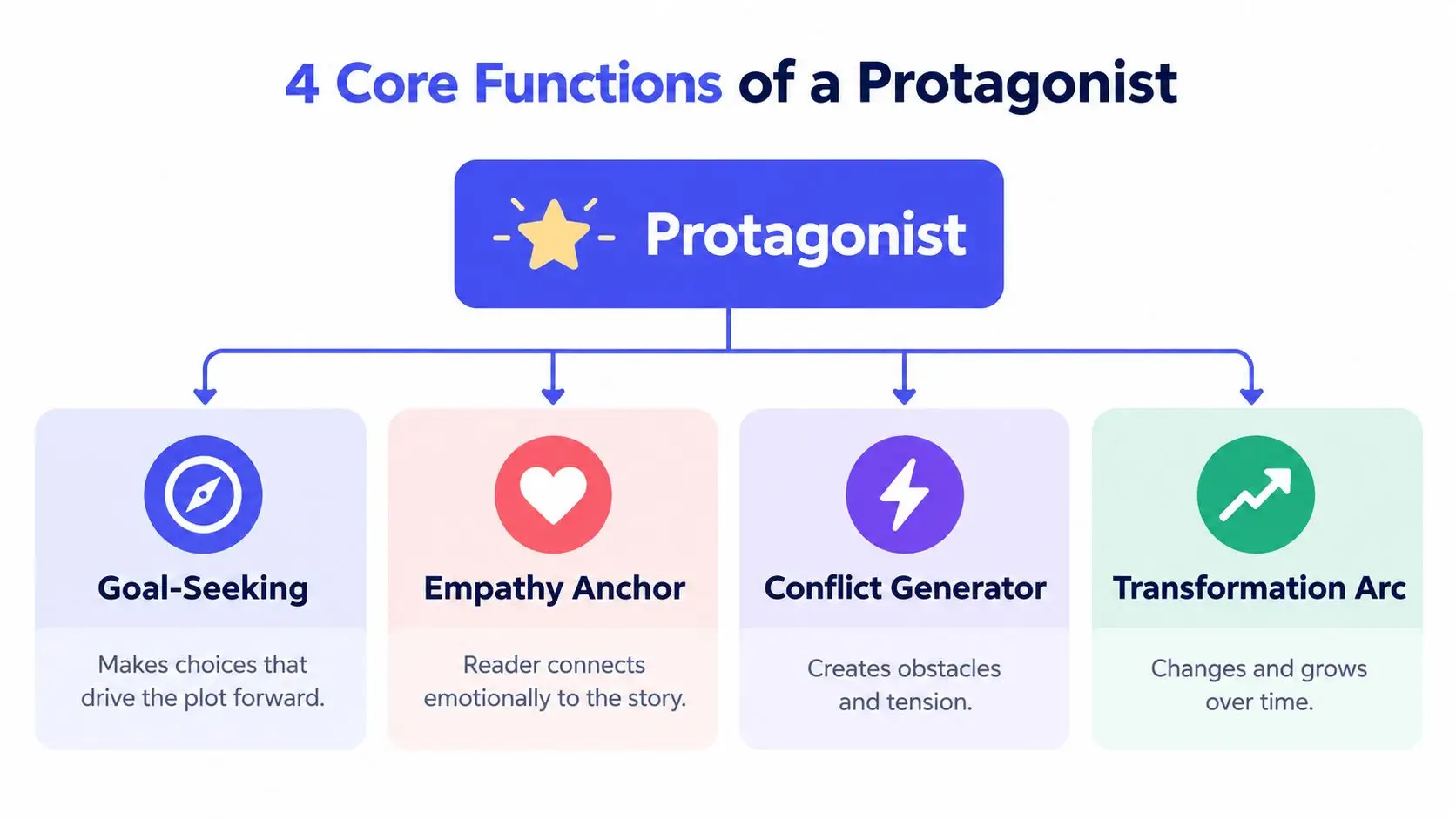
Driving action through choices
In narratology, the protagonist is best understood as the story's primary causal agent. Oregon State's writing guidance describes the protagonist as the figure who “drives the action,” is most central to the conflict, and whose fate matters most to the audience in this explanation of the protagonist's role.
Practical rule: If your central character doesn't make consequential choices, your plot will feel episodic instead of causal.
That one idea fixes many drafts. A scene isn't important because it contains motion. It's important because the protagonist wants something, acts toward it, and triggers a result.
Holding the central conflict in place
A protagonist also acts as the story's conflict magnet. The main struggle should keep bending back toward them. Even when villains scheme or side characters complicate the world, the deepest dramatic question usually sounds like this: what will happen because this character keeps pursuing this goal under pressure?
If your draft feels scattered, check whether too many scenes orbit side problems that don't squeeze the protagonist directly.
Carrying the emotional stakes
Readers don't need perfection. They need investment. The protagonist gives readers someone whose losses and hopes organize the emotional experience.
A useful draft check is simple:
- Name the want: What does your protagonist actively seek right now?
- Name the cost: What hurts if they fail?
- Name the pressure: Who or what pushes back?
- Name the fear: What inner wound makes this harder?
Those answers create an emotional throughline. If they stay vague, the story often feels decorative.
Changing in a way that matters
Most protagonists also carry the story's transformation arc. That change can be growth, disillusionment, corruption, acceptance, or painful self-knowledge. It doesn't have to be cheerful. It does have to feel earned.
If you're building fiction where character choices shape the whole reading experience, this piece on a character-driven story is a useful companion.
A strong ending usually shows not just whether the protagonist won, but who the struggle turned them into.
Understanding Different Types of Protagonists
Writers often ask the wrong question here. They ask, “Should my protagonist be likable?” The sharper question is, “What kind of connection do I want readers to have with this character?”
According to Literature and Latte's discussion of protagonist definition, a protagonist isn't technically required to be morally good, heroic, or even likable. The role is structural rather than ethical. That means a flawed, antiheroic, or even villainous central figure can still function perfectly well as long as their perspective, stakes, and choices organize the narrative.
Morality and structure are not the same thing
Many beginners loosen their grip on the story without meaning to. They worry so much about making the protagonist admirable that they flatten the character into a polite blur.
Readers often connect through viewpoint, internal conflict, and stakes, not virtue alone. A selfish character who's cornered by grief may feel more compelling than a kind character who never has to choose anything difficult.
Which protagonist type fits your story
| Protagonist Type | Moral Alignment | How Readers Connect | Best For |
|---|---|---|---|
| Classic hero | Usually admirable or aspirational | Readers root for courage, sacrifice, and perseverance | Quest stories, adventure, uplifting arcs |
| Antihero | Morally mixed, flawed, conflicted | Readers connect through vulnerability, honesty, or damage | Gritty drama, noir, psychological fiction |
| Villain protagonist | Often harmful or corrupt | Readers connect through fascination, tension, or insight into motive | Dark satire, tragedy, crime fiction |
| Ensemble protagonist | Shared across multiple central figures | Readers connect through contrasting goals and group dynamics | Heist stories, family sagas, team narratives |
| False protagonist | Appears central at first, then gives way | Readers connect through surprise and structural disruption | Thrillers, twist-heavy stories, experimental fiction |
A quick choice test
Use these questions when you're deciding which model fits:
- Do you want admiration? A classic hero often works well.
- Do you want messy intimacy? An antihero may fit better.
- Do you want unease or moral tension? A villain protagonist can do that work.
- Do you want the story to feel communal? An ensemble gives the spotlight to several intersecting arcs.
- Do you want to destabilize expectations? A false protagonist can create that jolt.
None of these types is automatically stronger than the others. The right one is the one that produces the emotional effect your story needs.
Memorable Protagonist Examples From Literature and Film
Examples make all this easier to feel in your bones.

The classic hero
Katniss Everdeen is a clean example of a protagonist who drives plot through urgent choice. She doesn't become central because the story camera likes her. She becomes central because she acts. She volunteers, survives, adapts, and keeps forcing new consequences.
Her goal shifts over time, but her agency never disappears. That's why the story keeps its grip.
If you want to study this tradition more broadly, these examples of archetypal heroes are a useful reference point.
The antihero
A character like Walter White shows how a protagonist can become less morally defensible while remaining structurally central. Readers don't stay because he's good. They stay because his decisions keep escalating danger.
His transformation also teaches an important craft lesson. A protagonist arc doesn't have to move toward virtue. It can move toward exposure. Sometimes the story reveals who the person was becoming all along.
The villain protagonist and the ensemble
Tom Ripley is a strong villain protagonist because the story aligns us with his schemes, fears, and improvisations. We may not approve of him. We still feel the pressure of his choices because the narrative keeps us close to the consequences he creates.
An ensemble works differently. In a story like The Office, the emotional center moves among several characters, and the pleasure comes from the group pattern as much as any single arc. Even short-form storytelling can use that principle well. If you want to see how structure sharpens audience attention in compact formats, this article on how narrative structure elevates short videos offers a helpful lens.
For a quick visual breakdown of character function on screen, this video is worth a look.
What all these examples share is simple. The protagonist, whether noble or disturbing, keeps making the story happen.
How to Create a Compelling Protagonist Readers Remember
A memorable protagonist usually starts with tension inside the character, not just around them.

Build from want, need, and contradiction
Start with three things:
A clear want
What does the character pursue on the surface? A crown, a reunion, revenge, safety, proof, escape.A deeper need
What truth do they need to face, accept, or learn? Trust, humility, grief, courage, self-respect.A contradiction
What makes them difficult to understand? Brave in public, terrified in private. Tender with strangers, cold with family.
That triangle gives you movement. The want pushes the plot. The need shapes the arc. The contradiction creates texture.
Force choices, not errands
Give your protagonist decisions that cost something. If every scene only asks them to gather information, travel somewhere, or react politely, the story will stay thin.
Use these revision checks:
- Remove coincidence: Can this turning point happen because of the protagonist's choice instead?
- Increase cost: What personal loss would make the goal matter more?
- Sharpen opposition: Who benefits if the protagonist fails?
- Track change: By the final act, what belief can this character no longer keep?
If you want a practical worksheet for this process, a character outline template can help you hold goals, flaws, voice, and backstory in one place. One option is Storyloft, which includes a character creator, planning workspace, manuscript editor, and beta-reader collaboration tools that help writers keep a protagonist consistent across a long draft.
The easiest protagonist to forget is the one who wants nothing strongly and risks nothing meaningful.
Test the character before you draft deep
Before you write fifty pages, tell a friend your protagonist's goal, fear, and central contradiction in a few sentences. If those pieces sound hazy, the draft probably will too.
You don't need a perfect character profile before chapter one. You do need a person capable of causing story. Once you have that, scenes stop feeling random. They start locking together.
If you're building a protagonist and want one place to shape the character, draft scenes, track changes, and prepare the manuscript for publishing, Storyloft brings those parts into a single writing workflow. It's especially useful when you want your protagonist's goals, voice, and arc to stay visible while the story grows.