Character Outline Template That Actually Works
You're staring at a fresh document late at night, armed with a protagonist's name, coffee order, childhood nickname, and carefully chosen hairstyle. You may even know the school they attended and the song they'd play on repeat. Yet the opening scene still feels lifeless because none of those details tells you what the character will do when someone threatens the thing they value most.
That's the failure mode of the traditional character sheet. It collects biography before it establishes pressure, contradiction, motivation, and scene-level choice. A useful character outline template should work beside the draft, not sit in a forgotten planning folder. It should be lean enough to complete quickly, specific enough to guide scenes, and flexible enough to change when the manuscript exposes a better version of the character.
Table of Contents
- Why Most Character Sheets Stall the Draft
- What a Modern Character Outline Template Actually Contains
- Choosing Between the Basic and Advanced Template
- Filling the Template With the Reverse-Build Method
- Filled Examples Across Three Genres
- Planning Characters With Identity and Stakes in Mind
- Keeping the Template Alive Through Drafting and Revision
Why Most Character Sheets Stall the Draft
A bio-style sheet often gives you information without giving you drama. You know where the character was born, what they look like, and what hobbies they enjoy, but you don't know what they want in the next scene, what they're afraid of losing, or which belief will make the wrong choice feel reasonable.
That distinction matters. Background can inform a character, but conflict turns information into behavior. A character who collects antique maps is only interesting when that habit affects a decision, reveals a private fear, creates friction with another character, or changes how they interpret the setting.
The questionnaire trap
Many templates encourage writers to answer every prompt before drafting. The result can be a detailed profile that reads like a personnel file. It feels productive because the page fills quickly, but the writer still has to invent the actual scene from scratch.
The problem isn't detail itself. The problem is detail without narrative function. A character's family history earns its place when it explains a present-day loyalty, secret, resentment, or blind spot. A favorite food usually doesn't survive revision unless it becomes part of a relationship, setting, memory, or recurring choice.
Practical rule: If a field can't influence dialogue, conflict, pacing, point of view, or a decision, leave it blank until the draft gives you a reason to use it.
Build for the page, not the biography
A draft-side outline needs a different order from a traditional profile. Put the story engine first:
- Scene pressure: What threatens the character now?
- Contradictory want: What do they desire while resisting the action that could achieve it?
- Core belief: What do they assume about themselves, other people, or the world?
- Relationship influence: Who can reward, expose, betray, or challenge them?
- Arc decision: What choice will prove that the character has changed, refused to change, or changed in the wrong direction?
Once those fields work, surface details become easier to choose. The character's occupation, gestures, clothing, and speech patterns can reinforce the central conflict instead of decorating an empty outline.
A strong character outline template is therefore a living draft tool. You fill it before writing, annotate it as scenes reveal new information, and delete anything that never affects the story. The goal isn't to know everything. The goal is to know enough to make the next meaningful choice.
What a Modern Character Outline Template Actually Contains
Character templates have moved well beyond niche workshop handouts. Reedsy says its character profile template has been downloaded by over 300,000 authors, and describes it as a long-standing staple in the writing community (Reedsy's character profile template). That adoption shows that structured planning has become a familiar part of fiction workflows, but popularity doesn't make every field useful.
Most professional sheets share a recognizable spine. They combine identifying information, physical presentation, psychology, backstory, relationships, and story function. Squibler's structure separates surface details, personality, and core identity, while the professional framework referenced by Reedsy organizes character design through layers such as core, characterisation, uniqueness, physical traits, backstory, and relationships.
Judge fields by their drafting value
| Cluster | Example Fields | Drafting Value |
|---|---|---|
| Identity and role | Name, role, age, occupation | Helps you orient the reader and keep the character's story function clear |
| Interior life | Motivation, fear, belief, flaw, contradiction | Drives decisions when the plot applies pressure |
| Social web | Key relationships, loyalties, enemies, dependencies | Creates leverage, conflict, and scene-specific stakes |
| Arc mechanics | Starting belief, endpoint, turning point, sacrifice | Gives the character movement instead of a static description |
| Voice and behavior | Speech pattern, silence, gesture, habit | Makes internal conflict visible through action and dialogue |
| Backstory | Formative event, family history, education, wound | Explains present behavior when it collides with current events |
The first cluster is necessary, but it shouldn't dominate the page. A name and role help you keep track of a cast. An occupation matters when it shapes access, expertise, status, or time. Physical description earns space when it affects how the character moves through the world or how others treat them.
Interior life and relationships usually carry more weight during drafting. “Stubborn” is a label. “They'd rather lose an opportunity than admit they need help” is a usable pressure point. “Has a sister” is background. “Calls the sister only when asking for a favor, then resents the debt” creates a scene pattern.
Writers who want to compare different formats can use a complete character sheet example alongside the leaner structure in this character design template. The useful question isn't how many prompts a sheet contains. Ask whether the answers help you decide what the character does next.
Advanced templates add more layers, but the shared spine remains stable: who the character is, what they want, what blocks them, who can affect them, and how their choices change. Start with those fields before adding hobbies, favorite possessions, or exhaustive chronology.
Choosing Between the Basic and Advanced Template
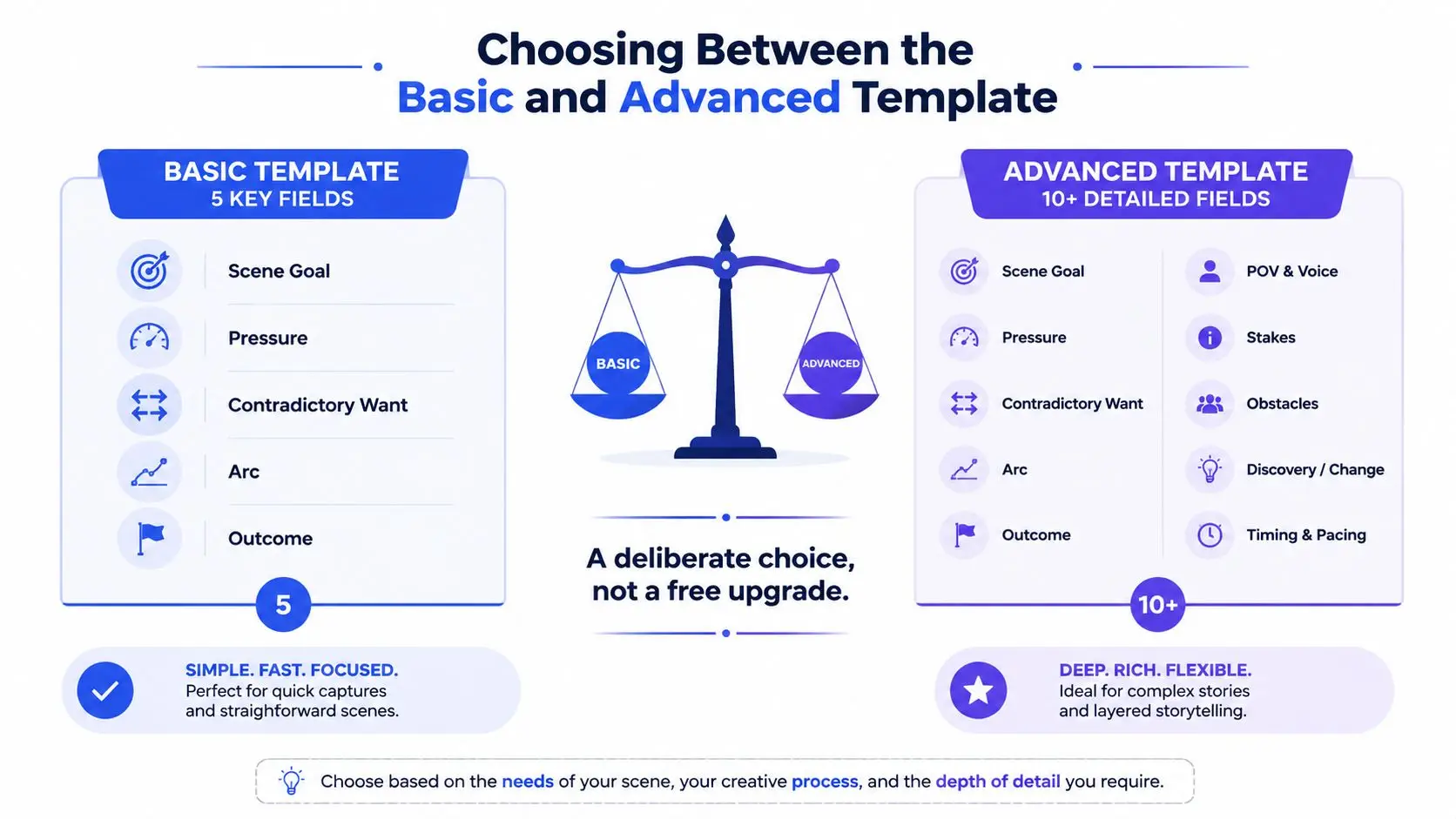
The basic and advanced versions shouldn't be treated as a free upgrade path. They solve different drafting problems.
A basic character outline template is designed for speed. It can contain roughly 10 fields, including scene goal, pressure, contradictory want, arc turning point, and a voice anchor. That structure suits a first draft, a short story, or a secondary character who only needs enough definition to behave consistently.
An advanced template adds roughly 12 more fields for complications such as backstory collisions, relationship mapping, test scenes, and revision checkpoints. It earns its space when a character carries a novel-length arc, appears across multiple points of view, or has relationships that change the plot rather than just decorate it.
Pick the smallest sheet that protects the draft
Choose the basic version if:
- You're drafting a short project: A compact sheet keeps momentum and prevents planning from replacing writing.
- The character has a narrow function: A witness, rival, or one-scene ally may not need a full relational history.
- You're still discovering the story: Basic fields leave room for the manuscript to surprise you.
Choose the advanced version if:
- The character appears throughout a long manuscript: Track continuity, evolving beliefs, and repeated relationships in one place.
- The character's past creates present conflict: Add collision points that force backstory into scenes rather than leaving it as exposition.
- Revision has exposed contradictions: Use checkpoints to record decisions that became fixed during drafting.
My recommendation is simple: start basic, then promote characters to advanced during revision. A character earns extra fields when the story proves they need them. Filling every advanced prompt before writing often creates false certainty and makes you defend details that no longer serve the manuscript.
For writers experimenting with interactive personas or speculative character behavior, character frameworks for AI chat can offer another way to test how a profile responds under pressure. Treat that exercise as behavioral testing, not as a replacement for scene-based storytelling.
Filling the Template With the Reverse-Build Method
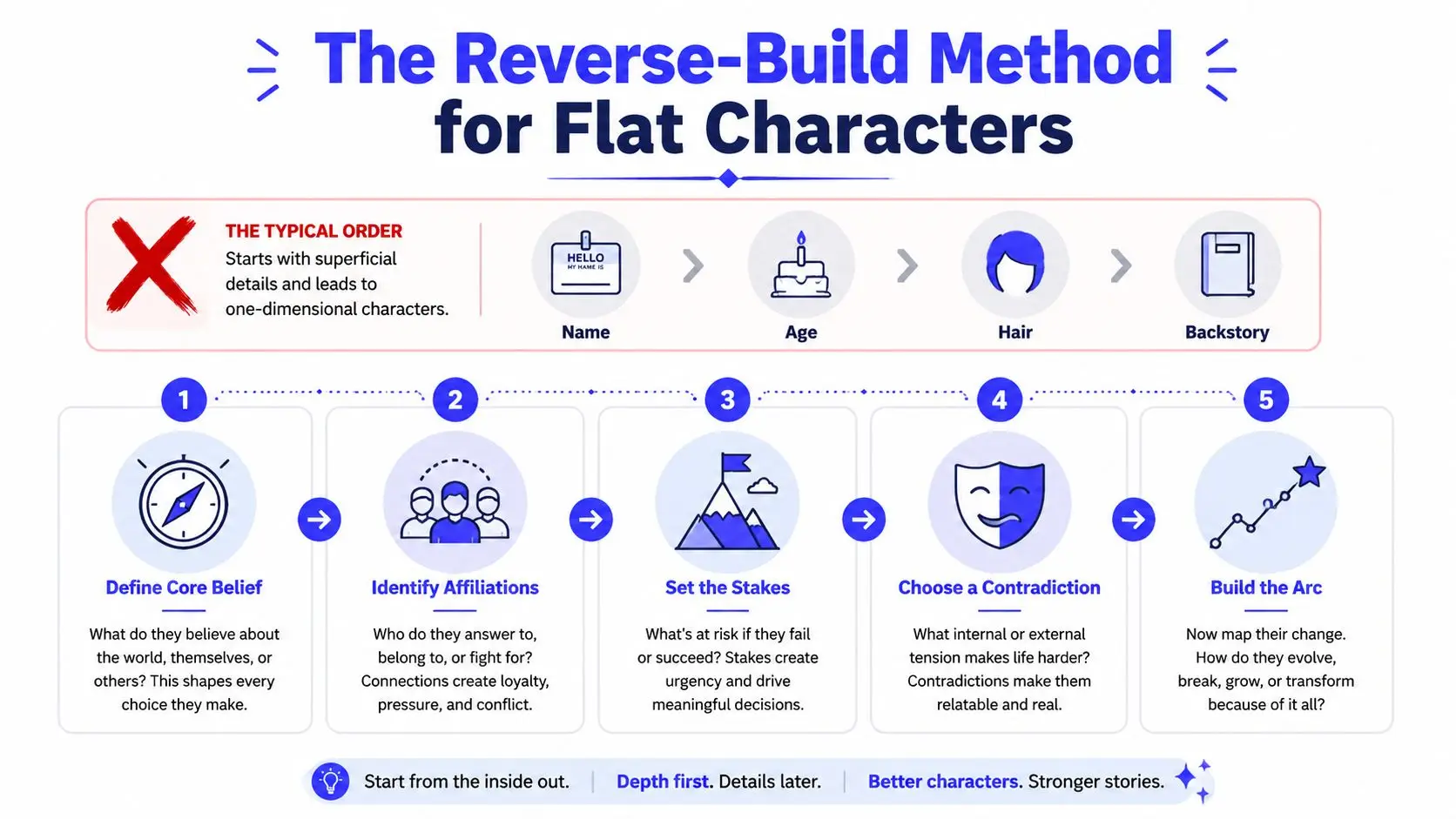
Most writers begin with a name, age, appearance, job, and backstory. That order feels natural, but it often produces a character who looks specific without wanting anything urgently enough to act.
The reverse-build method starts with the character's destination. It defines the choice that will expose them, then works backward to the belief and wound that make the choice difficult.
Use five moves
Define the endpoint. Write the worst-case decision or final meaningful choice. Ask, “What must this character finally do, refuse, confess, sacrifice, or destroy?” This populates the arc endpoint and gives every earlier scene a direction.
Identify the want behind it. Name the desire that makes the endpoint matter. The character may want safety, belonging, authority, forgiveness, independence, or recognition. Keep the wording active and concrete. “Wants to be loved” is broad; “wants to prove they can protect the family without relying on anyone” can shape behavior.
Trace the wound or false belief. What past experience taught the character an incomplete lesson? A wound isn't valuable because it is tragic. It matters because it produces a belief that collides with the present goal. Populate the core identity, misbelief, and formative event fields here.
Mark the starting state. Describe the character on page one, before the plot has challenged their strategy. What do they believe will work? What behavior protects them? What are they unwilling to admit? The starting state should stand in visible tension with the endpoint.
Layer in surface details. Only now choose the occupation, physical cues, speech patterns, habits, and objects that express the inner structure. A guarded character might answer questions with procedural language. A character desperate for approval might over-explain simple decisions. Surface details should make the hidden conflict observable.
This sequence changes the outline from a catalogue into a chain of cause and effect. The advanced version doesn't replace the basic method. It adds sub-beliefs, relationship fields, misbelief stages, and revision notes after the central arc already works.
You can enter the same reverse-build prompts in a character profile builder, then test whether each answer produces a scene choice. If the profile can't help you write a confrontation, refusal, lie, or compromise, it needs sharper pressure rather than more biography.
Filled Examples Across Three Genres
The same character outline template can support very different stories because the underlying fields describe behavior, not genre decoration. Mystery, romance, and science fiction may use different settings and stakes, but each protagonist still needs a want, a wound, a misbelief, and a starting state that can be challenged.
| Field | Mystery, Detective | Romance, Florist | Sci-Fi, Courier |
|---|---|---|---|
| Story want | Close the case before the evidence disappears | Save the family shop from closure | Deliver the last message to its destination |
| Wound | A wrongful accusation damaged their trust in judgment | A parent abandoned responsibility for the shop | A colony ignored an earlier warning |
| Misbelief | Rules keep people safe | Needing help means failing | Loyalty requires obedience |
| Starting state | Overconfident in procedure | Proud, capable, and isolated | Obedient, watchful, and wary |
| Pressure point | Evidence implicates someone protected by procedure | The rival offers the help the florist refuses | The message contradicts the courier's orders |
| Arc decision | Break protocol to expose the truth | Accept partnership without surrendering agency | Disobey authority to deliver the truth |
Mystery
The detective wants to close the case because a wrongful accusation taught them that procedural mistakes can ruin innocent lives. Their misbelief is that strict rules prevent harm, so they begin overconfident in procedure and dismiss evidence that falls outside the approved process. The central pressure arrives when the strongest clue implicates someone protected by that process. The detective must decide whether preserving institutional order matters more than exposing the truth.
Romance
The rival florist wants to save the family shop after watching a parent quit when responsibility became difficult. They interpret dependence as failure, so they reject practical help even when the shop's survival depends on cooperation. Their starting state is proud and isolated. The romantic conflict becomes inseparable from the business conflict when the person offering help is also the rival whose judgment they distrust.
Science fiction
The courier wants to deliver the last message because a colony ignored an earlier warning, leaving them convinced that obedience is the safest form of loyalty. They begin wary but compliant, following orders while privately questioning the people who issue them. When the message reveals that authority has concealed the truth, delivery becomes an act of disobedience rather than routine work.
Genre changes the surface cues, but the reverse-build fields remain the same. Writers looking for additional ways to shape visual and verbal details can compare these entries with a character description example, then keep only the details that alter behavior.
Planning Characters With Identity and Stakes in Mind
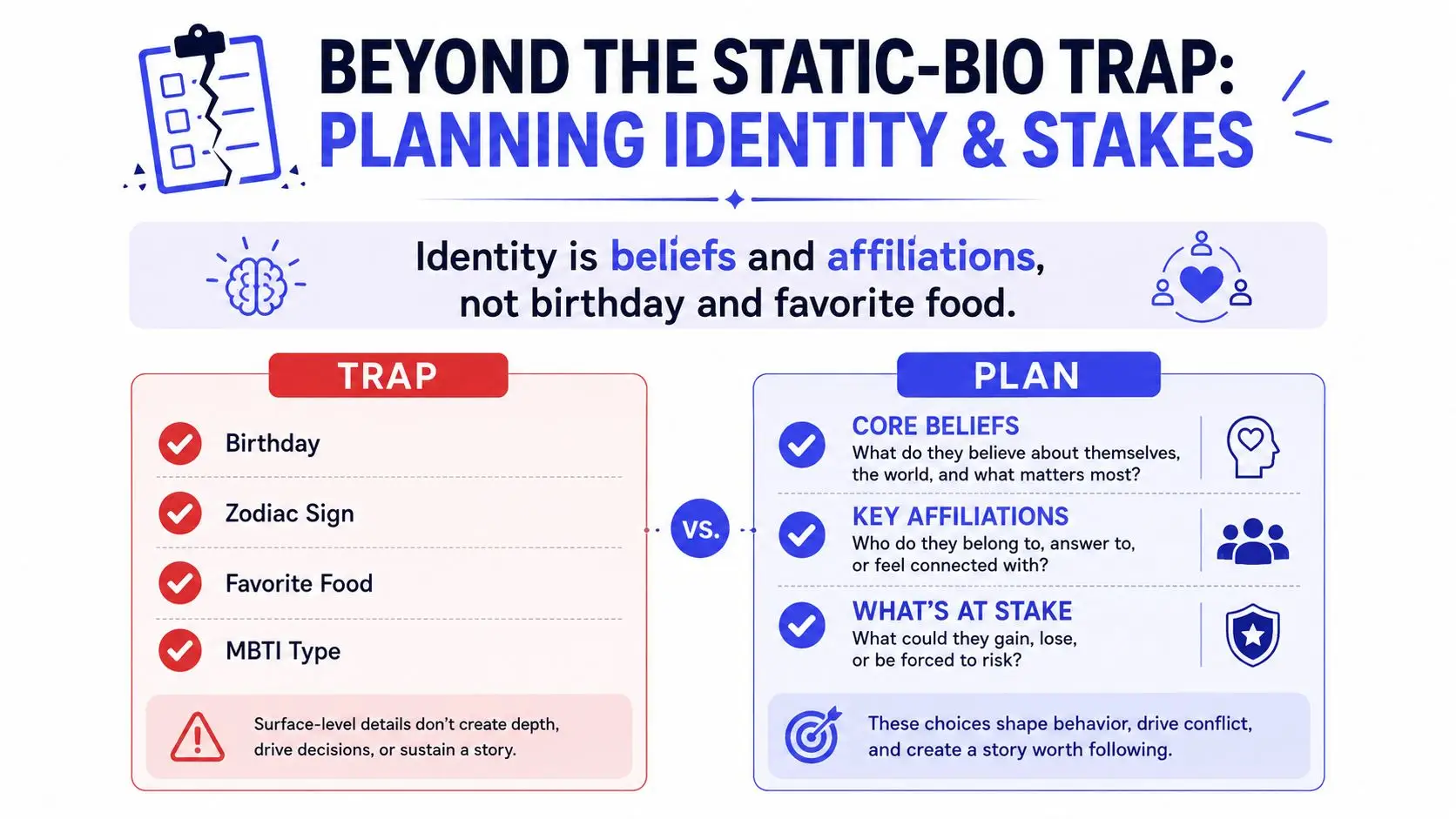
A list of pronouns, a birthday, and a favorite food doesn't amount to inclusive character planning. Those details may be relevant, but they don't explain how identity shapes access, belonging, conflict, language, or risk.
A more useful approach treats identity as the beliefs and affiliations a character will defend under pressure. Stakes are what the character loses if those beliefs break. This shifts identity from a demographic checkbox to a source of narrative consequence, while leaving room for cultural context, family structure, disability, religion, class, migration, and language to affect the story without reducing the character to any one label.
Add prompts that connect identity to action
Use these questions in the advanced template:
- Voice and distrust: Whose voice does the character distrust, and what experience taught them to listen or refuse?
- Ethical community: Which community shaped their ethics, and what obligation do they feel toward it?
- Hidden identity: What part of themselves have they concealed to remain safe, employed, accepted, or protected?
- Cost of disclosure: What specific loss would force them out of hiding?
- Language shift: How does their language change between private and public settings?
Each prompt should populate a story field, not merely add background. Voice and distrust can shape dialogue and point of view. Community can create loyalty and obligation. Hidden identity can generate secrecy, while the cost of disclosure supplies a scene-level stake. Language shifts can reveal code-switching, intimacy, authority, fear, or deliberate resistance.
A responsible test: Does this identity detail raise the cost of the central scene, change who has power, or alter what the character can safely say?
If the answer is no, you may still keep the detail for your own understanding, but don't pretend it is doing narrative work. Writers also need to verify cultural details through appropriate research and avoid using a character sheet as permission to generalize about a group. The strongest outline records lived context and consequences, not a decorative collection of labels.
Keeping the Template Alive Through Drafting and Revision
A character outline becomes useful when it stays close to the manuscript. Filling it once before chapter one and never opening it again turns a flexible planning tool into a static record of intentions.
Use one working document per major character. Pin those documents to the sidebar in your writing app, and give yourself a place to record changes without interrupting the scene.
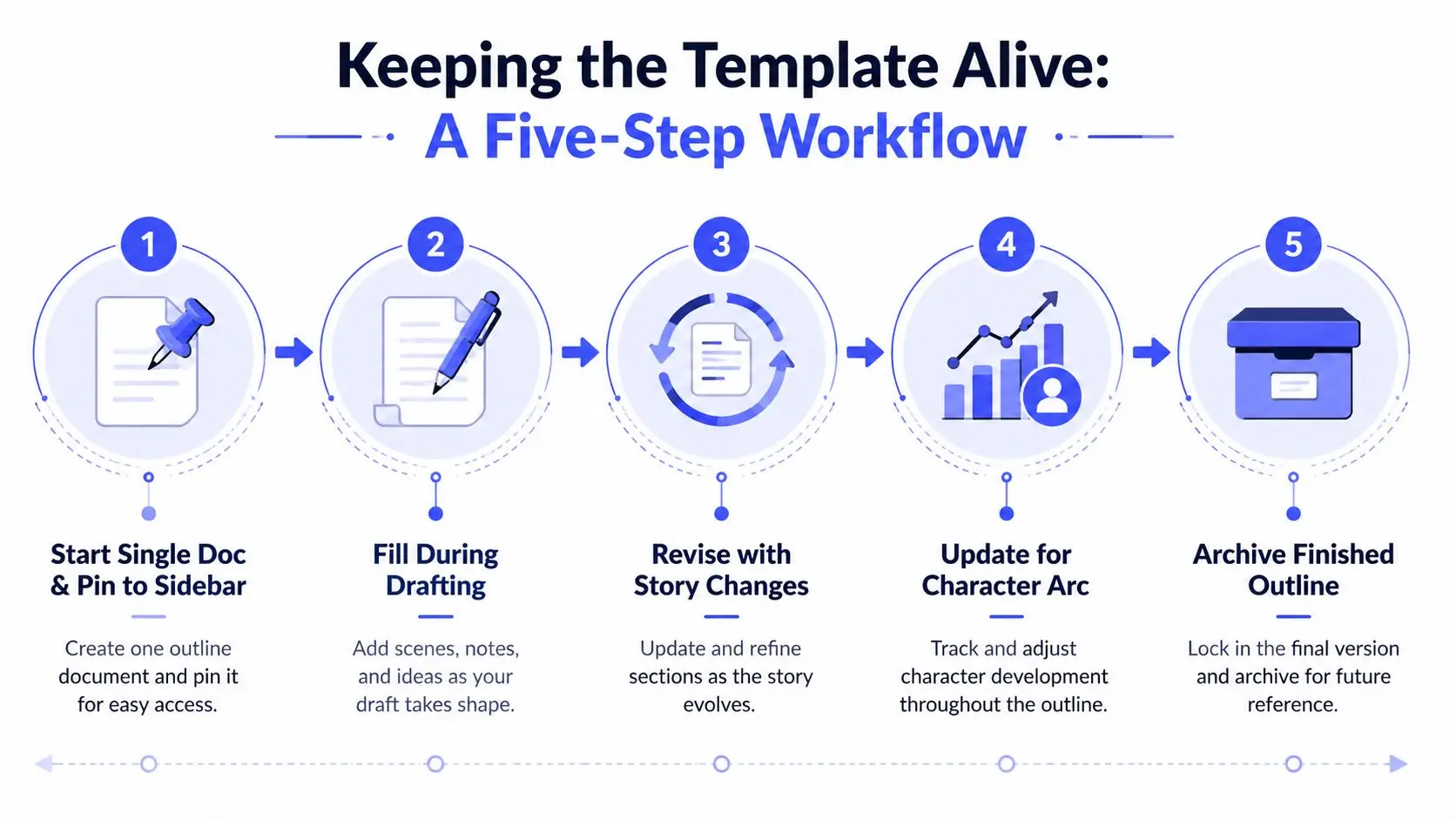
Run a five-step maintenance loop
Start with one pinned document. Put the core fields, arc endpoint, relationships, and voice anchor at the top. Keep research and optional biography below them so the decision-making fields remain visible.
Fill it during drafting. When the character first appears on the page, add a draft tag to fields confirmed by action or dialogue. Separate what you planned from what the manuscript has established.
Revise with story changes. If a scene reveals that the character lies under pressure rather than withdrawing, update the behavior field immediately. Don't protect an old answer just because you wrote it first.
Prune after the second draft. Delete unused hobbies, redundant history, and details that never affect a scene. Keep contradictions that create friction. Remove trivia that only makes the page look complete.
Capture hardened decisions. After revision, return to the outline and record facts that became permanent, such as a relationship boundary, speech pattern, injury, secret, or changed belief. The document should reflect the novel you wrote, not the one you originally imagined.
A writing workspace with binders, tags, side-by-side notes, and a manuscript editor can support this loop without scattering character information across separate files. For a practical overview of organizing this material, see how to create character profiles.
Revision rule: If a field hasn't affected a scene choice, simplify or delete it before the next draft.
Storyloft combines long-form manuscript drafting with planning tools such as binders, tags, notes, and side-by-side research, so authors can keep a character outline near the work it informs. Visit Storyloft to create a living character profile, pressure-test it during drafting, and revise the sheet as your manuscript changes.