10 Examples of Tropes Writers Can Use and Subvert
The most popular advice about tropes is also the least useful: “Avoid them.” A trope isn't automatically a cliché. It becomes stale when it appears without fresh motivation, specific character pressure, or meaningful consequences. Examples of tropes can give readers an immediate sense of genre and direction, but the writer still has to decide what the pattern means in this particular story.
The useful process is simple. Identify the trope's narrative function, study how recognizable stories use it, then adapt, complicate, combine, or invert it in a scene. The examples below move from broad story architecture to character, relationship, plot-device, setting, and ending tropes. Each one includes a short definition, familiar examples, a diagnostic question, and a practical way to make the pattern serve your story instead of replacing it.
Central craft lesson: A trope tells readers what kind of pattern they may be entering. Your characters decide what that pattern costs.
Table of Contents
- 1. The Hero's Journey
- 2. The Unreliable Narrator
- 3. The Love Triangle
- 4. The Mentor
- 5. The Redemption Arc
- 6. The MacGuffin
- 7. The Twist Ending
- 8. The Found Family
- 9. Unrequited Love
- 10. The Dystopia
- Comparison of 10 Story Tropes
- Turn Familiar Patterns Into Fresh Scenes
1. The Hero's Journey
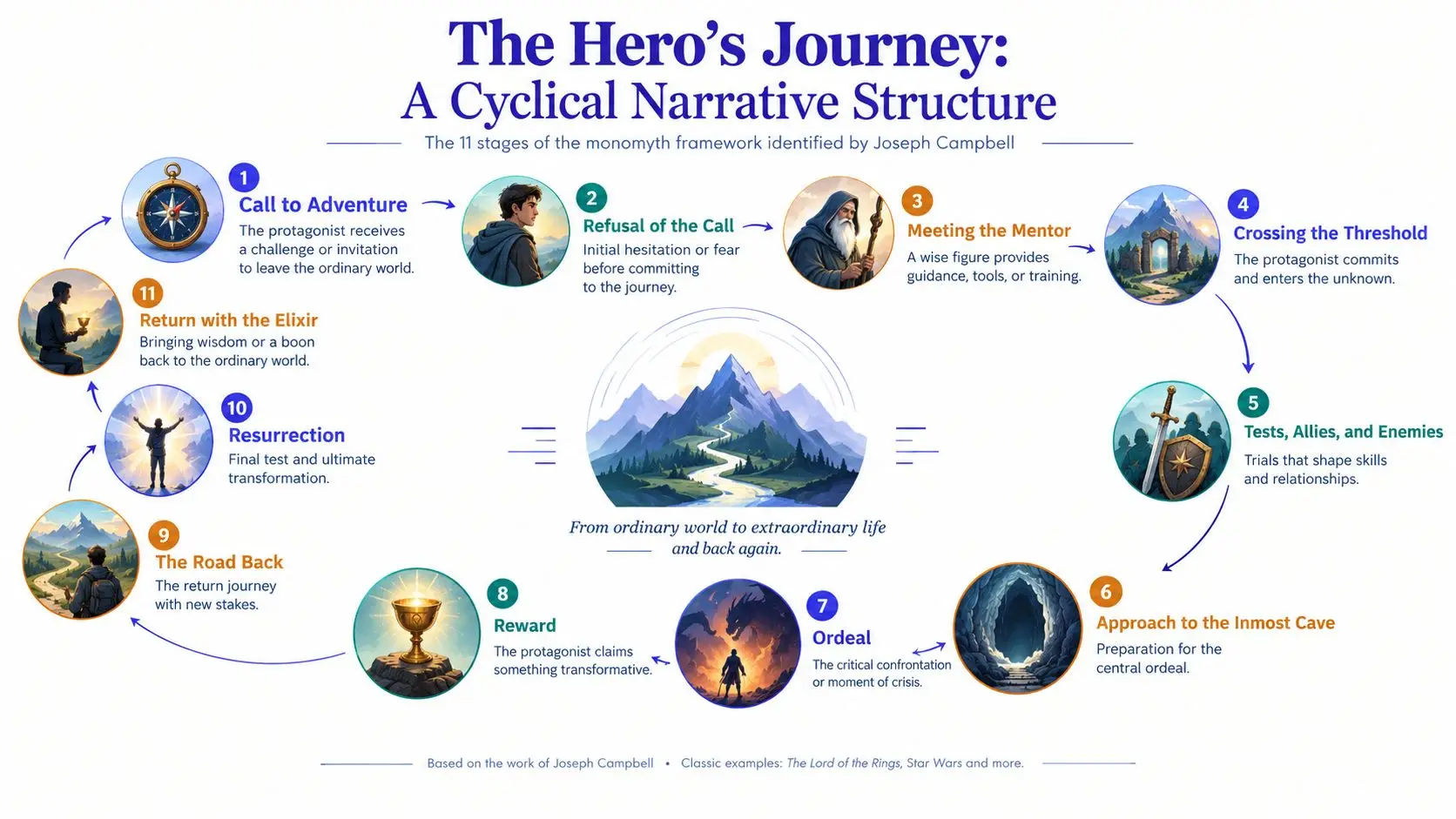
The Hero's Journey is a cyclical story structure in which a protagonist leaves an ordinary world, accepts or is forced into an adventure, faces trials, gains insight or power, and returns changed. The structure is associated with Joseph Campbell's monomyth, but writers don't need to treat it as a rigid sequence. Its real value lies in connecting external events to an internal transformation.
Frodo begins in the safety of the Shire and ends at Mount Doom, carrying a burden that changes his understanding of courage and power. Katniss Everdeen enters the Hunger Games after volunteering for Prim, then emerges from survival into political awakening. Luke Skywalker leaves his farm life, encounters mentors and enemies, and grows into a person capable of acting on a larger moral responsibility. Dorothy's journey through Oz also follows a movement away from home, through danger and discovery, and back toward home with a changed perspective.
Use the structure as pressure, not paperwork
Before assigning a stage to every chapter, ask what the protagonist believes at the beginning and what the ordeal will force them to reconsider. A call to adventure matters because it threatens the character's existing strategy for staying safe. A mentor matters because the protagonist lacks knowledge, confidence, or discipline. The return matters because the protagonist must apply what they learned, not merely survive the climax.
To plan a long manuscript, map each major phase in Storyloft's guide to structuring a story. Track the mentor relationship in your notes, mark moments when the protagonist's voice changes, and record visible consequences of the ordeal in their behavior, appearance, or relationships.
Subversion tactic: Make the protagonist complete the external quest but reject the identity the quest was supposed to give them.
The diagnostic question is direct: What does your protagonist lose by returning to the ordinary world? If the answer is “nothing,” the journey may be functioning as an adventure outline rather than a transformation.
2. The Unreliable Narrator
An unreliable narrator filters events through bias, distortion, or deliberate evasion. They may lie, misunderstand what happened, protect themselves from an unbearable truth, or interpret every situation through prejudice. Your task as the writer is to plant contradictory evidence that attentive readers can detect, while making the narrator's version meaningful enough to follow.
Gillian Flynn's Gone Girl makes perspective part of the conflict through Amy and Nick's competing accounts. In Edgar Allan Poe's The Tell-Tale Heart, the narrator's insistence on sanity strengthens the evidence of guilt and instability. Patrick Bateman's account in American Psycho keeps fabricated and actual violence difficult to separate. In Dennis Lehane's Shutter Island, fractured perception shapes the protagonist's identity and the story's revelation. The trope suits psychological fiction, mysteries, and horror, but its function changes with genre: it can conceal a fact, expose a character's self-deception, or make interpretation the central tension.
Plant evidence without announcing the trick
An unreliable voice works like a stained window. Readers still see the scene, but the narrator's fears and desires tint every detail. Contradictory facts, evasive descriptions, peculiar omissions, tonal shifts, and other characters' reactions can all press against the narrator's account. Give readers enough evidence to form questions. If the revelation depends on information the story withheld entirely, surprise may feel like manipulation.
Use Storyloft's explanation of tone in writing to examine how the voice changes when the narrator feels threatened, ashamed, or triumphant. Keep two records while drafting: the narrator's version and the underlying evidence. Mark clues that should register during a first reading without revealing the answer.

Ask: What does the narrator gain by making the reader believe this version? The answer should shape word choice, scene selection, and what the narrator refuses to describe. A useful subversion is to let the narrator tell the truth about the central event while misunderstanding the emotional meaning of everything around it.
Reader-response scholarship supports treating reception as evidence alongside authorial intention. Research on responses to Howl's Moving Castle distinguishes affective, textual, experiential, social, and cultural responses, with the study reporting experiential responses at 33.33% and textual responses at 27.08% in its sample research on reader response and literary interpretation. Beta-reader reactions can show whether readers are engaging with the intended ambiguity or becoming confused.
3. The Love Triangle
A love triangle places one central character between two romantic or emotional possibilities. The device creates tension around choice, loyalty, commitment, and self-knowledge. It doesn't have to be a contest in which one suitor is obviously superior. The stronger version gives each relationship a distinct emotional logic.
Bella's choice between Edward and Jacob in Twilight represents different kinds of desire, danger, and belonging. Katniss's relationships with Peeta and Gale in The Hunger Games also carry meanings beyond romance, including safety, loyalty, and political conviction. Elena's relationships with Stefan and Damon in The Vampire Diaries create a shifting emotional and moral conflict, while Claire's bond with Frank and Jamie in Outlander places love against history, identity, and competing obligations.
Give each side of the triangle a real argument
A weak triangle turns one love interest into a placeholder and the other into the inevitable choice. Develop separate chemistry, conflict, and values for each pairing. One person might make the protagonist feel understood, while another challenges the version of themselves they've been performing. The protagonist's hesitation should reveal a genuine divide inside them.
Use Storyloft's romance beat sheet guidance to pace attraction, rupture, and decision points. Track the protagonist's language around each person. Do they become more candid, defensive, playful, or ambitious? Those shifts create evidence that the triangle is emotionally active rather than merely delaying the ending.
Diagnostic question: What does each relationship ask the protagonist to become?
Subversion tactic: Have the protagonist choose neither person, because the triangle exposes a need for independence rather than a need to select a partner.
At scene level, avoid repeating the same conflict with different dialogue. Let each meeting produce a different consequence. A public choice might damage one relationship, a private confession might change another, and a final decision should cost the protagonist something they genuinely value.
4. The Mentor
The mentor is a character who offers knowledge, discipline, perspective, or emotional guidance to a protagonist who isn't ready to face the central conflict alone. Dumbledore helps Harry understand the magical world and the significance of prophecy. Yoda trains Luke in the Force. Haymitch teaches Katniss how to survive a system designed to turn people into entertainment. Mr. Miyagi teaches Daniel discipline and perception through methods that initially appear indirect.
The mentor works best as a person, not a delivery system for advice. They should have a history, a worldview, and a reason to invest in the protagonist. Dumbledore's guidance is shaped by his own knowledge and failures. Haymitch's methods emerge from his experience of the Games. Mr. Miyagi's lessons carry grief and memory as well as technique.
Build a relationship that changes both characters
Write a private rule for the mentor's teaching philosophy. Perhaps they value patience over force, obedience over improvisation, or compassion over victory. Then put that rule under pressure. A mentor who never revises their beliefs will feel like a statue.
Storyloft's character profile tools can help you record the mentor's background, motivation, fear, and limits alongside the protagonist's development. Keep a scene list for their conversations and note which lessons the protagonist accepts, misunderstands, or later rejects.
Ask: What does the mentor need from the protagonist that they won't admit?
Subversion tactic: Make the mentor's most important lesson an example of what not to become.
The mentor should eventually lose authority, leave, fail, or become unavailable. That separation forces the protagonist to act without borrowed certainty. If the protagonist solves the climax only because the mentor returns with a perfect answer, the story has protected the character from completing their own arc.
5. The Redemption Arc
A redemption arc follows a morally flawed, harmful, villainous, or emotionally damaged character as they move toward ethical or psychological recovery. The pattern explores forgiveness, responsibility, change, and second chances. Redemption isn't the same as receiving sympathy. A backstory can explain harmful behavior without excusing it.
Ebenezer Scrooge changes after supernatural encounters force him to confront the consequences of his isolation. Jaime Lannister's arc in A Song of Ice and Fire develops through loss, shame, and difficult choices. Severus Snape's morality becomes more complicated as later revelations alter the reader's understanding of earlier actions. These examples differ sharply, which is useful for writers. A redemption arc can be public and demonstrative, private and incomplete, or morally ambiguous.
Make change visible in decisions
Don't measure redemption by how sorry a character sounds. Measure it by what they do when the old behavior would be easier. The character should face a choice that offers a believable return to their previous self. Their new action needs a cost, and someone affected by their earlier behavior may still refuse forgiveness.
Build a causal timeline linking external events to internal change. Track rationalizations, doubts, attempts to repair harm, and moments when the character relapses. A single sacrifice at the end can't erase a pattern of cruelty established throughout the story.
Diagnostic question: Who is allowed to refuse this character's apology?
Subversion tactic: Let the character change sincerely, but deny them the social reward of being declared “good.”
This approach keeps redemption grounded in responsibility. The character may become safer, more honest, or more useful without becoming universally loved. Their transformation becomes a practice rather than a scene.
6. The MacGuffin
A MacGuffin is an object, goal, person, or concept that motivates the characters' actions while mattering less than the conflict created by pursuing it. The briefcase in Pulp Fiction drives attention precisely because its contents remain unexplained. The One Ring in The Lord of the Rings gives the characters a reason to travel and resist temptation, while the relationships formed during the quest carry much of the emotional weight. The Maltese Falcon and the Ark of the Covenant similarly attract competing characters whose desires reveal their values.
Make the object mean something different to everyone
A MacGuffin shouldn't be emotionally empty. Its practical function may be secondary, but each character should project a different meaning onto it. One person sees freedom, another sees proof of belonging, and a third sees a chance to control someone else.
Practical rule: If removing the object leaves every character unchanged, the object is only delaying the story.
For each scene, ask what pursuit of the MacGuffin reveals about a relationship or forces a decision. A chase can expose cowardice. A negotiation can reveal whose loyalty has a price. A theft can force a character to choose between an immediate victory and another person's safety.

Subvert the pattern by making the MacGuffin's physical value a lie, while the belief surrounding it remains powerful. The characters may fight over an ordinary object because they misunderstand its history, or because the person who controls the story behind it controls the group.
7. The Twist Ending
A twist ending changes the reader's understanding of earlier events through a revelation, reversal, or new context. It works like a second lens: familiar scenes remain the same, while their emotional meaning shifts. A strong twist also follows the story's rules, so surprise grows from preparation rather than missing information.
In The Sixth Sense, the revelation about Bruce Willis's character reshapes his interactions throughout the film. Fight Club redefines the relationship between the narrator and Tyler Durden. Gone Girl reverses the reader's view of the disappearance, while Agatha Christie's And Then There Were None uses its final explanation to recast the search for justice.
Design the second reading
Begin with the truth and work backward. Track what each character knows, what the reader assumes, and what the narration withholds. Each clue should function as an ordinary detail on the first reading, then become meaningful evidence on the second.
Storyloft's edit history and comments can help track planted clues across drafts. A dedicated binder can record which scenes the twist reinterprets and whether the revelation follows established rules. If readers could not access the necessary information, the surprise may feel arbitrary. If every clue announces itself, the ending may feel predictable.
Diagnostic question: What earlier scene carries a new emotional weight once the reader knows the truth?
Subversion tactic: Reveal the secret before the ending, then shift the climax to whether the characters can live with the truth after the illusion collapses.
The revelation should produce consequences. Once readers understand what happened, the protagonist still has to choose whether to confess, escape, forgive, or accept responsibility. That choice turns a clever answer into a meaningful ending.
8. The Found Family
The found family trope brings unrelated characters together through loyalty, care, shared experience, and mutual protection. It explores belonging as something people build rather than something guaranteed by blood. Harry, Ron, and Hermione form a chosen bond that expands through their shared dangers. Sense8 connects strangers through an extraordinary shared experience. Schitt's Creek shows people losing status and finding community, while the Guardians of the Galaxy turn a group of damaged misfits into a family.
Show the ordinary work of belonging
A found family becomes convincing through small acts. Someone remembers another character's food preference. A group creates a ritual after a crisis. One member notices silence and asks about it. These details matter because family isn't established by declaring that everyone is close. It's established through repeated attention.
Give every member a wound, a need, and a fear about dependence. The group's warmth should coexist with conflict. A character who has survived alone may interpret help as control. Another may demand loyalty that the group can't ethically provide.
Track inside jokes, shared rituals, fractures, and repairs in your planning notes. Spread “family” scenes across the manuscript so the bond develops between major action beats rather than appearing only during a final speech.
Diagnostic question: What does each member risk by accepting care from the others?
Subvert the trope by making the group loving but temporary. A found family can remain meaningful even when its members choose different futures. The ending doesn't need to preserve the original arrangement to prove that belonging mattered.
9. Unrequited Love
Unrequited love centers on feelings that aren't returned with equal intensity. The trope creates longing, embarrassment, hope, grief, and eventual growth. Cyrano de Bergerac loves Roxane while hiding behind another man's words. Penelope's feelings for Colin in Bridgerton develop through a long period of unequal awareness. In My Heart and Other Black Holes, romantic feeling exists alongside depression and emotional vulnerability. The Sun Is Also a Star explores whether a brief connection can become something deeper.
Protect both characters from simplification
The person who loves shouldn't become a passive victim, and the person who doesn't reciprocate shouldn't automatically become cruel. Attraction isn't a moral debt. Let the admired character have boundaries, limitations, and their own emotional truth. Let the unrequited lover experience desire without treating persistence as entitlement.
Write scenes that contrast public behavior with private feeling. Around the beloved, the character may become careful or performative. Alone, they may be funny, angry, ambitious, or uncertain. That contrast gives the arc a self beyond romance.
Ask: What part of the lover's identity has become organized around being chosen?
Subversion tactic: End the relationship without reciprocation, but give the unrequited character a larger life that isn't presented as consolation.
A meaningful arc can move from hope to acceptance, but acceptance shouldn't mean emotional erasure. The character may still care. They stop making another person's response the measure of their worth.
10. The Dystopia
A dystopia places characters inside a deteriorated or oppressive society shaped by surveillance, censorship, environmental collapse, resource control, technological domination, or authoritarian power. George Orwell's 1984 examines totalitarian surveillance. Suzanne Collins's The Hunger Games depicts a government that controls resources and populations. Octavia Butler's Parable of the Sower responds to environmental and economic collapse, while Ray Bradbury's Fahrenheit 451 explores censorship and mass entertainment.
Make the system visible in daily choices
Worldbuilding becomes persuasive when readers see how the system affects ordinary behavior. Who can travel? Who receives medicine? What does a family do before speaking about politics at home? Which jobs require loyalty tests? What harmless action has become suspicious?
Build rules, resources, institutions, history, and technology in a planning workspace. Then reveal them through consequences instead of explanatory blocks. A character's ration, housing assignment, school lesson, or interrupted message can communicate more than a page of institutional history.
Ask: What does the system make the protagonist do before they understand that they're participating in it?
Use visual references to keep architecture, surveillance devices, environmental damage, and public spaces consistent across scenes.
Subvert the trope by making resistance produce a morally troubling result. The regime may fall, but the replacement may inherit its tools. Or the protagonist may discover that some citizens support the system because it provides safety they fear losing. A dystopia gains depth when oppression affects people unevenly and resistance carries real responsibility.
Comparison of 10 Story Tropes
| Trope | Implementation complexity 🔄 | Resource requirements & pacing ⚡ | Expected outcomes 📊 | Ideal use cases 💡 | Key advantages ⭐ |
|---|---|---|---|---|---|
| The Hero's Journey | High, multi-phase mapping & beats 🔄 | High, long-form pacing (50k+) ⚡ | Strong emotional arc; satisfying payoff ⭐⭐⭐⭐📊 | Epic series, debut novels, genre fiction 💡 | Proven scaffolding for plot & character growth ⭐ |
| The Unreliable Narrator | High, precise clue placement & voice control 🔄 | Moderate–High, revision-heavy, continuity checks ⚡ | Deep psychological engagement; re-readability ⭐⭐⭐⭐📊 | Psychological thrillers, literary first-person 💡 | Engages readers as active interpreters; ambiguity depth ⭐ |
| The Love Triangle | Moderate, balance competing relationships 🔄 | Moderate, recurring relational scenes ⚡ | High emotional investment; reader debate ⭐⭐⭐📊 | Romance, YA, character-driven plots 💡 | Immediate tension and relatability; drives interpersonal conflict ⭐ |
| The Mentor | Low–Moderate, define role without overshadowing 🔄 | Low–Moderate, focused character backstory ⚡ | Facilitates believable growth; emotional guidance beats ⭐⭐⭐📊 | Coming-of-age, training arcs, hero quests 💡 | Explains skills, supplies wisdom, deepens protagonist arc ⭐ |
| The Redemption Arc | High, earned change requires careful pacing 🔄 | High, long-term moral beats & milestones ⚡ | Complex character depth; cathartic payoff ⭐⭐⭐⭐📊 | Character-driven dramas, epics, moral narratives 💡 | Adds moral complexity and meaningful transformation ⭐ |
| The MacGuffin | Low, simple plot engine; motive-focused 🔄 | Low–Moderate, plot scenes around pursuit ⚡ | Drives action and reveals character priorities ⭐⭐⭐📊 | Adventure, thrillers, quest narratives 💡 | Clear motivation that propels plot across genres ⭐ |
| The Twist Ending | High, meticulous foreshadowing & consistency 🔄 | High, extensive revision and clue-tracking ⚡ | Memorable surprise; encourages re-engagement ⭐⭐⭐⭐📊 | Mysteries, thrillers, psychological stories 💡 | Creates lasting impact and re-read value when fair ⭐ |
| The Found Family | Moderate, manage ensemble dynamics & roles 🔄 | High, multiple character arcs to develop ⚡ | Strong emotional bonds; ensemble resonance ⭐⭐⭐📊 | Ensemble fiction, adventure, comedy-drama 💡 | Broad emotional appeal; supports multiple interlocking arcs ⭐ |
| The Unrequited Love | Low–Moderate, internal focus, subtle pacing 🔄 | Moderate, interior scenes and emotional beats ⚡ | Poignant empathy; growth through acceptance ⭐⭐⭐📊 | Literary fiction, romance, YA introspective arcs 💡 | Creates sympathy and realistic emotional development ⭐ |
| The Dystopia | High, consistent world-building & systems 🔄 | High, research, rules, and ongoing exposition ⚡ | High thematic resonance; elevated stakes ⭐⭐⭐⭐📊 | Speculative fiction, social commentary, high-stakes plots 💡 | Explores societal themes and built-in conflict for drama ⭐ |
Turn Familiar Patterns Into Fresh Scenes
A trope revision begins with recognition. Write down the expected version in one sentence, without judging it. “A reluctant hero accepts a quest.” “Two rivals fall in love.” “A hidden truth changes the ending.” This gives you a baseline. You can't meaningfully subvert a pattern you haven't identified.
Next, define the character-specific pressure that activates it. Why does this protagonist accept the quest when another person wouldn't? What does each love interest represent to this particular character? Why does the narrator distort the truth? A familiar pattern becomes personal when the answer depends on a history, fear, desire, or contradiction that belongs to your cast.
Then add concrete consequences. A mentor's lesson should affect a later decision. A MacGuffin should damage a relationship or expose a value. A redemption should require restitution, not only remorse. A twist should change what characters do after the revelation. If the trope produces no cost, it may be decorative rather than structural.
Choose one of four approaches:
- Fulfill it: Give readers the emotional payoff they came for, but ground it in specific characters and circumstances.
- Complicate it: Preserve the recognizable pattern while adding competing motives, costs, or moral uncertainty.
- Combine it: Pair two tropes so each changes the other, such as an unreliable narrator inside a found family story.
- Invert it: Reverse the expected result, but keep the emotional or thematic question that made the trope appealing.
For each major scene, ask what the trope is doing right now. Is it creating anticipation, forcing a choice, revealing character, organizing the plot, or establishing genre? If you can't answer, the scene may be repeating a familiar beat without developing it.
A structured planning workspace can keep the moving parts visible. Storyloft offers binders, tags, notes, comments, edit history, tone analysis, character tools, collaboration features, and manuscript-focused drafting in one application. You can map arcs, store research, track world rules, compare revisions, and invite beta readers to test whether a reveal feels earned or whether a relationship has enough independent chemistry.
Reader feedback matters because your intention isn't the same as the audience's experience. If readers miss every clue, the twist may lack usable evidence. If they predict the ending but still feel moved, the emotional execution may be working. If they reject a relationship because one option never feels credible, the problem lies in scene construction, not in the existence of the trope.
The final test is simple: remove the trope label and describe the scene in terms of human action. Someone lies to preserve their identity. Someone accepts help despite fearing dependence. Someone returns home unable to fit their old life. If the scene still contains conflict, desire, consequence, and change, the trope is serving the story. If only the label remains, revise the scene until a specific person has something personal to lose.
Storyloft brings long-form drafting, planning binders, character development, tone analysis, AI-assisted revision, comments, edit history, and beta-reader collaboration into one writing environment. Use it to map a trope, test its consequences across scenes, and revise familiar patterns until they feel earned. Visit Storyloft to start shaping your next story.