How to Use a Metaphor That Actually Lands in Your Writing
You're at your desk, staring at a sentence that is technically correct and completely lifeless. You've written that the project is difficult, the manager is unkind, or the character feels trapped, but the words slide past the reader without leaving a mark. You want the sentence to hit harder, so you reach for a metaphor, then wonder whether you've clarified the idea or merely decorated it.
A good metaphor doesn't put glitter on a sentence. It gives the reader a structure for understanding something abstract. The craft lies in choosing the right structure, placing it where the reader needs it, and removing it when it stops carrying meaning.
Table of Contents
- Starting With One Sentence You Want to Hit Harder
- How Often Strong Writers Actually Reach for Metaphor
- Choosing the Right Source Domain for Your Idea
- Placing the Metaphor Where It Does the Most Work
- Common Ways Metaphors Fall Apart in Revision
- Putting It Together With a Practice Exercise
Starting With One Sentence You Want to Hit Harder
Start with the sentence you already have. Don't begin by hunting for a clever image. First ask what the sentence is trying to make the reader understand, feel, or remember.
Suppose your draft says:
The revision process is frustrating.
That sentence names an experience, but it doesn't give the reader anything to hold. A metaphor can transfer the qualities of something familiar onto the abstract idea. You might write:
Revision is excavation.
Now the process carries associations of digging, buried material, patience, resistance, and discovery. The metaphor has changed how the reader imagines revision. It hasn't merely supplied a prettier noun.
This is the practical definition I use with writers: a metaphor borrows what the reader already knows about one thing and lends it to another. The concrete thing is the source domain. The abstract idea receiving those qualities is the target.
Everyday speech performs this transfer constantly:
- “Time is money” lends money's scarcity and spendability to time.
- “Her voice was velvet” lends velvet's softness and texture to a voice.
- “The office was a zoo” lends a zoo's noise, disorder, and unruly movement to a workplace.
Nobody needs to pause and decode these examples word by word. The comparison works because the source domain is familiar and the shared quality is easy to recognize. Aristotle's discussion of metaphor in Poetics, dating to the 4th century BCE, described metaphor as the “application of an alien name by transference” across genus, species, or analogy, as documented by the Stanford Encyclopedia of Philosophy's account of Aristotle's rhetoric. His formulation has remained a reference point for over 2,300 years, which tells you something about metaphor's role in thought, not just style.
Find the target before the image
Before drafting a metaphor, complete this sentence:
I want the reader to understand that __________.
Then add:
I want the reader to feel __________.
For example:
I want the reader to understand that the team keeps delaying a decision.
I want the reader to feel the mounting frustration and wasted motion.
Only then should you search for a source domain. A revolving door might suggest people constantly moving without progress. A traffic jam might suggest congestion and blocked movement. A treadmill might suggest effort without arrival. Each image transfers something different.
If you're working on an opening line, metaphor can sit alongside other hook techniques rather than replace them. A guide to proven hook formulas for X can help you decide whether the sentence needs surprise, tension, specificity, or a question before you add figurative language. For sentence-level foundations, revisit the essential rules for writing a sentence.
The revision question is simple: what meaning does this image lend that the literal sentence doesn't already contain? If the answer is nothing, strip it out. If the answer is clear and useful, keep refining it.
How Often Strong Writers Actually Reach for Metaphor
Metaphor is far more common than many writers realize. Corpus-based research found metaphor-related language in about 13.3% of lexical units in the British National Corpus, or roughly one in every seven and a half lexical units, according to research on metaphor in language use. The same work found meaningful register differences: academic writing reached 18.5%, news writing 16.4%, fiction 11.7%, and conversation 7.7%.
Those figures don't give you a magic quota. They do correct a bad assumption, namely that metaphor belongs mainly to poems and novels. Academic writers use it to explain systems. Journalists use it to frame events. Workplace writers use it to make an unfamiliar process legible. The frequency changes because each register gives readers a different attention budget and expects a different relationship with figurative language.
| Register | Metaphors per 1,000 words | Reader experience | Practical guidance |
|---|---|---|---|
| Academic prose | 185 metaphor-related words | Conceptual and explanatory | Use images to clarify difficult relationships, then define the literal meaning |
| News writing | 164 metaphor-related words | Fast, framed, and public-facing | Prefer familiar images that orient the reader quickly |
| Fiction | 117 metaphor-related words | Sensory and immersive | Choose images that deepen character, setting, or mood |
| Conversation | 77 metaphor-related words | Immediate and shared | Use ordinary comparisons that depend on common experience |
The table translates the reported rates into a useful editorial insight, but it shouldn't be treated as a production target. A metaphor-related word isn't always a fresh, stand-alone metaphor, and a paragraph can become exhausting even when its images are technically strong.
Let the register set the pressure
Lyrical prose can tolerate a denser pattern of imagery because readers arrive expecting texture. An essay needs more restraint because the argument has to remain visible. A workplace email generally benefits from one clear comparison or fewer, especially when the reader needs to act rather than admire the phrasing.
The strongest working rule is qualitative: if a metaphor doesn't earn its keep by the next sentence, cut or rework it. Does it clarify the mechanism? Establish the emotional temperature? Connect two parts of the argument? If it only announces that the writer has a fondness for vivid language, it's probably a distraction.
Metaphor can persuade, but the effect depends heavily on design. A meta-analysis found a small overall attitude-change effect, r = .07, rising to r = .42 when the metaphor was a single, nonextended, novel image introduced early and mapped onto a familiar target, as reported in research on metaphor and persuasion. That pattern supports restraint. One well-placed image often does more work than a chain of increasingly elaborate comparisons.
Choosing the Right Source Domain for Your Idea
A metaphor starts with a relationship between a target and a source, but the relationship isn't “these two things sound interesting together.” The source must carry a quality that the target possesses.
Use this decision path:
- Name the abstract target. Write it in one plain phrase, such as trust, grief, career stagnation, or public memory.
- Name the reader's needed feeling. Do they need urgency, curiosity, empathy, suspicion, or relief?
- List three familiar source domains. Choose things the audience can see, touch, hear, or understand from ordinary experience.
- Test the shared quality. Ask what exactly travels from source to target.
- Remove contradictory baggage. A source may be vivid but imply the wrong motive, scale, speed, or emotional tone.
Consider trust. If you map trust onto stone, you emphasize weight, durability, and solidity. “Their trust was stone” suggests something firm, perhaps cold and difficult to alter. If you map trust onto weather, you emphasize changeability, pressure, atmosphere, and prediction. “Their trust changed like weather” suggests a relationship that shifts with conditions.
Neither metaphor is universally better. The right choice depends on the target you're describing. Stable trust wants stone. Unpredictable trust wants weather.
Career stagnation offers the same lesson. Rust suggests neglect, gradual deterioration, and a loss of usefulness. “Her career had begun to rust” implies that skills or opportunities have degraded because they haven't been maintained. Traffic suggests blocked movement while the surrounding world continues to move. “His career was stuck in traffic” emphasizes delay, frustration, and external congestion rather than personal decay.
Test the load, not the sparkle
A source domain should survive a literal translation:
Career stagnation is like traffic because both involve blocked forward movement while other activity continues around you.
That sentence may sound less elegant than the metaphor, but it reveals whether the comparison has a structural basis. If you can't explain the shared feature without vague language, the image may be ornamental.
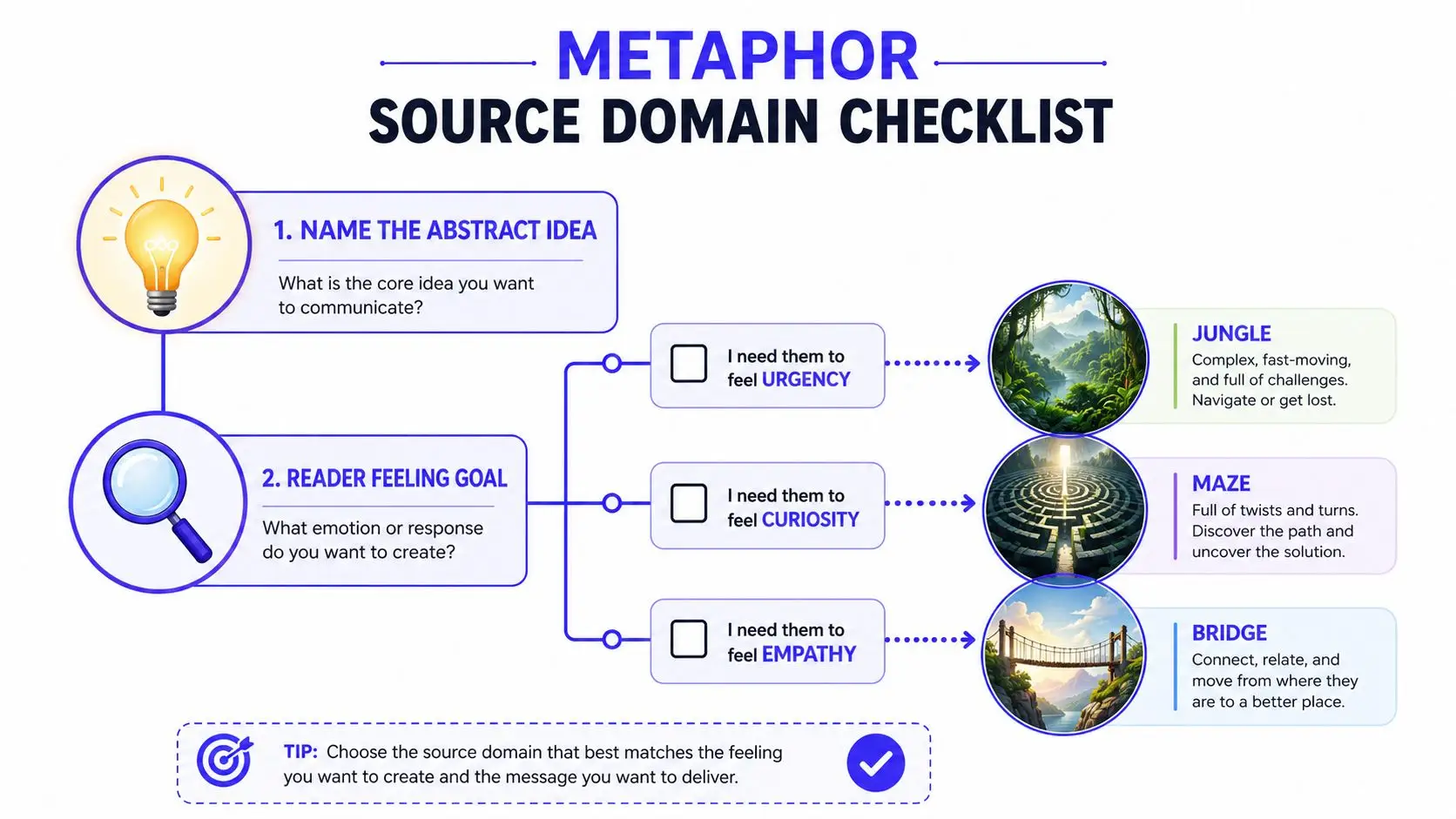
A reliable source domain usually meets four conditions:
- Familiarity: The reader can recognize the source without specialist knowledge.
- Sensory force: The image gives the reader a concrete feature, not just another abstraction.
- Shared structure: At least one meaningful quality travels from source to target.
- Consistent baggage: The image doesn't smuggle in implications that undermine your point.
When you need more raw material, use brainstorming techniques for writers to generate source domains from personal memory, physical settings, tools, routines, and natural processes. Then be severe about selection. Three mediocre images are not better than one accurate one.
Placing the Metaphor Where It Does the Most Work
Placement is a structural decision. A metaphor buried in the middle of a long sentence often arrives after the reader has already formed the mental model, so it contributes atmosphere instead of direction.
The highest-impact positions are usually the opening of a paragraph, the pivot between paragraphs, and the closing line. These are boundaries. Readers pause there, update their understanding, and decide what matters next.
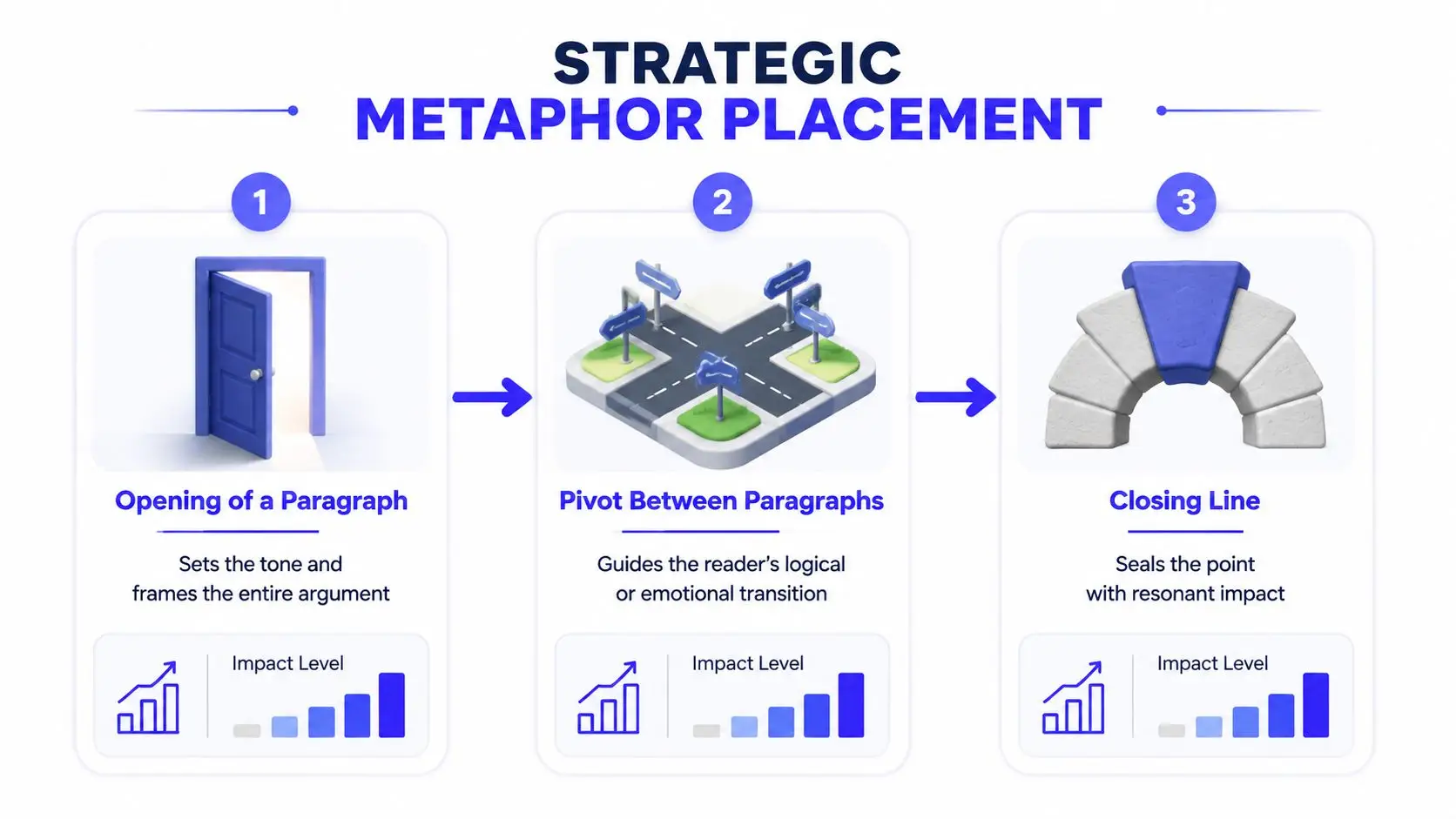
Opening position
Buried version:
The committee, after several meetings and a long exchange about competing priorities, was a locked gate that prevented the proposal from moving forward.
The image is technically present, but the sentence makes the reader wade through process before receiving the frame. Try this:
The committee was a locked gate. Every proposal stopped there until someone found a key.
The second sentence gives the reader a model first, then develops its practical consequence. It also avoids explaining every possible feature of a gate. The image has a job, and the writer stops before the job becomes a performance.
Pivot position
A paragraph may establish that a company has collected feedback, reports, and survey responses. The next idea is that collection hasn't produced change.
Weak hinge:
The company gathered plenty of information, although its decision-making process was a maze and managers still delayed action.
Stronger hinge:
The company had gathered plenty of information. The problem was no longer finding the map. It was choosing a direction.
The metaphor sits at the turn from evidence to action. It doesn't decorate either paragraph. It connects them.
Closing position
A closing metaphor should seal a point rather than open a new line of thought:
The policy changed the forms, the meeting schedules, and the reporting process, but it never changed the underlying behavior. The organization had rearranged the furniture in a burning room.
That final image gives the reader a compact judgment. It also carries risk, because the image is emotionally forceful. Use it only when the literal argument supports the severity.
Placement rule: Put the metaphor where the reader needs a mental model, usually at the moment an argument shifts from the known to the unknown.
Writers often scatter metaphors to avoid repetition, as if variety were automatically a virtue. That instinct produces decorative noise. Clustering a small number of images at structural seams gives the reader landmarks instead of confetti.
Common Ways Metaphors Fall Apart in Revision
A metaphor can sound vivid during drafting and still fail on the page. Writers are often too close to their own image to notice that the reader has no reason to make the same connection.
The cliché metaphor
“Time is running out,” “a light at the end of the tunnel,” and “thinking outside the box” have been used so often that many readers process them as signals rather than pictures. The source domain no longer creates fresh understanding.
Revision test: Replace the image with its literal meaning. If nothing changes except the sentence's mood, the metaphor is probably dead. Either find a more precise source or write the literal statement cleanly.
The mixed metaphor
We need to get the project back on track before the wheels fall off.
Track and wheels belong to related transport imagery, but the sentence begins to combine multiple mechanisms. A reader can understand it, yet the picture has no stable physical logic.
Revision test: Circle every image-bearing word. If the sentence asks the reader to build two source domains at once, keep the stronger one and remove the other.
The cold abstraction
Her sadness was a complicated architecture of emotional weather.
The target, “sadness,” remains vague, while the source domains, architecture and weather, compete. The sentence sounds serious without giving the reader a usable feature.
Revision test: State the exact form of the target. Is she withdrawing, revisiting a memory, losing interest, or expecting another loss? A metaphor can illuminate a defined experience, not a cloud of mood words.
The overextended metaphor
A writer finds a useful image and keeps adding to it: the argument becomes a journey, then acquires roads, vehicles, crossroads, fuel, passengers, destinations, and traffic lights. Eventually the image dictates the prose instead of serving it.
Revision test: Underline each extension and ask whether it explains a new feature of the target. If it only proves that the original image can generate more images, stop.
The audience mismatch
A metaphor drawn from an unfamiliar sport, profession, technology, or cultural reference may be vivid to the writer and blank to everyone else. Context can help, but context doesn't guarantee comprehension. Research on metaphor processing indicates that discourse context changes how readers handle metaphors, while novel metaphors can create greater difficulty than conventional ones, as discussed in research on contextual metaphor comprehension.
Revision test: Ask a reader outside your subject area to explain the comparison without help. If they need a lecture before the image works, choose a more familiar source.
A disciplined draft editing workflow gives you a useful distance from the first impulse. Read once for the argument, then read again only for figurative language. Mark every metaphor, identify its source domain, and write the literal quality it transfers. Any image that can't answer that question is a suspect.
Putting It Together With a Practice Exercise
Take this flat sentence:
The new software made the research process more difficult.
The sentence gives the reader a conclusion but no mechanism. “More difficult” could mean slower, confusing, repetitive, unreliable, or mentally exhausting. A useful metaphor begins by narrowing the target.
Step one, identify the abstract concept
Ask what the sentence is really trying to land. Suppose the writer means that the software forces researchers to search through scattered material before they can find what they need.
The target becomes:
Research has become harder because information is scattered and retrieval requires unnecessary effort.
That is already more precise. The metaphor now has something definite to illuminate.
Step two, generate familiar source domains
List three sources a general reader can recognize:
- A house with rooms full of unsorted boxes
- A maze with missing signs
- A kitchen drawer packed with tangled utensils
Each source suggests a different structure. The house emphasizes storage and disorganization. The maze emphasizes navigation and uncertainty. The drawer emphasizes clutter and friction during a familiar task.
Step three, choose the shared feature
The sentence concerns scattered information and difficult retrieval. The house full of unsorted boxes carries both qualities, but it may suggest that the information is stored and recoverable with patient searching. The maze suggests that the path itself is unclear. The drawer suggests irritation and small-scale inconvenience.
If the software is confusing, choose the maze. If it has buried useful material under poor organization, choose the boxes.
A possible revision is:
The new software turned our research archive into a house full of unsorted boxes. The sources were still there, but finding the right one meant opening drawers at random.
The first sentence plants the image. The second translates its load into a concrete consequence. Notice what the metaphor doesn't do. It doesn't become a full tour of the house. There are no hallways, windows, landlords, furniture, or collapsing roofs because none of those features explains the research problem.
Step four, place the image at the structural beat
The metaphor belongs at the point where the paragraph shifts from the old process to the new one:
We used to retrieve sources from a small, organized archive. The new software turned that archive into a house full of unsorted boxes. The sources were still available, but finding the right one required opening drawers at random.
That position makes the image a hinge. It frames the change, then lets the literal detail confirm the comparison.
Try one yourself
Revise this sentence:
The team has lost confidence in the plan because every meeting introduces another change.
Start by naming the target: confidence is weakening because the plan no longer feels stable. Now brainstorm three sources. You might consider a bridge under repeated repair, a map that keeps changing, or ice thinning underfoot.
Choose based on the feeling you need. The bridge gives you structural danger and the fear of crossing. The map gives you uncertainty about direction. The ice gives you immediate physical risk. A possible revision might be:
Each meeting redraws the map, so the team no longer knows whether it's moving toward the destination or merely replacing the road.
That image works if the central problem is uncertainty about direction. If the problem is fear that the plan will collapse, the bridge may carry more weight.
For independent practice, revise these two sentences without forcing an image where a literal sentence would be stronger:
The character avoids difficult conversations because she expects people to reject her.
The nonprofit has many volunteers, but its work lacks coordination.
Write a literal explanation beneath each metaphor. Then remove the metaphor and read the paragraph both ways. You're looking for a gain in understanding, not just a more dramatic sound.
Keep this checklist beside the draft
- One image at a time: Don't make the reader construct competing source domains.
- A clear target: Know the exact abstract idea before searching for language.
- A familiar source: Choose something the intended reader can recognize.
- A structural location: Plant the metaphor at an opening, pivot, or closing line when possible.
- A literal translation: Explain what quality transfers from source to target.
- A stopping point: End the comparison once it has done its work.
Metaphor-based writing instruction can help writers reconceptualize drafting and revision as a process rather than a hunt for polished sentences. Educational research has reported improved writing quality and deeper revision when trained tutors use deliberate metaphorical feedback, as described in research on metaphor as a writing scaffold. That finding fits ordinary workshop experience. Writers revise more intelligently when they can name what a sentence is doing.
If you're stuck before you can find a source domain, a practical creative inspiration guide from revid.ai can help you generate raw material. Keep the generation stage loose, then become strict during selection. Inspiration supplies possibilities. Revision decides whether any of them belong.
For more repeatable practice, use creative writing exercises for developing stronger drafts and apply the same ritual to different targets. Name the idea, define the feeling, list familiar sources, choose the shared structure, place the image once, and test the literal meaning. The more often you run that sequence, the less likely you are to mistake novelty for usefulness.
Storyloft gives you a manuscript editor, planning workspace, research organization tools, AI-assisted revision, and formatting workflows in one application, so you can test metaphors directly inside a longer draft instead of losing them across separate notes. Visit Storyloft to start shaping clearer sentences and more deliberate writing projects.