What Is a Flawed Character and Why It Matters
A flawed character is a protagonist or major figure whose internal limitation, such as arrogance, fear, or prejudice, shapes decisions, creates conflict, and drives the story forward. The idea reaches back more than 2,300 years to Aristotle's account of hamartia, a tragic error or frailty that can turn an ordinary weakness into irreversible downfall (historical overview of hamartia).
That definition is more useful than the popular advice that every character needs a list of negative traits. “Stubborn, jealous, reckless” may help you start brainstorming, but a list alone doesn't create a character. A flaw matters when it changes what someone chooses under pressure, damages a relationship, blocks a goal, or turns an ordinary problem into a plot-driving crisis.
The most important question, then, isn't “What's wrong with this character?” It's “Does this limitation distort the character's judgment in a way that changes the story?” That boundary separates a genuine character flaw from a skill gap, a passing quirk, or a trauma response that the narrative hasn't connected to behavior.
Table of Contents
- Redefining the Flawed Character Beyond Trait Lists
- The Historical and Psychological Roots of Character Flaws
- Types of Flaws Every Writer Should Know
- Memorable Flawed Characters in Literature and Film
- Why Flaws Must Drive the Plot Forward
- When Flaws Should Stay Unresolved
- How to Write Believable Flaws Without Common Pitfalls
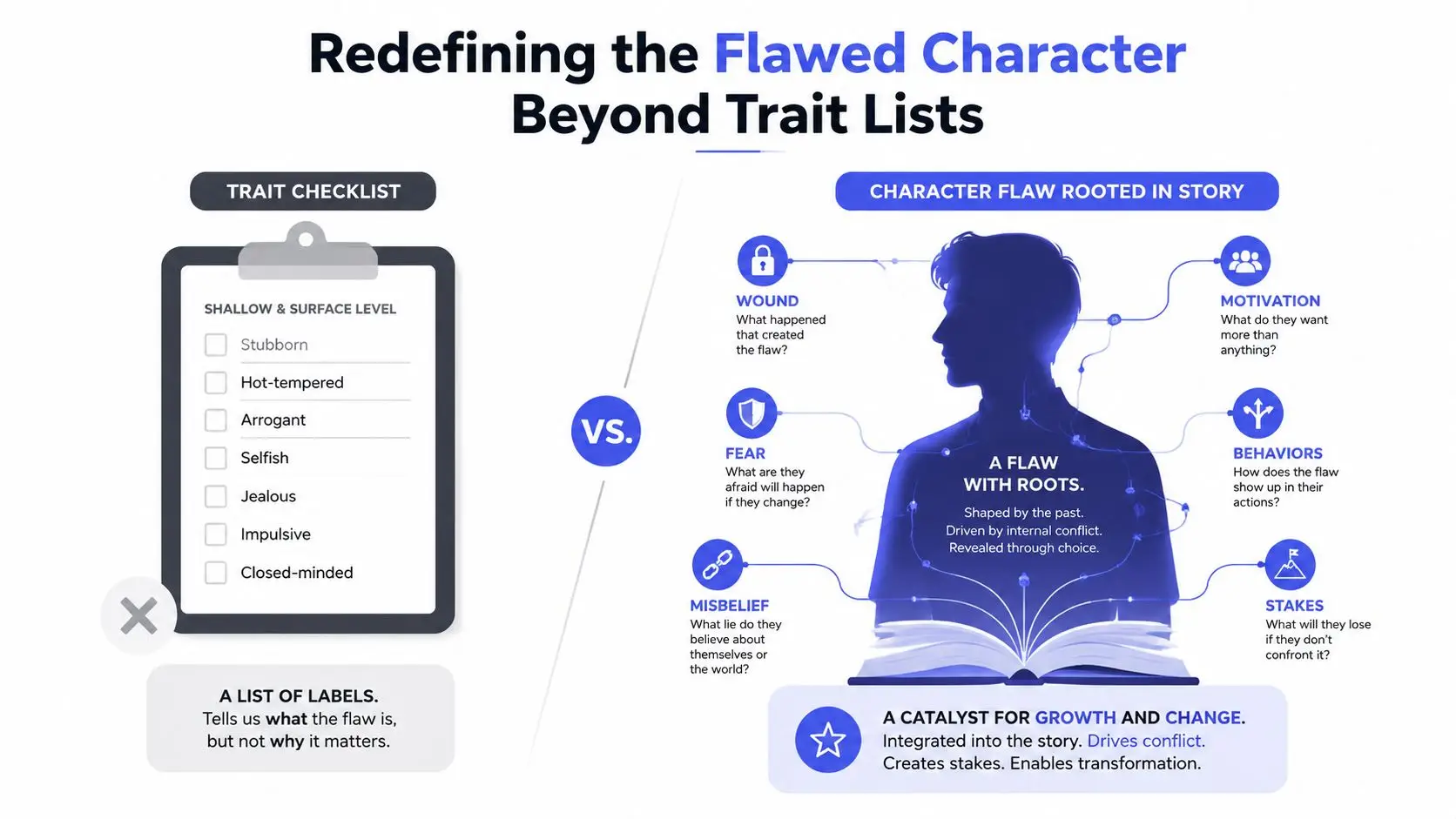
Redefining the Flawed Character Beyond Trait Lists
Many character worksheets treat flaws like items on a shopping list. Add impatience, vanity, insecurity, or sarcasm, and the character appears more human. Yet a detective who can't break into a computer system isn't necessarily flawed. They may lack a technical skill. Likewise, a traumatized character's hypervigilance may be an understandable protective response rather than a character flaw.
A true character flaw is an internal limitation that affects judgment or relationships. It changes the way the character interprets evidence, treats other people, or responds to danger. The flaw becomes dramatic when that pattern creates consequences.
The boundary test
Use these questions to diagnose the trait:
- Choice test: Does the trait influence a decision the character could make differently?
- Consequence test: Does that decision create trouble for the character or someone else?
- Pressure test: Does the limitation become more visible when the character faces fear, temptation, or loss?
- Relationship test: Does it alter trust, intimacy, cooperation, or conflict?
- Goal test: Does it interfere with something the character actively wants?
A character who can't hack a security system might hire someone who can, learn the skill, or find another route. The limitation creates a problem, but it doesn't reveal a distorted worldview. A character who refuses to trust the hacker because they assume every ally is secretly manipulating them has a flaw. Their belief shapes the decision, and the decision can affect the entire plot.
Trauma requires similar care. A painful history can explain behavior without excusing it. Hypervigilance becomes a functional flaw when the character's interpretation of danger repeatedly causes them to reject help, accuse innocent people, or sabotage close relationships. The wound supplies context. The flaw appears in the choices that follow.
Practical rule: If removing the trait leaves every major decision and consequence unchanged, you've probably written decoration, not a story-integrated flaw.
A useful character bible can help you record the distinction. Separate the character's abilities, wounds, beliefs, coping strategies, and flaws instead of placing everything under one vague label. The result is a protagonist whose internal limitation has a job to perform.
The Historical and Psychological Roots of Character Flaws
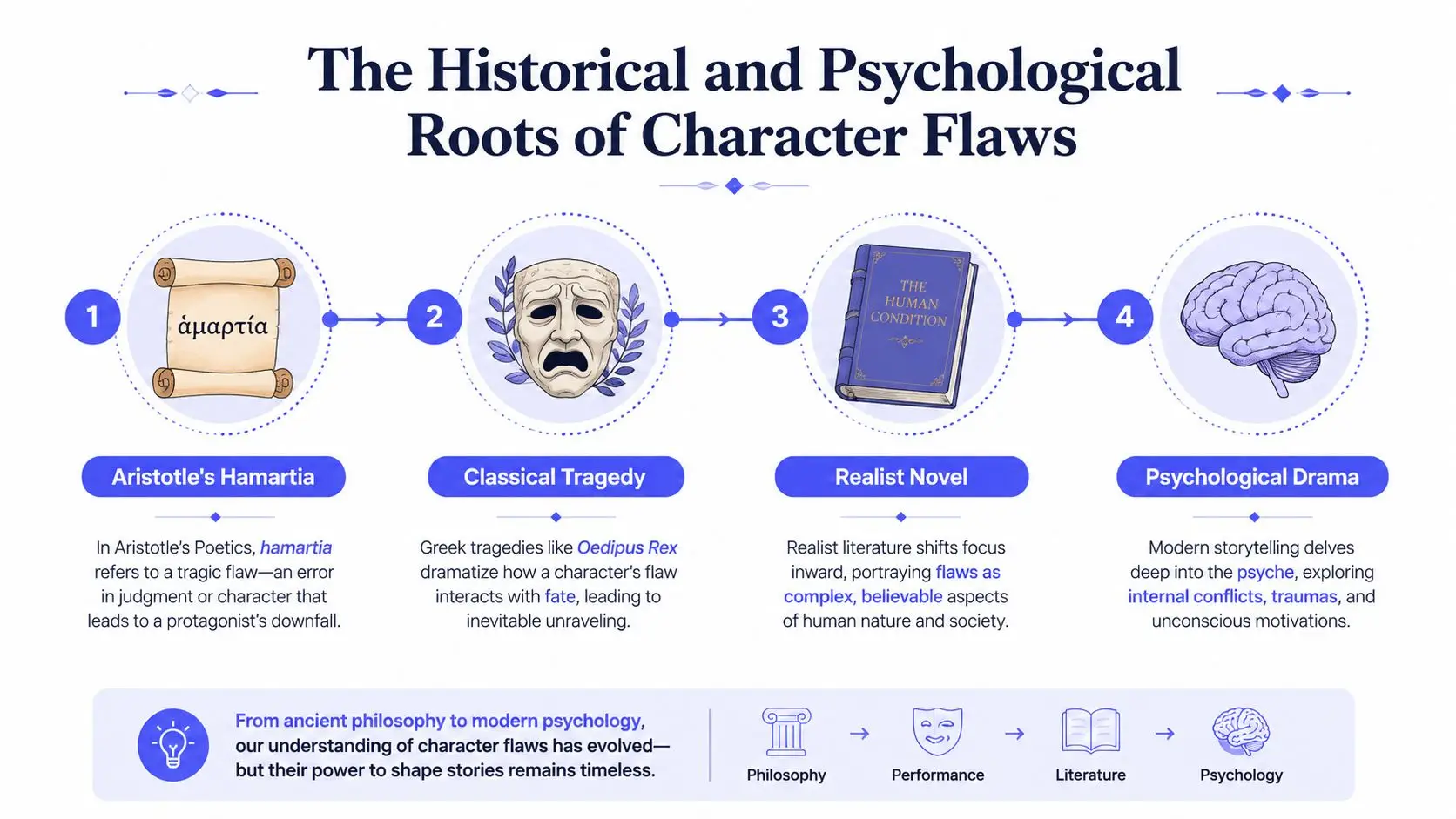
A character flaw is not just a bad trait copied from a list. Its deeper history begins with Aristotle's Poetics, written around 335 BCE, which presented the tragic protagonist as neither wholly virtuous nor villainous. The character falls through hamartia, an error or frailty later often translated as a “tragic flaw.” The discussion of Aristotle's hamartia shows why the concept remains useful for writers.
Hamartia did not mean wickedness. Aristotle's model examined how mistaken judgment, ordinary weakness, or an imbalance in character could produce catastrophe. A protagonist may follow a coherent worldview and still misread a situation so badly that the resulting harm cannot be undone. The boundary matters: poor swordsmanship is a skill gap, while refusing to draw the sword because pride forbids help is a character flaw.
Shakespeare develops that pattern through Macbeth. His ambition becomes more than desire for power. It turns into a way of interpreting authority, responsibility, and resistance. Modern fiction often moves the same mechanism inward, showing how assumptions about love, safety, status, or control determine what a character notices and dismisses.
From tragic error to measurable tendencies
Modern psychology gives writers a vocabulary for recurring patterns. The Big Five personality model describes openness, conscientiousness, extraversion, agreeableness, and neuroticism. A NIH-hosted review of personality structure connects neuroticism with nervousness or insecurity, and agreeableness with tendencies such as trusting or criticizing others.
These dimensions are not flaws by themselves. A trait becomes narratively damaging when its intensity or application repeatedly narrows a character's choices. Conscientiousness can support reliability, yet an extreme need for order can block flexibility. Extraversion can help someone lead, while constant demands for attention can erode intimacy.
A believable flaw often begins as protection. Control may once have prevented chaos, but later make delegation feel impossible. Betrayal may teach someone to treat vulnerability as weakness. Trauma supplies context, while the flaw appears in the interpretation and behavior that follow.
A character's motivation connects that pattern to a goal. The diagnostic question is simple: does the response reveal a belief that distorts judgment, or only an inability the character could solve through training or assistance? The answer separates a story-driving flaw from a temporary limitation.
Types of Flaws Every Writer Should Know
Not every flaw deserves the same narrative weight. A minor irritation can add texture to a supporting character, while a fatal limitation can define the structure of an entire tragedy. Choosing the right intensity prevents a comic protagonist from feeling melodramatic or a tragic hero from seeming underwritten.
Minor flaws add friction without taking over
Minor flaws include impatience, sarcasm, vanity, fussiness, or a tendency to interrupt. They make a character specific and can create amusing or revealing moments. Hermione Granger's rule-bound rigidity, for example, creates friction with Harry and Ron while also supporting her competence and loyalty.
Use a minor flaw when the central story doesn't depend on the character overcoming it. It can complicate scenes without determining the ending. A vain detective might care too much about appearances, but still solve the case. An impatient mentor may snap at students, then recognize when patience is necessary.
Major flaws sustain an arc
A major flaw shapes repeated decisions across a novel. Emotional avoidance, chronic dishonesty, deep prejudice, controlling behavior, or an inability to accept help can generate both internal and external conflict.
This level works well for protagonists because the flaw can evolve. The character may recognize the pattern, resist changing it, suffer consequences, and eventually choose differently. Growth doesn't require the flaw to disappear. It requires the character's relationship to the flaw to change.
Fatal flaws organize tragedy
Fatal flaws such as hubris, obsessive ambition, delusion, or paralyzing cowardice push the character toward downfall. The flaw becomes inseparable from the story's outcome. Macbeth's ambition isn't a colorful detail. It drives the decisions that create the tragedy.
A fatal flaw suits a cautionary tale or tragic structure more than a light adventure. If the story promises recovery, don't give the protagonist a limitation so destructive that survival would feel unearned. Match severity to the emotional contract of the genre.
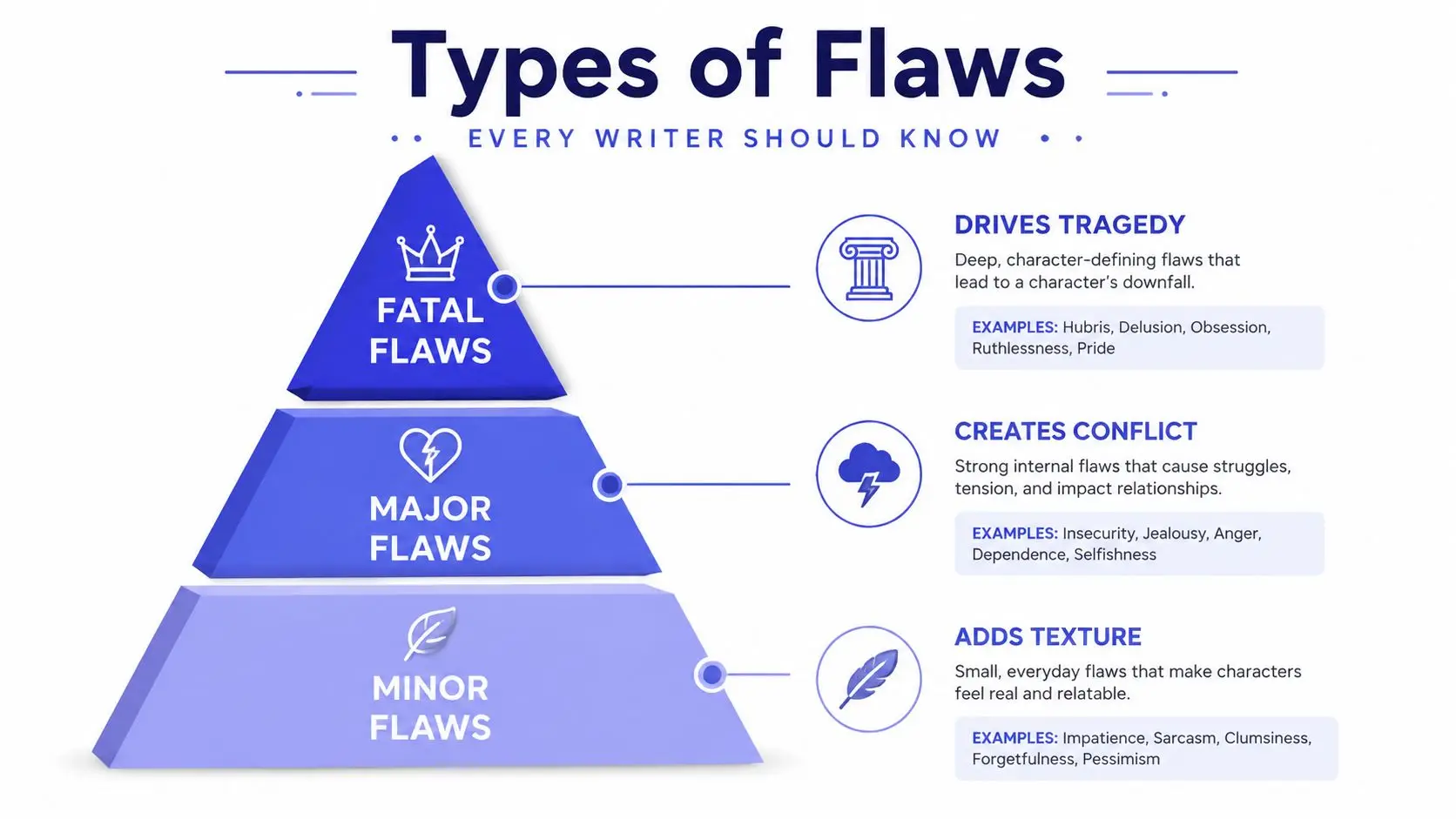
The pyramid is a planning tool, not a rigid law. A supporting character can carry a fatal flaw, and a protagonist can remain compelling with a minor one if the story focuses on relationships or everyday consequences.
Memorable Flawed Characters in Literature and Film
Memorable characters don't merely possess flaws. Their flaws determine how they pursue what they want.
Jay Gatsby's delusional idealism in The Great Gatsby drives his relationship with the past. He doesn't hope for a future with Daisy. He treats an imagined version of the past as something he can recover through wealth, performance, and persistence. That refusal to accept reality shapes his choices and leads him toward devastation.
Macbeth presents a darker version of ambition. His desire for power becomes inseparable from his interpretation of prophecy, loyalty, and threat. Once he begins treating authority as something he must seize and defend at any cost, each attempt to secure himself creates new danger. His flaw generates the chain of events rather than merely decorating his personality.
Flaws can be large or quiet
Walter White from Breaking Bad begins with motives that can invite sympathy, but his pride and need for control increasingly determine his decisions. He rejects limits, resists dependence, and turns competence into entitlement. The transformation works because his flaw keeps converting possible compromises into escalating acts of control.
A smaller flaw can create equally useful movement. Hermione's rigidity and respect for rules repeatedly place her at odds with friends who improvise. Yet the same qualities make her prepared, loyal, and courageous. Her imperfection creates friction without reducing her to a cautionary example.
The pattern is clear:
| Character | Central limitation | Narrative effect |
|---|---|---|
| Jay Gatsby | Idealized attachment to the past | Reality becomes impossible to accept |
| Macbeth | Ambition joined to insecurity | Power produces escalating violence |
| Walter White | Pride and control | Sympathy shifts toward moral collapse |
| Hermione Granger | Rigidity and rule-bound thinking | Competence clashes with improvisation |
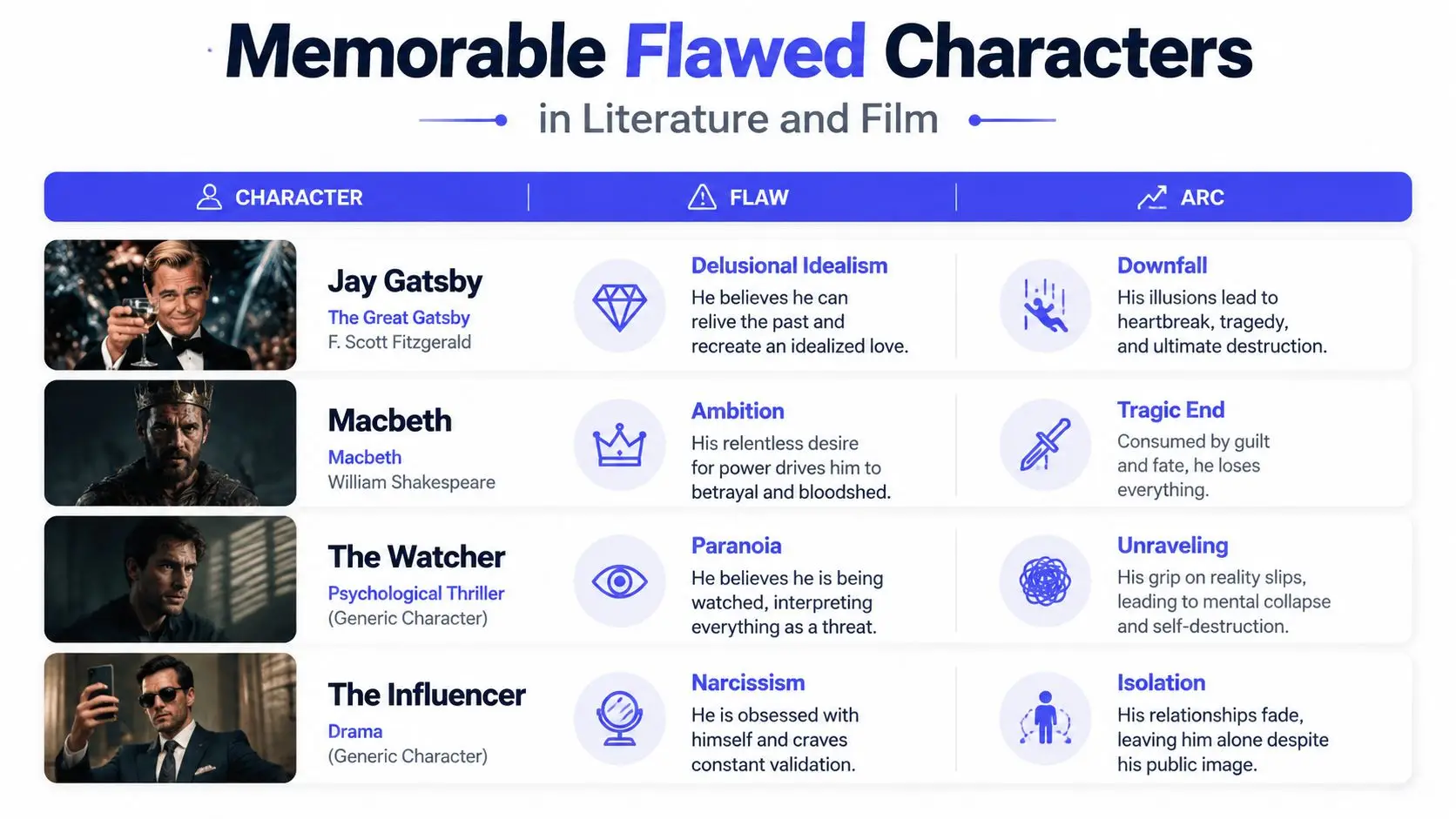
When studying these characters, don't copy the surface trait. Ask what the character believes, what they want, what they misread, and what their interpretation causes them to do. That sequence reveals the flaw's narrative function.
Why Flaws Must Drive the Plot Forward
A character can be described as guarded for an entire manuscript without creating a single meaningful complication. The reader may understand the label, but the story won't feel the character's limitation.
Plot integration follows a causal chain:
Flaw shapes perception. Perception shapes choice. Choice creates conflict. Conflict forces consequences.
Consider a protagonist who distrusts other people. In a shallow version, the character keeps their arms folded, offers short replies, and appears mysterious. The plot remains unchanged. In a functional version, the protagonist rejects an essential ally at the moment cooperation matters, withholds evidence because they assume betrayal is inevitable, and then faces a crisis made worse by their own decision.
The flaw-plot feedback loop
External pressure exposes the flaw, and the flawed response worsens the external pressure. The worsening situation then creates stronger pressure, which produces a more extreme response. This loop gives a character-driven story its tightening shape.
A trust issue might begin with guarded conversation. It becomes a refusal to share information, then an accusation, then a broken alliance. The flaw doesn't need to cause every event, but it should affect the events that matter.
Use this audit during revision:
- Identify the character's central limitation.
- Mark the major decisions influenced by it.
- Trace the consequence of each decision.
- Check whether other characters respond to the behavior.
- Remove the flaw temporarily and test the plot.
If the plot survives unchanged when you remove the flaw, the flaw is probably ornamental.
A strong character-driven story doesn't mean external events are absent. It means the protagonist's responses help determine which events occur, how relationships change, and what kind of ending becomes possible.
When Flaws Should Stay Unresolved
Many writing guides assume that a satisfying character arc must end with the flaw conquered. That formula works for some stories, but it isn't a universal rule. A character may grow, fail to grow, partially change, or become more committed to the belief that caused the damage.
Tragedy often depends on unresolved limitation. Gatsby's idealism doesn't need to be cured for the story to work. Macbeth doesn't need to become humble. Their inability to see themselves clearly is part of the emotional design, and the consequences matter more than a final lesson.
Growth isn't the only form of completion
A flat arc can leave a character's internal belief mostly intact while changing the world around them. A negative arc can show the character rejecting opportunities to change until the flaw becomes stronger than the person. An antihero may remain selfish, controlling, or morally compromised while still carrying the audience's attention.
The question is not “Did the character become better?” It's “Did the ending fulfill the pattern the story established?”
A flaw can remain unresolved when:
- The theme requires resistance: The story examines how people defend harmful beliefs.
- The structure is tragic: Downfall, rather than recovery, provides the emotional payoff.
- The world rewards the flaw: Arrogance may produce status, and manipulation may produce success.
- The character changes by degrees: Fear may be managed without disappearing.
- The consequences provide closure: The audience sees what the character refuses to understand.
This approach still requires accountability from the narrative. If a character lies, abuses trust, or acts from prejudice, the story shouldn't pretend those actions have no effect because the character remains central. Readers can accept an unresolved flaw when the consequences are visible and the behavior makes emotional sense.
Ask whether resolving the flaw would serve the theme or merely satisfy a familiar formula. A character who learns the correct lesson may feel less truthful than one who earns a more troubling ending. Satisfaction can come from coherence, not just redemption.
How to Write Believable Flaws Without Common Pitfalls
Start with the character's worldview, not a trait generator. Ask what they believe about safety, love, power, competence, or other people. Then connect that belief to an experience, family pattern, social conditioning, or earlier choice that makes the limitation understandable without making it unavoidable.
A character might believe that dependence invites abandonment. That belief can produce self-reliance, emotional distance, and a habit of refusing assistance. The backstory doesn't need to excuse every harmful action. It needs to explain why the character keeps choosing the same strategy.
Build the cause-and-effect chain
Write three major decisions the character will make. For each one, complete this sequence:
- Trigger: What pressure exposes the limitation?
- Interpretation: What does the character assume the situation means?
- Decision: What do they do because of that assumption?
- Cost: Who or what suffers?
- Recognition: Does the character understand the pattern?
If the same flaw influences all three decisions in exactly the same way, vary the expression. Fear might produce avoidance in one scene, aggression in another, and over-preparation in a third. The underlying limitation remains stable while the behavior develops.
Balance damage with capability
A sympathetic flawed character isn't necessarily nice. Readers need to understand the character's motives, see that the story recognizes consequences, and find evidence of agency or value. Compensating strengths can include loyalty, courage, humor, intelligence, patience, or practical generosity.
Watch for these revision problems:
- Cosmetic flaw: The character is called arrogant, but never dismisses advice or harms a relationship.
- Trauma excuse: Past pain explains every bad decision, while the character never accepts responsibility.
- Flaw dump: Too many weaknesses compete for attention and blur the central arc.
- Inconsistent behavior: The character acts against established beliefs only because the plot needs a twist.
- Instant cure: One speech removes a pattern built across the entire story.
A focused character description example can help you test whether the flaw appears through observable behavior rather than labels. During revision, underline every moment where the limitation affects a choice. If you can't find enough consequential moments, deepen the connection between the flaw, the goal, and the pressure surrounding the character.
Let the flaw evolve. The character may deny it, rationalize it, weaponize it, manage it, or finally choose against it. That movement creates a believable arc, whether the ending offers redemption, loss, or an uneasy mixture of both.
Storyloft gives writers a single workspace for drafting, planning, character profiles, AI-assisted editing, illustration, cover design, and publishing workflows, which can help you track how a flaw affects choices across a long manuscript. Visit Storyloft to organize your character's beliefs, relationships, and decision patterns while you develop a more convincing story.