How Do You Write an Outline: Easy Steps for Beginners
Ever found yourself staring at a blank page, wondering if real writers just wing it? What if I told you that even the most successful authors have a plan? Whether you’re a meticulous planner or someone who thrives on spontaneity, having a structure can transform your writing journey.
Outlining is not about stifling creativity; it’s about giving your story a backbone. Imagine embarking on a journey without a map. It can feel overwhelming and chaotic. But with a roadmap, every writer can navigate their ideas more effectively.
Tools like Storyloft’s Free Book Outline Generator can help turn a mere idea into a solid plan in minutes. With the right guidance, even those who prefer to fly by the seat of their pants can finish their manuscripts with confidence.
In this guide, I’ll share insights and steps that can lead to a successful outline, making the writing process feel less daunting. Get ready to explore the different methods and find what works best for your unique style.
Key Takeaways
- Outlining provides structure, preventing plot holes.
- Every writer benefits from some form of planning.
- Modern tools can simplify the outlining process.
- Flexibility in your outline is key to creativity.
- Finding your preferred method can enhance your writing experience.
TLDR; Some authors never finish their book. You will. Try our Free Powerful Book Outline Generator Now
Why Outlining Your Novel Matters: From Blank Page to Clear Path
Facing a blank page often feels like standing at the edge of a cliff, unsure of the leap. For many writers, this moment can be paralyzing. An outline acts as a compass, guiding you through the wilderness of creativity.
Without an outline, countless hours may be wasted on scenes that don’t fit your narrative. The blank page struggle is real and brutal. It’s like showing up to a marathon in slippers and wondering why your feet hurt. The good news? There’s a way to navigate this challenge.
Here’s why outlining matters:
- Clarity: An outline gives you a clear direction. It’s like having a map on a long road trip.
- Confidence: Knowing where your story is headed can boost your confidence. You won’t write yourself into a corner.
- Time-saving: Investing time in outlining now can save you from extensive rewrites later.
- Creative Freedom: Outlining doesn’t restrict creativity; it enhances it by providing guardrails.
- Focus: With a plan, you can concentrate on the writing process rather than worrying about plot holes.
When I finally embraced outlining, I stopped wasting weeks drafting scenes that had all the narrative purpose of a screensaver—pretty but pointless. Think of outlining as a long-term investment; it may take extra time up front, but it pays off in dividends.
I’ve learned that confidence in writing doesn’t come from talent alone. It comes from knowing where your story is headed before you dive into the draft. Overcoming the blank page struggle becomes infinitely easier when you sit down knowing exactly what scene comes next, even if the details still surprise you as you write.
The Plotter vs. Pantser Debate: Finding Your Writing Style
In the writing community, the divide between plotters and pantsers sparks more passion than a heated book club argument. Each camp has its champions, and both approaches have their merits. Understanding where you fit in this spectrum can help refine your writing process.
What’s a Plotter?
Plotters are the architects of the writing world. They meticulously plan every detail before diving into the writing phase. These writers create outlines that map out their entire story, ensuring they know every load-bearing wall of their narrative. It’s like constructing a building: the foundation must be solid for the structure to stand.
Who Are Pantsers?
Pantsers, on the other hand, are the adrenaline junkies of writing. They leap off the creative cliff, assembling their parachute on the way down. Notable authors like Stephen King exemplify this style, putting “interesting characters in difficult situations and writing to find out what happens.” With about half of all novelists identifying as pantsers, it’s clear this method has its place.
Hybrid Writers: Best of Both Worlds
Many writers find themselves somewhere in between—embracing a hybrid approach that balances planning and discovery. As Kirsten Bakis says, whether you think of yourself as a plotter, pantser, or neither, your book will evolve as you write it. This flexibility allows for creativity while still providing a framework.
“If you’re a Pantser (one who writes by the seat of your pants), you’re not interested in outlining a novel. Trust me, I’m a Pantser myself.” – Jerry Jenkins
Finding your writing style isn’t about picking a team; it’s about experimenting until you discover the process that makes you excited to write. I’ve noticed that my genre often dictates my approach. When writing thrillers, I plot more tightly because readers expect a roller coaster, not a lazy river.
The beauty of being a hybrid writer is that I can outline major plot points while allowing my characters to surprise me with their decisions. If you’re unsure which camp you belong in, try outlining a novel and see if you feel the urge to just start writing—that’s your pantser flag waving for attention.
| Writing Style | Description | Key Benefits |
|---|---|---|
| Plotter | Plans every detail before writing. | Clarity, confidence, and time-saving. |
| Pantser | Writes spontaneously without a detailed plan. | Creative freedom and surprise elements. |
| Hybrid | Combines planning with spontaneous writing. | Flexibility and adaptability in storytelling. |
The Foundation: Understanding Story Structure
Writing without a solid structure can feel like building a house on quicksand. Every writer, regardless of style, benefits from understanding the framework that holds their story together. A well-defined structure not only supports the narrative but also enhances the reader’s experience.
Dean Koontz’s Classic Story Structure, as explained by Jerry Jenkins, lays out a straightforward yet powerful approach. This method emphasizes the importance of a clear path for your protagonist, ensuring that the stakes are high and the plot remains engaging.
Dean Koontz’s Classic Story Structure Explained
Koontz’s structure consists of four essential steps:
- Plunge your main character into terrible trouble: Introduce the worst situation imaginable, with stakes that justify a full-length story.
- Complications escalate: Every attempt by the character to escape the trouble should logically worsen their situation, avoiding coincidences.
- Apparent hopelessness: Reach a point where even the writer doubts how the character can overcome the challenges.
- Resolution through struggle: The character’s growth through adversity equips them with the tools needed to succeed—or sometimes fail.
This structure has the potential to transform your writing. I spent years crafting stories that wandered aimlessly until I embraced this framework. The clarity it provides is invaluable, steering narratives away from becoming formless blobs.
Why Every Story Needs a Structure, Regardless of Your Style
Every story needs a structure, no matter your writing style. Readers have been conditioned by centuries of storytelling to expect certain rhythms. Ignoring these expectations can lead to confusion and frustration.
Here are some key reasons why understanding story structure is crucial:
- Logical progression: Each plot point should follow logically, keeping readers engaged.
- Character development: A solid structure allows characters to grow and evolve through their challenges.
- Increased stakes: Heightened tension keeps readers turning pages, eager to see what happens next.
- Confidence in creativity: Knowing the underlying architecture of your story allows for more creative risks.
When I finally embraced story structure, my revision process shifted dramatically. Instead of feeling overwhelmed, I could focus on polishing the narrative. This approach saved my sanity and my weekends!
Understanding structure gives writers the confidence to take creative risks. Whether your character faces a dragon, a divorce, or a deadline, the escalating complications will keep readers hooked. So, dive into the framework that supports your story and watch your writing flourish.
| Step | Description | Purpose |
|---|---|---|
| 1 | Introduce the protagonist’s dire situation. | Establishes high stakes. |
| 2 | Complications arise from the protagonist’s actions. | Maintains tension and engagement. |
| 3 | Reach a point of hopelessness. | Heightens emotional investment. |
| 4 | Resolution through learned experiences. | Provides satisfying closure. |
Popular Outlining Methods to Try
Every writer knows that choosing the right approach can make or break their story. With so many outlining methods available, it can feel like navigating a maze. Each technique offers a unique way to structure your narrative, helping you map out your plot and characters effectively.
The Traditional Novel Outline: Chapter-By-Chapter Mapping
The Traditional Novel Outline is a detailed breakdown of each chapter or scene. This method is perfect for those who want to know exactly what happens before writing a single word. It’s like having a GPS for your story, guiding you through every twist and turn.
The Three-Act Structure: Setup, Confrontation, Resolution
The Three-Act Structure is the little black dress of storytelling. It works for everything from literary fiction to space operas because it mirrors how humans naturally process narrative. This method divides your story into three clear sections, making it easier to build tension and resolve conflicts.
The Beat Sheet: Key Moments That Drive Your Story
When I discovered the Beat Sheet method, inspired by screenwriting, it was like someone handed me a recipe for pacing. This technique breaks down your story into key “beats” or moments that drive the narrative forward. Knowing where to hit emotional high notes can elevate your writing.
The Snowflake Method: Building from Simple to Complex
The Snowflake Method, developed by Randy Ingermanson, is for those who enjoy a more scientific approach. It starts with a one-sentence summary and gradually expands into a complex outline. While some find it intimidating, others are drawn to it like moths to a flame.
The Mind Map: Visualizing Your Story’s Web
I have a soft spot for Mind Maps because they let my visually-oriented brain see the entire story at once. This method creates a web of interconnected ideas, starting with a central concept and branching out to related characters, subplots, and conflicts. It’s like a detective’s conspiracy board but with fewer red strings!
Each outlining method has its own personality. The Traditional Outline is your Type-A best friend, while the Beat Sheet is your screenwriter buddy discussing “tentpole moments.” The Mind Map is your artsy cousin who thinks in pictures. The beauty of having five distinct methods to choose from is that you can mix and match. I often start with a Mind Map to brainstorm, then organize everything into a Beat Sheet for pacing.
As Jerry Jenkins aptly describes, Randy Ingermanson is “the Sheldon Cooper of novelists.” His Snowflake Method is brilliantly logical and slightly intimidating. Experiment with these methods without shame—try each one on a short story or a single chapter. Find the approach that excites you to write, rather than making you want to alphabetize your spice rack instead!
How Do You Outline a Novel: A Step-by-Step Beginner’s Guide
Starting your writing journey can feel like stepping into a maze without a map. But fear not! Outlining your story can turn that maze into a clear path. Here’s a simple guide to help you navigate the process, ensuring your narrative has the structure it needs to shine.
1. Distill Your Novel Idea into One Sentence
Step one is distilling your entire novel idea into one sentence. This might sound impossible, but consider this: Jerry Jenkins wrote a whole book based on the premise, “a judge tries a man for a murder that the judge committed.” If that can work, yours can too!
2. Choose Your Story Structure
Choosing your story structure is step two. This decision shapes everything from your pacing to your character development. Pick one that feels like home rather than a prison.
3. Develop Your Characters Deeply
Developing your characters deeply is where I spend the most time. Readers will forgive a predictable plot, but they’ll never forgive a protagonist who acts like a cardboard cutout with a name tag. I often conduct imaginary interviews with my characters, asking them about their childhood traumas and secret shames.
4. Flesh Out Your Plot and Conflict
Fleshing out your plot and conflict means deciding which classic plot types fit your story. Is it an Adventure, a Romance, a Race, or maybe a Mistake where an innocent person must overcome foes and dodge danger?
5. Decide on Setting and Atmosphere
Setting and atmosphere deserve their own dedicated step. Nothing transports readers faster than sensory details woven into the action rather than dumped in paragraph-long descriptions of weather patterns.
6. Outline Your Chapters with Synopses
Outlining your chapters with synopses has saved me from writing myself into dead ends more times than I can count. Write briefly in third person, present tense about what happens in each chapter.
7. Plan the Catalyst, Obstacles, and Climax
Planning the catalyst, obstacles, and climax is where I map out the emotional roller coaster. Kirsten Bakis suggests using the Pixar formula: “Once upon a time there was ___. Every day ___. One day ___.” This formula can help you structure your story effectively.
8. Define Your Character’s Arc and Resolution
Defining your character’s arc and resolution is the final step. I always ask myself: what did my protagonist learn that they couldn’t have learned any other way than through this specific suffering I’ve put them through?
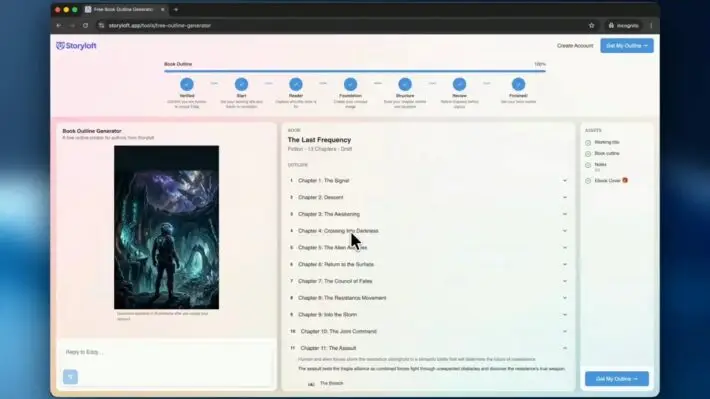
Storyloft’s Free Book Outline Generator: Your AI Writing Companion
Imagine having a co-pilot on your writing adventure, guiding you through the twists and turns. Storyloft’s Free Book Outline Generator is just that! It helps authors transform an idea into a real book plan in minutes. Instead of facing a blank page, you’ll work alongside Eddy, Storyloft’s AI writing companion.
This guided experience is designed for both fiction and non-fiction writers. As you answer a few simple questions about your book idea, Storyloft builds a complete, usable outline—not just a list of chapter titles that leave you wondering what happens next.
How Storyloft Works Alongside Your Creativity
Working with Eddy feels less like delegating your creativity and more like having a brainstorming buddy who’s read every craft book ever published. The process is intuitive and user-friendly, making it easy to start writing without the usual stress of organizing your thoughts.
Creating Detailed Outlines Beyond Chapter Titles
I was genuinely impressed by how the generated workspace includes detailed subpoints, chapter descriptions, creative notes, and reader direction. It’s like someone handed me a manuscript roadmap with all the scenic viewpoints marked. This level of detail is crucial for developing characters and plotting engaging scenes.
Creative Assets and Concept Book Covers
Storyloft doesn’t stop at the outline. It generates creative assets, including intelligent planning notes and a concept book cover inspired by your idea. This feature made my project feel real enough that I actually committed to writing it. Seeing a visual representation of my story idea was surprisingly motivating.
For both fiction and non-fiction writers, Storyloft provides the supporting context that bridges the gap between “I have an idea” and “I have a working book foundation.” There’s no complicated setup—just a straightforward path from idea to outline to manuscript.
By the end of the guided experience, I had a working book foundation I could continue developing inside Storyloft. This meant I could focus my energy on writing instead of organizing—and that’s a trade I’ll make every single time!

Balancing Planning and Flexibility as You Write
As I embark on each writing project, I often find that the best plans are those that adapt. Outlines should never be set in stone; they are meant to evolve. This fluidity is essential for any writer, whether you lean toward plotting or prefer a more spontaneous approach.
Why Outlines Should Evolve
Kirsten Bakis emphasizes that “if you write one, it will change before your last draft is done.” This permission to pivot can save your creative sanity. Outlines are living documents, not sacred texts. They should grow alongside your story, adapting as your characters surprise you or as the plot takes unexpected turns.
George Saunders puts it succinctly: “An artist works outside the realm of strict logic.” This means that characters may take the reins, leading your plot in directions you never anticipated. Embracing this flexibility can enrich your narrative and make it feel more authentic.
Allowing Room for Discovery and Serendipity
I’ve learned to hold my outline loosely, much like a suggested itinerary for a road trip. The real magic often happens at those unplanned roadside attractions. Allowing room for discovery means writing scenes that surprise even me, and those are often the passages my readers quote back to me.
Think of your outline as guardrails rather than train tracks. Guardrails keep you from veering off a cliff but don’t dictate every turn of the steering wheel. My outlines now include margin notes like “or something better happens here,” reflecting my acceptance that my subconscious is often smarter than my spreadsheet.
Even Jerry Jenkins, a proud Pantser, acknowledges that a loose outline serves as a safety net. It prevents you from stalling when the creative engine sputters. Balancing planning and flexibility is deeply personal; I’ve found my sweet spot is outlining about 60% of the story while leaving 40% for characters to stage their rebellions.
When I stopped treating my outline as a contract and began viewing it as a conversation, writing transformed. It became less about meeting quotas and more about genuine discovery. As a result, my word count doubled!
Tools and Resources to Support Your Outlining Journey
The path to successful writing is paved with the right tools and resources, guiding you along the way. From software that organizes your thoughts to worksheets that help develop characters, these resources can streamline your process. Here’s a rundown of some must-have tools that can elevate your outlining experience.
Writing Software: Scrivener, Plottr, and More
I’ve tested more writing software than I care to admit, and Scrivener remains my ride-or-die. It allows me to organize notes, research, and my outline all in one place without needing three monitors and a prayer. If you prefer visual aids, Plottr is the tool for you. It maps out story and character arcs on a timeline, making it easier to juggle multiple subplots.
For those who want an all-in-one solution, Dabble caught my attention. This program is user-friendly and perfect for writers who’d rather spend their time creating than configuring software settings.
Worksheets and Templates for Character and Plot
Worksheets and templates for character and plot are the unsung heroes of my outlining process. I’ve filled out enough character development worksheets to wallpaper my office, and each one reveals something new about my protagonist. Jerry Jenkins offers a free Character Development Worksheet that even Pantsers might find valuable. This resource digs into backstories that inform every decision my characters make.
Recommended Craft Books and Podcasts
Craft books are essential for honing your skills. Save the Cat! Writes a Novel by Jessica Brody adapts the famous screenwriting method for novelists, and it’s the reason my plots finally stopped sagging in the middle like a tired hammock. Another favorite is Story Genius by Lisa Cron, which emphasizes the psychological and emotional underpinnings of storytelling.
For auditory learners, I recommend podcasts like The Creative Penn Podcast featuring K.M. Weiland. I’ve binged this episode more times than I’ve rewatched The Office, and each listen provides new insights about balancing outlining with creative flow.
Randy Ingermanson’s Writing Fiction for Dummies sits on my desk with dog-eared pages. It’s a treasure trove of insights, especially for those grappling with story structure. Lastly, K.M. Weiland’s Outlining Your Novel introduces the Reverse Outline method, which has pulled me out of more plotting dead ends than I can count.
Tips for Staying Motivated and Overcoming Roadblocks
Writing can feel like a roller coaster, full of thrilling highs and gut-wrenching lows. When I hit a wall, I remind myself that motivation is key to keeping the ride enjoyable. Here are some tips to help navigate those tricky turns and stay on track.
Using Your Outline as a Safety Net, Not a Straitjacket
Your outline should be a comforting safety net rather than a rigid straitjacket. I’ve found that treating my outline like a supportive guide allows me to take creative risks. When I’m experimenting with a subplot about sentient houseplants, I know the structure will catch me if things go awry.
Even Jerry Jenkins, a dedicated Pantser, admits that during those dreaded midpoint slumps, an outline becomes a comforting security blanket. It helps sustain my writing through challenging moments. Remember, your outline is a helpful tool, not a set of strict rules.
Celebrating Small Wins and Progress
One of my favorite ways to stay motivated is by celebrating small wins. Finished a chapter? That’s a victory dance in my kitchen! Nailed a plot twist? A fancy coffee and a smug smile are in order for the rest of the day.
Kirsten Bakis wisely advises against judging your ideas too early in the outlining process. Nothing kills momentum faster than asking, “Is this good enough?” before allowing an idea to breathe. I like to leave breadcrumb notes at the end of my writing sessions, detailing what happens next. This way, I never sit down to a blank page, wondering where to pick up.
Tracking my progress has become an essential part of my writing journey. I note not just word count but also scenes completed, character revelations, and plot holes patched. This visible progress is a powerful motivator. When roadblocks appear—and they always do—I consult my outline like a trusted map. Sometimes, a detour can improve the story and keep me moving forward.
Celebrating small wins isn’t just feel-good advice; it’s a psychological survival strategy for a process that can take months or years. Writers who acknowledge their progress are often the ones who finish their novels.
| Tip | Description | Benefits |
|---|---|---|
| Use Your Outline | Think of your outline as a safety net. | Encourages creative risks without fear. |
| Celebrate Small Wins | Acknowledge every achievement, big or small. | Boosts motivation and morale. |
| Track Progress | Keep a detailed record of your writing journey. | Visible progress keeps you motivated. |
| Consult Your Outline | Use your outline as a guide when facing roadblocks. | Helps navigate through challenges effectively. |
From Outline to Manuscript: Taking the Next Step
Moving from a detailed outline to a completed manuscript is where the magic of storytelling truly unfolds. I’ve found that having a solid outline lets me write with the confidence of someone who actually knows where they’re going—even when I don’t.
My first draft flows so much faster now that I’m not simultaneously trying to figure out what happens next while also crafting beautiful prose. The outline handles the “what,” so I can focus on the “how.” This shift has been a game-changer in my writing process.
Kirsten Bakis wisely notes that when you start writing, your story will change. This isn’t a sign your outline failed; it’s a sign you’re on the unpredictable, creative journey of actually writing a novel. Embracing these changes can lead to delightful discoveries.
Using Your Outline to Write with Confidence
I’ve learned to allow changes during drafting without guilt. My outline is a conversation partner, not a dictator. Sometimes my characters know better than my planning brain what needs to happen. This flexibility enriches the narrative and keeps the writing process engaging.
The revision process becomes infinitely more manageable when you have an outline to compare against. You can see exactly where you deviated and decide whether those deviations are brilliant breakthroughs or narrative dead ends. It’s like having a GPS that recalibrates when you take a wrong turn.
Allowing Changes During Drafting and Revision
Jerry Jenkins says the outline’s purpose is to keep you on track, keep you from stalling, and give you a safety net. I’ve used mine for all three purposes within a single writing session. After finishing a draft, I sit down with my original outline and do the exercises again, just like Bakis recommends. I’m always amazed at how my understanding of the story has deepened.
The journey from outline to manuscript isn’t a straight line—it’s more like a spiral where you keep circling back to your core ideas with new insights each time. I’ve stopped treating my first draft as the final product and started viewing it as a natural extension of my outline—a more detailed exploration of the territory I’ve already mapped.
With tools like Storyloft providing a working book foundation from the start, the transition from outline to manuscript feels less like a leap of faith and more like a well-planned expedition where you’ve actually packed the right supplies.
Conclusion
In the world of writing, finishing a story is akin to finding treasure after a long quest. I began this journey terrified of the blank page, convinced that real writers didn’t need outlines. Now, I hold a completed manuscript and believe that structure is the secret weapon of productive writers everywhere.
Learning to outline isn’t about choosing between being a Plotter or a Pantser. It’s about discovering the method that helps you journey from “once upon a time” to “the end” without losing your mind. Remember, every writer has something to learn from each other’s techniques.
Writing a novel is an adventure. Some parts will feel like a fun vacation, while others may leave you meandering and lost. An outline can be the compass that keeps you on track. As your story evolves, embrace the changes—this is where the magic happens.
With tools like Storyloft’s Free Book Outline Generator, turning an idea into a real book plan is easier than ever. No more blank page paralysis! So grab your favorite outlining method and remember: the world needs your story, and now you have everything you need to write it.
FAQ
Why should I bother outlining my story?
Outlining transforms that daunting blank page into a structured roadmap, giving you clarity and confidence as you write. It’s like having a GPS for your narrative journey!
What’s the difference between a plotter and a pantser?
Plotters meticulously plan every detail before writing, while pantsers prefer to fly by the seat of their pants, discovering the story as they go. Both methods have their charm—pick your poison!
Can I mix outlining methods?
Absolutely! Many writers blend techniques, taking the best of both worlds. Call yourself a hybrid writer and enjoy the freedom to explore while still having a plan.
What’s the best story structure to use?
There’s no one-size-fits-all! Whether you choose the classic three-act structure or the intricate snowflake method, find what resonates with your story and your style.
How detailed should my outline be?
That’s entirely up to you! Some prefer a broad overview, while others dive deep into character arcs and plot points. The key is to find a balance that fuels your creativity without stifling it.
What tools can help me outline my novel?
There are plenty of tools out there! Software like Scrivener and Plottr can be lifesavers, alongside worksheets and templates that keep your ideas organized and flowing.
How do I stay motivated while outlining?
Use your outline as a safety net rather than a straightjacket. Celebrate small victories along the way to keep your spirits high and your creativity buzzing!
What if my outline changes while I write?
Embrace it! Outlines are meant to evolve as your story develops. Flexibility allows for those delightful surprises that make writing so much fun.