How to Write a Novel: My Complete Guide

I sat at my kitchen table at 5 a.m. one Tuesday, staring at a blank Word document. My coffee was getting cold. My cursor blinked like a tiny heartbeat, waiting for me to do something brave.
I had read Stephen King’s “On Writing” three times. I had notebooks full of scribbled ideas. But the gap between wanting to write a novel and actually doing it felt as wide as the Grand Canyon.
That morning changed everything for me. I typed one messy sentence. It was terrible. But it led to another sentence, and another, until I had a full page.
Four months later, I held a printed draft in my hands. It wasn’t perfect — not even close — but it was real.
If you’re wondering how to write a novel, I want you to know something right away. This isn’t about talent. It’s about having a clear path forward.
Writing your first book is a different challenge from crafting a short story or a college essay. A novel asks you to live inside a world for months, sometimes a full year.
The novel writing process breaks down into steps that anyone can follow. You need to understand your purpose. You need a premise that keeps you curious.
You need characters who want something badly enough to drive 80,000 words of story. And you need a plan to cross the finish line.
Most authors I know spend about four to ten months on their first draft. The ones who finish aren’t the most gifted writers in the room. They’re the ones with a roadmap and the grit to follow it, even on the days when the words don’t come easy.
This guide walks you through every stage — from that first spark of an idea all the way to publishing decisions. I built it from my own stumbles, breakthroughs, and hard-won lessons. Let’s get started.
Key Takeaways
- Learning how to write a novel starts with understanding your personal motivation and the big question your story explores.
- Writing your first book requires a step-by-step approach — from developing a strong premise to creating characters with clear wants.
- The novel writing process typically takes four to ten months, and finishing depends more on planning than natural talent.
- A “spirit guide book” — a published novel in your genre — can serve as a structural blueprint for your own work.
- Following tension in every scene and letting your characters suffer are the engines that keep readers turning pages.
- Completing a first draft is just the beginning; revision, beta readers, and editing shape a manuscript into a publishable book.
Understanding Why You Want to Write Your Novel
Before you start, take a moment. Ask yourself why you want to write this book. Your answer will guide everything, from your daily schedule to overcoming challenges. I learned this the hard way when I gave up my first manuscript at page sixty. Without a clear reason, I couldn’t keep going.
Identifying Your Core Motivation
Your reason for writing is very personal. It doesn’t need to impress anyone. It just needs to be true. Here are some common reasons writers write:
- Sharing a message or life experience that matters to you
- Bringing an imaginary world to life for others to explore
- Launching a career as a published author
- Proving to yourself that you can finish something big
Write your motivation on a sticky note. Pin it above your desk. On tough days, that note will remind you why you started.
Finding Your Big Question
Every great novel has a deep, tough question at its heart. Think of Nina Kenwood’s When You Read This, which explores finding meaning in a short life. The best stories come from this kind of emotional depth.
“A writer is someone for whom writing is more difficult than it is for other people.” — Thomas Mann
Ask yourself: What question am I willing to sit with for months? It might be about recovery, loyalty, or choosing between desire and duty. This question will be the heart of your story.
Connecting Purpose to Your Writing Journey
Once you know your motivation and big question, link them together. This connection drives your writing. It shapes your characters, plot, and writing style. When purpose meets skill, writing becomes a mission, not a chore. You’re now ready to find an idea that matches your mission.
Choosing Your Novel-Worthy Idea
Not every spark of inspiration can carry 80,000 words. When learning how to write a novel, picking the right idea is key. Some ideas are better for short stories or blog posts, not full manuscripts. It’s important to know the difference early on.
Testing Your Concept for Novel Potential
I like to quickly check if an idea feels right. Can I see a main character with a clear goal? Are there real obstacles in the way? What happens if this character fails? If I can’t answer these questions, the idea might not be ready yet.
Caroline Mitchell says in her guide to finding your perfect novel idea, passion is more important than trends. The best ideas stick with you long after you first think of them.
“Choose the idea that makes you both excited and a little scared. That fear is a sign you’re onto something real.”
Developing “What If” Questions
Great novels often start with a bold question. J.K. Rowling asked, “What if a wizard school existed alongside our world?” Gillian Flynn explored, “What if a woman framed her husband for murder?” These questions lead to conflict, stakes, and compelling characters.
Ensuring Your Premise Supports Full-Length Fiction
A premise like “a vampire moves to a small town” is just a start. You need layers. Here’s a quick way to check if your concept is strong:
| Element | Weak Premise | Novel-Worthy Premise |
|---|---|---|
| Character Goal | Vague or absent | Specific and urgent |
| Conflict | Surface-level tension | Multi-layered obstacles |
| Stakes | Low or unclear | Meaningful consequences of failure |
| Emotional Depth | One-note feeling | Complex inner journey |
| Big Question | Easy to answer | Debatable and thought-provoking |
Creating compelling characters starts at the premise stage. If your concept demands a rich, flawed protagonist facing impossible choices, you’ve found a story worth writing. This energy will carry you through drafting, revision, and every tough chapter.
Selecting Your Genre and Understanding Reader Expectations
Think of genre as a promise you make to your readers. When someone picks up a romance novel, they expect a love story with a satisfying ending. When they grab a thriller, they want fast pacing and high stakes. One of the most important fiction writing techniques I can share is this: know your genre before you write a single word.
Genre does more than tell a bookstore where to shelve your book. It shapes your character arcs, plot structure, pacing, and even your word count. If you’re writing your first book, picking the right genre early saves you from painful rewrites later. Each genre carries specific conventions that loyal readers expect — and love.
Here’s a quick breakdown of major fiction genres and what readers look for:
| Genre | Core Focus | Typical Word Count | Key Reader Expectation |
|---|---|---|---|
| Literary Fiction | The human condition | 70,000–100,000 | Rich prose and deep themes |
| Romance | Central love story | 50,000–90,000 | Happily ever after ending |
| Mystery/Thriller | Suspense and crime | 70,000–90,000 | Tension and a resolved case |
| Science Fiction | Technology and future | 80,000–120,000 | Believable world-building |
| Fantasy | Magic and invented worlds | 90,000–130,000 | Immersive settings and lore |
| Historical Fiction | Past eras | 80,000–110,000 | Accurate period details |
| Horror | Fear and dread | 60,000–90,000 | Genuine scares and atmosphere |
| Young Adult | Teen experiences | 55,000–80,000 | Relatable protagonist voice |
Once you’ve chosen your genre, I recommend finding three published novels similar to your idea. In the publishing world, these are called comp titles. Study them closely. Pay attention to:
- How the author structures each chapter
- The pacing between action and reflection
- Character types that appear again and again
- Endings that satisfy genre-specific promises
Mastering fiction writing techniques within your chosen genre gives you a framework — not a cage. Writing your first book becomes much easier when you understand what readers already love and expect. From here, you can start studying published works in your genre more deeply, which I’ll walk through next.
Finding Your Spirit Guide Book
Every writer needs a North Star. Before starting your novel, pick a book that feels like your story’s cousin. This is your spirit guide book—a source of inspiration when you’re stuck.
Think of it as a mentor on your shelf. It won’t write your book, but it shows what’s possible.
Studying Structure from Published Works
Chart the first 20–30 pages of your spirit guide book. Use a notebook to track the author’s scene-by-scene choices. You’ll notice patterns in:
- How the opening hooks readers
- Where backstory gets woven in
- Average chapter length and pacing rhythm
- How tension builds between quiet and intense moments
This study is powerful for outlining your novel. You’re not copying anyone’s plot. You’re borrowing structure, which is okay. Maria Semple’s Where’d You Go, Bernadette used emails and documents. Mary Laura Philpott studied Semple for Bomb Shelter, creating something new but informed.
Learning from Successful Authors in Your Genre
Your spirit guide book should be in the same genre as your writing. For thrillers, study Gillian Flynn’s pacing. For literary fiction, look at Elizabeth Strout’s chapter structure.
You don’t have to copy everything. Use your guide for specific questions. Outlining becomes easier when you’ve studied someone who solved similar problems. The novel writing process is less lonely with a great book guiding you.
How to Write a Novel Through Character Development
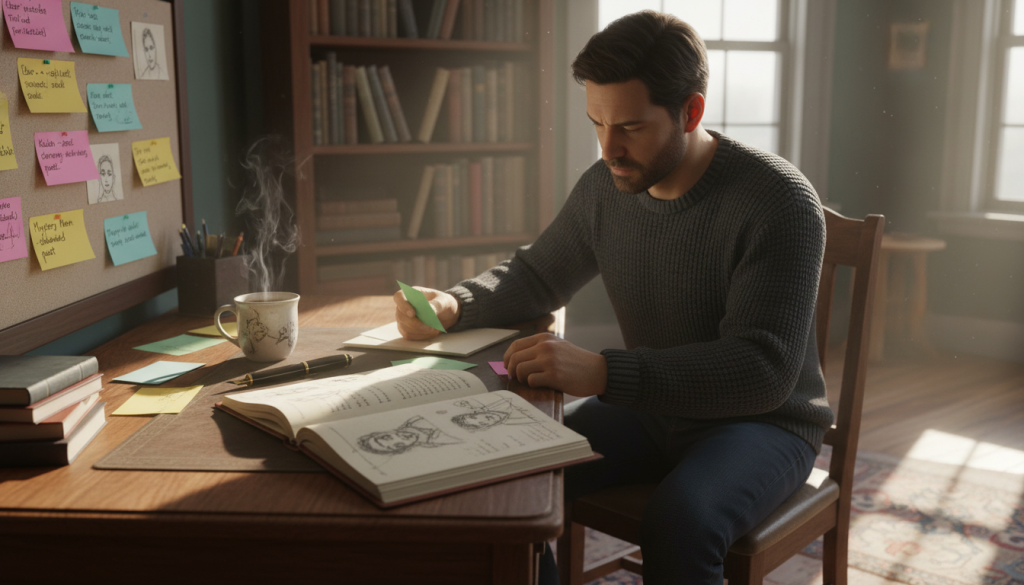
Readers connect with characters before they connect with the plot. This is something I’ve learned the hard way. Even if your story is perfect, flat characters will lose readers. Creating compelling characters is key to a great novel.
Creating Your Protagonist with Clear Goals
Every protagonist needs two things: an external goal and an internal emotional need. Think of Katniss Everdeen from The Hunger Games. Her goal is to survive the Games. Her emotional need is to protect her sister and loved ones.
This mix of outer action and inner desire is where great stories come alive. I always give my protagonists meaningful flaws. Fascinating characters are more interesting than likable ones. Readers will follow a flawed character through many pages if those flaws feel real.
Building Complex Antagonists
Your antagonist isn’t always a villain. They can be a rival, a natural force, or even your protagonist’s own mind. The key is that they must believe they’re justified in their actions. Give them goals that clash with your protagonist’s, and add a vulnerability to make them relatable.
Developing Supporting Characters That Matter
Supporting characters should never be just props. Each one should have a purpose, like challenging, supporting, or mirroring your protagonist. I use a framework to build quick profiles for each supporting character:
| Profile Element | Purpose | Example (Elizabeth Bennet – Pride and Prejudice) |
|---|---|---|
| Background | Shapes worldview | Middle-class family with five daughters |
| Core Motivation | Drives decisions | Independence and genuine connection |
| Greatest Fear | Creates internal tension | Losing autonomy through a loveless marriage |
| Defining Past Moment | Explains current reactions | Watching her mother’s obsession with marrying off daughters |
Using a structure like this makes every character in your story believable. With your characters ready, the next step is choosing the right point of view and narrative voice to tell their story.
Establishing Point of View and Narrative Voice
Point of view and narrative voice shape every sentence in your novel. They decide who tells the story and how the reader sees it. After creating your characters, choose whose eyes the reader will see through. Picking the right POV is crucial among all fiction writing techniques.
First Person vs Third Person Considerations
First person uses “I” and makes the reader feel close. It’s powerful but limits what you can share. Your narrator can only share what they know and feel. Suzanne Collins’ The Hunger Games is a great example.
Third person limited uses “he,” “she,” or “they” and stays close to one character. Third person omniscient knows everything about everyone, offering a wide view. Many suggest third person for complex stories with many plotlines.
| POV Type | Pronoun Used | Reader Intimacy | Information Access | Best For |
|---|---|---|---|---|
| First Person | I / Me | Very High | Limited to narrator | Coming-of-age, thrillers |
| Third Person Limited | He / She / They | Moderate | One character at a time | Fantasy, romance |
| Third Person Omniscient | He / She / They | Lower | All characters | Epic sagas, literary fiction |
Choosing Past or Present Tense
Past tense (“She walked down the hall”) feels natural. Most novels use it. Present tense (“She walks down the hall”) makes events feel urgent.
My favorite tip is to write the same scene in different POVs and tenses. See which one feels right. The best strategies suggest trying this early. Once you’ve found your voice, you’re ready to build your characters’ world.
Crafting Your Story’s Setting
Many new writers see setting as just a backdrop. But it’s so much more. It shapes your characters, drives conflict, and sets the mood.
For example, a romance in a small coastal town feels different from one in downtown Chicago. A mystery in the 1920s is different from one in 2024. Your setting is a silent character that influences every scene.
When writing your first book, ask yourself a few key questions about your world:
- What time period does my story take place in — past, present, or future?
- Is the geographic location real or imagined?
- What physical environments will my key scenes unfold in?
- Does my setting limit or enable my characters?
“Place is character. It shapes how people talk, what they eat, what they fear, and what they dream.” — Ann Patchett
My favorite test is this: if your story could be moved to any other location without changing a single plot point, you’re not using your setting well enough. The best settings naturally create tension. For example, put a water-fearing character on a boat or a financially struggling protagonist in an expensive world.
If you’re using a real location or historical period, research is key. Readers who know those places will catch mistakes. But don’t let research stop you from writing.
| Setting Element | Questions to Ask | Impact on Story |
|---|---|---|
| Time Period | What technology, laws, and social norms exist? | Shapes character behavior and available solutions |
| Geography | What’s the climate, terrain, and culture like? | Creates physical obstacles and opportunities |
| Social Environment | What class, power, or community dynamics are at play? | Drives interpersonal conflict and stakes |
| Specific Scenes | What does each room, street, or landscape look like? | Sets mood and emotional tone per chapter |
With your setting locked in, you’re ready to tackle story structure and plot development.
Mastering Story Structure and Plot Development
Great characters and a vivid setting are important, but they’re not enough. A good story needs a clear structure and plot. This gives your book direction and keeps readers interested from start to finish.
Structure is like a map, not a prison. Frameworks like the Three-Act Structure help you build tension and deliver emotional payoffs. This makes your story more engaging.
Understanding the Three-Act Structure
The Three-Act Structure divides your novel into three parts:
| Act | Percentage of Novel | Purpose | Key Elements |
|---|---|---|---|
| Act One (Setup) | First 25% | Introduce the world and protagonist | Ordinary world, inciting incident, established wants and obstacles |
| Act Two (Confrontation) | Middle 50% | Test your protagonist with rising stakes | Complications, difficult choices, progressive tension |
| Act Three (Resolution) | Final 25% | Resolve the central conflict | Climax, character transformation, emotional resolution |
Building Escalating Complications
The middle of your novel is crucial. Each complication should raise the stakes and challenge your protagonist. Ask yourself, “What’s the worst thing that could happen now?” and write that.
When outlining, plan at least three to five major turning points in the middle. This avoids the “saggy middle” that loses readers’ interest.
Creating Your Climactic Moment
Your climax is the payoff of your story’s structure and plot. It’s where your protagonist faces their biggest challenge. It should feel earned from everything leading up to it.
A strong climax does three things:
- Resolves the central conflict in a surprising yet inevitable way
- Shows how the protagonist has changed
- Delivers emotional satisfaction that lingers after the last page
“Structure is the way your story is organized — not a formula but a way of thinking about change.” — Robert McKee, Story
Missing any of these structural beats can leave readers feeling unsatisfied. With your structure mapped out, you’re ready to decide how much planning works best for your writing style.
The Outlining Decision: Plotter, Pantser, or Plantser
Before I start writing, I wonder: how much planning do I need? Writers vary from strict plans to complete freedom. It’s important to find a method that fits your mind.
Benefits of Different Planning Approaches
Writers fall into three main groups. Here’s a quick look at each:
- Plotters plan every detail before writing. They know the story from start to finish.
- Pantsers write without a plan. Stephen King creates characters and then sees where they go.
- Plantsers mix both. They have a basic plan but also leave room for surprises.
| Approach | Best For | Popular Framework |
|---|---|---|
| Plotter | Complex, multi-layered plots | Save the Cat, Snowflake Method |
| Pantser | Character-driven stories | Free writing, scene sketches |
| Plantser | Balanced structure with flexibility | Three-Act Structure, Hero’s Journey |
Creating Flexible Roadmaps
Getting clear before writing helps a lot. Mind mapping is a favorite of mine. It helps me connect ideas visually.
Outlining can be simple. Just write down key points for each chapter. Think of it as a guide, not a strict rule.
With your plan ready, it’s time to set up your writing space. Let’s talk about that next.
Setting Up Your Writing Space and Schedule
Before starting to write my novel, I need a special place and a schedule. Writing a book is serious, not just a hobby. It’s important to treat it like a job, knowing where and when to work.
Let’s look at the numbers. Writers usually write about 1,000 words per hour. A 60,000-word first draft takes about 60 hours. That’s just a few months of focused writing. Setting aside these hours on my calendar makes my dream a reality. My plan starts with these time slots, which I won’t give up.
J.K. Rowling fought hard for her writing time, even when it became her job. She kept her writing days safe from meetings and distractions. If she needed to protect her schedule, so do I.
Here’s how to set up a good writing space:
- Pick a consistent spot — a desk, a room corner, or a favorite café
- Use apps like Freedom or Cold Turkey to block distractions
- Keep the space comfortable but not too cozy (no beds!)
- Set non-negotiable daily or weekly writing hours
- Turn off social media and podcast notifications
My brain links a specific place with writing. This mental signal is key. When I sit in my writing spot, I know it’s time to write, not scroll.
A good writing process needs routine. With my space and schedule set, I can focus on the story. Now, I’m ready to start writing that first draft.
Writing Your First Draft
You’ve done the groundwork. You have your big question, premise, characters, and spirit guide book. Now, it’s time to start writing your first book. This moment can feel scary, but you’re ready.
Starting with an Unsatisfied Want
Begin your story with a character wanting something they can’t easily get. It doesn’t have to be deep. Maybe someone is stuck in traffic without air conditioning and really wants a drink. Or someone sees crutches across the room and needs them.
This want is a hook. It draws readers in right away. It might be solved by page ten or chapter two. That’s okay. Its job is to give you time.
Following the Tension
When you’re unsure where to go next, ask: which choice raises the tension? Let your big question guide you. This strategy helps you keep moving without getting stuck.
Keep tension going at least halfway through. Then, you can make a rough outline for the rest if needed.
Embracing the Rough Draft
Remember, your first draft is supposed to be rough. Anne Lamott called them “shitty first drafts” in Bird by Bird. And she was right. You’ll revise later.
Here are some tips to stay on track:
- Focus on getting ideas down, not perfect sentences
- Don’t self-edit as you write
- Accept awkward phrasing and keep going
- Remember, writing your first book is about finishing, not being perfect
“Start writing, no matter what. The water does not flow until the faucet is turned on.” — Louis L’Amour
Just get the story down. You’ll make it beautiful in revisions. But you must finish the draft first.
Maintaining Momentum Through the Middle
The middle of your novel can be tough. It’s like entering a dense jungle. You’ve lost the excitement of the start, and the end seems far away. But, there are ways to keep going.
Overcoming the Messy Middle
The messy middle is full of unknowns. You’re exploring new territory, unsure if your story will come together. A trick that helped me: end your writing sessions mid-sentence. This makes it easier to start again the next day.
Leave notes in brackets for things you can look up later. This tip is from practical tips for maintaining writing momentum.
Using Mini-Deadlines for Accountability
Parkinson’s Law says work expands to fill the time given. Mini-deadlines help avoid this. They make your work feel manageable and create positive stress.
- They sharpen your focus on what matters right now
- They reduce perfectionism by pushing action over polish
- They build self-esteem through small wins
- They improve discipline across your entire novel writing process
Touching Your Manuscript Daily
Staying in touch with your story daily keeps you engaged. It doesn’t mean writing a lot. Just reading a scene, jotting down ideas, or planning your next chapter.
This keeps you from feeling disconnected. It prepares you for the editing and revision process.
| Daily Activity | Time Needed | Impact on Momentum |
|---|---|---|
| Write 500 new words | 20–30 minutes | High — moves draft forward |
| Reread yesterday’s scene | 10–15 minutes | Medium — maintains immersion |
| Jot plot ideas in a notes app | 5 minutes | Medium — captures inspiration |
| Research a setting detail | 10–20 minutes | Low to Medium — fills gaps |
Allowing Your Characters to Suffer and Surprise
Here’s a truth I learned the hard way: the best fiction writing techniques mean letting your characters hurt. It might seem cruel. We want to help the characters we love. But, that can make your story forgettable.
Think of it like parenting. A child who never struggles doesn’t grow. Your characters are the same. Give them obstacles they can’t easily solve. Let them deal with the tension. Let it change them from the inside out.
When I stopped protecting my characters, something amazing happened. My endings started writing themselves. Characters who face real conflict learn real lessons. These lessons show the ending your story needs. It feels both inevitable and surprising, which readers love.
“You must kill your darlings.” — William Faulkner
This process makes your story emotionally rich. Character choices feel real. Growth is genuine. Here’s what suffering brings to your fiction:
- Deeper emotional stakes that keep readers turning pages
- Organic plot twists you couldn’t have planned at your outline stage
- Authentic character arcs rooted in earned transformation
- Endings that feel both surprising and right
| Protected Characters | Characters Allowed to Suffer |
|---|---|
| Predictable growth | Surprising, authentic growth |
| Low emotional stakes | High emotional stakes |
| Forced plot resolutions | Endings that write themselves |
| Flat story arcs | Resonant, layered arcs |
Letting go of control is a key fiction writing technique. Trust the process. Creating compelling characters takes courage — yours and theirs. The pain your characters face in the middle chapters makes your first draft worth revising.
Completing Your First Draft and Revision Strategy
Finishing your first draft is a big deal. You should celebrate it, even if it feels messy. That’s completely normal. Now, you’ll move from writing to refining.
First, read your draft from start to finish. Take notes and flag scenes that feel thin. This read-through is key for your editing journey.
Working with Beta Readers
Beta readers are your secret weapon. They’re trusted readers who give honest feedback. Before sending your manuscript, fix spelling and grammar errors. Set clear guidelines for your betas. Ask them to focus on pacing, plot holes, or character depth.
- Choose 3–5 readers who enjoy your genre
- Give them a deadline of 4–6 weeks
- Ask targeted questions about characters, subplots, and pacing
- Keep an open mind — separate personal preference from genuine quality concerns
Approaching Structural Edits
Stephen King said writing is about cutting your story to the bone. Structural edits focus on clarity and coherence. This is where your outline pays off — you can compare what you planned against what you wrote.
Professional Editing Considerations
At some point, you’ll want a professional editor. Their trained eyes are invaluable. Here’s a quick breakdown of common editing types:
| Editing Type | Focus Area | Typical Cost (Per Word) | When to Use |
|---|---|---|---|
| Developmental Edit | Plot, structure, character arcs | $0.07–$0.12 | After beta reader feedback |
| Line Edit | Sentence flow, style, voice | $0.05–$0.10 | After structural revisions |
| Copy Edit | Grammar, punctuation, consistency | $0.03–$0.05 | After line edits are complete |
| Proofread | Final typos and formatting errors | $0.01–$0.03 | Last step before publishing |
With your draft revised and polished, you’re ready to decide how to publish.
Making Publishing Decisions
You’ve learned how to write a novel from start to finish. Now, you face a big choice: how do you get it into readers’ hands? Finishing your first book is a huge achievement. But, the journey doesn’t stop there. You need a publishing plan that fits your goals and lifestyle.

Traditional vs Self-Publishing Options
Each publishing path has its own benefits. Traditional publishing means working with literary agents and publishing houses. Self-publishing lets you control everything through platforms like Amazon’s Kindle Direct Publishing.
“You don’t need permission to be a published author. You need a great book and the courage to share it.”
| Factor | Traditional Publishing | Self-Publishing |
|---|---|---|
| Creative Control | Shared with publisher | Full author control |
| Royalty Rate | 10–15% of sales | 35–70% of sales |
| Upfront Cost | None (publisher invests) | $2,000–$5,000+ typical |
| Distribution | Bookstores and libraries | Primarily online retailers |
| Marketing Support | Publisher-assisted | Author-managed |
Understanding the Publishing Timeline
Timelines vary a lot between these two paths. Traditional publishing takes 18 to 24 months from acceptance to release. Adding the agent search, which can take months or years, makes it even longer.
Self-publishing is faster. Once your manuscript is edited and your cover is designed, you can publish in weeks. This route offers speed and flexibility that traditional paths can’t match.
- Research agents carefully if you go traditional — look at deals they’ve closed in your genre
- Budget for professional editing and cover design if you self-publish
- Consider hybrid approaches that combine elements of both paths
Choosing how to publish is a personal decision. Pick the route that fits your vision and resources. What truly matters is writing a novel that connects with readers.
Conclusion
Learning to write a novel can seem hard at first. But breaking it down into steps makes it easier. You start by finding your motivation and choosing a genre.
Then, you build your characters and start writing your story. Each step helps you move forward. Just take it one step at a time.
The writing process takes patience and daily work for months. You’ll face big questions and create characters who grow. It’s okay to feel like quitting, but keep going.
Your first draft won’t be perfect. That’s okay. You’ll make it better with revisions, feedback, and editing. This is how you make your book shine.
Remember, finishing a novel is about showing up every day. Let your characters surprise you. Trust the story you’ve built.
Whether you publish traditionally or on your own, knowing how to write a novel is powerful. It lets you create a book that readers can hold.
FAQ
How long does it typically take to write a novel from start to finish?
Most authors spend four to ten months on their first draft. Writing speed varies, but a 60,000-word draft takes about 60 hours. However, the process includes outlining, revisions, and editing, extending the timeline.
Success comes from a clear plan and daily writing. It’s not just about talent or speed.
How do I know if my idea is strong enough for a full-length novel?
Not every idea works for a long novel. Test it with a few criteria. A strong idea has conflict and stakes, like J.K. Rowling’s Harry Potter.
Your idea should have a main character with goals, obstacles, and consequences. If it’s simple, like “a vampire moves to town,” it needs more depth.
What’s the difference between a Plotter, a Pantser, and a Plantser when it comes to outlining your novel?
These terms describe planning styles. Plotters plan everything first, while Pantsers write by the seat of their pants. Plantsers do a mix of both.
Getting some clarity before writing makes drafting easier. There’s no single right way to plan.
How do I choose the right point of view and tense for my novel?
Point of view and tense shape your sentences. First person is intimate but limited. Third person limited follows one character at a time.
Past tense is traditional, while present tense is immediate. Try different combinations to see what feels right for your story.
What is a “spirit guide book” and why do I need one?
A spirit guide book is a reference for craft challenges. It helps with structuring, chapter length, and integrating backstory. For example, *When You Read This* used *Where’d You Go, Bernadette* as a guide.
Studying successful books isn’t plagiarism. It’s ethical inspiration. Use it when you need help with your story.
How important is creating compelling characters compared to having a great plot?
Characters are more important than plot. They drive the story forward. Your protagonist should have goals, emotional needs, and flaws.
Think of Katniss Everdeen from *The Hunger Games* or Elizabeth Bennet from *Pride and Prejudice*. Characters don’t need to be likable, just fascinating.
What’s the best way to handle the editing and revision process after completing my first draft?
Start by reading through and cleaning your draft. Then, get feedback from beta readers. Focus on grammar and spelling first.
Be open-minded and differentiate between personal preferences and quality concerns. Revision is about cutting excess fat from your story.
Should I choose traditional publishing or self-publishing for my novel?
The choice depends on your goals and resources. Traditional publishing offers wider distribution but takes longer. Self-publishing gives you control but requires more work.
Both paths have successful examples. Research both options carefully to decide what’s best for you.
How do I maintain momentum and avoid getting stuck in the middle of my novel?
Use mini-deadlines to navigate the middle of your novel. They create positive stress and help you stay on track. Touch your manuscript daily, even if it’s just for a few minutes.
This keeps you immersed in your story without getting lost in details. It makes writing smoother.
Why is it important to let my characters suffer in the story?
Allowing characters to struggle is crucial for growth. It’s like parenting — children learn through challenges. Characters won’t develop without facing real hardship.
Creating tension means letting characters experience it. The best endings come from characters learning through their struggles. This makes your story emotionally resonant.