Flashback and Foreshadowing: How They Shape Stories
Flashbacks reveal past causes to reduce uncertainty, while foreshadowing plants early clues to create anticipatory suspense. Since 2008, computational narrative research has also treated these devices as structures that can deliberately shape surprise and reader expectation.
You may know exactly what happens in your story, yet your draft still feels flat. A character reveals a painful secret, but the scene reads like an information dump. A major twist arrives, but readers feel cheated because nothing prepared them for it. The problem may not be the event itself. It may be when the reader receives the information.
Flashback and foreshadowing give you control over that timing. One looks backward to explain, while the other points forward to suggest. Used together, they help readers ask questions, form predictions, revise their assumptions, and experience later events as both surprising and meaningful.
Table of Contents
- Why Mastering These Devices Changes Everything
- What Flashback and Foreshadowing Actually Are
- Understanding Their Complementary Purposes
- Choosing the Right Approach for Your Scene
- Concrete Examples That Bring Theory to Life
- Avoiding the Most Common Writing Mistakes
- Your Actionable Checklist for Implementation
- Bringing It All Together for Stronger Stories
Why Mastering These Devices Changes Everything
A character finally admits that she caused the accident that shaped her family's life. You could explain the entire event in a single paragraph at the moment of confession. The reader would understand the facts, but the confession might carry little force because the story hasn't given those facts room to gather emotional weight.
A stronger version might place small signs earlier. She avoids driving at night. She reacts sharply when someone mentions a damaged bridge. She keeps an old key in a drawer but refuses to explain it. None of these details needs to reveal the truth. Together, they make the reader sense that something remains hidden.
That difference separates information delivery from reader-state control. A flashback can answer a question the reader has been carrying. Foreshadowing can create a question the reader hasn't yet learned how to ask. The first manages uncertainty through explanation. The second manages uncertainty through anticipation.
Research treats these techniques as more than decorative literary devices. They function as mechanisms for controlling chronology, suspense, surprise, and postdictability, meaning the sense that an event makes greater sense after it has happened. The computational study by Bae and Young specifically modeled flashback and foreshadowing as tools for arousing surprise in readers through a plan-based narrative framework (the study of surprise arousal in interactive storytelling).
Practical rule: Give the reader the kind of information the scene needs, not all the information you possess as the author.
The most useful question isn't “Should I use a flashback?” or “Where can I add foreshadowing?” Ask instead: What should the reader feel and understand at this exact moment? If the reader needs motive, look backward. If the reader needs unease, expectation, or a reason to keep reading, look forward.
What Flashback and Foreshadowing Actually Are
A flashback interrupts the present timeline to show an earlier event. It delivers causally relevant information after the story has already moved beyond that event. A memory, a recalled conversation, a scene from childhood, or a return to an earlier stage of the conflict can all function as flashbacks when the narrative temporarily relocates the reader in time.
Foreshadowing plants a partial signal before the event it prepares us to recognize. The signal may be an object, image, gesture, line of dialogue, sensory detail, or pattern of behavior. It doesn't need to announce the outcome. Its job is to make the later event feel connected to what came before.
The distinction is rooted in information timing. A flashback says, “Here is what caused the present situation.” Foreshadowing says, “Notice this. It may matter later.” Britannica describes flashback as “as old as Western literature,” pointing to The Odyssey, where much of Odysseus's journey is told retrospectively at the court of the Phaeacians. The same reference identifies foreshadowing as the structured planting of clues that prepare audiences for later plot events (Britannica's discussion of flashback).
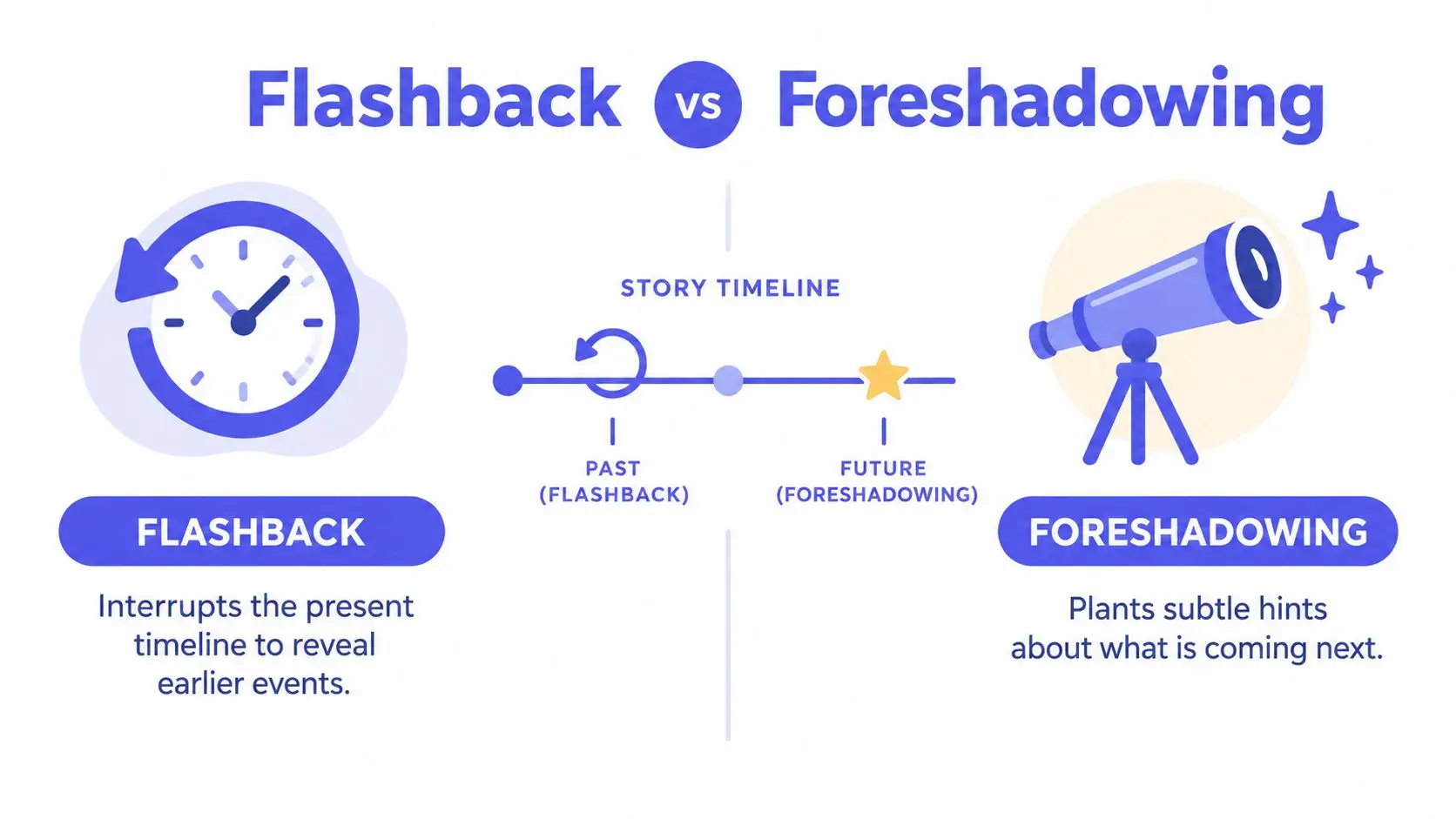
Flashback vs Foreshadowing at a Glance
| Aspect | Flashback | Foreshadowing |
|---|---|---|
| Time direction | Moves from the present into an earlier event | Plants meaning before a later event |
| Information effect | Explains causes and reduces uncertainty | Creates anticipation and increases uncertainty |
| Typical material | Memory, past action, earlier conversation | Image, warning, object, repeated detail |
| Reader question | “Why did this happen?” | “What might happen next?” |
| Main risk | Slowing the present action | Becoming too obvious or confusing |
| Strong payoff | A motive or event is reinterpreted | An earlier clue gains new significance |
Backstory and flashback aren't identical. Backstory is information about the past. A flashback is a narrative event that presents that past at a chosen point in the story. A paragraph explaining a character's childhood may be backstory. A scene that places us inside the childhood event, with its own action and emotional pressure, works more clearly as a flashback. For examples of planted objects and meaningful details, see Chekhov's gun examples.
Understanding Their Complementary Purposes
Flashback and foreshadowing work in opposite directions, but they solve related problems. A flashback reduces uncertainty by supplying a missing cause. Foreshadowing increases uncertainty by giving the reader evidence without a complete explanation.
Suppose a detective refuses to enter an abandoned house. The present scene creates a question: why is she afraid? A flashback can show the childhood event that explains her fear. That reveal closes one gap in the reader's understanding, but it may open another. Perhaps the person she saw in the house wasn't a stranger. Perhaps the memory contains a detail she has misunderstood.
Foreshadowing works before that answer. The detective notices that the house has a red door, the same color as a toy door from an old photograph. She hears a phrase she remembers from childhood. The reader doesn't yet know the connection, but the details create anticipatory inference. Readers begin to predict, compare, and search for confirmation.
One manages explanation, the other manages expectation
A useful sequence might look like this:
- Foreshadowing first: Plant a detail that makes a later event feel possible.
- Present conflict next: Let the character make a decision under pressure.
- Flashback at the point of need: Reveal the earlier cause that changes how the decision is understood.
- Payoff afterward: Allow the current action to carry the new meaning forward.
The result is more than a twist. The reader experiences a shift from “I wonder what this means” to “Now I understand why it mattered.” Narrative research describes this relationship as a difference between advancing cues and retrospective explanation. A flashback can supply context at the moment it becomes useful, while foreshadowing can sustain suspense without disclosing the outcome (research on flashback and foreshadowing as narrative functions).
This pairing also supports postdictability. A strong revelation surprises readers when it arrives, yet earlier details become legible afterward. That balance keeps a story from feeling either predictable or arbitrary. Plot development benefits when every major reveal changes both the character's situation and the reader's interpretation of what came before. A practical guide to plot development can help you place these shifts within the larger movement of a story.
Choosing the Right Approach for Your Scene
Start with the scene's pressure point. Is the reader confused about a cause, waiting for a threat, or about to reinterpret an earlier event? Your answer will usually indicate whether the scene needs a flashback, foreshadowing, or a combination.
A pure flashback is most useful when the present action has created a question that cannot be answered through ordinary dialogue or exposition. It should arrive because the character, conflict, or setting activates the past. A smell, object, location, or decision can provide a natural entry point.
Subtle foreshadowing fits a scene where you want to create tension without interrupting forward motion. It works best when the cue has a plausible present-day reason to exist. A character checks a window because of the weather, not because the author needs to signal an intrusion. Later, that ordinary action can acquire a second meaning.
A hybrid scene does both. It may begin as a flashback that explains an earlier event, then introduce an unresolved image or decision that prepares the reader for a later development. Research in computational narratology treats these structures as designable systems for managing surprise and postdictability, rather than as accidental effects (the computational study of narrative surprise).

Scene Decision Matrix
| Scene Goal | Recommended Technique | Effect on Reader |
|---|---|---|
| Explain why a character acts strangely | Pure flashback | Reduces uncertainty and deepens motive |
| Make an approaching danger feel possible | Subtle foreshadowing | Builds anticipation without giving away the outcome |
| Reframe an earlier choice | Flashback with a present trigger | Changes the meaning of the current scene |
| Make a twist feel earned | Foreshadowing followed by a later payoff | Creates surprise with retrospective logic |
| Connect past trauma to future behavior | Hybrid scene | Links emotional history to coming action |
| Preserve momentum during a tense sequence | Brief foreshadowing cue | Adds pressure without pausing the timeline |
Watch the pacing cost. A flashback that answers a question the reader isn't asking will feel like a detour. Foreshadowing that gives no usable signal may feel random. In revision, identify the reader's state immediately before the device appears and immediately after it ends. If the state hasn't changed, the technique may not be doing enough narrative work.
Concrete Examples That Bring Theory to Life
Consider a character named Mara who has just sabotaged a rescue mission. The other characters assume she panicked, but the reader senses that her decision was deliberate. A flashback can take us to the earlier night when Mara heard the same distress signal and watched her brother disappear after answering it. The flashback doesn't merely provide history. It transforms her present action from apparent cowardice into an attempt to prevent a repeated pattern.

The reader's uncertainty decreases, but emotional complexity increases. We understand Mara's fear while still questioning whether she made the right choice. That is a productive flashback because it changes the interpretation of the present rather than pausing the story to recite biography.
A quiet signal before a later turn
Now imagine a different story. Every time Elias lies, he straightens a crooked picture frame. The first occurrence seems incidental. The second creates a faint pattern. When he straightens the frame before denying that he entered the locked room, the gesture becomes a clue.
The gesture is foreshadowing because it gives the reader a small piece of evidence before the truth is confirmed. It doesn't need to be recognized consciously. After the reveal, readers can look back and understand that the story had been showing them Elias's behavior all along.
The technique depends on low-bandwidth signaling. A clue can be brief and incomplete, but it must still be interpretable after the payoff. Research on narrative techniques connects foreshadowing with anticipation and suspense, while associating flashbacks with deeper backstory and thematic coherence (research on these narrative techniques).
Here is a short hybrid example:
At twelve, Lila found a brass button in the river mud. Her father told her never to keep objects pulled from moving water. Years later, standing outside the flooded station, she felt the same button press against her palm.
The first sentence begins a flashback. The final image turns that memory into foreshadowing. The past event explains a relationship and plants an unresolved object. When the button matters in the present, the earlier memory performs both functions.
For more ways to make meaning emerge through what characters avoid saying, compare these techniques with examples of subtext.
Avoiding the Most Common Writing Mistakes
The first mistake is treating a flashback as an exposition dump. A character remembers an entire childhood, the narrative explains every relevant event, and the present conflict waits politely. The fix is to enter the past at the moment it changes a decision, emotion, or interpretation. Keep only the material that exerts pressure on the present.
The second mistake is confusing backstory with an actual flashback. A sentence such as “Jon had always feared hospitals” gives information about the past, but it doesn't necessarily dramatize that past. A flashback would place the reader inside a specific earlier event, such as Jon watching a nurse close a curtain while his mother's voice fades behind it.
Diagnose the device by its effect
Ask these questions during revision:
- Does the past alter the present? If removing the memory changes nothing, it may be unnecessary backstory.
- Does the clue create a question? If a detail carries no possible future meaning, it may be atmosphere rather than foreshadowing.
- Can the reader recognize the payoff afterward? A clue should support discovery, not appear from nowhere.
- Does the transition have a trigger? A sensory detail, object, location, or thought can make a time shift easier to follow.
- Does the scene return with new pressure? The story should come back from a flashback changed.
The third mistake is over-signaling. A character who says, “You'll regret opening that door,” while ominous music plays and the camera lingers on a weapon has received too much guidance. Subtle foreshadowing gives readers room to infer.
The boundary between flashback, backstory, flash-forward, and foreshadowing can blur. A memory may reveal the past while also preparing the reader for a later repetition. That doesn't make the scene incorrect. It means you should identify its dominant function and make the transition clear. If your narrator's account may be incomplete or biased, study how an unreliable narrator can complicate what a flashback appears to prove.
Your Actionable Checklist for Implementation
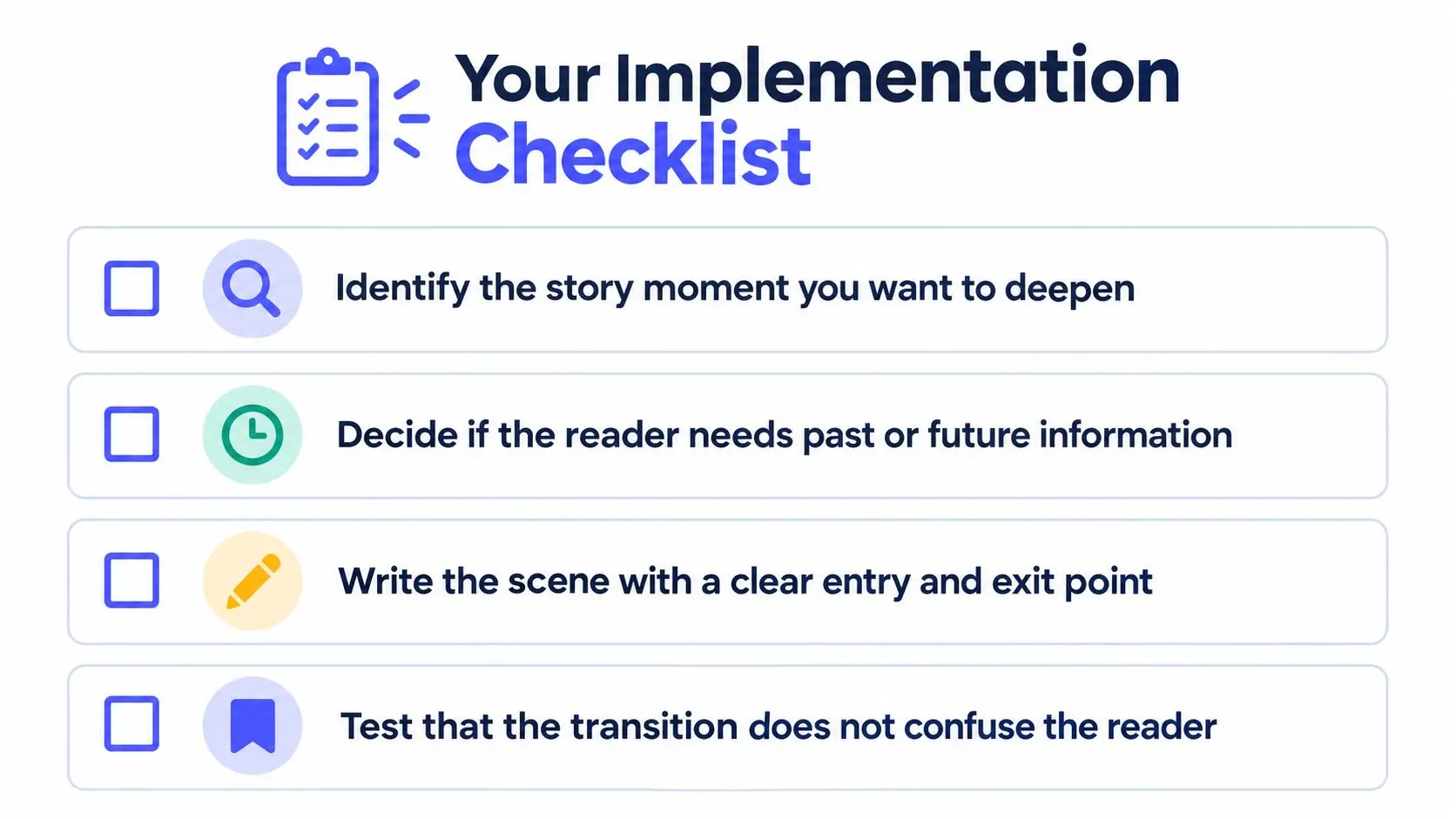
Take one scene from your manuscript and answer the questions below before rewriting it. Don't begin by adding a technique. Begin by identifying the reader experience you want.
- Name the pressure point. What should the reader feel here: curiosity, dread, sympathy, confusion, or recognition?
- Choose the information direction. Does the reader need a past cause, a future possibility, or both?
- Define the entry trigger. Select the object, sensation, line, or decision that moves naturally into the flashback or clue.
- Limit the reveal. Give enough information to change interpretation, but retain a question that keeps the scene alive.
- Create a clear exit. Return from the flashback with a decision, image, or consequence that affects the present.
- Test the clue. Remove the foreshadowing temporarily. If the later event feels entirely random, strengthen the signal. If the outcome becomes obvious, make the signal less direct.
- Check the payoff. When the later event occurs, ask whether the earlier detail gains a specific new meaning.
- Read in sequence. A device that works in isolation may disrupt the surrounding chapter. Check the sentence before the transition and the first sentence after it.
A useful final test is to describe the reader's state in one sentence before and after the scene. For example: “Before, the reader suspects that Mara is hiding something. After, the reader understands her fear but worries that she may repeat the past.” That change shows the device is doing functional work.
Bringing It All Together for Stronger Stories
Flashback and foreshadowing aren't rules you add to a manuscript to make it look complex. They're choices about revelation and concealment. A flashback should arrive when the past can sharpen the present. Foreshadowing should appear when a small early signal can make a later event more powerful.
The strongest stories often create a particular balance. Readers don't predict every detail, but they can recognize the pattern afterward. They feel surprise at the reveal, then look back and see that the story gave them enough evidence to accept it. That combination makes an ending feel earned rather than manufactured.
Keep your focus on reader-state control. Before a flashback, the reader may be asking for a cause. Before foreshadowing, the reader may need a reason to worry. After either device, the story should offer a changed interpretation, a sharper question, or a more urgent choice.
As you plan those relationships across chapters, a structured resource such as SEO playbooks can also help you think in terms of intent, sequencing, and how readers move through information. The same principle applies to fiction: place each piece where it serves the reader's next meaningful question.
Storyloft offers a cloud-based workspace for drafting, outlining, AI-assisted editing, research organization, illustration, cover design, and publishing preparation. Use it to map clues, track past events, and revise flashbacks and payoffs in one manuscript environment, then visit Storyloft to start developing your next story.