Story Outline Example: Build Your Blueprint for a Novel
You have a premise you can't stop thinking about. The opening scene feels vivid, the protagonist has a problem, and the ending seems somewhere in the distance. Then you reach the middle of the manuscript and discover that the characters are moving, but the story isn't. Subplots multiply, clues lose their purpose, and every new chapter creates another problem to repair.
A practical story outline prevents that drift without requiring you to script every sentence in advance. It gives you a working map for plot, character change, evidence, and pacing, while leaving enough space for discovery during drafting. The most useful approach combines the familiar beginning, middle, and end convention from academic writing with the flexible scene planning used by novelists.
Table of Contents
- Why You Need a Story Outline Before Drafting
- The Three-Phase Process for Building a Story Outline
- Real Story Outline Examples for Fiction and Nonfiction
- Avoiding the Over-Outline Trap
- Putting It All Together and Your Next Steps
Why You Need a Story Outline Before Drafting
An outline earns its place before drafting by forcing decisions while they're still inexpensive to change. A weak motivation, missing clue, or vague ending can be corrected in a planning document. The same problem becomes much harder to fix after it has spread through chapters of prose.
Academic writers have long used a beginning, middle, and end structure to organize arguments and evidence. A history-writing guide describes the outline as a tool for arranging main ideas, supporting evidence, and subsections in a logical or chronological pattern, while practical writing guides often expand the structure into introduction or background, body, and conclusion. That convention transfers naturally to fiction because a novel also needs orientation, development, and resolution. (The academic outline convention gives writers a useful foundation without dictating genre.)
What an outline solves
Suppose a mystery writer begins with a compelling setup: a conservator finds a coded note inside a damaged painting. The writer knows the detective will eventually uncover an old fraud, but not what the detective must do next. Without a plan, scenes tend to become research displays or conversations that repeat the same suspicion.
A useful outline identifies the pressure behind each scene:
- Plot direction: What changes because this scene exists?
- Character movement: What does the viewpoint character want, fear, misunderstand, or decide?
- Continuity: Which facts, objects, relationships, and promises must remain consistent?
- Pacing: Where does the reader receive a new question, complication, reversal, or answer?
That work reduces writer's block because you're no longer asking, “What happens in my book?” You're asking a narrower question, such as, “What evidence can make the detective trust the wrong person here?”
Practical rule: An outline should remove avoidable uncertainty, not eliminate every uncertainty.
This is why outlining isn't a cage. It's a map that lets you depart from the route deliberately. If a character makes a surprising choice during drafting, you can test that choice against the larger arc instead of abandoning the manuscript or forcing the character back into an old plan. Writers who want a deeper explanation of the planning benefits can also review why outlining a book helps.
The Three-Phase Process for Building a Story Outline
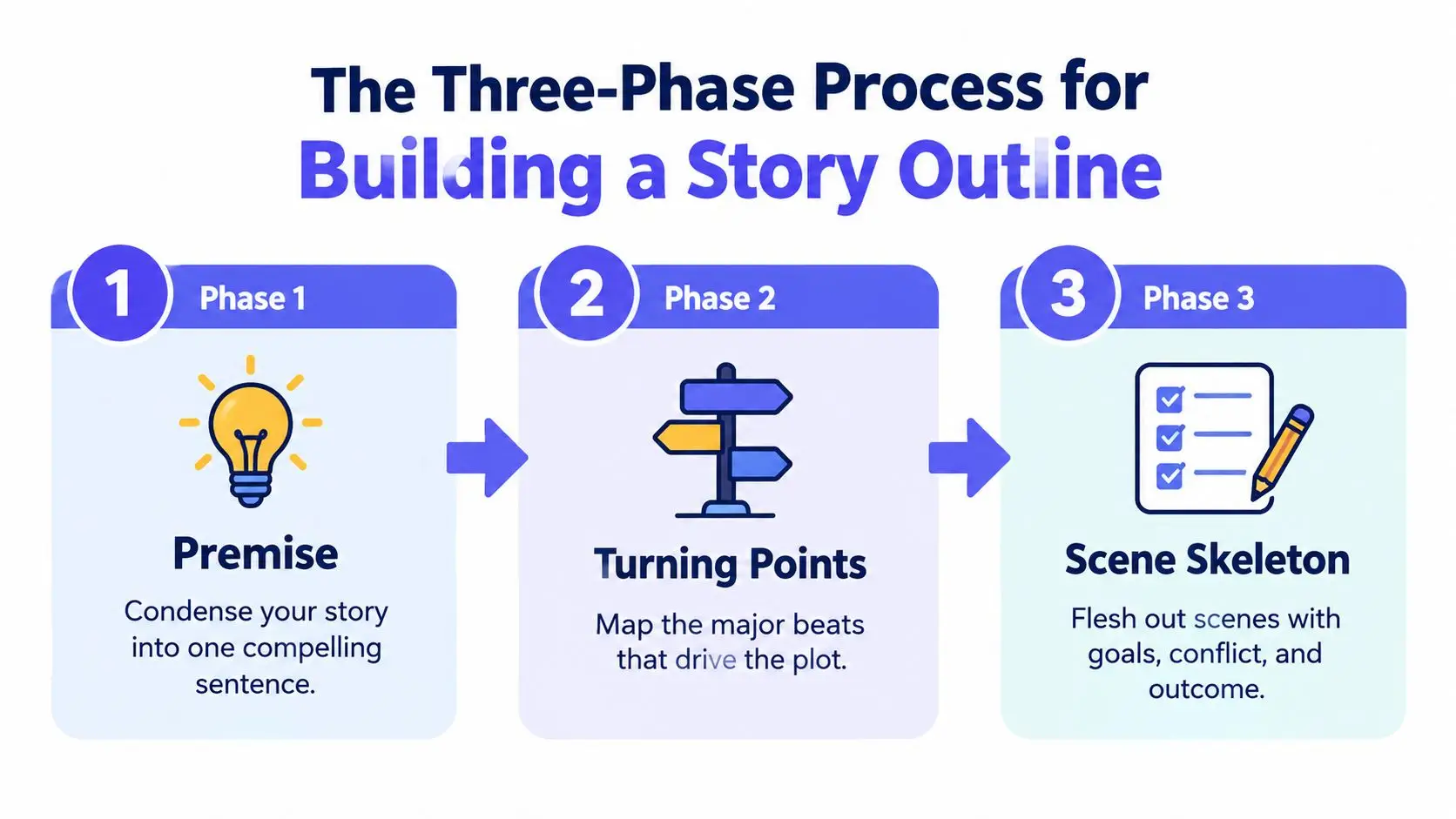
A reliable workflow moves from premise to turning points to scene skeleton. Starting with scenes is tempting, but it often produces attractive fragments without a causal spine. Beginning with the premise keeps the outline focused on the story's central change.
Phase one starts with the premise
Write one sentence containing the protagonist, the disruption, the goal, and the central obstacle. It doesn't need to sound like jacket copy. It needs to tell you what the story is about.
For example:
After a museum archivist discovers that a celebrated painting contains evidence of a vanished artist's murder, she must expose the institution protecting the truth before the artwork is destroyed.
This sentence gives you a decision filter. A scene belongs in the outline if it complicates the archivist's investigation, changes her understanding, tests her relationships, or moves her toward exposure. Research about unrelated artistic techniques may still matter, but it should support the premise rather than compete with it.
For nonfiction, use the same discipline. A guide might begin with: “A first-time novelist needs a flexible planning method that protects story momentum while preserving room for discovery.” That sentence becomes the standard against which every chapter earns its place.
Phase two maps the major beats
Next, divide the story into beginning, middle, and end, then assign a few decisive events to each part. This is the point where you choose direction, not detail.
- Beginning: Establish the protagonist's normal conditions, introduce the problem, and create a decision that makes retreat difficult.
- Middle: Increase resistance, expose mistaken assumptions, complicate relationships, and force a meaningful change in strategy.
- End: Bring the central conflict to its decisive test, reveal the consequences, and show what the protagonist now understands or can do.
For the museum mystery, the beats might look like this:
| Story phase | Major beat | Function |
|---|---|---|
| Beginning | The archivist finds the hidden note | Creates the investigation |
| Beginning | Her director orders her to suppress it | Turns curiosity into conflict |
| Middle | A trusted curator gives her a false provenance file | Redirects suspicion |
| Middle | The painting is scheduled for destruction | Raises the cost of delay |
| End | She confronts the institution with the original evidence | Forces the truth into public view |
| End | The archive changes its account of the artist | Shows the consequence of her choice |
The story-outline workflow from premise to scenes supports this progression. It recommends starting with a concise premise, mapping broad plot movement, and expanding only after the main structure is visible.
Phase three expands beats into scenes
Only now should you create a scene skeleton. Each scene needs a goal, conflict, and outcome.
“Archivist searches the basement” is a setting note. “The archivist searches the basement for the missing restoration log, but finds her own access record altered, forcing her to suspect an ally” is a scene plan. It tells you what the character wants, what blocks her, and what changes by the end.
Keep research and character material beside the outline rather than scattering it across unrelated files. In a binder or tagged workspace, you might create sections for plot beats, characters, locations, historical sources, and open questions. That arrangement makes it easier to check whether a scene depends on a fact you haven't verified or a character detail you've contradicted.
A short demonstration of this planning logic can help you see how premise, beats, and scenes connect:
The outline should become more concrete as you move forward, but it shouldn't become a substitute for the manuscript. For further practical guidance, see how to make a story outline.
Real Story Outline Examples for Fiction and Nonfiction
A story outline example becomes useful when it shows decisions, not just labels. The following two models use the same structural foundation but apply it to very different writing problems.
Fiction example for a mystery novel
Premise: An archivist discovers evidence that a famous painting was created by an artist who disappeared after witnessing a murder, then investigates while the museum director tries to erase the past.
Beginning
The archivist, Mara, repairs a damaged frame and finds a coded note beneath the backing. The note names a room that no longer exists in the museum and includes a date connected to the artist's disappearance. Mara's immediate goal is to identify the writer, but her director confiscates the note and warns her not to damage the museum's reputation.
Mara copies the note from memory and asks a retired registrar for help. The registrar denies knowing anything, yet later leaves Mara an outdated floor plan. This is the first useful contradiction. Mara chooses to continue the investigation, even though doing so risks her job.
Middle
Mara searches the closed wing and finds a restoration log with several pages removed. She assumes the director removed them, but a second clue points toward the retired registrar. Her colleague Tomas admits that he altered the digital catalogue years earlier at the director's request, which makes him look complicit.
At the midpoint, the museum announces that the painting will be destroyed because of structural damage. Mara now has limited time to prove that the hidden note concerns more than an obscure historical dispute. She discovers that the missing artist had made a second version of the painting, and the image contains a visual reference to the vanished room.
The pressure intensifies when Tomas is blamed for the catalogue fraud. Mara must decide whether to protect her colleague or use his mistake to gain access to the director's files. She chooses the latter, finds the original provenance record, and learns that the director's predecessor covered up a killing to preserve the museum's funding.
End
Mara confronts the director during the public destruction review. She presents the original record, the copied note, and the floor plan, but the director claims the evidence was fabricated. Tomas arrives with the server archive, proving that the digital catalogue was altered under the director's credentials.
The director loses control of the meeting, and the museum postpones the destruction. The final scene shows Mara entering the restored room, where she finds the artist's unfinished second painting. The mystery is resolved, but Mara's understanding of professional loyalty has changed. She no longer treats institutional approval as the same thing as truth.
This outline tracks clues, reversals, choices, and consequences. It also gives the middle a job. The central portion isn't a corridor between the opening and climax. It contains a false lead, a public deadline, a relationship under pressure, and a decision that changes Mara from a cautious employee into an active investigator.
Nonfiction example for a practical guide
Premise: A first-time novelist can plan a coherent book by moving from a one-sentence premise to major beats and then to flexible scene notes.
Opening chapters: Define the problem of beginning with disconnected scenes, explain what an outline is for, and present the beginning, middle, and end model. The reader finishes this part with a shared vocabulary and a reason to plan.
Development chapters: Demonstrate the three-phase process. One chapter focuses on premise, another on turning points, and another on scene skeletons. Each chapter should include a worked example, a short exercise, and a warning about a common misuse. The supporting evidence belongs beside the principle it supports, not in a detached research appendix.
Application chapters: Show how the method changes for a mystery, romance, fantasy, memoir, or practical guide. The point isn't to force every genre into identical beats. It's to show which elements remain stable, such as desire, resistance, change, and consequence.
Closing chapter: Help the reader diagnose a weak outline. Questions might include: Does the protagonist make consequential choices? Does the middle introduce new pressure? Does each chapter change the reader's understanding? Does the ending resolve the promise made by the premise?
For additional models, browse these book outline examples. The strongest examples don't merely list chapter topics. They show how each part prepares, complicates, or pays off another part.
Avoiding the Over-Outline Trap
Over-outlining happens when planning stops serving the draft and starts replacing it. Writers often script every exchange because detailed planning feels safer than facing an uncertain manuscript. The result can be a sequence of predetermined actions that technically fits the plan but no longer feels discovered.
The danger is greatest in the middle. Guidance on outlining warns that an outline should operate as a map rather than a finished manuscript, and that excessive detail can suppress discovery while leaving pacing and continuity problems unresolved. (This discussion of over-outlining makes the distinction clearly.) A scene-by-scene plan can tell you what happens without telling you why the reader should care.
Signs your plan has become too rigid
Look for these symptoms:
- The character's choice feels decorative: The outline decides the outcome before the character's pressure has been established.
- Every scene has fixed dialogue: You're transcribing a conversation instead of defining its conflict.
- The middle contains no open questions: Nothing can surprise you because every answer has already been settled.
- You protect weak beats: You keep a scene because it took effort to plan, not because it changes the story.
- Discovery feels like failure: A better idea during drafting is treated as a problem rather than useful evidence.
A flexible outline records what must happen and leaves room for how it happens. For the mystery above, “Mara obtains evidence that implicates the director” is a firm structural requirement. Whether she finds a server archive, receives a confession, or notices an error in a public catalogue can remain undecided until the draft reveals the most convincing option.
Build deliberate gaps
Mark certain notes as open, provisional, or to discover. Leave character reactions, connective scenes, minor settings, and some dialogue unresolved. You can also outline the middle by its pressures rather than by a fixed chain of events: the protagonist must lose a source, misread a clue, damage a relationship, and confront a deadline.
A good outline tells you where the story must arrive. It doesn't dictate every footstep.
Review the outline after drafting a section. If the manuscript has found a stronger cause-and-effect chain, update the plan instead of forcing the prose to obey an obsolete version. Structure protects momentum when it remains responsive to what the characters and scenes reveal.
Putting It All Together and Your Next Steps
Start with one project, not your entire writing life. Write a sentence that names the protagonist or reader, the central problem, and the change the work promises. Then place your main beats under beginning, middle, and end before expanding only the scenes you need to draft next.
Check every scene for a goal, resistance, and outcome. Tag research, character notes, and unresolved questions so you can retrieve them without interrupting the manuscript. If you want an automated starting point, Storyloft's free novel outline generator can produce a structured outline with chapter titles, summaries, descriptions, and beat-level planning that you can revise.
The best story outline example isn't the most elaborate document. It's the one that keeps the premise visible, gives the middle escalating pressure, and leaves enough uncertainty for the draft to feel alive. Use the outline as a working instrument, revise it when the story teaches you something, and keep drafting before planning becomes another form of avoidance.
Storyloft brings outlining, long-form manuscript drafting, research organization, AI-assisted editing, illustration, cover design, and publishing workflows into one cloud-based workspace. Visit Storyloft to turn your premise and beat sheet into a coherent manuscript while keeping the planning material close to the draft.