How to Build a World That Readers Actually Believe

Most worldbuilding advice tells you to build more. Draw the map, write the history, define every custom, document the magic, and fill a binder before you draft chapter one. That sounds responsible. In practice, it often produces writers who can explain their setting fluently but can't finish a scene.
The better question isn't “What else can I invent?” It's “What does this story need to work, and what must remain consistent when the characters act on it?” Learning how to build a world means creating pressure, limitations, consequences, and lived detail. The lore exists to make scenes possible, not to become a second manuscript.
A useful craft principle treats worldbuilding like an iceberg. One widely circulated writing lesson suggests that around 90% of a world's knowledge stays beneath the surface, while about 10% appears directly in the text (worldbuilding craft guidance). You don't need to publish the entire iceberg. You need enough visible ice to convince readers that the submerged mass exists.
Table of Contents
- Why Most Worldbuilding Advice Sets Writers Up to Stall
- The Load-Bearing Layers to Build First
- Weaving the World Through Character and Scene
- Testing Rules and Stress-Testing Scenes
- Research, Scope, and the Living Canon
- Build Enough, Then Draft
- A Practical Checklist and What Comes Next
Why Most Worldbuilding Advice Sets Writers Up to Stall
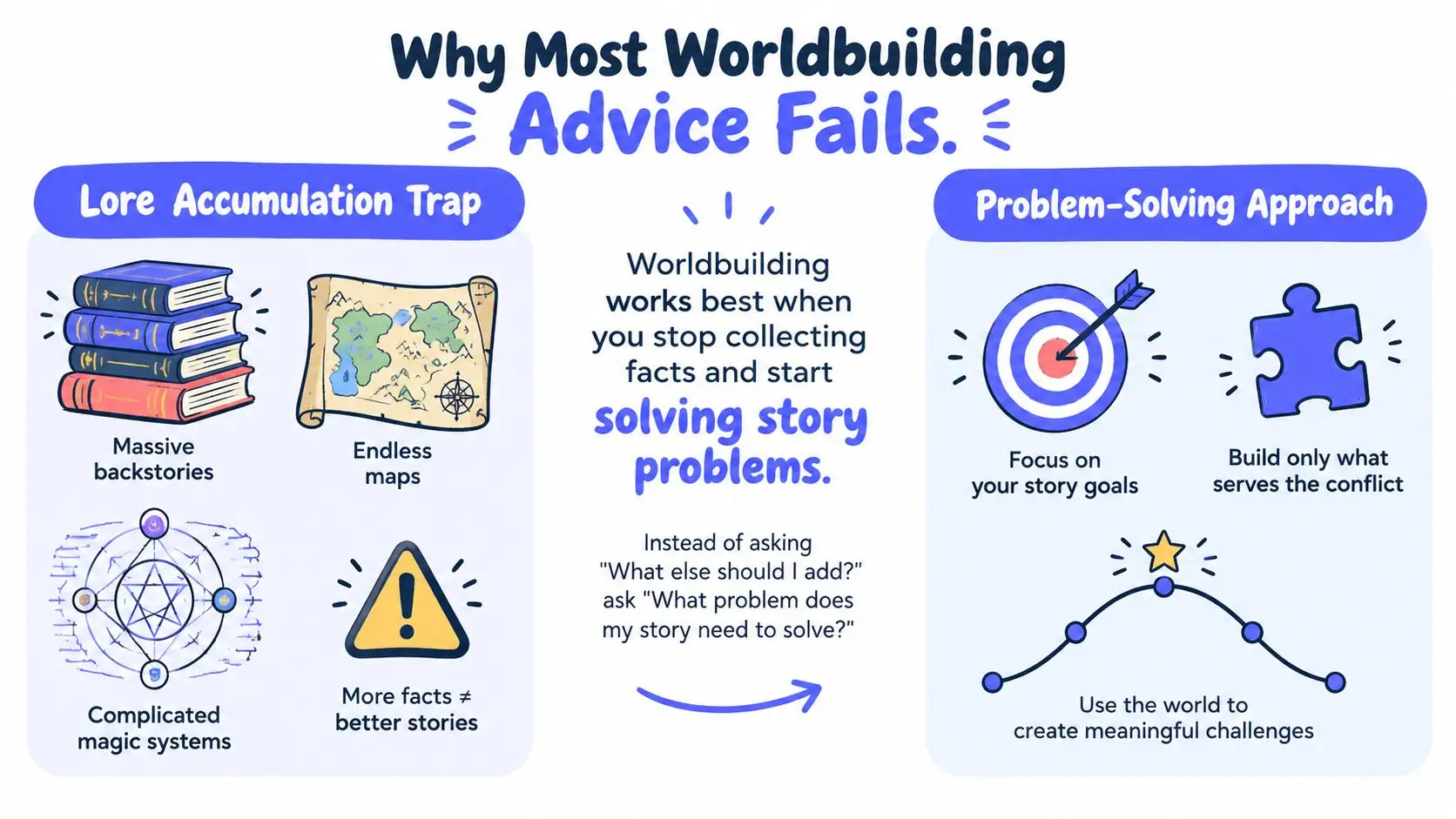
The worldbuilding file becomes a trap when it grows faster than the novel. Names, dynasties, maps, invented languages, and system rules can create the feeling of progress while leaving the draft untouched. A setting earns space when it creates a problem, limits a choice, reveals character, or changes what happens next.
Detailed bibles still have legitimate uses. A complex series may need a broad reference document, and collaboration can require shared terminology and continuity notes. The trouble starts when preparation replaces discovery. A map-first workflow can mislead you too. Geography affects movement and settlement, but a beautiful coastline does not explain what your protagonist wants, what blocks them, or why crossing one bridge is dangerous today.
Build for the next scene
I use a minimum viable world: the immediate setting, the rules governing the current conflict, and the facts needed to keep the next sequence coherent. If a character is fleeing across a border, establish who controls it, which permits or signals matter, how long the route takes, and what happens if the character is caught. A complete history of every neighboring province can wait.
Effective setting design starts with the material that will shape choices on the page, not with an unlimited search for background knowledge. The same discipline applies to invented worlds. Research or invent only what changes behavior, raises pressure, clarifies consequences, or prevents a continuity mistake.
Practical rule: Build enough to make the next scene inevitable, surprising, and internally consistent. Then draft it and record what the scene proves the world still lacks.
Over-planning kills drafts because unused detail consumes the energy required to write, while missing detail can be added during revision. Let scenes expose weak rules, convenient geography, or missing consequences. Update a living canon as the manuscript establishes what is true, rather than treating early notes as permanent law.
The goal is a setting that works under pressure, not an encyclopedia waiting for a story.
The Load-Bearing Layers to Build First
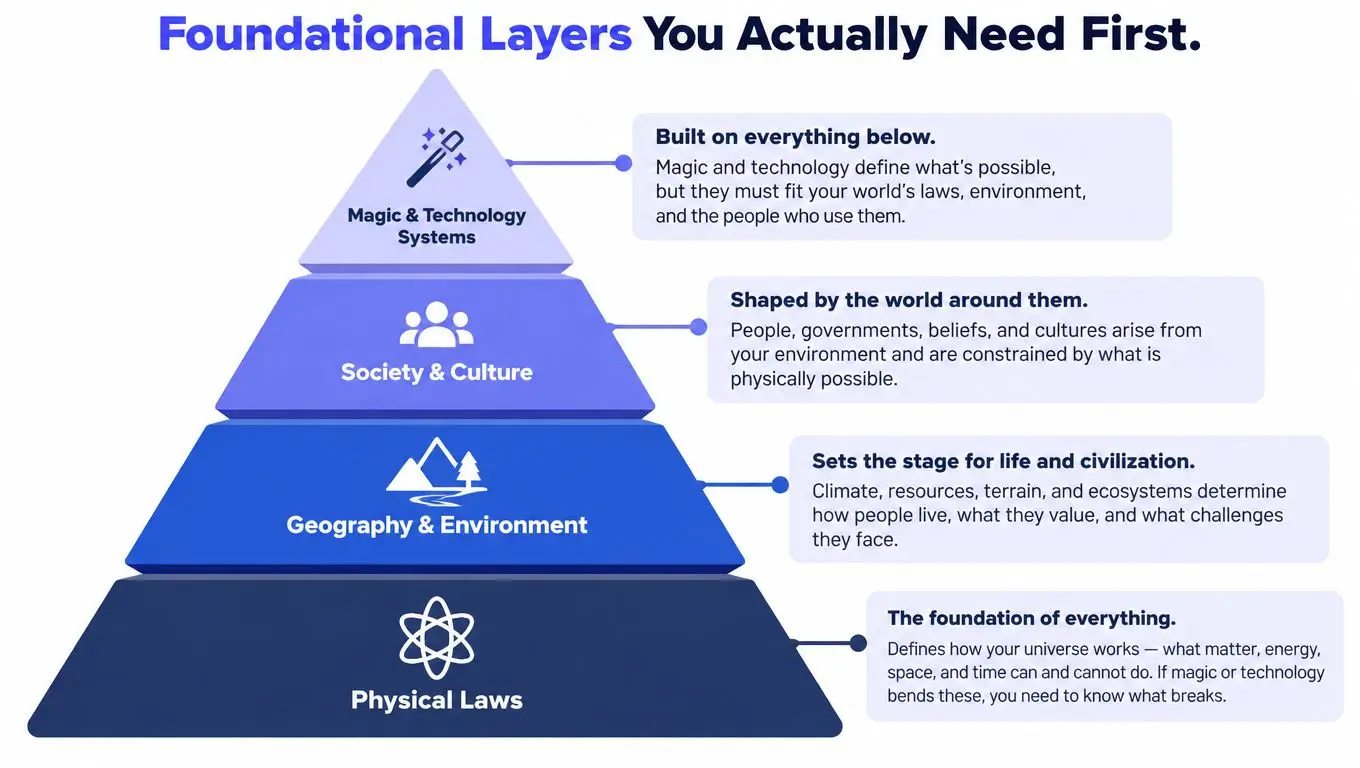
Start with the rules that constrain everything built on top of them. You do not need equal detail in every category. You do need to know which foundations can carry plot pressure.
Establish what the world permits
Set physical laws and exceptions first. Decide whether gravity, disease, aging, death, combustion, and distance work as readers expect. If magic or technology bends one rule, define its cost and boundary. Instant travel changes trade, warfare, privacy, and the meaning of distance. A healing system that closes wounds but cannot replace blood creates different medical urgency from one that restores a body without consequence.
Then place the world in physical space. Geography should explain movement and settlement, not decorate a map. A capital beside a navigable river may control grain shipments, taxation, and military access. A mountain pass can produce a fortified town, a local dialect, and a political dispute over tolls. Climate shapes what people grow, wear, store, fear, and celebrate.
Define how people organize survival
Culture becomes believable when it changes behavior. Choose the beliefs, taboos, kinship patterns, status signals, and power structures characters meet in ordinary situations. A society that treats salt as sacred will respond to a salt merchant differently from one that treats salt as cheap commodity. A city where public speech belongs to a ruling order will produce different conversations from one where debate is a civic duty.
History should apply pressure rather than arrive as a lecture. A famine fifteen years ago might explain restrictions on grain exports, family food hoarding, or a border patrol treating travelers as smugglers. You need the past events that still shape present incentives, not a complete chronology.
Add material limits
The economy answers practical questions that fantasy often skips. Who grows food? Who owns land? What can be traded? Which labor keeps the city alive? Technology sets the ceiling for plausible action, including communication, transportation, weapons, and record keeping.
Apply a load-bearing test to every layer:
- Plot-bearing: The rule changes a character's choices or creates a consequence.
- Scene-bearing: The detail affects what a character notices, says, buys, hides, or misunderstands.
- Decorative: The detail adds flavor without altering behavior or outcome.
Build plot-bearing systems first, then scene-bearing details. Decorative material can wait. A structured worldbuilding bible with templates and character integration can organize these layers, but the document should serve the draft. Let scenes expose weak rules, convenient geography, and missing consequences, then update the canon as the manuscript establishes what is true.
Weaving the World Through Character and Scene
Readers rarely believe a world because the narrator explains it accurately. They believe it because characters behave as though the setting has real consequences.
The iceberg principle gives you a useful division of labor. Keep the deeper system in your notes, then expose the part that a viewpoint character would notice under pressure. A soldier may know the history of a defeated dynasty, but in a scene they might flinch when a forbidden banner appears above a doorway. The flinch carries history without stopping the action.
Compare the difference:
- Explanation: The eastern kingdom lost a war decades ago, and its people still resent the empire.
- Scene: A baker sees the imperial crest on a soldier's coat, lowers her eyes, and removes the eastern loaves from the front shelf.
The second version gives readers an observable choice. It also leaves questions open, which makes the world feel larger.
Let the setting create friction
A merchant haggling over salt routes can reveal geography, scarcity, class, and political control in a few lines. A soldier checking a relic-ward before entering a tunnel can establish supernatural rules through action. A child refusing to step on a painted threshold can show religion more effectively than a paragraph defining the local faith.
POV determines which details appear. A hungry dockworker notices prices and locked storehouses. A noble notices seating order and inherited symbols. Two people can walk through the same city and produce two valid versions of it because they occupy different systems within it. That bias isn't a problem to correct. It's one of your strongest worldbuilding tools.
For stories with interactive or branching elements, studying real world interactive content examples can sharpen your sense of how environments communicate through user action rather than exposition. The same lesson works in a novel. Let the character touch, choose, avoid, misunderstand, and pay.
Audit each finished scene
After drafting, ask four questions:
- What setting detail does the viewpoint character notice?
- What rule or social expectation shapes a decision?
- What consequence would change if the world worked differently?
- Could I remove the detail without weakening the scene?
If the answer to the last question is yes, the detail may be atmosphere rather than story. Atmosphere has value, but it shouldn't crowd out the details that create conflict. For a practical way to keep character motives, locations, and notes connected, use a system for organizing character notes and worldbuilding alongside the manuscript.
Testing Rules and Stress-Testing Scenes
A world becomes reliable when its rules survive contact with characters who want something. Don't merely write rules as attractive statements in a bible. Turn each one into a proposition you can test.
A proposition should be specific enough to fail.
For example: “Travelers can cross the Ashen Plain in six days on foot.” That sentence immediately raises practical questions. What season? With what supplies? Along which route? Does a wounded traveler make it? Can someone carry a child? What prevents an organized army from using the same path?
Use the three-part test
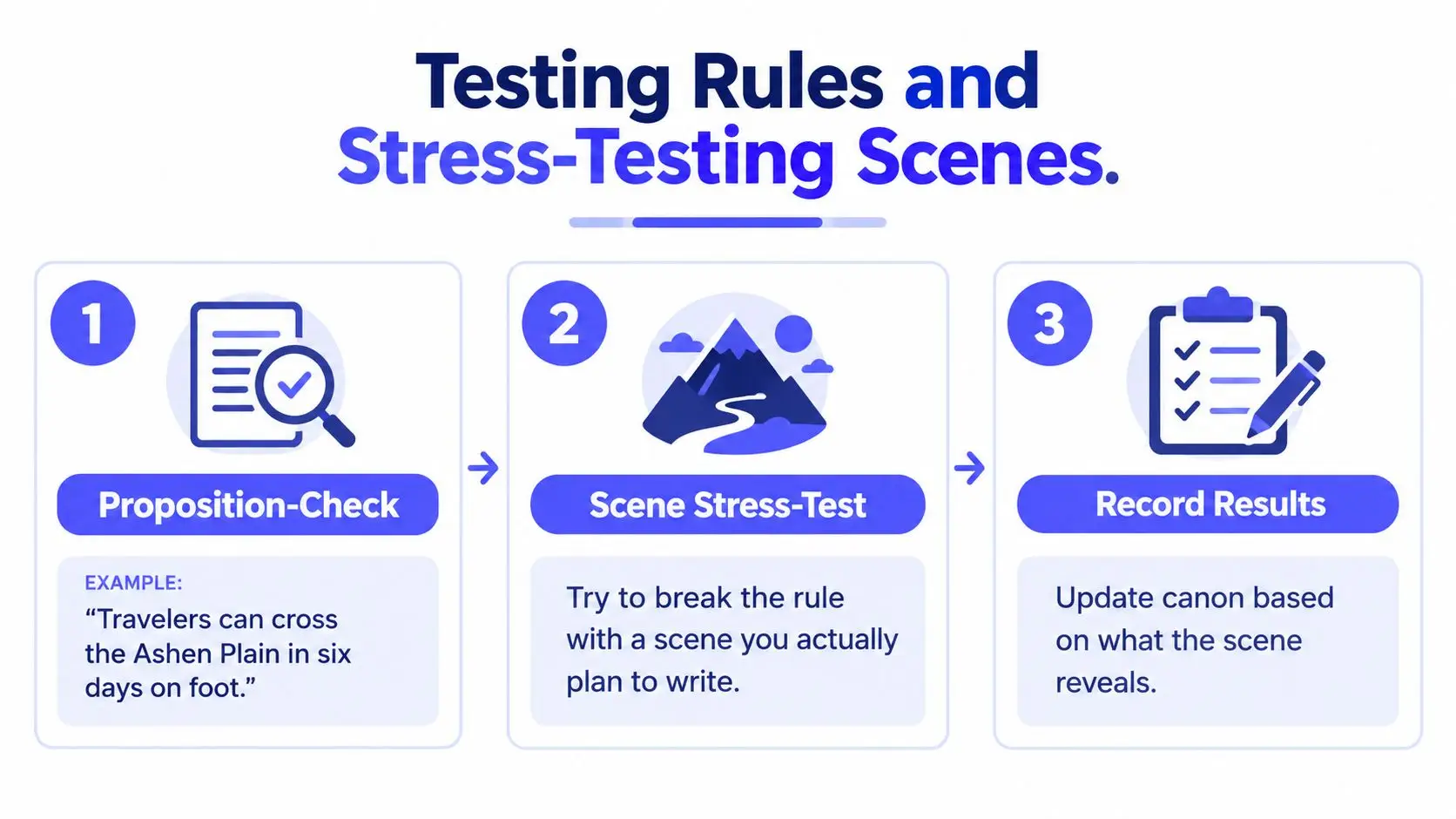
- Write the proposition. State one rule about travel, power, politics, technology, money, or causality.
- Write a planned scene. Put a character in a situation where the rule matters. Make them attempt the fastest, safest, or cheapest solution available.
- Record the break point. If the scene exposes a contradiction, revise the rule, the scene, or both.
Suppose the protagonist needs to cross the plain urgently, but the route has no water. The proposition may still work, but only if travelers carry water, use hidden wells, travel at night, or accept serious physical cost. Those conditions are more useful than a paragraph declaring that the plain is dangerous.
Academic methodology for fictional worldbuilding describes using tables of world propositions and checking each statement as true or false within the invented setting (proposition-based worldbuilding methodology). You can apply the same discipline without turning the novel into a technical project.
Let the bible grow from evidence
Create one working sheet for each load-bearing layer. Record the rule, the scene that tested it, the result, and any unresolved question. A rule that has survived a scene deserves more confidence than a rule that has only lived in your imagination.
Check the contradictions that cause the most trouble:
- Seasonal mismatches: Crops, clothing, festivals, daylight, and weather must fit the calendar.
- Currency problems: Prices, wages, taxes, and trade should support the economic conditions characters describe.
- Travel-time conflicts: Routes must align with the urgency and sequence of the plot.
- Power loopholes: A magic or technology solution shouldn't appear only when the protagonist needs rescue.
- Knowledge gaps: Characters shouldn't know information their position, education, or era can't provide.
A detailed science fiction worldbuilding rules guide can provide prompts for technical systems, but your manuscript remains the final test. If a rule never affects a scene, it may not belong in the working canon yet.
Research, Scope, and the Living Canon
Research earns its place when it answers a practical question raised by the next scene. It becomes avoidance when it keeps you collecting facts instead of making decisions on the page.
For a historical setting, investigate the object, custom, institution, or material the draft requires. Use editorially reviewed books, journals, magazines, and reliable educational or organizational sources rather than casual summaries. The focused worldbuilding research advice supports that standard, but the working rule is simpler: stop when you can make the character's action accurate enough to draft.
Give research a cutoff
Tie each research sprint to a writing problem. Before searching, phrase the question plainly:
- How would this character carry water?
- Who controls the bridge?
- What does a local court recognize as evidence?
- Which materials can this workshop obtain?
- What would a traveler call this tool?
Set a stopping point before the search begins. If fascinating facts do not affect the next scene, close the tab. Research is finished when you can write the passage without making an unsupported claim, not when you have exhausted the subject.
Control the project's edges
Scope is a creative decision. Define the smallest geography, time window, and group of characters the current book needs. A story set in one port may require detailed knowledge of its harbor, warehouses, neighborhoods, and governing council. Unless the plot sends characters elsewhere, a fully developed continent can wait.
Expanding the scope mid-draft creates continuity work. Each new region adds names, resources, institutions, and historical relationships that the manuscript may never use. Keep a “not yet” list for attractive ideas outside the current story. Revisit it only after the pages show a reason.
Maintain one source of truth
A living canon should be easy to revise and difficult to contradict. Keep one central file containing:
- Canon entries: Facts confirmed by drafted scenes or deliberate decisions.
- Open questions: Possibilities that still need testing.
- Retired material: Ideas removed from the active world.
- Change log: What changed, why, and which scenes may be affected.
- Drafted-scenes column: The pages that prove a rule matters.
A practical system for organizing research notes for long-form writers can keep sources, character notes, and setting decisions beside the manuscript. The software matters less than the update cycle. When the prose exposes a gap, record the decision, mark the affected scenes, and let the canon change with the draft.
Build Enough, Then Draft
You shouldn't finish the world before writing chapter one. You should build the minimum viable world for the opening movement, draft it, and then expand only where the pages expose a real need.
A useful loop looks like this:
- Define the setting, rules, factions, and history required by the next few chapters.
- Draft those chapters without stopping to solve every distant question.
- Mark contradictions, missing motivations, and unclear consequences.
- Update the canon.
- Continue with the next set of scenes.
This approach respects a fact many guides ignore: you don't know where the world is weak until characters try to live in it. A city may look complete in notes, then fail when a character needs to buy medicine at night. A magic system may seem balanced until the protagonist uses it to bypass the central conflict.
Read the signals in the draft
| Signal in the Draft | Action |
|---|---|
| A character's goal requires a new location | Expand the geography only as far as the journey and conflict demand |
| Readers need to predict an outcome | Define the relevant rule before the scene relies on it |
| The plot depends on magic or technology | Establish its limits, costs, and visible consequences |
| Lore appears in notes but no scene needs it | Cut it, archive it, or leave it unresolved |
| A historical detail never affects behavior | Remove the explanation and protect drafting momentum |
| A faction exists only in the bible | Don't develop it until a character meets its power or feels its influence |
The difference between expansion and avoidance is simple. Expansion solves a problem the draft has already revealed. Avoidance creates material that lets you postpone the difficult scene.
Keep the canon close to the manuscript. Never let it become a more finished version of a book you haven't written.
Use a sequencing rule that protects momentum: canon shouldn't outrun drafted pages by more than one act. A broad outline may point toward distant developments, but detailed systems should earn their place through actual narrative need.
A Practical Checklist and What Comes Next
Use this checklist before drafting, then return to it whenever the story stalls:
- Set scope: Choose the geography, time window, and social slice the current book needs.
- Define constraints: Establish the physical rules and the consequences of bending them.
- Map pressure points: Identify the geography, resources, institutions, and historical wounds that shape the central conflict.
- Build character-facing culture: Decide what your viewpoint characters notice, fear, value, and misunderstand.
- Test propositions: Turn important rules into statements that a planned scene can challenge.
- Track canon: Record confirmed facts, open questions, retired ideas, and the scenes that prove each rule.
- Research with a cutoff: Search for answers to the next writing problem, then return to the manuscript.
- Draft before expanding: Add detail only when prose reveals a missing location, rule, motivation, or consequence.
- Check for drift: Compare names, dates, travel, resources, power limits, and character knowledge before revising.
- Protect momentum: If no scene requires a piece of lore, don't develop it yet.
This method scales beyond a single novel. In a sequel, the canon becomes a continuity tool rather than a static encyclopedia. In a shared-world project, collaborators can distinguish confirmed facts from proposals before a new subplot contradicts established rules. Editors, co-writers, and sensitivity readers can also respond to specific cultural or institutional choices instead of sorting through an undifferentiated mass of lore.
Three failures appear repeatedly. Writers overbuild material that never reaches the page. They leave assumptions unexamined until a character needs to act on them. Then they allow canon drift because no one records which version a scene established. A living workflow addresses all three without demanding that you predict the entire series in advance.
The world is not the destination. It's the tool that makes character choices costly, scenes legible, and consequences unavoidable. Build the part the story can use, test it under pressure, and let the unwritten portions remain larger than the page.
Storyloft gives authors a manuscript-centered workspace for connecting characters, locations, factions, timelines, magic systems, technology, and lore while they draft. Use Storyloft to keep your working canon beside the manuscript, then turn tested world details into a coherent book instead of an ever-growing pile of notes.