
How to Know if Your Writing Is Good: Tests That Work
You finish a draft, reread it, and the verdict changes every time. At midnight, the pages feel profound. The next morning, every paragraph seems inflated, obvious, or strangely flat. Grammar software reports no errors, yet you still can't tell whether the writing works.
That uncertainty is normal, but “good” isn't a useful verdict on its own. The practical question is whether a specific reader can understand your point, follow its movement, trust its claims, and remember what matters. You can test those outcomes without relying on mood, instinct, or an AI tool's reassuring green lights.
Table of Contents
- Why You Can't Judge Your Own Writing
- What Research Says Good Writing Looks Like
- The Four Criteria to Check First
- Practical Tests You Can Run Tonight
- Getting Feedback You Can Actually Use
- Your Self-Review Rubric and Next Steps
Why You Can't Judge Your Own Writing
At 1 a.m., a writer rereads a finished chapter and sees the version that exists in their head. They know the backstory, the intended emotion, and the missing connection between two ideas. Their brain supplies details the page never states. The draft feels clear because the writer isn't encountering it as a stranger would.
That familiarity creates a serious editing problem. You remember what you meant to say, not necessarily what you wrote. A sentence that seems precise may force a new reader to guess. A transition that feels obvious may depend on knowledge the reader doesn't have. Grammar can be flawless while the argument remains dull, disorganized, or unsupported.
The useful question isn't “Is this good?” It's “Can this do its job for the reader?”
Self-judgment also swings with emotion. Pride makes weaknesses invisible. Fatigue makes ordinary sentences look embarrassing. Neither reaction gives you a stable basis for revision. A repeatable process does. Start with measurable surface signals, then test the larger argument, reader experience, and evidence.
For authors, confidence grows less from endless reassurance than from knowing what to inspect. A practical guide to writing confidence for authors can help with the emotional side, but confidence shouldn't replace diagnosis. You still need to know where readers may lose the thread.
Use four kinds of evidence:
- Measurable signals: sentence length, word complexity, and readability.
- Reader behavior: what someone can restate, skim, or remember.
- Editorial judgment: whether structure, voice, and pacing serve the purpose.
- A defined verdict: a rubric that tells you what to revise first.
The aim isn't to prove that every line is brilliant. Good writing is purpose-dependent. A research explanation, personal essay, sales page, and novel opening need different effects. A technically polished paper can still fail if readers can't locate its problem, method, contribution, or evidence. A literary passage can use long sentences successfully if the rhythm and meaning remain controlled.
Once you stop asking for a universal judgment and start checking reader outcomes, the draft becomes easier to work on. You don't need to decide whether you're talented. You need to find the point where the reader's experience breaks.
What Research Says Good Writing Looks Like
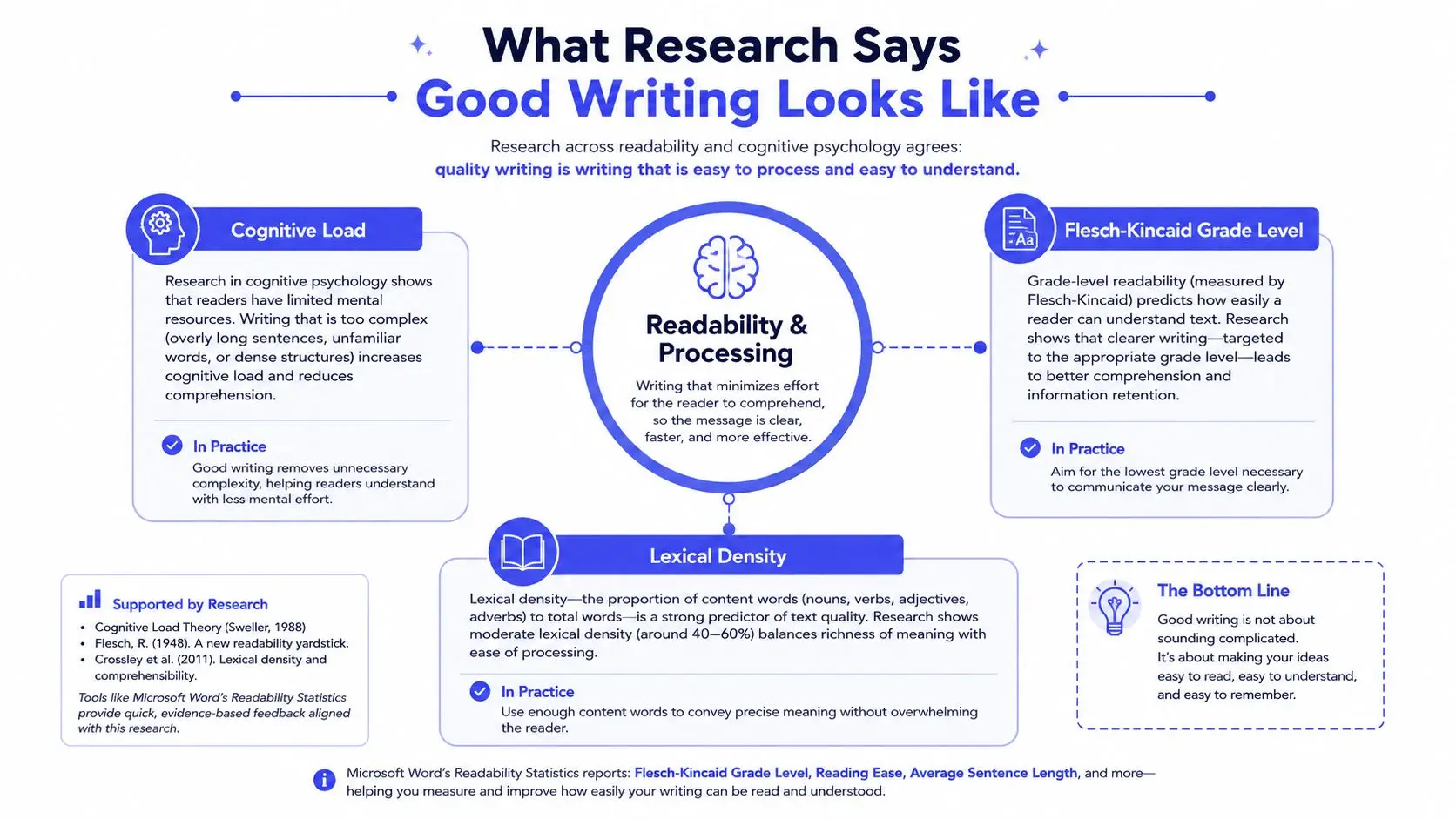
Readability is a useful starting point because researchers define it in operational terms: how easily a text can be processed and understood. Microsoft Word still expresses this idea through measures such as Flesch Reading Ease and Flesch-Kincaid Grade Level, which use sentence length and syllables per word as core inputs. This tradition moved writing evaluation away from purely subjective taste and toward observable features of text, as described in the 2022 corpus study on readability.
The Flesch Reading Ease equation is:
206.835 minus 1.015 times average sentence length minus 84.6 times average syllables per word.
You don't need to calculate it by hand. The practical interpretation matters more. Shorter sentences and simpler words usually raise the score, while longer sentences and more complex words lower it. That makes readability software useful for identifying friction, especially in dense explanations.
It doesn't make the score a quality verdict.
Readability is a signal, not a destination
A low readability score may reveal tangled syntax, excessive abstraction, or sentences carrying too many ideas. It may also reflect necessary technical vocabulary. Cutting every long word can make a medical, legal, or academic text less exact. Replacing a precise term with a vague short one improves a metric while damaging meaning.
Human judgments involve more than processing ease. Research on writing quality identifies vocabulary and discourse as strong predictors of readability, with features such as average verb phrases per sentence, article length, and discourse-likelihood measures also correlating with judgments of how well an article is written. The same line of research points to syntactic complexity, lexical diversity, and word frequency as the three most predictive indices of essay quality in a peer-reviewed study from 2010, summarized in the ACM paper on linguistic features of writing quality.
That combination changes the editing brief. Don't merely shorten. Ask whether sentence structure carries the logic, whether vocabulary has enough precision and variation, and whether each paragraph contributes to a coherent discourse.
Turn the research into three checks
Run these checks together:
- Processing: Where must the reader reread a sentence? Mark the sentence, then identify whether length, syntax, or vocabulary caused the delay.
- Structure: Can the reader tell why each paragraph follows the previous one? If not, add a visible relationship, such as contrast, cause, example, or consequence.
- Lexical choice: Did you choose the simplest accurate word, or merely the shortest word? “Reduce” may be better than “make smaller,” but “change” may be too vague where “reverse” is correct.
Good writing is therefore both readable and well-structured. Grammar is a baseline. A clean sentence can still make a weak claim, hide its evidence, or lead nowhere.
The Four Criteria to Check First
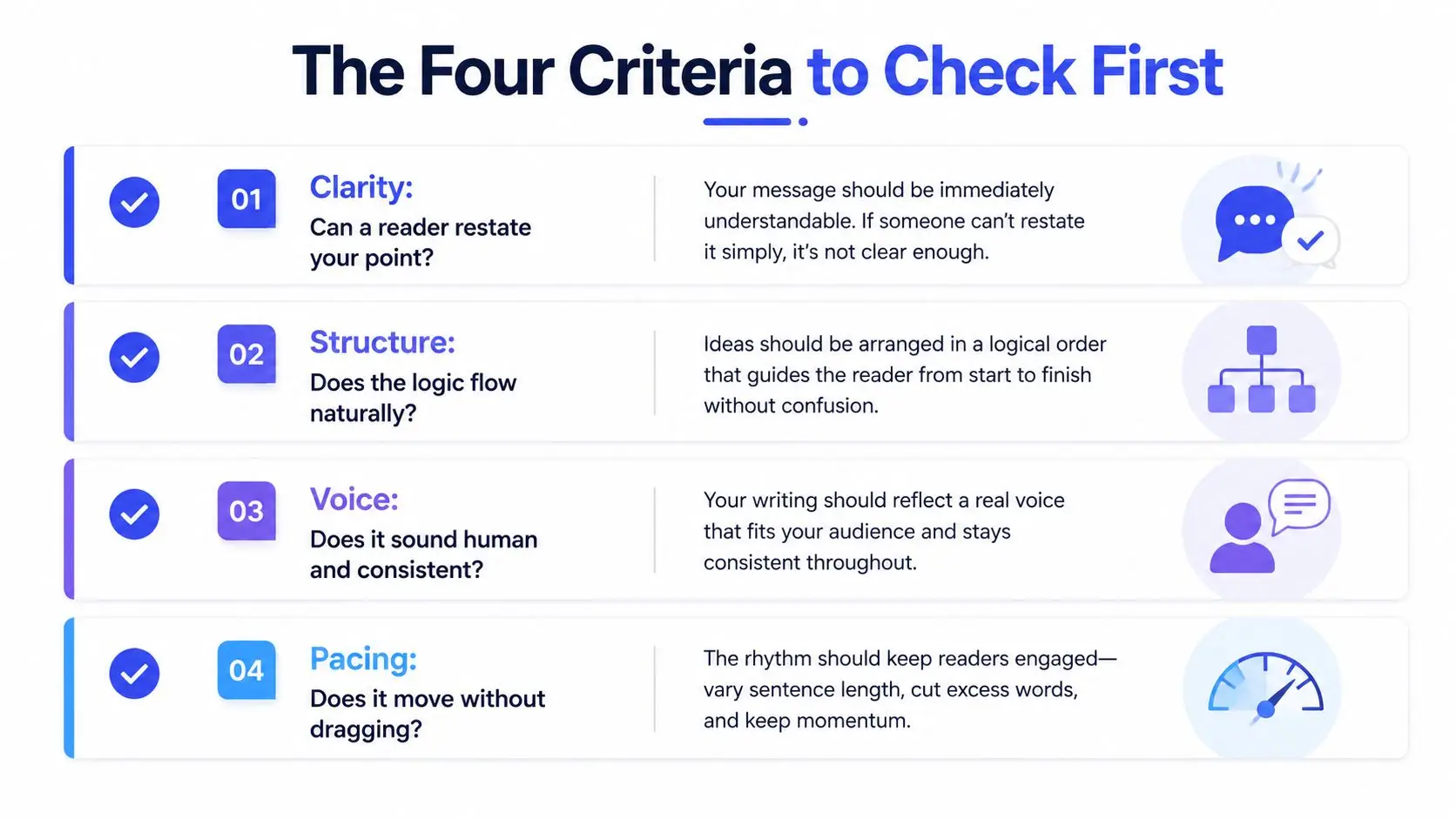
Editors usually find the biggest problems before they worry about commas. Check clarity, structure, voice, and pacing in that order, because sentence polish can't rescue a draft that fails at the level of purpose.
Clarity
Pass question: Can a reader restate your main point after one pass?
Weak: “The implementation of a more focused process can potentially facilitate improvements in overall team communication.”
Stronger: “A shorter meeting agenda helps the team make decisions faster.”
The revision works because it names the actor, action, and outcome. It doesn't avoid complexity when complexity matters. It removes fog that was doing no useful work.
Read each paragraph and write its point in your own words. If you need several sentences to explain what the paragraph is saying, the paragraph may contain multiple claims or no clear one.
Structure
Pass question: Can a skimmer reconstruct the argument?
A strong section gives readers orientation. Headings should signal the question being answered, paragraphs should arrive in a deliberate order, and examples should prove or clarify the point rather than interrupt it. If deleting a paragraph changes nothing, the paragraph hasn't earned its place.
Try writing a one-line summary beside every paragraph. Look at the summaries without the draft. If they form a logical sequence, the structure is carrying its weight. If they repeat, jump, or leave a gap, revise the order before rewriting sentences.
For broader guidance on organizing introductions, transitions, and conclusions, consult this essential blog writing advice. Use it as a checklist, not as a formula to impose on every genre.
Voice
Voice isn't a collection of quirky phrases. It's the consistent impression created by your vocabulary, level of confidence, rhythm, point of view, and willingness to make specific observations.
Pass question: Does this sound like a person with a reason to say it?
Weak: “In today's rapidly changing world, it is important to understand the significance of effective communication.”
Stronger: “Most teams don't have a communication problem. They have a decision problem disguised as a meeting problem.”
The second version takes a position. It also gives the reader a reason to continue. Voice can be quiet or formal, but it shouldn't sound like interchangeable template copy.
Pacing
Pass question: Does the reader move through the draft without drag?
Pacing comes from variation and consequence. A paragraph of similar sentences can feel slow even when each sentence is clear. A sequence of short sentences can feel breathless when the subject needs reflection.
Weak: “She opened the message. She read the first line. She read it again. She put down the phone.”
Stronger: “She opened the message, read the first line, and put the phone down. The second reading would make the decision real.”
The revised passage varies sentence movement and adds a reason for the pause. Count paragraphs as well as sentences. A page made of many tiny paragraphs may feel choppy, while a page of dense blocks may discourage skimming. For a repeatable editing process, keep a writing and editing checklist beside the draft and mark each criterion separately.
Practical Tests You Can Run Tonight
You don't need a workshop to expose many weaknesses. You need distance, a timer, and a willingness to notice where your attention breaks.
Start with distance
Don't test a draft while you can still recite it from memory. Change the font, increase the text size, print the pages, or read from a different device. If you can wait, leave the draft alone for 48 hours before running a serious review. The point isn't that a particular delay guarantees objectivity. Distance weakens your memory of what you intended to write.
Read aloud next. Mark every stumble, breathless clause, repeated word, and place where your voice changes tone. Your ear catches missing words and overloaded syntax faster than silent rereading because you must process the sentence in sequence.
If you stumble in the same place twice, assume the reader will feel friction there too.
Don't automatically shorten every stumble. Sometimes the fix is a stronger verb, a clearer subject, or a missing transition. Preserve deliberate rhythm when the difficulty creates an intended effect.
The read-aloud method also works for memoir and personal narrative, where cadence carries emotional meaning. Writers working on life stories may find remembers.life storytelling guidance useful when checking whether scenes preserve a clear human thread rather than becoming a list of events.
Run the skim test
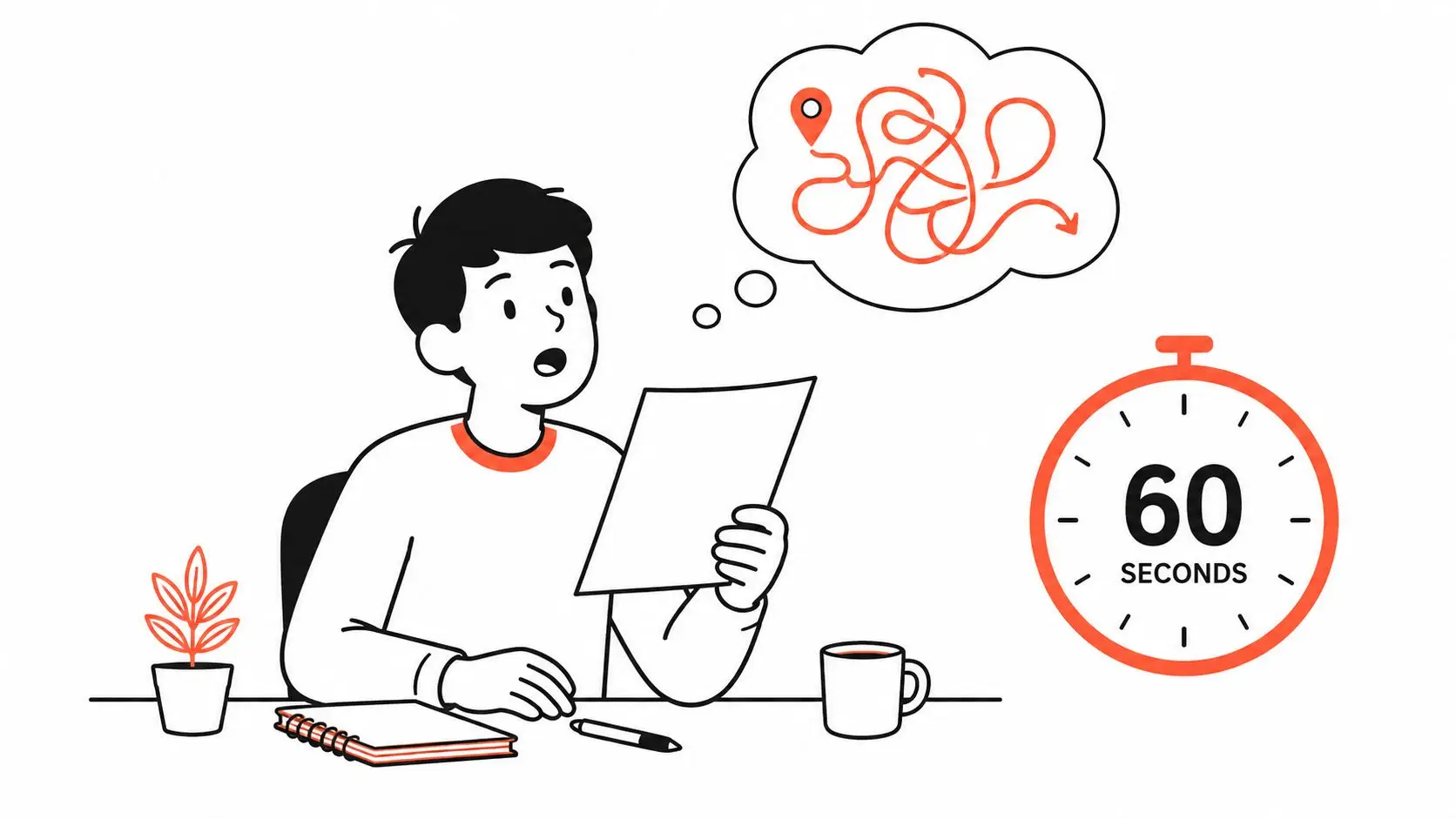
Open the draft with fresh eyes and give yourself 60 seconds. Read the title, headings, first sentences, bold text, captions, and any conclusion. Then close the document and answer:
- Main point: What is this text trying to make me understand?
- Reader need: Who is it helping, and with what problem?
- Evidence: Which example, fact, or observation supports the point?
- Next thought: What should the reader consider or do afterward?
If your answer is vague, don't line-edit yet. The headings, opening sentences, or conclusion probably need structural work.
Use this video as another read-aloud and listening-pass aid, especially if your eyes have become too familiar with the page:
Test every claim
Apply the “so what?” test to important statements. Write the claim in one line, then write the evidence beneath it. If the evidence only suggests a possibility, weaken the conclusion. If the claim depends on a source, add the source. If no support exists, label the sentence as interpretation rather than fact.
The same discipline helps when recruiting outside readers. A beta reader search is more useful when you give readers a specific question than when you ask whether they “liked it.” Ask them to identify the first confusing sentence, the point where interest dipped, and the idea they carried away.
Getting Feedback You Can Actually Use
Every feedback source answers a different question, and each one can mislead you. Self-review is fast but suffers from familiarity. Beta readers experience the text as readers do, but they may soften criticism or focus on personal taste. AI tools are tireless and consistent at surface revision, yet they can approve a polished version of the same weak argument.
The right question isn't which source is best. It's which source is qualified to detect the problem in front of you.
| Feedback Source | Best For | Blind Spot | Time Cost |
|---|---|---|---|
| Self-review | Intent, accuracy, obvious repetition, first-pass structure | Familiarity with the draft | Low |
| Beta readers | Confusion, engagement, emotional response, reader takeaway | Personal preference and polite feedback | Medium |
| AI editing tools | Grammar, phrasing, patterns, revision alternatives | Context, judgment, and macro-level purpose | Low to medium |
Ask beta readers questions that create evidence
“I liked it” doesn't tell you what worked. Give readers prompts they can answer from experience:
“Where did you stop reading, even briefly, and why?”
“What did you believe the central point was after reading the opening?”
“Which part felt underexplained, overstated, or out of order?”
“What would you remove without harming the main message?”
Ask for marked locations, not general impressions. A reader who points to the exact paragraph where they became confused gives you something you can revise. Invite more than one perspective when the audience contains distinct reader types, but don't average every opinion into blandness. Look for repeated friction and distinguish it from a single preference.
Use AI as a diagnostic assistant
Research from 2025 reports that generative AI can improve surface-level writing issues and revision productivity, while human feedback remains important for deeper, contextual revisions. Other work reports gains in organization and content development, which means AI can help beyond grammar, but improvement still needs to be judged against the draft's purpose. See the 2025 ACL study on AI-assisted revision for that research context.
AI feedback becomes dangerous when “better” means smoother. Ask the tool to identify the central claim, list the evidence supporting each major conclusion, flag unsupported leaps, and describe what a skeptical reader might misunderstand. Then compare its diagnosis with your own rubric. If the tool only changes adjectives and sentence rhythm, it hasn't solved a structural problem.
For a clearer division of labor among editorial roles, review this editor, beta reader, and proofreader comparison. The distinction matters because proofing a sentence and challenging an argument require different kinds of attention.
Your Self-Review Rubric and Next Steps
Give each category a score from 1 to 5, but define the score before emotion takes over.
- Clarity: 1 means the point is difficult to identify. 3 means the main idea is understandable with rereading. 5 means a reader can restate it accurately after one pass.
- Structure: 1 means the order feels arbitrary. 3 means the sequence mostly works but contains detours. 5 means a skimmer can reconstruct the logic.
- Voice: 1 means the prose sounds generic or inconsistent. 3 means a recognizable voice appears intermittently. 5 means the tone is distinct, controlled, and suited to the audience.
- Pacing: 1 means the draft drags or rushes. 3 means some passages lose momentum. 5 means sentence, paragraph, and section movement support the purpose.
- Reader takeaway: 1 means readers may leave with unrelated impressions. 3 means they remember the topic but not the point. 5 means they can state what matters and why.
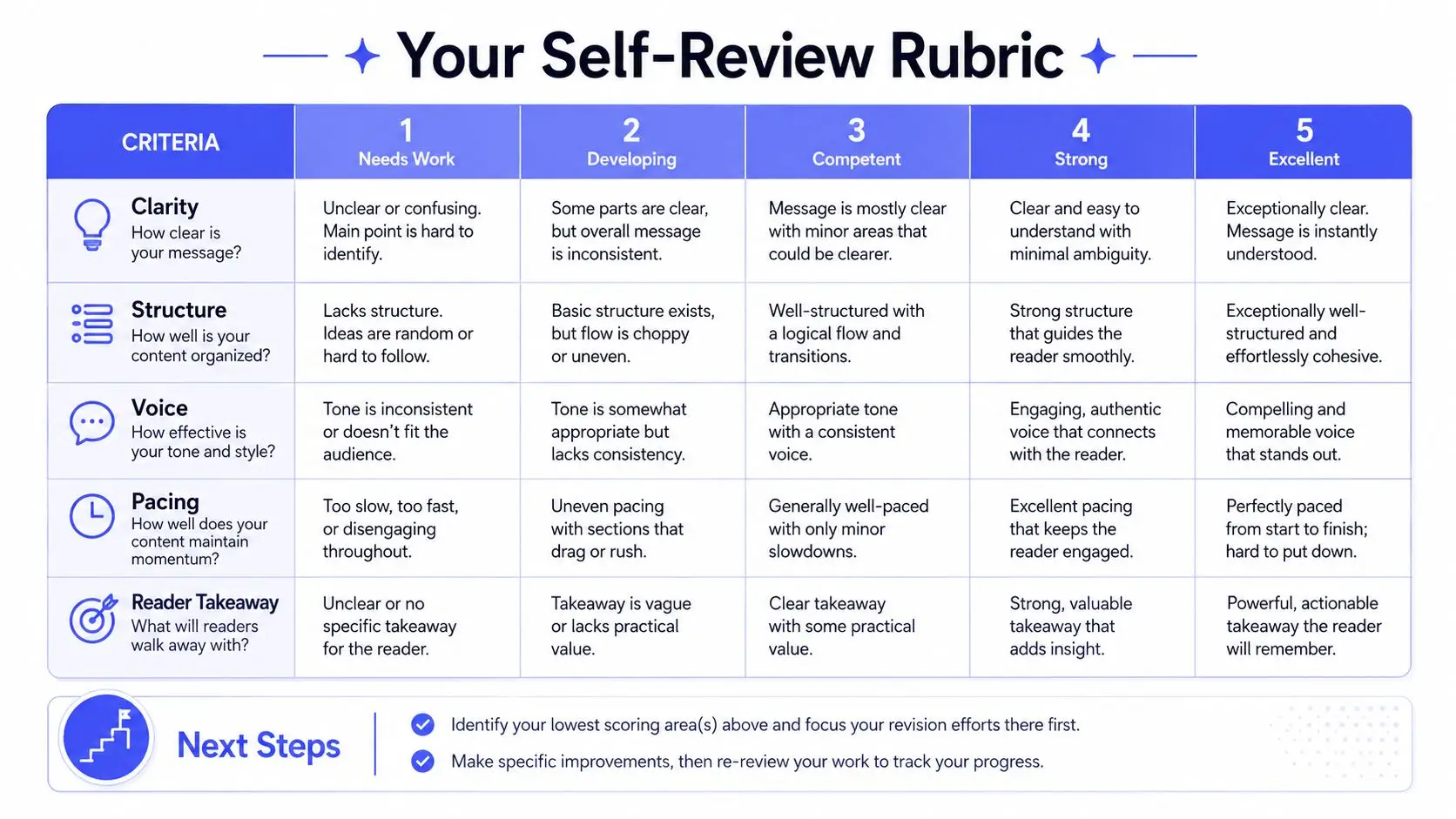
Revise in passes. Fix the argument and section order first, then repair paragraph logic, then improve individual lines. After each pass, rerun the read-aloud, skim, claim-support, and rubric checks. Don't spend an hour polishing a sentence that belongs in a section you may later delete.
“Good enough” means good enough for this reader and this purpose. That's a demanding standard, but it is reachable. You don't need universal approval, and you don't need an AI tool to declare victory. You need a draft that delivers its intended experience with clarity, control, and evidence.
Storyloft brings manuscript drafting, manuscript-aware AI editing, tone analysis, and role-based beta reader collaboration into one writing workflow. Use Storyloft to inspect structure and prose in context, collect reader feedback beside the text, and repeat the diagnostic loop before you publish.